
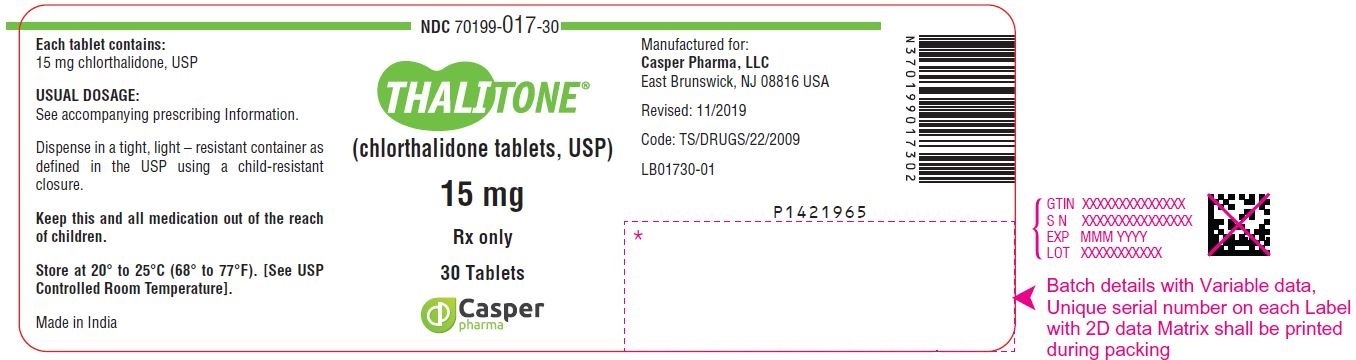
Thalitone Chlorthalidone 15 mg Tablet, 30-count — NDC 70199-017-30 (Billing 70199-0017-30)
This is a package of 30 tablets of Thalitone Chlorthalidone 15 mg Tablet from Casper Pharma LLC, marketed since Nov 2019 and currently FDA-listed; retail pharmacies pay about $3.54 per tablet (NADAC). It is the main listing for this product, which comes in 2 package sizes.
NDC database record
One package, one record: these facts belong to NDC 70199-017-30 alone.
- Record
- FDA NDC Directory package listing · Human prescription drug
- Code segments
- 70199 labeler · 017 product · 30 package
- Package marketed since
- Nov 27, 2019
- Sample package
- No — commercial package
- Listing certified through
- Dec 31, 2027
- Billing quantity
- 30 EA per package
- Barcode (UPC-A, from the NDC)
- 3 7019901730 2
- Medicaid fills, this package
- 700 prescriptions in the last four reported quarters
- FDA record last changed
- Jul 24, 2026
Other active recalls for Chlorthalidone (different manufacturers) — 3 · tap to view
Identity & classification
Regulatory identifiers FDA, NLM and CMS codes for this package
Drug-database identifiers Medi-Span GPI and First Databank GCN / HICL / AHFS classification
- GSN (GCN sequence number): 016837
- GCN: 34985
- GPI-14 (Medi-Span): 37600025000303
- HICL (First Databank): 003662
- AHFS class code: 24:36.24.00
- RxCUI (RxNorm): 197498
Where does this data come from?
- FDA openFDA NDC Directory · synced Oct 8, 2026
- FDA label on DailyMed · label index refreshed Oct 8, 2026
- RxNorm (NLM RxNav) · catalog refreshed Oct 1, 2026
- Medi-Span GPI (licensed)
- First Databank (licensed) · refreshed Oct 8, 2026
RxNorm drug class
This medicine belongs to the Thiazide-like Diuretic class.
Where does this data come from?
- RxClass (NLM) · catalog refreshed Oct 1, 2026
Clinical
Chlorthalidone, a is used to treat high blood pressure and fluid retention. Chlorthalidone is in a class of medications called diuretics ('water pills'). It causes the kidneys to get rid of unneeded water and salt from the body into the urine. High blood pressure is a common condition, and when not treated it can cause damage to the brain, heart, blood vessels, kidneys, and other parts of the body. Damage to these organs may cause heart disease, a heart attack, heart failure, stroke, kidney failure, loss of vision, and other problems. In addition to taking medication, making lifestyle changes...
Read the full MedlinePlus article ↗- It lowers high blood pressure, which reduces your risk of stroke and heart attack. Some products, like Thalitone and generic chlorthalidone tablets, are also used to help with flui...
- Take it by mouth, usually once a day with food. The generic tablets are best taken in the morning. Follow your prescriber's directions and the label on your product.
- Dizziness, headache, stomach upset and muscle cramps are among those reported. Standing up slowly can help if you feel lightheaded. Call your doctor if you faint, feel very weak, o...
- A long time. Its half-life is about 40 to 60 hours, and its water-pill effect can last up to 72 hours. It starts working about 2.6 hours after a dose.
Patient education
Supplement & herbal interactions
Some supplements/herbs that may interact with Chlorthalidone — tap one for details:
Chlorthalidone may be associated with lower levels of 8 nutrients — worth a chat with your pharmacist, not a cause for alarm.
Where does this data come from?
- MedlinePlus (NLM) · refreshed Oct 8, 2026
- FDA label on DailyMed · label index refreshed Oct 8, 2026
Ask a licensed pharmacist directly — free, answered by our team.
Pricing
A drug doesn't have one price. Each row is a different public payment system, and none is what you'd pay at the counter — that depends on your insurance. The ⓘ on each row explains what it measures.
| Price system | Per ea | Per package |
|---|---|---|
| Retail pharmacies payNADAC · weekly | $3.542 | $106.27 / 30 tablets |
| Medicaid paysCMS SDUD · 12 mo | $3.73 | $112.01 / 30 tablets |
| Medicare drug plans payPart D · Q2 2026 | $3.61 | $108.23 / 30 tablets |
Where does this data come from?
- CMS NADAC weekly file · file of Oct 7, 2026
- CMS ASP pricing files · refreshed Sep 20, 2026
- CMS Medicaid State Drug Utilization Data · through Q1 2026
- CMS Part D plan pricing files · refreshed Sep 24, 2026
- VA National Acquisition Center price file
Packaging — all sizes for this product
| Package NDC | Description | Per unit | Per pack | Marketing start | Marketing end | Status |
|---|---|---|---|---|---|---|
| 70199-0017-01 70199-017-01 | 100 TABLET in 1 BOTTLE | — | — | 2019-11-27 | — | Active |
| 70199-0017-30 You're viewing this Main listing | 30 TABLET in 1 BOTTLE | $3.54 / ea | $106.27 | 2019-11-27 | — | Active |
You're viewing the smallest of 2 pack sizes for this product.
In Medicaid, this is the most-dispensed pack of this product — about 100% of fills over the last four reported quarters. See all packs ↓
Pack size FAQ
What quantity is in this package?
How does this package differ from NDC 70199-0017-01?
What NDC number is used to bill for this package of Thalitone Chlorthalidone 15 mg Tablet?
Prices are the latest CMS NADAC pharmacy acquisition cost per NDC; per-pack figures are per-unit × pack quantity, shown only when the pack is denominated in the same measure NADAC prices.
Therapeutic equivalents
| Product | Labeler | Pack | NADAC/unit | TE | Status | Price vs. this |
|---|---|---|---|---|---|---|
| Thalitone 15 mgthis 70199-0017-30 | Casper | 30 tablets | $3.542 | — | Availability likely | — |
Where does this data come from?
- FDA openFDA NDC Directory · synced Oct 8, 2026
- FDA Orange Book · refreshed Oct 3, 2026
- CMS NADAC weekly file · file of Oct 7, 2026
Availability & generic status
FDA-approved generic versions are listed, and recent pricing/market data suggests they may be available — see Therapeutic equivalents.
Where does this data come from?
- FDA Orange Book · refreshed Oct 3, 2026
What it looks like
Where does this data come from?
- FDA label on DailyMed · label index refreshed Oct 8, 2026
Inactive Ingredients / Excipients
Inactive ingredients, also called excipients, are components of the drug product other than the active ingredient. They may include fillers, dyes, coatings, preservatives, flavors, or other formulation ingredients.
🧪 Avoiding an ingredient? See Chlorthalidone inactive ingredients by manufacturer: every current product's list side by side, so you can ask your pharmacy for the version that does not list it.
💡 Tap an ingredient (hover on desktop) to see what it is and why it’s used.
-
UNII OP1R32D61U
Microcrystalline cellulose is a purified form of cellulose, a natural fiber from plant sources. It acts as a binder and filler in tablets and capsules, helping hold ingredients together and give the medicine its shape and size.
-
UNII EWQ57Q8I5X
Lactose monohydrate is a natural sugar derived from milk. It serves as a filler and binder in tablets and capsules, helping create the proper size, texture, and consistency of the medicine.
-
UNII 70097M6I30
Magnesium stearate is a salt made from magnesium and stearic acid, a fatty substance. It's used in tablets and capsules as a lubricant and glidant to help ingredients flow smoothly during manufacturing and prevent sticking.
-
UNII FZ989GH94E
Povidone is a synthetic polymer made from a plastic-like material. It acts as a binder to hold tablet ingredients together and as a disintegrant to help the tablet break apart in your stomach so the medicine can be absorbed.
-
UNII ETJ7Z6XBU4
Silicon dioxide is a naturally occurring mineral used as a glidant and anti-caking agent. It helps powder ingredients flow smoothly and prevents clumping during manufacturing and storage.
-
UNII 5856J3G2A2
A starch-based powder made from potatoes and processed with sodium. It acts as a disintegrant, helping the tablet or capsule break apart quickly in the stomach so the medicine can be absorbed.
6 inactive ingredients listed in the exact product block matched to this NDC.
Where does this data come from?
ingredient classCode="IACT" elements from the exact product block matched by this NDC. Label-section narrative from DailyMed / the openFDA label index is shown separately when available.- FDA label on DailyMed · label index refreshed Oct 8, 2026
- FDA openFDA NDC Directory · synced Oct 8, 2026
Inactive ingredient FAQ
Are inactive ingredients the same for every manufacturer?
Why might an inactive ingredient be missing?
Can inactive ingredients matter?
Manufacturer & labeler
More NDCs from Casper Pharma LLC labeler code 70199
Where does this data come from?
- FDA openFDA NDC Directory · synced Oct 8, 2026
- Drugs@FDA
Full prescribing information FDA SPL
🎯 Indications and Usage ▾
1 INDICATIONS AND USAGE THALITONE is a thiazide-like diuretic indicated: • For the treatment of hypertension, to lower blood pressure. Lowering blood pressure reduces the risk of fatal and nonfatal cardiovascular events, primarily strokes and myocardial infarctions (1.1). • as adjunctive therapy in edema associated with heart failure, cirrhosis of the liver, and renal disease, including nephrotic syndrome (1.2).
1.1Hypertension THALITONE ® is indicated for the treatment of hypertension, to lower blood pressure. Lowering blood pressure reduces the risk of fatal and nonfatal cardiovascular events, primarily strokes and myocardial infarctions. These benefits have been seen in controlled trials of antihypertensive drugs from a wide variety of pharmacologic classes including the class to which this drug principally belongs.
There are no controlled trials demonstrating risk reduction with THALITONE. Control of high blood pressure should be part of comprehensive cardiovascular risk management, including, as appropriate, lipid control, diabetes management, antithrombotic therapy, smoking cessation, exercise, and limited sodium intake. Many patients will require more than one drug to achieve blood pressure goals.
For specific advice on goals and management, see published guidelines, such as those of the National High Blood Pressure Education Program’s Joint National Committee on Prevention, Detection, Evaluation, and Treatment of High Blood Pressure (JNC). Numerous antihypertensive drugs, from a variety of pharmacologic classes and with different mechanisms of action, have been shown in randomized controlled trials to reduce cardiovascular morbidity and mortality, and it can be concluded that it is blood pressure reduction, and not some other pharmacologic property of the drugs, that is largely responsible for those benefits.
The largest and most consistent cardiovascular outcome benefit has been a reduction in the risk of stroke, but reductions in myocardial infarction and cardiovascular mortality also have been seen regularly. Elevated systolic or diastolic pressure causes increased cardiovascular risk, and the absolute risk increase per mmHg is greater at higher blood pressures, so that even modest reductions of severe hypertension can provide substantial benefit. Relative risk reduction from blood pressure reduction is similar across populations with varying absolute risk, so the absolute benefit is greater in patients who are at higher risk independent of their hypertension (for example, patients with diabetes or hyperlipidemia), and such patients would be expected to benefit from more aggressive treatment to a lower blood pressure goal.
THALITONE can be used alone or in combination with other antihypertensive agents.
1.2Edema Chlorthalidone is indicated in adults as adjunctive therapy in edema associated with heart failure, cirrhosis of the liver, and renal disease, including nephrotic syndrome.
⏱️ Dosage and Administration ▾
2 DOSAGE AND ADMINISTRATION • Initiate therapy with the lowest possible dose, then titrate according to individual patient response (2.1). • Hypertension: Recommended initial dose is 15 mg daily with food. If additional blood pressure reduction is needed, increase the dose to 25 mg (2.2). • Edema: Recommended initial dose is 50 mg to 100 mg daily or 100 mg on alternate days. Depending on response, dosage can be decreased or increased up to a maximum of 200 mg daily (2.3).
2.1General Considerations THALITONE cannot be substituted with other formulations of chlorthalidone. Initiate therapy with the lowest possible dose, then titrate according to individual patient response.
2.2Hypertension The initial recommended dose is 15 mg once daily with food. After 2 weeks, the dosage may be increased to a single daily dose of 25 mg if additional blood pressure reduction is needed. Doses above 25 mg are not expected to result in increased blood pressure reduction.
2.3Edema The recommended initial dosage is 50 to 100 mg daily or 100 mg on alternate days. Depending on response, dosage can be decreased or increased up to a maximum of 200 mg daily.
💊 Dosage Forms and Strengths ▾
3 DOSAGE FORMS AND STRENGTHS THALITONE 15 mg tablets are white biconvex, kidney shaped tablets with “L” on lower punch and “96” on the upper punch. THALITONE 25 mg tablets are white biconvex, kidney shaped tablets with “L” on one side and “99” on the other side. Tablets: 15 mg and 25 mg (3).
⛔ Contraindications ▾
4 CONTRAINDICATIONS THALITONE is contraindicated in patients with anuria or hypersensitivity to chlorthalidone or other sulfonamide-derived drugs. • Anuria (4). • Hypersensitivity (4).
⚠️ Warnings and Cautions ▾
5 WARNINGS AND PRECAUTIONS • Hypotension: Higher risk for patients with impaired sympathetic response, volume-depletion or salt restriction (5.1). • Renal Impairment: Patients with pre-existing kidney disease may be at higher risk. (5.2). • Monitor serum electrolytes periodically (5.3).
5.1Hypotension THALITONE may cause symptomatic hypotension. Patients with impaired sympathetic response, volume-depletion or who are salt restricted may be at increased risk for developing hypotension. If hypotension occurs, place the patient in the supine position and, if necessary, give intravenous normal saline.
A transient hypotensive response is not a contraindication to further treatment, which usually can be continued without difficulty once the blood pressure has stabilized.
5.2Impaired Renal Function Changes in renal function including acute renal failure can be caused by diuretics. Patients with chronic kidney disease, heart failure, or volume depletion may be at particular risk of developing acute renal failure on THALITONE. Monitor renal function periodically. Consider withholding or discontinuing therapy in patients who develop a clinically significant decrease in renal function on THALITONE [see Drug Interactions (7)].
5.3Electrolyte Abnormalities THALITONE can cause hypokalemia, hyponatremia, hypochloremic alkalosis, and hypomagnesemia. Hypomagnesemia can result in hypokalemia which appears difficult to treat despite potassium repletion. Monitor serum electrolytes periodically.
If hypokalemia is accompanied by clinical signs (e.g., muscular weakness, paresis, or ECG alterations), THALITONE should be discontinued. Correction of hypokalemia and any coexisting hypomagnesemia is recommended prior to the initiation of thiazides.
5.4Metabolic Disturbances Chlorthalidone may alter glucose tolerance. Chlorthalidone may raise serum levels of cholesterol and triglycerides. Chlorthalidone may raise the serum uric acid level due to reduced clearance of uric acid and may cause or exacerbate hyperuricemia and precipitate gout in susceptible patients.
Chlorthalidone decreases urinary calcium excretion and may cause elevations of serum calcium. Monitor calcium levels in patients with hypercalcemia receiving THALITONE.
🤒 Adverse Reactions ▾
6 ADVERSE REACTIONS The following adverse reactions are described in more detail elsewhere in the label; • Hypotension [see Warnings and Precautions (5.1)] • Impaired Renal Function [see Warnings and Precautions (5.2)] • Electrolyte Abnormalities [see Warnings and Precautions (5.3)] • Metabolic Disturbances [see Warnings and Precautions (5.4)] The following adverse reactions have been observed, but there is not enough systematic collection of data to support an estimate of their frequency. Gastrointestinal System Reactions: anorexia, gastric irritation, nausea, vomiting, cramping, diarrhea, constipation, jaundice (intrahepatic cholestatic jaundice), pancreatitis.
Central Nervous System Reactions : dizziness, paresthesias, headache. Hematologic Reactions: leukopenia, agranulocytosis, thrombocytopenia, aplastic anemia. Dermatologic-Hypersensitivity Reactions: purpura, photosensitivity, rash, urticaria, necrotizing angiitis (vasculitis) (cutaneous vasculitis), Lyell’s syndrome (toxic epidermal necrolysis).
Cardiovascular Reaction: Orthostatic hypotension. Other Adverse Reactions: muscle spasm, weakness, restlessness, impotence, xanthopsia. The most frequently expected adverse drug reactions among patients receiving THALITONE are hypotension, dizziness, renal dysfunction, and electrolyte abnormalities (6).
To report SUSPECTED ADVERSE REACTIONS, contact Casper Pharma LLC at 1-844-5-CASPER (1-844-522-7737) or FDA at 1-800-FDA-1088 or www.fda.gov/medwatch .
🔄 Drug Interactions ▾
7 DRUG INTERACTIONS Effect of chlorthalidone on other drugs Chlorthalidone may add to or potentiate the action of other antihypertensive drugs. Chlorthalidone and related drugs may increase the responsiveness to tubocurarine. Lithium renal clearance is reduced by chlorthalidone, increasing the risk of lithium toxicity.
Monitor serum lithium levels during concomitant use. • Antihypertensive drugs: Chlorthalidone may add to or potentiate the action of other antihypertensive drugs (7). • Lithium: Lithium renal clearance is reduced by chlorthalidone, increasing the risk of lithium toxicity (7).
👥 Use in Specific Populations ▾
8 USE IN SPECIFIC POPULATIONS • Pregnancy: May cause fetal harm (8.1). • Lactation: Breastfeeding not recommended (8.2). • Pediatrics: Safety and efficacy in children have not been established (8.4). • Geriatric Use: No overall difference in responses versus younger patients but care should be taken in dose selection in patients with impaired renal function (8.5).
8.1Pregnancy Risk Summary Available data over decades from observational studies and reports with chlorthalidone use in pregnant women have not identified a drug-associated risk of major birth defects or miscarriage. However, adverse fetal outcomes, including fetal or neonatal jaundice, thrombocytopenia, hypoglycemia, and electrolyte abnormalities have been reported following maternal use of thiazide diuretics ( see Clinical Considerations ). Chlorthalidone should not be used as first-line therapy to treat hypertension in pregnancy.
Advise pregnant women of the potential risk to a fetus. The estimated background risk of major birth defects and miscarriage for the indicated population is unknown. All pregnancies have a background risk of birth defect, loss, or other adverse outcomes.
In the U.S. general population, the estimated background risks of major birth defects and miscarriage in clinically recognized pregnancies is 2 to 4% and 15 to 20%, respectively. Clinical Considerations Disease-associated maternal and/or embryo/fetal risk Hypertension in pregnancy increases the maternal risk for pre-eclampsia, gestational diabetes, premature delivery, and delivery complications (e.g., need for cesarean section, and post-partum hemorrhage). Hypertension increases the fetal risk for intrauterine growth restriction and stillbirth.
Fetal/Neonatal Adverse Reactions Thiazides can cross the placenta, and concentrations reached in the umbilical vein approach those in the maternal plasma. Thiazides, like other diuretics, can cause placental hypoperfusion. Use of thiazides during pregnancy is associated with a risk of fetal or neonatal jaundice, thrombocytopenia, hypoglycemia, and electrolyte abnormalities.
Thiazides do not prevent or alter the course of EPH (Edema, Proteinuria, Hypertension) gestosis (pre-eclampsia) and should not be used as first-line therapy to treat hypertension in pregnant women. Data Animal Data Reproduction studies have been performed in the rat and the rabbit and have revealed no evidence of harm to the fetus due to chlorthalidone.The available data do not allow the calculation of comparisons between the exposure of chlorthalidone observed in animal studies to the systemic exposure that would be expected in humans.
8.2Lactation Risk Summary Chlorthalidone is present in human milk. There is no information regarding the effects of chlorthalidone on the breastfed infant or the effects on milk production. Because of the potential for chlorthalidone accumulation which may lead to serious adverse reactions in the breastfed infant (such as jaundice, thrombocytopenia, hyperglycemia, electrolyte abnormalities), advise patients that breastfeeding is not recommended during treatment with chlorthalidone.
8.4Pediatric Use Safety and effectiveness in children have not been established.
8.5Geriatric Use Clinical studies of THALITONE did not include sufficient numbers of subjects aged 65 and over to determine whether they respond differently from younger subjects. Other reported clinical experience has not identified differences in responses between the elderly and younger patients. In general, dose selection for an elderly patient should be cautious, usually starting at the low end of the dosing range, reflecting the greater frequency of decreased hepatic, renal or cardiac function, and of concomitant disease or other drug therapy.
This drug is known to be substantially excreted by the kidney, and the risk of toxic reactions to this drug may be greater in patients with impaired renal function. Because elderly patients are more likely to have decreased renal function,… [Excerpted — this section continues on DailyMed.]
🤰 Pregnancy ▾
8.1Pregnancy Risk Summary Available data over decades from observational studies and reports with chlorthalidone use in pregnant women have not identified a drug-associated risk of major birth defects or miscarriage. However, adverse fetal outcomes, including fetal or neonatal jaundice, thrombocytopenia, hypoglycemia, and electrolyte abnormalities have been reported following maternal use of thiazide diuretics ( see Clinical Considerations ). Chlorthalidone should not be used as first-line therapy to treat hypertension in pregnancy.
Advise pregnant women of the potential risk to a fetus. The estimated background risk of major birth defects and miscarriage for the indicated population is unknown. All pregnancies have a background risk of birth defect, loss, or other adverse outcomes.
In the U.S. general population, the estimated background risks of major birth defects and miscarriage in clinically recognized pregnancies is 2 to 4% and 15 to 20%, respectively. Clinical Considerations Disease-associated maternal and/or embryo/fetal risk Hypertension in pregnancy increases the maternal risk for pre-eclampsia, gestational diabetes, premature delivery, and delivery complications (e.g., need for cesarean section, and post-partum hemorrhage). Hypertension increases the fetal risk for intrauterine growth restriction and stillbirth.
Fetal/Neonatal Adverse Reactions Thiazides can cross the placenta, and concentrations reached in the umbilical vein approach those in the maternal plasma. Thiazides, like other diuretics, can cause placental hypoperfusion. Use of thiazides during pregnancy is associated with a risk of fetal or neonatal jaundice, thrombocytopenia, hypoglycemia, and electrolyte abnormalities.
Thiazides do not prevent or alter the course of EPH (Edema, Proteinuria, Hypertension) gestosis (pre-eclampsia) and should not be used as first-line therapy to treat hypertension in pregnant women. Data Animal Data Reproduction studies have been performed in the rat and the rabbit and have revealed no evidence of harm to the fetus due to chlorthalidone.The available data do not allow the calculation of comparisons between the exposure of chlorthalidone observed in animal studies to the systemic exposure that would be expected in humans.
🧒 Pediatric Use ▾
8.4Pediatric Use Safety and effectiveness in children have not been established.
🧓 Geriatric Use ▾
8.5Geriatric Use Clinical studies of THALITONE did not include sufficient numbers of subjects aged 65 and over to determine whether they respond differently from younger subjects. Other reported clinical experience has not identified differences in responses between the elderly and younger patients. In general, dose selection for an elderly patient should be cautious, usually starting at the low end of the dosing range, reflecting the greater frequency of decreased hepatic, renal or cardiac function, and of concomitant disease or other drug therapy.
This drug is known to be substantially excreted by the kidney, and the risk of toxic reactions to this drug may be greater in patients with impaired renal function. Because elderly patients are more likely to have decreased renal function, care should be taken in dose selection, and it may be useful to monitor renal function.
🆘 Overdosage ▾
10 OVERDOSAGE Symptoms of acute overdosage include nausea, weakness, dizziness and disturbances of electrolyte balance. The oral LD 50 of the drug in the mouse and the rat is more than 25,000 mg/kg body weight. The minimum lethal dose (MLD) in humans has not been established.
There is no specific antidote but gastric lavage is recommended, followed by supportive treatment. Where necessary, this may include intravenous dextrose-saline with potassium, administered with caution.
🧬 Clinical Pharmacology ▾
12 CLINICAL PHARMACOLOGY
12.1Mechanism of Action Chlorthalidone is a long-acting oral diuretic with antihypertensive activity. The diuretic effects of chlorthalidone and the benzothiadiazine (thiazide) diuretics appear to arise from similar mechanisms and the maximal effect of chlorthalidone and the thiazides appear to be similar. The site of the action appears to be the distal convoluted tubule of the nephron.
Although the mechanism of action of chlorthalidone and related drugs is not wholly clear, sodium and water depletion appear to provide a basis for its antihypertensive effect.
12.2Pharmacodynamics The diuretic action of chlorthalidone commences a mean of 2.6 hours after dosing and continues for up to 72 hours. The drug produces diuresis with increased excretion of sodium and chloride. The diuretic effects of chlorthalidone lead to decreased extracellular fluid volume, plasma volume, cardiac output, total exchangeable sodium, glomerular filtration rate, and renal plasma flow.
Chlorthalidone produces dose-related reductions in serum potassium levels, elevations in serum uric acid and blood glucose, and it can lead to decreased sodium and chloride levels.
12.3Pharmacokinetics Absorption THALITONE (chlorthalidone USP) has been formulated with PVP (povidone polyvinylpyrrolidone), a bioavailability enhancer that provides 104% to 116% bioavailability relative to an oral solution of chlorthalidone [see Clinical Studies (14)]. THALITONE cannot be substituted with other formulations of chlorthalidone. Distribution In the blood, approximately 75% of the drug is bound to plasma proteins over a concentration range of 0.2 to 7.7 ug/mL.
Elimination The mean plasma half-life of chlorthalidone is about 40 to 60 hours. It is eliminated primarily as unchanged drug in the urine.
🧬 Mechanism of Action ▾
12.1Mechanism of Action Chlorthalidone is a long-acting oral diuretic with antihypertensive activity. The diuretic effects of chlorthalidone and the benzothiadiazine (thiazide) diuretics appear to arise from similar mechanisms and the maximal effect of chlorthalidone and the thiazides appear to be similar. The site of the action appears to be the distal convoluted tubule of the nephron.
Although the mechanism of action of chlorthalidone and related drugs is not wholly clear, sodium and water depletion appear to provide a basis for its antihypertensive effect.
📦 How Supplied / Storage and Handling ▾
16 HOW SUPPLIED/STORAGE AND HANDLING THALITONE (chlorthalidone) Tablets USP 15 mg are white biconvex, kidney shaped tablets with “L” on lower punch and “96” on the upper punch. Bottles of 30 NDC 70199-017-30 Bottles of 100 NDC 70199-017-01 THALITONE (chlorthalidone) Tablets USP 25 mg are white biconvex, kidney shaped tablets with “L” on one side and “99” on the other side. Bottles of 30 NDC 70199-001-30 Bottles of 100 NDC 70199-001-01 Store at 20 o to 25 o C (68 o to 77 o F). [See USP Controlled Room Temperature].
Dispense in a tight, light-resistant container as defined in the USP using a child-resistant closure.
📋 Description ▾
11 DESCRIPTION THALITONE (chlorthalidone USP) is an antihypertensive/diuretic supplied as 15 mg and 25 mg tablets for oral use. It is a monosulfamyl diuretic that differs chemically from thiazide diuretics in that a double ring system is incorporated in its structure. It is a racemic mixture of 2-chloro-5-(1-hydroxy-3-oxo-1-isoindolinyl) benzenesulfonamide, with the following structural formula: Chlorthalidone is practically insoluble in water, in ether and in chloroform; soluble in methanol; slightly soluble in alcohol.
The inactive ingredients are colloidal silicon dioxide, lactose monohydrate, magnesium stearate, microcrystalline cellulose, povidone, sodium starch glycolate. chlorthalidone-struc-1.jpg
💬 Information for Patients ▾
17 PATIENT COUNSELING INFORMATION • Patients should inform their doctor if they have had an allergic reaction to chlorthalidone or other diuretics; kidney disease; gout; been taking lithium carbonate. • Patients should be cautioned to contact their physician if they experience any of the following symptoms of potassium loss: excess thirst, tiredness, drowsiness, restlessness, muscle pains or cramps, nausea, vomiting or increased heart rate or pulse. • Patients should inform their doctor if they have symptoms of light-headedness or dizziness. • Pregnancy Advise a pregnant woman of the potential risk to a fetus.
Advise females of reproductive potential to inform their prescriber of a known or suspected pregnancy [see Use in Specific Populations (8.1)] . • Lactation Advise females not to breastfeed during treatment with chlorthalidone [see Use in Specific Populations (8.2)] . Rx Only PIB00101-05 Manufactured for: Casper Pharma LLC East Brunswick, NJ 08816 Made in India. Revised: 12/2019
🧬 Pharmacokinetics ▾
12.3Pharmacokinetics Absorption THALITONE (chlorthalidone USP) has been formulated with PVP (povidone polyvinylpyrrolidone), a bioavailability enhancer that provides 104% to 116% bioavailability relative to an oral solution of chlorthalidone [see Clinical Studies (14)]. THALITONE cannot be substituted with other formulations of chlorthalidone. Distribution In the blood, approximately 75% of the drug is bound to plasma proteins over a concentration range of 0.2 to 7.7 ug/mL.
Elimination The mean plasma half-life of chlorthalidone is about 40 to 60 hours. It is eliminated primarily as unchanged drug in the urine.
🧬 Pharmacodynamics ▾
12.2Pharmacodynamics The diuretic action of chlorthalidone commences a mean of 2.6 hours after dosing and continues for up to 72 hours. The drug produces diuresis with increased excretion of sodium and chloride. The diuretic effects of chlorthalidone lead to decreased extracellular fluid volume, plasma volume, cardiac output, total exchangeable sodium, glomerular filtration rate, and renal plasma flow.
Chlorthalidone produces dose-related reductions in serum potassium levels, elevations in serum uric acid and blood glucose, and it can lead to decreased sodium and chloride levels.
🔬 Clinical Studies ▾
14 CLINICAL STUDIES Two similarly designed, 12-week, double-blind, parallel group, placebo-controlled multicenter studies were conducted to compare THALITONE 15 mg to the standard chlorthalidone 25 mg in terms of reduction in blood pressure and metabolic disturbances. Collectively, a total of 222 patients with long-standing diastolic blood pressure between 90 and 104 mm Hg were randomized to receive THALITONE 15 mg (N=71), standard chlorthalidone 25 mg (N=75), or placebo (N=76). THALITONE 15 mg has the advantage of demonstrating potentially fewer metabolic disturbances (Table 1) in particular, lowered glucose levels when compared to Hygroton® 25 mg in clinical setting (Table 2).
THALITONE 15 mg helps meet the goal of lowering blood pressure in patients that respond to Chlorthalidone therapy. In general, electrolyte abnormalities are a class effect associated with Chlorthalidone therapy. Table 1.
Reduction in blood pressure at 12 weeks (THALITONE 15 mg vs. Standard chlorthalidone 25 mg) Pairwise comparison 2 through 12 weeks 4 through 12 weeks Mean change (95% CI) Significance level Mean change (95% CI) Significance level Standing SBP, mm Hg THALITONE 15 mg vs. placebo −11.77 vs. −1.89 (−13.02, −6.74) <0.001 −12.43 vs. −2.02 (−13.87, −6.95) <0.001 THALITONE 15 mg vs. standard chlorthalidone 25 mg −11.77 vs. −11.73 (−3.18, 3.1) 0.98 −12.43 vs. −11.70 (−4.19, 2.73)
0.68Standing DBP, mm Hg THALITONE 15 mg vs. placebo −5.95 vs. −3.28 (−4.5, −0.84) <0.01 −6.64 vs. −3.42 (−5.29, −1.15) <0.01 THALITONE 15 mg vs. standard chlorthalidone 25 mg − 5.95 vs. −6.79 (−0.99, 2.67) 0.37 −6.64 vs. −7.06 (−1.65, 2.49)
0.69Supine SBP, mm Hg THALITONE 15 mg vs. placebo −8.42 vs. −2.63 (−8.87, −2.71) <0.001 −8.91 vs. −2.85 (-9.46, -2.66) <0.001 THALITONE 15 mg vs. standard chlorthalidone 25 mg −8.42 vs. −10.31 (−1.19, 4.97) 0.23 −8.91 vs. −10.61 (−1.70, 5.10)
0.33Supine DBP, mm Hg THALITONE 15 mg vs. placebo −6.44 vs. −4.16 (−4.46, −0.11) 0.04 −6.72 vs. −4.28 (−4.85, −0.03)
0.05THALITONE 15 mg vs. standard chlorthalidone 25 mg −6.44 vs. −6.82 (−1.80, 2.56) 0.73 −6.72 vs. −7.05 (−2.08, 2.74)
0.79SBP: systolic blood pressure, DBP: diastolic blood pressure, CI: confidence interval Table 2. Mean changes in laboratory parameters (THALITONE 15 mg vs. Standard chlorthalidone 25 mg) Parameter THALITONE 15 mg Standard chlorthalidone 25 mg Placebo Potassium (mmol/L) Baseline N/A N/A N/A 4 Weeks −0.35 (0.08)* −0.53 (0.05)* 0.10 (0.05) 12 Weeks −0.31 (0.07)* −0.55 (0.06)* 0.12 (0.06) Cholesterol (mg/dL) Baseline N/A N/A N/A 4 Weeks 5.51 (3.70)* 5.14 (3.29)* −7.18 (3.30) 12 Weeks 9.34 (3.03) 8.11 (3.86) 0.26 (4.53) Glucose (mg/dL) Baseline N/A N/A N/A 4 Weeks 1.83 (2.55) 6.56 (2.36) 1.52 (2.17) 12 Weeks −0.84 (2.58) + 11.02 (2.71)* −1.83 (2.29) Uric Acid (mg/dL) Baseline N/A N/A N/A 4 Weeks 0.66 (0.16)* 1.04 (0.14)* −0.34 (0.15) 12 Weeks 0.71 (0.13)* 1.10 (0.14)* −0.19 (0.15) *p<0.05 vs. placebo +p<0.05 vs. standard chlorthalidone 25 mg N/A: Not Applicable
🧪 Nonclinical Toxicology ▾
13 NONCLINICAL TOXICOLOGY
13.1Carcinogenesis & Mutagenesis & Impairment Of Fertility No information is available.
📄 Carcinogenesis, Mutagenesis, Impairment of Fertility ▾
13.1Carcinogenesis & Mutagenesis & Impairment Of Fertility No information is available.
📄 Package Label / Principal Display Panel ▾
PACKAGE LABEL.PRINCIPAL DISPLAY PANEL Thalitone ® (chlorthalidone tablets USP) 15 mg Bottles of 30 NDC 70199-017-30 Thalitone ® (chlorthalidone tablets USP) 25 mg Bottles of 30 NDC 70199-001-30 chlorthalidone-15mg chlorthalidone-25mg