
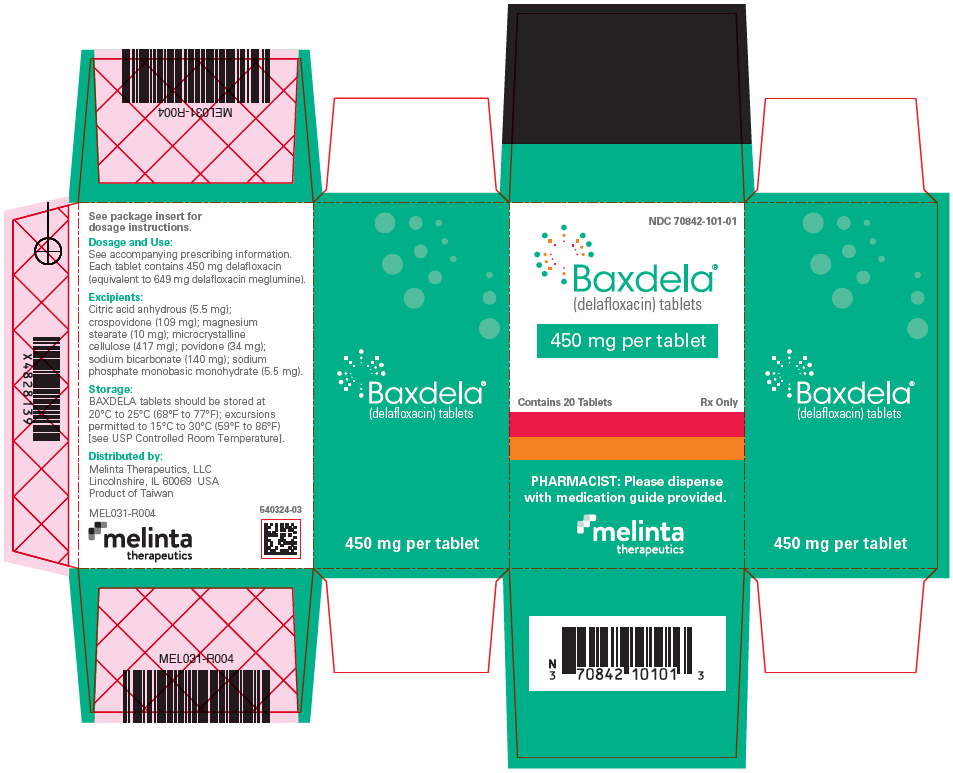
Baxdela delafloxacin meglumine 450 mg Tablet, 20-count — NDC 70842-101-01 (Billing 70842-0101-01)
This is a package of 20 tablets of Baxdela delafloxacin meglumine 450 mg Tablet from Melinta Therapeutics, LLC, marketed since Jun 2017 and currently FDA-listed. It is the main listing for this product, which comes in 3 package sizes.
NDC database record
One package, one record: these facts belong to NDC 70842-101-01 alone.
- Record
- FDA NDC Directory package listing · Human prescription drug
- Code segments
- 70842 labeler · 101 product · 01 package
- Package marketed since
- Jun 19, 2017
- Sample package
- No — commercial package
- Listing certified through
- Dec 31, 2026
- Billing quantity
- 20 EA per package
- Barcode (UPC-A, from the NDC)
- 3 7084210101 3
- FDA record last changed
- Jul 24, 2026
Identity & classification
Regulatory identifiers FDA, NLM and CMS codes for this package
Drug-database identifiers Medi-Span GPI and First Databank GCN / HICL / AHFS classification
- GSN (GCN sequence number): 077492
- GCN: 43532
- GPI-14 (Medi-Span): 05000025100320
- HICL (First Databank): 044372
- AHFS class code: 08:12.18.00
- RxCUI (RxNorm): 1927667
Where does this data come from?
- FDA openFDA NDC Directory · synced Oct 8, 2026
- FDA label on DailyMed · label index refreshed Oct 6, 2026
- RxNorm (NLM RxNav) · catalog refreshed Oct 1, 2026
- Medi-Span GPI (licensed)
- First Databank (licensed) · refreshed Oct 8, 2026
RxNorm drug class
This medicine belongs to the Fluoroquinolone Antibacterial class.
Where does this data come from?
- RxClass (NLM) · catalog refreshed Oct 1, 2026
Clinical
- It treats adults with acute bacterial skin infections and community-acquired pneumonia caused by susceptible bacteria. It won't help with viral infections like colds or flu.
- Take one every 12 hours, with or without food. Keep them apart from antacids, iron, zinc or multivitamins: take Baxdela at least 2 hours before or 6 hours after those. If you miss...
- The most common are nausea, diarrhea, headache, and vomiting. Blood tests may also show raised liver enzymes. These are usually manageable, but let us know if they bother you.
- Stop and call right away if you have tendon pain or swelling, tingling, burning or numbness in your hands or feet, new confusion, hallucinations or mood changes, a rash or swelling...
Patient education
Supplement & herbal interactions
Where does this data come from?
- MedlinePlus (NLM) · refreshed Oct 1, 2026
- FDA label on DailyMed · label index refreshed Oct 6, 2026
Ask a licensed pharmacist directly — free, answered by our team.
Pricing
A drug doesn't have one price. Each row is a different public payment system, and none is what you'd pay at the counter — that depends on your insurance. The ⓘ on each row explains what it measures.
| Price system | Per each | Per package |
|---|---|---|
| Retail pharmacies payNADAC · weekly | Not in the retail survey — common for institutional, discontinued, or low-volume packs. | |
| Medicaid paysCMS SDUD · 12 mo | No recent Medicaid claims on file for this NDC — rare and low-volume NDCs are suppressed in the public data. | |
| Medicare drug plans payPart D · Q2 2026 | $82.40 | $1,647.93 / 20 tablets |
Where does this data come from?
- CMS NADAC weekly file
- CMS ASP pricing files · refreshed Sep 20, 2026
- CMS Medicaid State Drug Utilization Data · refreshed Oct 8, 2026
- CMS Part D plan pricing files · refreshed Sep 24, 2026
- VA National Acquisition Center price file
Packaging — all sizes for this product
| Package NDC | Description | Marketing start | Marketing end | Status |
|---|---|---|---|---|
| 70842-0101-01 You're viewing this Main listing | 1 BOTTLE in 1 CARTON / 20 TABLET in 1 BOTTLE | 2017-06-19 | — | Active |
| 70842-0101-02 70842-101-02 | 2 BLISTER PACK in 1 CARTON / 10 TABLET in 1 BLISTER PACK | 2017-06-19 | — | Active |
| 70842-0101-05 70842-101-05 | 1 BLISTER PACK in 1 CARTON / 2 TABLET in 1 BLISTER PACK Sample | 2018-05-09 | — | Active |
Pack size FAQ
What quantity is in this package?
How does this package differ from NDC 70842-0101-05?
What NDC number is used to bill for this package of Baxdela delafloxacin meglumine 450 mg Tablet?
Therapeutic equivalents
| Product | Labeler | Pack | NADAC/unit | TE | Status | Price vs. this |
|---|---|---|---|---|---|---|
| Baxdela 450 mgthis 70842-0101-01 | Melinta | 20 tablets | — | — | FDA listed | — |
Where does this data come from?
- FDA openFDA NDC Directory · synced Oct 8, 2026
- FDA Orange Book · refreshed Oct 3, 2026
- CMS NADAC weekly file
Availability & generic status
We did not find an FDA-approved generic match for this exact strength, form and route. Patent/protection dates below may affect future generic timing.
Why the date isn’t exact: Generic timing can change because patents may be challenged, settled, licensed, added, removed, or worked around with a narrower label — and FDA approval does not always mean a pharmacy can get the generic today.
🛈 What do these terms mean?
- Patent
- Legal protection listed in the Orange Book that may delay generic approval or launch. Issued by the U.S. Patent & Trademark Office.
- Substance patent
- Covers the active drug molecule itself — the hardest to design around. A generic generally can’t launch until it expires.
- Formulation (product) patent
- Covers a specific formulation or dosage form. A generic can sometimes work around it with a different formulation.
- Method-of-use patent
- A patent covering one specific approved use of the drug — not necessarily the whole molecule. A generic can sometimes launch with a “skinny label” that carves out the protected use and keeps the others.
- Skinny label
- A generic label that omits a still-patented use when the FDA allows it — letting a generic reach the market for the unprotected uses.
- Exclusivity
- FDA-granted marketing protection, separate from patents — e.g. 5-yr new chemical entity, 7-yr orphan drug, or a +6-month pediatric extension.
- Paragraph IV
- A generic applicant’s formal challenge to a listed patent. It can potentially lead to earlier generic entry, but often involves litigation or a settlement.
- RLD / RS
- Reference Listed Drug — the brand product the FDA uses as the reference for generic applications. Reference Standard — the product the FDA expects generics to compare against in bioequivalence testing.
- TE / AB rating
- FDA therapeutic-equivalence rating. An AB rating generally means the FDA considers a generic therapeutically equivalent to — and substitutable for — the brand.
- LOE (loss of exclusivity)
- The latest patent or exclusivity currently listed — the loss-of-exclusivity / latest-listed-protection date shown on this page. Paragraph-IV challenges and settlements can move the real date earlier; FDA approval and a manufacturer’s decision to market can move it later.
Built from the FDA Orange Book. The bars above are scaled to each protection’s expiry; the red LOE marker is the last one to lapse.
| Patent | Type | Use code | Expires |
|---|---|---|---|
| US 8252813 ↗ | Method of use | U-2028 | Oct 2, 2026 |
| US 8871938 ↗ | Drug substance | — | Sep 23, 2029 |
| US 8273892 ↗ | Drug substance | — | Aug 6, 2026 |
| US 7728143 ↗ | Drug substance | — | Jun 19, 2031 |
| US RE46617 ↗ | Drug substance | — | Dec 28, 2029 |
| Code | What it grants | Expires |
|---|---|---|
| NCE | New Chemical Entity (5-year) | Jun 19, 2022 |
| GAIN | Qualified Infectious Disease Product (+5-year) | Jun 19, 2027 |
Is there a generic version of BAXDELA 450 MG TABLET?
The FDA approved a generic — why can’t I get it at my pharmacy yet?
Why do different websites show different generic release dates?
What does “FDA listed” mean?
What does a patent or protection date mean here?
What does “current Orange Book estimate” mean?
Can a generic come out before the last patent expires?
Can a generic come out after the listed dates?
What is the difference between patents and exclusivity?
Why are there multiple patent dates?
Where does this data come from?
- FDA Orange Book · refreshed Oct 3, 2026
What it looks like
Where does this data come from?
- FDA label on DailyMed · label index refreshed Oct 6, 2026
Inactive Ingredients / Excipients
Inactive ingredients, also called excipients, are components of the drug product other than the active ingredient. They may include fillers, dyes, coatings, preservatives, flavors, or other formulation ingredients.
🧪 Avoiding an ingredient? See Delafloxacin inactive ingredients by manufacturer: every current product's list side by side, so you can ask your pharmacy for the version that does not list it.
💡 Tap an ingredient (hover on desktop) to see what it is and why it’s used.
-
5.5 mg
UNII XF417D3PSL
Anhydrous citric acid is a sour, crystalline powder derived from citric acid with water removed. In medicines, it acts as a buffer to control pH, adds tartness to improve taste, and helps tablets disintegrate.
-
109 mg
UNII 40UAA97IT9
Crospovidone is a synthetic polymer derived from povidone. It absorbs liquid quickly and swells, helping tablets and capsules break apart and dissolve faster in your stomach.
-
10 mg
UNII 70097M6I30
Magnesium stearate is a salt made from magnesium and stearic acid, a fatty substance. It's used in tablets and capsules as a lubricant and glidant to help ingredients flow smoothly during manufacturing and prevent sticking.
-
417 mg
UNII OP1R32D61U
Microcrystalline cellulose is a purified form of cellulose, a natural fiber from plant sources. It acts as a binder and filler in tablets and capsules, helping hold ingredients together and give the medicine its shape and size.
-
34 mg
UNII U725QWY32X
Povidone K30 is a synthetic polymer made from petroleum. It acts as a binder to hold tablet ingredients together and as a disintegrant to help the tablet break apart in the stomach so the medicine can be absorbed.
-
140 mg
UNII 8MDF5V39QO
A white powder form of baking soda that acts as a buffer and pH regulator in medicines. It helps maintain the right acid-base balance and may aid tablet disintegration.
-
5.5 mg
UNII 593YOG76RN
A salt made from sodium and phosphate that helps regulate acidity and maintain proper pH balance in the medicine. It also acts as a buffer to keep the product stable.
-
UNII 059QF0KO0R
Water is a liquid solvent that dissolves and mixes ingredients together in liquid medicines, syrups, and injections. It helps distribute the active drug evenly throughout the product.
8 inactive ingredients listed in the exact product block matched to this NDC.
Where does this data come from?
ingredient classCode="IACT" elements from the exact product block matched by this NDC. Label-section narrative from DailyMed / the openFDA label index is shown separately when available.- FDA label on DailyMed · label index refreshed Oct 6, 2026
- FDA openFDA NDC Directory · synced Oct 8, 2026
Inactive ingredient FAQ
Are inactive ingredients the same for every manufacturer?
Why might an inactive ingredient be missing?
Can inactive ingredients matter?
Manufacturer & labeler
More NDCs from Melinta Therapeutics, LLC labeler code 70842
- Baxdela delafloxacin meglumine 300 mg/10.5mL Injection, Powder, Lyophilized, For Solution NDC 70842-102-03
- TOPROL XL Metoprolol Succinate 25 mg Tablet, Extended Release NDC 70842-110-02
- TOPROL XL Metoprolol Succinate 50 mg Tablet, Extended Release NDC 70842-111-02
- TOPROL XL Metoprolol Succinate 100 mg Tablet, Extended Release NDC 70842-112-02
- TOPROL XL Metoprolol Succinate 200 mg Tablet, Extended Release NDC 70842-113-02
- VABOMERE Meropenem-Vaborbactam 1 g/2g; 1 g/2g Injection, Powder, For Solution NDC 70842-120-06
Where does this data come from?
- FDA openFDA NDC Directory · synced Oct 8, 2026
- Drugs@FDA
Full prescribing information FDA SPL
🚨 Boxed Warning ▾
WARNING: SERIOUS ADVERSE REACTIONS INCLUDING TENDINITIS, TENDON RUPTURE, PERIPHERAL NEUROPATHY, CENTRAL NERVOUS SYSTEM EFFECTS and EXACERBATION OF MYASTHENIA GRAVIS Fluoroquinolones have been associated with disabling and potentially irreversible serious adverse reactions that have occurred together (5.1), including: Tendinitis and tendon rupture (5.2) Peripheral neuropathy (5.3) Central nervous system effects (5.4) Discontinue BAXDELA immediately and avoid the use of fluoroquinolones, including BAXDELA, in patients who experience any of these serious adverse reactions (5.1) Fluoroquinolones may exacerbate muscle weakness in patients with myasthenia gravis.
Avoid BAXDELA in patients with known history of myasthenia gravis. (5.5) WARNING: SERIOUS ADVERSE REACTIONS INCLUDING TENDINITIS, TENDON RUPTURE, PERIPHERAL NEUROPATHY, CENTRAL NERVOUS SYSTEM EFFECTS, and EXACERBATION OF MYASTHENIA GRAVIS See full prescribing information for complete boxed warning. Fluoroquinolones have been associated with disabling and potentially irreversible serious adverse reactions that have occurred together ( 5.1 ), including: Tendinitis and tendon rupture ( 5.2 ) Peripheral neuropathy ( 5.3 ) Central nervous system effects ( 5.4 ) Discontinue BAXDELA immediately and avoid the use of fluoroquinolones, including BAXDELA, in patients who experience any of these serious adverse reactions.
( 5.1 ) Fluoroquinolones may exacerbate muscle weakness in patients with myasthenia gravis. Avoid BAXDELA in patients with known history of myasthenia gravis. ( 5.5 )
🎯 Indications and Usage ▾
1 INDICATIONS AND USAGE BAXDELA is a fluoroquinolone antibacterial indicated for the treatment of adults with the following infections caused by designated susceptible bacteria: Acute Bacterial Skin and Skin Structure Infections (ABSSSI) ( 1.1 ) Community-Acquired Bacterial Pneumonia (CABP) ( 1.2 ) To reduce the development of drug-resistant bacteria and maintain the effectiveness of BAXDELA and other antibacterial drugs, BAXDELA should be used only to treat or prevent infections that are proven or strongly suspected to be caused by bacteria.
( 1.3 )
1.1Acute Bacterial Skin and Skin Structure Infections BAXDELA is indicated in adults for the treatment of acute bacterial skin and skin structure infections (ABSSSI) caused by the following susceptible microorganisms: Staphylococcus aureus (including methicillin-resistant [MRSA] and methicillin-susceptible [MSSA] isolates), Staphylococcus haemolyticus, Staphylococcus lugdunensis, Streptococcus agalactiae , Streptococcus anginosus Group (including Streptococcus anginosus , Streptococcus intermedius , and Streptococcus constellatus ), Streptococcus pyogenes , Enterococcus faecalis , Escherichia coli, Enterobacter cloacae, Klebsiella pneumoniae, and Pseudomonas aeruginosa.
1.2Community-Acquired Bacterial Pneumonia BAXDELA is indicated in adults for the treatment of community-acquired bacterial pneumonia (CABP) caused by the following susceptible microorganisms: Streptococcus pneumoniae, Staphylococcus aureus (methicillin-susceptible [MSSA] isolates only), Klebsiella pneumoniae , Escherichia coli, Pseudomonas aeruginosa, Haemophilus influenzae, Haemophilus parainfluenzae , Chlamydia pneumoniae , Legionella pneumophila, and Mycoplasma pneumoniae.
1.3Usage To reduce the development of drug-resistant bacteria and maintain the effectiveness of BAXDELA and other antibacterial drugs, BAXDELA should be used only to treat or prevent infections that are proven or strongly suspected to be caused by susceptible bacteria. When culture and susceptibility information are available, they should be considered in selecting or modifying antibacterial therapy. In the absence of such data, local epidemiology and susceptibility patterns may contribute to the empiric selection of therapy.
⏱️ Dosage and Administration ▾
2 DOSAGE AND ADMINISTRATION For ABSSSI and CABP: Administer BAXDELA for injection 300 mg by intravenous infusion over 60 minutes, every 12 hours, or a 450 mg BAXDELA tablet orally every 12 hours. ( 2.1 , 2.2 ) Recommended duration of treatment: ( 2.2 ) ABSSSI: 5 to 14 days CABP: 5 to 10 days Dosage for patients with renal impairment is based on the estimated glomerular filtration rate (eGFR) ( 2.3 ) Estimated Glomerular Filtration Rate (eGFR)(mL/min/1.73m 2 ) Estimate of GFR based on a Modification of Diet in Renal Disease (MDRD) equation.
Recommended Dosage Regimen for BAXDELA For a total treatment duration of 5 to 14 days for the treatment of ABSSSI and 5 to 10 days for the treatment of CABP. Oral Intravenous All intravenous doses of BAXDELA are administered over 60 minutes. 30-89 No dosage adjustment No dosage adjustment 15-29 No dosage adjustment 200 mg every 12 hours End Stage Renal Disease (ESRD) (< 15 including hemodialysis) Not Recommended Not recommended due to insufficient information to provide dosing recommendations.
2.1Important Administration Instructions BAXDELA Tablets Administer BAXDELA at least 2 hours before or 6 hours after antacids containing magnesium, or aluminum, with sucralfate, with metal cations such as iron, or with multivitamin preparations containing zinc or iron, or with didanosine buffered tablets for oral suspension or the pediatric powder for oral solution [see Drug Interactions (7.1) ] . BAXDELA Tablets can be taken with or without food [see Clinical Pharmacology (12.3) ] . If patients miss a dose, they should take it as soon as possible anytime up to 8 hours prior to their next scheduled dose.
If less than 8 hours remain before the next dose, wait until their next scheduled dose. BAXDELA for Injection Do NOT administer BAXDELA for Injection with any solution containing multivalent cations, e.g., calcium and magnesium, through the same intravenous line [see Drug Interactions (7.1) ]. Do NOT co-infuse BAXDELA for Injection with other medications [see Dosage and Administration (2.4) ] .
2.2Recommended Dosage Regimen For treatment of adults with ABSSSI or CABP, the recommended dosage regimen of BAXDELA is described in Table 1 below. Table 1 Dosage of BAXDELA in Adult ABSSSI or CABP Patients Infection Dosage and Route of Administration Total Duration (days) ABSSSI 300 mg of BAXDELA for Injection every 12 hours over 60 minutes by intravenous infusion Or 300 mg of BAXDELA for Injection every 12 hours over 60 minutes by intravenous infusion, then switch to a 450 mg BAXDELA tablet orally every 12 hours at the discretion of the physician Or 450 mg BAXDELA tablet orally every 12 hours.
5 to 14 CABP 5 to 10
2.3Dosage in Patients with Renal Impairment Table 2 below describes the dosage modification based on the estimated glomerular filtration rate (eGFR) that is recommended in patients with renal impairment. Dosage adjustment is required for patients with severe renal impairment (eGFR 15-29 mL/min/1.73m 2 ). In patients with severe renal impairment receiving BAXDELA intravenously, closely monitor serum creatinine levels and eGFR [see Use in Specific Populations (8.7) ] .
If serum creatinine level increases, consider switching to BAXDELA Tablets. Discontinue BAXDELA if eGFR decreases to < 15 mL/min/1.73 m 2 . Table 2 Dosage Adjustment of BAXDELA in Patients with Renal Impairment Estimated Glomerular Filtration Rate (eGFR) (mL/min/1.73 m 2 ) As calculated using the MDRD eGFR equation as follows: eGFR (mL/min/1.73m 2 ) = 175 × (serum creatinine) -1.154 × (age) -0.203 × (0.742 if female) × (1.212 if African American).
Recommended Dosage Regimen For a total treatment duration of 5 to 14 days for the treatment of ABSSSI and 5 to 10 days for the treatment of CABP in adult patients. BAXDELA Tablets BAXDELA for Injection All doses of BAXDELA are administered by intravenous infusion over 60 minutes. 30-89 No dosage adjustment No dosage adjustment 15-29 No dosage adjustment 200 mg every 12 hours Or 200 mg every… [Excerpted — this section continues on DailyMed.]
💊 Dosage Forms and Strengths ▾
3 DOSAGE FORMS AND STRENGTHS For Injection: 300 mg of delafloxacin (equivalent to 433 mg delafloxacin meglumine) as a lyophilized powder in a single dose vial for reconstitution and further dilution before intravenous infusion. ( 3 ) Oral Tablets: 450 mg delafloxacin (equivalent to 649 mg delafloxacin meglumine). ( 3 ) BAXDELA for Injection : A sterile, lyophilized powder containing 300 mg delafloxacin (equivalent to 433 mg delafloxacin meglumine) in a single-dose vial, which must be reconstituted and further diluted prior to intravenous infusion.
The lyophilized powder is a light yellow to tan cake, which may exhibit cracking and shrinkage and slight variation in texture and color. BAXDELA Tablets : Modified capsule shaped tablets in beige to mottled beige color with RX3341 debossed on one side containing 450 mg delafloxacin (equivalent to 649 mg delafloxacin meglumine).
⛔ Contraindications ▾
4 CONTRAINDICATIONS BAXDELA is contraindicated in patients with known hypersensitivity to delafloxacin or any of the fluoroquinolone class of antibacterial drugs, or any of the components of BAXDELA [see Warnings and Precautions (5.6) ] . Known hypersensitivity to BAXDELA or other fluoroquinolones. ( 4 , 5.6 )
⚠️ Warnings and Cautions ▾
5 WARNINGS AND PRECAUTIONS Hypersensitivity Reactions: May occur after first or subsequent doses of BAXDELA. Discontinue BAXDELA at the first sign of a skin rash or any other sign of hypersensitivity. ( 5.6 ) Clostridium difficile -associated diarrhea: Evaluate if diarrhea occurs. ( 5.7 )
5.1Disabling and Potentially Irreversible Serious Adverse Reactions Including Tendinitis and Tendon Rupture, Peripheral Neuropathy and Central Nervous System Effects Fluoroquinolones have been associated with disabling and potentially irreversible serious adverse reactions from different body systems that can occur together in the same patient. Commonly seen adverse reactions include tendinitis, tendon rupture, arthralgia, myalgia, peripheral neuropathy, and central nervous system effects (hallucinations, anxiety, depression, insomnia, severe headaches, and confusion).
These reactions could occur within hours to weeks after starting a fluoroquinolone. Patients of any age or without pre-existing risk factors have experienced these adverse reactions [see Warnings and Precautions (5.2 , 5.3 and 5.4) ] . Discontinue BAXDELA immediately at the first signs or symptoms of any serious adverse reaction.
In addition, avoid the use of fluoroquinolones, including BAXDELA, in patients who have experienced any of these serious adverse reactions associated with fluoroquinolones.
5.2Tendinitis and Tendon Rupture Fluoroquinolones have been associated with an increased risk of tendinitis and tendon rupture in all ages. This adverse reaction most frequently involves the Achilles tendon, and has also been reported with the rotator cuff (the shoulder), the hand, the biceps, the thumb, and other tendons. Tendinitis or tendon rupture can occur, within hours or days of starting a fluoroquinolone, or as long as several months after completion of fluoroquinolone therapy.
Tendinitis and tendon rupture can occur bilaterally. This risk of developing fluoroquinolone-associated tendinitis and tendon rupture is increased in patients over age 60 years of age, in patients taking corticosteroid drugs, and, in patients with kidney, heart, and lung transplant. Other factors that may independently increase the risk of tendon rupture include strenuous physical activity, renal failure, and previous tendon disorders such as rheumatoid arthritis.
Tendinitis and tendon rupture have also occurred in patients taking fluoroquinolones who do not have the above risk factors. Discontinue BAXDELA immediately if the patient experiences pain, swelling, inflammation or rupture of a tendon. Advise patients, at the first sign of tendon pain, swelling, or inflammation, to stop taking BAXDELA, to avoid exercise and use of the affected area, and to promptly contact their healthcare provider about changing to a non-quinolone antimicrobial drug.
Avoid BAXDELA in patients who have a history of tendon disorders or have experienced tendinitis or tendon rupture .
5.3Peripheral Neuropathy Fluoroquinolones have been associated with an increased risk of peripheral neuropathy. Cases of sensory or sensorimotor axonal polyneuropathy affecting small and/or large axons resulting in paresthesias, hypoesthesias, dysesthesias, and weakness have been reported in patients receiving fluoroquinolones, including BAXDELA. Symptoms may occur soon after initiation of fluoroquinolones and may be irreversible in some patients [see Warnings and Precautions (5.1) and Adverse Reactions (6.1) ].
Discontinue BAXDELA immediately if the patient experiences symptoms of peripheral neuropathy including pain, burning, tingling, numbness, and/or weakness or other alterations of sensation including light touch, pain, temperature, position sense, and vibratory sensation and/or motor strength in order to minimize the development of an irreversible condition. Avoid fluoroquinolones, including BAXDELA in patients who have previously experienced peripheral neuropathy [see Adverse Reactions (6.1) ] .
5.4Central Nervous System Effects Psychi… [Excerpted — this section continues on DailyMed.]
🤒 Adverse Reactions ▾
6 ADVERSE REACTIONS The following serious and otherwise important adverse reactions are discussed in greater detail in other sections of labeling: Disabling and Potentially Irreversible Serious Adverse Reactions [see Warnings and Precautions (5.1) ] Tendinitis and Tendon Rupture [see Warnings and Precautions (5.2) ] Peripheral Neuropathy [see Warnings and Precautions (5.3) ] Central Nervous System Effects [see Warnings and Precautions (5.4) ] Hypersensitivity Reactions [see Warnings and Precautions (5.6) ] Clostridium difficile -Associated Diarrhea [see Warnings and Precautions (5.7) ] Blood Glucose Disturbances [see Warnings and Precautions (5.10) ] Most common adverse reactions (incidence ≥ 2%) are nausea, diarrhea, headache, transaminase elevations, and vomiting.
( 6.1 ) To report SUSPECTED ADVERSE REACTIONS, contact Melinta Therapeutics at 1-844-633-6568 or FDA at 1-800-FDA-1088 or www.fda.gov/medwatch
6.1Clinical Trials Experience Because clinical trials are conducted under widely varying conditions, adverse reaction rates observed in clinical trials of BAXDELA cannot be directly compared to rates in the clinical trials of another drug and may not reflect rates observed in practice. Overview of the Safety Evaluation of BAXDELA BAXDELA was evaluated in three Phase 3 multicenter, multinational, randomized, double-blind clinical trials. These trials included two trials in ABSSSI patients (Trial 1 and Trial 2) and one trial in CABP (Trial 3).
A total of 1170 patients were treated with BAXDELA across all Phase 3 trials (741 patients in the two ABSSSI trials and 429 patients in the CABP trial). Acute Bacterial Skin and Skin Structure Infections (ABSSSI) BAXDELA was evaluated in two multicenter, multinational, randomized, double-blind, double-dummy, non-inferiority trials (Trial 1 and Trial 2) in adults with ABSSSI. In Trial 1 patients received BAXDELA 300 mg by intravenous infusion every 12 hours and in Trial 2 the patients received BAXDELA 300 mg by intravenous infusion every 12 hours for 6 doses then were switched to BAXDELA 450 mg tablets every 12 hours.
The total treatment duration was 5 to 14 days. Adverse reactions were evaluated for 741 patients treated with BAXDELA and 751 patients treated with comparator antibacterial drugs. The median age of patients treated with BAXDELA was 49 years, ranging between 18 and 94 years old; 15% were age 65 years and older.
Patients treated with BAXDELA were predominantly male (62%) and Caucasian (86%). The BAXDELA treated population included 44% obese patients (BMI ≥ 30 kg/m 2 ), 11% with diabetes, and 16% with baseline renal impairment (calculated creatinine clearance less than 90 mL/min). Serious Adverse Reactions and Adverse Reactions Leading to Discontinuation Serious adverse reactions occurred in 3/741 (0.4%) of patients treated with BAXDELA and in 6/751 (0.8%) of patients treated with the comparator.
BAXDELA was discontinued due to an adverse reaction in 7/741 (0.9%) patients and the comparator was discontinued due to an adverse reaction in 21/751 (2.8%) patients. The most commonly reported adverse reactions leading to study discontinuation in the BAXDELA arm included urticaria (2/741; 0.3%) and hypersensitivity (2/741; 0.3%); whereas, the most commonly reported adverse reactions leading to study discontinuation in the comparator arm included urticaria (5/751; 0.7%), rash (4/751; 0.5%), hypersensitivity and infusion site extravasation (2/751; 0.3%).
Most Common Adverse Reactions The most common adverse reactions in patients treated with BAXDELA were nausea (8%), diarrhea (8%), headache (3%), transaminase elevations (3%), and vomiting (2%). Table 4 lists selected adverse reactions occurring in ≥ 2% of patients receiving BAXDELA in the pooled adult Phase 3 clinical trials. Table 4 Selected Adverse Reactions Occurring in ≥ 2% of Patients Receiving BAXDELA in the Pooled Adult Phase 3 ABSSSI Clinical Trials Adverse Reactions BAXDELA N = 741 (%) Vancomycin/aztreonam N = 751 (%) Nausea 8… [Excerpted — this section continues on DailyMed.]
🔄 Drug Interactions ▾
7 DRUG INTERACTIONS
7.1Chelation Agents: Antacids, Sucralfate, Metal Cations, Multivitamins Fluoroquinolones form chelates with alkaline earth and transition metal cations. Oral administration of BAXDELA with antacids containing aluminum or magnesium, with sucralfate, with metal cations such as iron, or with multivitamins containing iron or zinc, or with formulations containing divalent and trivalent cations such as didanosine buffered tablets for oral suspension or the pediatric powder for oral solution, may substantially interfere with the absorption of BAXDELA, resulting in systemic concentrations considerably lower than desired.
Therefore, BAXDELA should be taken at least 2 hours before or 6 hours after these agents [see Dosage and Administration (2.1) ] . There are no data concerning an interaction of intravenous BAXDELA with oral antacids, sucralfate, multivitamins, didanosine, or metal cations. However, BAXDELA should not be co-administered with any solution containing multivalent cations, e.g., magnesium, through the same intravenous line [see Dosage and Administration (2.1) ] .
👥 Use in Specific Populations ▾
8 USE IN SPECIFIC POPULATIONS Renal Impairment: Closely monitor serum creatinine levels in patients with severe renal impairment (eGFR 15-29 mL/min/1.73 m 2 ) receiving intravenous delafloxacin. If serum creatinine level increases occur, consider changing to oral delafloxacin. Discontinue BAXDELA if eGFR decreases to < 15 mL/min/1.73 m 2 ( 8.6 ).
8.1Pregnancy Risk Summary The limited available data with BAXDELA use in pregnant women are insufficient to inform a drug-associated risk of major birth defects and miscarriages. When delafloxacin (as the N-methyl glucamine salt) was administered orally to rats during the period of organogenesis, no malformations or fetal death were observed at up to 7 times the estimated clinical exposure based on AUC. When rats were dosed intravenously in late pregnancy and through lactation, there were no adverse effects on offspring at exposures approximating the clinical intravenous (IV) exposure based on AUC [see Data ].
The background risk of major birth defects and miscarriage for the indicated population is unknown. In the U.S. general population, the estimated background risk of major birth defects and miscarriage in clinically recognized pregnancies is 2–4% and 15–20%, respectively. Data Animal Data In embryo-fetal studies, oral administration of delafloxacin to pregnant rats during the period of major organogenesis resulted in maternal toxicity and reduced fetal body weights at the highest dose (1600 mg/kg/day) and fetal ossification delays at all doses.
No malformations were reported up to the highest dose tested (approximately 7 times the estimated human plasma exposure based on AUC). The lowest dose, 200 mg/kg/day (approximately 2.5 times the estimated human plasma exposure based on AUC), was still toxic to the fetus, based on ossification delays. In rabbits, a species known to be extremely sensitive to maternal toxicity of antibacterial drugs, no embryo-fetal developmental toxicity was observed up to the highest dose which induced maternal toxicity (1.6 mg/kg/day, or approximately 0.01 times the estimated human plasma exposure based on AUC).
In a pre-postnatal study in rats of IV administered delafloxacin, dams at the highest dose tested (120 mg/kg/day) exhibited slightly lower body weights and slightly longer gestation length than control animals. Exposure at that dose was estimated to be approximately 5 times human plasma exposure based on AUC, as determined in a separate shorter term study at an earlier stage of pregnancy. Effects on pups at that dose included increased mortality during lactation, small stature, and lower body weights, but no changes in learning and memory, sensory function, locomotor activity, developmental landmarks, or reproductive performance were reported.
The No Adverse Effect Level (NOAEL) for maternal toxicity pup development in that study was 60 mg/kg/day (approximately 580 mg/day IV for a 60 kg patient, or just below the clinical IV dose).
8.2Lactation Risk Summary There are no data available on the presence of delafloxacin in human milk, the effects on the breast-fed infant, or the effects on milk production. Delafloxacin is excreted in the breast milk of rats [see Data ] . The developmental and health benefits of breastfeeding should be considered along with the mother's clinical need for BAXDELA and any potential adverse effects on the breast-fed child from BAXDELA or from the underlying maternal condition.
Data After single oral dose of 20 mg/kg (approximately 194 mg for a 60 kg patient) 14 C-labeled delafloxacin on post-natal day 11, the radioactivity was transferred into the milk of lactating rats. The mean milk/plasma radioactivity concentration ratios in dams at 4 and 8 hours after dosing were 8.5 and 4.0, respectively, and essentially background by 24 hours. The rate of elimination of radioactivity was similar in milk and plasma.
Absorption of radioactive drug by rat pups following nursing was observed.
8.4Pediatric Use Use in patients under 18… [Excerpted — this section continues on DailyMed.]
🤰 Pregnancy ▾
8.1Pregnancy Risk Summary The limited available data with BAXDELA use in pregnant women are insufficient to inform a drug-associated risk of major birth defects and miscarriages. When delafloxacin (as the N-methyl glucamine salt) was administered orally to rats during the period of organogenesis, no malformations or fetal death were observed at up to 7 times the estimated clinical exposure based on AUC. When rats were dosed intravenously in late pregnancy and through lactation, there were no adverse effects on offspring at exposures approximating the clinical intravenous (IV) exposure based on AUC [see Data ].
The background risk of major birth defects and miscarriage for the indicated population is unknown. In the U.S. general population, the estimated background risk of major birth defects and miscarriage in clinically recognized pregnancies is 2–4% and 15–20%, respectively. Data Animal Data In embryo-fetal studies, oral administration of delafloxacin to pregnant rats during the period of major organogenesis resulted in maternal toxicity and reduced fetal body weights at the highest dose (1600 mg/kg/day) and fetal ossification delays at all doses.
No malformations were reported up to the highest dose tested (approximately 7 times the estimated human plasma exposure based on AUC). The lowest dose, 200 mg/kg/day (approximately 2.5 times the estimated human plasma exposure based on AUC), was still toxic to the fetus, based on ossification delays. In rabbits, a species known to be extremely sensitive to maternal toxicity of antibacterial drugs, no embryo-fetal developmental toxicity was observed up to the highest dose which induced maternal toxicity (1.6 mg/kg/day, or approximately 0.01 times the estimated human plasma exposure based on AUC).
In a pre-postnatal study in rats of IV administered delafloxacin, dams at the highest dose tested (120 mg/kg/day) exhibited slightly lower body weights and slightly longer gestation length than control animals. Exposure at that dose was estimated to be approximately 5 times human plasma exposure based on AUC, as determined in a separate shorter term study at an earlier stage of pregnancy. Effects on pups at that dose included increased mortality during lactation, small stature, and lower body weights, but no changes in learning and memory, sensory function, locomotor activity, developmental landmarks, or reproductive performance were reported.
The No Adverse Effect Level (NOAEL) for maternal toxicity pup development in that study was 60 mg/kg/day (approximately 580 mg/day IV for a 60 kg patient, or just below the clinical IV dose).
🧒 Pediatric Use ▾
8.4Pediatric Use Use in patients under 18 years of age is not recommended. Safety and effectiveness in pediatric patients below the age of 18 years have not been established. Pediatric studies were not conducted because risk-benefit considerations do not support the use of BAXDELA for ABSSSI in this population. Fluoroquinolones cause arthropathy in juvenile animals.
🧓 Geriatric Use ▾
8.5Geriatric Use Of the 754 adult ABSSSI patients treated with BAXDELA, in Trials 1 and 2, 111/754 (15%) were 65 years of age and older. The clinical response rates at 48-72 hours for the BAXDELA-treated and comparator-treated patients were 84/111 (75.7%) and 72/101 (71.3%), respectively in ABSSSI patients aged 65 years and older compared to patients aged less than 65 years of age 529/643 (82.3%) and 538/655 (82.1%), respectively. In the safety population, of the 741 adult patients treated with BAXDELA, 18/110 (16.4%) patients aged 65 years and older and 146/631 (23.1%) patients aged less than 65 years had at least one adverse drug reaction.
Of the 431 adult CABP patients treated with BAXDELA, in Trial 3, 203/431 (47.1%) were 65 years of age and older, while 85/431 (19.7%) were 75 and over. The clinical response rates at 72-120 hours for the BAXDELA-treated and moxifloxacin-treated patients were 177/203 (87.2%) and 161/179 (89.9%), respectively in the CABP patients aged 65 years and older compared to patients aged less than 65 years old (206/228 (90.4%) and 220/249 (88.4%), respectively). In the safety population, of the 429 adult patients treated with BAXDELA, 10/84 (11.9%) patients aged 75 and older, 27/202 (13.4%) patients aged 65 years and older and 38/227 (16.7%) patients aged less than 65 years old had at least one adverse drug reaction.
Geriatric patients are at increased risk for developing severe tendon disorders including tendon rupture when being treated with a fluoroquinolone. This risk is further increased in patients receiving concomitant corticosteroid therapy. Tendinitis or tendon rupture can involve the Achilles, hand, shoulder, or other tendon sites and can occur during or after completion of therapy; cases occurring up to several months after fluoroquinolone treatment have been reported.
Caution should be used when prescribing BAXDELA to elderly patients especially those on corticosteroids. Patients should be informed of this potential adverse reaction and advised to discontinue BAXDELA and contact their healthcare provider if any symptoms of tendinitis or tendon rupture occur [see Warnings and Precautions (5.1) ] . Epidemiologic studies report an increased rate of aortic aneurysm and dissection within two months following use of fluoroquinolones, particularly in elderly patients [see Warnings and Precautions (5.8) ] .
In elderly subjects (≥ 65 years), the mean C max and AUC ∞ of delafloxacin were about 35% higher compared with young adults, which is not considered clinically significant [see Clinical Pharmacology (12.3) ] .
🆘 Overdosage ▾
10 OVERDOSAGE Treatment of overdose with BAXDELA should consist of observation and general supportive measures. Hemodialysis removed about 19% of delafloxacin and 56% of SBECD (Sulfobutylether β cyclodextrin) after intravenous administration of BAXDELA [see Clinical Pharmacology (12.3) ].
🧬 Clinical Pharmacology ▾
12 CLINICAL PHARMACOLOGY
12.1Mechanism of Action BAXDELA is an antibacterial drug [see Microbiology (12.4) ] .
12.2Pharmacodynamics The antibacterial activity of delafloxacin appears to best correlate with the ratio of area under the concentration-time curve of free delafloxacin to minimal inhibitory concentration ( f AUC/MIC) for Gram-positive organisms such as Staphylococcus aureus and Gram-negative organisms such as Escherichia coli based on animal models of infection. Cardiac Electrophysiology In a randomized, positive- and placebo-controlled, thorough QT/QTc study, 51 healthy subjects received BAXDELA 300 mg IV, BAXDELA 900 mg IV, oral moxifloxacin 400 mg, or placebo.
Neither BAXDELA 300 mg nor BAXDELA 900 mg (three times the intravenous therapeutic dose) had any clinically relevant adverse effect on cardiac repolarization. Photosensitivity Potential A study of photosensitizing potential to ultraviolet (UVA and UVB) and visible radiation was conducted in 52 healthy volunteers (originally 13 subjects per treatment group). BAXDELA, at 200 mg/day and 400 mg/day (0.22 and 0.44 times the approved recommended daily oral dosage, respectively) for 7 days, and placebo did not demonstrate clinically significant phototoxic potential at any wavelengths tested (295 nm to 430 nm), including solar simulation.
The active comparator (lomefloxacin) demonstrated a moderate degree of phototoxicity at UVA 335 nm and 365 nm and solar simulation wavelengths.
12.3Pharmacokinetics The pharmacokinetic parameters of delafloxacin following single- and multiple-dose (every 12 hours) oral (450 mg) and intravenous (300 mg) administration are shown in Table 6. Steady-state was achieved within approximately three days with accumulation of approximately 10% and 36% following IV and oral administration, respectively. Table 6 Mean (SD) Delafloxacin Pharmacokinetic Parameters Following Single and Multiple Oral and Intravenous Administration Parameters Tablet Intravenous Injection Single Dose 450 mg Steady State 450 mg Q12h Q12h is every 12 hours Single Dose 300 mg Steady State 300 mg Q12h C max = maximum concentration; T max = time to reach C max ; AUC = area under the concentration-time curve; CL = systemic clearance; CL/F = apparent oral clearance; R ac = accumulation ratio T max (h) Median (range) 0.75 (0.5, 4.0) 1.00 (0.50, 6.00) 1.0 (1.0, 1.2) 1.0 (1.0, 1.0) C max (µg/mL) 7.17 (2.01) 7.45 (3.16) 8.94 (2.54) 9.29 (1.83) AUC (µg∙h/mL) AUC is AUCτ (AUC from time 0 to 12 hours) for single dose and multiple-dose administration 22.7 (6.21) 30.8 (11.4) 21.8 (4.54) 23.4 (6.90) CL or CL/F(L/h) CL is reported for intravenous injection.
CL/F is reported for tablet 20.6 (6.07) 16.8 (6.54) 14.1 (2.81) 13.8 (3.96) CLr (L/h) - - 5.89 (1.53) 6.69 (2.19) R ac - 1.36 -
1.1Absorption The absolute bioavailability for BAXDELA 450 mg oral tablet administered as a single dose was 58.8%. The AUC of delafloxacin following administration of a single 450 mg oral (tablet) dose was comparable to that following a single 300 mg intravenous dose. The C max of delafloxacin was achieved within about 1 hour after oral administration under fasting condition.
Food (kcal: 917, Fat: 58.5%, Protein: 15.4%, Carbohydrate: 26.2%). did not affect the bioavailability of delafloxacin [see Dosage and Administration (2.1) ] . Distribution The steady state volume of distribution of delafloxacin is 30–48 L which approximates total body water. The plasma protein binding of delafloxacin is approximately 84%; delafloxacin primarily binds to albumin.
Plasma protein binding of delafloxacin is not significantly affected by renal impairment. Following IV administration of 7 doses of 300 mg of BAXDELA to 30 healthy volunteers, the mean BAXDELA AUC 0-12 (3.6 hr*mcg/mL) in alveolar macrophages was 80% of the free-plasma AUC 0-12 , and the mean BAXDELA AUC 0-12 (2.8 hr*mcg/mL) in epithelial lining fluid was 70% of the free-plasma AUC 0-12. Elimination In a mass balance study, the mean half-life for delafloxac… [Excerpted — this section continues on DailyMed.]
🧬 Mechanism of Action ▾
12.1Mechanism of Action BAXDELA is an antibacterial drug [see Microbiology (12.4) ] .
📦 How Supplied / Storage and Handling ▾
16 HOW SUPPLIED/STORAGE AND HANDLING
16.1BAXDELA for Injection BAXDELA is supplied as a sterile, lyophilized powder in single-dose clear glass vials of 300 mg delafloxacin (equivalent to 433 mg delafloxacin meglumine). The lyophilized powder is a light yellow to tan cake, which may exhibit cracking and shrinkage and slight variation in texture and color. They are supplied as follows: 300 mg single-dose vials (NDC 70842-102-01), packaged in cartons of 10 vials (NDC 70842-102-03).
16.2BAXDELA Tablets BAXDELA Tablets contain 450 mg delafloxacin (equivalent to 649 mg delafloxacin meglumine); each modified capsule-shaped tablet in beige to mottled beige color is debossed with RX3341 on one side. They are supplied as follows: Bottles of 20 tablets with child-resistant closure (NDC 70842-101-01) Unit dose blister packs which contain 20 tablets (2 blister cards of 10 tablets each) (20 tablet blister pack: NDC 70842-101-02, 10 tablet blister card: NDC 70842-101-03)
16.3Storage and Handling BAXDELA Tablets and BAXDELA for Injection should be stored at 20°C to 25°C (68°F to 77°F); excursions permitted to 15°C to 30°C (59°F to 86°F) [see USP Controlled Room Temperature] . The reconstituted powder may be stored for up to 24 hours under refrigerated or controlled room temperature and then further diluted for intravenous infusion. The reconstituted solution in the infusion bag may be stored under refrigerated or controlled room temperature conditions for up to 24 hours [see Dosage and Administration (2.4) ] .
Do not freeze.
📦 Storage and Handling ▾
16.3Storage and Handling BAXDELA Tablets and BAXDELA for Injection should be stored at 20°C to 25°C (68°F to 77°F); excursions permitted to 15°C to 30°C (59°F to 86°F) [see USP Controlled Room Temperature] . The reconstituted powder may be stored for up to 24 hours under refrigerated or controlled room temperature and then further diluted for intravenous infusion. The reconstituted solution in the infusion bag may be stored under refrigerated or controlled room temperature conditions for up to 24 hours [see Dosage and Administration (2.4) ] .
Do not freeze.
📋 Description ▾
11 DESCRIPTION BAXDELA (delafloxacin) for Injection and BAXDELA (delafloxacin) Tablets contain meglumine salt of delafloxacin, a fluoroquinolone antibacterial. Delafloxacin meglumine is identified chemically as 1-Deoxy-1-(methylamino)-D-glucitol, 1-(6-amino-3,5-difluoropyridin-2-yl)-8-chloro-6-fluoro-7-(3-hydroxyazetidin-1-yl)-4-oxo-1,4-dihydroquinoline-3-carboxylate (salt), the chemical structure of which is shown below. The meglumine salt has a molecular weight of 635.97 g/mol, whereas the molecular weight of the delafloxacin free acid is 440.76 g/mol.
Figure 1 Chemical Structure C 18 H 12 ClF 3 N 4 O 4 ∙ C 7 H 17 NO 5 M.W. 635.97 BAXDELA is intended for intravenous infusion or oral administration. BAXDELA is supplied as a sterile, lyophilized powder for injection and oral tablets as follows: BAXDELA for Injection Each vial of BAXDELA for Injection, 300 mg, is a sterile lyophilized powder that contains 300 mg delafloxacin (equivalent to 433 mg delafloxacin meglumine) and the following inactive ingredients: Edetate disodium (EDTA), (3.4 mg); meglumine (59 mg); sulfobutylether-β-cyclodextrin (2400 mg).
Sodium hydroxide and/or hydrochloric acid may have been used to adjust the pH. BAXDELA Tablets Each BAXDELA tablet for oral use contains 450 mg delafloxacin (equivalent to 649 mg delafloxacin meglumine) and the following inactive ingredients: Citric acid anhydrous (5.5 mg); crospovidone (109 mg); magnesium stearate (10 mg); microcrystalline cellulose (417 mg); povidone (34 mg); sodium bicarbonate (140 mg); sodium phosphate monobasic monohydrate (5.5 mg). Chemical Structure
💬 Information for Patients ▾
17 PATIENT COUNSELING INFORMATION Advise the patient to read the FDA - approved patient labeling (Medication Guide). Serious Adverse Reactions Advise patients to stop taking BAXDELA if they experience an adverse reaction and to call their healthcare provider for advice on completing the full course of treatment with another antibacterial drug. Inform patients of the following serious adverse reactions that have been associated with BAXDELA or other fluoroquinolone use: Disabling and Potentially Irreversible Serious Adverse Reactions that may occur together: Inform patients that disabling and potentially irreversible serious adverse reactions, including tendinitis and tendon rupture, peripheral neuropathies, and central nervous system effects, have been associated with use of fluoroquinolones and may occur together in the same patient.
Inform patients to stop taking BAXDELA immediately if they experience an adverse reaction and to call their healthcare provider. Tendinitis and Tendon Rupture: Instruct patients to contact their healthcare provider if they experience pain, swelling, or inflammation of a tendon, or weakness or inability to use one of their joints; rest and refrain from exercise; and discontinue BAXDELA treatment. Symptoms may be irreversible.
The risk of severe tendon disorder with fluoroquinolones is higher in older patients usually over 60 years of age, in patients taking corticosteroid drugs, and in patients with kidney, heart or lung transplants. Peripheral Neuropathy: Inform patients that peripheral neuropathies have been associated with BAXDELA use, symptoms may occur soon after initiation of therapy and may be irreversible. If symptoms of peripheral neuropathy including pain, burning, tingling, numbness and/or weakness develop, immediately discontinue BAXDELA and tell them to contact their physician.
Central Nervous System Effects: (for example, convulsions, dizziness, lightheadedness, increased intracranial pressure): Inform patients that convulsions have been reported in patients receiving fluoroquinolones. Instruct patients to notify their physician before taking this drug if they have a history of convulsions. Inform patients that they should know how they react to BAXDELA before they operate an automobile or machinery or engage in other activities requiring mental alertness and coordination.
Instruct patients to notify their physician if persistent headache with or without blurred vision occurs. Exacerbation of Myasthenia Gravis: Instruct patients to inform their physician of any history of myasthenia gravis. Instruct patients to notify their physician if they experience any symptoms of muscle weakness, including respiratory difficulties.
Hypersensitivity Reactions: Inform patients that BAXDELA can cause hypersensitivity reactions, even following a single dose, and to discontinue BAXDELA at the first sign of a skin rash, hives or other skin reactions, a rapid heartbeat, difficulty in swallowing or breathing, any swelling suggesting angioedema (for example, swelling of the lips, tongue, face, tightness of the throat, hoarseness), or other symptoms of an allergic reaction. Diarrhea: Diarrhea is a common problem caused by antibiotics which usually ends when the antibiotic is discontinued.
Sometimes after starting treatment with antibiotics, patients can develop watery and bloody stools (with or without stomach cramps and fever) even as late as two or more months after having taken the last dose of the antibiotic. If this occurs, instruct patients to contact their physician as soon as possible. Aortic Aneurysm and Dissection: Inform patients to seek emergency medical care if they experience sudden chest, stomach, or back pain.
Antibacterial Resistance: Patients should be counseled that antibacterial drugs including BAXDELA Tablets and Injection should only be used to treat bacterial infections. They do not treat viral infections (for example, the common cold). When BAXDELA Tablets and BAXDELA Injection are… [Excerpted — this section continues on DailyMed.]
💬 Medication Guide ▾
This Medication Guide has been approved by the U.S. Food and Drug Administration MEL011-R007 Revised: 6/2021 MEDICATION GUIDE BAXDELA® (Bax-de'-lah) (delafloxacin) for injection BAXDELA® (Bax-de'-lah) (delafloxacin) tablets for oral use What is the most important information I should know about BAXDELA? BAXDELA, a fluoroquinolone antibacterial medicine, can cause serious side effects.
Some of these serious side effects can happen at the same time and could result in death . If you get any of the following serious side effects while you take BAXDELA, you should stop taking BAXDELA immediately and get medical help right away. 1.
Tendon rupture or swelling of the tendon (tendinitis). Tendon problems can happen in people of all ages who take BAXDELA . Tendons are tough cords of tissue that connect muscles to bones.
Symptoms of tendon problems may include: Pain, swelling, tears and inflammation of tendons including the back of the ankle (Achilles), shoulder, hand, or other tendon sites. The risk of getting tendon problems while you take BAXDELA is higher if you: are over 60 years of age are taking steroids (corticosteroids) have had a kidney, heart or lung transplant Tendon problems can happen in people who do not have the above risk factors when they take BAXDELA. Other reasons that can increase your risk of tendon problems can include: physical activity or exercise kidney failure tendon problems in the past, such as in people with rheumatoid arthritis (RA) Stop taking BAXDELA immediately and call your healthcare provider right away at the first sign of tendon pain, swelling or inflammation.
Stop taking BAXDELA until tendinitis or tendon rupture has been ruled out by your healthcare provider. Avoid exercise and using the affected area. The most common area of pain and swelling is in the Achilles tendon at the back of your ankle.
This can also happen with other tendons. Talk to your healthcare provider about the risk of tendon rupture with continued use of BAXDELA. You may need a different antibacterial that is not a fluoroquinolone to treat your infection.
Tendon rupture can happen while you are taking or after you have finished taking fluoroquinolone antibacterial medicines like BAXDELA. Tendon ruptures can happen within hours or days of taking a fluoroquinolone and have happened up to several months after patients have finished taking their fluoroquinolone. Stop taking BAXDELA immediately and get medical help right away if you get any of the following signs or symptoms of a tendon rupture: hear or feel a snap or pop in a tendon area bruising right after an injury in a tendon area unable to move the affected area or bear weight 2.
Changes in sensation and possible nerve damage (Peripheral Neuropathy). Damage to the nerves in arms, hands, legs, or feet can happen in people who take fluoroquinolones, including BAXDELA. Stop taking BAXDELA immediately and talk to your healthcare provider right away if you get any of the following symptoms of peripheral neuropathy in your arms, hands, legs, or feet: pain burning tingling numbness weakness BAXDELA may need to be stopped to prevent permanent nerve damage.
3. Central Nervous System (CNS) effects. Seizures have been reported in people who take fluoroquinolone antibacterial medicines.
Tell your healthcare provider if you have a history of seizures before you start taking BAXDELA. CNS side effects may happen as soon as after taking the first dose of BAXDELA. Stop taking BAXDELA immediately and talk to your healthcare provider right away if you get any of these side effects, or other changes in mood or behavior: seizures hear voices, see things, or sense things that are not there (hallucinations) feel restless tremors feel anxious or nervous confusion depression trouble sleeping nightmares feel lightheaded or dizzy feel more suspicious (paranoia) suicidal thoughts or acts headaches that will not go away, with or without blurred vision memory problems false or strange thoughts or beliefs (de… [Excerpted — this section continues on DailyMed.]
🧬 Pharmacokinetics ▾
12.3Pharmacokinetics The pharmacokinetic parameters of delafloxacin following single- and multiple-dose (every 12 hours) oral (450 mg) and intravenous (300 mg) administration are shown in Table 6. Steady-state was achieved within approximately three days with accumulation of approximately 10% and 36% following IV and oral administration, respectively. Table 6 Mean (SD) Delafloxacin Pharmacokinetic Parameters Following Single and Multiple Oral and Intravenous Administration Parameters Tablet Intravenous Injection Single Dose 450 mg Steady State 450 mg Q12h Q12h is every 12 hours Single Dose 300 mg Steady State 300 mg Q12h C max = maximum concentration; T max = time to reach C max ; AUC = area under the concentration-time curve; CL = systemic clearance; CL/F = apparent oral clearance; R ac = accumulation ratio T max (h) Median (range) 0.75 (0.5, 4.0) 1.00 (0.50, 6.00) 1.0 (1.0, 1.2) 1.0 (1.0, 1.0) C max (µg/mL) 7.17 (2.01) 7.45 (3.16) 8.94 (2.54) 9.29 (1.83) AUC (µg∙h/mL) AUC is AUCτ (AUC from time 0 to 12 hours) for single dose and multiple-dose administration 22.7 (6.21) 30.8 (11.4) 21.8 (4.54) 23.4 (6.90) CL or CL/F(L/h) CL is reported for intravenous injection.
CL/F is reported for tablet 20.6 (6.07) 16.8 (6.54) 14.1 (2.81) 13.8 (3.96) CLr (L/h) - - 5.89 (1.53) 6.69 (2.19) R ac - 1.36 -
1.1Absorption The absolute bioavailability for BAXDELA 450 mg oral tablet administered as a single dose was 58.8%. The AUC of delafloxacin following administration of a single 450 mg oral (tablet) dose was comparable to that following a single 300 mg intravenous dose. The C max of delafloxacin was achieved within about 1 hour after oral administration under fasting condition.
Food (kcal: 917, Fat: 58.5%, Protein: 15.4%, Carbohydrate: 26.2%). did not affect the bioavailability of delafloxacin [see Dosage and Administration (2.1) ] . Distribution The steady state volume of distribution of delafloxacin is 30–48 L which approximates total body water. The plasma protein binding of delafloxacin is approximately 84%; delafloxacin primarily binds to albumin.
Plasma protein binding of delafloxacin is not significantly affected by renal impairment. Following IV administration of 7 doses of 300 mg of BAXDELA to 30 healthy volunteers, the mean BAXDELA AUC 0-12 (3.6 hr*mcg/mL) in alveolar macrophages was 80% of the free-plasma AUC 0-12 , and the mean BAXDELA AUC 0-12 (2.8 hr*mcg/mL) in epithelial lining fluid was 70% of the free-plasma AUC 0-12. Elimination In a mass balance study, the mean half-life for delafloxacin was 3.7 hours (SD 0.7 hour) after a single dose intravenous administration.
The mean half-life values for delafloxacin ranged from 4.2 to 8.5 hours following multiple oral administrations. Following administration of a single 300 mg intravenous dose of BAXDELA, the mean clearance (CL) of delafloxacin was
16.3 L/h (SD
3.7L/h), and the renal clearance (CLr) of delafloxacin accounts for 35-45% of the total clearance. Metabolism Glucuronidation of delafloxacin is the primary metabolic pathway with oxidative metabolism representing about 1% of an administered dose. The glucuronidation of delafloxacin is mediated mainly by UGT1A1, UGT1A3, and UGT2B15.
Unchanged parent drug is the predominant component in plasma. There are no significant circulating metabolites in humans. Excretion After single intravenous dose of 14 C-labeled delafloxacin, 65% of the radioactivity was excreted in urine as unchanged delafloxacin and glucuronide metabolites and 28% was excreted in feces as unchanged delafloxacin.
Following a single oral dose of 14 C-labeled delafloxacin, 50% of the radioactivity was excreted in urine as unchanged delafloxacin and glucuronide metabolites and 48% was excreted in feces as unchanged delafloxacin. Specific Populations No clinical significance in the pharmacokinetics of delafloxacin was observed based on age, sex, race, weight, body mass index, and disease state (ABSSSI and CABP). Patients with Hepatic Impairment No clinically meaningfu… [Excerpted — this section continues on DailyMed.]
🧬 Pharmacodynamics ▾
12.2Pharmacodynamics The antibacterial activity of delafloxacin appears to best correlate with the ratio of area under the concentration-time curve of free delafloxacin to minimal inhibitory concentration ( f AUC/MIC) for Gram-positive organisms such as Staphylococcus aureus and Gram-negative organisms such as Escherichia coli based on animal models of infection. Cardiac Electrophysiology In a randomized, positive- and placebo-controlled, thorough QT/QTc study, 51 healthy subjects received BAXDELA 300 mg IV, BAXDELA 900 mg IV, oral moxifloxacin 400 mg, or placebo.
Neither BAXDELA 300 mg nor BAXDELA 900 mg (three times the intravenous therapeutic dose) had any clinically relevant adverse effect on cardiac repolarization. Photosensitivity Potential A study of photosensitizing potential to ultraviolet (UVA and UVB) and visible radiation was conducted in 52 healthy volunteers (originally 13 subjects per treatment group). BAXDELA, at 200 mg/day and 400 mg/day (0.22 and 0.44 times the approved recommended daily oral dosage, respectively) for 7 days, and placebo did not demonstrate clinically significant phototoxic potential at any wavelengths tested (295 nm to 430 nm), including solar simulation.
The active comparator (lomefloxacin) demonstrated a moderate degree of phototoxicity at UVA 335 nm and 365 nm and solar simulation wavelengths.
🔬 Clinical Studies ▾
14 CLINICAL STUDIES
14.1Acute Bacterial Skin and Skin Structure Infections A total of 1510 adults with acute bacterial skin and skin structure infections (ABSSSI) were randomized in 2 multicenter, multinational, double-blind, double-dummy, non-inferiority trials. Trial 1 compared BAXDELA 300 mg via intravenous infusion every 12 hours to comparator. In Trial 2, patients received BAXDELA 300 mg via intravenous infusion every 12 hours for 6 doses then made a mandatory switch to oral BAXDELA 450 mg every 12 hours.
In both studies, the comparator was the intravenous combination of vancomycin 15 mg/kg actual body weight and aztreonam. Aztreonam therapy was discontinued if no gram-negative pathogens were identified in the baseline cultures. In Trial 1, 331 patients with ABSSSI were randomized to BAXDELA and 329 patients were randomized to vancomycin plus aztreonam.
Patients in this trial had the following infections: cellulitis (39%), wound infection (35%), major cutaneous abscess (25%), and burn infection (1%). The overall mean surface area of the infected lesion as measured by digital planimetry was 307 cm 2 . The average age of patients was 46 years (range 18 to 94 years).
Patients were predominately male (63%) and white (91%); 32% had BMI ≥ 30 kg/m 2 . The population studied in Trial 1 included a distribution of patients with associated comorbidities such as hypertension (21%), diabetes (9%), and renal impairment (16%; 0.2% with severe renal impairment or ESRD). Current or recent history of drug abuse, including IV drug abuse, was reported by 55% of patients.
Bacteremia was documented at baseline in 2% of patients. In Trial 2, 423 patients were randomized to BAXDELA and 427 patients were randomized to vancomycin plus aztreonam. Patients in this trial had the following infections: cellulitis (48%), wound infection (26%), major cutaneous abscess (25%), and burn infection (1%).
The overall mean surface area of the infected lesion, as measured by digital planimetry, was 353 cm 2 . The average age of patients was 51 years (range 18 to 93 years). Patients were predominately male (63%) and white (83%); 50 % had a BMI ≥ 30 kg/m 2 .
The population studied in Trial 2 included a distribution of patients with associated comorbidities such as hypertension (31%), diabetes (13%) and renal impairment (16%; 0.2% with severe renal impairment or ESRD). Current or recent history of drug abuse, including IV drug abuse, was reported by 30% of patients. Bacteremia was documented at baseline in 2% of patients.
In both trials, objective clinical response at 48 to 72 hours post initiation of treatment was defined as a 20% or greater decrease in lesion size as determined by digital planimetry of the leading edge of erythema. Table 7 summarizes the objective clinical response rates in both of these trials. Table 7 Clinical Response at 48–72 hours Objective clinical response was defined as a 20% or greater decrease in lesion size as determined by digital planimetry of the leading edge of erythema at 48 to 72 hours after initiation of treatment without any reasons for failure (less than 20% reduction in lesion size, administration of rescue antibacterial therapy, use of another antibacterial or surgical procedure to treat for lack of efficacy, or death).
Missing patients were treated as failures. in the ITT Population with ABSSSI in Trial 1 and Trial 2 CI = Confidence Interval; ITT = Intent To Treat and includes all randomized patients Trial BAXDELA (300 mg IV) Vancomycin 15 mg/kg + Aztreonam Treatment Difference Treatment difference, expressed as percentage, and CI based on Miettinen and Nurminen method without stratification. (2-sided 95% CI) Trial 1 Total N 331 329 Responder, n (%) 259 (78.2%) 266 (80.9%) -2.6 (-8.8, 3.6) BAXDELA (300 mg IV and 450 mg oral) Vancomycin 15 mg/kg + Aztreonam Trial 2 Total N 423 427 Responder, n (%) 354 (83.7%) 344 (80.6%) 3.1 (-2.0, 8.3) In both trials, an investigator assessment of response was made at Follow-up (Day 14 ± 1… [Excerpted — this section continues on DailyMed.]
🧪 Nonclinical Toxicology ▾
13 NONCLINICAL TOXICOLOGY
13.1Carcinogenesis, Mutagenesis, Impairment of Fertility Long-term carcinogenicity studies have not been conducted with BAXDELA. Delafloxacin was not mutagenic in a bacterial reverse mutation (Ames) assay, and was not clastogenic in a mouse bone marrow micronucleus test at ≥ 15 times the estimated human plasma exposure based on AUC. In an in vitro clastogenicity assay using isolated human lymphocytes, delafloxacin was negative in short incubations (~3 hours) and, at high cytotoxic concentrations (> 1.0 mM), was positive in a long incubation (~19 hours).
Delafloxacin did not affect the fertility of male and female rats up to the highest intravenous dose tested (120 mg/kg/day); female rats were dosed 2 weeks prior to mating and through gestation day 7 and male rats were treated for 28 days prior to mating and beyond for a total of 58-59 days. AUC in male and female (non-pregnant and pregnant) rats at 120 mg/kg/day delafloxacin intravenous was estimated to be approximately 5 times the estimated human plasma exposure based on AUC in separate intravenous toxicology studies in rats, one of which was a 2-week study that used a different vehicle for delafloxacin than in the fertility study, and another was an 8-day study in nonpregnant and pregnant (gestation day 13) rats that used the same vehicle for delafloxacin as in the fertility study.
13.2Animal Toxicology and/or Pharmacology Fluoroquinolone antibacterials are associated with degenerative changes in articular cartilage and arthropathy in skeletally immature animals. In a toxicology study of the formulated tablet in dogs, the femoral head of one of three high dose (480 mg/kg/day) females had minimal focal degeneration of the superficial articular cartilage and a small focal cleft in the articular cartilage. No other joints were examined.
📄 Carcinogenesis, Mutagenesis, Impairment of Fertility ▾
13.1Carcinogenesis, Mutagenesis, Impairment of Fertility Long-term carcinogenicity studies have not been conducted with BAXDELA. Delafloxacin was not mutagenic in a bacterial reverse mutation (Ames) assay, and was not clastogenic in a mouse bone marrow micronucleus test at ≥ 15 times the estimated human plasma exposure based on AUC. In an in vitro clastogenicity assay using isolated human lymphocytes, delafloxacin was negative in short incubations (~3 hours) and, at high cytotoxic concentrations (> 1.0 mM), was positive in a long incubation (~19 hours).
Delafloxacin did not affect the fertility of male and female rats up to the highest intravenous dose tested (120 mg/kg/day); female rats were dosed 2 weeks prior to mating and through gestation day 7 and male rats were treated for 28 days prior to mating and beyond for a total of 58-59 days. AUC in male and female (non-pregnant and pregnant) rats at 120 mg/kg/day delafloxacin intravenous was estimated to be approximately 5 times the estimated human plasma exposure based on AUC in separate intravenous toxicology studies in rats, one of which was a 2-week study that used a different vehicle for delafloxacin than in the fertility study, and another was an 8-day study in nonpregnant and pregnant (gestation day 13) rats that used the same vehicle for delafloxacin as in the fertility study.
📄 Package Label / Principal Display Panel ▾
PRINCIPAL DISPLAY PANEL - 450 mg Tablet Blister Pack Carton NDC 70842-101-02 PHARMACIST: Please dispense with medication guide provided. Baxdela ® (delafloxacin) tablets 450 mg per tablet Contains 20 Tablets (2 blister cards of 10 tablets each) Rx Only Melinta THERAPEUTICS The Antibiotics Company PRINCIPAL DISPLAY PANEL - 450 mg Tablet Blister Pack Carton
PRINCIPAL DISPLAY PANEL - 450 mg Tablet Bottle Carton NDC 70842-101-01 Baxdela ® (delafloxacin) tablets 450 mg per tablet Contains 20 Tablets Rx Only PHARMACIST: Please dispense with medication guide provided. melinta therapeutics PRINCIPAL DISPLAY PANEL - 450 mg Tablet Bottle Carton
PRINCIPAL DISPLAY PANEL - 20 Tablet Bottle Carton NDC 70842-101-01 Baxdela ® (delafloxacin) tablets 450 mg per tablet Contains 20 Tablets Rx Only PHARMACIST: Please dispense with medication guide provided. melinta therapeutics PRINCIPAL DISPLAY PANEL - 20 Tablet Bottle Carton
PRINCIPAL DISPLAY PANEL - 300 mg Vial Carton NDC 70842-102-03 Baxdela ® (delafloxacin) for injection 300 mg per single-dose vial Must be reconstituted and further diluted. For intravenous infusion only. Contains 10 Vials Rx Only PRINCIPAL DISPLAY PANEL - 300 mg Vial Carton
Medicare Part D spend CMS · PART D · 2026 (Q1)
About this NDC listing & data coverage
What data is (and isn’t) available for this NDC — tap to expand
| NDC identity (package / product / labeler codes) | ✓ Available |
| Labeler | ✓ Available |
| Product & package description | ✓ Available |
| Marketing category & status | ✓ Available |
| Active ingredient / dosage form / route | ✓ Available |
| FDA label (SPL via DailyMed) | ✓ Available |
| Package photos | ✓ Available |
| Inactive ingredients (structured) | ✓ Available |
| NADAC pharmacy acquisition price (CMS) | — Not published for this NDC CMS publishes NADAC only for NDCs reported in its retail-pharmacy survey. |
| Orange Book / therapeutic-equivalence data | ✓ Available |
| HCPCS J-code billing crosswalk | — Not published for this NDC Most self-administered / retail products have no J-code — that is normal. |
| Medicaid utilization (CMS SDUD) | — Not published for this NDC CMS reports utilization only for NDCs with Medicaid claims above its privacy threshold. |