
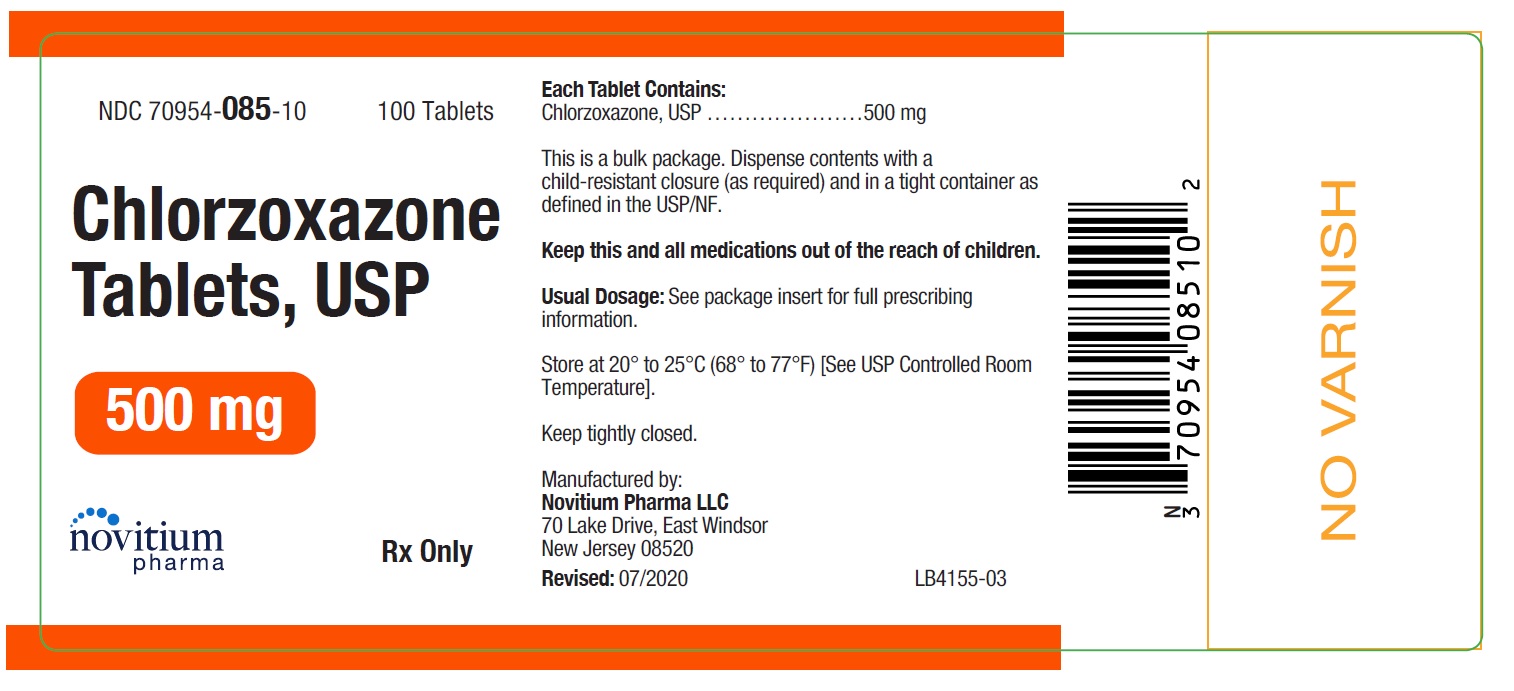
Chlorzoxazone 500 mg Tablet, 100-count — NDC 70954-085-10 (Billing 70954-0085-10)
This is a package of 100 tablets of Chlorzoxazone 500 mg Tablet from Novitium Pharma LLC, marketed since Sep 2019 and currently FDA-listed; retail pharmacies pay about $0.2101 per tablet (NADAC). It is the main listing for this product, which comes in 2 package sizes.
NDC database record
One package, one record: these facts belong to NDC 70954-085-10 alone.
- Record
- FDA NDC Directory package listing · Human prescription drug
- Code segments
- 70954 labeler · 085 product · 10 package
- Package marketed since
- Sep 12, 2019
- Sample package
- No — commercial package
- Listing certified through
- Dec 31, 2026
- Billing quantity
- 100 EA per package
- Barcode (UPC)
- 0370954085201, 0370954085102
- Medicaid fills, this package
- 6,199 prescriptions in the last four reported quarters
- FDA record last changed
- Jul 24, 2026
Identity & classification
Regulatory identifiers FDA, NLM and CMS codes for this package
Drug-database identifiers Medi-Span GPI and First Databank GCN / HICL / AHFS classification
- GSN (GCN sequence number): 004660
- GCN: 17901
- GPI-14 (Medi-Span): 75100040000310
- HICL (First Databank): 001941
- AHFS class code: 12:20.04.00
- RxCUI (RxNorm): 197502
Where does this data come from?
- FDA openFDA NDC Directory · synced Oct 8, 2026
- FDA label on DailyMed · label index refreshed Oct 6, 2026
- RxNorm (NLM RxNav) · catalog refreshed Oct 1, 2026
- Medi-Span GPI (licensed)
- First Databank (licensed) · refreshed Oct 8, 2026
RxNorm drug class
This medicine belongs to the Muscle Relaxant class.
Where does this data come from?
- RxClass (NLM) · catalog refreshed Oct 1, 2026
Clinical
- It helps relieve discomfort from sudden, painful muscle and bone conditions. It is meant to be used along with rest, physical therapy and other measures, not by itself.
- You take it by mouth, usually three or four times a day. Your doctor may adjust the amount depending on how you respond, and it can often be lowered as you get better. Follow the d...
- Most people tolerate it well. Some feel drowsy, dizzy, lightheaded or a bit unwell, and a few feel over-stimulated. Your urine may change color, which isn't known to be a problem.
- Rarely, it can harm the liver. Stop the medicine and call if you have fever, rash, nausea, vomiting, unusual tiredness, upper right belly pain, dark urine or yellow skin or eyes. S...
Patient education
Supplement & herbal interactions
Some supplements/herbs that may interact with Chlorzoxazone — tap one for details:
Where does this data come from?
- MedlinePlus (NLM) · refreshed Oct 1, 2026
- FDA label on DailyMed · label index refreshed Oct 6, 2026
Ask a licensed pharmacist directly — free, answered by our team.
Pricing
A drug doesn't have one price. Each row is a different public payment system, and none is what you'd pay at the counter — that depends on your insurance. The ⓘ on each row explains what it measures.
| Price system | Per ea | Per package |
|---|---|---|
| Retail pharmacies payNADAC · weekly | $0.210 | $21.01 / 100 tablets |
| Medicaid paysCMS SDUD · 12 mo | $0.3124 | $31.24 / 100 tablets |
| Medicare drug plans payPart D · Q2 2026 | $0.2693 | $26.93 / 100 tablets |
Where does this data come from?
- CMS NADAC weekly file · file of Oct 7, 2026
- CMS ASP pricing files · refreshed Sep 20, 2026
- CMS Medicaid State Drug Utilization Data · through Q1 2026
- CMS Part D plan pricing files · refreshed Sep 24, 2026
- VA National Acquisition Center price file
Packaging — all sizes for this product
| Package NDC | Description | Per unit | Per pack | Marketing start | Marketing end | Status |
|---|---|---|---|---|---|---|
| 70954-0085-10 You're viewing this Main listing | 100 TABLET in 1 BOTTLE | $0.2101 / ea | $21.01 | 2019-09-12 | — | Active |
| 70954-0085-20 70954-085-20 | 500 TABLET in 1 BOTTLE | $0.2101 / ea | $105.05 | 2019-09-12 | — | Active |
You're viewing the smallest of 2 pack sizes for this product.
This pack has the lowest per-ea cost of the 2 priced pack sizes ($0.2101 NADAC).
In Medicaid, this is the most-dispensed pack of this product — about 99% of fills over the last four reported quarters. See all packs ↓
Pack size FAQ
What quantity is in this package?
How does this package differ from NDC 70954-0085-20?
What NDC number is used to bill for this package of Chlorzoxazone 500 mg Tablet?
Prices are the latest CMS NADAC pharmacy acquisition cost per NDC; per-pack figures are per-unit × pack quantity, shown only when the pack is denominated in the same measure NADAC prices.
Therapeutic equivalents
| Product | Labeler | Pack | NADAC/unit | TE | Status | Price vs. this |
|---|---|---|---|---|---|---|
| Chlorzoxazone 500 mg 00591-2520-01 | Actavis | 100 tablets | $0.210 | AA | Availability likely | — |
| Chlorzoxazone 500 mg 16571-0726-01 | Rising | 100 tablets | $0.210 | AA | Availability likely | — |
| Chlorzoxazone 500 mg 59651-0306-01 | Aurobindo | 100 tablets | $0.210 | — | Availability likely | — |
| Chlorzoxazone 500 mgthis 70954-0085-10 | Novitium | 100 tablets | $0.210 | AA | Availability likely | — |
| Chlorzoxazone 500 mg 24470-0940-10 | Cintex | 100 tablets | — | AA | FDA listed | — |
| Chlorzoxazone 500 mg 50090-0315-00 | A-S | 30 tablets | — | AA | FDA listed | — |
| Chlorzoxazone 500 mg 50090-7504-00 | A-S | 30 tablets | — | AA | FDA listed | — |
| Chlorzoxazone 500 mg 51862-0339-01 | Mayne | 100 tablets | — | AA | FDA listed | — |
| Chlorzoxazone 500 mg 55289-0633-10 | PD-Rx | 10 tablets | — | AA | FDA listed | — |
| Chlorzoxazone 500 mg 63187-0317-20 | Proficient | 20 tablets | — | AA | FDA listed | — |
| Chlorzoxazone 500 mg 63629-1586-01 | Bryant | 20 tablets | — | AA | FDA listed | — |
| Chlorzoxazone 500 mg 70518-4364-00 | REMEDYREPACK | 90 tablets | — | AA | FDA listed | — |
| Chlorzoxazone 500 mg 71205-0711-30 | Proficient | 30 tablets | — | AA | FDA listed | — |
| Chlorzoxazone 500 mg 71335-1914-01 | Bryant | 20 tablets | — | AA | FDA listed | — |
| Chlorzoxazone 500 mg 71335-2009-01 | Bryant | 20 tablets | — | AA | FDA listed | — |
| Chlorzoxazone 500 mg 71335-2433-01 | Bryant | 20 tablets | — | AA | FDA listed | — |
| Chlorzoxazone 500 mg 71335-3122-00 | Bryant | 10 tablets | — | AA | FDA listed | — |
| Chlorzoxazone 500 mg 80425-0315-01 | Advanced | 30 tablets | — | AA | FDA listed | — |
| Chlorzoxazone 500 mg 80425-0507-01 | Advanced | 30 tablets | — | AA | FDA listed | — |
| Chlorzoxazone 500 mg 85766-0283-01 | Sportpharm | 100 tablets | — | AA | FDA listed | — |
Where does this data come from?
- FDA openFDA NDC Directory · synced Oct 8, 2026
- FDA Orange Book · refreshed Oct 3, 2026
- CMS NADAC weekly file · file of Oct 7, 2026
Availability & generic status
This product is an FDA-approved generic. Other versions of the same drug are listed under Therapeutic equivalents, least expensive first.
Where does this data come from?
- FDA Orange Book · refreshed Oct 3, 2026
Inactive Ingredients / Excipients
Inactive ingredients, also called excipients, are components of the drug product other than the active ingredient. They may include fillers, dyes, coatings, preservatives, flavors, or other formulation ingredients.
🧪 Avoiding an ingredient? See Chlorzoxazone inactive ingredients by manufacturer: every current product's list side by side, so you can ask your pharmacy for the version that does not list it.
💡 Tap an ingredient (hover on desktop) to see what it is and why it’s used.
-
UNII OP1R32D61U
Microcrystalline cellulose is a purified form of cellulose, a natural fiber from plant sources. It acts as a binder and filler in tablets and capsules, helping hold ingredients together and give the medicine its shape and size.
-
UNII M28OL1HH48
Croscarmellose sodium is a plant-based substance derived from cellulose. It acts as a disintegrant, helping tablets and capsules break down quickly in the digestive system so the medicine can be absorbed.
-
UNII F05Q2T2JA0
Docusate sodium is a stool softener compound that helps medicines dissolve and move through the digestive tract. It acts as a surfactant, reducing surface tension in the intestines, and also serves as a wetting agent in tablet formulations.
-
UNII 70097M6I30
Magnesium stearate is a salt made from magnesium and stearic acid, a fatty substance. It's used in tablets and capsules as a lubricant and glidant to help ingredients flow smoothly during manufacturing and prevent sticking.
-
UNII ETJ7Z6XBU4
Silicon dioxide is a naturally occurring mineral used as a glidant and anti-caking agent. It helps powder ingredients flow smoothly and prevents clumping during manufacturing and storage.
-
UNII OJ245FE5EU
Sodium benzoate is a salt derived from benzoic acid, a preservative. It's added to medicines to prevent growth of bacteria, fungi, and other microorganisms that could spoil the product.
-
UNII O8232NY3SJ
A plant-based carbohydrate derived from corn kernels. It acts as a filler to add bulk, a binder to hold ingredients together, and a disintegrant to help the tablet break apart in your stomach for absorption.
7 inactive ingredients listed in the exact product block matched to this NDC.
Where does this data come from?
ingredient classCode="IACT" elements from the exact product block matched by this NDC. Label-section narrative from DailyMed / the openFDA label index is shown separately when available.- FDA label on DailyMed · label index refreshed Oct 6, 2026
- FDA openFDA NDC Directory · synced Oct 8, 2026
Inactive ingredient FAQ
Are inactive ingredients the same for every manufacturer?
Why might an inactive ingredient be missing?
Can inactive ingredients matter?
Manufacturer & labeler
More NDCs from Novitium Pharma LLC labeler code 70954
- Prednisone 5 mg Tablet NDC 70954-058-10
- Prednisone 10 mg Tablet NDC 70954-059-10
- Prednisone 20 mg Tablet NDC 70954-060-10
- Prednisone 50 mg Tablet NDC 70954-061-10
- Meloxicam 5 mg Capsule NDC 70954-076-10
- Meloxicam 10 mg Capsule NDC 70954-077-10
- Dapsone 25 mg Tablet NDC 70954-135-10
- Dapsone 100 mg Tablet NDC 70954-136-10
- Levocarnitine 1 g/10mL Solution NDC 70954-139-10
- Levocarnitine 1 g/10mL Solution NDC 70954-140-10
- Pyridostigmine 60 mg/5mL Solution NDC 70954-148-10
- Naproxen Oral Suspension 125 mg/5mL Suspension NDC 70954-151-10
Where does this data come from?
- FDA openFDA NDC Directory · synced Oct 8, 2026
- Drugs@FDA
Full prescribing information FDA SPL
🎯 Indications and Usage ▾
INDICATIONS & USAGE Chlorzoxazone is indicated as an adjunct to rest, physical therapy, and other measures for the relief of discomfort associated with acute, painful musculoskeletal conditions. The mode of action of this drug has not been clearly identified, but may be related to its sedative properties. Chlorzoxazone does not directly relax tense skeletal muscles in man.
⏱️ Dosage and Administration ▾
DOSAGE & ADMINISTRATION Usual Adult Dosage One tablet three or four times daily. If adequate response is not obtained with this dose, it may be increased to one and one-half tablets (750 mg) three or four times daily. As improvement occurs dosage can usually be reduced.
⛔ Contraindications ▾
CONTRAINDICATIONS Chlorzoxazone is contraindicated in patients with known intolerance to the drug.
⚠️ Warnings ▾
WARNINGS Serious (including fatal) hepatocellular toxicity has been reported rarely in patients receiving chlorzoxazone. The mechanism is unknown but appears to be idiosyncratic and unpredictable. Factors predisposing patients to this rare event are not known.
Patients should be instructed to report early signs and/or symptoms of hepatotoxicity such as fever, rash, anorexia, nausea, vomiting, fatigue, right upper quadrant pain, dark urine, or jaundice. Chlorzoxazone should be discontinued immediately and a physician consulted if any of these signs or symptoms develop. Chlorzoxazone use should also be discontinued if a patient develops abnormal liver enzymes (e.g., AST, ALT, alkaline phosphatase and bilirubin.) The concomitant use of alcohol or other central nervous system depressants may have an additive effect.
Usage in Pregnancy The safe use of chlorzoxazone has not been established with respect to the possible adverse effects upon fetal development. Therefore, it should be used in women of childbearing potential only when, in the judgment of the physician, the potential benefits outweigh the possible risks.
🤒 Adverse Reactions ▾
ADVERSE REACTIONS Chlorzoxazone containing products are usually well tolerated. It is possible in rare instances that chlorzoxazone may have been associated with gastrointestinal bleeding. Drowsiness, dizziness, lightheadedness, malaise, or over-stimulation may be noted by an occasional patient.
Rarely, allergic- type skin rashes, petechiae, or ecchymoses may develop during treatment. Angioneurotic edema or anaphylactic reactions are extremely rare. There is no evidence that the drug will cause renal damage.
Rarely, a patient may note discoloration of the urine resulting from a phenolic metabolite of chlorzoxazone. This finding is of no known clinical significance. To report SUSPECTED ADVERSE EVENTS, contact Novitium Pharma LLC at 1-855-204-1431 or FDA at 1-800- FDA-1088 or http://www.fda.gov/ for voluntary reporting of adverse reactions.
🆘 Overdosage ▾
OVERDOSAGE Symptoms Initially, gastrointestinal disturbances such as nausea, vomiting, or diarrhea together with drowsiness, dizziness, lightheadedness or headache may occur. Early in the course there may be malaise or sluggishness followed by marked loss of muscle tone, making voluntary movement impossible. The deep tendon reflexes may be decreased or absent.
The sensorium remains intact, and there is no peripheral loss of sensation. Respiratory depression may occur with rapid, irregular respiration and intercostal and substernal retraction. The blood pressure is lowered, but shock has not been observed.
Treatment Gastric lavage or induction of emesis should be carried out, followed by administration of activated charcoal. Thereafter, treatment is entirely supportive. If respirations are depressed, oxygen and artificial respiration should be employed and a patent airway assured by use of an oropharyngeal airway or endotracheal tube.
Hypotension may be counteracted by use of dextran, plasma, concentrated albumin or a vasopressor agent such as norepinephrine. Cholinergic drugs or analeptic drugs are of no value and should not be used
🧬 Clinical Pharmacology ▾
CLINICAL PHARMACOLOGY Chlorzoxazone is a centrally-acting agent for painful musculoskeletal conditions. Data available from animal experiments as well as human study indicate that chlorzoxazone acts primarily at the level of the spinal cord and subcortical areas of the brain where it inhibits multisynaptic reflex arcs involved in producing and maintaining skeletal muscle spasm of varied etiology. The clinical result is a reduction of the skeletal muscle spasm with relief of pain and increased mobility of the involved muscles.
Blood levels of chlorzoxazone can be detected in people during the first 30 minutes and peak levels may be reached, in the majority of the subjects, in about 1 to 2 hours after oral administration of chlorzoxazone. Chlorzoxazone is rapidly metabolized and is excreted in the urine, primarily in a conjugated form as the glucuronide. Less than one percent of a dose of chlorzoxazone is excreted unchanged in the urine in 24 hours.
📦 How Supplied / Storage and Handling ▾
HOW SUPPLIED Chlorzoxazone Tablets, USP 500 mg for Oral administration are supplied as follows, White to off-white capsule shaped tablets debossed with N085 on the bisected side: NDC 70954-085-10 100 Tablets NDC 70954-085-20 500 Tablets Store at 20° to 25°C (68° to 77°F) [See USP Controlled Room Temperature]. Dispense contents with a child-resistant closure (as required) and in a tight container as defined in the USP/NF. Manufactured by: Novitium Pharma LLC 70 Lake Drive, East Windsor, New Jersey-08520 Issued: 07/2020
📋 Description ▾
DESCRIPTION Chlorzoxazone USP is a centrally acting skeletal muscle relaxant, available as tablets of 500 mg for oral administration. Its chemical name is 5-Chloro-2-benzoxazolinone, and its structural formula is: C 7 H 4 CINO 2 MW 169.57 Chlorzoxazone USP is a white or practically white, practically odorless, crystalline powder. Chlorzoxazone is slightly soluble in water; sparingly soluble in alcohol, in isopropyl alcohol, and in methanol; soluble in solutions of alkali hydroxides and ammonia.
Chlorzoxazone tablets contain the inactive ingredients Pregelatinized Starch, Croscarmellose Sodium, Microcrystalline Cellulose, Docusate Sodium, Sodium Benzoate, Colloidal Silicon dioxide, Magnesium Stearate. structure
⚠️ Precautions ▾
PRECAUTIONS Chlorzoxazone should be used with caution in patients with known allergies or with a history of allergic reactions to drugs. If a sensitivity reaction occurs such as urticaria, redness, or itching of the skin, the drug should be stopped. If any symptoms suggestive of liver dysfunction are observed, the drug should be discontinued
📄 Package Label / Principal Display Panel ▾
PACKAGE LABEL.PRINCIPAL DISPLAY PANEL Chlorzoxazone Tablets, USP 500 mg - 100's Count Chlorzoxazone Tablets, USP 500 mg - 500's Count chlorzoxazone-100-counts chlorzoxazone-500-counts