
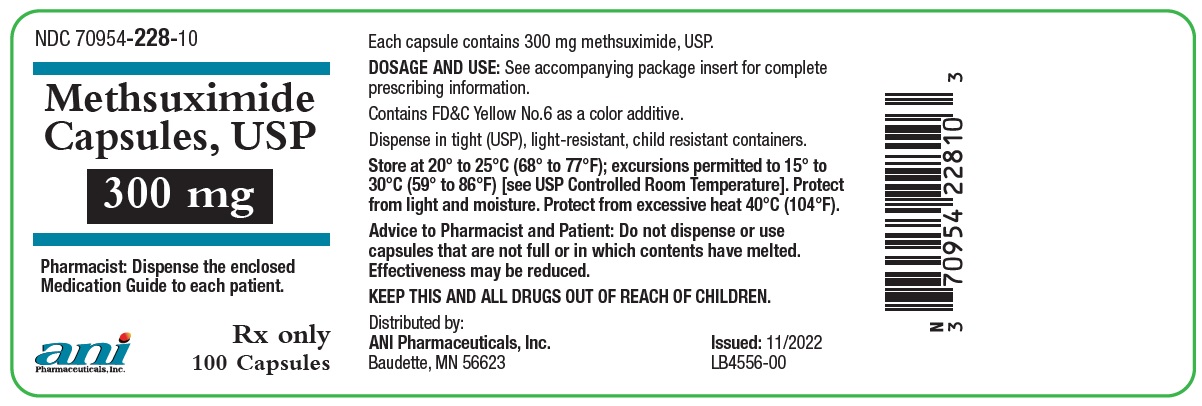
Methsuximide 300 mg Capsule, 100-count — NDC 70954-228-10 (Billing 70954-0228-10)
This is a package of 100 capsules of Methsuximide 300 mg Capsule from ANI Pharmaceuticals, Inc., marketed since May 2023 and currently FDA-listed. It is this product's only package size.
NDC database record
One package, one record: these facts belong to NDC 70954-228-10 alone.
- Record
- FDA NDC Directory package listing · Human prescription drug
- Code segments
- 70954 labeler · 228 product · 10 package
- Package marketed since
- May 1, 2023
- Sample package
- No — commercial package
- Listing certified through
- Dec 31, 2026
- Billing quantity
- 100 EA per package
- Barcode (UPC)
- 0370954228103
- Medicaid fills, this package
- 309 prescriptions in the last four reported quarters
- FDA record last changed
- Jul 24, 2026
Identity & classification
Regulatory identifiers FDA, NLM and CMS codes for this package
Drug-database identifiers Medi-Span GPI and First Databank GCN / HICL / AHFS classification
- GSN (GCN sequence number): 004553
- GCN: 17411
- GPI-14 (Medi-Span): 72400020000110
- HICL (First Databank): 001890
- AHFS class code: 28:12.20.00
- RxCUI (RxNorm): 197949
Where does this data come from?
- FDA openFDA NDC Directory · synced Oct 1, 2026
- FDA label on DailyMed · label index refreshed Oct 5, 2026
- RxNorm (NLM RxNav) · catalog refreshed Oct 1, 2026
- Medi-Span GPI (licensed)
- First Databank (licensed) · refreshed Oct 1, 2026
RxNorm drug class
This medicine belongs to the Anti-epileptic Agent class.
Where does this data come from?
- RxClass (NLM) · catalog refreshed Oct 1, 2026
Clinical
Methsuximide is used to control absence seizures (petit mal; a type of seizure in which there is a very short loss of awareness during which the person may stare straight ahead or blink his eyes and does not respond to others) that cannot be treated with other medications. Methsuximide is in a class of medications called anticonvulsants. It works by decreasing abnormal electrical activity in the brain.
Read the full MedlinePlus article ↗- It controls absence (petit mal) seizures, the brief ones that cause lapses of consciousness. It's used when other medicines haven't worked well enough.
- You take it by mouth as a capsule. Your prescriber usually starts you low and raises the amount gradually to find what controls your seizures with the fewest side effects. Follow y...
- Drowsiness, dizziness and unsteadiness are the most common. Some people get nausea, poor appetite, headache or trouble sleeping. Tell your doctor if they bother you.
- Call right away for fever or sore throat, a rash or hives, confusion, or any new depression, mood changes or thoughts of self-harm. You'll also need regular blood, urine and liver...
Patient education
Supplement & herbal interactions
Some supplements/herbs that may interact with Methsuximide — tap one for details:
Methsuximide may be associated with lower levels of 1 nutrient — worth a chat with your pharmacist, not a cause for alarm.
Where does this data come from?
- MedlinePlus (NLM) · refreshed Oct 1, 2026
- FDA label on DailyMed · label index refreshed Oct 5, 2026
Ask a licensed pharmacist directly — free, answered by our team.
Pricing
A drug doesn't have one price. Each row is a different public payment system, and none is what you'd pay at the counter — that depends on your insurance. The ⓘ on each row explains what it measures.
| Price system | Per each | Per package |
|---|---|---|
| Retail pharmacies payNADAC · weekly | Not in the retail survey — common for institutional, discontinued, or low-volume packs. | |
| Medicaid paysCMS SDUD · 12 mo | $3.65 | $364.72 / 100 capsules |
| Medicare drug plans payPart D · Q2 2026 | $3.48 | $348.40 / 100 capsules |
Where does this data come from?
- CMS NADAC weekly file
- CMS ASP pricing files · refreshed Sep 20, 2026
- CMS Medicaid State Drug Utilization Data · through Q1 2026
- CMS Part D plan pricing files · refreshed Sep 24, 2026
- VA National Acquisition Center price file
Packaging — all sizes for this product
| Package NDC | Description | Marketing start | Marketing end | Status |
|---|---|---|---|---|
| 70954-0228-10 You're viewing this Main listing | 100 CAPSULE in 1 BOTTLE | 2023-05-01 | — | Active |
Therapeutic equivalents
| Product | Labeler | Pack | NADAC/unit | TE | Status | Price vs. this |
|---|---|---|---|---|---|---|
| Celontin 300 mg 00071-0525-24 | Parke-Davis | 100 capsules | $4.402 | AB | Availability likely | — |
| Methsuximide 300 mgthis 70954-0228-10 | ANI | 100 capsules | — | AB | FDA listed | — |
Where does this data come from?
- FDA openFDA NDC Directory · synced Oct 1, 2026
- FDA Orange Book · refreshed Oct 3, 2026
- CMS NADAC weekly file
Availability & generic status
This product is an FDA-approved generic. Other versions of the same drug are listed under Therapeutic equivalents, least expensive first.
Where does this data come from?
- FDA Orange Book · refreshed Oct 3, 2026
What it looks like
Where does this data come from?
- FDA label on DailyMed · label index refreshed Oct 5, 2026
Inactive Ingredients / Excipients
Inactive ingredients, also called excipients, are components of the drug product other than the active ingredient. They may include fillers, dyes, coatings, preservatives, flavors, or other formulation ingredients.
🧪 Avoiding an ingredient? See Methsuximide inactive ingredients by manufacturer: every current product's list side by side, so you can ask your pharmacy for the version that does not list it.
💡 Tap an ingredient (hover on desktop) to see what it is and why it’s used.
-
UNII 3K9958V90M
A liquid solvent derived from fermentation or chemical synthesis. In medicines, alcohol dissolves active ingredients, helps preserve the product, and improves how the body absorbs certain drugs.
-
UNII 5138Q19F1X
Ammonia is a colorless gas made from nitrogen and hydrogen. It's used in medicines as a pH buffer to maintain the correct acidity level and help keep the product stable.
-
UNII 8PJ61P6TS3
Butyl alcohol is a clear liquid organic solvent derived from petroleum or natural sources. In medicines, it helps dissolve active ingredients and serves as a solvent in liquid formulations and some topical products.
-
UNII 35SW5USQ3G
A synthetic yellow dye used to color medicines. It helps make tablets, capsules, and liquids visually distinct so patients can easily identify their medication.
-
UNII H77VEI93A8
A synthetic yellow dye used to color medications. It helps identify the drug and make it visually distinctive, with no effect on how the medicine works.
-
UNII XM0M87F357
A dark iron oxide compound that gives medicines their black or dark color. It's used as a colorant in tablets and capsules to help identify the product and make it visually distinctive.
-
UNII 2G86QN327L
Gelatin is a protein derived from animal collagen, commonly used in medicines as a gelling agent and capsule material. It helps create soft or hard capsule shells that hold and release medication, and can also thicken liquid formulations.
-
UNII ND2M416302
Isopropyl alcohol is a clear liquid solvent derived from petroleum. In medicines, it dissolves active ingredients and other components, helps the product flow smoothly, and aids in sterilization during manufacturing.
-
UNII 70097M6I30
Magnesium stearate is a salt made from magnesium and stearic acid, a fatty substance. It's used in tablets and capsules as a lubricant and glidant to help ingredients flow smoothly during manufacturing and prevent sticking.
-
UNII WZH3C48M4T
Potassium hydroxide is a strong alkaline chemical used in medicines to adjust and maintain the pH level of liquid formulations, helping keep the product stable and the active ingredients effective.
-
UNII 6DC9Q167V3
Propylene glycol is a clear liquid derived from petroleum or vegetable sources. It acts as a solvent, humectant, and preservative in medicines, helping dissolve active ingredients and maintain product stability.
-
UNII MB5IUD6JUA
Shellac is a natural resin secreted by lac beetles, purified and processed into a coating material. It seals and protects tablets and capsules, controls how quickly the medicine dissolves, and gives pills their glossy finish.
-
UNII ETJ7Z6XBU4
Silicon dioxide is a naturally occurring mineral used as a glidant and anti-caking agent. It helps powder ingredients flow smoothly and prevents clumping during manufacturing and storage.
-
UNII 368GB5141J
A detergent and foaming agent derived from coconut or palm oil. In medications, it helps break down and mix oil and water-based ingredients, aids in tablet disintegration, and improves how the drug dissolves and spreads in the mouth or digestive system.
-
UNII O8232NY3SJ
A plant-based carbohydrate derived from corn kernels. It acts as a filler to add bulk, a binder to hold ingredients together, and a disintegrant to help the tablet break apart in your stomach for absorption.
-
UNII 059QF0KO0R
Water is a liquid solvent that dissolves and mixes ingredients together in liquid medicines, syrups, and injections. It helps distribute the active drug evenly throughout the product.
16 inactive ingredients listed in the exact product block matched to this NDC.
Where does this data come from?
ingredient classCode="IACT" elements from the exact product block matched by this NDC. Label-section narrative from DailyMed / the openFDA label index is shown separately when available.- FDA label on DailyMed · label index refreshed Oct 5, 2026
- FDA openFDA NDC Directory · synced Oct 1, 2026
Inactive ingredient FAQ
Are inactive ingredients the same for every manufacturer?
Why might an inactive ingredient be missing?
Can inactive ingredients matter?
Manufacturer & labeler
More NDCs from ANI Pharmaceuticals, Inc. labeler code 70954
- Potassium chloride 1.5 g/1.56g For Solution NDC 70954-197-20
- Digoxin .0625 mg Tablet NDC 70954-200-10
- Digoxin .125 mg Tablet NDC 70954-201-10
- Digoxin .25 mg Tablet NDC 70954-202-10
- Trihexyphenidyl Hydrochloride 5 mg Tablet NDC 70954-211-10
- Trihexyphenidyl Hydrochloride 2 mg Tablet NDC 70954-212-10
- Carbamazepine 100 mg/5mL Suspension NDC 70954-240-10
- Fludrocortisone Acetate .1 mg Tablet NDC 70954-252-10
- Methyltestosterone 10 mg Capsule NDC 70954-255-10
- Sulfamethoxazole and Trimethoprim 200 mg/5mL; 40 mg/5mL Suspension NDC 70954-258-10
- Dicyclomine Hydrochloride 10 mg/5mL Solution NDC 70954-261-10
- Alendronate Sodium 70 mg/75mL Solution NDC 70954-264-10
Where does this data come from?
- FDA openFDA NDC Directory · synced Oct 1, 2026
- Drugs@FDA
Full prescribing information FDA SPL
🎯 Indications and Usage ▾
INDICATIONS & USAGE Methsuximide is indicated for the control of absence (petit mal) seizures that are refractory to other drugs.
⏱️ Dosage and Administration ▾
DOSAGE & ADMINISTRATION Optimum dosage of methsuximide must be determined by trial. A suggested dosage schedule is 300 mg per day for the first week. If required, dosage may be increased thereafter at weekly intervals by 300 mg per day for the three weeks following to a daily dosage of 1.2 g.
Because therapeutic effect and tolerance vary among patients, therapy with methsuximide must be individualized according to the response of each patient. Optimal dosage is that amount of methsuximide which is barely sufficient to control seizures so that side effects may be kept to a minimum. Methsuximide may be administered in combination with other anticonvulsants when other forms of epilepsy coexist with absence (petit mal).
⛔ Contraindications ▾
CONTRAINDICATIONS Methsuximide should not be used in patients with a history of hypersensitivity to succinimides.
⚠️ Warnings ▾
WARNINGS Blood dyscrasias Blood dyscrasias, including some with fatal outcome, have been reported to be associated with the use of succinimides; therefore, periodic blood counts should be performed. Should signs and/or symptoms of infection (eg, sore throat, fever) develop, blood counts should be considered at that point. Effects on Liver It has been reported that succinimides have produced morphological and functional changes in animal liver.
For this reason, methsuximide should be administered with extreme caution to patients with known liver or renal disease. Periodic urinalysis and liver function studies are advised for all patients receiving the drug. Systemic Lupus Erythematosus Cases of systemic lupus erythematosus have been reported with the use of succinimides.
The physician should be alert to this possibility. Suicidal Behavior and Ideation Antiepileptic drugs (AEDs), including methsuximide, increase the risk of suicidal thoughts or behavior in patients taking these drugs for any indication. Patients treated with any AED for any indication should be monitored for the emergence or worsening of depression, suicidal thoughts or behavior, and/or any unusual changes in mood or behavior.
Pooled analyses of 199 placebo-controlled clinical trials (mono- and adjunctive therapy) of 11 different AEDs showed that patients randomized to one of the AEDs had approximately twice the risk (adjusted Relative Risk 1.8, 95% CI:1.2, 2.7) of suicidal thinking or behavior compared to patients randomized to placebo. In these trials, which had a median treatment duration of 12 weeks, the estimated incidence rate of suicidal behavior or ideation among 27,863 AED-treated patients was 0.43%, compared to 0.24% among 16,029 placebo-treated patients, representing an increase of approximately one case of suicidal thinking or behavior for every 530 patients treated.
There were four suicides in drug-treated patients in the trials and none in placebo-treated patients, but the number is too small to allow any conclusion about drug effect on suicide. The increased risk of suicidal thoughts or behavior with AEDs was observed as early as one week after starting drug treatment with AEDs and persisted for the duration of treatment assessed. Because most trials included in the analysis did not extend beyond 24 weeks, the risk of suicidal thoughts or behavior beyond 24 weeks could not be assessed.
The risk of suicidal thoughts or behavior was generally consistent among drugs in the data analyzed. The finding of increased risk with AEDs of varying mechanisms of action and across a range of indications suggests that the risk applies to all AEDs used for any indication. The risk did not vary substantially by age (5–100 years) in the clinical trials analyzed.
Table 1 shows absolute and relative risk by indication for all evaluated AEDs. Table 1 Risk by indication for antiepileptic drugs in the pooled analysis Indication Placebo Patients with Events Per 1000 Patients Drug Patients with Events Per 1000 Patients Relative Risk: Incidence of Events in Drug Patients/Incidence in Placebo Patients Risk Difference: Additional Drug Patients with Events Per 1000 Patients Epilepsy 1.0 3.4 3.5
2.4Psychiatric 5.7 8.5 1.5
2.9Other 1.0 1.8 1.9
0.9Total 2.4 4.3 1.8
1.9The relative risk for suicidal thoughts or behavior was higher in clinical trials for epilepsy than in clinical trials for psychiatric or other conditions, but the absolute risk differences were similar for the epilepsy and psychiatric indications. Anyone considering prescribing methsuximide or any other AED must balance the risk of suicidal thoughts or behavior with the risk of untreated illness. Epilepsy and many other illnesses for which AEDs are prescribed are themselves associated with morbidity and mortality and an increased risk of suicidal thoughts and behavior.
Should suicidal thoughts and behavior emerge during treatment, the prescriber needs to consider whether the emergence of these symptoms in any g… [Excerpted — this section continues on DailyMed.]
🤒 Adverse Reactions ▾
ADVERSE REACTIONS Gastrointestinal System: Gastrointestinal symptoms occur frequently and have included nausea or vomiting, anorexia, diarrhea, weight loss, epigastric and abdominal pain, and constipation. Hemopoietic System: Hemopoietic complications associated with the administration of methsuximide have included eosinophilia, leukopenia, monocytosis, and pancytopenia with or without bone marrow suppression. Nervous System : Neurologic and sensory reactions reported during therapy with methsuximide have included drowsiness, ataxia or dizziness, irritability and nervousness, headache, blurred vision, photophobia, hiccups, and insomnia.
Drowsiness, ataxia, and dizziness have been the most frequent side effects noted. Psychologic abnormalities have included confusion, instability, mental slowness, depression, hypochondriacal behavior, and aggressiveness. There have been rare reports of psychosis, suicidal behavior, and auditory hallucinations.
Integumentary System : Dermatologic manifestations which have occurred with the administration of methsuximide have included urticaria, Stevens-Johnson syndrome, and pruritic erythematous rashes. Cardiovascular : Hyperemia. Genitourinary System : Proteinuria, microscopic hematuria.
Body as a Whole : Periorbital edema.
🔄 Drug Interactions ▾
DRUG INTERACTIONS Since methsuximide may interact with concurrently administered antiepileptic drugs, periodic serum level determinations of these drugs may be necessary (eg, methsuximide may increase the plasma concentrations of phenytoin and phenobarbital).
🤰 Pregnancy ▾
PREGNANCY To provide information regarding the effects of in utero exposure to methsuximide, physicians are advised to recommend that pregnant patients taking methsuximide enroll in the (NAAED) Pregnancy Registry. This can be done by calling the toll free number 1-888-233-2334, and must be done by patients themselves. Information on the registry can also be found at the website: http://www.aedpregnancyregistry.org/. See WARNINGS.
🧒 Pediatric Use ▾
PEDIATRIC USE See DOSAGE AND ADMINISTRATION.
🆘 Overdosage ▾
OVERDOSAGE Acute overdoses may produce nausea, vomiting, and CNS depression including coma with respiratory depression. Methsuximide poisoning may follow a biphasic course. Following an initial comatose state, patients have awakened and then relapsed into a coma within 24 hours.
It is believed that an active metabolite of methsuximide, N-desmethylmethsuximide, is responsible for this biphasic profile. It is important to follow plasma levels of N-desmethylmethsuximide in methsuximide poisonings. Levels greater than 40 μg/mL have caused toxicity, and coma has been seen at levels of 150 μg/mL.
Treatment Treatment should include emesis (unless the patient is or could rapidly become obtunded, comatose, or convulsing) or gastric lavage, activated charcoal, cathartics, and general supportive measures. Charcoal hemoperfusion may be useful in removing the N-desmethyl metabolite of methsuximide. Forced diuresis and exchange transfusions are ineffective.
🧬 Clinical Pharmacology ▾
CLINICAL PHARMACOLOGY Methsuximide suppresses the paroxysmal three cycle per second spike and wave activity associated with lapses of consciousness which is common in absence (petit mal) seizures. The frequency of epileptiform attacks is reduced, apparently by depression of the motor cortex and elevation of the threshold of the central nervous system to convulsive stimuli.
📦 How Supplied / Storage and Handling ▾
HOW SUPPLIED Methsuximide Capsules, USP are supplied as pale yellow colored, size "1" hard gelatin capsules, imprinted 228 on the cap and 300 mg on the body in black ink filled with white to off-white powder with each capsule containing 300 mg methsuximide, USP. NDC 70954-228-10 Bottles of 100 Store at 20° to 25°C (68° to 77°F); excursions permitted to 15° to 30°C (59° to 86°F) [see USP Controlled Room Temperature]. Protect from light and moisture.
Protect from excessive heat 40°C (104°F). Trademarks are the property of their respective owners. Distributed by: ANI Pharmaceuticals, Inc.
Baudette, MN 56623 Issued: 11/2022 LB4557-00
📋 Description ▾
DESCRIPTION Methsuximide is an anticonvulsant succinimide, chemically designated as N,2-Dimethyl-2-phenylsuccinimide, with the following structural formula: Each Methsuximide Capsule, USP contains 300 mg methsuximide, USP. Also contains corn starch, colloidal silicon dioxide and magnesium stearate. The capsule shells contain gelatin, purified water, sodium lauryl sulfate, D&C Yellow No.10 and FD&C Yellow No.6.
The imprinting ink contains shellac, alcohol, isopropyl alcohol, butyl alcohol, propylene glycol, ammonia, black iron oxide, potassium hydroxide and purified water. FDA approved dissolution test specifications differ from USP. structure
💬 Information for Patients ▾
INFORMATION FOR PATIENTS Inform patients of the availability of a Medication Guide, and instruct them to read the Medication Guide prior to taking methsuximide. Instruct patients to take methsuximide only as prescribed. Methsuximide may impair the mental and/or physical abilities required for the performance of potentially hazardous tasks, such as driving a motor vehicle or other such activity requiring alertness; therefore, the patient should be cautioned accordingly.
Patients taking methsuximide should be advised of the importance of adhering strictly to the prescribed dosage regimen. Patients should be instructed to promptly contact their physician if they develop signs and/or symptoms suggesting an infection (eg, sore throat, fever). ADVICE TO THE PHARMACIST AND PATIENT: Since methsuximide has a relatively low melting temperature (124° F), storage conditions which may promote high temperatures (closed cars, delivery vans, or storage near steam pipes) should be avoided.
Do not dispense or use capsules that are not full or in which contents have melted. Effectiveness may be reduced. Protect from excessive heat (104° F).
Patients, their caregivers, and families should be counseled that AEDs, including methsuximide, may increase the risk of suicidal thoughts and behavior and should be advised of the need to be alert for the emergence or worsening of symptoms of depression, any unusual changes in mood or behavior, or the emergence of suicidal thoughts, behavior, or thoughts about self-harm. Behaviors of concern should be reported immediately to healthcare providers. Patients should be encouraged to enroll in the North American Antiepileptic Drug (NAAED) Pregnancy Registry if they become pregnant.
This registry is collecting information about the safety of antiepileptic drugs during pregnancy. To enroll, patients can call the toll free number 1-888-233-2334 (see PRECAUTIONS: Pregnancy section).
💬 Medication Guide ▾
SPL MEDGUIDE Methsuximide (meth SUX i mide) Capsules, USP Read this Medication Guide before you start taking methsuximide and each time you get a refill. There may be new information. This information does not take the place of talking to your healthcare provider about your medical condition or treatment.
If you have any questions about methsuximide, ask your healthcare provider or pharmacist. What is the most important information I should know about methsuximide? Do not stop taking methsuximide without first talking to your healthcare provider.
Stopping methsuximide suddenly can cause serious problems. Methsuximide can cause serious side effects, including: 1. Rare but serious blood problems that may be life-threatening.
Call your healthcare provider right away if you have: fever, swollen glands, or sore throat that come and go or do not go away frequent infections or an infection that does not go away easy bruising red or purple spots on your body bleeding gums or nose bleeds severe fatigue or weakness 2. Systematic Lupus Erythematosus. Call your healthcare provider right away if you have any of these symptoms: joint pain and swelling muscle pain fatigue low-grade fever pain in the chest that is worse with breathing unexplained skin rash 3.
Like other antiepileptic drugs, methsuximide may cause suicidal thoughts or actions in a very small number of people, about 1 in 500. Call a healthcare provider right away if you have any of these symptoms, especially if they are new, worse, or worry you: thoughts about suicide or dying attempts to commit suicide new or worse depression new or worse anxiety feeling agitated or restless panic attacks trouble sleeping (insomnia) new or worse irritability acting aggressive, being angry, or violent acting on dangerous impulses an extreme increase in activity and talking (mania) other unusual changes in behavior or mood How can I watch for early symptoms of suicidal thoughts and actions?
Pay attention to any changes, especially sudden changes, in mood, behaviors, thoughts, or feelings. Keep all follow-up visits with your healthcare provider as scheduled. Call your healthcare provider between visits as needed, especially if you are worried about symptoms.
Do not stop methsuximide without first talking to a healthcare provider. Stopping methsuximide suddenly can cause serious problems. Stopping a seizure medicine suddenly in a patient who has epilepsy can cause seizures that will not stop (status epilepticus).
Suicidal thoughts or actions can be caused by things other than medicines. If you have suicidal thoughts or actions, your healthcare provider may check for other causes. What is methsuximide?
Methsuximide is a prescription medicine used to treat absence (petit mal) seizures that have not gotten better with other seizure medicines. Who should not take methsuximide? Do not take methsuximide if you are allergic to succinimides (methsuximide or ethosuximide) or any of the ingredients in methsuximide.
See the end of this Medication Guide for a complete list of ingredients in methsuximide. What should I tell my healthcare provider before taking methsuximide? Before you take methsuximide, tell your healthcare provider if you: have or have had liver problems have or have had depression, mood problems or suicidal thoughts or behavior have any other medical conditions are pregnant or plan to become pregnant.
It is not known if methsuximide can harm your unborn baby. Tell your healthcare provider right away if you become pregnant while taking methsuximide. You and your healthcare provider will decide if you should take methsuximide while you are pregnant.
If you become pregnant while taking methsuximide, talk to your healthcare provider about registering with the North American Antiepileptic Drug (NAAED) Pregnancy Registry. The purpose of this registry is to collect information about the safety of antiepileptic drugs during pregnancy. You can enroll in this registry by calling 1-888-233-2334. are br… [Excerpted — this section continues on DailyMed.]
⚠️ Precautions ▾
PRECAUTIONS GENERAL PRECAUTIONS It is recommended that the physician withdraw the drug slowly on the appearance of unusual depression, aggressiveness, or other behavioral alterations. As with other anticonvulsants, it is important to proceed slowly when increasing or decreasing dosage, as well as when adding or eliminating other medication. Abrupt withdrawal of anticonvulsant medication may precipitate absence (petit mal) status.
Methsuximide, when used alone in mixed types of epilepsy, may increase the frequency of grand mal seizures in some patients. INFORMATION FOR PATIENTS Inform patients of the availability of a Medication Guide, and instruct them to read the Medication Guide prior to taking methsuximide. Instruct patients to take methsuximide only as prescribed.
Methsuximide may impair the mental and/or physical abilities required for the performance of potentially hazardous tasks, such as driving a motor vehicle or other such activity requiring alertness; therefore, the patient should be cautioned accordingly. Patients taking methsuximide should be advised of the importance of adhering strictly to the prescribed dosage regimen. Patients should be instructed to promptly contact their physician if they develop signs and/or symptoms suggesting an infection (eg, sore throat, fever).
ADVICE TO THE PHARMACIST AND PATIENT: Since methsuximide has a relatively low melting temperature (124° F), storage conditions which may promote high temperatures (closed cars, delivery vans, or storage near steam pipes) should be avoided. Do not dispense or use capsules that are not full or in which contents have melted. Effectiveness may be reduced.
Protect from excessive heat (104° F). Patients, their caregivers, and families should be counseled that AEDs, including methsuximide, may increase the risk of suicidal thoughts and behavior and should be advised of the need to be alert for the emergence or worsening of symptoms of depression, any unusual changes in mood or behavior, or the emergence of suicidal thoughts, behavior, or thoughts about self-harm. Behaviors of concern should be reported immediately to healthcare providers.
Patients should be encouraged to enroll in the North American Antiepileptic Drug (NAAED) Pregnancy Registry if they become pregnant. This registry is collecting information about the safety of antiepileptic drugs during pregnancy. To enroll, patients can call the toll free number 1-888-233-2334 (see PRECAUTIONS: Pregnancy section).
DRUG INTERACTIONS Since methsuximide may interact with concurrently administered antiepileptic drugs, periodic serum level determinations of these drugs may be necessary (eg, methsuximide may increase the plasma concentrations of phenytoin and phenobarbital). PREGNANCY To provide information regarding the effects of in utero exposure to methsuximide, physicians are advised to recommend that pregnant patients taking methsuximide enroll in the (NAAED) Pregnancy Registry. This can be done by calling the toll free number 1-888-233-2334, and must be done by patients themselves.
Information on the registry can also be found at the website: http://www.aedpregnancyregistry.org/. See WARNINGS. PEDIATRIC USE See DOSAGE AND ADMINISTRATION.
📄 Package Label / Principal Display Panel ▾
PACKAGE LABEL.PRINCIPAL DISPLAY PANEL Methsuximide Capsules, USP 300 mg NDC 70954-228-10 - Bottles of 100 container
Medicaid utilization & spend
Medicare Part D spend CMS · PART D · 2026 (Q1)
Reported adverse events (FAERS)
Top reported reactions
Age at onset
Reporter sex
Serious outcomes
Where does this data come from?
About this NDC listing & data coverage
What data is (and isn’t) available for this NDC — tap to expand
| NDC identity (package / product / labeler codes) | ✓ Available |
| Labeler | ✓ Available |
| Product & package description | ✓ Available |
| Marketing category & status | ✓ Available |
| Active ingredient / dosage form / route | ✓ Available |
| FDA label (SPL via DailyMed) | ✓ Available |
| Package photos | ✓ Available |
| Inactive ingredients (structured) | ✓ Available |
| NADAC pharmacy acquisition price (CMS) | — Not published for this NDC CMS publishes NADAC only for NDCs reported in its retail-pharmacy survey. |
| Orange Book / therapeutic-equivalence data | ✓ Available |
| HCPCS J-code billing crosswalk | — Not published for this NDC Most self-administered / retail products have no J-code — that is normal. |
| Medicaid utilization (CMS SDUD) | ✓ Available |