
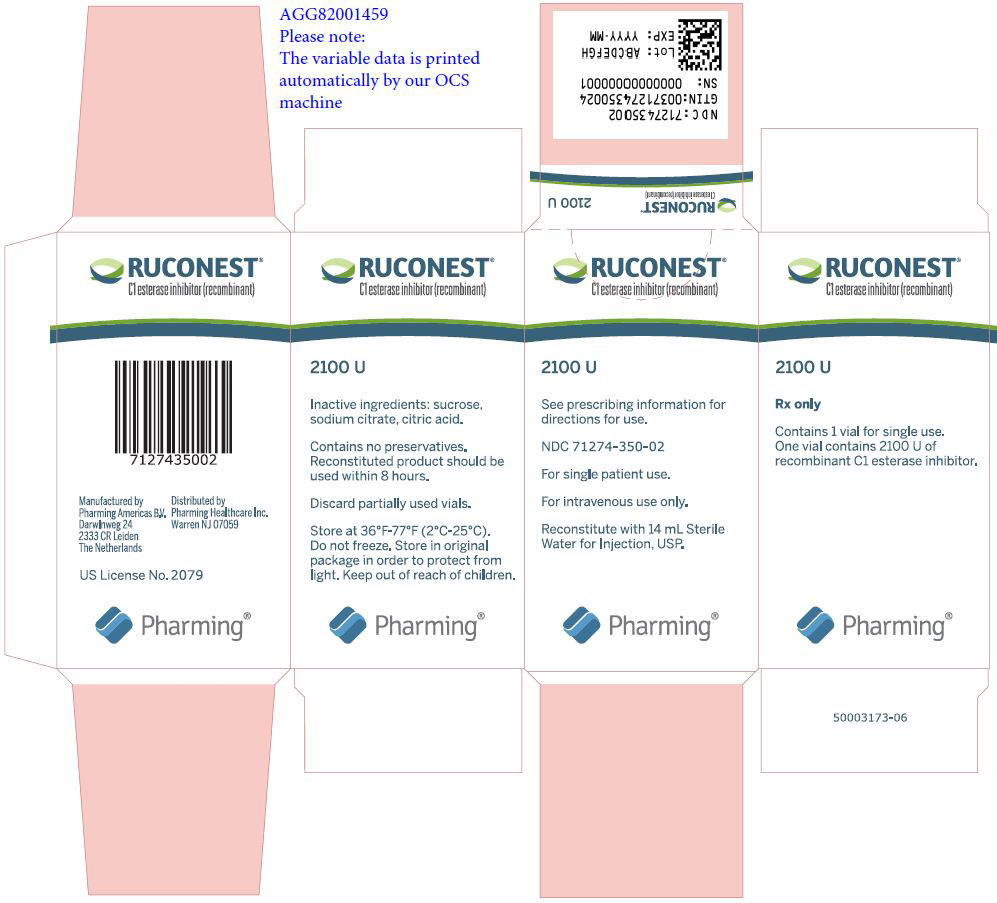
Ruconest c1 esterase inhibitor recombinant 2100 U Injection, Powder, For Solution, 1 vial — NDC 71274-350-02 (Billing 71274-0350-02)
This is a package of 1 vial of Ruconest c1 esterase inhibitor recombinant 2100 U Injection, Powder, For Solution from Pharming Healthcare Inc., marketed since Apr 2018 and currently FDA-listed. It is this product's only package size.
NDC database record
One package, one record: these facts belong to NDC 71274-350-02 alone.
- Record
- FDA NDC Directory package listing · Human prescription drug
- Code segments
- 71274 labeler · 350 product · 02 package
- Package marketed since
- Apr 1, 2018
- Sample package
- No — commercial package
- Listing certified through
- Dec 31, 2026
- Billing quantity
- 1 EA per package
- Barcode (UPC-A, from the NDC)
- 3 7127435002 4
- Medicaid fills, this package
- 370 prescriptions in the last four reported quarters
- FDA record last changed
- Jul 24, 2026
Identity & classification
Regulatory identifiers FDA, NLM and CMS codes for this package
Drug-database identifiers Medi-Span GPI and First Databank GCN / HICL / AHFS classification
- GSN (GCN sequence number): 067598
- GCN: 30182
- GPI-14 (Medi-Span): 85802022102130
- HICL (First Databank): 037766
- AHFS class code: 92:32.00.00
- RxCUI (RxNorm): 1599836
Where does this data come from?
- FDA openFDA NDC Directory · synced Oct 8, 2026
- FDA label on DailyMed · label index refreshed Oct 8, 2026
- RxNorm (NLM RxNav) · catalog refreshed Oct 1, 2026
- Medi-Span GPI (licensed)
- First Databank (licensed) · refreshed Oct 8, 2026
RxNorm drug class
This medicine belongs to the Human C1 Esterase Inhibitor class.
Where does this data come from?
- RxClass (NLM) · catalog refreshed Oct 1, 2026
Clinical
- Ruconest is a lab-made version of a protein your body normally makes called C1-esterase inhibitor. If you have hereditary angioedema (HAE), your body doesn't produce enough of this...
- What exactly is Ruconest and why has it been prescribed to me?
- Yes, Ruconest is given as a slow injection directly into a vein (intravenously), over about 5 minutes. If your healthcare team has trained you properly, you can give it to yourself...
- How do I actually take it — is it a shot I give myself?
Patient education
Supplement & herbal interactions
Where does this data come from?
- MedlinePlus (NLM) · refreshed Oct 8, 2026
- FDA label on DailyMed · label index refreshed Oct 8, 2026
Ask a licensed pharmacist directly — free, answered by our team.
Pricing
A drug doesn't have one price. Each row is a different public payment system, and none is what you'd pay at the counter — that depends on your insurance. The ⓘ on each row explains what it measures.
| Price system | Per mL | Per package |
|---|---|---|
| Retail pharmacies payNADAC · weekly | Not in the retail survey — common for institutional, discontinued, or low-volume packs. | |
| Medicaid paysCMS SDUD · 12 mo | $8,036.25 | — |
| Medicare drug plans payPart D · Q2 2026 | $8,585.98 | — |
| Medicare Part B allowsASP · J0596 | $37.832 / J0596 unit | — |
Where does this data come from?
- CMS NADAC weekly file
- CMS ASP pricing files · refreshed Sep 20, 2026
- CMS Medicaid State Drug Utilization Data · through Q1 2026
- CMS Part D plan pricing files · refreshed Sep 24, 2026
- VA National Acquisition Center price file
Billing & reimbursement
Where does this data come from?
- CMS ASP NDC-HCPCS crosswalk · refreshed Sep 22, 2026
- DMEPDAC NDC-HCPCS crosswalk
- openFDA NSDE billing units · refreshed Oct 7, 2026
Packaging — all sizes for this product
| Package NDC | Description | Marketing start | Marketing end | Status |
|---|---|---|---|---|
| 71274-0350-02 You're viewing this Main listing | 1 VIAL, SINGLE-USE in 1 CARTON / 1 INJECTION, POWDER, FOR SOLUTION in 1 VIAL, SINGLE-USE | 2018-04-01 | — | Active |
Therapeutic equivalents
| Product | Labeler | Pack | NADAC/unit | TE | Status | Price vs. this |
|---|---|---|---|---|---|---|
| Ruconest 2100 Uthis 71274-0350-02 | Pharming | 1 vial | — | — | FDA listed | — |
Where does this data come from?
- FDA openFDA NDC Directory · synced Oct 8, 2026
- FDA Purple Book · refreshed Oct 5, 2026
- CMS NADAC weekly file
Availability & biosimilar status
Biologics have no small-molecule generics; biosimilar competition is tracked in the FDA Purple Book.
Why the date isn’t exact: Biosimilar timing can change because patents may be challenged, settled, licensed, added or removed, and litigation can move the real date earlier or later.
🛈 What do these terms mean?
- Biologic patent
- A patent the reference product’s maker has publicly listed. A biosimilar generally can’t launch until these expire — unless they’re invalidated or resolved in a settlement.
- Reference-product exclusivity
- A flat 12 years of FDA market protection from the biologic’s first licensure (the BPCIA). No biosimilar can be licensed before it ends, regardless of patents.
- Interchangeable exclusivity
- The first interchangeable biosimilar can earn a period as the only interchangeable version (pharmacists can substitute it without the prescriber).
- Earliest biosimilar (LOE)
- The latest of all the dates above — the soonest a biosimilar can realistically reach the market. Litigation and settlements can move it earlier.
Biologics have no small-molecule “generics” — competition comes from FDA-licensed biosimilars, tracked in the FDA Purple Book.
| Code | What it grants | Expires |
|---|---|---|
| RefProduct | Reference-product exclusivity (12-year, BPCIA) — no biosimilar can be licensed before this date | Jul 16, 2026 |
Is there a biosimilar for RUCONEST 2,100 UNIT VIAL?
Why do different websites show different biosimilar dates?
Can a biosimilar launch before the last patent expires?
What does “current Purple Book estimate” mean?
What does “FDA listed” mean?
What does a patent or protection date mean here?
Where does this data come from?
- FDA Purple Book · refreshed Oct 5, 2026
What it looks like
Where does this data come from?
- FDA label on DailyMed · label index refreshed Oct 8, 2026
Inactive Ingredients / Excipients
Inactive ingredients, also called excipients, are components of the drug product other than the active ingredient. They may include fillers, dyes, coatings, preservatives, flavors, or other formulation ingredients.
🧪 Avoiding an ingredient? See C1-Esterase Inhibitor (Recombinant) Injection inactive ingredients by manufacturer: every current product's list side by side, so you can ask your pharmacy for the version that does not list it.
💡 Tap an ingredient (hover on desktop) to see what it is and why it’s used.
-
UNII 2968PHW8QP
A weak organic acid derived from citrus fruits or made through fermentation. It works as a buffer to control pH, a preservative to extend shelf life, and a flavoring agent in medications.
-
UNII 1Q73Q2JULR
Sodium citrate is a salt derived from citric acid. It works as a buffer to maintain the medicine's pH level and may also help improve taste or act as a preservative in the formulation.
-
UNII C151H8M554
A natural sugar derived from sugar cane or sugar beets. It's used as a sweetener, filler, and binder to improve taste, add bulk, and help hold tablet or capsule ingredients together.
3 inactive ingredients listed in the exact product block matched to this NDC.
Where does this data come from?
ingredient classCode="IACT" elements from the exact product block matched by this NDC. Label-section narrative from DailyMed / the openFDA label index is shown separately when available.- FDA label on DailyMed · label index refreshed Oct 8, 2026
- FDA openFDA NDC Directory · synced Oct 8, 2026
Inactive ingredient FAQ
Are inactive ingredients the same for every manufacturer?
Why might an inactive ingredient be missing?
Can inactive ingredients matter?
Manufacturer & labeler
More NDCs from Pharming Healthcare Inc. labeler code 71274
Where does this data come from?
- FDA openFDA NDC Directory · synced Oct 8, 2026
- Drugs@FDA
Full prescribing information FDA SPL
🎯 Indications and Usage ▾
1 INDICATIONS AND USAGE RUCONEST is a C1 esterase inhibitor [recombinant] indicated for the treatment of acute attacks in adult and adolescent patients with hereditary angioedema (HAE). Limitation of Use: Effectiveness was not established in HAE patients with laryngeal attacks. RUCONEST is a C1 esterase inhibitor [recombinant] indicated for the treatment of acute attacks in adult and adolescent patients with hereditary angioedema (HAE).
( 1 ) Limitation of Use: Effectiveness was not established in HAE patients with laryngeal attacks.
⏱️ Dosage and Administration ▾
2 DOSAGE AND ADMINISTRATION For intravenous use after reconstitution only. For Intravenous Use Only. Reconstitute each vial (2100 U) by adding 14 mL sterile Water for Injection per vial to obtain a solution of 150 U per mL.
( 2.3 ) Administer the reconstituted solution at room temperature as a slow intravenous injection over approximately 5 minutes. ( 2.4 ) Appropriately trained patients may self-administer upon recognition of an HAE attack. ( 2.4 ) Recommended dose of RUCONEST for an acute attack Body weight RUCONEST Dose for Intravenous Injection Volume (mL) of Reconstituted Solution (150 U/mL) to be Administered < 84 kg 50 U per kg Body weight in kg divided by 3 ≥ 84 kg 4200 U (2 vials) 28 mL If the attack symptoms persist, an additional (second) dose can be administered at the recommended dose level.
Do not exceed 4200 U per dose. No more than two doses should be administered within a 24-hour period.
2.1Recommended Dosing Training on how to administer RUCONEST should be conducted by a qualified healthcare professional experienced in the treatment of HAE. Appropriately trained patients may self-administer upon recognition of an HAE attack. The recommended dose of RUCONEST is 50 U per kg with a maximum of 4200 U to be administered as a slow intravenous injection over approximately 5 minutes.
If the attack symptoms persist, an additional (second) dose can be administered at the recommended dose level. Do not exceed 4200 U per dose. No more than two doses should be administered within a 24-hour period.
Table 1. Recommended dose of RUCONEST for an acute attack Body Weight RUCONEST Dose for Intravenous Injection Volume (mL) of Reconstituted Solution (150 U/mL) to be Administered < 84 kg 50 U per kg Body weight in kg divided by 3 ≥ 84 kg 4200 U (2 vials) 28 mL
2.2Preparation and Handling Store RUCONEST in the original carton and protect from light prior to reconstitution. Do not use after expiration date on the product vial label. Water for Injection is not included in the RUCONEST package.
Use aseptic technique to reconstitute, mix the solution, and to combine the reconstituted solution from more than one vial ( see Reconstitution [ 2.3 ] and Administration [ 2.4 ]). Do not mix or administer RUCONEST with other medicinal products or solutions. Discard all partially used vials after treatment.
2.3Reconstitution Each package contains one single-use vial of RUCONEST. To reconstitute, the following are also required: Sterile Water for Injection (diluent) - At least 14 mL per vial of RUCONEST requiring reconstitution. Antiseptic wipe Syringe Commercially available vial adapter and syringe luer lock or large bore needle.
If using a syringe with vial adapter, use a new vial adapter for each vial of RUCONEST and diluent. The procedures below are provided as general guidelines for the reconstitution and administration of RUCONEST. Ensure that the RUCONEST vial and diluent vial are at room temperature.
Remove the flip caps from the RUCONEST and diluent vials. Treat the vial stoppers with the antiseptic wipe and allow to dry. Using the syringe/needle or syringe/vial adapter, withdraw 14 mL of sterile water for injection from the diluent vial.
Remove the syringe and transfer the diluent to the RUCONEST vial. Add the diluent slowly to avoid forceful impact on the powder. Swirl the vial slowly to mix and avoid foaming.
Repeat this procedure using another 14 mL of diluent and a second vial of RUCONEST. If the same patient is to receive more than one vial, the contents of multiple vials may be pooled into a single administration device (i.e., syringe). Inspect RUCONEST visually for particulate matter and discoloration after reconstitution and prior to administration.
The reconstituted solution should be colorless, clear, and free from visible particles. Do not use if the solution is cloudy, colored, or contains particulates. RUCONEST vial is for single-use only.
Use the reconstituted product immediately, or within 8 hours stored at 36ºF - 46… [Excerpted — this section continues on DailyMed.]
💊 Dosage Forms and Strengths ▾
3 DOSAGE FORMS AND STRENGTHS RUCONEST is available as a lyophilized powder for reconstitution for injection in a single-use 25 mL glass vial. Each vial contains 2100 U of rhC1INH. 2100 U Lyophilized powder for reconstitution for injection in a single-use vial. ( 3 )
⛔ Contraindications ▾
4 CONTRAINDICATIONS RUCONEST is contraindicated in patients with a history of allergy to rabbits or rabbit-derived products. RUCONEST is contraindicated in patients with a history of life-threatening immediate hypersensitivity reactions to C1 esterase inhibitor preparations, including anaphylaxis. Known or suspected allergy to rabbits and rabbit-derived products.
( 4 ) History of immediate hypersensitivity reactions, including anaphylaxis, to C1 esterase inhibitor preparations. ( 4 )
⚠️ Warnings and Cautions ▾
5 WARNINGS AND PRECAUTIONS Hypersensitivity reactions, including anaphylaxis may occur. Should symptoms occur, discontinue RUCONEST and administer appropriate treatment. ( 5.1 ) Serious arterial and venous thromboembolic (TE) events have been reported at the recommended dose of plasma derived C1 esterase inhibitor products in patients with risk factors. Monitor patients with known risk factors for TE events during and after RUCONEST administration. ( 5.2 )
5.1Hypersensitivity Severe hypersensitivity reactions may occur . The signs and symptoms of hypersensitivity reactions may include hives, generalized urticaria, tightness of the chest, wheezing, hypotension, and/or anaphylaxis during or after injection of RUCONEST. Should symptoms occur, discontinue RUCONEST and institute appropriate treatment.
Because hypersensitivity reactions may have symptoms similar to HAE attacks, treatment methods should be carefully considered. [see Patient Counseling Information (17) ]
5.2Thromboembolic Events Serious arterial and venous thromboembolic (TE) events have been reported at the recommended dose of plasma derived C1 esterase inhibitor products in patients with risk factors. Risk factors may include the presence of an indwelling venous catheter/access device, prior history of thrombosis, underlying atherosclerosis, use of oral contraceptives or certain androgens, morbid obesity, and immobility. Monitor patients with known risk factors for TE events during and after RUCONEST administration.
🤒 Adverse Reactions ▾
6 ADVERSE REACTIONS The serious adverse reaction in clinical studies of RUCONEST was anaphylaxis. The most common adverse reactions (≥ 2%) reported in all clinical trials were headache, nausea, and diarrhea. The serious adverse reaction reported in clinical trials was anaphylactic reaction.
( 6 ) The common adverse reactions (≥ 2%) reported in clinical trials were headache, nausea, and diarrhea. ( 6 ) To report SUSPECTED ADVERSE REACTIONS, contact Pharming Healthcare Inc. at 1-800-930-5221 or FDA at 1-800-FDA-1088 or www.fda.gov/medwatch.
6.1Clinical Trials Experience Because clinical trials are conducted under widely varying conditions, the adverse reaction rates observed in the clinical trials of a drug cannot be directly compared to rates in the clinical trials of another drug and may not reflect the rates observed in clinical practice. The RUCONEST clinical development program evaluated a combined total of 940 administrations in 236 subjects (symptomatic and non-symptomatic). In clinical studies, a total of 205 symptomatic HAE patients received treatment with RUCONEST for a combined total of 650 acute angioedema attacks.
Among these HAE patients, 83 were treated for a single HAE attack and 122 were treated for multiple attacks. Three randomized, placebo-controlled clinical trials (RCTs) were conducted in which 137 patients experiencing acute HAE attacks received RUCONEST (either an initial 50 U/kg or 100 U/kg body weight dose) or placebo (saline solution). Table 2 shows all adverse reactions (ARs) in the RCTs, compared with the placebo group.
Table 2. Adverse reactions occurring In ≥ 2% of subjects in the three RCT studies MedDRA Preferred Term RUCONEST 100 U/kg (N=29) n (%) RUCONEST 50 U/kg* (N=66) n (%) Placebo** (N=47) n (%) Total number of patients with adverse reactions 4 (14%) 6 (9%) 13 (28%) Headache 3 (10%) 0 2 (4%) Sneezing 0 1 (2%) 0 Angioedema 1 (3%) 0 0 Erythema marginatum 0 1 (2%) 0 Skin burning sensation 0 1 (2%) 0 Back pain 0 2 (3%) 0 C-reactive protein increased 0 1 (2%) 0 Fibrin D-dimer increased 0 1 (2%) 0 Vertigo 1 (3%) 0 0 Procedural headache 0 1 (2%) 0 Lipoma 0 1 (2%) 0 * Includes 5 patients who received an additional 50 U/kg dose MedDRA: Medical Dictionary for Regulatory Activities, version 15.0. ** Events only occurring in placebo patients are not listed.
Integrated RCT and Open-Label Extension (OLE) Studies In a total of seven RCT and OLE studies, 205 patients experiencing acute HAE attacks were treated with RUCONEST for a total of 650 HAE attacks. Included in this population were 124 patients who were treated at the 50 U/kg dosage strength for one or more attacks. Table 3 shows adverse reactions in ≥ 2% of patients in any RUCONEST group for the integrated dataset combining all seven RCT and OLE studies in patients experiencing acute HAE attacks.
Table 3. Adverse reactions in the seven RCT and OLE studies occurring ≥ 2% of RUCONEST-treated patients (all doses), irrespective of causality MedDRA Preferred Term All RUCONEST doses* N=205 n (%) Headache 19 (9%) Nausea 5 (2%) Diarrhea 5 (2%) * RUCONEST doses: doses up to 100 U/kg MedDRA: Medical Dictionary for Regulatory Activities, version 15.0. Immunogenicity As with all therapeutic proteins, there is potential for immunogenicity.
Pre- and post-exposure samples from 205 HAE patients treated for 650 acute attacks with RUCONEST were tested for the antibodies against plasma-derived C1INH or rhC1INH and for antibodies against host-related impurities (HRI). Testing was performed prior to and after treatment of a first attack and subsequent repeated attacks at 7, 22 or 28, and 90 days after RUCONEST treatment. Prior to the first exposure to RUCONEST, the frequency of anti-C1INH antibodies varied from 1.2% to 1.6% of samples.
After the first exposure, the frequency of anti-C1INH antibodies varied from 0.6% to 1.0% of samples tested. After repeated exposures, the frequency of anti-C1INH antibodies varied from 0.5 to 2.2% of samples tested. The frequency of ant… [Excerpted — this section continues on DailyMed.]
👥 Use in Specific Populations ▾
8 USE IN SPECIFIC POPULATIONS
8.1Pregnancy Risk Summary There are no adequate and well-controlled studies of RUCONEST in pregnant women. In the U.S. general population, regardless of drug exposure, available data suggest that major birth defects occur in 2 to 4% of the general population and miscarriage occurs in 15 to 20% of clinically recognized pregnancies. Data Human Data Limited available postmarketing safety data with RUCONEST use in pregnant women do not indicate any adverse effects in this population.
In a retrospective case collection study, 14 pregnant women aged 17 to 37 years with HAE received RUCONEST at 50 U/kg (max 4200 U) via intravenous administration for treatment of acute atttacks or for prophylaxis during pregnancy. For all 14 women in this study, delivery at full term with the births of healthy babies occurred without complications. No adverse events related to RUCONEST treatment were reported during the pregnancy period.
1,2 However these data cannot definitely establish the absence of any risk because of the small sample size and non-randomized study design. Animal Data Embryo toxicity with 625 U/kg of RUCONEST (12.5 times the human dose) was tested after intravenous dosing of pregnant rats in a segment II (embryofetal toxicity) study design. There were no significant outcomes from this study.
Dosing of pregnant rabbits with 625 U/kg during organogenesis showed no drug-related adverse effects on either the developing fetuses or mothers [see Animal Toxicology and/or Pharmacology (13.2)].
8.2Lactation Risk Summary There are no data on the presence of RUCONEST in human milk, its effects on the breastfed infant, or its effects on milk production. The developmental and health benefits of breastfeeding should be considered along with the mother's clinical need for RUCONEST and any potential adverse effects on the breastfed child from RUCONEST or from the underlying maternal condition.
8.4Pediatric Use The safety and efficacy of RUCONEST were evaluated in 17 adolescent patients (13-17 years of age) treated for 52 HAE attacks. Eight out of 17 (47%) adolescent patients experienced adverse reactions. No serious adverse reactions were reported in these patients. The most common reactions (occurring in at least 2 patients) were: abdominal pain, headache, and oropharyngeal pain.
8.5Geriatric Use The clinical studies of RUCONEST included seven patients older than 65 years. The clinical studies included an insufficient number of patients in this age group to determine if they respond differently from younger patients.
🤰 Pregnancy ▾
8.1Pregnancy Risk Summary There are no adequate and well-controlled studies of RUCONEST in pregnant women. In the U.S. general population, regardless of drug exposure, available data suggest that major birth defects occur in 2 to 4% of the general population and miscarriage occurs in 15 to 20% of clinically recognized pregnancies. Data Human Data Limited available postmarketing safety data with RUCONEST use in pregnant women do not indicate any adverse effects in this population.
In a retrospective case collection study, 14 pregnant women aged 17 to 37 years with HAE received RUCONEST at 50 U/kg (max 4200 U) via intravenous administration for treatment of acute atttacks or for prophylaxis during pregnancy. For all 14 women in this study, delivery at full term with the births of healthy babies occurred without complications. No adverse events related to RUCONEST treatment were reported during the pregnancy period.
1,2 However these data cannot definitely establish the absence of any risk because of the small sample size and non-randomized study design. Animal Data Embryo toxicity with 625 U/kg of RUCONEST (12.5 times the human dose) was tested after intravenous dosing of pregnant rats in a segment II (embryofetal toxicity) study design. There were no significant outcomes from this study.
Dosing of pregnant rabbits with 625 U/kg during organogenesis showed no drug-related adverse effects on either the developing fetuses or mothers [see Animal Toxicology and/or Pharmacology (13.2)].
🧒 Pediatric Use ▾
8.4Pediatric Use The safety and efficacy of RUCONEST were evaluated in 17 adolescent patients (13-17 years of age) treated for 52 HAE attacks. Eight out of 17 (47%) adolescent patients experienced adverse reactions. No serious adverse reactions were reported in these patients. The most common reactions (occurring in at least 2 patients) were: abdominal pain, headache, and oropharyngeal pain.
🧓 Geriatric Use ▾
8.5Geriatric Use The clinical studies of RUCONEST included seven patients older than 65 years. The clinical studies included an insufficient number of patients in this age group to determine if they respond differently from younger patients.
🧬 Clinical Pharmacology ▾
12 CLINICAL PHARMACOLOGY
12.1Mechanism of Action C1 esterase inhibitor (C1INH) is a normal constituent of human blood and is one of the serine protease inhibitors (serpins). The primary function of C1INH is to regulate the activation of the complement and contact system pathways. Regulation of these systems is performed through the formation of complexes between the protease and the inhibitor, resulting in inactivation of both and consumption of the C1INH.
C1INH exerts its inhibitory effect by irreversibly binding several proteases (target proteases) of the contact and complement systems. The effect of RUCONEST on the following target proteases was assessed in vitro : activated C1s, kallikrein, factor XIIa and factor XIa. Inhibition kinetics were found to be comparable with those observed for plasma-derived human C1INH.
HAE patients have low levels of endogenous or functional C1INH. Although the events that induce attacks of angioedema in HAE patients are not well defined, it is thought that contact system activation, and resulting increased vascular permeability lead to the clinical manifestation of HAE attacks. Suppression of contact system activation by C1INH through the inactivation of plasma kallikrein and factor XIIa is thought to modulate vascular permeability by preventing the generation of bradykinin.
3 Administration of RUCONEST increases plasma levels of functional C1INH activity.
12.2Pharmacodynamics The complement component (protein) C4 is a substrate for activated C1. Patients with HAE have low levels of C4 in the circulation; RUCONEST shows a dose-dependent restoration of complement homeostasis of C4 in HAE patients. A dose of 50 U/kg of RUCONEST increases plasma C1INH activity levels to greater than
0.7U/mL (the lower limit of normal) in HAE patients.
12.3Pharmacokinetics The pharmacokinetics of RUCONEST was evaluated in a study of 12 asymptomatic HAE patients (dose ranged from
6.25U/kg to 100 U/kg). Pharmacokinetics evaluation was performed by non-compartmental analysis, using functional C1INH levels. Following administration of RUCONEST (50 U/kg) in asymptomatic HAE patients ( Table 5 ), the mean Cmax was
1.2U/mL, and the elimination half-life was approximately 2.5 hours. The clearance of RUCONEST was nonlinear (clearance decreased with increasing dose) over the dose range of 25-100 U/kg. Table 5. Baseline corrected pharmacokinetic parameters (Mean ± SD) of functional C1INH following administration of 50 U/kg and 100 U/kg RUCONEST to asymptomatic HAE patients Parameters 50 U/kg 100 U/kg C baseline (U/mL) 0.18 ± 0.12 0.14 ±
0.08C max (U/mL) 1.2 ± 0.2 2.3 ±
0.2T max (hours) 0.31 ± 0.10 0.31 ±
0.10AUC (U x hr/mL) 3.3 ± 1.0 10.6 ±
2.5CL (mL/hr) 1207 ± 414 781 ± 147 Half-life (hours) 2.4 ± 0.6 2.7 ±
0.3V ss (L) 3.0 ± 0.9 2.4 ±
0.5Studies have not been conducted to evaluate the PK of RUCONEST in special patient populations, identified by race, age (pediatric or geriatric), or the presence of renal or hepatic impairment.
📦 How Supplied / Storage and Handling ▾
16 HOW SUPPLIED/STORAGE AND HANDLING
16.1How Supplied RUCONEST is supplied in single-use 25 mL glass vials with a stopper (siliconized chlorobutyl rubber) and a flip-off seal (aluminum and colored plastic). Each carton contains one single-use vial. Each vial contains 2100 U rhC1INH lyophilized powder for reconstitution for injection.
16.2Storage and Handling Store in the original package in order to protect from light. Shelf life: 48 months when stored at 36ºF - 77ºF (2ºC - 25ºC). Do not freeze.
Each vial of RUCONEST should be reconstituted with 14 mL Water for Injection (not supplied). The reconstituted solution contains 150 U/mL rhC1INH and is clear and colorless. Each vial of RUCONEST is for single use only.
RUCONEST contains no preservative. Any product that has been reconstituted should be used immediately, or within 8 hours stored at 36ºF - 46ºF (2ºC - 8ºC). Discard partially used vials after treatment.
📋 Description ▾
11 DESCRIPTION RUCONEST is a recombinant analogue of human complement component 1 esterase inhibitor for intravenous injection. RUCONEST is purified from the milk of transgenic rabbits, and supplied as a sterile, preservative-free, white/off-white lyophilized powder for reconstitution for injection. One U of rhC1INH activity is defined as the equivalent of C1 esterase inhibiting activity present in 1 mL of pooled normal plasma.
RUCONEST is a soluble, single-chain glycoprotein containing 478 amino acids, with a molecular mass of 68 kDa, of which approximately 22% comprises oligosaccharide structures. The primary and secondary structures of the molecule and target protease selectivity are consistent with those of plasma-derived C1 esterase inhibitor. Each vial of RUCONEST contains 2100 U of rhC1INH, 937 mg of sucrose, 83.3 mg of sodium citrate dihydrate and 1.0 mg of citric acid monohydrate.
After reconstitution with 14 mL of sterile Water for Injection, each vial of RUCONEST contains 150 U of rhC1INH per 1 mL in a 20 mM sodium citrate buffer with a pH of 6.8. RUCONEST does not contain preservatives and each vial is for single use only. RUCONEST is purified from the milk of transgenic rabbits.
The rabbits are maintained in a closed colony that is controlled and routinely monitored for specific pathogens. The skimmed milk is screened for adventitious contaminants prior to further manufacture. The manufacturing process has been validated to demonstrate adequate capacity for removal and/or inactivation of viruses ( Table 4 ).
RUCONEST contains less than 0.002% of host-related impurities. Table 4. Viral reduction capacity of the rhC1INH manufacturing process a MLV: Murine leukemia virus; REO-3: Reovirus type 3; ORF: Scab-mouth ORF virus; FCV: Feline calicivirus; PPV: Porcine parvovirus; b SP BB: SP Sepharose BB; SD: Solvent/detergent; Q HP: Q Sepharose HP; Zn FF: Zinc Chelating Sepharose FF; c Not added to the total reduction factor since independence of clearance mechanism has not been experimentally verified; d Not applicable since indicated model virus is not enveloped; e Not tested because SD chemicals are present in the starting material.
Virus Reduction Factor (Log 10 ) Step MLV a REO 3 ORF FCV PPV SP BB chromatography b 1.8 2.2 c 1.5 c 2.3 1.5 b SD incubation b ≥
5.8 NA d
3.7 NA NA Q HP chromatography b NT e
4.8NT 0.8 c
2.2Zn FF chromatography b 1.1 c 3.2 c 3.3 1.9 c 0.4 c Nanofiltration ≥ 5.5 ≥ 6.5 ≥ 5.8 ≥ 6.9
5.8Total reduction factor ≥ 13.1 ≥ 11.3 ≥ 12.8 ≥ 9.2 8.0
💬 Information for Patients ▾
17 PATIENT COUNSELING INFORMATION Advise the patient to read the FDA-Approved patient labeling (Product Information and Instructions for Use). Patients being treated with RUCONEST should receive the following information and instructions. This information is intended to aid the patient in the safe and effective use of RUCONEST.
Advise female patients to notify their physician if they are pregnant or intend to become pregnant during the treatment of acute attacks of HAE with RUCONEST. Advise patients to notify their physician if they are breastfeeding or plan to breastfeed. Inform patients of the risks and benefits of RUCONEST before prescribing or administering it to the patient.
Advise patients to immediately report : Signs and symptoms of allergic hypersensitivity reactions, such as hives, urticaria, tightness of the chest, wheezing, hypotension and/or anaphylaxis experienced during or after injection of RUCONEST [ see WARNINGS AND PRECAUTIONS/Hypersensitivity ( 5 )]. Manufactured by: Pharming Americas B.V. Darwinweg 24 2333 CR Leiden The Netherlands RUCONEST ® is a registered trademark of Pharming Intellectual Property B.V.
Distributed by: Pharming Healthcare Inc. Warren NJ 07059 Product protected by U.S patent Nos. 7,067,713 and RE43691.
Please see www.ruconest.com for patent information. US License No. 2079 pharming
🔬 Clinical Studies ▾
14 CLINICAL STUDIES The safety and efficacy of RUCONEST for treatment of acute angioedema attacks in patients with HAE was established in Study 1, a double-blind, randomized, placebo-controlled trial (RCT) which included an open-label extension (OLE) phase; and supported by the results of 2 additional RCTs and 2 additional OLE studies. Randomized, Controlled Trials The safety and efficacy of RUCONEST in the treatment of acute attacks in patients with hereditary angioedema were demonstrated in a placebo-controlled, double-blind, randomized study (Study 1).
Supportive evidence of effectiveness is provided by two double-blind, randomized, placebo-controlled studies (Studies 2 and 3). Evidence for the efficacy of repeat treatment of HAE attacks is provided from the open-label extensions (OLE) of each of the three randomized studies. Study 1 was a randomized, double-blind, placebo-controlled trial that included an open-label extension (OLE) phase to assess the efficacy and safety of RUCONEST 50 U/kg in the treatment of acute attacks in patients with HAE.
Seventy-five (75) adults and adolescent patients were randomized (3:2) to receive RUCONEST 50 U/kg (N = 44) or placebo (N = 31). Patients ranged in age from 17 to 69 years of age; 63% were female and 37% were male; 96% were Caucasian. The primary efficacy endpoint was the time to beginning of relief of symptoms, assessed using patient-reported responses to two questions from a Treatment Effect Questionnaire (TEQ).
The TEQ required patients to assess the severity of their attack symptoms at each affected anatomic location, using a seven-point scale (“much worse” to “much better” [TEQ Question 1]), and whether their symptoms had begun to decrease notably since receiving the study medication (“yes” or “no” [TEQ Question 2]). To achieve the primary endpoint, a patient had to have a positive response to both questions along with persistence of improvement at the next assessment time (i.e., the same or better response). Rescue treatment with RUCONEST was available for patients who did not experience the beginning of relief at 4 hours after study drug administration, or earlier to patients who experienced life-threatening oropharyngeal-laryngeal angioedema symptoms.
If a patient received a medication which could have impacted the efficacy evaluation or open-label RUCONEST as rescue medication, prior to achieving beginning of relief of symptoms, the time to beginning of relief of symptoms was censored at the last assessed time prior to medication use. In the RCT phase, the median time to beginning of relief of symptoms was statistically significantly shorter in patients treated with RUCONEST 50 U/kg compared with patients treated with placebo as assessed by the TEQ; ( Table 6 , Figure 1).
Table 6. Time to Beginning of Relief of Symptoms based on questionnaire based on TEQ (Study 1, RCT Phase) Time to Beginning of Relief of Symptoms, minutes RUCONEST 50 U/kg N=44 Placebo N=31 Values that are not estimable are displayed as ‘- ’. Median 90 152 95% CI (61, 150) (93, -) Log-rank p-value 0.031 Figure 1.
Kaplan-Meier Plot of Time to Beginning of Relief of Symptoms (Study 1, RCT Phase) Among several planned subgroup analyses, descriptive statistics showed that in US patients a median time to beginning of relief of symptoms with persistence at the primary attack location (based on TEQ) was 98 minutes [95% CI:(45, 240); n=22] for those receiving RUCONEST and 90 minutes [95% CI: (50, -); n=16] for those receiving placebo. The hazard ratio for time to the beginning of relief of symptoms in this subpopulation was 1.20 [95% CI: (0.48, 3.01)] for patients receiving RUCONEST as compared with patients receiving placebo.
Non-US patients receiving RUCONEST had a median time to beginning of relief of 90 minutes [95% CI: (63, 120); n=22] and non-US patients receiving placebo had a median time to beginning of relief of 334 minutes [95% CI: (150, -); n=15]. The hazard ratio for the non-US subgroup was 4.82 [95%… [Excerpted — this section continues on DailyMed.]
🧪 Nonclinical Toxicology ▾
13 NONCLINICAL TOXICOLOGY
13.1Carcinogenesis, Mutagenesis, Impairment of Fertility No animal studies have been conducted to evaluate the effects of RUCONEST on carcinogenesis and mutagenesis. Fertility was not evaluated in animal studies.
13.2Animal Toxicology and/or Pharmacology Single- and repeat-dose studies of up to 14 days in rats, dogs, and cynomolgus monkeys with daily doses of RUCONEST up to 80 times the human dose (50 U/kg) were conducted. In a 14-day monkey toxicology study of intravenous doses up to 2000 U/kg twice daily, increases in AST and ALP were observed at doses of 500 U/kg and higher. No histopathological correlates were observed in the liver and the increases in liver enzymes were reversible.
Histologic findings included changes in the size of thymic cortex and medulla, and microvacuoles in the epithelial cells lining the renal tubules. The renal tubular vacuolation was dose dependent, but was not accompanied by other histological changes in the kidney. This finding was only partially reversible at the highest dose level of 2000 U/kg twice daily.
It was concluded that the NOAEL of RUCONEST was 1000 U/kg twice daily in this species. There were no adverse findings in a safety pharmacology study in dogs and a local tolerance study in rabbits. It is concluded that preclinical toxicology data for daily doses up to 40 times the proposed human dose of RUCONEST (50 U/kg) do not indicate a safety concern for the use of RUCONEST in humans.
Embryo-fetal studies have been conducted in rabbits and rats at a dose of RUCONEST 12.5 times the human dose of 50 U/kg. In rats, no malformed fetuses were observed. In rabbits, an increase in the incidence of fetal cardiac vessel defects was observed (1.12% [2 cases] in the treatment group compared to 0.03% in historical controls).
These defects are considered to be a chance finding, but a RUCONEST-related effect cannot be excluded.
📄 Carcinogenesis, Mutagenesis, Impairment of Fertility ▾
13.1Carcinogenesis, Mutagenesis, Impairment of Fertility No animal studies have been conducted to evaluate the effects of RUCONEST on carcinogenesis and mutagenesis. Fertility was not evaluated in animal studies.
📚 References ▾
15 REFERENCES Moldovan D, Bernstein JA, Hakl R, Porebski G, Poarch K, Lumry WR, Relan A. Safety of recombinant human C1 esterase inhibitor for hereditary angioedema attacks during pregnancy. J Allergy Clin Immunol Pract.
2019 Jun 3. pii: S2213-2198(19)30499-4. Hakl R, Kuklinek P, Krcmova I, Kralickova P, Freiberger T, Janku P, Vlkova M, Litzman J. Treatment of hereditary angioedema attacks with icatibant and recombinant C1 inhibitor during pregnancy.
J Clin Immunol. 2018 Oct;38(7):80-815. Caliezi C, Wuillemin WA, Zeerleder S, Redondo M, Eisele B, Hack CE.
C1-esterase inhibitor: an anti-inflammatory agent and its potential use in the treatment of diseases other than hereditary angioedema. Pharmacol Rev. 2000 Mar;52(1):91-112.
📄 Patient Package Insert ▾
FDA-Approved Patient Labeling - Patient Product Information (PPI) RUCONEST ® (ROO-Ko-nest) ( C1 esterase inhibitor [recombinant]) Lyophilized powder for reconstitution for injection in a single-use vial This leaflet summarizes important information about RUCONEST. Please read it carefully each time before using RUCONEST. There may be new information provided.
This information does not take the place of talking with your healthcare provider, and it does not include all of the important information about RUCONEST. If you have any questions after reading this, ask your healthcare provider. What is RUCONEST?
RUCONEST is an injectable medicine that is used to treat acute angioedema attacks in adult and adolescent patients with Hereditary Angioedema (HAE). HAE is caused by a shortage of a protein called C1 esterase inhibitor, that is present in your blood and helps control inflammation (swelling) and parts of the immune system. A shortage of C1 esterase inhibitor can lead to repeated attacks of swelling, pain in the abdomen, difficulty breathing and other symptoms.
RUCONEST contains C1 esterase inhibitor. Who should not use RUCONEST? You should not use RUCONEST if you have a known or suspected allergy (hypersensitivity) to rabbits or rabbit-derived products.
You should not use RUCONEST if you have experienced life-threatening immediate hypersensitivity reactions, including anaphylaxis, to RUCONEST or to any other C1 esterase inhibitor product. RUCONEST is not indicated for use in children under the age of 13 years. What should I tell my healthcare provider before using RUCONEST?
Tell your healthcare provider about all of your medical conditions, including if you: have an allergy to rabbits since this can put you at high risk of a serious allergic reaction with RUCONEST. These allergy symptoms could include runny nose, itchy nose, sneezing, coughing, wheezing, difficulty breathing or watery eyes when you are near rabbits. are pregnant or planning to become pregnant. It is not known if RUCONEST can harm your unborn baby. are breastfeeding or plan to breastfeed.
It is not known if RUCONEST passes to your milk and if it can harm your baby. Tell your healthcare provider and pharmacist about all of the medicines you take, including all prescription and non-prescription medicines such as over-the-counter medicines, supplements, or herbal remedies. How is RUCONEST given?
RUCONEST will be slowly injected into your vein (intravenous injection). Before injection, the RUCONEST powder must be dissolved using sterile Water for Injection. The dose will be determined based on your weight.
Most of the time a single dose of RUCONEST is enough to treat an attack, but a second dose may be needed. What are the possible side effects of RUCONEST? Like all medicines, RUCONEST can cause side effects, although not everybody gets them.
Allergic reactions may occur with RUCONEST. Call your healthcare provider or the emergency department immediately if you have any of the following symptoms after receiving RUCONEST: wheezing difficulty breathing chest tightness turning blue (look at lips and gums) fast heartbeat swelling faintness rash hives In clinical studies, the most severe side effect reported in a person who received RUCONEST was a severe allergic reaction in a subject who was allergic to rabbits. Other side effects patients experienced during clinical research studies include: headache nausea diarrhea These are not all the possible side effects of RUCONEST.
If any of the side effects get serious, or if you notice any side effects not listed in the leaflet, please inform your healthcare provider or pharmacist. You can also report side effects to the FDA at 1-800-FDA-1088 or www.fda.gov/medwatch or contact Pharming Healthcare Inc. at 1-800-930-5221. You can ask your healthcare provider for information about RUCONEST that is written for healthcare providers.
General Information about RUCONEST Do not use RUCONEST for a condition for which it is not prescribe… [Excerpted — this section continues on DailyMed.]
📄 Package Label / Principal Display Panel ▾
Package Label/Principal Display Panel - 2100 U Vial Label RUCONEST® C1 esterase inhibitor (recombinant) 2100 U NDC 71274-350-01 For intravenous use only. For single patient use. See prescribing information for directions for use. Rx only Label
Package Label/Principal Display Panel - 2100 U Carton RUCONEST® C1 esterase inhibitor (recombinant) 2100 U NDC 71274-350-02 For intravenous use only. For single patient use. See prescribing information for directions for use. Rx only Carton
Medicaid utilization & spend
Medicare Part D spend CMS · PART D · 2026 (Q1)
About this NDC listing & data coverage
What data is (and isn’t) available for this NDC — tap to expand
| NDC identity (package / product / labeler codes) | ✓ Available |
| Labeler | ✓ Available |
| Product & package description | ✓ Available |
| Marketing category & status | ✓ Available |
| Active ingredient / dosage form / route | ✓ Available |
| FDA label (SPL via DailyMed) | ✓ Available |
| Package photos | ✓ Available |
| Inactive ingredients (structured) | ✓ Available |
| NADAC pharmacy acquisition price (CMS) | — Not published for this NDC CMS publishes NADAC only for NDCs reported in its retail-pharmacy survey. |
| Orange Book / therapeutic-equivalence data | ✓ Available |
| HCPCS J-code billing crosswalk | ✓ Available |
| Medicaid utilization (CMS SDUD) | ✓ Available |