
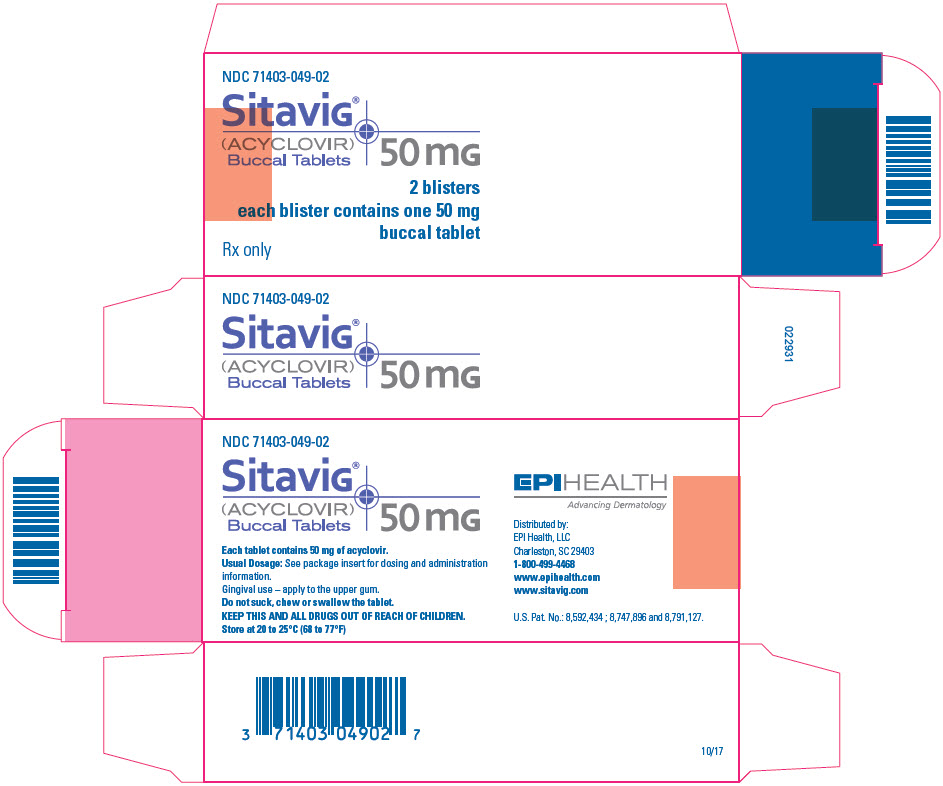
Sitavig Acyclovir 50 mg Tablet, Delayed Release, 2-count
🆔 Identity & classification
Where does this data come from?
🏭 Manufacturer & labeler
Where does this data come from?
🩺 Clinical
Acyclovir is used to treat viral infections like chickenpox, herpes zoster (shingles) and genital herpes (a sexually transmitted disease). Acyclovir is in a class of medications called antivirals. It works by stopping the spread of the virus in the body. Acyclovir will not cure herpes infections and may not stop the spread of herpes virus to other people.
Read the full MedlinePlus article ↗- Acyclovir doesn't cure herpes — it can't eliminate the virus from your body. What it does is slow down the virus's ability to copy itself, which shortens outbreaks, eases symptoms,...
- What exactly does acyclovir do — does it cure herpes?
- Timing really does matter with acyclovir. For cold sores, you want to start at the very first warning sign — that tingling or itching feeling — before a sore even appears. For geni...
- How soon do I need to start taking it for it to work?
Patient education
Supplement & herbal interactions
Some supplements/herbs that may interact with Acyclovir — tap one for details:
Where does this data come from?
Ask a licensed pharmacist directly — free, answered by our team.
💊 What it looks like
Where does this data come from?
🧪 Inactive Ingredients / Excipients
Inactive ingredients, also called excipients, are components of the drug product other than the active ingredient. They may include fillers, dyes, coatings, preservatives, flavors, or other formulation ingredients.
💡 Tap an ingredient (hover on desktop) to see what it is and why it’s used.
-
UNII Z78RG6M2N2
Hypromellose 2208 is a plant-derived thickening agent used as a binder and film-coating material in tablets and capsules. It helps hold ingredients together and creates a protective coating that controls how quickly the medicine dissolves.
-
UNII 70097M6I30
Magnesium stearate is a salt made from magnesium and stearic acid, a fatty substance. It's used in tablets and capsules as a lubricant and glidant to help ingredients flow smoothly during manufacturing and prevent sticking.
-
UNII OP1R32D61U
Microcrystalline cellulose is a purified form of cellulose, a natural fiber from plant sources. It acts as a binder and filler in tablets and capsules, helping hold ingredients together and give the medicine its shape and size.
-
UNII FZ989GH94E
Povidone is a synthetic polymer made from a plastic-like material. It acts as a binder to hold tablet ingredients together and as a disintegrant to help the tablet break apart in your stomach so the medicine can be absorbed.
-
UNII ETJ7Z6XBU4
Silicon dioxide is a naturally occurring mineral used as a glidant and anti-caking agent. It helps powder ingredients flow smoothly and prevents clumping during manufacturing and storage.
-
UNII 368GB5141J
A detergent and foaming agent derived from coconut or palm oil. In medications, it helps break down and mix oil and water-based ingredients, aids in tablet disintegration, and improves how the drug dissolves and spreads in the mouth or digestive system.
-
UNII 059QF0KO0R
Water is a liquid solvent that dissolves and mixes ingredients together in liquid medicines, syrups, and injections. It helps distribute the active drug evenly throughout the product.
7 inactive ingredients listed in the exact product block matched to this NDC.
Where does this data come from?
ingredient classCode="IACT" elements from the exact product block matched by this NDC. Label-section narrative from DailyMed / the openFDA label index is shown separately when available.Inactive ingredient FAQ
Are inactive ingredients the same for every manufacturer?
Why might an inactive ingredient be missing?
Can inactive ingredients matter?
💲 Pricing
A drug doesn't have one price. Each row is a different public payment system, and none is what you'd pay at the counter — that depends on your insurance. The ⓘ on each row explains what it measures.
| Price system | Per each | Per package |
|---|---|---|
| Retail pharmacies payNADAC · weekly | Not in the retail survey — common for institutional, discontinued, or low-volume packs. | |
| Medicaid paysCMS SDUD · 12 mo | No recent Medicaid claims on file for this NDC — rare and low-volume NDCs are suppressed in the public data. | |
| Medicare drug plans payPart D · quarterly | No Part D plan price is available for this NDC in our data. | |
Where does this data come from?
🔁 Therapeutic equivalents
| Product | Labeler | Pack | NADAC/unit | TE | Status | Price vs. this |
|---|---|---|---|---|---|---|
| Sitavig 50 mgthis 71403-0049-02 | EPI | 2 tablets | — | — | Discontinued | — |
Where does this data come from?
⏳ Availability & generic status
We did not find an FDA-approved generic match for this exact strength, form and route. Patent/protection dates below may affect future generic timing.
Why the date isn’t exact: Generic timing can change because patents may be challenged, settled, licensed, added, removed, or worked around with a narrower label — and FDA approval does not always mean a pharmacy can get the generic today.
🛈 What do these terms mean?
- Patent
- Legal protection listed in the Orange Book that may delay generic approval or launch. Issued by the U.S. Patent & Trademark Office.
- Substance patent
- Covers the active drug molecule itself — the hardest to design around. A generic generally can’t launch until it expires.
- Formulation (product) patent
- Covers a specific formulation or dosage form. A generic can sometimes work around it with a different formulation.
- Method-of-use patent
- A patent covering one specific approved use of the drug — not necessarily the whole molecule. A generic can sometimes launch with a “skinny label” that carves out the protected use and keeps the others.
- Skinny label
- A generic label that omits a still-patented use when the FDA allows it — letting a generic reach the market for the unprotected uses.
- Exclusivity
- FDA-granted marketing protection, separate from patents — e.g. 5-yr new chemical entity, 7-yr orphan drug, or a +6-month pediatric extension.
- Paragraph IV
- A generic applicant’s formal challenge to a listed patent. It can potentially lead to earlier generic entry, but often involves litigation or a settlement.
- RLD / RS
- Reference Listed Drug — the brand product the FDA uses as the reference for generic applications. Reference Standard — the product the FDA expects generics to compare against in bioequivalence testing.
- TE / AB rating
- FDA therapeutic-equivalence rating. An AB rating generally means the FDA considers a generic therapeutically equivalent to — and substitutable for — the brand.
- LOE (loss of exclusivity)
- The latest patent or exclusivity currently listed — the loss-of-exclusivity / latest-listed-protection date shown on this page. Paragraph-IV challenges and settlements can move the real date earlier; FDA approval and a manufacturer’s decision to market can move it later.
Built from the FDA Orange Book. The bars above are scaled to each protection’s expiry; the red LOE marker is the last one to lapse.
| Patent | Type | Use code | Expires |
|---|---|---|---|
| US 8747896 ↗ | Method of use | U-1460 | Jun 3, 2027 |
| US 8592434 ↗ | Method of use | U-1460 | Jun 16, 2030 |
| US 8791127 ↗ | Method of use | U-1460 | Mar 23, 2027 |
Is there a generic version of SITAVIG 50 MG BUCCAL TABLET?
The FDA approved a generic — why can’t I get it at my pharmacy yet?
Why do different websites show different generic release dates?
What does “FDA listed” mean?
What does a patent or protection date mean here?
What does “current Orange Book estimate” mean?
Can a generic come out before the last patent expires?
Can a generic come out after the listed dates?
What is the difference between patents and exclusivity?
Why are there multiple patent dates?
Where does this data come from?
📊 Medicare Part D spend CMS · PART D · 2026 (Q1)
📦 Packaging — all sizes for this product
| Package NDC | Description | Marketing start | Status |
|---|---|---|---|
| 71403-0049-02 You're viewing this | 1 BLISTER PACK in 1 CARTON (71403-049-02) / 2 TABLET, DELAYED RELEASE in 1 BLISTER PACK | 2014-03-20 | Inactivated by FDA |
🧭 About this NDC listing & data coverage
What data is (and isn’t) available for this NDC — tap to expand
| NDC identity (package / product / labeler codes) | ✓ Available |
| Labeler | ✓ Available |
| Product & package description | ✓ Available |
| Marketing category & status | ✓ Available |
| Active ingredient / dosage form / route | ✓ Available |
| FDA label (SPL via DailyMed) | ✓ Available |
| Package photos | ✓ Available |
| Inactive ingredients (structured) | ✓ Available |
| NADAC pharmacy acquisition price (CMS) | — Not published for this NDC CMS publishes NADAC only for NDCs reported in its retail-pharmacy survey. |
| Orange Book / therapeutic-equivalence data | ✓ Available |
| HCPCS J-code billing crosswalk | — Not published for this NDC Most self-administered / retail products have no J-code — that is normal. |
| Medicaid utilization (CMS SDUD) | — Not published for this NDC CMS reports utilization only for NDCs with Medicaid claims above its privacy threshold. |
Questions about this listing
Why is there no price listed?
What does the discontinued status mean for this NDC?
Is the NDC printed on the package the same as the 11-digit billing NDC?
What do the three segments of this NDC mean?
Who lists this product with the FDA?
Do I need a prescription for this product?
Where does this data come from?
📄 Full prescribing information FDA SPL
🎯 Indications and Usage ▾
1 INDICATIONS AND USAGE SITAVIG is indicated for the treatment of recurrent herpes labialis (cold sores) in immunocompetent adults. SITAVIG is a deoxynucleoside analogue of DNA polymerase inhibitor, indicated for the treatment of recurrent herpes labialis (cold sores) in immunocompetent adults. ( 1 ).
⏱️ Dosage and Administration ▾
2 DOSAGE AND ADMINISTRATION Application of one SITAVIG 50 mg buccal tablet as a single dose to the upper gum (canine fossa) region ( 2.1 ). SITAVIG should be applied within one hour after the onset of prodromal symptoms and before the appearance of any signs of herpes labialis. Do not crush, chew, suck or swallow tablets ( 2.2 ).
2.1Basic Dosing Information One SITAVIG 50 mg buccal tablet should be applied as a single dose to the upper gum region (canine fossa).
2.2Administration Instructions SITAVIG should be applied within one hour after the onset of prodromal symptoms and before the appearance of any signs of herpes labialis lesions. The tablet should be applied with a dry finger immediately after taking it out of the blister. The tablet should be placed to the upper gum just above the incisor tooth (canine fossa) and held in place with a slight pressure over the upper lip for 30 seconds to ensure adhesion.
For comfort the rounded side should be placed to the upper gum, but either side of the tablet can be applied. Tablet should be applied on the same side of the mouth as the herpes labialis symptoms. Once applied, SITAVIG stays in position and gradually dissolves during the day. [See Clinical Pharmacology (12.3) ].
In addition, SITAVIG should not be crushed, chewed, sucked or swallowed. Food and drink can be taken normally when SITAVIG is in place. Avoid any situations which may interfere with adhesion of the tablet such as chewing gum, touching or pressing the tablet after placement, wearing upper dentures, and brushing teeth.
If the teeth need to be cleaned while the tablet is in place, rinse the mouth gently. Drink plenty of liquids in the case of dry mouth. If SITAVIG does not adhere or falls off within the first 6 hours , the same tablet should be repositioned immediately.
If the tablet cannot be repositioned, a new tablet should be placed. If SITAVIG is swallowed within the first 6 hours , the patient should drink a glass of water and a new tablet should be applied. [see Patient Counseling Information (17) ]. SITAVIG does not need to be reapplied if the tablet falls out or is swallowed after the first 6 hours.
💊 Dosage Forms and Strengths ▾
3 DOSAGE FORMS AND STRENGTHS SITAVIG is a buccal tablet containing 50 mg of acyclovir. SITAVIG tablets are round, off-white tablets, with a rounded side and a flat side. The tablets are marked with an "AL21" on the flat side. 50 mg buccal tablets ( 3 ).
⛔ Contraindications ▾
4 CONTRAINDICATIONS SITAVIG is contraindicated in patients with known hypersensitivity (e.g., anaphylaxis) to acyclovir, milk protein concentrate, or any other component of the product. Known hypersensitivity to acyclovir, milk protein concentrate, or any other component of the product ( 4 ).
🤒 Adverse Reactions ▾
6 ADVERSE REACTIONS Most common adverse reactions (≥1%) are: headache and application site pain ( 6.1 ). To report SUSPECTED ADVERSE REACTIONS, contact EPI Health, LLC at 1-800-499-4468 or FDA at 1-800-FDA-1088 or www.fda.gov/medwatch.
6.1Clinical Trial Experience Because clinical trials are conducted under widely varying conditions, adverse reaction rates observed in the clinical trials of a drug cannot be directly compared to rates in the clinical trials of another drug and may not reflect the rates observed in clinical practice. The overall safety of SITAVIG was assessed in 378 adult subjects having at least 4 herpes labialis episodes the previous year. One randomized, double-blind, placebo controlled trial was conducted in patients with recurrent herpes labialis (cold sores).
In this trial, 378 HSV infected subjects used SITAVIG as a single dose, and 397 subjects used placebo. Selected treatment emergent adverse events without regard to causality and reported in at least 1% of patients can be seen in Table 1. Table 1: Selected Treatment Emergent Adverse Events reported in at least 1% of patients Event SITAVIG N = 378 Placebo N = 397 Nervous System Disorders Headache 3% 3% Dizziness 1% 1% Lethargy 1% 0 Gastrointestinal system Disorders Gingival Pain 1% 0.3% Aphthous Stomatitis 1% 0 Administration Site Conditions Application Site Pain 1% 1% Application Site Irritation 1% 0 Skin and Subcutaneous Disorders Erythema 1% 0.3% Rash 1% 0.3% The treatment emergent adverse events considered related to treatment that occurred in greater than or equal to 1% of patients included headache (1% SITAVIG vs.
2% placebo) and application site pain (1% both arms). There was no discontinuation of SITAVIG due to adverse drug reactions. Most treatment related adverse events were mild or moderate in severity.
One report of headache from both treatment arms was classified as severe.
🔄 Drug Interactions ▾
7 DRUG INTERACTIONS No interaction studies have been performed with SITAVIG. Acyclovir is primarily eliminated unchanged in the urine via active tubular secretion. Drugs administered concomitantly that compete with tubular secretion may increase acyclovir plasma concentrations.
However, due to the low dose and minimal systemic absorption of SITAVIG, systemic drug interactions are unlikely. Due to the low dose and minimal systemic absorption of SITAVIG, drug interactions are unlikely ( 7 )
👥 Use in Specific Populations ▾
8 USE IN SPECIFIC POPULATIONS
8.1Pregnancy There are no available data on SITAVIG use in pregnant women. However, published observational studies over decades of use of acyclovir have not identified a drug-associated risk of major birth defects, miscarriage, or adverse maternal or fetal outcomes. Systemic exposure of acyclovir following buccal administration of SITAVIG is minimal [see Clinical Pharmacology (12.3) ] .
Animal reproduction studies have not been conducted with SITAVIG. Animal reproduction studies with systemic exposure of acyclovir have been conducted. Refer to oral and parental acyclovir prescribing information for additional details.
8.2Lactation There are no data on the presence of acyclovir in human milk following buccal administration. There are no data on the effects of acyclovir on the breastfed infant or milk production. Systemic exposure following buccal administration of acyclovir is minimal [see Clinical Pharmacology (12.3) ] .
The developmental and health benefits of breastfeeding should be considered along with the mother's clinical need for SITAVIG and any potential adverse effects on the breastfed child from SITAVIG or from the underlying maternal condition.
8.4Pediatric Use Safety and effectiveness of SITAVIG in pediatric patients have not been established. The ability of pediatric patients to comply with the application instructions has not been evaluated. Use in younger children is not recommended due to potential risk of choking.
8.5Geriatric Use Clinical studies of SITAVIG did not include sufficient numbers of subjects aged 65 and over to determine whether they respond differently from younger subjects.
8.6Immunocompromised Patients The safety of SITAVIG has not been studied in immunocompromised subjects.
🤰 Pregnancy ▾
8.1Pregnancy There are no available data on SITAVIG use in pregnant women. However, published observational studies over decades of use of acyclovir have not identified a drug-associated risk of major birth defects, miscarriage, or adverse maternal or fetal outcomes. Systemic exposure of acyclovir following buccal administration of SITAVIG is minimal [see Clinical Pharmacology (12.3) ] .
Animal reproduction studies have not been conducted with SITAVIG. Animal reproduction studies with systemic exposure of acyclovir have been conducted. Refer to oral and parental acyclovir prescribing information for additional details.
🧒 Pediatric Use ▾
8.4Pediatric Use Safety and effectiveness of SITAVIG in pediatric patients have not been established. The ability of pediatric patients to comply with the application instructions has not been evaluated. Use in younger children is not recommended due to potential risk of choking.
🧓 Geriatric Use ▾
8.5Geriatric Use Clinical studies of SITAVIG did not include sufficient numbers of subjects aged 65 and over to determine whether they respond differently from younger subjects.
🆘 Overdosage ▾
10 OVERDOSAGE Acyclovir absorption and systemic exposure following application of SITAVIG are minimal. Overdose is therefore unlikely [see Clinical Pharmacology (12.3) ]. Symptomatic and supportive care is the basis for management.
🧬 Clinical Pharmacology ▾
12 CLINICAL PHARMACOLOGY
12.1Mechanism of Action Acyclovir is an antiviral drug active against α-herpesviruses [see Microbiology (12.4) ] .
12.3Pharmacokinetics Absorption and Distribution Salivary The pharmacokinetic parameters of acyclovir after a single dose of SITAVIG in the saliva and plasma of healthy volunteers are provided in Table 2. Table 2: Pharmacokinetic (PK) Parameters of Acyclovir in Saliva and Plasma Following Application of a Single SITAVIG 50 mg Tablet in Healthy Volunteers (N = 12) PK Parameters (N = 12) Salivary Mean ±SD (Min - Max) Plasma Acyclovir plasma concentrations had a delayed appearance (undetectable at 5 hours) and were below the concentrations required for antiviral activity (range: 17.5 to 55.3 nanogram per mL).
Mean ±SD (Min - Max) AUC 0-24h (mcg∙h/mL) 2900 ± 2400 (849 - 9450) 0.225 + 0.132 (0.027-0.422) C max (mcg/mL) 440 ± 241 (149 – 959) 0.028 + 0.010 (0.017-0.055) T max (hour) Median (Min – Max). 7.04 (3.07 – 18.05) 12 (5-16) In the Phase 3 study, the levels of acyclovir in saliva were measured within 24 hours of SITAVIG application in 56 patients with recurrent herpes labialis (mean value 88.1 micrograms per mL) and were within the range of those observed in the PK study in healthy volunteers. In healthy volunteers, the median duration of buccal adhesion was 14 hours following application of a single SITAVIG 50 mg tablet.
Plasma Plasma concentrations of acyclovir were measured in 12 healthy volunteers after a singledose application of SITAVIG 50 mg buccal tablet. Acyclovir concentrations had a delayed appearance (undetectable at 5 hours) and were below the concentrations required for antiviral activity (range: 17.5 to 55.3 nanogram per mL). Metabolism and Excretion Acyclovir is metabolized to 9-[(carboxymethoxy)methyl]guanine (CMMG) and 8-hydroxy-acyclovir (8-OH-ACV) by oxidation and hydroxylation, and is primarily excreted unchanged by the kidneys.
Food Effect There was no formal food effect study conducted with SITAVIG; however, in clinical studies patients were allowed to eat and drink while taking SITAVIG.
12.4Microbiology Mechanism of Action Acyclovir is a synthetic purine deoxynucleoside analogue with inhibitory activity against herpes simplex viruses type 1 (HSV-1) and type 2 (HSV-2) DNA polymerases. It inhibits HSV-1 and HSV-2 replication in cell culture and in vivo . The inhibitory activity of acyclovir is selective due to its affinity for the enzyme thymidine kinase encoded by HSV.
This viral enzyme converts acyclovir into acyclovir monophosphate, a deoxynucleotide analogue. The monophosphate is further converted into diphosphate by cellular guanylate kinase and into triphosphate by a number of cellular enzymes. In biochemical assays, acyclovir triphosphate inhibits replication of α-herpes viral DNA.
This inhibition is accomplished in 3 ways: 1) competitive inhibition of viral DNA polymerase, 2) incorporation into and termination of the growing viral DNA chain, and 3) inactivation of the viral DNA polymerase. Antiviral activity The quantitative relationship between the susceptibility of herpes viruses to antivirals in cell culture and the clinical response to therapy has not been established in humans, and virus sensitivity testing has not been standardized. Sensitivity testing results, expressed as the concentration of drug required to inhibit by 50% the growth of virus in cell culture (EC 50 ), vary greatly depending upon a number of factors.
Using plaque-reduction assays on Vero cells, the EC 50 values of acyclovir against herpes virus isolates ranged from 0.09 to 60 µM (0.02 to 13.5 µg/mL) for HSV-1 and from 0.04 to 44 µM (0.01 to 9.9 μg/mL) for HSV-2. Resistance In Cell Culture Acyclovir-resistant HSV-1 and HSV-2 strains were isolated in cell culture. Acyclovirresistant HSV resulted from mutations in the viral thymidine kinase (TK; pUL23) and DNA polymerase (POL; pUL30) genes.
Frameshifts were commonly isolated and result in premature truncation of the HSV TK product with…
🧬 Mechanism of Action ▾
12.1Mechanism of Action Acyclovir is an antiviral drug active against α-herpesviruses [see Microbiology (12.4) ] .
📦 How Supplied / Storage and Handling ▾
16 HOW SUPPLIED/STORAGE AND HANDLING SITAVIG buccal tablets are supplied as off-white tablets containing 50 mg of acyclovir. SITAVIG tablets have a rounded side and a flat side and are imprinted with AL21 on one side. SITAVIG tablets are packaged in blisters of two tablets (NDC 71403-049-02).
SITAVIG should be stored at 20 to 25°C (68 to 77°F) [see USP controlled room temperature]; excursions between 15 and 30°C (59-86°F) permitted at room temperature. Protect from moisture and keep out of reach of children.
📦 Storage and Handling ▾
SITAVIG should be stored at 20 to 25°C (68 to 77°F) [see USP controlled room temperature]; excursions between 15 and 30°C (59-86°F) permitted at room temperature. Protect from moisture and keep out of reach of children.
📋 Description ▾
11 DESCRIPTION SITAVIG (acyclovir) buccal tablet is applied topically to the gum and releases acyclovir as the buccal tablet gradually dissolves [see Clinical Pharmacology (12.3) ]. Acyclovir is a synthetic purine nucleoside analogue active against herpes viruses. The chemical name of acyclovir is 2-amino-1,9-dihydro-9-[(2-hydroxyethoxy)methyl]-6H-purin-6-one; it has a molecular formula of C 8 H 11 N 5 O 3 and a molecular weight of 225.
The structural formula is shown in Figure 1. Figure 1: Structural Formula of Acyclovir Acyclovir drug substance is a white or almost white crystalline powder. SITAVIG contains 50 mg of acyclovir, USP and the following inactive ingredients: hypromellose, USP; milk protein concentrate; sodium lauryl sulfate, NF; magnesium stearate, NF; microcrystalline cellulose, NF; povidone, USP; colloidal silicon dioxide, NF.
Chemical Structure
💬 Information for Patients ▾
17 PATIENT COUNSELING INFORMATION See FDA-approved patient labeling ( Patient Information and Instructions for Use ).
17.1Instructions for Use Read the Instructions for Use that comes with SITAVIG before you start using it. Talk to your doctor or pharmacist if you have any questions. Important: SITAVIG should be applied to the area of the upper gum above the incisor tooth.
SITAVIG tablets should not be crushed, sucked, chewed or swallowed. If it comes out before 6 hours have gone by, reapply it. If this does not work then a new tablet should be applied.
It should not be applied to the inside of the lip or cheek. Tablet should be applied on the same side of the mouth as the herpes labialis symptoms. Do not remove SITAVIG if it sticks to your upper gum.
If SITAVIG does not stick or falls off of your upper gum within the first 6 hours that you apply it, place it back onto your upper gum. If it still does not stick, replace it with a new SITAVIG tablet. Do not re-apply SITAVIG if it falls out or you swallow it after it has been in place 6 hours or longer.
If you swallow SITAVIG within the first 6 hours of applying it, drink a glass of water and place a new SITAVIG tablet onto your upper gum.
17.2Adverse Reactions Patients may experience adverse reactions including headache, and application site pain.