
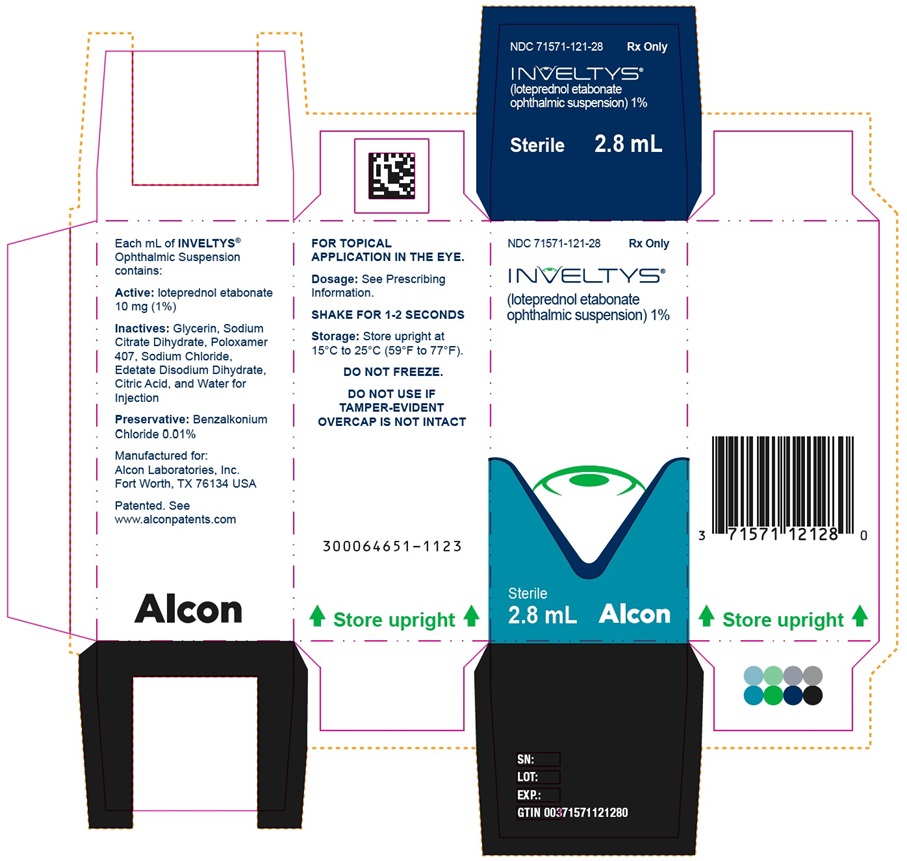
Inveltys loteprednol etabonate 10 mg/mL Suspension, 1 bottle
🆔 Identity & classification
Where does this data come from?
🏭 Manufacturer & labeler
Where does this data come from?
🩺 Clinical
- It depends on which product you've been given. Some versions — like Alrex — treat seasonal eye allergies. Eysuvis is used short-term for dry eye disease. Others, like Inveltys and...
- What is loteprednol etabonate actually used for?
- Always wash your hands before touching your eyes or the bottle. Shake the bottle as directed — the shaking instructions are slightly different for each product, so check your label...
- That depends on your condition and which product you're using. For post-surgical use, most products are used for the first two weeks after surgery. Eysuvis for dry eye is approved...
Patient education
Supplement & herbal interactions
Where does this data come from?
Ask a licensed pharmacist directly — free, answered by our team.
🧪 Inactive Ingredients / Excipients
Inactive ingredients, also called excipients, are components of the drug product other than the active ingredient. They may include fillers, dyes, coatings, preservatives, flavors, or other formulation ingredients.
💡 Tap an ingredient (hover on desktop) to see what it is and why it’s used.
-
UNII 2968PHW8QP
A weak organic acid derived from citrus fruits or made through fermentation. It works as a buffer to control pH, a preservative to extend shelf life, and a flavoring agent in medications.
-
UNII 7FLD91C86K
Edetate disodium is a chemical compound that binds and removes certain metal ions. In medicines, it acts as a preservative and stabilizer by preventing metals like calcium from interfering with the product's shelf life and consistency.
-
UNII PDC6A3C0OX
Glycerin is a clear, thick liquid derived from plant oils or fats. It acts as a humectant to retain moisture, a sweetener, and a solvent in medications.
-
UNII 451W47IQ8X
Sodium chloride is common table salt. It's used in medicines as a buffer to maintain proper pH, as a filler to add bulk, or to adjust the osmotic balance in liquid formulations.
-
UNII B22547B95K
A salt derived from citric acid that helps maintain the proper acid-base balance in the medicine. It's used as a buffer to keep the product stable and at the right pH level.
-
UNII 059QF0KO0R
Water is a liquid solvent that dissolves and mixes ingredients together in liquid medicines, syrups, and injections. It helps distribute the active drug evenly throughout the product.
6 inactive ingredients listed in the exact product block matched to this NDC.
Where does this data come from?
ingredient classCode="IACT" elements from the exact product block matched by this NDC. Label-section narrative from DailyMed / the openFDA label index is shown separately when available.Inactive ingredient FAQ
Are inactive ingredients the same for every manufacturer?
Why might an inactive ingredient be missing?
Can inactive ingredients matter?
💲 Pricing
A drug doesn't have one price. Each row is a different public payment system, and none is what you'd pay at the counter — that depends on your insurance. The ⓘ on each row explains what it measures.
| Price system | Per mL | Per package |
|---|---|---|
| Retail pharmacies payNADAC · weekly | $103.185 | $288.92 / 2.8 ml |
| Medicaid paysCMS SDUD · 12 mo | $106.45 | $298.07 / 2.8 ml |
| Medicare drug plans payPart D · Q2 2026 | $103.63 | $290.16 / 2.8 ml |
Where does this data come from?
🔁 Therapeutic equivalents
| Product | Labeler | Pack | NADAC/unit | TE | Status | Price vs. this |
|---|---|---|---|---|---|---|
| Inveltys 10 mg/mLthis 71571-0121-28 | ALCON | 1 bottle | $103.185 | — | Availability likely | — |
| Inveltys 10 mg/mL 00065-9307-04 | Alcon | 1 bottle | — | — | FDA listed | — |
Where does this data come from?
⏳ Availability & generic status
We did not find an FDA-approved generic match for this exact strength, form and route. Patent/protection dates below may affect future generic timing.
Why the date isn’t exact: Generic timing can change because patents may be challenged, settled, licensed, added, removed, or worked around with a narrower label — and FDA approval does not always mean a pharmacy can get the generic today.
🛈 What do these terms mean?
- Patent
- Legal protection listed in the Orange Book that may delay generic approval or launch. Issued by the U.S. Patent & Trademark Office.
- Substance patent
- Covers the active drug molecule itself — the hardest to design around. A generic generally can’t launch until it expires.
- Formulation (product) patent
- Covers a specific formulation or dosage form. A generic can sometimes work around it with a different formulation.
- Method-of-use patent
- A patent covering one specific approved use of the drug — not necessarily the whole molecule. A generic can sometimes launch with a “skinny label” that carves out the protected use and keeps the others.
- Skinny label
- A generic label that omits a still-patented use when the FDA allows it — letting a generic reach the market for the unprotected uses.
- Exclusivity
- FDA-granted marketing protection, separate from patents — e.g. 5-yr new chemical entity, 7-yr orphan drug, or a +6-month pediatric extension.
- Paragraph IV
- A generic applicant’s formal challenge to a listed patent. It can potentially lead to earlier generic entry, but often involves litigation or a settlement.
- RLD / RS
- Reference Listed Drug — the brand product the FDA uses as the reference for generic applications. Reference Standard — the product the FDA expects generics to compare against in bioequivalence testing.
- TE / AB rating
- FDA therapeutic-equivalence rating. An AB rating generally means the FDA considers a generic therapeutically equivalent to — and substitutable for — the brand.
- LOE (loss of exclusivity)
- The latest patent or exclusivity currently listed — the loss-of-exclusivity / latest-listed-protection date shown on this page. Paragraph-IV challenges and settlements can move the real date earlier; FDA approval and a manufacturer’s decision to market can move it later.
Built from the FDA Orange Book. The bars above are scaled to each protection’s expiry; the red LOE marker is the last one to lapse.
| Patent | Type | Use code | Expires |
|---|---|---|---|
| US 9056057 ↗ | Method of use | U-2491 | May 3, 2033 |
| US 9532955 ↗ | Method of use | U-2491 | May 3, 2033 |
| US 10058511 ↗ | Method of use | U-2492 | May 3, 2033 |
| US 11219597 ↗ | Method of use | U-3278 | May 3, 2033 |
| US 11219597 ↗ | Method of use | U-3279 | May 3, 2033 |
| US 10864219 ↗ | Method of use | U-3011 | May 3, 2033 |
| US 9737491 ↗ | Method of use | U-2492 | May 3, 2033 |
| US 9827191 ↗ | Method of use | U-2493 | May 3, 2033 |
| US 12115246 ↗ | Method of use | U-4025 | May 3, 2033 |
| US 10688045 ↗ | Drug product | — | May 3, 2033 |
| US 11642317 ↗ | Drug product | — | May 3, 2033 |
| US 10646437 ↗ | Drug product | — | May 3, 2033 |
| US 9393213 ↗ | Drug product | — | May 3, 2033 |
| US 11872318 ↗ | Drug product | — | May 3, 2033 |
Is there a generic version of INVELTYS 1% EYE DROP?
The FDA approved a generic — why can’t I get it at my pharmacy yet?
Why do different websites show different generic release dates?
What does “FDA listed” mean?
What does a patent or protection date mean here?
What does “current Orange Book estimate” mean?
Can a generic come out before the last patent expires?
Can a generic come out after the listed dates?
What is the difference between patents and exclusivity?
Why are there multiple patent dates?
Where does this data come from?
🗺️ Medicaid utilization & spend
💊 Medicaid utilization by pack size
📊 Medicare Part D spend CMS · PART D · 2026 (Q1)
🔬 Reported adverse events (FAERS)
Top reported reactions
Age at onset
Reporter sex
Serious outcomes
Where does this data come from?
📦 Packaging — all sizes for this product
| Package NDC | Description | Per unit | Per pack | Marketing start | Status |
|---|---|---|---|---|---|
| 71571-0121-20 | 2.8 mL in 1 BOTTLE, DROPPER (71571-121-20) | — | — | 2018-08-22 | Active |
| 71571-0121-28 You're viewing this | 1 BOTTLE, DROPPER in 1 CARTON (71571-121-28) / 2.8 mL in 1 BOTTLE, DROPPER | $103.19 / mL | $288.92 | 2018-08-22 | Active |
In Medicaid, this is the most-dispensed pack of this product — about 100% of fills over the last four reported quarters. See all packs ↓
Pack size FAQ
What quantity is in NDC 71571-0121-28?
What is the difference between NDC 71571-0121-28 and NDC 71571-0121-20?
What NDC number is used to bill for this package of Inveltys loteprednol etabonate 10 mg/mL Suspension?
Prices are the latest CMS NADAC pharmacy acquisition cost per NDC; per-pack figures are per-unit × pack quantity, shown only when the pack is denominated in the same measure NADAC prices.
📄 Full prescribing information FDA SPL
🎯 Indications and Usage ▾
1 INDICATIONS AND USAGE INVELTYS is a corticosteroid indicated for the treatment of post-operative inflammation and pain following ocular surgery. INVELTYS is a corticosteroid indicated for the treatment of post-operative inflammation and pain following ocular surgery. ( 1 )
⏱️ Dosage and Administration ▾
2 DOSAGE AND ADMINISTRATION Shake for one to two seconds before using. ( 2 ) Instill one to two drops of INVELTYS into the affected eye twice daily beginning the day after surgery and continuing throughout the first 2 weeks of the post-operative period. ( 2 )
2.1Dosage Information Instill one to two drops of INVELTYS into the affected eye twice daily beginning the day after surgery and continuing throughout the first 2 weeks of the post-operative period.
2.2Administration Instructions Instruct patient to wash hands well before each use. Shake for one to two seconds before using. If the patient is using other eye drops in addition to INVELTYS , advise the patient to wait at least 5 minutes between instillation of INVELTYS and other eye drops.
2.1Dosage Information Instill one to two drops of INVELTYS into the affected eye twice daily beginning the day after surgery and continuing throughout the first 2 weeks of the post-operative period.
2.2Administration Instructions Instruct patient to wash hands well before each use. Shake for one to two seconds before using. If the patient is using other eye drops in addition to INVELTYS , advise the patient to wait at least 5 minutes between instillation of INVELTYS and other eye drops.
💊 Dosage Forms and Strengths ▾
3 DOSAGE FORMS AND STRENGTHS Ophthalmic suspension containing 10 mg/mL of loteprednol etabonate. Ophthalmic suspension containing 10 mg/mL of loteprednol etabonate. ( 3 )
⛔ Contraindications ▾
4 CONTRAINDICATIONS INVELTYS is contraindicated in most viral diseases of the cornea and conjunctiva including epithelial herpes simplex keratitis (dendritic keratitis), vaccinia, and varicella, and also in mycobacterial infection of the eye and fungal diseases of ocular structures. INVELTYS is contraindicated in most viral diseases of the cornea and conjunctiva including epithelial herpes simplex keratitis (dendritic keratitis), vaccinia, and varicella, and also in mycobacterial infection of the eye and fungal diseases of ocular structures.
( 4 )
⚠️ Warnings and Cautions ▾
5 WARNINGS AND PRECAUTIONS Intraocular Pressure (IOP) Increase : Prolonged use of corticosteroids may result in glaucoma with damage to the optic nerve, defects in visual acuity and fields of vision. If this product is used for 10 days or longer, IOP should be monitored. ( 5.1 ) Cataracts : Use of corticosteroids may result in posterior subcapsular cataract formation.
( 5.2 ) Delayed Healing : Use of steroids after cataract surgery may delay healing and increase the incidence of bleb formation. In those diseases causing thinning of the cornea or sclera, perforations have been known to occur with the use of topical steroids. The initial prescription and renewal of the medication order should be made by a physician only after examination of the patient with the aid of magnification such as slit lamp biomicroscopy and, where appropriate, fluorescein staining.
( 5.3 ) Bacterial Infections : Prolonged use of corticosteroids may suppress the host response and thus increase the hazard of secondary ocular infections. In acute purulent conditions, steroids may mask infection or enhance existing infection. ( 5.4 ) Viral Infections : Use of a corticosteroid medication in the treatment of patients with a history of herpes simplex requires great caution.
Use of ocular steroids may prolong the course and may exacerbate the severity of many viral infections of the eye (including herpes simplex). ( 5.5 ) Fungal Infections : Fungal infections of the cornea are particularly prone to develop coincidentally with long-term local steroid application. Fungus invasion must be considered in any persistent corneal ulceration where a steroid has been used or is in use.
( 5.6 )
5.1Intraocular Pressure (IOP) Increase Prolonged use of corticosteroids may result in glaucoma with damage to the optic nerve, as well as defects in visual acuity and fields of vision. Steroids should be used with caution in the presence of glaucoma. If this product is used for 10 days or longer, intraocular pressure should be monitored.
5.2Cataracts Use of corticosteroids may result in posterior subcapsular cataract formation.
5.3Delayed Healing Use of steroids after cataract surgery may delay healing and increase the incidence of bleb formation. In those diseases causing thinning of the cornea or sclera, perforations have been known to occur with the use of topical steroids. The initial prescription and renewal of the medication order should be made by a physician only after examination of the patient with the aid of magnification such as slit lamp biomicroscopy and, where appropriate, fluorescein staining.
5.4Bacterial Infections Prolonged use of corticosteroids may suppress the host response and thus increase the hazard of secondary ocular infections. In acute purulent conditions of the eye, steroids may mask infection or enhance existing infection.
5.5Viral Infections Use of corticosteroid medication in the treatment of patients with a history of herpes simplex requires great caution. Use of ocular steroids may prolong the course and may exacerbate the severity of many viral infections of the eye (including herpes simplex).
5.6Fungal Infections Fungal infections of the cornea are particularly prone to develop coincidentally with long-term local steroid application. Fungus invasion must be considered in any persistent corneal ulceration where a steroid has been used or is in use. Fungal cultures should be taken when appropriate.
5.7Risk of Contamination Do not to allow the dropper tip to touch any surface, as this may contaminate the suspension.
5.8Contact Lens Wear The preservative in INVELTYS may be absorbed by soft contact lenses. Contact lenses should be removed prior to instillation of INVELTYS and may be reinserted 15 minutes following administration.
🤒 Adverse Reactions ▾
6 ADVERSE REACTIONS Adverse reactions associated with ophthalmic steroids include elevated intraocular pressure, which may be associated with infrequent optic nerve damage, visual acuity and field defects, posterior subcapsular cataract formation, delayed wound healing and secondary ocular infection from pathogens including herpes simplex, and perforation of the globe where there is thinning of the cornea or sclera. The most common adverse drug reactions were eye pain (1%) and posterior capsular opacification (1%). These reactions may have been the consequence of the surgical procedure.
( 6 ) To report SUSPECTED ADVERSE REACTIONS, contact Alcon Laboratories, Inc. at 1-800-757-9195 or FDA at 1-800-FDA-1088 or www.fda.gov/medwatch .
6.1Clinical Trials Experience Because clinical trials are conducted under widely varying conditions, adverse reaction rates observed in the clinical trials of a drug cannot be directly compared to rates in the clinical trials of another drug and may not reflect the rates observed in practice. The most common adverse drug reactions in the clinical trials with INVELTYS were eye pain and posterior capsular opacification, both reported in 1% of patients. These reactions may have been the consequence of the surgical procedure.
👥 Use in Specific Populations ▾
8 USE IN SPECIFIC POPULATIONS
8.1Pregnancy Risk Summary INVELTYS is not absorbed systemically following topical ophthalmic administration and maternal use is not expected to result in fetal exposure to the drug.
8.2Lactation Risk Summary INVELTYS is not absorbed systemically by the mother following topical ophthalmic administration, and breastfeeding is not expected to result in exposure of the child to INVELTYS .
8.3Pediatric Use Safety and effectiveness in pediatric patients have not been established.
8.4Geriatric Use No overall differences in safety and effectiveness have been observed between elderly and younger patients.
🤰 Pregnancy ▾
8.1Pregnancy Risk Summary INVELTYS is not absorbed systemically following topical ophthalmic administration and maternal use is not expected to result in fetal exposure to the drug.
🧒 Pediatric Use ▾
8.3Pediatric Use Safety and effectiveness in pediatric patients have not been established.
🧓 Geriatric Use ▾
8.4Geriatric Use No overall differences in safety and effectiveness have been observed between elderly and younger patients.
🧬 Clinical Pharmacology ▾
12 CLINICAL PHARMACOLOGY
12.1Mechanism of Action Corticosteroids inhibit the inflammatory response to a variety of inciting agents and probably delay or slow healing. They inhibit the edema, fibrin deposition, capillary dilation, leukocyte migration, capillary proliferation, fibroblast proliferation, deposition of collagen, and scar formation associated with inflammation. While glucocorticoids are known to bind to and activate the glucocorticoid receptor, the molecular mechanisms involved in glucocorticoid/glucocorticoid receptor-dependent modulation of inflammation are not clearly established.
However, corticosteroids are thought to inhibit prostaglandin production through several independent mechanisms.
12.3Pharmacokinetics Loteprednol etabonate is lipid soluble and can penetrate into cells. Loteprednol etabonate is synthesized through structural modifications of prednisolone-related compounds so that it will undergo a predictable transformation to an inactive metabolite. Based upon in vivo and in vitro preclinical metabolism studies, loteprednol etabonate undergoes extensive metabolism to inactive carboxylic acid metabolites, PJ-91 and PJ-90.
Following twice-daily unilateral topical ocular dosing of INVELTYS for 14 days in healthy subjects, the plasma concentrations of loteprednol etabonate were below the limit of quantitation (1 ng/mL) at all timepoints.
🧬 Mechanism of Action ▾
12.1Mechanism of Action Corticosteroids inhibit the inflammatory response to a variety of inciting agents and probably delay or slow healing. They inhibit the edema, fibrin deposition, capillary dilation, leukocyte migration, capillary proliferation, fibroblast proliferation, deposition of collagen, and scar formation associated with inflammation. While glucocorticoids are known to bind to and activate the glucocorticoid receptor, the molecular mechanisms involved in glucocorticoid/glucocorticoid receptor-dependent modulation of inflammation are not clearly established.
However, corticosteroids are thought to inhibit prostaglandin production through several independent mechanisms.
📦 How Supplied / Storage and Handling ▾
16 HOW SUPPLIED/STORAGE AND HANDLING INVELTYS (loteprednol etabonate ophthalmic suspension) 1% is a sterile ophthalmic suspension. It is supplied in a white low-density polyethylene plastic dropper bottle with a controlled-drop linear low-density polyethylene tip, a pink high-density polyethylene cap, and a white low-density polyethylene tamper-evident overcap in the following size: 2.8 mL in a 5 mL bottle (NDC 71571-121-28) Storage and Handling Do not use if tamper-evident overcap seal is not intact. The white tamper-evident overcap can be thrown away.
Retain the pink cap and keep the bottle tightly closed when not in use. Store upright at 15°C to 25°C (59°F to 77°F). Do not freeze.
📦 Storage and Handling ▾
Storage and Handling Do not use if tamper-evident overcap seal is not intact. The white tamper-evident overcap can be thrown away. Retain the pink cap and keep the bottle tightly closed when not in use. Store upright at 15°C to 25°C (59°F to 77°F). Do not freeze.
📋 Description ▾
11 DESCRIPTION Loteprednol etabonate is a corticosteroid. Its chemical name is chloromethyl 17α-[(ethoxycarbonyl)oxy]-11β-hydroxy-3-oxoandrosta-1,4-diene-17β-carboxylate. Its molecular formula is C 24 H 31 ClO 7 and its chemical structure is: C 24 H 31 ClO 7 Mol.
Wt. 467.0 INVELTYS (loteprednol etabonate ophthalmic suspension) 1% contains a sterile, topical anti-inflammatory corticosteroid for ophthalmic use. Each mL contains: ACTIVE: loteprednol etabonate 10 mg (1%) INACTIVES: glycerin, sodium citrate dihydrate, Poloxamer 407, sodium chloride, edetate disodium dihydrate, citric acid, and water for injection PRESERVATIVE: benzalkonium chloride 0.01% Chemical Structure
💬 Information for Patients ▾
17 PATIENT COUNSELING INFORMATION Administration Instruct the patient to shake the bottle for one to two seconds before using. If the patient is using other eye drops in addition to INVELTYS , advise the patient to wait at least 5 minutes between instillation of INVELTYS and other eye drops. Risk of Contamination Advise patients to wash their hands well before each use.
Advise patients not to allow the dropper tip to touch any surface, as this may contaminate the suspension. Risk of Secondary Infection Advise the patient to consult a physician if pain develops, or redness, itching, or inflammation becomes aggravated. Contact Lens Wear Advise patients that the preservative in INVELTYS may be absorbed by soft contact lenses.
Contact lenses should be removed prior to instillation of INVELTYS and may be reinserted after 15 minutes following administration.