
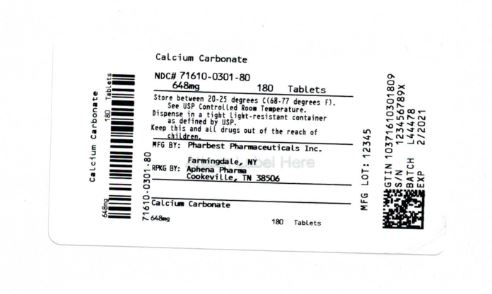
Calcium Carbonate 10 gr (648 mg) (Antacid) Calcium Carbonate 10gr 648 mg Tablet, 180-count — NDC 71610-301-80 (Billing 71610-0301-80)
This is a package of 180 tablets of Calcium Carbonate 10 gr (648 mg) (Antacid) Calcium Carbonate 10gr 648 mg Tablet from Aphena Pharma Solutions - Tennessee, LLC, marketed since Feb 2019 and currently FDA-listed.
NDC database record
One package, one record: these facts belong to NDC 71610-301-80 alone.
- Record
- FDA NDC Directory package listing · Human OTC drug
- Code segments
- 71610 labeler · 301 product · 80 package
- Package marketed since
- Jul 10, 2019
- Sample package
- No — commercial package
- Listing certified through
- Dec 31, 2026
- Billing quantity
- 180 EA per package
- Barcode (UPC-A, from the NDC)
- 3 7161030180 2
- FDA record last changed
- Jul 24, 2026
Identity & classification
Regulatory identifiers FDA, NLM and CMS codes for this package
Drug-database identifiers Medi-Span GPI and First Databank GCN / HICL / AHFS classification
- GSN (GCN sequence number): 059510
- GCN: 25203
- GPI-14 (Medi-Span): 48300010000309
- HICL (First Databank): 001163
- AHFS class code: 40:12.00.00
- RxCUI (RxNorm): 577040
Where does this data come from?
- FDA openFDA NDC Directory · synced Oct 8, 2026
- FDA label on DailyMed · label index refreshed Oct 8, 2026
- RxNorm (NLM RxNav) · catalog refreshed Oct 8, 2026
- Medi-Span GPI (licensed)
- First Databank (licensed) · refreshed Oct 8, 2026
RxNorm drug class
This medicine belongs to the Calcium compounds class.
Where does this data come from?
- RxClass (NLM) · catalog refreshed Oct 8, 2026
Clinical
Calcium carbonate is a dietary supplement used when the amount of calcium taken in the diet is not enough. Calcium is needed by the body for healthy bones, muscles, nervous system, and heart. Calcium carbonate also is used as an antacid to relieve heartburn, acid indigestion, and upset stomach. It is available with or without a prescription. This medication is sometimes prescribed for other uses; ask your doctor or pharmacist for more information.
Read the full MedlinePlus article ↗- Most often it's an antacid. It relieves heartburn, acid indigestion, sour stomach and upset stomach tied to those symptoms. A few supplement products have other uses, like bone sup...
- What is calcium carbonate usually used for?
- You chew it when symptoms come on. Many labels say to chew or crush the tablets completely and not swallow them whole. The number of tablets varies by product, so read your label o...
- Many labels say not to use the maximum dose for more than 2 weeks unless a doctor is supervising you. If your symptoms last longer than 2 weeks, check in with your doctor.
Patient education
Supplement & herbal interactions
Where does this data come from?
- MedlinePlus (NLM) · refreshed Oct 8, 2026
- FDA label on DailyMed · label index refreshed Oct 8, 2026
Ask a licensed pharmacist directly — free, answered by our team.
Pricing
A drug doesn't have one price. Each row is a different public payment system, and none is what you'd pay at the counter — that depends on your insurance. The ⓘ on each row explains what it measures.
| Price system | Per each | Per package |
|---|---|---|
| Retail pharmacies payNADAC · weekly | Not in the retail survey — common for institutional, discontinued, or low-volume packs. | |
| Medicaid paysCMS SDUD · 12 mo | No recent Medicaid claims on file for this NDC — rare and low-volume NDCs are suppressed in the public data. | |
| Medicare drug plans payPart D · quarterly | No Part D plan price is available for this NDC in our data. | |
Where does this data come from?
- CMS NADAC weekly file
- CMS ASP pricing files · refreshed Sep 20, 2026
- CMS Medicaid State Drug Utilization Data · refreshed Oct 9, 2026
- CMS Part D plan pricing files · refreshed Sep 24, 2026
- VA National Acquisition Center price file
Packaging — all sizes for this product
| Package NDC | Description | Marketing start | Marketing end | Status |
|---|---|---|---|---|
| 71610-0301-60 71610-301-60 Main listing | 90 TABLET in 1 BOTTLE, PLASTIC | 2019-07-31 | — | Active |
| 71610-0301-65 71610-301-65 | 100 TABLET in 1 BOTTLE, PLASTIC | 2019-07-16 | — | Active |
| 71610-0301-80 You're viewing this | 180 TABLET in 1 BOTTLE, PLASTIC | 2019-07-10 | — | Active |
| 71610-0301-92 71610-301-92 | 270 TABLET in 1 BOTTLE, PLASTIC | 2019-07-31 | — | Active |
You're viewing one of 4 pack sizes for this product.
Pack size FAQ
What quantity is in this package?
How does this package differ from NDC 71610-0301-60?
What NDC number is used to bill for this package of Calcium Carbonate 10 gr (648 mg) (Antacid) Calcium Carbonate 10gr 648 mg Tablet?
Therapeutic equivalents
| Product | Labeler | Pack | NADAC/unit | TE | Status | Price vs. this |
|---|---|---|---|---|---|---|
| Calcium Carbonate 10 gr (648 mg) (Antacid) 00536-1206-10 | RUGBY | 1000 tablets | $0.008 | — | Availability likely | — |
| Antacid 648 mg 17714-0025-01 | Advance | 100 tablets | — | — | FDA listed | — |
| Calcium Carbonate 10 gr (648 mg) 70369-0004-01 | CitraGen | 1000 tablets | — | — | FDA listed | — |
| Calcium Carbonate 10 gr (648 mg) (Antacid)this 71610-0301-80 | Aphena | 180 tablets | — | — | FDA listed | — |
| Calcium Carbonate 10 gr (648 mg) (Antacid) 73057-0377-08 | Ulai | 100 tablets | — | — | FDA listed | — |
Where does this data come from?
- FDA openFDA NDC Directory · synced Oct 8, 2026
- FDA Orange Book · refreshed Oct 3, 2026
- CMS NADAC weekly file
Availability & generic status
We did not find an FDA-approved generic match for this exact strength, form and route.
Where does this data come from?
- FDA Orange Book · refreshed Oct 3, 2026
What it looks like
Where does this data come from?
- FDA label on DailyMed · label index refreshed Oct 8, 2026
Inactive Ingredients / Excipients
Inactive ingredients, also called excipients, are components of the drug product other than the active ingredient. They may include fillers, dyes, coatings, preservatives, flavors, or other formulation ingredients.
🧪 Avoiding an ingredient? See Calcium Carbonate inactive ingredients by manufacturer: every current product's list side by side, so you can ask your pharmacy for the version that does not list it.
💡 Tap an ingredient (hover on desktop) to see what it is and why it’s used.
-
UNII 5C5403N26O
Acacia is a natural gum derived from acacia tree sap. It serves as a binder, thickener, and emulsifier to help hold ingredients together, improve texture, and stabilize the medicine.
-
UNII M28OL1HH48
Croscarmellose sodium is a plant-based substance derived from cellulose. It acts as a disintegrant, helping tablets and capsules break down quickly in the digestive system so the medicine can be absorbed.
-
UNII 70097M6I30
Magnesium stearate is a salt made from magnesium and stearic acid, a fatty substance. It's used in tablets and capsules as a lubricant and glidant to help ingredients flow smoothly during manufacturing and prevent sticking.
-
UNII 7CVR7L4A2D
A starch-derived carbohydrate produced by breaking down corn, potato, or tapioca starch. It functions as a filler and binder to give the medicine bulk and texture, and sometimes as a mild sweetener or texture enhancer in powders and tablets.
-
UNII OP1R32D61U
Microcrystalline cellulose is a purified form of cellulose, a natural fiber from plant sources. It acts as a binder and filler in tablets and capsules, helping hold ingredients together and give the medicine its shape and size.
-
UNII 4ELV7Z65AP
Stearic acid is a fatty acid derived from plant or animal sources. It acts as a binder and lubricant in tablets and capsules, helping them hold together and flow smoothly during manufacturing.
6 inactive ingredients listed in the exact product block matched to this NDC.
Label-section wording can be broader than the structured product block and may mention additional formulation ingredients.
Where does this data come from?
ingredient classCode="IACT" elements from the exact product block matched by this NDC. Label-section narrative from DailyMed / the openFDA label index is shown separately when available.- FDA label on DailyMed · label index refreshed Oct 8, 2026
- FDA openFDA NDC Directory · synced Oct 8, 2026
Inactive ingredient FAQ
Are inactive ingredients the same for every manufacturer?
Why might an inactive ingredient be missing?
Can inactive ingredients matter?
Manufacturer & labeler
More NDCs from Aphena Pharma Solutions - Tennessee, LLC labeler code 71610
- Spironolactone 50 mg Tablet, Film Coated NDC 71610-287-30
- Spironolactone 100 mg Tablet, Film Coated NDC 71610-288-30
- Divalproex sodium 250 mg Tablet, Film Coated, Extended Release NDC 71610-289-30
- Nifedipine 30 mg Tablet, Extended Release NDC 71610-290-60
- BusPIRone Hydrochloride 15 mg Tablet NDC 71610-291-60
- Alogliptin 25 mg Tablet, Film Coated NDC 71610-300-09
- Pregabalin 25 mg Capsule NDC 71610-313-30
- Pregabalin 50 mg Capsule NDC 71610-314-30
- Pregabalin 100 mg Capsule NDC 71610-316-30
- Pregabalin 150 mg Capsule NDC 71610-317-30
- Pregabalin 200 mg Capsule NDC 71610-318-30
- Pregabalin 225 mg Capsule NDC 71610-319-46
Where does this data come from?
- FDA openFDA NDC Directory · synced Oct 8, 2026
- Drugs@FDA
FDA label — Drug Facts FDA SPL
🎯 Indications and Usage ▾
Uses relieves acid indigestion heartburn sour stomach upset stomach associated with these symptoms
⏱️ Dosage and Administration ▾
Directions take one to four tablets daily do not take more than 4 tablets in 24 hours do not use the maximum dosage for more than two weeks
⚠️ Warnings ▾
Warnings Ask a doctor before use if you have kidney stones a calcium-restricted diet Ask a doctor or pharmacist before use if you are taking a prescription drug. Antacids may interact with certain prescription drugs. Stop use and ask a doctor if symptoms last more than 2 weeks. If pregnant or breast-feeding, ask a health professional before use. Keep out of reach of children.
📦 Storage and Handling ▾
Other information each tablet contains: calcium 260 mg store at room temperature
🧪 Active Ingredient ▾
Active ingredient (in each tablet) Calcium Carbonate 10 gr (648 mg)
🧪 Inactive Ingredients ▾
Inactive ingredients acacia, croscarmellose sodium, magnesium stearate, maltodextrin, microcrystalline cellulose, stearic acid
🎯 Purpose ▾
Purpose Antacid
📄 Ask a Doctor Before Use If ▾
Ask a doctor before use if you have kidney stones a calcium-restricted diet
📄 Ask a Doctor or Pharmacist Before Use If ▾
Ask a doctor or pharmacist before use if you are taking a prescription drug. Antacids may interact with certain prescription drugs.
📄 Stop Use and Ask a Doctor If ▾
Stop use and ask a doctor if symptoms last more than 2 weeks.
🤰 If Pregnant or Breast-Feeding ▾
If pregnant or breast-feeding, ask a health professional before use.
📄 Keep Out of Reach of Children ▾
Keep out of reach of children.
📄 Questions or Comments ▾
Questions or comments? 1-800-645-2158
📄 Package Label / Principal Display Panel ▾
PRINCIPAL DISPLAY PANEL - 648 mg NDC 71610-301 - Calcium Carbonate 648 mg Tablets Bottle Label 648 mg
About this NDC listing & data coverage
What data is (and isn’t) available for this NDC — tap to expand
| NDC identity (package / product / labeler codes) | ✓ Available |
| Labeler | ✓ Available |
| Product & package description | ✓ Available |
| Marketing category & status | ✓ Available |
| Active ingredient / dosage form / route | ✓ Available |
| FDA label (SPL via DailyMed) | ✓ Available |
| Package photos | ✓ Available |
| Inactive ingredients (structured) | ✓ Available |
| NADAC pharmacy acquisition price (CMS) | — Not published for this NDC CMS publishes NADAC only for NDCs reported in its retail-pharmacy survey. |
| Orange Book / therapeutic-equivalence data | — Not published for this NDC Applies only to products approved under an NDA/ANDA; many listings are out of scope. |
| HCPCS J-code billing crosswalk | — Not published for this NDC Most self-administered / retail products have no J-code — that is normal. |
| Medicaid utilization (CMS SDUD) | — Not published for this NDC CMS reports utilization only for NDCs with Medicaid claims above its privacy threshold. |