
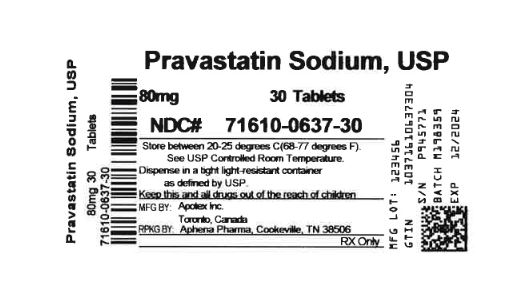
Pravastatin Sodium 80 mg Tablet, 30-count — NDC 71610-637-30 (Billing 71610-0637-30)
This is a package of 30 tablets of Pravastatin Sodium 80 mg Tablet from Aphena Pharma Solutions - Tennessee, LLC, marketed since Jul 2011 and currently FDA-listed. It is the main listing for this product, which comes in 2 package sizes.
NDC database record
One package, one record: these facts belong to NDC 71610-637-30 alone.
- Record
- FDA NDC Directory package listing · Human prescription drug
- Code segments
- 71610 labeler · 637 product · 30 package
- Package marketed since
- Feb 24, 2022
- Sample package
- No — commercial package
- Listing certified through
- Dec 31, 2026
- Billing quantity
- 30 EA per package
- Barcode (UPC-A, from the NDC)
- 3 7161063730 7
- FDA record last changed
- Jul 24, 2026
Other active recalls for Pravastatin Sodium (different manufacturers) — 3 · tap to view
Identity & classification
Regulatory identifiers FDA, NLM and CMS codes for this package
Drug-database identifiers Medi-Span GPI and First Databank GCN / HICL / AHFS classification
- GSN (GCN sequence number): 049758
- GCN: 15412
- GPI-14 (Medi-Span): 39400065100360
- HICL (First Databank): 006227
- AHFS class code: 24:06.08.00
- RxCUI (RxNorm): 904481
Where does this data come from?
- FDA openFDA NDC Directory · synced Oct 8, 2026
- FDA label on DailyMed · label index refreshed Oct 8, 2026
- RxNorm (NLM RxNav) · catalog refreshed Oct 1, 2026
- Medi-Span GPI (licensed)
- First Databank (licensed) · refreshed Oct 8, 2026
RxNorm drug class
This medicine belongs to the HMG-CoA Reductase Inhibitor class.
Where does this data come from?
- RxClass (NLM) · catalog refreshed Oct 1, 2026
Clinical
- It lowers cholesterol and triglycerides, and it helps reduce your risk of heart attack, stroke and other heart problems. It works best together with a cholesterol-lowering diet. So...
- Take it by mouth once a day at whatever time suits you, with or without food. Try to take it at the same time each day. If you use cholestyramine or colestipol, take pravastatin at...
- Most people tolerate it well. Some notice muscle or joint aches, nausea, diarrhea, headache or cold-like symptoms. These are usually mild and temporary.
- Call promptly if you have muscle pain, tenderness or weakness that is unexplained or doesn't go away. Rarely, statins cause serious muscle breakdown that can harm the kidneys. Your...
Patient education
Supplement & herbal interactions
Some supplements/herbs that may interact with Pravastatin Sodium — tap one for details:
Pravastatin Sodium may be associated with lower levels of 1 nutrient — worth a chat with your pharmacist, not a cause for alarm.
Where does this data come from?
- MedlinePlus (NLM) · refreshed Oct 8, 2026
- FDA label on DailyMed · label index refreshed Oct 8, 2026
Ask a licensed pharmacist directly — free, answered by our team.
Pricing
A drug doesn't have one price. Each row is a different public payment system, and none is what you'd pay at the counter — that depends on your insurance. The ⓘ on each row explains what it measures.
| Price system | Per each | Per package |
|---|---|---|
| Retail pharmacies payNADAC · weekly | Not in the retail survey — common for institutional, discontinued, or low-volume packs. | |
| Medicaid paysCMS SDUD · 12 mo | No recent Medicaid claims on file for this NDC — rare and low-volume NDCs are suppressed in the public data. | |
| Medicare drug plans payPart D · Q2 2026 | $0.1412 | $4.24 / 30 tablets |
Where does this data come from?
- CMS NADAC weekly file
- CMS ASP pricing files · refreshed Sep 20, 2026
- CMS Medicaid State Drug Utilization Data · refreshed Oct 8, 2026
- CMS Part D plan pricing files · refreshed Sep 24, 2026
- VA National Acquisition Center price file
Packaging — all sizes for this product
| Package NDC | Description | Marketing start | Marketing end | Status |
|---|---|---|---|---|
| 71610-0637-30 You're viewing this Main listing | 30 TABLET in 1 BOTTLE | 2022-02-24 | — | Active |
| 71610-0637-45 71610-637-45 | 45 TABLET in 1 BOTTLE | 2022-02-24 | — | Active |
You're viewing the smallest of 2 pack sizes for this product.
Pack size FAQ
What quantity is in this package?
How does this package differ from NDC 71610-0637-45?
What NDC number is used to bill for this package of Pravastatin Sodium 80 mg Tablet?
Therapeutic equivalents
| Product | Labeler | Pack | NADAC/unit | TE | Status | Price vs. this |
|---|---|---|---|---|---|---|
| Pravastatin Sodium 80 mg 00480-7270-10 | Teva | 1000 tablets | $0.143 | AB | Availability likely | — |
| Pravastatin Sodium 80 mg 16714-0570-01 | NorthStar | 90 tablets | $0.143 | AB | Availability likely | — |
| Pravastatin Sodium 80 mg 50268-0668-12 | AvPAK | 20 tablets | $0.143 | AB | Availability likely | — |
| Pravastatin Sodium 80 mg 69097-0792-05 | CIPLA | 90 tablets | $0.143 | AB | Availability likely | — |
| Pravastatin Sodium 80 mg 82009-0008-05 | Quallent | 500 tablets | $0.143 | AB | Availability likely | — |
| Pravastatin sodium 80 mg 84386-0034-90 | Aurobindo | 90 tablets | $0.143 | AB | Availability likely | — |
| Pravastatin Sodium 80 mg 68462-0198-05 | Glenmark | 500 tablets | $0.150 | AB | Availability likely | — |
| Pravastatin Sodium 80 mg 68180-0488-02 | Lupin | 500 tablets | $0.150 | AB | Discontinued | — |
| Pravastatin Sodium 80 mg 16729-0011-15 | Accord | 90 tablets | $0.173 | AB | FDA listed | — |
| Pravastatin Sodium 80 mg 00615-8542-39 | NCS | 30 tablets | — | AB | FDA listed | — |
| Pravastatin Sodium 80 mg 00615-8621-39 | NCS | 30 tablets | — | AB | FDA listed | — |
| Pravastatin Sodium 80 mg 50090-3204-00 | A-S | 30 tablets | — | AB | FDA listed | — |
| Pravastatin Sodium 80 mg 50090-5809-00 | A-S | 30 tablets | — | AB | FDA listed | — |
| Pravastatin sodium 80 mg 51407-0890-10 | Golden | 1000 tablets | — | AB | FDA listed | — |
| Pravastatin Sodium 80 mg 51655-0976-52 | Northwind | 30 tablets | — | AB | FDA listed | — |
| Pravastatin sodium 80 mg 55111-0274-01 | Dr.Reddy's | 100 tablets | — | AB | FDA listed | — |
| Pravastatin Sodium 80 mg 60505-1323-01 | Apotex | 100 tablets | — | AB | FDA listed | — |
| Pravastatin Sodium 80 mg 62135-0850-90 | Chartwell | 90 tablets | — | AB | FDA listed | — |
| Pravastatin Sodium 80 mg 63629-7508-01 | Bryant | 30 tablets | — | AB | FDA listed | — |
| Pravastatin Sodium 80 mg 63629-8836-01 | Bryant | 90 tablets | — | AB | FDA listed | — |
| Pravastatin Sodium 80 mg 63629-8912-01 | Bryant | 90 tablets | — | AB | FDA listed | — |
| Pravastatin Sodium 80 mg 63629-8913-01 | Bryant | 500 tablets | — | AB | FDA listed | — |
| Pravastatin Sodium 80 mg 63629-9165-01 | Bryant | 30 tablets | — | AB | FDA listed | — |
| Pravastatin sodium 80 mg 65862-0635-05 | Aurobindo | 500 tablets | — | — | FDA listed | — |
| Pravastatin Sodium 80 mg 68788-7660-00 | Preferred | 100 tablets | — | AB | FDA listed | — |
| Pravastatin Sodium 80 mg 69292-0104-10 | Amici | 1000 tablets | — | AB | FDA listed | — |
| Pravastatin sodium 80 mg 70377-0048-11 | Biocon | 30 tablets | — | AB | FDA listed | — |
| Pravastatin Sodium 80 mg 71335-2253-01 | Bryant | 30 tablets | — | AB | FDA listed | — |
| Pravastatin Sodium 80 mgthis 71610-0637-30 | Aphena | 30 tablets | — | AB | FDA listed | — |
| Pravastatin Sodium 80 mg 71610-0877-30 | Aphena | 30 tablets | — | AB | FDA listed | — |
| Pravastatin Sodium 80 mg 72189-0119-90 | DIRECT | 90 tablets | — | AB | FDA listed | — |
Where does this data come from?
- FDA openFDA NDC Directory · synced Oct 8, 2026
- FDA Orange Book · refreshed Oct 3, 2026
- CMS NADAC weekly file
Availability & generic status
This product is an FDA-approved generic. Other versions of the same drug are listed under Therapeutic equivalents, least expensive first.
Where does this data come from?
- FDA Orange Book · refreshed Oct 3, 2026
What it looks like
Where does this data come from?
- FDA label on DailyMed · label index refreshed Oct 8, 2026
Inactive Ingredients / Excipients
Inactive ingredients, also called excipients, are components of the drug product other than the active ingredient. They may include fillers, dyes, coatings, preservatives, flavors, or other formulation ingredients.
🧪 Avoiding an ingredient? See Pravastatin inactive ingredients by manufacturer: every current product's list side by side, so you can ask your pharmacy for the version that does not list it.
💡 Tap an ingredient (hover on desktop) to see what it is and why it’s used.
-
UNII M28OL1HH48
Croscarmellose sodium is a plant-based substance derived from cellulose. It acts as a disintegrant, helping tablets and capsules break down quickly in the digestive system so the medicine can be absorbed.
-
UNII EX438O2MRT
Ferric oxide yellow is a naturally occurring iron compound used as a colorant in medications. It gives tablets, capsules, and other forms a yellow or golden hue for identification and appearance.
-
UNII EWQ57Q8I5X
Lactose monohydrate is a natural sugar derived from milk. It serves as a filler and binder in tablets and capsules, helping create the proper size, texture, and consistency of the medicine.
-
UNII 70097M6I30
Magnesium stearate is a salt made from magnesium and stearic acid, a fatty substance. It's used in tablets and capsules as a lubricant and glidant to help ingredients flow smoothly during manufacturing and prevent sticking.
-
UNII OP1R32D61U
Microcrystalline cellulose is a purified form of cellulose, a natural fiber from plant sources. It acts as a binder and filler in tablets and capsules, helping hold ingredients together and give the medicine its shape and size.
5 inactive ingredients listed in the exact product block matched to this NDC.
Where does this data come from?
ingredient classCode="IACT" elements from the exact product block matched by this NDC. Label-section narrative from DailyMed / the openFDA label index is shown separately when available.- FDA label on DailyMed · label index refreshed Oct 8, 2026
- FDA openFDA NDC Directory · synced Oct 8, 2026
Inactive ingredient FAQ
Are inactive ingredients the same for every manufacturer?
Why might an inactive ingredient be missing?
Can inactive ingredients matter?
Manufacturer & labeler
More NDCs from Aphena Pharma Solutions - Tennessee, LLC labeler code 71610
- Gabapentin 400 mg Capsule NDC 71610-631-53
- Potassium Chloride 1500 mg Tablet, Extended Release NDC 71610-632-15
- Atorvastatin Calcium 80 mg Tablet, Film Coated NDC 71610-633-15
- Furosemide 40 mg Tablet NDC 71610-634-30
- Furosemide 20 mg Tablet NDC 71610-635-30
- Furosemide 80 mg Tablet NDC 71610-636-30
- Lisinopril 10 mg Tablet NDC 71610-638-15
- Oxazepam 15 mg Capsule NDC 71610-639-30
- Buspirone Hydrochloride 15 mg Tablet NDC 71610-640-30
- Metoprolol Succinate 50 mg Tablet, Extended Release NDC 71610-642-45
- Carbidopa and Levodopa 25 mg; 100 mg Tablet NDC 71610-647-60
- Loperamide Hydrochloride 2 mg Capsule NDC 71610-648-53
Where does this data come from?
- FDA openFDA NDC Directory · synced Oct 8, 2026
- Drugs@FDA
Full prescribing information FDA SPL
🎯 Indications and Usage ▾
1 INDICATIONS AND USAGE Therapy with lipid-altering agents should be only one component of multiple risk factor intervention in individuals at significantly increased risk for atherosclerotic vascular disease due to hypercholesterolemia. Drug therapy is indicated as an adjunct to diet when the response to a diet restricted in saturated fat and cholesterol and other nonpharmacologic measures alone has been inadequate. Pravastatin sodium is an HMG-CoA reductase inhibitor (statin) indicated as an adjunctive therapy to diet to: Reduce the risk of MI, revascularization, and cardiovascular mortality in hypercholesterolemic patients without clinically evident CHD.
( 1.1 ) Reduce the risk of total mortality by reducing coronary death, MI, revascularization, stroke/TIA, and the progression of coronary atherosclerosis in patients with clinically evident CHD. ( 1.1 ) Reduce elevated Total-C, LDL-C, ApoB, and TG levels and to increase HDL-C in patients with primary hypercholesterolemia and mixed dyslipidemia. ( 1.2 ) Reduce elevated serum TG levels in patients with hypertriglyceridemia.
( 1.2 ) Treat patients with primary dysbetalipoproteinemia who are not responding to diet. ( 1.2 ) Treat children and adolescent patients ages 8 years and older with heterozygous familial hypercholesterolemia after failing an adequate trial of diet therapy. ( 1.2 ) Limitations of use: Pravastatin sodium has not been studied in Fredrickson Types I and V dyslipidemias.
( 1.3 )
1.1Prevention of Cardiovascular Disease In hypercholesterolemic patients without clinically evident coronary heart disease (CHD), pravastatin sodium tablets are indicated to: reduce the risk of myocardial infarction (MI). reduce the risk of undergoing myocardial revascularization procedures. reduce the risk of cardiovascular mortality with no increase in death from non-cardiovascular causes. In patients with clinically evident CHD, pravastatin sodium is indicated to: reduce the risk of total mortality by reducing coronary death. reduce the risk of MI. reduce the risk of undergoing myocardial revascularization procedures. reduce the risk of stroke and stroke/transient ischemic attack (TIA). slow the progression of coronary atherosclerosis.
1.2Hyperlipidemia Pravastatin sodium tablets are indicated: as an adjunct to diet to reduce elevated total cholesterol (Total-C), low-density lipoprotein cholesterol (LDL-C), apolipoprotein B (ApoB), and triglyceride (TG) levels and to increase high-density lipoprotein cholesterol (HDL-C) in patients with primary hypercholesterolemia and mixed dyslipidemia ( Fredrickson Types IIa and IIb). 1 as an adjunct to diet for the treatment of patients with elevated serum TG levels ( Fredrickson Type IV). for the treatment of patients with primary dysbetalipoproteinemia ( Fredrickson Type III) who do not respond adequately to diet. as an adjunct to diet and lifestyle modification for treatment of heterozygous familial hypercholesterolemia (HeFH) in children and adolescent patients ages 8 years and older if after an adequate trial of diet the following findings are present: a.
LDL-C remains ≥190 mg/dL or b. LDL-C remains ≥160 mg/dL and: • there is a positive family history of premature cardiovascular disease (CVD) or • two or more other CVD risk factors are present in the patient.
1.3Limitations of Use Pravastatin sodium has not been studied in conditions where the major lipoprotein abnormality is elevation of chylomicrons ( Fredrickson Types I and V).
⏱️ Dosage and Administration ▾
2 DOSAGE AND ADMINISTRATION Adults: the recommended starting dose is 40 mg once daily. Use 80 mg dose only for patients not reaching LDL-C goal with 40 mg. ( 2.2 ) Significant renal impairment: the recommended starting dose is pravastatin 10 mg once daily. ( 2.3 ) Children (ages 8 to 13 years, inclusive): the recommended starting dose is 20 mg once daily. ( 2.4 ) Adolescents (ages 14 to 18 years): the recommended starting dose is 40 mg once daily. ( 2.4 )
2.1General Dosing Information The patient should be placed on a standard cholesterol-lowering diet before receiving pravastatin sodium tablets and should continue on this diet during treatment with pravastatin sodium tablets [see NCEP Treatment Guidelines for details on dietary therapy].
2.2Adult Patients The recommended starting dose is 40 mg once daily. If a daily dose of 40 mg does not achieve desired cholesterol levels, 80 mg once daily is recommended. Pravastatin sodium tablets can be administered orally as a single dose at any time of the day, with or without food.
Since the maximal effect of a given dose is seen within 4 weeks, periodic lipid determinations should be performed at this time and dosage adjusted according to the patient’s response to therapy and established treatment guidelines.
2.3Patients with Renal Impairment In patients with severe renal impairment, a starting dose of 10 mg pravastatin daily is recommended.
2.4Pediatric Patients Children (Ages 8 to 13 Years, Inclusive) The recommended dose is 20 mg once daily in children 8 to 13 years of age. Doses greater than 20 mg have not been studied in this patient population. Adolescents (Ages 14 to 18 Years) The recommended starting dose is 40 mg once daily in adolescents 14 to 18 years of age.
Doses greater than 40 mg have not been studied in this patient population. Children and adolescents treated with pravastatin should be reevaluated in adulthood and appropriate changes made to their cholesterol-lowering regimen to achieve adult goals for LDL-C [see Indications and Usage (1.2) ].
2.5Concomitant Lipid-Altering Therapy Pravastatin sodium may be used with bile acid resins. When administering a bile-acid-binding resin (e.g., cholestyramine, colestipol) and pravastatin, pravastatin sodium tablets should be given either 1 hour or more before or at least 4 hours following the resin [see Clinical Pharmacology (12.3) ].
2.6Dosage in Patients Taking Cyclosporine In patients taking immunosuppressive drugs such as cyclosporine concomitantly with pravastatin, therapy should begin with 10 mg of pravastatin sodium once-a-day at bedtime and titration to higher doses should be done with caution. Most patients treated with this combination received a maximum pravastatin sodium dose of 20 mg/day. In patients taking cyclosporine, therapy should be limited to 20 mg of pravastatin sodium once daily [see Warnings and Precautions (5.1) and Drug Interactions (7.1) ].
2.7Dosage in Patients Taking Clarithromycin In patients taking clarithromycin, therapy should be limited to 40 mg of pravastatin sodium once daily [see Drug Interactions (7.2) ].
💊 Dosage Forms and Strengths ▾
3 DOSAGE FORMS AND STRENGTHS Pravastatin Sodium Tablets, USP are supplied as: 10 mg tablets: Light pink, round, unscored tablets, imprinted “APO” on one side and “PRA” over “10” on the other side. 20 mg tablets: Off-white to light yellow, round, unscored tablets, imprinted “APO” on one side and “PRA” over “20” on the other side. 40 mg tablets: Light green, round, unscored tablets, imprinted “APO” on one side and “PRA” over “40” on the other side.
80 mg tablets: Off-white to light yellow, round, unscored tablets, imprinted “APO” on one side and “PRA” over “80” on the other side. Tablets: 10 mg, 20 mg, 40 mg, 80 mg. ( 3 )
⛔ Contraindications ▾
4 CONTRAINDICATIONS Hypersensitivity to any component of this medication. ( 4.1 , 6.2 , 11 ) Active liver disease or unexplained, persistent elevations of serum transaminases. ( 4.2 , 5.3 ) Pregnancy ( 4.3 , 8.1, 8.3 ) Lactation ( 4.4 , 8.2 )
4.1Hypersensitivity Hypersensitivity to any component of this medication.
4.2Liver Active liver disease or unexplained, persistent elevations of serum transaminases [see Warnings and Precautions (5.3) ].
4.3Pregnancy Atherosclerosis is a chronic process and discontinuation of lipid-lowering drugs during pregnancy should have little impact on the outcome of long-term therapy of primary hypercholesterolemia. Cholesterol and other products of cholesterol biosynthesis are essential components for fetal development (including synthesis of steroids and cell membranes). Since statins decrease cholesterol synthesis and possibly the synthesis of other biologically active substances derived from cholesterol, they are contraindicated during pregnancy and in nursing mothers.
PRAVASTATIN SHOULD BE ADMINISTERED TO WOMEN OF CHILDBEARING AGE ONLY WHEN SUCH PATIENTS ARE HIGHLY UNLIKELY TO CONCEIVE AND HAVE BEEN INFORMED OF THE POTENTIAL HAZARDS. If the patient becomes pregnant while taking this class of drug, therapy should be discontinued immediately and the patient apprised of the potential hazard to the fetus [see Use in Specific Populations (8.1 , 8.3 ) ].
4.4Lactation Pravastatin is present in human milk. Because statins have the potential for serious adverse reactions in nursing infants, women who require pravastatin sodium treatment should not breastfeed their infants [see Use Specific Populations ( 8.2 ) ].
⚠️ Warnings and Cautions ▾
5 WARNINGS AND PRECAUTIONS Skeletal muscle effects (e.g., myopathy and rhabdomyolysis): predisposing factors include advanced age (≥65), uncontrolled hypothyroidism, and renal impairment. Patients should be advised to promptly report to their physician any unexplained and/or persistent muscle pain, tenderness, or weakness. Pravastatin therapy should be discontinued if myopathy is diagnosed or suspected.
( 5.1 , 8.5 ) Immune-Mediated Necrotizing Myopathy (IMNM): There have been rare reports of IMNM, an autoimmune myopathy, associated with statin use. IMNM is characterized by: proximal muscle weakness and elevated serum creatine kinase, which persist despite discontinuation of statin treatment, positive anti-HMG CoA reductase antibody, muscle biopsy showing necrotizing myopathy and improvement with immunosuppressive agents (5.2). Liver enzyme abnormalities: persistent elevations in hepatic transaminases can occur.
Check liver enzyme tests before initiating therapy and as clinically indicated thereafter. ( 5.3 )
5.1Skeletal Muscle Rare cases of rhabdomyolysis with acute renal failure secondary to myoglobinuria have been reported with pravastatin and other drugs in this class . A history of renal impairment may be a risk factor for the development of rhabdomyolysis. Such patients merit closer monitoring for skeletal muscle effects.
Uncomplicated myalgia has also been reported in pravastatin-treated patients [see Adverse Reactions ( 6 ) ]. Myopathy, defined as muscle aching or muscle weakness in conjunction with increases in creatine phosphokinase (CPK) values to greater than 10 times the ULN, was rare (<0.1%) in pravastatin clinical trials. Myopathy should be considered in any patient with diffuse myalgias, muscle tenderness or weakness, and/or marked elevation of CPK.
Predisposing factors include advanced age (≥65), uncontrolled hypothyroidism, and renal impairment. All patients should be advised to promptly report to their physician unexplained muscle pain, tenderness, or weakness, particularly if accompanied by malaise or fever or if muscle signs and symptoms persist after discontinuing pravastatin. Pravastatin therapy should be discontinued if markedly elevated CPK levels occur or myopathy is diagnosed or suspected.
Pravastatin therapy should also be temporarily withheld in any patient experiencing an acute or serious condition predisposing to the development of renal failure secondary to rhabdomyolysis, e.g., sepsis; hypotension; major surgery; trauma; severe metabolic, endocrine, or electrolyte disorders; or uncontrolled epilepsy. The risk of myopathy during treatment with statins is increased with concurrent therapy with either erythromycin, cyclosporine, niacin, or fibrates. However, neither myopathy nor significant increases in CPK levels have been observed in 3 reports involving a total of 100 post-transplant patients (24 renal and 76 cardiac) treated for up to 2 years concurrently with pravastatin 10 to 40 mg and cyclosporine.
Some of these patients also received other concomitant immunosuppressive therapies. Further, in clinical trials involving small numbers of patients who were treated concurrently with pravastatin and niacin, there were no reports of myopathy. Also, myopathy was not reported in a trial of combination pravastatin (40 mg/day) and gemfibrozil (1,200 mg/day), although 4 of 75 patients on the combination showed marked CPK elevations versus 1 of 73 patients receiving placebo.
There was a trend toward more frequent CPK elevations and patient withdrawals due to musculoskeletal symptoms in the group receiving combined treatment as compared with the groups receiving placebo, gemfibrozil, or pravastatin monotherapy. The use of fibrates alone may occasionally be associated with myopathy. The benefit of further alterations in lipid levels by the combined use of pravastatin sodium with fibrates should be carefully weighed against the potential risks of this combination.
Cases of myopathy, including rhabdomyolysi… [Excerpted — this section continues on DailyMed.]
🤒 Adverse Reactions ▾
6 ADVERSE REACTIONS Pravastatin is generally well tolerated; adverse reactions have usually been mild and transient. In 4-month-long placebo-controlled trials, 1.7% of pravastatin-treated patients and 1.2% of placebo-treated patients were discontinued from treatment because of adverse experiences attributed to study drug therapy; this difference was not statistically significant. In short-term clinical trials, the most commonly reported adverse reactions (≥2% and > placebo) regardless of causality were: musculoskeletal pain, nausea/vomiting, upper respiratory infection, diarrhea, and headache.
( 6.1 ) To report SUSPECTED ADVERSE REACTIONS, contact Apotex at 1-800-706-5575 or FDA at 1-800-FDA-1088 or www.fda.gov/medwatch.
6.1Adverse Clinical Events Short-Term Controlled Trials In the pravastatin sodium placebo-controlled clinical trials database of 1313 patients (age range 20 to 76 years, 32.4% women, 93.5% Caucasians, 5% Blacks, 0.9% Hispanics, 0.4% Asians, 0.2% Others) with a median treatment duration of 14 weeks, 3.3% of patients on pravastatin sodium and 1.2% patients on placebo discontinued due to adverse events regardless of causality. The most common adverse reactions that led to treatment discontinuation and occurred at an incidence greater than placebo were: liver function test increased, nausea, anxiety/depression, and dizziness.
All adverse clinical events (regardless of causality) reported in ≥2% of pravastatin-treated patients in placebo-controlled trials of up to 8 months duration are identified in Table 1: Table 1: Adverse Events in ≥ 2% of Patients Treated with Pravastatin 5 to 40 mg and at an Incidence Greater Than Placebo in Short-Term Placebo-Controlled Trials (% of patients) Body System/Event 5 mg N=10 0 10 mg N=153 20 mg N=478 40 mg N=171 Any Dose N=902 Placebo N=411 Cardiovascular Angina Pectoris 5.0 4.6 4.8 3.5 4.5
3.4Dermatologic Rash 3.0 2.6 6.7 1.2 4.5
1.4Gastrointestinal Nausea/Vomiting 4.0 5.9 10.5 2.3 7.4
7.1Diarrhea 8.0 8.5 6.5 4.7 6.7
5.6Flatulence 2.0 3.3 4.6 0.0 3.2
4.4Dyspepsia/Heartburn 0.0 3.3 3.6 0.6 2.5
2.7Abdominal Distension 2.0 3.3 2.1 0.6 2.0
2.4General Fatigue 4.0 1.3 5.2 0.0 3.4
3.9Chest Pain 4.0 1.3 3.3 1.2 2.7
1.9Influenza 4.0 2.6 1.9 0.6 2.0
0.7Musculoskeletal Musculoskeletal Pain 13.0 3.9 13.2 5.3 10.1
10.2Myalgia 1.0 2.6 2.9 1.2 2.3
1.2Nervous System Headache 5.0 6.5 7.5 3.5 6.3
4.6Dizziness 4.0 1.3 5.2 0.6 3.5
3.4Respiratory Pharyngitis 2.0 4.6 1.5 1.2 2.0
2.7Upper Respiratory Infection 6.0 9.8 5.2 4.1 5.9
5.8Rhinitis 7.0 5.2 3.8 1.2 3.9
4.9Cough 4.0 1.3 3.1 1.2 2.5
1.7Investigation ALT Increased 2.0 2.0 4.0 1.2 2.9 1.2 g-GT Increased 3.0 2.6 2.1 0.6 2.0
1.2CPK Increased 5.0 1.3 5.2 2.9 4.1
3.6The safety and tolerability of pravastatin sodium at a dose of 80 mg in 2 controlled trials with a mean exposure of 8.6 months was similar to that of pravastatin sodium at lower doses except that 4 out of 464 patients taking 80 mg of pravastatin had a single elevation of CK >10 times ULN compared to 0 out of 115 patients taking 40 mg of pravastatin. Long-Term Controlled Morbidity and Mortality Trials In the pravastatin sodium placebo-controlled clinical trials database of 21,483 patients (age range 24 to 75 years, 10.3% women, 52.3% Caucasians, 0.8% Blacks, 0.5% Hispanics, 0.1% Asians, 0.1% Others, 46.1% Not Recorded) with a median treatment duration of 261 weeks, 8.1% of patients on pravastatin sodium and 9.3% patients on placebo discontinued due to adverse events regardless of causality.
Adverse event data were pooled from 7 double-blind, placebo-controlled trials (West of Scotland Coronary Prevention Study [WOS]; Cholesterol and Recurrent Events study [CARE]; Long-term Intervention with Pravastatin in Ischemic Disease study [LIPID] ; Pravastatin Limitation of Atherosclerosis in the Coronary Arteries study [PLAC I]; Pravastatin, Lipids and Atherosclerosis in the Carotids study [PLAC II]; Regression Growth Evaluation Statin Study [REGRESS]; and Kuopio Atherosclerosis… [Excerpted — this section continues on DailyMed.]
🔄 Drug Interactions ▾
7 DRUG INTERACTIONS For the concurrent therapy of either cyclosporine, fibrates, niacin (nicotinic acid), or erythromycin, the risk of myopathy increases [see Warnings and Precautions (5.1) and Clinical Pharmacology (12.3) ]. Concomitant lipid-lowering therapies: use with fibrates or lipid-modifying doses (≥1 g/day) of niacin increases the risk of adverse skeletal muscle effects. Caution should be used when prescribing with pravastatin sodium.
( 7 ) Cyclosporine: combination increases exposure. Limit pravastatin to 20 mg once daily. ( 2.6 , 7.1 ) Clarithromycin: combination increases exposure.
Limit pravastatin to 40 mg once daily. ( 2.7 , 7.2 )
7.1Cyclosporine The risk of myopathy/rhabdomyolysis is increased with concomitant administration of cyclosporine. Limit pravastatin to 20 mg once daily for concomitant use with cyclosporine [see Dosage and Administration (2.6) , Warnings and Precautions (5.1) , and Clinical Pharmacology (12.3) ].
7.2Clarithromycin and Other Macrolide Antibiotics The risk of myopathy/rhabdomyolysis is increased with concomitant administration of clarithromycin. Limit pravastatin to 40 mg once daily for concomitant use with clarithromycin [see Dosage and Administration (2.7) , Warnings and Precautions (5.1) , and Clinical Pharmacology (12.3) ]. Other macrolides (e.g., erythromycin and azithromycin) have the potential to increase statin exposures while used in combination.
Pravastatin should be used cautiously with macrolide antibiotics due to a potential increased risk of myopathies.
7.3Colchicine The risk of myopathy/rhabdomyolysis is increased with concomitant administration of colchicine [see Warnings and Precautions (5.1) ].
7.4Gemfibrozil Due to an increased risk of myopathy/rhabdomyolysis when HMG-CoA reductase inhibitors are coadministered with gemfibrozil, concomitant administration of pravastatin with gemfibrozil should be avoided [see Warnings and Precautions (5.1) ].
7.5Other Fibrates Because it is known that the risk of myopathy during treatment with HMG-CoA reductase inhibitors is increased with concurrent administration of other fibrates, pravastatin should be administered with caution when used concomitantly with other fibrates [see Warnings and Precautions (5.1) ].
7.6Niacin The risk of skeletal muscle effects may be enhanced when pravastatin is used in combination with niacin; a reduction in pravastatin dosage should be considered in this setting [see Warnings and Precautions (5.1) ].
👥 Use in Specific Populations ▾
8 USE IN SPECIFIC POPULATIONS
8.1Pregnancy Risk Summary Pravastatin sodium is contraindicated for use in pregnant woman because of the potential for fetal harm. As safety in pregnant women has not been established and there is no apparent benefit to therapy with pravastatin during pregnancy, pravastatin sodium tablets should be immediately discontinued as soon as pregnancy is recognized [see Contraindications ( 4.3 ) ]. Limited published data on the use of pravastatin sodium in pregnant women are insufficient to determine a drug-associated risk of major congenital malformations or miscarriage.
In animal reproduction studies, no evidence of fetal malformations was seen in rabbits or rats exposed to 10 times to 120 times, respectively, the maximum recommended human dose (MRHD) of 80 mg/day. Fetal skeletal abnormalities, offspring mortality, and developmental delays occurred when pregnant rats were administered 10 times to 12 times the MRHD during organogenesis to parturition [see Data ]. Advise pregnant women of the potential risk to a fetus.
The estimated background risk of major birth defects and miscarriage for the indicated population is unknown. In the U.S. general population, the estimated background risk of major birth defects and miscarriage in clinically recognized pregnancies is 2 to 4% and 15 to 20%, respectively. Data Human Data Limited published data on pravastatin have not shown an increased risk of major congenital malformations or miscarriage.
Rare reports of congenital anomalies have been received following intrauterine exposure to other statins. In a review 2 of approximately 100 prospectively followed pregnancies in women exposed to simvastatin or lovastatin, the incidences of congenital anomalies, spontaneous abortions, and fetal deaths/stillbirths did not exceed what would be expected in the general population. The number of cases is adequate to exclude a ≥3 to 4-fold increase in congenital anomalies over the background incidence.
In 89% of the prospectively followed pregnancies, drug treatment was initiated prior to pregnancy and was discontinued at some point in the first trimester when pregnancy was identified. Animal Data Embryofetal and neonatal mortality was observed in rats given pravastatin during the period of organogenesis or during organogenesis continuing through weaning. In pregnant rats given oral gavage doses of 4, 20, 100, 500, and 1,000 mg/kg/day from gestation days 7 through 17 (organogenesis) increased mortality of offspring and increased cervical rib skeletal anomalies were observed at ≥100 mg/kg/day systemic exposure, 10 times the human exposure at 80 mg/day MRHD based on body surface area (mg/m 2 ).
In other studies, no teratogenic effects were observed when pravastatin was dosed orally during organogenesis in rabbits (gestation days 6 through 18) up to 50 mg/kg/day or in rats (gestation days 7 through 17) up to 1,000 mg/kg/day. Exposures were 10 times (rabbit) or 120 times (rat) the human exposure at 80 mg/day MRHD based on body surface area (mg/m 2 ). In pregnant rats given oral gavage doses of 10, 100, and 1,000 mg/kg/day from gestation day 17 through lactation day 21 (weaning), increased mortality of offspring and developmental delays were observed at ≥100 mg/kg/day systemic exposure, corresponding to 12 times the human exposure at 80 mg/day MRHD, based on body surface area (mg/m 2 ).
In pregnant rats, pravastatin crosses the placenta and is found in fetal tissue at 30% of the maternal plasma levels following administration of a single dose of 20 mg/day orally on gestation day 18, which corresponds to exposure 2 times the MRHD of 80 mg daily based on body surface area (mg/m 2 ). In lactating rats, up to 7 times higher levels of pravastatin are present in the breast milk than in the maternal plasma, which corresponds to exposure 2 times the MRHD of 80 mg/day based on body surface area (mg/m 2 ).
8.2Lactation Risk Summary Pravastatin use is contraindicated during breastfeeding [see… [Excerpted — this section continues on DailyMed.]
🤰 Pregnancy ▾
4.3Pregnancy Atherosclerosis is a chronic process and discontinuation of lipid-lowering drugs during pregnancy should have little impact on the outcome of long-term therapy of primary hypercholesterolemia. Cholesterol and other products of cholesterol biosynthesis are essential components for fetal development (including synthesis of steroids and cell membranes). Since statins decrease cholesterol synthesis and possibly the synthesis of other biologically active substances derived from cholesterol, they are contraindicated during pregnancy and in nursing mothers.
PRAVASTATIN SHOULD BE ADMINISTERED TO WOMEN OF CHILDBEARING AGE ONLY WHEN SUCH PATIENTS ARE HIGHLY UNLIKELY TO CONCEIVE AND HAVE BEEN INFORMED OF THE POTENTIAL HAZARDS. If the patient becomes pregnant while taking this class of drug, therapy should be discontinued immediately and the patient apprised of the potential hazard to the fetus [see Use in Specific Populations (8.1 , 8.3 ) ].
8.1Pregnancy Risk Summary Pravastatin sodium is contraindicated for use in pregnant woman because of the potential for fetal harm. As safety in pregnant women has not been established and there is no apparent benefit to therapy with pravastatin during pregnancy, pravastatin sodium tablets should be immediately discontinued as soon as pregnancy is recognized [see Contraindications ( 4.3 ) ]. Limited published data on the use of pravastatin sodium in pregnant women are insufficient to determine a drug-associated risk of major congenital malformations or miscarriage.
In animal reproduction studies, no evidence of fetal malformations was seen in rabbits or rats exposed to 10 times to 120 times, respectively, the maximum recommended human dose (MRHD) of 80 mg/day. Fetal skeletal abnormalities, offspring mortality, and developmental delays occurred when pregnant rats were administered 10 times to 12 times the MRHD during organogenesis to parturition [see Data ]. Advise pregnant women of the potential risk to a fetus.
The estimated background risk of major birth defects and miscarriage for the indicated population is unknown. In the U.S. general population, the estimated background risk of major birth defects and miscarriage in clinically recognized pregnancies is 2 to 4% and 15 to 20%, respectively. Data Human Data Limited published data on pravastatin have not shown an increased risk of major congenital malformations or miscarriage.
Rare reports of congenital anomalies have been received following intrauterine exposure to other statins. In a review 2 of approximately 100 prospectively followed pregnancies in women exposed to simvastatin or lovastatin, the incidences of congenital anomalies, spontaneous abortions, and fetal deaths/stillbirths did not exceed what would be expected in the general population. The number of cases is adequate to exclude a ≥3 to 4-fold increase in congenital anomalies over the background incidence.
In 89% of the prospectively followed pregnancies, drug treatment was initiated prior to pregnancy and was discontinued at some point in the first trimester when pregnancy was identified. Animal Data Embryofetal and neonatal mortality was observed in rats given pravastatin during the period of organogenesis or during organogenesis continuing through weaning. In pregnant rats given oral gavage doses of 4, 20, 100, 500, and 1,000 mg/kg/day from gestation days 7 through 17 (organogenesis) increased mortality of offspring and increased cervical rib skeletal anomalies were observed at ≥100 mg/kg/day systemic exposure, 10 times the human exposure at 80 mg/day MRHD based on body surface area (mg/m 2 ).
In other studies, no teratogenic effects were observed when pravastatin was dosed orally during organogenesis in rabbits (gestation days 6 through 18) up to 50 mg/kg/day or in rats (gestation days 7 through 17) up to 1,000 mg/kg/day. Exposures were 10 times (rabbit) or 120 times (rat) the human exposure at 80 mg/day MRHD based on body surface area (mg/m 2 ). In pregnant rats giv… [Excerpted — this section continues on DailyMed.]
🧒 Pediatric Use ▾
6.4Pediatric Patients In a 2-year, double-blind, placebo-controlled study involving 100 boys and 114 girls with HeFH (n=214; age range 8 to 18.5 years, 53% female, 95% Caucasians, <1% Blacks, 3% Asians, 1% Other), the safety and tolerability profile of pravastatin was generally similar to that of placebo [see Warnings and Precautions (5.4) , Use in Specific Populations (8.4) , and Clinical Pharmacology (12.3) ].
8.4Pediatric Use The safety and effectiveness of pravastatin sodium in children and adolescents from 8 to 18 years of age have been evaluated in a placebo-controlled study of 2 years duration. Patients treated with pravastatin had an adverse experience profile generally similar to that of patients treated with placebo with influenza and headache commonly reported in both treatment groups [see Adverse Reactions (6.4) ]. Doses greater than 40 mg have not been studied in this population.
Children and adolescent females of childbearing potential should be counseled on appropriate contraceptive methods while on pravastatin therapy [see Contraindications (4.3) and Use in Specific Populations (8.1) ]. For dosing information [see Dosage and Administration ( 2.4 )]. Double-blind, placebo-controlled pravastatin studies in children less than 8 years of age have not been conducted.
🧓 Geriatric Use ▾
8.5Geriatric Use Two secondary prevention trials with pravastatin (CARE and LIPID) included a total of 6593 subjects treated with pravastatin 40 mg for periods ranging up to 6 years. Across these 2 studies, 36.1% of pravastatin subjects were aged 65 and older and 0.8% were aged 75 and older. The beneficial effect of pravastatin in elderly subjects in reducing cardiovascular events and in modifying lipid profiles was similar to that seen in younger subjects.
The adverse event profile in the elderly was similar to that in the overall population. Other reported clinical experience has not identified differences in responses to pravastatin between elderly and younger patients. Mean pravastatin AUCs are slightly (25% to 50%) higher in elderly subjects than in healthy young subjects, but mean maximum plasma concentration (C max ), time to maximum plasma concentration (T max ), and half-life (t ½ ) values are similar in both age groups and substantial accumulation of pravastatin would not be expected in the elderly [see Clinical Pharmacology (12.3) ].
Since advanced age (≥65 years) is a predisposing factor for myopathy, pravastatin sodium should be prescribed with caution in the elderly [see Warnings and Precautions (5.1) and Clinical Pharmacology (12.3) ].
🆘 Overdosage ▾
10 OVERDOSAGE To date, there has been limited experience with overdosage of pravastatin. If an overdose occurs, it should be treated symptomatically with laboratory monitoring and supportive measures should be instituted as required.
🧬 Clinical Pharmacology ▾
12 CLINICAL PHARMACOLOGY
12.1Mechanism of Action Pravastatin is a reversible inhibitor of 3-hydroxy-3-methylglutaryl-coenzyme A (HMG-CoA) reductase, the enzyme that catalyzes the conversion of HMG-CoA to mevalonate, an early and rate limiting step in the biosynthetic pathway for cholesterol. In addition, pravastatin reduces VLDL and TG and increases HDL-C.
12.3Pharmacokinetics General Absorption Pravastatin sodium is administered orally in the active form. In studies in man, peak plasma pravastatin concentrations occurred 1 to 1.5 hours upon oral administration. Based on urinary recovery of total radiolabeled drug, the average oral absorption of pravastatin is 34% and absolute bioavailability is 17%.
While the presence of food in the gastrointestinal tract reduces systemic bioavailability, the lipid-lowering effects of the drug are similar whether taken with or 1 hour prior to meals. Pravastatin plasma concentrations, including area under the concentration-time curve (AUC), C max , and steady-state minimum (C min ), are directly proportional to administered dose. Systemic bioavailability of pravastatin administered following a bedtime dose was decreased 60% compared to that following an AM dose.
Despite this decrease in systemic bioavailability, the efficacy of pravastatin administered once daily in the evening, although not statistically significant, was marginally more effective than that after a morning dose. The coefficient of variation (CV), based on between-subject variability, was 50% to 60% for AUC. The geometric means of pravastatin C max and AUC following a 20 mg dose in the fasted state were 26.5 ng/mL and 59.8 ng*hr/mL, respectively.
Steady-state AUCs, C max , and C min plasma concentrations showed no evidence of pravastatin accumulation following once or twice daily administration of pravastatin sodium tablets. Distribution Approximately 50% of the circulating drug is bound to plasma proteins. Metabolism The major biotransformation pathways for pravastatin are: (a) isomerization to 6-epi pravastatin and the 3α-hydroxyisomer of pravastatin (SQ 31,906) and (b) enzymatic ring hydroxylation to SQ 31,945.
The 3α-hydroxyisomeric metabolite (SQ 31,906) has 1/10 to 1/40 the HMG-CoA reductase inhibitory activity of the parent compound. Pravastatin undergoes extensive first-pass extraction in the liver (extraction ratio 0.66). Excretion Approximately 20% of a radiolabeled oral dose is excreted in urine and 70% in the feces.
After intravenous administration of radiolabeled pravastatin to normal volunteers, approximately 47% of total body clearance was via renal excretion and 53% by non-renal routes (i.e., biliary excretion and biotransformation). Following single dose oral administration of 14 C-pravastatin, the radioactive elimination t ½ for pravastatin is 1.8 hours in humans. Specific Populations Renal Impairment A single 20 mg oral dose of pravastatin was administered to 24 patients with varying degrees of renal impairment (as determined by creatinine clearance).
No effect was observed on the pharmacokinetics of pravastatin or its 3α-hydroxy isomeric metabolite (SQ 31,906). Compared to healthy subjects with normal renal function, patients with severe renal impairment had 69% and 37% higher mean AUC and C max values, respectively, and a 0.61 hour shorter t½ for the inactive enzymatic ring hydroxylation metabolite (SQ 31,945). Hepatic Impairment In a study comparing the kinetics of pravastatin in patients with biopsy confirmed cirrhosis (N=7) and normal subjects (N=7), the mean AUC varied 18-fold in cirrhotic patients and 5-fold in healthy subjects.
Similarly, the peak pravastatin values varied 47-fold for cirrhotic patients compared to 6-fold for healthy subjects [see Warnings and Precautions (5.3) ]. Geriatric In a single oral dose study using pravastatin 20 mg, the mean AUC for pravastatin was approximately 27% greater and the mean cumulative urinary excretion (CUE) approximately 19% lower in elderly men (65 to 75 ye… [Excerpted — this section continues on DailyMed.]
🧬 Mechanism of Action ▾
12.1Mechanism of Action Pravastatin is a reversible inhibitor of 3-hydroxy-3-methylglutaryl-coenzyme A (HMG-CoA) reductase, the enzyme that catalyzes the conversion of HMG-CoA to mevalonate, an early and rate limiting step in the biosynthetic pathway for cholesterol. In addition, pravastatin reduces VLDL and TG and increases HDL-C.
📦 How Supplied / Storage and Handling ▾
16 HOW SUPPLIED/STORAGE AND HANDLING
16.1How Supplied Pravastatin Sodium Tablets, USP 10 mg are available for oral administration as light pink, round, unscored tablets, imprinted “APO” on one side and “PRA” over “10” on the other side. They are supplied as follows: Bottles of 90 (NDC 60505-0168-9) Bottles of 100 (NDC 60505-0168-1) Bottles of 500 (NDC 60505-0168-5) Bottles of 1,000 (NDC 60505-0168-7) Pravastatin Sodium Tablets, USP 20 mg are available for oral administration as off-white to light yellow, round, unscored tablets, imprinted “APO” on one side and “PRA” over “20” on the other side.
They are supplied as follows: Bottles of 90 (NDC 60505-0169-9) Bottles of 100 (NDC 60505-0169-1) Bottles of 500 (NDC 60505-0169-5) Bottles of 1,000 (NDC 60505-0169-7) Pravastatin Sodium Tablets, USP 40 mg are available for oral administration as light green, round, unscored tablets, imprinted “APO” on one side and “PRA” over “40” on the other side. They are supplied as follows: Bottles of 90 (NDC 60505-0170-9) Bottles of 100 (NDC 60505-0170-1) Bottles of 500 (NDC 60505-0170-5) Bottles of 1,000 (NDC 60505-0170-7) Pravastatin Sodium Tablets, USP 80 mg are available for oral administration as off-white to light yellow, round, unscored tablets, imprinted "APO" on one side and "PRA" over "80" on the other side.
They are supplied as follows: Bottles of 90 (NDC 60505-1323-9) Bottles of 100 (NDC 60505-1323-1) Bottles of 500 (NDC 60505-1323-5) Bottles of 1,000 (NDC 60505-1323-7)
16.2Storage Store at 20°C to 25°C (68°F to 77°F); excursions permitted from 15°C to 30°C (59°F to 86°F). [See USP Controlled Room Temperature]. Dispense in a tight, light-resistant container [see USP]. Protect from light and moisture.
16.1How Supplied Pravastatin Sodium Tablets, USP 10 mg are available for oral administration as light pink, round, unscored tablets, imprinted “APO” on one side and “PRA” over “10” on the other side. They are supplied as follows: Bottles of 90 (NDC 60505-0168-9) Bottles of 100 (NDC 60505-0168-1) Bottles of 500 (NDC 60505-0168-5) Bottles of 1,000 (NDC 60505-0168-7) Pravastatin Sodium Tablets, USP 20 mg are available for oral administration as off-white to light yellow, round, unscored tablets, imprinted “APO” on one side and “PRA” over “20” on the other side.
They are supplied as follows: Bottles of 90 (NDC 60505-0169-9) Bottles of 100 (NDC 60505-0169-1) Bottles of 500 (NDC 60505-0169-5) Bottles of 1,000 (NDC 60505-0169-7) Pravastatin Sodium Tablets, USP 40 mg are available for oral administration as light green, round, unscored tablets, imprinted “APO” on one side and “PRA” over “40” on the other side. They are supplied as follows: Bottles of 90 (NDC 60505-0170-9) Bottles of 100 (NDC 60505-0170-1) Bottles of 500 (NDC 60505-0170-5) Bottles of 1,000 (NDC 60505-0170-7) Pravastatin Sodium Tablets, USP 80 mg are available for oral administration as off-white to light yellow, round, unscored tablets, imprinted "APO" on one side and "PRA" over "80" on the other side.
They are supplied as follows: Bottles of 90 (NDC 60505-1323-9) Bottles of 100 (NDC 60505-1323-1) Bottles of 500 (NDC 60505-1323-5) Bottles of 1,000 (NDC 60505-1323-7)
📦 Storage and Handling ▾
16.2Storage Store at 20°C to 25°C (68°F to 77°F); excursions permitted from 15°C to 30°C (59°F to 86°F). [See USP Controlled Room Temperature]. Dispense in a tight, light-resistant container [see USP]. Protect from light and moisture.
📋 Description ▾
11 DESCRIPTION Pravastatin sodium is one of a class of lipid-lowering compounds, the HMG-CoA reductase inhibitors, which reduce cholesterol biosynthesis. These agents are competitive inhibitors of 3-hydroxy-3-methylglutaryl-coenzyme A (HMG-CoA) reductase, the enzyme catalyzing the early rate-limiting step in cholesterol biosynthesis, conversion of HMG-CoA to mevalonate. Pravastatin sodium is designated chemically as Sodium (3R,5R)-3,5-dihydroxy-7-[(1S,2S,6S,8S,8aR)-6-hydroxy-2-methyl-8-[[(2S)-methylbutanoyl]oxy]-1,2,6,7,8,8a-hexahydronaphthalen-1-yl]heptanoate.
Structural Formula: Pravastatin sodium is an odorless, white to off-white, fine or crystalline powder. It is a relatively polar hydrophilic compound with a partition coefficient (octanol/ water) of 0.59 at a pH of 7.0. It is soluble in methanol and water (>300 mg/mL), slightly soluble in isopropanol, and practically insoluble in acetone, acetonitrile, chloroform, and ether.
Each tablet, for oral administration contains 10 mg, 20 mg, 40 mg or 80mg of pravastatin sodium. In addition, each tablet contains the following inactive ingredients: croscarmellose sodium, lactose monohydrate, magnesium stearate and microcrystalline cellulose. The 10 mg tablet also contains Red Ferric Oxide, the 20 mg tablet also contains Yellow Ferric Oxide, the 40 mg tablet also contains a blend of Yellow Ferric Oxide and FD&C Blue #1 Aluminum Lake, and the 80 mg tablet also contains Yellow Ferric Oxide. pravastatin-structure
💬 Information for Patients ▾
17 PATIENT COUNSELING INFORMATION Muscle Pain Patients should be advised to report promptly unexplained muscle pain, tenderness or weakness, particularly if accompanied by malaise or fever or if these muscle signs or symptoms persist after discontinuing pravastatin [see Warnings and Precautions (5.1) ]. Liver Enzymes It is recommended that liver enzyme tests be performed before the initiation of pravastatin, and thereafter when clinically indicated. All patients treated with pravastatin should be advised to promptly report any symptoms that may indicate liver injury, including fatigue, anorexia, right upper abdominal discomfort, dark urine, or jaundice [see Warnings and Precautions (5.3) ].
Embryofetal Toxicity Advise females of reproductive potential of the risk to a fetus, to use effective contraception during treatment, and to inform their healthcare provider of a known or suspected pregnancy [see Contraindications ( 4.3 ), Use in Specific Populations ( 8.1 , 8.3 ) ]. Lactation Advise women not to breastfeed during treatment with pravastatin sodium tablets [see Contraindications ( 4.4 ) , Use in Specific Populations ( 8.2 )]. APOTEX INC.
PRAVASTATIN SODIUM TABLETS, USP 10 mg, 20 mg, 40 mg and 80 mg Manufactured by Manufactured for Apotex Inc. Apotex Corp. Toronto, Ontario Weston, Florida Canada M9L 1T9 33326 Revised: November 2020 Rev.
12
🍼 Nursing Mothers ▾
4.4Lactation Pravastatin is present in human milk. Because statins have the potential for serious adverse reactions in nursing infants, women who require pravastatin sodium treatment should not breastfeed their infants [see Use Specific Populations ( 8.2 ) ].
8.2Lactation Risk Summary Pravastatin use is contraindicated during breastfeeding [see Contraindications (4.4) ]. Based on one lactation study in published literature, pravastatin is present in human milk. There is no available information on the effects of the drug on the breastfed infant or the effects of the drug on milk production.
Because of the potential for serious adverse reactions in a breastfed infant, advise patients that breastfeeding is not recommended during treatment with pravastatin sodium tablets.
🧬 Pharmacokinetics ▾
12.3Pharmacokinetics General Absorption Pravastatin sodium is administered orally in the active form. In studies in man, peak plasma pravastatin concentrations occurred 1 to 1.5 hours upon oral administration. Based on urinary recovery of total radiolabeled drug, the average oral absorption of pravastatin is 34% and absolute bioavailability is 17%.
While the presence of food in the gastrointestinal tract reduces systemic bioavailability, the lipid-lowering effects of the drug are similar whether taken with or 1 hour prior to meals. Pravastatin plasma concentrations, including area under the concentration-time curve (AUC), C max , and steady-state minimum (C min ), are directly proportional to administered dose. Systemic bioavailability of pravastatin administered following a bedtime dose was decreased 60% compared to that following an AM dose.
Despite this decrease in systemic bioavailability, the efficacy of pravastatin administered once daily in the evening, although not statistically significant, was marginally more effective than that after a morning dose. The coefficient of variation (CV), based on between-subject variability, was 50% to 60% for AUC. The geometric means of pravastatin C max and AUC following a 20 mg dose in the fasted state were 26.5 ng/mL and 59.8 ng*hr/mL, respectively.
Steady-state AUCs, C max , and C min plasma concentrations showed no evidence of pravastatin accumulation following once or twice daily administration of pravastatin sodium tablets. Distribution Approximately 50% of the circulating drug is bound to plasma proteins. Metabolism The major biotransformation pathways for pravastatin are: (a) isomerization to 6-epi pravastatin and the 3α-hydroxyisomer of pravastatin (SQ 31,906) and (b) enzymatic ring hydroxylation to SQ 31,945.
The 3α-hydroxyisomeric metabolite (SQ 31,906) has 1/10 to 1/40 the HMG-CoA reductase inhibitory activity of the parent compound. Pravastatin undergoes extensive first-pass extraction in the liver (extraction ratio 0.66). Excretion Approximately 20% of a radiolabeled oral dose is excreted in urine and 70% in the feces.
After intravenous administration of radiolabeled pravastatin to normal volunteers, approximately 47% of total body clearance was via renal excretion and 53% by non-renal routes (i.e., biliary excretion and biotransformation). Following single dose oral administration of 14 C-pravastatin, the radioactive elimination t ½ for pravastatin is 1.8 hours in humans. Specific Populations Renal Impairment A single 20 mg oral dose of pravastatin was administered to 24 patients with varying degrees of renal impairment (as determined by creatinine clearance).
No effect was observed on the pharmacokinetics of pravastatin or its 3α-hydroxy isomeric metabolite (SQ 31,906). Compared to healthy subjects with normal renal function, patients with severe renal impairment had 69% and 37% higher mean AUC and C max values, respectively, and a 0.61 hour shorter t½ for the inactive enzymatic ring hydroxylation metabolite (SQ 31,945). Hepatic Impairment In a study comparing the kinetics of pravastatin in patients with biopsy confirmed cirrhosis (N=7) and normal subjects (N=7), the mean AUC varied 18-fold in cirrhotic patients and 5-fold in healthy subjects.
Similarly, the peak pravastatin values varied 47-fold for cirrhotic patients compared to 6-fold for healthy subjects [see Warnings and Precautions (5.3) ]. Geriatric In a single oral dose study using pravastatin 20 mg, the mean AUC for pravastatin was approximately 27% greater and the mean cumulative urinary excretion (CUE) approximately 19% lower in elderly men (65 to 75 years old) compared with younger men (19 to 31 years old). In a similar study conducted in women, the mean AUC for pravastatin was approximately 46% higher and the mean CUE approximately 18% lower in elderly women (65 to 78 years old) compared with younger women (18 to 38 years old).
In both studies, C max , T max , and t ½ values were similar in older and you… [Excerpted — this section continues on DailyMed.]
🔬 Clinical Studies ▾
14 CLINICAL STUDIES
14.1Prevention of Coronary Heart Disease In the Pravastatin Primary Prevention Study (WOS), 3 the effect of pravastatin sodium on fatal and nonfatal CHD was assessed in 6595 men 45 to 64 years of age, without a previous MI, and with LDL-C levels between 156 to 254 mg/dL (4 to 6.7 mmol/L). In this randomized, double-blind, placebo-controlled study, patients were treated with standard care, including dietary advice, and either pravastatin sodium 40 mg daily (N=3302) or placebo (N=3293) and followed for a median duration of 4.8 years.
Median (25 th , 75 th percentile) percent changes from baseline after 6 months of pravastatin treatment in Total-C, LDL-C, TG, and HDL-C were −20.3 (−26.9, −11.7), −27.7 (−36.0, −16.9), −9.1 (−27.6, 12.5), and 6.7 (−2.1, 15.6), respectively. Pravastatin sodium significantly reduced the rate of first coronary events (either CHD death or nonfatal MI) by 31% (248 events in the placebo group [CHD death=44, nonfatal MI=204] versus 174 events in the pravastatin sodium group [CHD death=31, nonfatal MI=143], p=0.0001 [see figure below]).
The risk reduction with pravastatin sodium was similar and significant throughout the entire range of baseline LDL cholesterol levels. This reduction was also similar and significant across the age range studied with a 40% risk reduction for patients younger than 55 years and a 27% risk reduction for patients 55 years and older. The Pravastatin Primary Prevention Study included only men, and therefore it is not clear to what extent these data can be extrapolated to a similar population of female patients.
Pravastatin sodium also significantly decreased the risk for undergoing myocardial revascularization procedures (coronary artery bypass graft [CABG] surgery or percutaneous transluminal coronary angioplasty [PTCA]) by 37% (80 vs 51 patients, p=0.009) and coronary angiography by 31% (128 vs 90, p=0.007). Cardiovascular deaths were decreased by 32% (73 vs 50, p=0.03) and there was no increase in death from non-cardiovascular causes. pravastatin-fig1
14.2Secondary Prevention of Cardiovascular Events In the LIPID 4 study, the effect of pravastatin sodium tablets, 40 mg daily, was assessed in 9014 patients (7498 men; 1516 women; 3514 elderly patients [age ≥65 years]; 782 diabetic patients) who had experienced either an MI (5754 patients) or had been hospitalized for unstable angina pectoris (3260 patients) in the preceding 3 to 36 months. Patients in this multicenter, double-blind, placebo-controlled study participated for an average of 5.6 years (median of 5.9 years) and at randomization had Total-C between 114 and 563 mg/dL (mean 219 mg/dL), LDL-C between 46 and 274 mg/dL (mean 150 mg/dL), TG between 35 and 2710 mg/dL (mean 160 mg/dL), and HDL-C between 1 and 103 mg/dL (mean 37 mg/dL).
At baseline, 82% of patients were receiving aspirin and 76% were receiving antihypertensive medication. Treatment with pravastatin sodium tablets significantly reduced the risk for total mortality by reducing coronary death (see Table 5). The risk reduction due to treatment with pravastatin sodium tablets on CHD mortality was consistent regardless of age.
Pravastatin sodium tablets significantly reduced the risk for total mortality (by reducing CHD death) and CHD events (CHD mortality or nonfatal MI) in patients who qualified with a history of either MI or hospitalization for unstable angina pectoris. Table 5: LIPID - Primary and Secondary Endpoints Number (%) of Subjects Event Pravastatin 40 mg (N=4512) Placebo (N=4502) Risk Reduction p-value Primary Endpoint CHD mortality 287 (6.4) 373 (8.3) 24% 0.0004 Secondary Endpoints Total mortality 498 (11.0) 633 (14.1) 23% <0.0001 CHD mortality or nonfatal MI 557 (12.3) 715 (15.9) 24% <0.0001 Myocardial revascularization procedures (CABG or PTCA) 584 (12.9) 706 (15.7) 20% <0.0001 Stroke All-cause 169 (3.7) 204 (4.5) 19% 0.0477 Non-hemorrhagic 154 (3.4) 196 (4.4) 23% 0.0154 Cardiovascular mortality 331 (7.3) 433 (9.6) 25% <0.0001 I… [Excerpted — this section continues on DailyMed.]
🧪 Nonclinical Toxicology ▾
13 NONCLINICAL TOXICOLOGY
13.1Carcinogenesis, Mutagenesis, Impairment of Fertility In a 2-year study in rats fed pravastatin at doses of 10, 30, or 100 mg/kg body weight, there was an increased incidence of hepatocellular carcinomas in males at the highest dose (p<0.01). These effects in rats were observed at approximately 12 times the human dose (HD) of 80 mg based on body surface area (mg/m 2 ) and at approximately 4 times the HD, based on AUC. In a 2-year study in mice fed pravastatin at doses of 250 and 500 mg/kg/day, there was an increased incidence of hepatocellular carcinomas in males and females at both 250 and 500 mg/kg/day (p<0.0001).
At these doses, lung adenomas in females were increased (p=0.013). These effects in mice were observed at approximately 15 times (250 mg/kg/day) and 23 times (500 mg/kg/day) the HD of 80 mg, based on AUC. In another 2-year study in mice with doses up to 100 mg/kg/day (producing drug exposures approximately 2 times the HD of 80 mg, based on AUC), there were no drug-induced tumors.
No evidence of mutagenicity was observed in vitro , with or without rat-liver metabolic activation, in the following studies: microbial mutagen tests, using mutant strains of Salmonella typhimurium or Escherichia coli ; a forward mutation assay in L5178Y TK +/− mouse lymphoma cells; a chromosomal aberration test in hamster cells; and a gene conversion assay using Saccharomyces cerevisiae . In addition, there was no evidence of mutagenicity in either a dominant lethal test in mice or a micronucleus test in mice. In a fertility study in adult rats with daily doses up to 500 mg/kg, pravastatin did not produce any adverse effects on fertility or general reproductive performance.
13.2Animal Toxicology and/or Pharmacology CNS Toxicity CNS vascular lesions, characterized by perivascular hemorrhage and edema and mononuclear cell infiltration of perivascular spaces, were seen in dogs treated with pravastatin at a dose of 25 mg/kg/day. These effects in dogs were observed at approximately 59 times the HD of 80 mg/day, based on AUC. Similar CNS vascular lesions have been observed with several other drugs in this class.
A chemically similar drug in this class produced optic nerve degeneration (Wallerian degeneration of retinogeniculate fibers) in clinically normal dogs in a dose-dependent fashion starting at 60 mg/kg/day, a dose that produced mean plasma drug levels about 30 times higher than the mean drug level in humans taking the highest recommended dose (as measured by total enzyme inhibitory activity). This same drug also produced vestibulocochlear Wallerian-like degeneration and retinal ganglion cell chromatolysis in dogs treated for 14 weeks at 180 mg/kg/day, a dose which resulted in a mean plasma drug level similar to that seen with the 60 mg/kg/day dose.
When administered to juvenile rats (postnatal days [PND] 4 through 80 at 5 to 45 mg/kg/day), no drug related changes were observed at 5 mg/kg/day. At 15 and 45 mg/kg/day, altered body weight gain was observed during the dosing and 52-day recovery periods as well as slight thinning of the corpus callosum at the end of the recovery period. This finding was not evident in rats examined at the completion of the dosing period and was not associated with any inflammatory or degenerative changes in the brain.
The biological relevance of the corpus callosum finding is uncertain due to the absence of any other microscopic changes in the brain or peripheral nervous tissue and because it occurred at the end of the recovery period. Neurobehavioral changes (enhanced acoustic startle responses and increased errors in water-maze learning) combined with evidence of generalized toxicity were noted at 45 mg/kg/day during the later part of the recovery period. Serum pravastatin levels at 15 mg/kg/day are approximately ≥1 times (AUC) the maximum pediatric dose of 40 mg.
No thinning of the corpus callosum was observed in rats dosed with pravastatin (≥250 mg/kg/day) beginning PND 35 f… [Excerpted — this section continues on DailyMed.]
📄 Carcinogenesis, Mutagenesis, Impairment of Fertility ▾
13.1Carcinogenesis, Mutagenesis, Impairment of Fertility In a 2-year study in rats fed pravastatin at doses of 10, 30, or 100 mg/kg body weight, there was an increased incidence of hepatocellular carcinomas in males at the highest dose (p<0.01). These effects in rats were observed at approximately 12 times the human dose (HD) of 80 mg based on body surface area (mg/m 2 ) and at approximately 4 times the HD, based on AUC. In a 2-year study in mice fed pravastatin at doses of 250 and 500 mg/kg/day, there was an increased incidence of hepatocellular carcinomas in males and females at both 250 and 500 mg/kg/day (p<0.0001).
At these doses, lung adenomas in females were increased (p=0.013). These effects in mice were observed at approximately 15 times (250 mg/kg/day) and 23 times (500 mg/kg/day) the HD of 80 mg, based on AUC. In another 2-year study in mice with doses up to 100 mg/kg/day (producing drug exposures approximately 2 times the HD of 80 mg, based on AUC), there were no drug-induced tumors.
No evidence of mutagenicity was observed in vitro , with or without rat-liver metabolic activation, in the following studies: microbial mutagen tests, using mutant strains of Salmonella typhimurium or Escherichia coli ; a forward mutation assay in L5178Y TK +/− mouse lymphoma cells; a chromosomal aberration test in hamster cells; and a gene conversion assay using Saccharomyces cerevisiae . In addition, there was no evidence of mutagenicity in either a dominant lethal test in mice or a micronucleus test in mice. In a fertility study in adult rats with daily doses up to 500 mg/kg, pravastatin did not produce any adverse effects on fertility or general reproductive performance.
📚 References ▾
15 REFERENCES Fredrickson DS, Levy RI, Lees RS. Fat transport in lipoproteins - An integrated approach to mechanisms and disorders. N Engl J Med.
1967;276: 34-44, 94-103, 148-156, 215-225, 273-281. Manson JM, Freyssinges C, Ducrocq MB, Stephenson WP. Postmarketing surveillance of lovastatin and simvastatin exposure during pregnancy.
Reprod Toxicol. 1996;10(6):439-446. Shepherd J, Cobbe SM, Ford I, et al, for the West of Scotland Coronary Prevention Study Group (WOS).
Prevention of coronary heart disease with pravastatin in men with hypercholesterolemia. N Engl J Med. 1995;333:1301-1307.
The Long-term Intervention with Pravastatin in Ischemic Disease Group (LIPID). Prevention of cardiovascular events and death with pravastatin in patients with coronary heart disease and a broad range of initial cholesterol levels. N Engl J Med .
1998;339:1349-1357. Sacks FM, Pfeffer MA, Moye LA, et al, for the Cholesterol and Recurrent Events Trial Investigators (CARE). The effect of pravastatin on coronary events after myocardial infarction in patients with average cholesterol levels.
N Engl J Med . 1996;335:1001-1009. Pitt B, Mancini GBJ, Ellis SG, et al, for the PLAC I Investigators.
Pravastatin limitation of atherosclerosis in the coronary arteries (PLAC I): Reduction in atherosclerosis progression and clinical events. J Am Coll Cardiol. 1995;26:1133-1139.
Jukema JW, Bruschke AVG, van Boven AJ, et al, for the Regression Growth Evaluation Statin Study Group (REGRESS). Effects of lipid lowering by pravastatin on progression and regression of coronary artery disease in symptomatic man with normal to moderately elevated serum cholesterol levels. Circ.
1995;91:2528-2540. Crouse JR, Byington RP, Bond MG, et al. Pravastatin, lipids, and atherosclerosis in the carotid arteries: Design features of a clinical trial with carotid atherosclerosis outcome (PLAC II).
Control Clin Trials . 1992;13:495-506. Salonen R, Nyyssonen K, Porkkala E, et al.
Kuopio Atherosclerosis Prevention Study (KAPS). A population-based primary preventive trial of the effect of LDL lowering on atherosclerotic progression in carotid and femoral arteries. Circ.
1995;92:1758-1764.
📄 Recent Major Changes ▾
Warnings and Precautions Immune-Mediated Necrotizing Myopathy (5.2) 9/2020
📄 Package Label / Principal Display Panel ▾
PRINCIPAL DISPLAY PANEL - 80 mg NDC 71610-637 - Pravastatin Sodium, USP 80 mg Tablets - Rx Only Bottle Label 80 mg
Medicare Part D spend CMS · PART D · 2026 (Q1)
About this NDC listing & data coverage
What data is (and isn’t) available for this NDC — tap to expand
| NDC identity (package / product / labeler codes) | ✓ Available |
| Labeler | ✓ Available |
| Product & package description | ✓ Available |
| Marketing category & status | ✓ Available |
| Active ingredient / dosage form / route | ✓ Available |
| FDA label (SPL via DailyMed) | ✓ Available |
| Package photos | ✓ Available |
| Inactive ingredients (structured) | ✓ Available |
| NADAC pharmacy acquisition price (CMS) | — Not published for this NDC CMS publishes NADAC only for NDCs reported in its retail-pharmacy survey. |
| Orange Book / therapeutic-equivalence data | ✓ Available |
| HCPCS J-code billing crosswalk | — Not published for this NDC Most self-administered / retail products have no J-code — that is normal. |
| Medicaid utilization (CMS SDUD) | — Not published for this NDC CMS reports utilization only for NDCs with Medicaid claims above its privacy threshold. |