
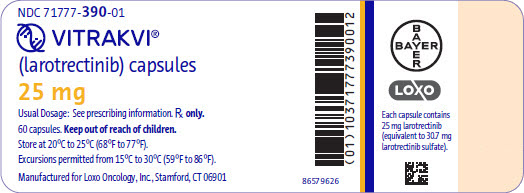
Vitrakvi Larotrectinib 25 mg Capsule, 60-count — NDC 71777-390-01 (Billing 71777-0390-01)
This is a package of 60 capsules of Vitrakvi Larotrectinib 25 mg Capsule from Loxo Oncology, Inc., marketed since Nov 2018 and currently FDA-listed. It is this product's only package size.
NDC database record
One package, one record: these facts belong to NDC 71777-390-01 alone.
- Record
- FDA NDC Directory package listing · Human prescription drug
- Code segments
- 71777 labeler · 390 product · 01 package
- Package marketed since
- Nov 26, 2018
- Sample package
- No — commercial package
- Listing certified through
- Dec 31, 2026
- Billing quantity
- 60 EA per package
- Barcode (UPC-A, from the NDC)
- 3 7177739001 5
- FDA record last changed
- Jul 24, 2026
Identity & classification
Regulatory identifiers FDA, NLM and CMS codes for this package
Drug-database identifiers Medi-Span GPI and First Databank GCN / HICL / AHFS classification
- GSN (GCN sequence number): 079309
- GCN: 45793
- GPI-14 (Medi-Span): 21533835200120
- HICL (First Databank): 045494
- AHFS class code: 10:00.00.00
- RxCUI (RxNorm): 2105633
Where does this data come from?
- FDA openFDA NDC Directory · synced Oct 8, 2026
- FDA label on DailyMed · label index refreshed Oct 8, 2026
- RxNorm (NLM RxNav) · catalog refreshed Oct 8, 2026
- Medi-Span GPI (licensed)
- First Databank (licensed) · refreshed Oct 8, 2026
RxNorm drug class
This medicine belongs to the Kinase Inhibitor class.
Where does this data come from?
- RxClass (NLM) · catalog refreshed Oct 8, 2026
Clinical
- Vitrakvi (larotrectinib) is a targeted cancer medicine — it doesn't treat cancer by location (like 'lung cancer' or 'breast cancer') but by a specific genetic change in your tumor...
- What exactly is Vitrakvi and why did my doctor prescribe it for me?
- You can take Vitrakvi with or without food — your choice. However, you should avoid grapefruit and grapefruit juice entirely while on this medicine. Grapefruit interferes with the...
- Can I eat before taking Vitrakvi, and is grapefruit okay?
Patient education
Supplement & herbal interactions
Some supplements/herbs that may interact with Larotrectinib — tap one for details:
Where does this data come from?
- MedlinePlus (NLM) · refreshed Oct 8, 2026
- FDA label on DailyMed · label index refreshed Oct 8, 2026
Ask a licensed pharmacist directly — free, answered by our team.
Pricing
A drug doesn't have one price. Each row is a different public payment system, and none is what you'd pay at the counter — that depends on your insurance. The ⓘ on each row explains what it measures.
| Price system | Per each | Per package |
|---|---|---|
| Retail pharmacies payNADAC · weekly | Not in the retail survey — common for institutional, discontinued, or low-volume packs. | |
| Medicaid paysCMS SDUD · 12 mo | No recent Medicaid claims on file for this NDC — rare and low-volume NDCs are suppressed in the public data. | |
| Medicare drug plans payPart D · Q2 2026 | $237.20 | $14,232.13 / 60 capsules |
Where does this data come from?
- CMS NADAC weekly file
- CMS ASP pricing files · refreshed Sep 20, 2026
- CMS Medicaid State Drug Utilization Data · refreshed Oct 9, 2026
- CMS Part D plan pricing files · refreshed Sep 24, 2026
- VA National Acquisition Center price file
Packaging — all sizes for this product
| Package NDC | Description | Marketing start | Marketing end | Status |
|---|---|---|---|---|
| 71777-0390-01 You're viewing this Main listing | 60 CAPSULE in 1 BOTTLE | 2018-11-26 | — | Active |
Therapeutic equivalents
| Product | Labeler | Pack | NADAC/unit | TE | Status | Price vs. this |
|---|---|---|---|---|---|---|
| Vitrakvi 25 mg 50419-0390-01 | Bayer | 60 capsules | — | — | FDA listed | — |
| Vitrakvi 25 mgthis 71777-0390-01 | Loxo | 60 capsules | — | — | FDA listed | — |
Where does this data come from?
- FDA openFDA NDC Directory · synced Oct 8, 2026
- FDA Orange Book · refreshed Oct 3, 2026
- CMS NADAC weekly file
Availability & generic status
We did not find an FDA-approved generic match for this exact strength, form and route. Patent/protection dates below may affect future generic timing.
Why the date isn’t exact: Generic timing can change because patents may be challenged, settled, licensed, added, removed, or worked around with a narrower label — and FDA approval does not always mean a pharmacy can get the generic today.
🛈 What do these terms mean?
- Patent
- Legal protection listed in the Orange Book that may delay generic approval or launch. Issued by the U.S. Patent & Trademark Office.
- Substance patent
- Covers the active drug molecule itself — the hardest to design around. A generic generally can’t launch until it expires.
- Formulation (product) patent
- Covers a specific formulation or dosage form. A generic can sometimes work around it with a different formulation.
- Method-of-use patent
- A patent covering one specific approved use of the drug — not necessarily the whole molecule. A generic can sometimes launch with a “skinny label” that carves out the protected use and keeps the others.
- Skinny label
- A generic label that omits a still-patented use when the FDA allows it — letting a generic reach the market for the unprotected uses.
- Exclusivity
- FDA-granted marketing protection, separate from patents — e.g. 5-yr new chemical entity, 7-yr orphan drug, or a +6-month pediatric extension.
- Paragraph IV
- A generic applicant’s formal challenge to a listed patent. It can potentially lead to earlier generic entry, but often involves litigation or a settlement.
- RLD / RS
- Reference Listed Drug — the brand product the FDA uses as the reference for generic applications. Reference Standard — the product the FDA expects generics to compare against in bioequivalence testing.
- TE / AB rating
- FDA therapeutic-equivalence rating. An AB rating generally means the FDA considers a generic therapeutically equivalent to — and substitutable for — the brand.
- LOE (loss of exclusivity)
- The latest patent or exclusivity currently listed — the loss-of-exclusivity / latest-listed-protection date shown on this page. Paragraph-IV challenges and settlements can move the real date earlier; FDA approval and a manufacturer’s decision to market can move it later.
Built from the FDA Orange Book. The bars above are scaled to each protection’s expiry; the red LOE marker is the last one to lapse.
| Patent | Type | Use code | Expires |
|---|---|---|---|
| US 10047097 ↗ | Method of use | U-2474 | Oct 21, 2029 |
| US 9447104 ↗ | Method of use | U-2470 | Oct 21, 2029 |
| US 8865698 ↗ | Method of use | U-2469 | Oct 21, 2029 |
| US 10005783 ↗ | Method of use | U-2472 | Oct 21, 2029 |
| US 9782414 ↗ | Method of use | U-2475 | Nov 16, 2035 |
| US 10005783 ↗ | Method of use | U-2472 | Oct 21, 2029 |
| US 10047097 ↗ | Method of use | U-2474 | Oct 21, 2029 |
| US 9676783 ↗ | Method of use | U-2469 | Oct 21, 2029 |
| US 10285993 ↗ | Method of use | U-2470 | Nov 16, 2035 |
| US 11974998 ↗ | Method of use | U-4124 | May 16, 2037 |
| US 11974998 ↗ | Method of use | U-4124 | May 16, 2037 |
| US 11337967 ↗ | Method of use | U-4123 | May 16, 2037 |
| US 11337967 ↗ | Method of use | U-4123 | May 16, 2037 |
| US 10813936 ↗ | Method of use | U-2987 | Nov 16, 2035 |
| US 10813936 ↗ | Method of use | U-2987 | Nov 16, 2035 |
| US 8865698 ↗ | Method of use | U-2469 | Oct 21, 2029 |
| US 9782414 ↗ | Method of use | U-2475 | Nov 16, 2035 |
| US 9447104 ↗ | Method of use | U-2470 | Oct 21, 2029 |
| US 10285993 ↗ | Method of use | U-2470 | Nov 16, 2035 |
| US 9676783 ↗ | Method of use | U-2469 | Oct 21, 2029 |
| US 10774085 ↗ | Method of use | U-2470 | Oct 21, 2029 |
| US 10774085 ↗ | Method of use | U-2470 | Oct 21, 2029 |
| US 8513263 ↗ | Drug substance | — | Dec 23, 2029 |
| US 8513263 ↗ | Drug substance | — | Dec 23, 2029 |
| US 10799505 ↗ | Drug substance | — | Aug 15, 2036 |
| US 10172861 ↗ | Drug substance | — | Nov 16, 2035 |
| US 10799505 ↗ | Drug substance | — | Aug 15, 2036 |
| US 9127013 ↗ | Drug substance | — | Oct 21, 2029 |
| US 9127013 ↗ | Drug substance | — | Oct 21, 2029 |
| US 10172861 ↗ | Drug substance | — | Nov 16, 2035 |
Is there a generic version of VITRAKVI 25 MG CAPSULE?
The FDA approved a generic — why can’t I get it at my pharmacy yet?
Why do different websites show different generic release dates?
What does “FDA listed” mean?
What does a patent or protection date mean here?
What does “current Orange Book estimate” mean?
Can a generic come out before the last patent expires?
Can a generic come out after the listed dates?
What is the difference between patents and exclusivity?
Why are there multiple patent dates?
Where does this data come from?
- FDA Orange Book · refreshed Oct 3, 2026
What it looks like
Where does this data come from?
- FDA label on DailyMed · label index refreshed Oct 8, 2026
Inactive Ingredients / Excipients
Inactive ingredients, also called excipients, are components of the drug product other than the active ingredient. They may include fillers, dyes, coatings, preservatives, flavors, or other formulation ingredients.
🧪 Avoiding an ingredient? See Larotrectinib inactive ingredients by manufacturer: every current product's list side by side, so you can ask your pharmacy for the version that does not list it.
💡 Tap an ingredient (hover on desktop) to see what it is and why it’s used.
-
UNII 2G86QN327L
Gelatin is a protein derived from animal collagen, commonly used in medicines as a gelling agent and capsule material. It helps create soft or hard capsule shells that hold and release medication, and can also thicken liquid formulations.
-
UNII 15FIX9V2JP
Titanium dioxide is a bright white mineral powder commonly used as a colorant and opacifying agent. It makes pills and tablets white or lighter in color and helps make coatings non-transparent.
2 inactive ingredients listed in the exact product block matched to this NDC.
Where does this data come from?
ingredient classCode="IACT" elements from the exact product block matched by this NDC. Label-section narrative from DailyMed / the openFDA label index is shown separately when available.- FDA label on DailyMed · label index refreshed Oct 8, 2026
- FDA openFDA NDC Directory · synced Oct 8, 2026
Inactive ingredient FAQ
Are inactive ingredients the same for every manufacturer?
Why might an inactive ingredient be missing?
Can inactive ingredients matter?
Manufacturer & labeler
More NDCs from Loxo Oncology, Inc. labeler code 71777
Where does this data come from?
- FDA openFDA NDC Directory · synced Oct 8, 2026
- Drugs@FDA
Full prescribing information FDA SPL
🎯 Indications and Usage ▾
1 INDICATIONS AND USAGE VITRAKVI is indicated for the treatment of adult and pediatric patients with solid tumors that: • have a neurotrophic receptor tyrosine kinase ( NTRK ) gene fusion without a known acquired resistance mutation, • are metastatic or where surgical resection is likely to result in severe morbidity, and • have no satisfactory alternative treatments or that have progressed following treatment. This indication is approved under accelerated approval based on overall response rate and duration of response [see Clinical Studies ( 14 )] .
Continued approval for this indication may be contingent upon verification and description of clinical benefit in confirmatory trials. VITRAKVI is a kinase inhibitor indicated for the treatment of adult and pediatric patients with solid tumors that: • have a neurotrophic receptor tyrosine kinase ( NTRK ) gene fusion without a known acquired resistance mutation, • are metastatic or where surgical resection is likely to result in severe morbidity, and • have no satisfactory alternative treatments or that have progressed following treatment.
This indication is approved under accelerated approval based on overall response rate and duration of response. Continued approval for this indication may be contingent upon verification and description of clinical benefit in confirmatory trials ( 1 , 14 ).
⏱️ Dosage and Administration ▾
2 DOSAGE AND ADMINISTRATION • Select patients for treatment with VITRAKVI based on the presence of a NTRK gene fusion ( 2.1 , 14 ). • Recommended Dosage in Adult and Pediatric Patients with Body Surface Area of at Least
1.0Meter-Squared: 100 mg orally twice daily ( 2.2 ) • Recommended Dosage in Pediatric Patients with Body Surface Area of Less Than
1.0Meter-Squared: 100 mg/m 2 orally twice daily ( 2.2 )
2.1Patient Selection Select patients for treatment with VITRAKVI based on the presence of a NTRK gene fusion in tumor specimens [see Clinical Studies ( 14 )] . An FDA-approved test for the detection of NTRK gene fusion is not currently available.
2.2Recommended Dosage Recommended Dosage in Adult and Pediatric Patients with Body Surface Area of at Least
1.0Meter-Squared The recommended dosage of VITRAKVI is 100 mg orally twice daily, with or without food, until disease progression or until unacceptable toxicity. Recommended Dosage in Pediatric Patients with Body Surface Area Less Than
1.0Meter-Squared The recommended dosage of VITRAKVI is 100 mg/m 2 orally twice daily, with or without food, until disease progression or until unacceptable toxicity.
2.3Dosage Modifications for Adverse Reactions For Grade 3 or 4 adverse reactions: • Withhold VITRAKVI until adverse reaction resolves or improves to baseline or Grade 1. Resume at the next dosage modification if resolution occurs within 4 weeks. • Permanently discontinue VITRAKVI if an adverse reaction does not resolve within 4 weeks. The recommended dosage modifications for VITRAKVI for adverse reactions are provided in Table 1 .
Table 1 Recommended Dosage Modifications for VITRAKVI for Adverse Reactions Dosage Modification Adult and Pediatric Patients with Body Surface Area of at Least 1.0 m 2 Pediatric Patients with Body Surface Area Less Than 1.0 m 2 First 75 mg orally twice daily 75 mg/m 2 orally twice daily Second 50 mg orally twice daily 50 mg/m 2 orally twice daily Third 100 mg orally once daily 25 mg/m 2 orally twice daily Permanently discontinue VITRAKVI in patients who are unable to tolerate VITRAKVI after three dose modifications.
2.4Dosage Modifications for Coadministration with Strong CYP3A4 Inhibitors Avoid coadministration of strong CYP3A4 inhibitors with VITRAKVI. If coadministration of a strong CYP3A4 inhibitor cannot be avoided, reduce the VITRAKVI dose by 50%. After the inhibitor has been discontinued for 3 to 5 elimination half-lives, resume the VITRAKVI dose taken prior to initiating the CYP3A4 inhibitor [see Drug Interactions ( 7.1 ), Clinical Pharmacology ( 12.3 )] .
2.5Dosage Modifications for Coadministration with Strong CYP3A4 Inducers Avoid coadministration of strong CYP3A4 inducers with VITRAKVI. If coadministration of a strong CYP3A4 inducer cannot be avoided, double the VITRAKVI dose. After the inducer has been discontinued for 3 to 5 elimination half-lives, resume the VITRAKVI dose taken prior to initiating the CYP3A4 inducer [see Drug Interactions ( 7.1 ), Clinical Pharmacology ( 12.3 )] .
2.6Dosage Modifications for Patients with Hepatic Impairment Reduce the starting dose of VITRAKVI by 50% in patients with moderate (Child-Pugh B) to severe (Child-Pugh C) hepatic impairment [see Use in Specific Populations ( 8.6 ), Clinical Pharmacology ( 12.3 )] .
2.7Administration VITRAKVI capsule or oral solution may be used interchangeably. Do not make up a missed dose within 6 hours of the next scheduled dose. If vomiting occurs after taking a dose of VITRAKVI, take the next dose at the scheduled time.
Capsules Swallow capsules whole with water. Do not chew or crush the capsules. Oral Solution • Store the glass bottle of VITRAKVI oral solution in the refrigerator.
Discard any unused VITRAKVI oral solution remaining after 90 days of first opening the bottle. • Prior to preparing an oral dose for administration, refer to the Instructions for Use.
💊 Dosage Forms and Strengths ▾
3 DOSAGE FORMS AND STRENGTHS Capsules • 25 mg: white opaque hard gelatin capsule, size 2, with blue printing of "LOXO" and "LARO 25 mg" on body of capsules. 25 mg larotrectinib is equivalent to 30.7 mg larotrectinib sulfate. • 100 mg: white opaque hard gelatin capsule, size 0, with blue printing of "LOXO" and "LARO 100 mg" on body of capsule. 100 mg larotrectinib is equivalent to 123 mg larotrectinib sulfate.
Oral Solution • 20 mg/mL: clear yellow to orange solution. 20 mg/mL larotrectinib is equivalent to 24.6 mg/mL larotrectinib sulfate. • Capsules: 25 mg, 100 mg ( 3 ) • Oral Solution: 20 mg/mL ( 3 )
⛔ Contraindications ▾
4 CONTRAINDICATIONS None. None. ( 4 )
⚠️ Warnings and Cautions ▾
5 WARNINGS AND PRECAUTIONS • Neurotoxicity: Advise patients and caretakers of the risk of neurologic adverse reactions. Advise patients not to drive or operate hazardous machinery if experiencing neurotoxicity. Withhold and modify dosage, or permanently discontinue VITRAKVI based on severity.
( 2.3 , 5.1 ) • Hepatotoxicity: Monitor liver tests including ALT and AST every 2 weeks during the first month of treatment, then monthly thereafter and as clinically indicated. Withhold and modify dosage, or permanently discontinue VITRAKVI based on severity. ( 2.6 , 5.2 ) • Embryo-Fetal Toxicity: Can cause fetal harm.
Advise females with reproductive potential of potential risk to the fetus and to use effective contraception. ( 5.3 , 8.3 )
5.1Neurotoxicity Among the 176 patients who received VITRAKVI, neurologic adverse reactions of any grade occurred in 53% of patients, including Grade 3 and Grade 4 neurologic adverse reactions in 6% and 0.6% of patients, respectively [see Adverse Reactions ( 6.1 )] . The majority (65%) of neurologic adverse reactions occurred within the first three months of treatment (range: 1 day to 2.2 years). Grade 3 neurologic adverse reactions included delirium (2%), dysarthria (1%), dizziness (1%), gait disturbance (1%), and paresthesia (1%).
Grade 4 encephalopathy (0.6%) occurred in a single patient. Neurologic adverse reactions leading to dose modification included dizziness (3%), gait disturbance (1%), delirium (1%), memory impairment (1%), and tremor (1%). Advise patients and caretakers of these risks with VITRAKVI.
Advise patients not to drive or operate hazardous machinery if they are experiencing neurologic adverse reactions. Withhold or permanently discontinue VITRAKVI based on the severity. If withheld, modify the VITRAKVI dosage when resumed [see Dosage and Administration ( 2.3 )] .
5.2Hepatotoxicity Among the 176 patients who received VITRAKVI, increased transaminases of any grade occurred in 45%, including Grade 3 increased AST or ALT in 6% of patients [see Adverse Reactions ( 6.1 )] . One patient (0.6%) experienced Grade 4 increased ALT. The median time to onset of increased AST was 2 months (range: 1 month to 2.6 years).
The median time to onset of increased ALT was 2 months (range: 1 month to 1.1 years). Increased AST and ALT leading to dose modifications occurred in 4% and 6% of patients, respectively. Increased AST or ALT led to permanent discontinuation in 2% of patients.
Monitor liver tests, including ALT and AST, every 2 weeks during the first month of treatment, then monthly thereafter, and as clinically indicated. Withhold or permanently discontinue VITRAKVI based on the severity. If withheld, modify the VITRAKVI dosage when resumed [see Dosage and Administration ( 2.3 )] .
5.3Embryo-Fetal Toxicity Based on literature reports in human subjects with congenital mutations leading to changes in TRK signaling, findings from animal studies, and its mechanism of action, VITRAKVI can cause fetal harm when administered to a pregnant woman. Larotrectinib resulted in malformations in rats and rabbits at maternal exposures that were approximately 11- and 0.7-times, respectively, those observed at the clinical dose of 100 mg twice daily. Advise women of the potential risk to a fetus.
Advise females of reproductive potential to use an effective method of contraception during treatment and for 1 week after the final dose of VITRAKVI [see Use in Specific Populations ( 8.1 , 8.3 )] .
🤒 Adverse Reactions ▾
6 ADVERSE REACTIONS The following clinically significant adverse reactions are described elsewhere in the labeling: • Neurotoxicity [see Warnings and Precautions ( 5.1 )] • Hepatotoxicity [see Warnings and Precautions ( 5.2 )] The most common adverse reactions (≥ 20%) with VITRAKVI were fatigue, nausea, dizziness, vomiting, increased AST, cough, increased ALT, constipation, and diarrhea. ( 6 ). To report SUSPECTED ADVERSE REACTIONS, contact Bayer HealthCare Pharmaceuticals Inc. at 1-888-842-2937 or FDA at 1-800-FDA-1088 or www.fda.gov/medwatch.
6.1Clinical Trial Experience Because clinical trials are conducted under widely varying conditions, adverse reaction rates observed in the clinical trials of a drug cannot be directly compared to rates in the clinical trials of another drug and may not reflect the rates observed in practice. Data in WARNINGS AND PRECAUTIONS and below reflects exposure to VITRAKVI in 176 patients, including 70 (40%) patients exposed for greater than 6 months and 35 (20%) patients exposed for greater than 1 year. VITRAKVI was studied in one adult dose-finding trial [LOXO-TRK-14001 (n = 70)], one pediatric dose-finding trial [SCOUT (n = 43)], and one single arm trial [NAVIGATE (n = 63)].
All patients had an unresectable or metastatic solid tumor and no satisfactory alternative treatment options or disease progression following treatment. Across these 176 patients, the median age was 51 years (range: 28 days to 82 years); 25% were 18 years or younger; 52% were male; and 72% were White, 11% were Hispanic/Latino, 8% were Black, and 3% were Asian. The most common tumors in order of decreasing frequency were soft tissue sarcoma (16%), salivary gland (11%), lung (10%), thyroid (9%), colon (8%), infantile fibrosarcoma (8%), primary central nervous system (CNS) (7%), or melanoma (5%).
NTRK gene fusions were present in 60% of VITRAKVI-treated patients. Most adults (80%) received VITRAKVI 100 mg orally twice daily and 68% of pediatrics (18 years or younger) received VITRAKVI 100 mg/m 2 twice daily up to a maximum dose of 100 mg twice daily. The dose ranged from 50 mg daily to 200 mg twice daily in adults and 9.6 mg/m 2 twice daily to 120 mg/m 2 twice daily in pediatrics [see Pediatric Use ( 8.4 )] .
The most common adverse reactions (≥ 20%) in order of decreasing frequency were fatigue, nausea, dizziness, vomiting, anemia, increased AST, cough, increased ALT, constipation, and diarrhea. The most common serious adverse reactions (≥ 2%) were pyrexia, diarrhea, sepsis, abdominal pain, dehydration, cellulitis, and vomiting. Grade 3 or 4 adverse reactions occurred in 51% of patients; adverse reactions leading to dose interruption or reduction occurred in 37% of patients and 13% permanently discontinued VITRAKVI for adverse reactions.
The most common adverse reactions (1-2% each) that resulted in discontinuation of VITRAKVI were brain edema, intestinal perforation, pericardial effusion, pleural effusion, small intestinal obstruction, dehydration, fatigue, increased ALT, increased AST, enterocutaneous fistula, increased amylase, increased lipase, muscular weakness, abdominal pain, asthenia, decreased appetite, dyspnea, hyponatremia, jaundice, syncope, vomiting, acute myeloid leukemia, and nausea. The most common adverse reactions (≥ 3%) resulting in dose modification (interruption or reduction) were increased ALT (6%), increased AST (6%), and dizziness (3%).
Most (82%) adverse reactions leading to dose modification occurred during the first three months of exposure. Adverse reactions of VITRAKVI occurring in ≥ 10% of patients and laboratory abnormalities worsening from baseline in ≥ 5% of patients are summarized in Table 2 and Table 3 , respectively. Table 2 Adverse Reactions Occurring in ≥ 10% of Patients Treated with VITRAKVI Adverse Reaction VITRAKVI N = 176 All Grades National Cancer Institute-Common Terminology Criteria for Adverse Events (NCI-CTCAE) v 4.03.
(%) Grade 3-4 One Grade 4 adverse reaction of pyrexia. (%)… [Excerpted — this section continues on DailyMed.]
🔄 Drug Interactions ▾
7 DRUG INTERACTIONS • Strong CYP3A4 Inhibitors: Avoid coadministration of strong CYP3A4 inhibitors with VITRAKVI. If coadministration cannot be avoided, reduce the VITRAKVI dose. ( 2.4 , 7.1 ) • Strong CYP3A4 Inducers: Avoid coadministration of strong CYP3A4 inducers with VITRAKVI.
If coadministration cannot be avoided, increase the VITRAKVI dose. ( 2.5 , 7.1 ) • Sensitive CYP3A4 Substrates: Avoid coadministration of sensitive CYP3A4 substrates with VITRAKVI. ( 7.2 )
7.1Effects of Other Drugs on VITRAKVI Strong CYP3A4 Inhibitors Coadministration of VITRAKVI with a strong CYP3A4 inhibitor may increase larotrectinib plasma concentrations, which may result in a higher incidence of adverse reactions [see Clinical Pharmacology ( 12.3 )] . Avoid coadministration of VITRAKVI with strong CYP3A4 inhibitors, including grapefruit or grapefruit juice. If coadministration of strong CYP3A4 inhibitors cannot be avoided, modify VITRAKVI dose as recommended [see Dosage and Administration ( 2.4 )] .
Strong CYP3A4 Inducers Coadministration of VITRAKVI with a strong CYP3A4 inducer may decrease larotrectinib plasma concentrations, which may decrease the efficacy of VITRAKVI [see Clinical Pharmacology ( 12.3 )] . Avoid coadministration of VITRAKVI with strong CYP3A4 inducers, including St. John’s wort.
If coadministration of strong CYP3A4 inducers cannot be avoided, modify VITRAKVI dose as recommended [see Dosage and Administration ( 2.5 )] .
7.2Effects of VITRAKVI on Other Drugs Sensitive CYP3A4 Substrates Coadministration of VITRAKVI with sensitive CYP3A4 substrates may increase their plasma concentrations, which may increase the incidence or severity of adverse reactions [see Clinical Pharmacology ( 12.3 )] . Avoid coadministration of VITRAKVI with sensitive CYP3A4 substrates. If coadministration of these sensitive CYP3A4 substrates cannot be avoided, monitor patients for increased adverse reactions of these drugs.
👥 Use in Specific Populations ▾
8 USE IN SPECIFIC POPULATIONS • Lactation: Advise not to breastfeed. ( 8.2 ) • Hepatic Impairment: Reduce the starting dose of VITRAKVI in patients with moderate (Child-Pugh B) to severe (Child-Pugh C) hepatic impairment. ( 2.6 , 8.7 )
8.1Pregnancy Risk Summary Based on literature reports in human subjects with congenital mutations leading to changes in TRK signaling, findings from animal studies, and its mechanism of action [see Clinical Pharmacology ( 12.1 )] , VITRAKVI can cause embryo-fetal harm when administered to a pregnant woman. There are no available data on VITRAKVI use in pregnant women. Administration of larotrectinib to pregnant rats and rabbits during the period of organogenesis resulted in malformations at maternal exposures that were approximately 11- and 0.7-times, respectively, those observed at the clinical dose of 100 mg twice daily (see Data ) .
Advise pregnant women of the potential risk to a fetus. In the U.S. general population, the estimated background risk of major birth defects and miscarriage in clinically recognized pregnancies is 2% to 4% and 15% to 20%, respectively. Data Human Data Published reports of individuals with congenital mutations in TRK pathway proteins suggest that decreases in TRK-mediated signaling are correlated with obesity, developmental delays, cognitive impairment, insensitivity to pain, and anhidrosis.
Animal Data Larotrectinib crosses the placenta in animals. Larotrectinib did not result in embryolethality at maternally toxic doses [up to 40 times the human exposure based on area under the curve (AUC) at the clinical dose of 100 mg twice daily] in embryo-fetal development studies in pregnant rats dosed during the period of organogenesis; however, larotrectinib was associated with fetal anasarca in rats from dams treated at twice-daily doses of 40 mg/kg [11 times the human exposure (AUC) at the clinical dose of 100 mg twice daily].
In pregnant rabbits, larotrectinib administration was associated with omphalocele at twice-daily doses of 15 mg/kg (0.7 times the human exposure at the clinical dose of 100 mg twice daily).
8.2Lactation Risk Summary There are no data on the presence of larotrectinib or its metabolites in human milk and no data on its effects on the breastfed child or on milk production. Because of the potential for serious adverse reactions in breastfed children, advise women not to breastfeed during treatment with larotrectinib and for 1 week after the final dose.
8.3Females and Males of Reproductive Potential Pregnancy Testing Verify pregnancy status in females of reproductive potential prior to initiating VITRAKVI [see Use in Specific Populations ( 8.1 )] . Contraception VITRAKVI can cause embryo-fetal harm when administered to a pregnant woman [see Use in Specific Populations ( 8.1 )] . Females Advise female patients of reproductive potential to use effective contraception during treatment with VITRAKVI and for at least 1 week after the final dose.
Males Advise males with female partners of reproductive potential to use effective contraception during treatment with VITRAKVI and for 1 week after the final dose. Infertility Females Based on histopathological findings in the reproductive tracts of female rats in a 1-month repeated-dose study, VITRAKVI may reduce fertility [See Nonclinical Toxicology ( 13.1 )] .
8.4Pediatric Use The safety and effectiveness of VITRAKVI in pediatric patients was established based upon data from three multicenter, open-label, single-arm clinical trials in adult or pediatric patients 28 days and older [see Adverse Reactions ( 6.1 ), Clinical Studies ( 14 )] . The efficacy of VITRAKVI was evaluated in 12 pediatric patients and is described in the Clinical Studies section [see Clinical Studies ( 14 )] . The safety of VITRAKVI was evaluated in 44 pediatric patients who received VITRAKVI.
Of these 44 patients, 27% were 1 month to < 2 years (n = 12), 43% were 2 years to < 12 years (n = 19), and 30% were 12 years to < 18 years (n = 13);… [Excerpted — this section continues on DailyMed.]
🤰 Pregnancy ▾
8.1Pregnancy Risk Summary Based on literature reports in human subjects with congenital mutations leading to changes in TRK signaling, findings from animal studies, and its mechanism of action [see Clinical Pharmacology ( 12.1 )] , VITRAKVI can cause embryo-fetal harm when administered to a pregnant woman. There are no available data on VITRAKVI use in pregnant women. Administration of larotrectinib to pregnant rats and rabbits during the period of organogenesis resulted in malformations at maternal exposures that were approximately 11- and 0.7-times, respectively, those observed at the clinical dose of 100 mg twice daily (see Data ) .
Advise pregnant women of the potential risk to a fetus. In the U.S. general population, the estimated background risk of major birth defects and miscarriage in clinically recognized pregnancies is 2% to 4% and 15% to 20%, respectively. Data Human Data Published reports of individuals with congenital mutations in TRK pathway proteins suggest that decreases in TRK-mediated signaling are correlated with obesity, developmental delays, cognitive impairment, insensitivity to pain, and anhidrosis.
Animal Data Larotrectinib crosses the placenta in animals. Larotrectinib did not result in embryolethality at maternally toxic doses [up to 40 times the human exposure based on area under the curve (AUC) at the clinical dose of 100 mg twice daily] in embryo-fetal development studies in pregnant rats dosed during the period of organogenesis; however, larotrectinib was associated with fetal anasarca in rats from dams treated at twice-daily doses of 40 mg/kg [11 times the human exposure (AUC) at the clinical dose of 100 mg twice daily].
In pregnant rabbits, larotrectinib administration was associated with omphalocele at twice-daily doses of 15 mg/kg (0.7 times the human exposure at the clinical dose of 100 mg twice daily).
🧒 Pediatric Use ▾
8.4Pediatric Use The safety and effectiveness of VITRAKVI in pediatric patients was established based upon data from three multicenter, open-label, single-arm clinical trials in adult or pediatric patients 28 days and older [see Adverse Reactions ( 6.1 ), Clinical Studies ( 14 )] . The efficacy of VITRAKVI was evaluated in 12 pediatric patients and is described in the Clinical Studies section [see Clinical Studies ( 14 )] . The safety of VITRAKVI was evaluated in 44 pediatric patients who received VITRAKVI.
Of these 44 patients, 27% were 1 month to < 2 years (n = 12), 43% were 2 years to < 12 years (n = 19), and 30% were 12 years to < 18 years (n = 13); 43% had metastatic disease and 57% had locally advanced disease; and 91% had received prior treatment for their cancer, including surgery, radiotherapy, or systemic therapy. The most common cancers were infantile fibrosarcoma (32%), soft tissue sarcoma (25%), primary CNS tumors (20%), and thyroid cancer (9%). The median duration of exposure was 5.4 months (range: 9 days to 1.9 years).
Due to the small number of pediatric and adult patients, the single arm design of clinical studies of VITRAKVI, and confounding factors such as differences in susceptibility to infections between pediatric and adult patients, it is not possible to determine whether differences in the incidence of adverse reactions to VITRAKVI are related to patient age or other factors. Adverse reactions and laboratory abnormalities of Grade 3 or 4 severity occurring more frequently (at least a 5% increase in per-patient incidence) in pediatric patients compared to adult patients were increased weight (11% vs.
2%) and neutropenia (20% vs. 2%). One of the 44 pediatric patients discontinued VITRAKVI due to an adverse reaction (Grade 3 increased ALT).
The pharmacokinetics of VITRAKVI in the pediatric population were similar to those seen in adults [see Clinical Pharmacology ( 12.3 )]. Juvenile Animal Toxicity Data Larotrectinib was administered in a juvenile toxicity study in rats at twice daily doses of 0.2, 2 and 7.5 mg/kg from postnatal day (PND) 7 to 27 and at twice daily doses of 0.6, 6 and 22.5mg/kg between PND 28 and 70. The dosing period was equivalent to human pediatric populations from newborn to adulthood.
The doses of 2/6 mg/kg twice daily [approximately 0.7 times the human exposure (AUC) at the clinical dose of 100 mg twice daily] and 7.5/22.5 mg/kg twice daily (approximately 4 times the human exposure at the clinical dose of 100 mg twice daily) resulted in mortality between PND 9 to 99; a definitive cause of death was not identified in the majority of cases. The main findings were transient central nervous system-related signs including head flick, tremor, and circling in both sexes. An increase in the number of errors in a maze swim test occurred in females at exposures of approximately 4 times the human exposure (AUC) at the clinical dose of 100 mg twice daily.
Decreased growth and delays in sexual development occurred in the mid- and high-dose groups. Mating was normal in treated animals, but a reduction in pregnancy rate occurred at the high-dose of 7.5/22.5 mg/kg twice daily (approximately 4 times the human exposure at the clinical dose of 100 mg twice daily).
🧓 Geriatric Use ▾
8.5Geriatric Use Of 176 patients in the overall safety population who received VITRAKVI, 22% of patients were ≥ 65 years of age and 5% of patients were ≥ 75 years of age. Clinical studies of VITRAKVI did not include sufficient numbers of subjects aged 65 and over to determine whether they respond differently from younger subjects.
🧬 Clinical Pharmacology ▾
12 CLINICAL PHARMACOLOGY
12.1Mechanism of Action Larotrectinib is an inhibitor of the tropomyosin receptor kinases (TRK), TRKA, TRKB, and TRKC. In a broad panel of purified enzyme assays, larotrectinib inhibited TRKA, TRKB, and TRKC with IC 50 values between 5-11 nM. One other kinase TNK2 was inhibited at approximately 100-fold higher concentration.
TRKA, B, and C are encoded by the genes NTRK1, NTRK2, and NTRK3 . Chromosomal rearrangements involving in-frame fusions of these genes with various partners can result in constitutively-activated chimeric TRK fusion proteins that can act as an oncogenic driver, promoting cell proliferation and survival in tumor cell lines. In in vitro and in vivo tumor models, larotrectinib demonstrated anti-tumor activity in cells with constitutive activation of TRK proteins resulting from gene fusions, deletion of a protein regulatory domain, or in cells with TRK protein overexpression.
Larotrectinib had minimal activity in cell lines with point mutations in the TRKA kinase domain, including the clinically identified acquired resistance mutation, G595R. Point mutations in the TRKC kinase domain with clinically identified acquired resistance to larotrectinib include G623R, G696A, and F617L.
12.2Pharmacodynamics Cardiac Electrophysiology At a dose 9-fold higher than the recommended adult dose, VITRAKVI does not prolong QTc intervals to any clinically relevant extent.
12.3Pharmacokinetics The pharmacokinetics of larotrectinib were studied in healthy subjects and adult and pediatric patients with locally advanced or metastatic solid tumors. In healthy subjects who received a single dose of VITRAKVI capsules, systemic exposure (C max and AUC) of larotrectinib was dose proportional over the dose range of 100 mg to 400 mg (1 to 4 times the recommended adult dose) and slightly greater than proportional at doses of 600 mg to 900 mg (6 to 9 times the recommended adult dose). In adult patients who received VITRAKVI capsules 100 mg twice daily in Study LOXO-TRK-14001, peak plasma levels (C max ) of larotrectinib were achieved at approximately 1 hour after dosing and steady-state was reached within 3 days.
Mean steady-state larotrectinib [coefficient of variation (CV%)] for C max was 788 (81%) ng/mL and AUC 0-24hr was 4351 (97%) ng*h/mL. Absorption The mean absolute bioavailability of VITRAKVI capsules was 34% (range: 32% to 37%). In healthy subjects, the AUC of VITRAKVI oral solution was similar to that of the capsules and the C max was 36% higher with the oral solution.
Effect of Food The AUC of larotrectinib was similar and the C max was reduced by 35% after oral administration of a single 100 mg capsule of VITRAKVI to healthy subjects taken with a high-fat meal (approximately 900 calories, 58 grams carbohydrate, 56 grams fat and 43 grams protein) compared to the C max and AUC in the fasted state. Distribution The mean (CV%) volume of distribution (V ss ) of larotrectinib is 48 (38%) L following intravenous administration of larotrectinib in healthy subjects. Larotrectinib is 70% bound to human plasma proteins in vitro and binding is independent of drug concentrations.
The blood-to-plasma concentration ratio is 0.9. Elimination The mean (CV%) clearance (CL/F) of larotrectinib is 98 (44%) L/h and the half-life is 2.9 hours following oral administration of VITRAKVI in healthy subjects. Metabolism Larotrectinib is metabolized predominantly by CYP3A4.
Following oral administration of a single [ 14 C] radiolabeled 100 mg dose of larotrectinib to healthy subjects, unchanged larotrectinib constituted 19% and an O-linked glucuronide constituted 26% of the major circulating radioactive drug components in plasma. Excretion Following oral administration of a single [ 14 C] radiolabeled 100 mg dose of larotrectinib to healthy subjects, 58% (5% unchanged) of the administered radioactivity was recovered in feces and 39% (20% unchanged) was recovered in urine. Specific Populations Age (range: 28 days to 82 years), sex… [Excerpted — this section continues on DailyMed.]
🧬 Mechanism of Action ▾
12.1Mechanism of Action Larotrectinib is an inhibitor of the tropomyosin receptor kinases (TRK), TRKA, TRKB, and TRKC. In a broad panel of purified enzyme assays, larotrectinib inhibited TRKA, TRKB, and TRKC with IC 50 values between 5-11 nM. One other kinase TNK2 was inhibited at approximately 100-fold higher concentration.
TRKA, B, and C are encoded by the genes NTRK1, NTRK2, and NTRK3 . Chromosomal rearrangements involving in-frame fusions of these genes with various partners can result in constitutively-activated chimeric TRK fusion proteins that can act as an oncogenic driver, promoting cell proliferation and survival in tumor cell lines. In in vitro and in vivo tumor models, larotrectinib demonstrated anti-tumor activity in cells with constitutive activation of TRK proteins resulting from gene fusions, deletion of a protein regulatory domain, or in cells with TRK protein overexpression.
Larotrectinib had minimal activity in cell lines with point mutations in the TRKA kinase domain, including the clinically identified acquired resistance mutation, G595R. Point mutations in the TRKC kinase domain with clinically identified acquired resistance to larotrectinib include G623R, G696A, and F617L.
📦 How Supplied / Storage and Handling ▾
16 HOW SUPPLIED/STORAGE AND HANDLING Capsules 25 mg: Hard gelatin opaque white capsule size #2 with blue printing of "LOXO" and "LARO 25 mg" on the body of the capsule. • 60 count bottle NDC# 71777-390-01 100 mg: Hard gelatin opaque white capsule size #0 with blue printing of "LOXO" and "LARO 100 mg" on the body of the capsule. • 60 count bottle NDC# 71777-391-01 Store capsules at room temperature 20°C to 25°C (68°F to 77°F); temperature excursions between 15°C and 30°C (59°F to 86°F) are permitted [see USP Controlled Room Temperature].
Oral Solution 20 mg/mL: Clear yellow to orange solution. • 100 mL bottle NDC# 71777-392-01 Refrigerate oral solution at 2°C to 8°C (36°F to 46°F). Do not freeze.
📋 Description ▾
11 DESCRIPTION Larotrectinib is a kinase inhibitor. VITRAKVI (larotrectinib) capsules and oral solution are formulated using larotrectinib sulfate. The molecular formula for larotrectinib sulfate is C 21 H 24 F 2 N 6 O 6 S and the molecular weight is 526.51 g/mol for the sulfate salt and 428.44 g/mol for the free base.
The chemical name is (3 S )- N -{5-[(2 R )-2-(2,5-difluorophenyl)-1-pyrrolidinyl]pyrazolo[1,5-a]pyrimidin-3-yl}-3-hydroxy-1-pyrrolidinecarboxamide sulfate. Larotrectinib sulfate has the following chemical structure: Larotrectinib sulfate is an off-white to pinkish yellow solid that is not hygroscopic. The aqueous solubility of larotrectinib at 37°C is pH dependent (very soluble at pH 1.0 and freely soluble at pH 6.8, according to USP descriptive terms of solubility).
VITRAKVI (larotrectinib) capsules and oral solution are for oral use. Each capsule contains 25 mg or 100 mg larotrectinib (30.7 mg and 123 mg larotrectinib sulfate, respectively) in a hard gelatin capsule. The capsule is composed of gelatin, titanium dioxide, and edible ink.
The oral solution contains 20 mg/mL larotrectinib (24.6 mg/mL larotrectinib sulfate) and the following inactive ingredients: purified water, hydroxypropyl betadex, sucrose, glycerin, sorbitol, citric acid, sodium phosphate, sodium citrate dihydrate, propylene glycol and flavoring. Preserved with methylparaben and potassium sorbate. image of the chemical structure of VITRAKVI
💬 Information for Patients ▾
17 PATIENT COUNSELING INFORMATION Advise the patient to read the FDA-approved patient labeling ( Patient Information and Instructions for Use ). Neurotoxicity Advise patients to notify their healthcare provider if they experience new or worsening neurotoxicity. Advise patients not to drive or operate hazardous machinery if they are experiencing neurologic adverse reactions [see Warnings and Precautions ( 5.1 )] .
Hepatotoxicity Advise patients that they will need to undergo laboratory tests to monitor liver function [see Warnings and Precautions ( 5.2 )] . Embryo-Fetal Toxicity Advise males and females of reproductive potential of the potential risk to a fetus [see Warnings and Precautions ( 5.3 ), Use in Specific Populations ( 8.1 )] . Advise females of reproductive potential to inform their healthcare provider of a known or suspected pregnancy and to use effective contraception during the treatment with VITRAKVI and for at least 1 week after the final dose [see Use in Specific Populations ( 8.3 )] .
Advise males with female partners of reproductive potential to use effective contraception during treatment with VITRAKVI and for at least 1 week after the final dose [see Use in Specific Populations ( 8.3 )] . Lactation Advise women not to breastfeed during treatment with VITRAKVI and for 1 week following the final dose [see Use in Specific Populations ( 8.2 )] . Infertility Advise females of reproductive potential that VITRAKVI may impair fertility [See Nonclinical Toxicology ( 13.1 )] .
Drug Interactions Advise patients and caregivers to inform their healthcare provider of all concomitant medications, including prescription medicines, over-the-counter drugs, vitamins, and herbal products. Inform patients to avoid St. John’s wort, grapefruit or grapefruit juice while taking VITRAKVI [see Drug Interactions ( 7.1 , 7.2 )] .
Manufactured for: Loxo Oncology, Inc. Stamford, CT 06901
🍼 Nursing Mothers ▾
8.2Lactation Risk Summary There are no data on the presence of larotrectinib or its metabolites in human milk and no data on its effects on the breastfed child or on milk production. Because of the potential for serious adverse reactions in breastfed children, advise women not to breastfeed during treatment with larotrectinib and for 1 week after the final dose.
🧬 Pharmacokinetics ▾
12.3Pharmacokinetics The pharmacokinetics of larotrectinib were studied in healthy subjects and adult and pediatric patients with locally advanced or metastatic solid tumors. In healthy subjects who received a single dose of VITRAKVI capsules, systemic exposure (C max and AUC) of larotrectinib was dose proportional over the dose range of 100 mg to 400 mg (1 to 4 times the recommended adult dose) and slightly greater than proportional at doses of 600 mg to 900 mg (6 to 9 times the recommended adult dose). In adult patients who received VITRAKVI capsules 100 mg twice daily in Study LOXO-TRK-14001, peak plasma levels (C max ) of larotrectinib were achieved at approximately 1 hour after dosing and steady-state was reached within 3 days.
Mean steady-state larotrectinib [coefficient of variation (CV%)] for C max was 788 (81%) ng/mL and AUC 0-24hr was 4351 (97%) ng*h/mL. Absorption The mean absolute bioavailability of VITRAKVI capsules was 34% (range: 32% to 37%). In healthy subjects, the AUC of VITRAKVI oral solution was similar to that of the capsules and the C max was 36% higher with the oral solution.
Effect of Food The AUC of larotrectinib was similar and the C max was reduced by 35% after oral administration of a single 100 mg capsule of VITRAKVI to healthy subjects taken with a high-fat meal (approximately 900 calories, 58 grams carbohydrate, 56 grams fat and 43 grams protein) compared to the C max and AUC in the fasted state. Distribution The mean (CV%) volume of distribution (V ss ) of larotrectinib is 48 (38%) L following intravenous administration of larotrectinib in healthy subjects. Larotrectinib is 70% bound to human plasma proteins in vitro and binding is independent of drug concentrations.
The blood-to-plasma concentration ratio is 0.9. Elimination The mean (CV%) clearance (CL/F) of larotrectinib is 98 (44%) L/h and the half-life is 2.9 hours following oral administration of VITRAKVI in healthy subjects. Metabolism Larotrectinib is metabolized predominantly by CYP3A4.
Following oral administration of a single [ 14 C] radiolabeled 100 mg dose of larotrectinib to healthy subjects, unchanged larotrectinib constituted 19% and an O-linked glucuronide constituted 26% of the major circulating radioactive drug components in plasma. Excretion Following oral administration of a single [ 14 C] radiolabeled 100 mg dose of larotrectinib to healthy subjects, 58% (5% unchanged) of the administered radioactivity was recovered in feces and 39% (20% unchanged) was recovered in urine. Specific Populations Age (range: 28 days to 82 years), sex, and body weight (range: 3.8 kg to 179 kg) had no clinically meaningful effect on the pharmacokinetics of larotrectinib.
Pediatric Patients In pediatric patients, the larotrectinib geometric mean (%CV) AUC 0-24hr by age subgroup was: 3348 (66%) ng*h/mL in patients 1 month to < 2 years (n = 9), 4135 (36%) ng*h/mL in patients 2 to < 12 years (n = 15), and 3108 (69%) ng*h/mL and in patients 12 to < 18 years (n = 9). Patients with Renal Impairment Following oral administration of a single 100 mg dose of VITRAKVI capsules in subjects with end-stage renal disease (e.g., subjects who required dialysis), the AUC 0-INF of larotrectinib increased 1.5-fold and C max increased 1.3-fold as compared to that in subjects with normal renal function (creatinine clearance ≥ 90 mL/min as estimated by Cockcroft-Gault).
The pharmacokinetics of VITRAKVI in patients with moderate to severe renal impairment (creatinine clearance ≤ 60 mL/min) have not been studied. Patients with Hepatic Impairment Following oral administration of a single 100 mg dose of VITRAKVI capsules, the AUC 0-INF of larotrectinib increased 1.3-fold in subjects with mild hepatic impairment (Child-Pugh A), 2-fold in subjects with moderate hepatic impairment (Child-Pugh B) and 3.2-fold in subjects with severe hepatic impairment (Child-Pugh C) as compared to that in subjects with normal hepatic function.
The C max was similar in subjects with mild and mo… [Excerpted — this section continues on DailyMed.]
🧬 Pharmacodynamics ▾
12.2Pharmacodynamics Cardiac Electrophysiology At a dose 9-fold higher than the recommended adult dose, VITRAKVI does not prolong QTc intervals to any clinically relevant extent.
🔬 Clinical Studies ▾
14 CLINICAL STUDIES The efficacy of VITRAKVI was evaluated in pediatric and adult patients with unresectable or metastatic solid tumors with a NTRK gene fusion enrolled in one of three multicenter, open-label, single-arm clinical trials: Study LOXO-TRK-14001 (NCT02122913), SCOUT (NCT02637687), and NAVIGATE (NCT02576431). All patients were required to have progressed following systemic therapy for their disease, if available, or would have required surgery with significant morbidity for locally advanced disease. Adult patients received VITRAKVI 100 mg orally twice daily and pediatric patients (18 years or younger) received VITRAKVI 100 mg/m 2 up to a maximum dose of 100 mg orally twice daily until unacceptable toxicity or disease progression.
Identification of positive NTRK gene fusion status was prospectively determined in local laboratories using next generation sequencing (NGS) or fluorescence in situ hybridization (FISH). NTRK gene fusions were inferred in three patients with infantile fibrosarcoma who had a documented ETV6 translocation identified by FISH. The major efficacy outcome measures were overall response rate (ORR) and duration of response (DOR), as determined by a blinded independent review committee (BIRC) according to RECIST v1.1.
The assessment of efficacy was based on the first 55 patients with solid tumors with an NTRK gene fusion enrolled across the three clinical trials. Baseline characteristics were: median age 45 years (range 4 months to 76 years); 22% <18 years of age, and 78% ≥18 years of age; 53% male; 67% White; 7% Hispanic/Latino, 4% Asian, 4% Black; and ECOG performance status 0-1 (93%) or 2 (7%). Eighty-two percent of patients had metastatic disease and 18% had locally advanced, unresectable disease.
Ninety-eight percent of patients had received prior treatment for their cancer, including surgery, radiotherapy, or systemic therapy. Of these, 82% (n = 45) received prior systemic therapy with a median of two prior systemic regimens and 35% (n = 19) received three or more prior systemic regimens. The most common cancers were salivary gland tumors (22%), soft tissue sarcoma (20%), infantile fibrosarcoma (13%), and thyroid cancer (9%).
A total of 50 patients had NTRK gene fusions detected by NGS and 5 patients had NTRK gene fusions detected by FISH. Efficacy results are summarized in Table 4 , 5 , and 6 . Table 4 Efficacy Results for Patients with Solid Tumors Harboring NTRK Gene Fusions Efficacy Parameter VITRAKVI N = 55 Overall response rate (95% CI) 75% (61%, 85%) Complete response rate 22% Partial response rate Includes one pediatric patient with unresectable infantile fibrosarcoma who underwent resection following partial response and who remained disease-free at data cutoff.
53% Duration of response Median duration of response not reached at time of data cutoff. N = 41 Range (months) 1.6+, 33.2+ % with duration ≥ 6 months 73% % with duration ≥ 9 months 3 patients with an ongoing response were followed < 9 months from onset of response. 63% % with duration ≥ 12 months 10 patients with an ongoing response were followed < 12 months from onset of response.
39% + Denotes ongoing response. Table 5 Efficacy Results by Tumor Type Tumor Type Patients (N=55) ORR DOR % 95% CI Range (months) Soft tissue sarcoma 11 91% (59%, 100%) 3.6, 33.2+ Salivary gland 12 83% (52%, 98%) 7.7, 27.9+ Infantile fibrosarcoma 7 100% (59%, 100%) 1.4+, 10.2+ Thyroid 5 100% (48%, 100%) 3.7, 27.0+ Lung 4 75% (19%, 99%) 8.2, 20.3+ Melanoma 4 50% NA 1.9, 17.5+ Observed values at data cutoff, not a range. Colon 4 25% NA
5.6Gastrointestinal stromal tumor 3 100% (29%, 100%) 9.5,
17.3Cholangiocarcinoma 2 SD, NE NA NA Appendix 1 SD NA NA Breast 1 PD NA NA Pancreas 1 SD NA NA NA = not applicable due to small numbers or lack of response; CR = complete response; PR = partial response; NE = not evaluable; SD = stable disease; PD = progressive disease. + Denotes ongoing response. Table 6 Efficacy Results by NTRK Fusion Partner NTRK Partner F… [Excerpted — this section continues on DailyMed.]
🧪 Nonclinical Toxicology ▾
13 NONCLINICAL TOXICOLOGY
13.1Carcinogenesis, Mutagenesis, Impairment of Fertility Carcinogenicity studies have not been conducted with larotrectinib. Larotrectinib was not mutagenic in the in vitro bacterial reverse mutation (Ames) assays, with or without metabolic activation, or in the in vitro mammalian mutagenesis assays, with or without metabolic activation. In vivo, larotrectinib was negative in the mouse micronucleus test.
Fertility studies with larotrectinib have not been conducted. In a 3-month repeat-dose toxicity study in the rat, larotrectinib had no effects on spermatogenesis at 75 mg/kg/day (approximately 7 times the human exposure at the 100 mg twice daily dose). Additionally, larotrectinib had no histological effects on the male reproductive tract in rats or monkeys at doses resulting in exposures up to 10 times the human exposure (AUC 0-24hr ) at the 100 mg twice daily clinical dose.
In a 1-month repeat-dose study in the rat, decreased uterine weight and uterine atrophy were seen at 200 mg/kg/day [approximately 45 times the human exposure (AUC) at the 100 mg twice daily dose]. Fewer corpora lutea and increased incidence of anestrus were also noted at doses ≥ 60 mg/kg/day (approximately 10 times the human exposure at the 100 mg twice daily dose). Decreased fertility occurred in a juvenile animal study [see Use in Specific Populations ( 8.4 )] .
There were no findings in female reproductive organs in repeat-dose studies in monkeys at exposures up to 22 times the human exposure at the 100 mg twice daily dose.
13.2Animal Toxicology and/or Pharmacology In general toxicology studies conducted in rats and monkeys and in reproductive toxicology studies conducted in rats and rabbits, administration of larotrectinib led to increased food consumption and increased body weight at doses resulting in exposures 0.6 times the human exposure at the 100 mg twice daily clinical dose. Obesity has also been one phenotypic outcome of some human syndromes resulting from congenital mutations in NTRK2 resulting in altered TRK signaling.
📄 Carcinogenesis, Mutagenesis, Impairment of Fertility ▾
13.1Carcinogenesis, Mutagenesis, Impairment of Fertility Carcinogenicity studies have not been conducted with larotrectinib. Larotrectinib was not mutagenic in the in vitro bacterial reverse mutation (Ames) assays, with or without metabolic activation, or in the in vitro mammalian mutagenesis assays, with or without metabolic activation. In vivo, larotrectinib was negative in the mouse micronucleus test.
Fertility studies with larotrectinib have not been conducted. In a 3-month repeat-dose toxicity study in the rat, larotrectinib had no effects on spermatogenesis at 75 mg/kg/day (approximately 7 times the human exposure at the 100 mg twice daily dose). Additionally, larotrectinib had no histological effects on the male reproductive tract in rats or monkeys at doses resulting in exposures up to 10 times the human exposure (AUC 0-24hr ) at the 100 mg twice daily clinical dose.
In a 1-month repeat-dose study in the rat, decreased uterine weight and uterine atrophy were seen at 200 mg/kg/day [approximately 45 times the human exposure (AUC) at the 100 mg twice daily dose]. Fewer corpora lutea and increased incidence of anestrus were also noted at doses ≥ 60 mg/kg/day (approximately 10 times the human exposure at the 100 mg twice daily dose). Decreased fertility occurred in a juvenile animal study [see Use in Specific Populations ( 8.4 )] .
There were no findings in female reproductive organs in repeat-dose studies in monkeys at exposures up to 22 times the human exposure at the 100 mg twice daily dose.
📄 Patient Package Insert ▾
PATIENT INFORMATION VITRAKVI (vi trak vee) (larotrectinib) capsules and oral solution What is VITRAKVI? VITRAKVI is a prescription medicine that is used to treat adults and children with solid tumors (cancer) that: • are caused by certain abnormal NTRK genes and • have spread or if surgery to remove their cancer is likely to cause severe complications, and • there is no acceptable treatment option or the cancer grew or spread on other treatment. Your healthcare provider will perform a test to make sure that VITRAKVI is right for you.
It is not known if VITRAKVI is safe and effective in children younger than 1 month of age. Before taking VITRAKVI, tell your healthcare provider about all of your medical conditions, including if you: • have liver problems • have nervous system (neurological) problems • are pregnant or plan to become pregnant. VITRAKVI can harm your unborn baby.
You should not become pregnant during treatment with VITRAKVI. • If you are able to become pregnant, your healthcare provider may do a pregnancy test before you start treatment with VITRAKVI. • Females who are able to become pregnant should use effective birth control (contraception) during treatment and for at least 1 week after the final dose of VITRAKVI. Talk to your healthcare provider about birth control methods that may be right for you. • Males with female partners who are able to become pregnant should use effective birth control during treatment with VITRAKVI and for at least 1 week after the final dose of VITRAKVI. • are breastfeeding or plan to breastfeed.
It is not known if VITRAKVI passes into your breast milk. Do not breastfeed during treatment and for 1 week after the last dose of VITRAKVI. Tell your healthcare provider about all the medicines you take, including prescription and over-the-counter medicines, vitamins, and herbal supplements.
Certain other medicines may affect how VITRAKVI works. Know the medicines you take. Keep a list of them to show your healthcare provider and pharmacist when you get a new medicine.
How should I take VITRAKVI? • Take VITRAKVI exactly as your healthcare provider tells you. • Your healthcare provider may stop treatment or change your dose of VITRAKVI if you have side effects. Do not change your dose or stop taking VITRAKVI unless your healthcare provider tells you. • VITRAKVI comes in capsules and as an oral solution. • If your healthcare provider prescribes VITRAKVI oral solution: • Your healthcare provider will provide you with the VITRAKVI oral solution and oral syringes or send you to a pharmacy that can provide you with VITRAKVI oral solution and oral syringes. • Your healthcare provider should show you how to correctly measure and give a dose of VITRAKVI oral solution. • See the detailed Instructions for Use that comes with VITRAKVI oral solution for information about the correct way to measure and give a dose of VITRAKVI oral solution.
If you have any questions, talk to your healthcare provider or pharmacist. • VITRAKVI is usually taken by mouth 2 times a day. • Swallow VITRAKVI capsules whole. Do not chew or crush the capsules. • Take VITRAKVI with or without food. • If you vomit after taking a dose of VITRAKVI, wait and take the next dose at your scheduled time • If you miss a dose of VITRAKVI, take it as soon as you remember unless your next scheduled dose is due within 6 hours. Take the next dose at your regular time.
If you take too much VITRAKVI, call your healthcare provider. What should I avoid while taking VITRAKVI? • VITRAKVI can make you feel dizzy. Do not drive or operate machinery until you know how VITRAKVI affects you. • Avoid taking St.
John’s wort, eating grapefruit, or drinking grapefruit juice during treatment with VITRAKVI. What are the possible side effects of VITRAKVI? VITRAKVI may cause serious side effects, including: • Nervous system problems.
Tell your healthcare provider if you develop any symptoms such as confusion, difficulty speaking, dizziness, coordination problems, tin… [Excerpted — this section continues on DailyMed.]
📖 Instructions for Use ▾
INSTRUCTIONS FOR USE VITRAKVI (vi trak vee) (larotrectinib) oral solution Read this Instructions for Use before you take or give a dose of VITRAKVI oral solution for the first time and each time you get a refill. There may be new information. This information does not take the place of talking with your healthcare provider about your medical condition or your treatment.
Your healthcare provider should show you how to correctly measure the prescribed dose of VITRAKVI oral solution before you take or give a dose for the first time. Important information about measuring VITRAKVI oral solution: • Always use the oral syringes provided with VITRAKVI to make sure that you correctly measure the prescribed dose. • When you receive VITRAKVI oral solution from your healthcare provider or pharmacist, you will get a box that contains 1 glass bottle of VITRAKVI oral solution and a bottle adaptor.
You may receive more than 1 box of VITRAKVI oral solution. • You will receive five 1 mL or 5 mL oral syringes that are marked to help you correctly measure the prescribed dose of VITRAKVI oral solution. Each oral syringe may be used over a 7-day period. Do not use a household teaspoon to measure the dose.
Supplies needed to take or give a dose of VITRAKVI oral solution How to prepare a dose of VITRAKVI oral solution: Step 1: Remove the VITRAKVI oral solution bottle from the box. Place the bottle on a flat work surface. Open the bottle by pushing down firmly on the child-resistant cap and turning it in the direction of the arrow (counter-clockwise) See Figure B.
Do not throw away the child-resistant cap. Step 2: Insert the bottle adaptor by pressing it into the bottle neck and make sure it is secure. See Figure C.
Do not remove the bottle adaptor. If the bottle adaptor is missing, talk to your healthcare provider. Step 3: Remove the oral syringe from the wrapper.
Throw the wrapper away in your household trash. The barrel of the oral syringe has markings in milliliters (mL). Look at the markings on the barrel of the oral syringe and find the mL marking that matches the VITRAKVI oral solution dose in mL prescribed by your healthcare provider.
See Figure D . Step 4: With the bottle on your flat work surface, use 1 hand to hold the bottle upright. Using your other hand, push the air out of the oral syringe by pushing the plunger down.
Then, insert the tip of the oral syringe into the bottle adaptor at the top of the bottle. See Figure E . The tip of the oral syringe should fit snugly into the hole of the bottle adaptor.
Step 5: Use 1 hand to hold the oral syringe in place. With the other hand, turn the bottle upside down. Pull back on the plunger until the top of the plunger lines up with the marking on the barrel of the oral syringe that matches the dose of VITRAKVI oral solution prescribed by your healthcare provider.
See Figure "F" . Your dose may be different than the dose shown in Figure F. Step 6: Check for air bubbles in the oral syringe.
If you see air bubbles, push up gently on the plunger to push any large air bubbles back into the bottle. Then, pull back on the plunger to the prescribed dose. See Figure G .
Step 7: Turn the bottle upright again and place it on your work surface. Remove the oral syringe from the bottle adaptor by gently pulling up on the syringe barrel. See Figure H.
Do not push on the plunger during this step. The bottle adaptor should stay attached to the bottle. Giving a dose of VITRAKVI oral solution by mouth: Step 8: Place the tip of the oral syringe into the child’s mouth against the inside of the cheek.
Slowly squirt VITRAKVI oral solution into the mouth by pressing down on the plunger and allow the child to swallow. See Figure I . • The child should be kept in an upright position for a few minutes right after giving a dose of VITRAKVI. • If the child spits up a dose or you are not sure the entire dose was given, do not give another dose. Wait until the next scheduled dose.
Step 9: Replace the child-resistant cap on the… [Excerpted — this section continues on DailyMed.]
📄 Package Label / Principal Display Panel ▾
Package Label - Carton - 25 mg - 60 Capsules PRINCIPAL DISPLAY PANEL VITRAKVI® (larotrectinib) capsules 25 mg Each capsule contains 25 mg larotrectinib (equivalent to 30.7 mg larotrectinib sulfate). -60 capsules -oral use image of 25 mg carton principal panel - 60 capsules
Package Label - 25 mg - 60 Capsules PRINCIPAL DISPLAY PANEL NDC 71777- 390 -01 VITRAKVI® (larotrectinib) capsules 25 mg Usual Dosage: See prescribing information. Rx only. 60 capsules.
Keep out of reach of children. Store at 20°C to 25°C (68°F to 77°F). Excursions permitted from 15°C to 30°C (59° to 86°F).
Manufactured for Loxo Omcology, Inc. Stamford, CT 06901 86579626 (01)10371777390012 Bayer LOXO Each capsule contains 25 mg larotrectinib (equivalent to 30.7 mg larotrectinib sulfate). image of 25 mg label principal panel - 60 capsules
Package Label - Carton - 100 mg - 60 Capsules PRINCIPAL DISPLAY PANEL VITRAKVI® (larotrectinib) capsules 100 mg Each capsule contains 100 mg larotrectinib (equivalent to 123 mg larotrectinib sulfate). -60 capsules -oral use image of 100 mg carton principal panel - 60 capsules
Package Label - 100 mg - 60 Capsules PRINCIPAL DISPLAY PANEL NDC 71777- 391 -01 VITRAKVI® (larotrectinib) capsules 100 mg Usual Dosage: See prescribing information. Rx only. 60 capsules.
Keep out of reach of children. Store at 20°C to 25°C (68°F to 77°F). Excursions permitted from 15°C to 30°C (59° to 86°F).
Manufactured for Loxo Omcology, Inc. Stamford, CT 06901 86579634 (01)10371777391019 Bayer LOXO Each capsule contains 100 mg larotrectinib (equivalent to 123 mg larotrectinib sulfate). image of 100 mg label principal panel - 60 capsules
Package Label - Carton - 20 mg/mL - 100 mL Oral Solution PRINCIPAL DISPLAY PANEL VITRAKVI® (larotrectinib) oral solution 20 mg/mL Each bottle contains 100 mL of 20 mg/mL larotrectinib (equivalent to 24.6 mg/mL larotrectinib sulfate). -100 mL oral solution -oral use image of 20 mg/mL carton principal panel - 100 mL oral solution
Package Label - 20 mg/mL - 100 mL Oral Solution PRINCIPAL DISPLAY PANEL NDC 71777- 392 -01 VITRAKVI® (larotrectinib) oral solution 20 mg/mL Usual Dosage: See prescribing information. Keep refrigerated. Store at 2°C to 8°C (36°F to 46°F).
Rx only. Date of first opening ____/____/____. Discard unused portion 90 days after first opening.
100 mL oral solution. Keep out of reach of children. Manufactured for Loxo Omcology, Inc.
Stamford, CT 06901 86659069 (01)10371777392016 Bayer LOXO Each bottle contains 100 ml of 20 mg/mL larotrectinib (equivalent to 24.6 mg/mL larotrectinib sulfate). image of 20 mg/mL label principal panel - 100 mL oral solution
Medicare Part D spend CMS · PART D · 2026 (Q1)
About this NDC listing & data coverage
What data is (and isn’t) available for this NDC — tap to expand
| NDC identity (package / product / labeler codes) | ✓ Available |
| Labeler | ✓ Available |
| Product & package description | ✓ Available |
| Marketing category & status | ✓ Available |
| Active ingredient / dosage form / route | ✓ Available |
| FDA label (SPL via DailyMed) | ✓ Available |
| Package photos | ✓ Available |
| Inactive ingredients (structured) | ✓ Available |
| NADAC pharmacy acquisition price (CMS) | — Not published for this NDC CMS publishes NADAC only for NDCs reported in its retail-pharmacy survey. |
| Orange Book / therapeutic-equivalence data | ✓ Available |
| HCPCS J-code billing crosswalk | — Not published for this NDC Most self-administered / retail products have no J-code — that is normal. |
| Medicaid utilization (CMS SDUD) | — Not published for this NDC CMS reports utilization only for NDCs with Medicaid claims above its privacy threshold. |