
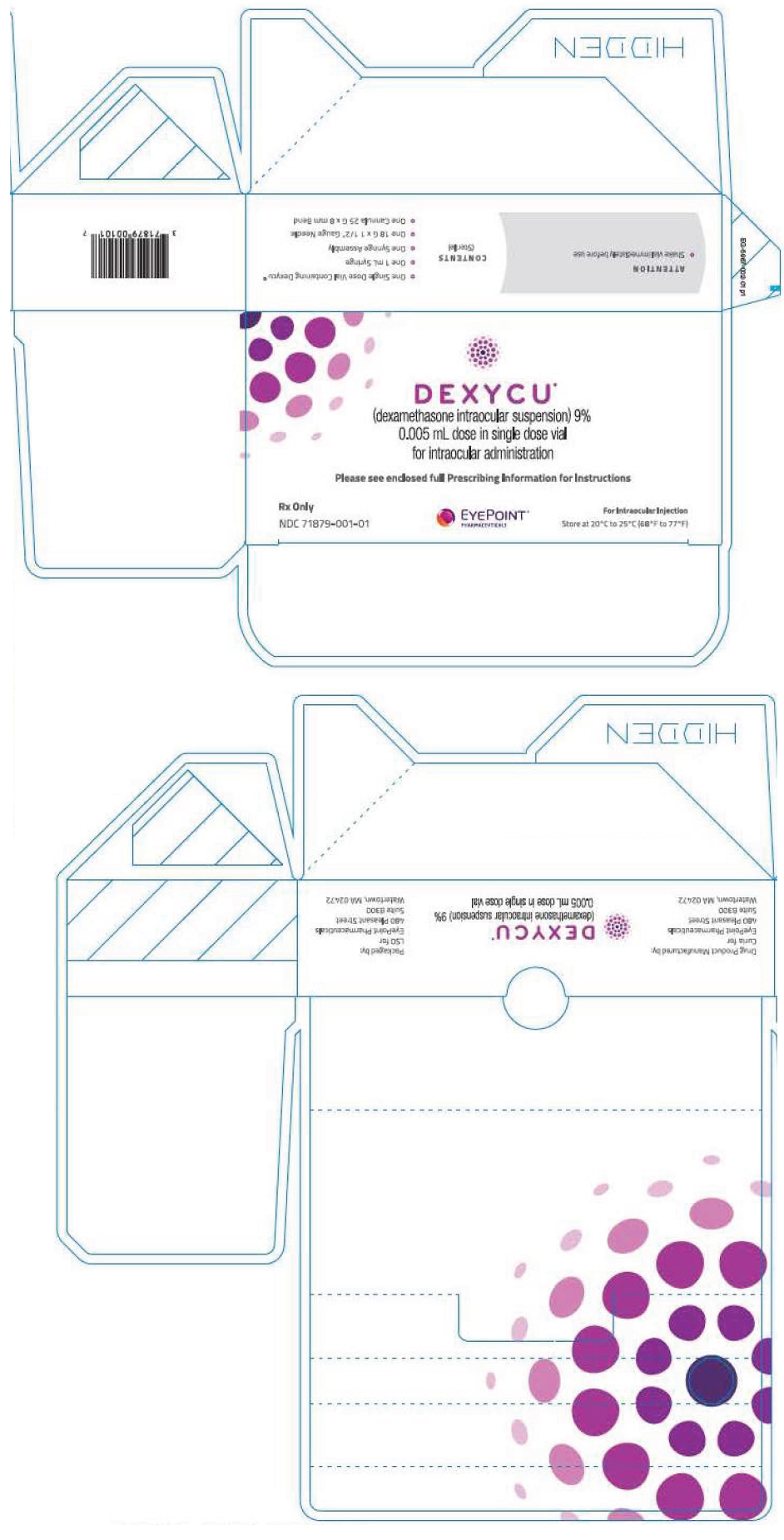
Dexycu dexamethasone 517 ug/.005mL Injection, Suspension, 1 vial — NDC 71879-001-01 (Billing 71879-0001-01)
This is a package of 1 vial of Dexycu dexamethasone 517 ug/.005mL Injection, Suspension from EyePoint Pharmaceuticals US, Inc, no longer marketed (first marketed May 2018), no longer in the FDA NDC Directory. It is this product's only package size.
NDC database record
One package, one record: these facts belong to NDC 71879-001-01 alone.
- Record
- FDA NDC Directory package listing · Human prescription drug
- Code segments
- 71879 labeler · 001 product · 01 package
- Package marketed since
- May 22, 2018
- Sample package
- No — commercial package
- Listing certified through
- Dec 31, 2026
- Barcode (UPC-A, from the NDC)
- 3 7187900101 7
- FDA record last changed
- Jul 24, 2026
Identity & classification
Regulatory identifiers FDA, NLM and CMS codes for this package
Drug-database identifiers Medi-Span GPI and First Databank GCN / HICL / AHFS classification
- GSN (GCN sequence number): 078417
- GCN: 44741
- GPI-14 (Medi-Span): 86300010001860
- HICL (First Databank): 044921
- AHFS class code: 52:08.08.00
- RxCUI (RxNorm): 2045404
Where does this data come from?
- FDA openFDA NDC Directory · synced Oct 8, 2026
- FDA label on DailyMed · label index refreshed Oct 8, 2026
- RxNorm (NLM RxNav) · catalog refreshed Oct 1, 2026
- Medi-Span GPI (licensed)
- First Databank (licensed) · refreshed Oct 8, 2026
RxNorm drug class
This medicine belongs to the Corticosteroid class.
Where does this data come from?
- RxClass (NLM) · catalog refreshed Oct 1, 2026
Clinical
Dexamethasone injection is used to treat severe allergic reactions. It is used in the management of certain types of edema (fluid retention and swelling; excess fluid held in body tissues,) gastrointestinal disease, and certain types of arthritis. Dexamethasone injection is also used for diagnostic testing. Dexamethasone injection is also used to treat certain conditions that affect the blood, skin, eyes, thyroid, kidneys, lungs, and nervous system. It is sometimes used in combination with other medications to treat symptoms of low corticosteroid levels (lack of certain substances that are usu...
Read the full MedlinePlus article ↗- It calms inflammation and treats many conditions, including severe allergic reactions, arthritis flares, certain skin diseases, brain swelling, and adrenal problems. It can also be...
- A healthcare professional gives it into a vein, muscle, joint, or lesion, depending on why you need it. Your dose is tailored to you and is usually brought down to the lowest effec...
- If you have been treated for more than a few days, it is usually stopped gradually. Stopping too fast can cause low adrenal function that may last for months. Never change the plan...
- Call right away for signs of infection, a severe allergic reaction, vision changes, or eye pain. Steroids can hide infection, so even mild symptoms matter. Seek urgent help for sud...
Patient education
Supplement & herbal interactions
Some supplements/herbs that may interact with Dexamethasone — tap one for details:
Dexamethasone may be associated with lower levels of 8 nutrients — worth a chat with your pharmacist, not a cause for alarm.
Where does this data come from?
- MedlinePlus (NLM) · refreshed Oct 8, 2026
- FDA label on DailyMed · label index refreshed Oct 8, 2026
Ask a licensed pharmacist directly — free, answered by our team.
Pricing
A drug doesn't have one price. Each row is a different public payment system, and none is what you'd pay at the counter — that depends on your insurance. The ⓘ on each row explains what it measures.
| Price system | Per mL | Per package |
|---|---|---|
| Retail pharmacies payNADAC · weekly | Not in the retail survey — common for institutional, discontinued, or low-volume packs. | |
| Medicaid paysCMS SDUD · 12 mo | No recent Medicaid claims on file for this NDC — rare and low-volume NDCs are suppressed in the public data. | |
| Medicare drug plans payPart D · quarterly | No Part D plan price is available for this NDC in our data. | |
Where does this data come from?
- CMS NADAC weekly file
- CMS ASP pricing files · refreshed Sep 20, 2026
- CMS Medicaid State Drug Utilization Data · refreshed Oct 8, 2026
- CMS Part D plan pricing files · refreshed Sep 24, 2026
- VA National Acquisition Center price file
Packaging — all sizes for this product
| Package NDC | Description | Marketing start | Marketing end | Status |
|---|---|---|---|---|
| 71879-0001-01 You're viewing this Main listing | 1 VIAL, GLASS in 1 CARTON / .5 mL in 1 VIAL, GLASS | 2018-05-22 | — | Inactivated by FDA |
Therapeutic equivalents
| Product | Labeler | Pack | NADAC/unit | TE | Status | Price vs. this |
|---|---|---|---|---|---|---|
| Dexycu 517 ug/.005mLthis 71879-0001-01 | EyePoint | 1 vial | — | — | Discontinued | — |
Where does this data come from?
- FDA openFDA NDC Directory · synced Oct 8, 2026
- FDA Orange Book · refreshed Oct 3, 2026
- CMS NADAC weekly file
Availability & generic status
We did not find an FDA-approved generic match for this exact strength, form and route. Patent/protection dates below may affect future generic timing.
Why the date isn’t exact: Generic timing can change because patents may be challenged, settled, licensed, added, removed, or worked around with a narrower label — and FDA approval does not always mean a pharmacy can get the generic today.
🛈 What do these terms mean?
- Patent
- Legal protection listed in the Orange Book that may delay generic approval or launch. Issued by the U.S. Patent & Trademark Office.
- Substance patent
- Covers the active drug molecule itself — the hardest to design around. A generic generally can’t launch until it expires.
- Formulation (product) patent
- Covers a specific formulation or dosage form. A generic can sometimes work around it with a different formulation.
- Method-of-use patent
- A patent covering one specific approved use of the drug — not necessarily the whole molecule. A generic can sometimes launch with a “skinny label” that carves out the protected use and keeps the others.
- Skinny label
- A generic label that omits a still-patented use when the FDA allows it — letting a generic reach the market for the unprotected uses.
- Exclusivity
- FDA-granted marketing protection, separate from patents — e.g. 5-yr new chemical entity, 7-yr orphan drug, or a +6-month pediatric extension.
- Paragraph IV
- A generic applicant’s formal challenge to a listed patent. It can potentially lead to earlier generic entry, but often involves litigation or a settlement.
- RLD / RS
- Reference Listed Drug — the brand product the FDA uses as the reference for generic applications. Reference Standard — the product the FDA expects generics to compare against in bioequivalence testing.
- TE / AB rating
- FDA therapeutic-equivalence rating. An AB rating generally means the FDA considers a generic therapeutically equivalent to — and substitutable for — the brand.
- LOE (loss of exclusivity)
- The latest patent or exclusivity currently listed — the loss-of-exclusivity / latest-listed-protection date shown on this page. Paragraph-IV challenges and settlements can move the real date earlier; FDA approval and a manufacturer’s decision to market can move it later.
Built from the FDA Orange Book. The bars above are scaled to each protection’s expiry; the red LOE marker is the last one to lapse.
| Patent | Type | Use code | Expires |
|---|---|---|---|
| US 10028965 ↗ | Method of use | U-2340 | May 23, 2034 |
| US 11097061 ↗ | Method of use | U-3418 | Jun 23, 2039 |
| US 10022502 ↗ | Method of use | U-2340 | Jun 22, 2034 |
| US 10799642 ↗ | Drug product | — | May 11, 2032 |
| US 10159683 ↗ | Drug product | — | May 23, 2034 |
Is there a generic version of DEXYCU 9% VIAL?
The FDA approved a generic — why can’t I get it at my pharmacy yet?
Why do different websites show different generic release dates?
What does “FDA listed” mean?
What does a patent or protection date mean here?
What does “current Orange Book estimate” mean?
Can a generic come out before the last patent expires?
Can a generic come out after the listed dates?
What is the difference between patents and exclusivity?
Why are there multiple patent dates?
Where does this data come from?
- FDA Orange Book · refreshed Oct 3, 2026
Inactive Ingredients / Excipients
Inactive ingredients, also called excipients, are components of the drug product other than the active ingredient. They may include fillers, dyes, coatings, preservatives, flavors, or other formulation ingredients.
🧪 Avoiding an ingredient? See Dexamethasone Injection inactive ingredients by manufacturer: every current product's list side by side, so you can ask your pharmacy for the version that does not list it.
💡 Tap an ingredient (hover on desktop) to see what it is and why it’s used.
-
5233 ug / 0.005 mL
UNII 5WBR36T90E
A plasticizer derived from citric acid, used to make tablet coatings and film coatings more flexible and less brittle so they don't crack during handling and storage.
-
UNII N762921K75
A colorless, odorless gas that makes up most of the air we breathe. In medicines, it's used as a packaging gas or propellant to protect products from oxidation and maintain freshness.
2 inactive ingredients listed in the exact product block matched to this NDC.
Where does this data come from?
ingredient classCode="IACT" elements from the exact product block matched by this NDC. Label-section narrative from DailyMed / the openFDA label index is shown separately when available.- FDA label on DailyMed · label index refreshed Oct 8, 2026
- FDA openFDA NDC Directory · synced Oct 8, 2026
Inactive ingredient FAQ
Are inactive ingredients the same for every manufacturer?
Why might an inactive ingredient be missing?
Can inactive ingredients matter?
Manufacturer & labeler
Where does this data come from?
- FDA openFDA NDC Directory · synced Oct 8, 2026
- Drugs@FDA
Full prescribing information FDA SPL
🎯 Indications and Usage ▾
1 INDICATIONS AND USAGE DEXYCU (dexamethasone intraocular suspension) 9% is indicated for the treatment of postoperative inflammation. DEXYCU is a corticosteroid indicated for the treatment of postoperative inflammation ( 1 ).
⏱️ Dosage and Administration ▾
2 DOSAGE AND ADMINISTRATION For intraocular administration ( 2 ). Administer 0.005 mL of DEXYCU into the posterior chamber inferiorly behind the iris at the end of ocular surgery ( 2 ).
2.1Dosing Information DEXYCU should be administered as a single dose, intraocularly in the posterior chamber at the end of surgery. The dose is 0.005 mL of dexamethasone 9% (equivalent to 517 micrograms).
2.2Preparation and Administration Each kit of DEXYCU is for a single administration. After preparation, 0.005 mL will be administered. The DEXYCU administration kit contains the following items: One glass vial: 0.5 mL of DEXYCU One sterile 1-mL syringe One sterile syringe guide One sterile syringe ring One sterile 18-gauge needle (1½ inches long), plastic cap attached One sterile 25-gauge bent cannula (8 mm long), plastic cap attached Step 1.
Prepare a sterile field. Remove the components of the administration kit from their respective pouches: syringe syringe guide syringe ring needle cannula Place onto the sterile field. Step 2.
Withdraw the syringe plunger approximately 1 inch. Place the syringe ring on the plunger (slit facing the plunger). Apply slight downward pressure until the syringe ring "snaps" into place.
Step 3. Place the 18-gauge needle firmly on the syringe. Remove the cap from the needle.
Depress the plunger completely and then withdraw the plunger to fill the syringe with air. Step 4. Mix using a vortex mixer or vigorously shake the vial of DEXYCU sideways for a minimum of 30 seconds.
The suspended drug material must be used immediately after shaking. Step 5. Remove the blue plastic flip-cap from the vial and wipe the top of rubber stopper with an alcohol pad.
Invert the vial. Step 6. Insert the needle into the vial and inject the air into the vial.
Making sure the needle tip is immersed in the drug material pooled in the neck of the inverted vial, fill the syringe by slowly withdrawing the plunger approximately 0.2 mL. Remove the needle from the vial and discard the unused portion in the vial. Step 7.
Remove the needle from the syringe. Firmly place the cannula on the syringe and remove the plastic cap. Hold the syringe vertically with the cannula pointing up.
Depress the plunger to expel air bubbles from syringe. Step 8. Affix the syringe guide over the syringe ring on the plunger.
Step 9. Depress the plunger until the syringe guide/ring mechanism comes gently into contact with the flange of the syringe. Lightly tap/flick the barrel of the syringe to remove any excess drug from the tip of the cannula.
Do not wipe or touch the tip of the cannula to remove excess drug. Step 10. Remove the syringe guide, leaving the syringe ring in place.
Caution to not move the plunger. The space between the syringe ring and the top of the plunger is the medication injection volume that will be applied to the patient's eye. The syringe is now ready for injection.
Step 11. In a single slow motion, inject 0.005 mL of the drug material behind the iris in the inferior portion of the posterior chamber. If the sphere of administered drug after intraocular injection appears to be larger than 2 mm in diameter, excess drug material may be removed by irrigation and aspiration in the sterile surgical setting PLEASE NOTE: Some drug material will remain in the syringe after the injection—this is necessary for accurate dosing.
Discard unused portion remaining in the syringe after administration. Figure Figure Figure Figure Figure Figure Figure Figure Figure Figure Figure Figure
💊 Dosage Forms and Strengths ▾
3 DOSAGE FORMS AND STRENGTHS DEXYCU contains dexamethasone 9% w/w (103.4 mg/mL) as a sterile suspension for intraocular ophthalmic administration. DEXYCU is provided as a kit for administration of a single dose of 0.005 mL of 9% dexamethasone (equivalent to 517 micrograms of dexamethasone). Intraocular suspension: 9% equivalent to dexamethasone 103.4 mg/mL in a single-dose vial provided in a kit ( 3 ).
⛔ Contraindications ▾
4 CONTRAINDICATIONS None. None ( 4 ).
⚠️ Warnings and Cautions ▾
5 WARNINGS AND PRECAUTIONS Increase in Intraocular Pressure (IOP) : Monitor for increases in IOP ( 5.1 ). Delayed Healing : Monitor for delayed healing ( 5.2 ). Infection Exacerbation : Monitor and treat for any exacerbations of bacterial, viral or fungal infections ( 5.3 ). Cataract Progression : Cataracts may develop or progress in phakic patients ( 5.4 ).
5.1Increase in Intraocular Pressure Prolonged use of corticosteroids including DEXYCU may result in glaucoma with damage to the optic nerve, defects in visual acuity and fields of vision. Steroids should be used with caution in the presence of glaucoma.
5.2Delayed Healing The use of steroids after cataract surgery may delay healing and increase the incidence of bleb formation. In those diseases causing thinning of the cornea or sclera, perforations have been known to occur with the use of corticosteroids.
5.3Exacerbation of Infection The use of DEXYCU, as with other ophthalmic corticosteroids, is not recommended in the presence of most active viral diseases of the cornea and conjunctiva including epithelial herpes simplex keratitis (dendritic keratitis), vaccinia, and varicella, and also in mycobacterial infection of the eye and fungal disease of ocular structures. Employment of a corticosteroid medication in the treatment of patients with a history of herpes simplex requires caution. Use of ocular steroids may prolong the course and may exacerbate the severity of many viral infections of the eye (including herpes simplex).
Fungal infections of the cornea are particularly prone to develop coincidentally with long-term local steroid application. Fungus invasion must be considered in any persistent corneal ulceration where a steroid has been used or is in use. Fungal culture should be taken when appropriate.
Prolonged use of corticosteroids may suppress the host response and thus increase the hazard of secondary ocular infections. In acute purulent conditions, steroids may mask infection or enhance existing infection.
5.4Cataract Progression The use of corticosteroids in phakic individuals may promote the development of posterior subcapsular cataracts.
🤒 Adverse Reactions ▾
6 ADVERSE REACTIONS The following adverse reactions are described elsewhere in the labeling: Increase in Intraocular Pressure [see Warnings and Precautions (5.1) ] Delayed Healing [see Warnings and Precautions (5.2) ] Infection Exacerbation [see Warnings and Precautions (5.3) ] Cataract Progression [see Warnings and Precautions (5.4) ] In controlled studies, the most common adverse reactions reported by 5-15% of patients were intraocular pressure increased, corneal edema and iritis ( 6.1 ). To report SUSPECTED ADVERSE REACTIONS, contact EyePoint Pharmaceuticals US at 1-833-EYEPOINT (1-833-393-7646) or FDA at 1-800-FDA-1088 or www.fda.gov/medwatch.
6.1Clinical Trials Experience Because clinical trials are conducted under widely varying conditions, adverse reaction rates observed in the clinical studies of a drug cannot be directly compared to rates in the clinical trials of another drug and may not reflect the rates observed in practice. The following adverse events rates are derived from three clinical trials in which 339 patients received the 517 microgram dose of DEXYCU. The most commonly reported adverse reactions occurred in 5-15% of subjects and included increases in intraocular pressure, corneal edema and iritis.
Other ocular adverse reactions occurring in 1-5% of subjects included, corneal endothelial cell loss, blepharitis, eye pain, cystoid macular edema, dry eye, ocular inflammation, posterior capsule opacification, blurred vision, reduced visual acuity, vitreous floaters, foreign body sensation, photophobia, and vitreous detachment.
👥 Use in Specific Populations ▾
8 USE IN SPECIFIC POPULATIONS
8.1Pregnancy Risk Summary There are no adequate and well-controlled studies of DEXYCU (dexamethasone intraocular suspension) 9% in pregnant women. Topical ocular administration of dexamethasone in mice and rabbits during the period of organogenesis produced cleft palate and embryofetal death in mice and malformations of abdominal wall/intestines and kidneys in rabbits at doses 7 and 5 times higher than the injected recommended human ophthalmic dose (RHOD) of DEXYCU (517 micrograms dexamethasone), respectively [see Data ] .
In the US general population the estimated background risk of major birth defects and miscarriage in clinically recognized pregnancies is 2 to 4% and 15 to 20%, respectively. Data Animal Data Topical ocular administration of 0.15% dexamethasone (0.75 mg/kg/day) on gestational days 10 to 13 produced embryofetal lethality and a high incidence of cleft palate in mice. A dose of 0.75 mg/kg/day in the mouse is approximately 7-times the injected RHOD of DEXYCU, on a mg/m 2 basis.
In rabbits, topical ocular administration of 0.1% dexamethasone throughout organogenesis (0.20 mg/kg/day on gestational day 6, followed by 0.13 mg/kg/day on gestational days 7 – 18) produced intestinal anomalies, intestinal aplasia, gastroschisis and hypoplastic kidneys. A dose of 0.13 mg/kg/day in the rabbit is approximately 5-times the injected RHOD of DEXYCU, on a mg/m 2 basis. A no-observed-adverse-effect-level (NOAEL) was not identified in the mouse or rabbit studies.
8.2Lactation Risk Summary Systemically administered corticosteroids are present in human milk and can suppress growth, interfere with endogenous corticosteroid production, or cause other unwanted effects. There is no information regarding the presence of injected DEXYCU in human milk, the effects on breastfed infants, or the effects on milk production to inform risk of DEXYCU to an infant during lactation. The developmental and health benefits of breastfeeding should be considered, along with the mother's clinical need for DEXYCU and any potential adverse effects on the breastfed child from DEXYCU.
8.4Pediatric Use Safety and effectiveness of DEXYCU in pediatric patients have not been established.
8.5Geriatric Use No overall differences in safety or effectiveness have been observed between older and younger patients.
🤰 Pregnancy ▾
8.1Pregnancy Risk Summary There are no adequate and well-controlled studies of DEXYCU (dexamethasone intraocular suspension) 9% in pregnant women. Topical ocular administration of dexamethasone in mice and rabbits during the period of organogenesis produced cleft palate and embryofetal death in mice and malformations of abdominal wall/intestines and kidneys in rabbits at doses 7 and 5 times higher than the injected recommended human ophthalmic dose (RHOD) of DEXYCU (517 micrograms dexamethasone), respectively [see Data ] .
In the US general population the estimated background risk of major birth defects and miscarriage in clinically recognized pregnancies is 2 to 4% and 15 to 20%, respectively. Data Animal Data Topical ocular administration of 0.15% dexamethasone (0.75 mg/kg/day) on gestational days 10 to 13 produced embryofetal lethality and a high incidence of cleft palate in mice. A dose of 0.75 mg/kg/day in the mouse is approximately 7-times the injected RHOD of DEXYCU, on a mg/m 2 basis.
In rabbits, topical ocular administration of 0.1% dexamethasone throughout organogenesis (0.20 mg/kg/day on gestational day 6, followed by 0.13 mg/kg/day on gestational days 7 – 18) produced intestinal anomalies, intestinal aplasia, gastroschisis and hypoplastic kidneys. A dose of 0.13 mg/kg/day in the rabbit is approximately 5-times the injected RHOD of DEXYCU, on a mg/m 2 basis. A no-observed-adverse-effect-level (NOAEL) was not identified in the mouse or rabbit studies.
🧒 Pediatric Use ▾
8.4Pediatric Use Safety and effectiveness of DEXYCU in pediatric patients have not been established.
🧓 Geriatric Use ▾
8.5Geriatric Use No overall differences in safety or effectiveness have been observed between older and younger patients.
🧬 Clinical Pharmacology ▾
12 CLINICAL PHARMACOLOGY
12.1Mechanism of Action Dexamethasone is a corticosteroid. Corticosteroids have been shown to suppress inflammation by inhibiting multiple inflammatory cytokines resulting in decreased edema, fibrin deposition, capillary leakage and migration of inflammatory cells.
12.3Pharmacokinetics Systemic exposure to dexamethasone was evaluated in a subgroup of patients enrolled in two studies (n=25 for the first study and n=13 for the second study). The patients received a single intraocular injection of DEXYCU containing 342 mcg or 517 mcg of dexamethasone at the end of cataract surgery and blood samples were collected prior to surgery and at several time points post-surgery between Day 1 and up to Day 30. In the first study, the dexamethasone plasma concentrations on post-surgery Day 1 ranged from 0.09 to 0.86 ng/mL and from 0.07 to 1.16 ng/mL following administration of DEXYCU 342 mcg and 517 mcg, respectively.
In the second study, dexamethasone plasma concentrations on post-surgery Day 1 ranged from 0.349 to 2.79 ng/mL following administration of DEXYCU 517 mcg. In both the studies, dexamethasone plasma concentrations declined over time and very few patients had quantifiable dexamethasone plasma concentrations at the final time point of sampling (Day 15 or Day 30).
🧬 Mechanism of Action ▾
12.1Mechanism of Action Dexamethasone is a corticosteroid. Corticosteroids have been shown to suppress inflammation by inhibiting multiple inflammatory cytokines resulting in decreased edema, fibrin deposition, capillary leakage and migration of inflammatory cells.
📦 How Supplied / Storage and Handling ▾
16 HOW SUPPLIED/STORAGE AND HANDLING Each kit of DEXYCU contains a single dose for a single patient. The 2-mL glass vial is filled with 0.5 mL of 9% dexamethasone intraocular suspension and has a blue cap (NDC # 71879-001-01). Each kit also contains one sterile 18-gauge, 1.5-inch needle with a plastic cap attached, one sterile plastic 1-mL syringe for withdrawal of the vial contents, one sterile 25-gauge 8-mm cannula with a plastic cap attached for the intraocular administration, and one syringe assembly pouch containing a sterile ring and a sterile syringe guide used for measuring and injection of the 0.005 mL dose.
Store at 20°C to 25°C (68°F to 77°F).
📦 Storage and Handling ▾
Store at 20°C to 25°C (68°F to 77°F).
📋 Description ▾
11 DESCRIPTION DEXYCU (dexamethasone intraocular suspension) 9% is a corticosteroid, sterile, white to off-white opaque suspension for intraocular administration. Each vial of DEXYCU contains 0.5 mL of 9% w/w dexamethasone suspension equivalent to 51.7 mg of dexamethasone. The inactive ingredient is acetyl triethyl citrate.
DEXYCU does not contain an antimicrobial preservative. The chemical name of dexamethasone is pregna-1,4-diene-3,20-dione, 9-fluoro-11,17,21-trihydroxy-16-methyl-, (11β,16α)-. It has a molecular formula of C 22 H 29 FO 5 and a molecular weight of 392.46 grams per mole.
Its structural formula is: Chemical Structure
🧬 Pharmacokinetics ▾
12.3Pharmacokinetics Systemic exposure to dexamethasone was evaluated in a subgroup of patients enrolled in two studies (n=25 for the first study and n=13 for the second study). The patients received a single intraocular injection of DEXYCU containing 342 mcg or 517 mcg of dexamethasone at the end of cataract surgery and blood samples were collected prior to surgery and at several time points post-surgery between Day 1 and up to Day 30. In the first study, the dexamethasone plasma concentrations on post-surgery Day 1 ranged from 0.09 to 0.86 ng/mL and from 0.07 to 1.16 ng/mL following administration of DEXYCU 342 mcg and 517 mcg, respectively.
In the second study, dexamethasone plasma concentrations on post-surgery Day 1 ranged from 0.349 to 2.79 ng/mL following administration of DEXYCU 517 mcg. In both the studies, dexamethasone plasma concentrations declined over time and very few patients had quantifiable dexamethasone plasma concentrations at the final time point of sampling (Day 15 or Day 30).
🔬 Clinical Studies ▾
14 CLINICAL STUDIES Clinical efficacy was evaluated in a randomized, double-masked, placebo-controlled trial (NCT02006888) in which subjects received either DEXYCU or placebo (vehicle). A dose of 5 microliters of DEXYCU (equivalent to 517 micrograms of dexamethasone), a dose equivalent to 342 micrograms of dexamethasone or vehicle was administered by the physician at the end of the surgical procedure. The primary efficacy endpoint for the study was the proportion of patients with anterior chamber cell clearing (i.e., cell score=0) on postoperative day (POD) 8.
The presence of anterior cells was assessed using a slit lamp binocular microscope up to 30 days post treatment. The percentage of patients with anterior chamber clearing at Day 8 was 20% in the placebo group, and 57%, and 60% in the 342 and 517 microgram treatment groups, respectively (Table 1). The percentage of subjects receiving rescue medication of ocular steroid or NSAID was significantly lower at Day 3, 8, 15 and 30 in the 342 and 517 microgram treatment groups compared to placebo (Table 2).
Table 1: Proportion of subjects with clearing of the anterior chamber cells by visit Treatments Difference and 97.5% CI Visits Placebo N=80 DEX342 N=158 DEX517 N=156 DEX342 vs Placebo DEX517 vs Placebo Subjects who received rescue medication were treated as failure. Day 1 7 (9%) 17 (11%) 24 (15%) 2% (-7%, 11%) 7% (-3%, 16%) Day 3 13 (16%) 60 (38%) 44 (28%) 22% (9%, 34%) 12% (0%, 24%) Day 8 16 (20%) 90 (57%) 94 (60%) 37% (24%, 50%) 40% (27%, 54%) Day 15 21 (26%) 83 (52%) 91 (58%) 26% (12%, 40%) 32% (18%, 46%) Day 30 28 (35%) 113 (72%) 103 (66%) 36% (22%, 51%) 31% (16%, 46%) Table 2: Proportion of subjects receiving rescue medications Visits Number (Percent) of Patients Receiving Rescue Medication, and 95% CI Placebo N=80 DEX342 N=158 DEX517 N=156 Subjects who received an ocular corticosteroid or NSAID in study eye.
Day 1 10 (13%); 6%, 22% 9 (6%); 3%, 10% 10 (6%); 3%, 12% Day 3 30 (38%); 27%, 49% 9 (6%); 3%, 10% 16 (10%); 6%,16% Day 8 40 (50%); 39%, 61% 12 (8%); 4%, 13% 16 (10%); 6%,16% Day 15 43 (54%); 42%, 65% 22 (14%); 9%, 20% 26 (17%); 11%, 24% Day 30 43 (54%); 42%, 65% 25 (16%); 10%, 22% 31 (20%); 14%, 27%
🧪 Nonclinical Toxicology ▾
13 NONCLINICAL TOXICOLOGY
13.1Carcinogenesis, Mutagenesis, Impairment of Fertility Animal studies have not been conducted to determine whether DEXYCU has the potential for carcinogenesis or mutagenesis. Fertility studies have not been conducted in animals.
📄 Carcinogenesis, Mutagenesis, Impairment of Fertility ▾
13.1Carcinogenesis, Mutagenesis, Impairment of Fertility Animal studies have not been conducted to determine whether DEXYCU has the potential for carcinogenesis or mutagenesis. Fertility studies have not been conducted in animals.
📄 Recent Major Changes ▾
Dosage and Administration ( 2.2 ) 6/2020
📄 Package Label / Principal Display Panel ▾
PRINCIPAL DISPLAY PANEL - 0.005 mL Vial Carton DEXYCU™ (dexamethasone intraocular suspension) 9% 0.005 mL dose in single dose vial for intraocular administration Please see enclosed full Prescribing Information for Instructions Rx Only NDC 71879-001-01 EYEPOINT™ PHARMACEUTICALS For Intraocular Injection Store at 20°C to 25°C (68°F to 77°F) PRINCIPAL DISPLAY PANEL - 0.005 mL Vial Carton
Medicare Part D spend CMS · PART D · 2026 (Q1)
Reported adverse events (FAERS)
Top reported reactions
Age at onset
Reporter sex
Serious outcomes
Where does this data come from?
About this NDC listing & data coverage
What data is (and isn’t) available for this NDC — tap to expand
| NDC identity (package / product / labeler codes) | ✓ Available |
| Labeler | ✓ Available |
| Product & package description | ✓ Available |
| Marketing category & status | ✓ Available |
| Active ingredient / dosage form / route | ✓ Available |
| FDA label (SPL via DailyMed) | ✓ Available |
| Package photos | ✓ Available |
| Inactive ingredients (structured) | ✓ Available |
| NADAC pharmacy acquisition price (CMS) | — Not published for this NDC CMS publishes NADAC only for NDCs reported in its retail-pharmacy survey. |
| Orange Book / therapeutic-equivalence data | ✓ Available |
| HCPCS J-code billing crosswalk | — Not published for this NDC Most self-administered / retail products have no J-code — that is normal. |
| Medicaid utilization (CMS SDUD) | — Not published for this NDC CMS reports utilization only for NDCs with Medicaid claims above its privacy threshold. |