
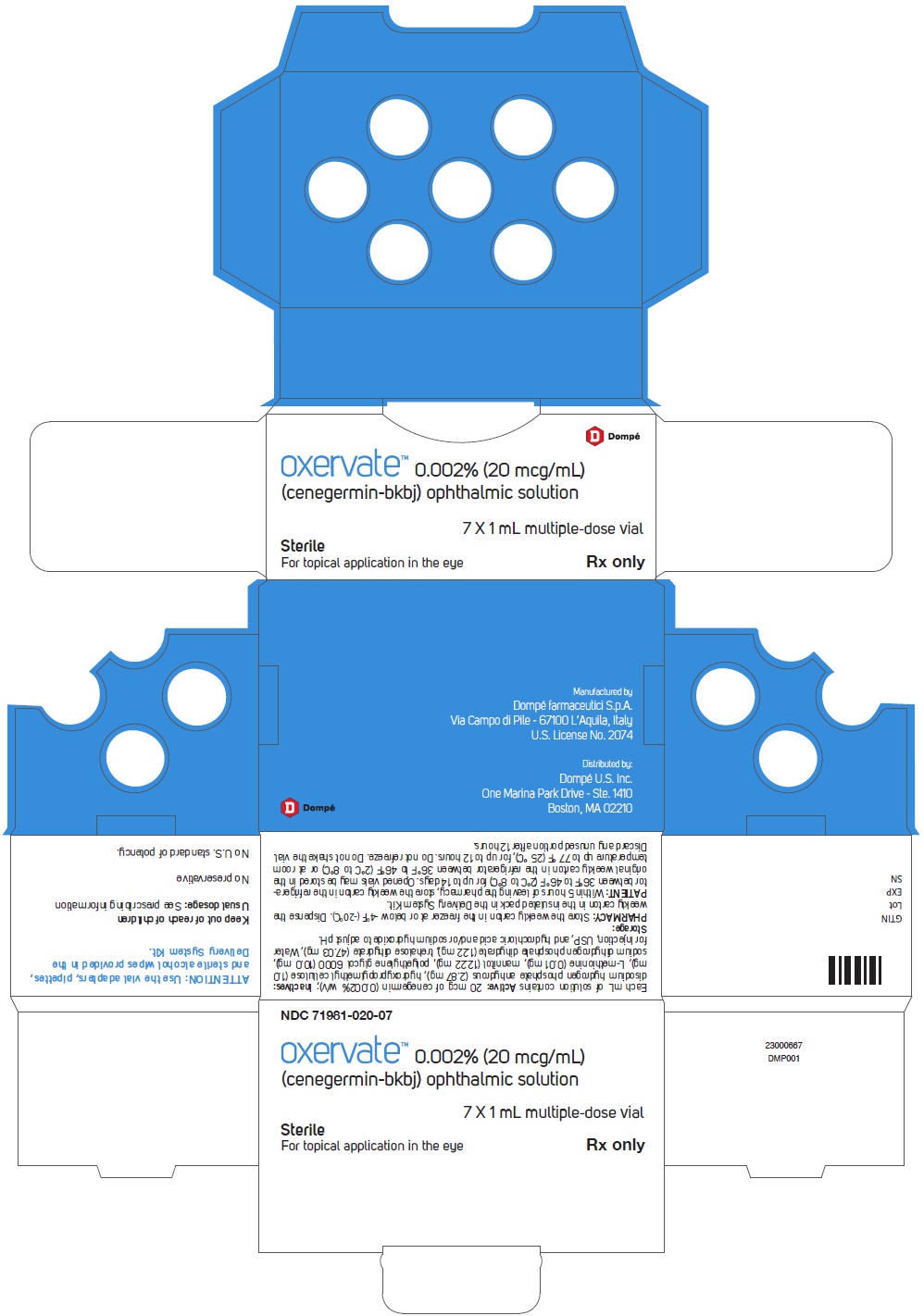
OXERVATE cenegermin-bkbj 20 ug/mL Solution/ Drops, 7 vials — NDC 71981-020-07 (Billing 71981-0020-07)
This is a package of 7 vials of OXERVATE cenegermin-bkbj 20 ug/mL Solution/ Drops from Domp farmaceutici S.p.A., marketed since Nov 2018 and currently FDA-listed. It is this product's only package size.
NDC database record
One package, one record: these facts belong to NDC 71981-020-07 alone.
- Record
- FDA NDC Directory package listing · Human prescription drug
- Code segments
- 71981 labeler · 020 product · 07 package
- Package marketed since
- Nov 26, 2018
- Sample package
- No — commercial package
- Listing certified through
- Dec 31, 2027
- Barcode (UPC-A, from the NDC)
- 3 7198102007 4
- Medicaid fills, this package
- 1,769 prescriptions in the last four reported quarters
- FDA record last changed
- Sep 3, 2026
Identity & classification
Regulatory identifiers FDA, NLM and CMS codes for this package
Drug-database identifiers Medi-Span GPI and First Databank GCN / HICL / AHFS classification
- GSN (GCN sequence number): 079287
- GCN: 45762
- HICL (First Databank): 045258
- AHFS class code: 52:08.00.00
- RxCUI (RxNorm): 2104336
Where does this data come from?
- FDA openFDA NDC Directory · synced Oct 8, 2026
- FDA label on DailyMed · label index refreshed Oct 8, 2026
- RxNorm (NLM RxNav) · catalog refreshed Oct 1, 2026
- Medi-Span GPI (licensed)
- First Databank (licensed) · refreshed Oct 8, 2026
RxNorm drug class
This medicine belongs to the Recombinant Human Nerve Growth Factor class.
Where does this data come from?
- RxClass (NLM) · catalog refreshed Oct 1, 2026
Clinical
- Neurotrophic keratitis is a condition where the nerves supplying your cornea — the clear front part of your eye — become damaged. Without those nerve signals, your cornea can't fee...
- What exactly is neurotrophic keratitis, and why do I need this medication?
- The six-times-a-day schedule, every two hours, is the regimen that was tested in clinical trials and shown to work. It keeps a steady supply of the nerve growth factor on the surfa...
- Why do I have to use these drops six times a day? That seems like a lot.
Patient education
Supplement & herbal interactions
Where does this data come from?
- MedlinePlus (NLM) · refreshed Oct 8, 2026
- FDA label on DailyMed · label index refreshed Oct 8, 2026
Ask a licensed pharmacist directly — free, answered by our team.
Pricing
A drug doesn't have one price. Each row is a different public payment system, and none is what you'd pay at the counter — that depends on your insurance. The ⓘ on each row explains what it measures.
| Price system | Per mL | Per package |
|---|---|---|
| Retail pharmacies payNADAC · weekly | Not in the retail survey — common for institutional, discontinued, or low-volume packs. | |
| Medicaid paysCMS SDUD · 12 mo | $2,090.25 | $14,631.73 / 7 ml |
| Medicare drug plans payPart D · Q2 2026 | $2,133.87 | $14,937.11 / 7 ml |
Where does this data come from?
- CMS NADAC weekly file
- CMS ASP pricing files · refreshed Sep 20, 2026
- CMS Medicaid State Drug Utilization Data · through Q1 2026
- CMS Part D plan pricing files · refreshed Sep 24, 2026
- VA National Acquisition Center price file
Packaging — all sizes for this product
| Package NDC | Description | Marketing start | Marketing end | Status |
|---|---|---|---|---|
| 71981-0020-07 You're viewing this Main listing | 7 VIAL, MULTI-DOSE in 1 CARTON / 1 mL in 1 VIAL, MULTI-DOSE | 2018-11-26 | — | Active |
Therapeutic equivalents
| Product | Labeler | Pack | NADAC/unit | TE | Status | Price vs. this |
|---|---|---|---|---|---|---|
| Oxervate 71981-0001-01 | Domp | 1 kit | — | — | FDA listed | — |
| Oxervate 20 ug/mLthis 71981-0020-07 | Domp | 7 vials | — | — | FDA listed | — |
Where does this data come from?
- FDA openFDA NDC Directory · synced Oct 8, 2026
- FDA Purple Book · refreshed Oct 5, 2026
- CMS NADAC weekly file
Availability & biosimilar status
Biologics have no small-molecule generics; biosimilar competition is tracked in the FDA Purple Book.
Why the date isn’t exact: Biosimilar timing can change because patents may be challenged, settled, licensed, added or removed, and litigation can move the real date earlier or later.
🛈 What do these terms mean?
- Biologic patent
- A patent the reference product’s maker has publicly listed. A biosimilar generally can’t launch until these expire — unless they’re invalidated or resolved in a settlement.
- Reference-product exclusivity
- A flat 12 years of FDA market protection from the biologic’s first licensure (the BPCIA). No biosimilar can be licensed before it ends, regardless of patents.
- Interchangeable exclusivity
- The first interchangeable biosimilar can earn a period as the only interchangeable version (pharmacists can substitute it without the prescriber).
- Earliest biosimilar (LOE)
- The latest of all the dates above — the soonest a biosimilar can realistically reach the market. Litigation and settlements can move it earlier.
Biologics have no small-molecule “generics” — competition comes from FDA-licensed biosimilars, tracked in the FDA Purple Book.
| Code | What it grants | Expires |
|---|---|---|
| RefProduct | Reference-product exclusivity (12-year, BPCIA) — no biosimilar can be licensed before this date | Aug 22, 2030 |
Is there a biosimilar for OXERVATE 0.002% EYE DROP?
Why do different websites show different biosimilar dates?
Can a biosimilar launch before the last patent expires?
What does “current Purple Book estimate” mean?
What does “FDA listed” mean?
What does a patent or protection date mean here?
Where does this data come from?
- FDA Purple Book · refreshed Oct 5, 2026
Inactive Ingredients / Excipients
Inactive ingredients, also called excipients, are components of the drug product other than the active ingredient. They may include fillers, dyes, coatings, preservatives, flavors, or other formulation ingredients.
🧪 Avoiding an ingredient? See Cenegermin-bkbj Ophthalmic inactive ingredients by manufacturer: every current product's list side by side, so you can ask your pharmacy for the version that does not list it.
💡 Tap an ingredient (hover on desktop) to see what it is and why it’s used.
-
UNII QTT17582CB
A strong acid used to adjust and maintain the proper pH level in liquid medicines, ensuring stability and preventing breakdown of active ingredients.
-
1.0 mg / 1 mL
UNII 3NXW29V3WO
Hypromellose is a plant-based thickener made from cellulose. It's used in medicines as a binder to hold ingredients together, a coating for tablets, and a thickener for liquids.
-
12.22 mg / 1 mL
UNII 3OWL53L36A
A natural sugar alcohol derived from seaweed or synthesized in the lab. It's used as a filler to add bulk, a sweetener in sugar-free formulas, and a disintegrant to help tablets break apart in the stomach.
-
0.01 mg / 1 mL
UNII AE28F7PNPL
Methionine is an amino acid used as a nutrient supplement and pH buffer in medicines. It helps stabilize the formulation and supports the product's overall composition.
-
UNII N762921K75
A colorless, odorless gas that makes up most of the air we breathe. In medicines, it's used as a packaging gas or propellant to protect products from oxidation and maintain freshness.
-
10.0 mg / 1 mL
UNII 30IQX730WE
Polyethylene glycol 6000 is a synthetic polymer made from ethylene glycol units. It acts as a binder, filler, and solubilizer in medicines to help hold ingredients together, add bulk, and improve how well active drugs dissolve and absorb.
-
UNII 55X04QC32I
A strong alkaline chemical used to adjust and maintain the pH balance of liquid medicines. It helps keep the medicine stable and ensures it stays effective during storage.
-
2.87 mg / 1 mL
UNII 22ADO53M6F
A mineral salt derived from phosphoric acid, used as a buffer to maintain the pH balance of the medication and help stabilize the active ingredients.
-
1.22 mg / 1 mL
UNII 5QWK665956
A salt derived from phosphoric acid and sodium, used primarily as a buffer to control the acidity or pH of a medication, helping keep it stable during storage and use.
-
47.03 mg / 1 mL
UNII 7YIN7J07X4
A natural sugar derived from plants and microorganisms. It acts as a filler to give the medication bulk and stability, and helps preserve the active ingredient during storage and manufacturing.
-
UNII 059QF0KO0R
Water is a liquid solvent that dissolves and mixes ingredients together in liquid medicines, syrups, and injections. It helps distribute the active drug evenly throughout the product.
11 inactive ingredients listed in the exact product block matched to this NDC.
Where does this data come from?
ingredient classCode="IACT" elements from the exact product block matched by this NDC. Label-section narrative from DailyMed / the openFDA label index is shown separately when available.- FDA label on DailyMed · label index refreshed Oct 8, 2026
- FDA openFDA NDC Directory · synced Oct 8, 2026
Inactive ingredient FAQ
Are inactive ingredients the same for every manufacturer?
Why might an inactive ingredient be missing?
Can inactive ingredients matter?
Manufacturer & labeler
More NDCs from Domp farmaceutici S.p.A. labeler code 71981
Where does this data come from?
- FDA openFDA NDC Directory · synced Oct 8, 2026
- Drugs@FDA
Full prescribing information FDA SPL
🎯 Indications and Usage ▾
1 INDICATIONS AND USAGE OXERVATE ® (cenegermin-bkbj) ophthalmic solution 0.002% is indicated for the treatment of neurotrophic keratitis. OXERVATE is a recombinant human nerve growth factor indicated for the treatment of neurotrophic keratitis. ( 1 )
⏱️ Dosage and Administration ▾
2 DOSAGE AND ADMINISTRATION One drop of OXERVATE in the affected eye(s), 6 times per day at 2-hour intervals, for eight weeks. ( 2.1 )
2.1General Dosing Information Contact lenses should be removed before applying OXERVATE and may be reinserted 15 minutes after administration. If a dose is missed, treatment should be continued as normal, at the next scheduled administration. If more than one topical ophthalmic product is being used, administer the eye drops at least 15 minutes apart to avoid diluting products.
Administer OXERVATE 15 minutes prior to using any eye ointment, gel or other viscous eye drops.
2.2Recommended Dosage and Dose Administration Instill one drop of OXERVATE in the affected eye(s), 6 times a day at 2-hour intervals for eight weeks.
2.3Preparation for Administration Remove the weekly carton(s) containing OXERVATE vials from the insulated pack and store it for up to 14 days in a refrigerator (no later than 5 hours from when you receive the medicine from your pharmacy). OXERVATE is stored in a freezer at the pharmacy. If treatment is started immediately after receiving the weekly carton, wait until the first vial is thawed (this could take up to 30 minutes when kept at room temperature up to 77°F (25°C)).
Do not shake the vial. Follow Steps 1 to 19 each day you use OXERVATE: Take an individual vial of OXERVATE from the refrigerator in the morning and prepare it in the following way: Step 1. Wash your hands.
Step 2. If you wear contact lenses, take them out before using OXERVATE. Step 3.
Remove the plastic flip-off cap from the vial. Step 4. Peel-off the back of the vial adapter blister pack.
Step 5. Without removing the vial adapter from its blister pack, connect it to the vial by firmly pushing it down until it snaps into place over the neck of the vial. The spike of the vial adapter should pierce through the vial’s rubber stopper.
After the vial adapter has been connected correctly, do not remove it from the vial. Note: After the vial adapter is connected to the vial, OXERVATE can be stored in the refrigerator between 36°F to 46°F (2°C to 8°C) for up to 12 hours. If needed, the OXERVATE with the connected vial adapter may be stored at room temperature up to 77°F (25°C).
Step 6. Remove and throw away the packaging of the vial adapter. The multi-dose vial of OXERVATE is now ready for use (1 drop in the affected eye every 2 hours six times a day).
To withdraw and give each dose of OXERVATE, follow the Steps 7 to 19 : Step 7. Take a single sterile disinfectant wipe and gently clean the surface of the valve on the connector part of the vial adapter. After cleaning, wait for about 1 minute to allow the valve to dry.
Step 8. Remove a pipette from its protective packaging. Step 9.
Screw the pipette (clockwise) into the connector part of the vial adapter. Step 10. Make sure that the pipette plunger is pushed all the way down.
Step 11. Turn the vial upside-down with the pipette still connected. Gently pull the plunger until it stops, to draw the eye drop solution into the pipette.
Make sure the plunger has reached the stop point. Step 12. Check the pipette to make sure it contains the eye drop solution.
Air bubbles may cause blockage and prevent the pipette from filling properly (especially the first time you withdraw the eye drop solution). If the pipette is empty, keep the vial with the connected pipette upside-down, push the plunger all the way in and pull it out again. Step 13.
After the pipette has been correctly filled, unscrew the pipette from the connector part of the vial adapter (counter-clockwise). Pull the pipette straight up to remove it. Step 14.
Sit or lie down to steady yourself when you instill OXERVATE. Holding the pipette, pointing down, between your middle finger and thumb, tilt your head back and position the pipette above your affected eye. With your other hand, pull down your lower eyelid, increasing the space between the inner eyelid and the eyeball (the conjunctival fornix).
Gently push the… [Excerpted — this section continues on DailyMed.]
💊 Dosage Forms and Strengths ▾
3 DOSAGE FORMS AND STRENGTHS Ophthalmic solution: cenegermin-bkbj 0.002% (20 mcg/mL) as a clear, colorless solution in a multiple dose vial. Ophthalmic solution: cenegermin-bkbj 0.002% (20 mcg/mL) in a multiple-dose vial. ( 3 )
⛔ Contraindications ▾
4 CONTRAINDICATIONS None. None. ( 4 )
⚠️ Warnings and Cautions ▾
5 WARNINGS AND PRECAUTIONS Patients should remove contact lenses before applying OXERVATE and wait 15 minutes after instillation of the dose before reinsertion. ( 5.1 )
5.1Use with Contact Lens Contact lenses should be removed before applying OXERVATE because the presence of a contact lens (either therapeutic or corrective) could theoretically limit the distribution of cenegermin-bkbj onto the area of the corneal lesion. Lenses may be reinserted 15 minutes after administration.
5.2Eye Discomfort OXERVATE may cause mild to moderate eye discomfort such as eye pain during treatment. The patient should be advised to contact their doctor if a more serious eye reaction occurs.
🤒 Adverse Reactions ▾
6 ADVERSE REACTIONS The most common adverse reactions (incidence >5%) are eye pain, ocular hyperemia, eye inflammation and increased lacrimation. ( 6.1 ) To report SUSPECTED ADVERSE REACTIONS, contact Dompé U.S. Inc. at 1-833-366-7387 or FDA at 1-800-FDA-1088 or www.fda.gov/medwatch .
6.1Clinical Trials Experience Because clinical studies are conducted under widely varying conditions, adverse reaction rates observed in the clinical studies of a drug cannot be directly compared to rates in the clinical studies of another drug and may not reflect the rates observed in practice. In two clinical trials of patients with neurotrophic keratitis, a total of 101 patients received cenegermin-bkbj eye drops at 20 mcg/mL at a frequency of 6 times daily in the affected eye(s) for a duration of 8 weeks. The mean age of the population was 61 to 65 years of age (18 to 95).
The majority of the treated patients were female (61%). The most common adverse reaction was eye pain following instillation which was reported in approximately 16% of patients. Eye pain may arise as corneal healing occurs.
Other adverse reactions occurring in 1% to 10% of OXERVATE patients included corneal deposits, foreign body sensation, ocular hyperemia, ocular inflammation, photophobia, tearing, and headache.
6.2Postmarketing Experience The following adverse reactions have been identified during postapproval use of OXERVATE. Because these reactions are reported voluntarily from a population of uncertain size, it is not always possible to reliably estimate their frequency or establish a causal relationship to drug exposure. Eye disorders : eye irritation, blepharitis (including eyelid margin crusting and eyelid edema) and corneal neovascularization.
👥 Use in Specific Populations ▾
8 USE IN SPECIFIC POPULATIONS
8.1Pregnancy Risk Summary There are no data from the use of OXERVATE in pregnant women to inform any drug associated risks. Administration of cenegermin-bkbj to pregnant rats or rabbits during the period of organogenesis did not produce adverse fetal effects at clinically relevant doses. In a pre- and postnatal development study, administration of cenegermin-bkbj to pregnant rats throughout gestation and lactation did not produce adverse effects in offspring at clinically relevant doses.
Data Animal Data In embryofetal development studies, daily subcutaneous administration of cenegermin-bkbj to pregnant rats and rabbits throughout the period of organogenesis produced a slight increase in post-implantation loss at doses greater than or equal to 42 mcg/kg/day (267 times the MRHOD). A no observed adverse effect level (NOAEL) was not established for post-implantation loss in either species. In rats, hydrocephaly and ureter anomalies were observed each in one fetuses at 267 mcg/kg/day (1709 times the MRHOD).
In rabbits, cardiovascular malformations, including ventricular and atrial septal defects, enlarged heart and aortic arch dilation were observed each in one fetuses at 83 mcg/kg/day (534 times the MRHOD). No fetal malformations were observed in rats and rabbits at doses of 133 mcg/kg/day and 42 mcg/kg/day, respectively. In a pre- and postnatal development study, daily subcutaneous administration of cenegermin-bkbj to pregnant rats during the period of organogenesis and lactation did not affect parturition and was not associated with adverse toxicity in offspring at doses up to 267 mcg/kg/day.
In parental rats and rabbits, an immunogenic response to cenegermin-bkbj was observed. Given that cenegermin-bkbj is a heterologous protein in animals, this response may not be relevant to humans.
8.2Lactation Risk Summary There are no data on the presence of OXERVATE in human milk, the effects on breastfed infant, or the effects on milk production. The developmental and health benefits of breastfeeding should be considered, along with the mother’s clinical need for OXERVATE, and any potential adverse effects on the breastfed infant from OXERVATE.
8.4Pediatric Use The safety and effectiveness of OXERVATE have been established in the pediatric population. Use of OXERVATE in this population is supported by evidence from adequate and well-controlled trials of OXERVATE in adults with additional safety data in pediatric patients from 2 years of age and older [see Clinical Studies (14) ].
8.5Geriatric Use Of the total number of subjects in clinical studies of OXERVATE, 43.5% were 65 years old and over. No overall differences in safety or effectiveness were observed between elderly and younger adult patients.
🤰 Pregnancy ▾
8.1Pregnancy Risk Summary There are no data from the use of OXERVATE in pregnant women to inform any drug associated risks. Administration of cenegermin-bkbj to pregnant rats or rabbits during the period of organogenesis did not produce adverse fetal effects at clinically relevant doses. In a pre- and postnatal development study, administration of cenegermin-bkbj to pregnant rats throughout gestation and lactation did not produce adverse effects in offspring at clinically relevant doses.
Data Animal Data In embryofetal development studies, daily subcutaneous administration of cenegermin-bkbj to pregnant rats and rabbits throughout the period of organogenesis produced a slight increase in post-implantation loss at doses greater than or equal to 42 mcg/kg/day (267 times the MRHOD). A no observed adverse effect level (NOAEL) was not established for post-implantation loss in either species. In rats, hydrocephaly and ureter anomalies were observed each in one fetuses at 267 mcg/kg/day (1709 times the MRHOD).
In rabbits, cardiovascular malformations, including ventricular and atrial septal defects, enlarged heart and aortic arch dilation were observed each in one fetuses at 83 mcg/kg/day (534 times the MRHOD). No fetal malformations were observed in rats and rabbits at doses of 133 mcg/kg/day and 42 mcg/kg/day, respectively. In a pre- and postnatal development study, daily subcutaneous administration of cenegermin-bkbj to pregnant rats during the period of organogenesis and lactation did not affect parturition and was not associated with adverse toxicity in offspring at doses up to 267 mcg/kg/day.
In parental rats and rabbits, an immunogenic response to cenegermin-bkbj was observed. Given that cenegermin-bkbj is a heterologous protein in animals, this response may not be relevant to humans.
🧒 Pediatric Use ▾
8.4Pediatric Use The safety and effectiveness of OXERVATE have been established in the pediatric population. Use of OXERVATE in this population is supported by evidence from adequate and well-controlled trials of OXERVATE in adults with additional safety data in pediatric patients from 2 years of age and older [see Clinical Studies (14) ].
🧓 Geriatric Use ▾
8.5Geriatric Use Of the total number of subjects in clinical studies of OXERVATE, 43.5% were 65 years old and over. No overall differences in safety or effectiveness were observed between elderly and younger adult patients.
🧬 Clinical Pharmacology ▾
12 CLINICAL PHARMACOLOGY
12.1Mechanism of Action Nerve growth factor is an endogenous protein involved in the differentiation and maintenance of neurons, which acts through specific high-affinity (i.e., TrkA) and low-affinity (i.e. p75NTR) nerve growth factor receptors in the anterior segment of the eye to support corneal innervation and integrity.
12.2Pharmacodynamics No pharmacodynamic studies have been conducted in humans.
12.3Pharmacokinetics Systemic exposure to cenegermin-bkbj was evaluated by measuring serum nerve growth factor (NGF) concentrations in 20 healthy subjects who received single and multiple (up to six times a day) administration of one drop (35 μL) OXERVATE (0.70 μg of cenegermin-bkbj/administration). The study also included a placebo arm in 10 healthy subjects who received vehicle only. At baseline/pre-dose, 17 out of the 20 subjects in the OXERVATE treatment arm had serum NGF concentrations below the limit of assay quantification (LLOQ <15 pg/mL) and the remaining three subjects had serum NGF concentrations ranging from 120 pg/mL to 503 pg/mL.
At baseline/pre-dose, 8 of the 10 subjects in the placebo arm had serum NGF concentrations below the limit of assay quantification (LLOQ <15 pg/mL) and the remaining two subjects had serum NGF concentrations ranging from 15 pg/mL to 116 pg/mL. Overall, there was no apparent relationship between OXERVATE treatment and serum NGF concentrations.
🧬 Mechanism of Action ▾
12.1Mechanism of Action Nerve growth factor is an endogenous protein involved in the differentiation and maintenance of neurons, which acts through specific high-affinity (i.e., TrkA) and low-affinity (i.e. p75NTR) nerve growth factor receptors in the anterior segment of the eye to support corneal innervation and integrity.
📦 How Supplied / Storage and Handling ▾
16 HOW SUPPLIED/STORAGE AND HANDLING OXERVATE (cenegermin-bkbj) ophthalmic solution, 0.002% (20 mcg/mL), is a sterile, clear, colorless solution in a multiple-dose vial, closed with a rubber stopper (not made with natural rubber latex), and an aluminum overseal with a polypropylene flip-off cap. OXERVATE is supplied in weekly cartons containing 7 multiple-dose vials (NDC 71981-020-07). OXERVATE is dispensed to patients in an insulated pack and co-packaged with the Delivery System Kit (NDC 71981-001-01).
The Delivery System Kit contains 8 vial adapters, 45 pipettes, 45 sterile disinfectant wipes, and 1 Dose Recording Card. Pharmacy Storage Store the weekly cartons containing OXERVATE vials in the freezer at or below -4°F (-20°C). Dispense the weekly carton(s) containing OXERVATE vials in an insulated pack in combination with the Delivery System Kit.
Patient Storage Within 5 hours of delivery, store the weekly carton(s) containing OXERVATE vials in the refrigerator between 36°F to 46°F (2°C to 8°C) for up to 14 days. A vial opened for daily use may be stored in the original weekly carton in the refrigerator between 36°F to 46°F (2°C to 8°C) or at room temperature up to 77°F (25°C), for up to 12 hours [see Dosage and Administration (2.1) ] . Do not refreeze the vials.
Do not shake the vials. Discard the opened vial after 12 hours even if there is still some solution left inside.
📋 Description ▾
11 DESCRIPTION OXERVATE ophthalmic solution contains cenegermin-bkbj, a recombinant form of human nerve growth factor produced in Escherichia coli . Cenegermin-bkbj contains 118 amino acids. Cenegermin-bkbj has a relative molecular mass of 13,266 Daltons and the following molecular formula: C 583 H 908 N 166 O 173 S 8 .
OXERVATE (cenegermin-bkbj) is a clear, colorless sterile solution with a pH of 7.0-7.4 and osmolarity 280-320 mOsm/kg for topical ophthalmic use. Each mL contains Active : 20 mcg of cenegermin (0.002% w/v); Inactives : disodium hydrogen phosphate anhydrous (2.87 mg), hydroxypropylmethyl cellulose (1.0 mg), L-methionine (0.01 mg), mannitol (12.22 mg), polyethylene glycol 6000 (10.0 mg), sodium dihydrogen phosphate dihydrate (1.22 mg), trehalose dihydrate (47.03 mg), Water for Injection, USP, and hydrochloric acid and/or sodium hydroxide to adjust pH.
OXERVATE does not contain an anti-microbial preservative.
💬 Information for Patients ▾
17 PATIENT COUNSELING INFORMATION Advise the patient to read the FDA-approved patient labeling ( Patient Information and Instructions for Use ). Handling the Vials and the Delivery System Advise patients that OXERVATE should be administered using the vial adapters, pipettes, and sterile disinfectant wipes provided in the Delivery System Kit and according to the instructions [see Dosage and Administration (2) ] . One individual pipette should be used per application.
Use with Contact Lenses Advise patients that contact lenses should be removed before applying OXERVATE and to wait 15 minutes after instillation of the dose before reinserting the contact lenses into the eyes [see Dosage and Administration (2.2) and Warnings and Precautions (5.1) ] . Use with other topical products Advise the patient to administer the eye drops at least 15 minutes apart, if more than one topical ophthalmic product is being used to avoid diluting products. Administer OXERVATE 15 minutes prior to using any eye ointment, gel or other viscous eye drops.
Delayed or Missed Dose If a dose is missed, treatment should be continued as normal, at the next scheduled administration. Storage Information Instruct the patient to remove the weekly carton(s) containing 7 OXERVATE vials from the insulated pack within 5 hours of receiving it from the pharmacy and store the weekly carton(s) in the refrigerator [36°F to 46°F (2°C to 8°C)]. Instruct the patient to only remove the number of OXERVATE vials from the weekly carton required for use over the course of a single day.
Do not shake the vial. Once opened, the vial can be kept in the original weekly carton in the refrigerator between 36°F to 46°F (2°C to 8°C) for up to 12 hours or at room temperature up to 77°F (25°C), but must be used within 12 hours. After 12 hours, advise patients to discard the vial with any unused amount.
Manufactured by Dompé farmaceutici S.p.A. Via Campo di Pile 67100 L’Aquila, Italy U.S. License No.
2074 ® 2024. Dompé U.S. Inc.
🧬 Pharmacokinetics ▾
12.3Pharmacokinetics Systemic exposure to cenegermin-bkbj was evaluated by measuring serum nerve growth factor (NGF) concentrations in 20 healthy subjects who received single and multiple (up to six times a day) administration of one drop (35 μL) OXERVATE (0.70 μg of cenegermin-bkbj/administration). The study also included a placebo arm in 10 healthy subjects who received vehicle only. At baseline/pre-dose, 17 out of the 20 subjects in the OXERVATE treatment arm had serum NGF concentrations below the limit of assay quantification (LLOQ <15 pg/mL) and the remaining three subjects had serum NGF concentrations ranging from 120 pg/mL to 503 pg/mL.
At baseline/pre-dose, 8 of the 10 subjects in the placebo arm had serum NGF concentrations below the limit of assay quantification (LLOQ <15 pg/mL) and the remaining two subjects had serum NGF concentrations ranging from 15 pg/mL to 116 pg/mL. Overall, there was no apparent relationship between OXERVATE treatment and serum NGF concentrations.
🧬 Pharmacodynamics ▾
12.2Pharmacodynamics No pharmacodynamic studies have been conducted in humans.
🔬 Clinical Studies ▾
14 CLINICAL STUDIES The efficacy and safety of OXERVATE for the treatment of neurotrophic keratitis was studied in a total of 151 patients, evaluated in two 8-week, randomized, multi-center, double-masked, vehicle-controlled studies. Patients were randomized to OXERVATE, cenegermin-bkbj 10 mcg/mL, or vehicle in Study NGF0212, and OXERVATE or vehicle in Study NGF0214 dosed 6 times daily in the affected eye(s) for 8 weeks. In study NGF0212, only patients with unilateral disease were enrolled, while in study NGF0214 patients with bilateral disease were treated bilaterally.
The mean age was 61 to 65 years (18-95). The majority of patients were female (approximately 61%). Table 1 below summarizes the results for complete corneal healing defined as absence of staining of the corneal lesion and no persistent staining in the rest of the cornea after 8 weeks of treatment.
Table 1. Percentage of Patients with Complete Corneal Healing at Week 8 Patients without any post-baseline measurements were excluded from the analysis. * p-value < 0.01 for both studies. Study OXERVATE Vehicle Treatment Difference* (95% CI) NGF0214 15/23 (65.2%) 4/24 (16.7%) 48.6% (24%, 73.1%) NGF0212 36/50 (72.0%) 17/51 (33.3%) 38.7% (20.7%, 56.6%) In patients who were healed after 8 weeks of treatment with OXERVATE, recurrences occurred in approximately 20% of patients in Study NGF0212 and 14% of patients in Study NGF0214.
The results of the mean change from baseline in corneal sensitivity inside the lesion after 8 weeks of treatment are summarized descriptively in Table 2. The mean changes in corneal sensitivity were not clinically significant in either study. Table 2.
Mean Corneal Sensitivity inside the Lesion: Baseline and Change from Baseline at Week 8 Change from baseline in corneal sensitivity inside the lesion was analyzed using an analysis of covariance model adjusting for baseline values. Patients without any post-baseline measurements were excluded from the analysis. *Mean (standard deviation) are presented at baseline; least squared means (standard error) are presented at Week 8 ** NGF0214: OXERVATE, n = 21; Vehicle, n = 23 NGF0212: OXERVATE, n = 48; Vehicle, n = 47 Study Visit* OXERVATE Vehicle Treatment Difference** (95% CI) NGF0214 Baseline 0.8 (1.19) 0.6 (0.70) Change from baseline at Week 8 1.6 (0.26) 0.7 (0.25) 0.9 (0.2, 1.7) NGF0212 Baseline 1.1 (1.34) 1.0 (1.19) Change from baseline at Week 8 1.1 (0.23) 0.8 (0.23) 0.3 (-0.4, 0.9)
🧪 Nonclinical Toxicology ▾
13 NONCLINICAL TOXICOLOGY
13.1Carcinogenesis, Mutagenesis, Impairment of Fertility Carcinogenesis and Mutagenesis Animal studies have not been conducted to determine the carcinogenic and mutagenic potential of cenegermin-bkbj. Impairment of fertility Daily subcutaneous administration of cenegermin-bkbj to male and female rats for at least 14 days prior mating, and at least 18 days post-coitum had no effect on fertility parameters in male or female rats at doses up to 267 mcg/kg/day (1709 times the MRHOD). In general toxicology studies, subcutaneous and ocular administration of cenegermin-bkbj in females was associated with ovarian findings including persistent estrus, ovarian follicular cysts, atrophy/reduction of corpora lutea, and changes in ovarian weight at doses greater than or equal to 19 mcg/kg/day (119 times the MRHOD).
📄 Carcinogenesis, Mutagenesis, Impairment of Fertility ▾
13.1Carcinogenesis, Mutagenesis, Impairment of Fertility Carcinogenesis and Mutagenesis Animal studies have not been conducted to determine the carcinogenic and mutagenic potential of cenegermin-bkbj. Impairment of fertility Daily subcutaneous administration of cenegermin-bkbj to male and female rats for at least 14 days prior mating, and at least 18 days post-coitum had no effect on fertility parameters in male or female rats at doses up to 267 mcg/kg/day (1709 times the MRHOD). In general toxicology studies, subcutaneous and ocular administration of cenegermin-bkbj in females was associated with ovarian findings including persistent estrus, ovarian follicular cysts, atrophy/reduction of corpora lutea, and changes in ovarian weight at doses greater than or equal to 19 mcg/kg/day (119 times the MRHOD).
📄 Patient Package Insert ▾
PATIENT INFORMATION OXERVATE ® (ox'-er-vayt) (cenegermin-bkbj) ophthalmic solution, for topical ophthalmic use What is OXERVATE ® ? OXERVATE is a prescription eye drop solution used to treat a condition called neurotrophic keratitis. OXERVATE is safe and effective in children two years of age and older.
Before you use OXERVATE, tell your doctor about all of your medical conditions, including if you: have an infection in your eye. If you get an eye infection while using OXERVATE, talk to your doctor right away. are using any other eye drops. wear contact lenses. are pregnant or plan to become pregnant. It is not known if OXERVATE will harm your unborn baby. are breastfeeding or plan to breastfeed.
It is not known if OXERVATE passes into your breast milk. Talk to your doctor about the best way to feed your baby if you use OXERVATE. Tell your doctor about all the medicines you take , including prescription and over-the-counter medicines, vitamins, and herbal supplements.
How should I use OXERVATE? See the complete Instructions for Use at the end of this Patient Information leaflet for detailed instructions about the right way to use OXERVATE. Use OXERVATE exactly as your doctor tells you.
Use 1 drop of OXERVATE in the affected eye or both eyes if needed, 6 times each day, about 2 hours apart starting in the morning. Continue your treatment for 8 weeks. If you use any other eye drops, wait at least 15 minutes before or after using OXERVATE.
This will help to avoid one eye drop diluting the other eye drop. If you also use an eye ointment or gel or an eye drop that is thick, use OXERVATE first , and then wait at least 15 minutes before using the other eye ointment, gel, or drops. If you wear contact lenses in your affected eye or both eyes remove them before using OXERVATE and wait 15 minutes after using OXERVATE before reinserting them.
If you miss a dose of OXERVATE, take your next dose at your scheduled time. Do not take an extra dose to make up for a missed dose. Do not use other eye medicines without talking to your doctor.
Talk to your doctor first before you stop using OXERVATE. If you have any questions about how to use OXERVATE, ask your doctor or pharmacist. What should I avoid while using OXERVATE?
Your vision may be blurred for a short time after using OXERVATE. If this happens, wait until your vision clears before you drive or use machines . What are the possible side effects of OXERVATE?
The most common side effects of OXERVATE are eye pain, enlarged blood vessels in the white of the eyes (ocular hyperemia), swelling (inflammation) of the eye, and increase of tears (increased lacrimation). Tell your doctor if you have any side effects that bother you. These are not all the possible side effects of OXERVATE.
Call your doctor for medical advice about side effects. You may report side effects to FDA at 1-800-FDA-1088. General information about the safe and effective use of OXERVATE.
Medicines are sometimes prescribed for purposes other than those listed in a Patient Information leaflet. Do not use OXERVATE for a condition for which it was not prescribed. Do not give OXERVATE to other people, even if they have the same symptoms you have.
It may harm them. You can ask your pharmacist or doctor for information about OXERVATE that is written for health professionals. What are the ingredients in OXERVATE?
Active ingredient: cenegermin-bkbj Inactive ingredients: disodium hydrogen phosphate anhydrous, hydroxypropylmethyl cellulose, L‑methionine, mannitol, polyethylene glycol 6000, sodium dihydrogen phosphate dihydrate, trehalose dihydrate, Water for Injection, USP, and hydrochloric acid and/or sodium hydroxide to adjust pH. Manufactured by: Dompé farmaceutici S.p.A. Via Campo di Pile 67100 L’Aquila, Italy U.S.
License No. 2074 Manufactured for: Dompé U.S. Inc.
400 S El Camino Real - Ste. 400, San Mateo, CA 94402 For more information, go to www.oxervate.com or call 1-833-366-7387. This Patient Information has been approved by the… [Excerpted — this section continues on DailyMed.]
📖 Instructions for Use ▾
INSTRUCTIONS FOR USE OXERVATE ® (ox'-er-vayt) (cenegermin-bkbj) ophthalmic solution, for topical ophthalmic use Read this Instructions for Use before you start using OXERVATE ® and each time you get a refill. There may be new information. This leaflet does not take the place of talking to your doctor about your medical condition, or your treatment.
Only you and your doctor can decide if OXERVATE is right for you. Share the important information in this leaflet with members of your household. Important: OXERVATE is for use in the eye.
Do not shake the OXERVATE vial. Use OXERVATE with the vial adapters, sterile disinfectant wipes, and pipettes that come with your Delivery System Kit. OXERVATE is supplied in an insulated pack, in weekly cartons containing 7 multiple-dose vials.
OXERVATE is supplied with an accompanying Delivery System Kit. The Delivery System Kit will have medical devices for withdrawing and using OXERVATE. You will receive both the OXERVATE weekly carton(s) and the Delivery System Kit from the pharmacy.
The OXERVATE carton contains: 7 multiple-dose vials of OXERVATE (1 vial per day of the week) The Delivery System Kit contains the following: 7 vial adapters 42 pipettes 42 sterile disinfectant wipes and Dose Recording Card (1) Extra adapter (1) pipettes (3) and wipes (3) are included as spares. How should I store OXERVATE? Remove the weekly carton(s) of OXERVATE from the insulated pack and store it for up to 14 days in a refrigerator in the original carton as soon as you can.
Store the weekly carton(s) at 36°F to 46°F (2°C to 8°C) no later than 5 hours from when you receive the medicine from your pharmacy. Do not freeze. OXERVATE is stored in a freezer at the pharmacy.
If you start treatment right away after receiving the weekly carton, you will have to wait until the first vial is thawed. Thaw the vial at room temperature up to 77°F (25°C). Thawing the vial could take up to 30 minutes when kept at room temperature.
Keep all medicines out of the reach of children. Follow Steps 1 to 19 each day you use OXERVATE. Gather your supplies: Remove 1 vial of OXERVATE from the refrigerator in the morning (always at the same time each morning) to use during the day.
If OXERVATE is to be used in both eyes, remove 2 vials from the refrigerator. 1 vial adapter 1 pipette (if both eyes 2 pipettes) 1 sterile disinfectant wipe (if both eyes 2 sterile disinfectant wipes) Dose Recording Card Step 1. Wash your hands.
Step 2. If you wear contact lenses, take them out before using OXERVATE. Step 3.
Remove the plastic flip-off cap from the vial. Step 4. Peel-off the back of the vial adapter blister pack.
Step 5. Without removing the vial adapter from its blister pack, connect it to the vial by firmly pushing it down until it snaps into place over the neck of the vial. The spike of the vial adapter should pierce through the vial’s rubber stopper.
After the vial adapter has been connected correctly, do not remove it from the vial. Note: After the vial adapter is connected to the vial, OXERVATE can be stored in the refrigerator between 36°F to 46°F (2°C to 8°C) for up to 12 hours. If needed, the OXERVATE with the connected vial adapter may be stored at room temperature up to 77°F (25°C).
Step 6. Remove and throw away the packaging of the vial adapter. The multiple-dose vial of OXERVATE is now ready for use (1 drop in the affected eye every 2 hours six times a day).
To withdraw and give each dose of OXERVATE, follow Steps 7 to 19 : Step 7. Take a single sterile disinfectant wipe and gently clean the surface of the valve on the connector part of the vial adapter. After cleaning, wait for about 1 minute to allow the valve to dry.
Step 8. Remove a pipette from its protective packaging. Step 9.
Screw the pipette (clockwise) into the connector part of the vial adapter. Step 10. Make sure that the pipette plunger is pushed all the way down.
Step 11. Turn the vial upside-down with the pipette still connected. Gently pull the plunger until it stops… [Excerpted — this section continues on DailyMed.]
📄 Package Label / Principal Display Panel ▾
PRINCIPAL DISPLAY PANEL - Carton NDC 71981-020-07 Oxervate ® 0.002% (20 mcg/mL) (cenegermin-bkbj) ophthalmic solution 7 X 1 mL multiple-dose vial Sterile For topical application in the eye Rx only Oxervate Carton
PRINCIPAL DISPLAY PANEL- Delivery System Kit NDC 71981-001-01 Delivery system kit for use with Oxervate ® (cenegermin-bkbj ophthalmic solution) Rx only Dompé Oxervate Delivery System Kit
Medicaid utilization & spend
Medicare Part D spend CMS · PART D · 2026 (Q1)
Reported adverse events (FAERS)
Top reported reactions
Reporter sex
Serious outcomes
Where does this data come from?
About this NDC listing & data coverage
What data is (and isn’t) available for this NDC — tap to expand
| NDC identity (package / product / labeler codes) | ✓ Available |
| Labeler | ✓ Available |
| Product & package description | ✓ Available |
| Marketing category & status | ✓ Available |
| Active ingredient / dosage form / route | ✓ Available |
| FDA label (SPL via DailyMed) | ✓ Available |
| Package photos | ✓ Available |
| Inactive ingredients (structured) | ✓ Available |
| NADAC pharmacy acquisition price (CMS) | — Not published for this NDC CMS publishes NADAC only for NDCs reported in its retail-pharmacy survey. |
| Orange Book / therapeutic-equivalence data | ✓ Available |
| HCPCS J-code billing crosswalk | — Not published for this NDC Most self-administered / retail products have no J-code — that is normal. |
| Medicaid utilization (CMS SDUD) | ✓ Available |