
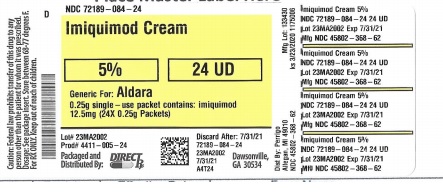
Imiquimod 12.5 mg/.25g Cream, 25 g — NDC 72189-084-24 (Billing 72189-0084-24)
This is a package of 25 g of Imiquimod 12.5 mg/.25g Cream from DIRECT RX, marketed since Mar 2020 and currently FDA-listed. It is this product's only package size.
Identity & classification
Regulatory identifiers FDA, NLM and CMS codes for this package
Drug-database identifiers Medi-Span GPI and First Databank GCN / HICL / AHFS classification
- GPI-14 (Medi-Span): 90773040003720
- RxCUI (RxNorm): 310982
Where does this data come from?
- FDA openFDA NDC Directory · synced Oct 1, 2026
- FDA label on DailyMed · label index refreshed Oct 1, 2026
- RxNorm (NLM RxNav) · catalog refreshed Oct 1, 2026
- Medi-Span GPI (licensed)
- First Databank (licensed) · refreshed Oct 1, 2026
RxNorm drug class
This medicine belongs to the Antivirals class.
Where does this data come from?
- RxClass (NLM) · catalog refreshed Oct 1, 2026
Clinical
- Imiquimod 5% cream treats actinic keratosis on the face or scalp, certain superficial basal cell carcinomas, and external genital or perianal warts. Which one you use it for decide...
- Wash the area with mild soap and let it dry. Put the cream on before bed and rub it in until it vanishes. Wash it off with mild soap and water after the recommended hours. Wash you...
- Yes, local skin reactions are very common. Expect redness, itching, burning, flaking and crusting. If the skin weeps, breaks open, or you feel flu-like, call your doctor. A rest pe...
- Is it normal for my skin to get red and sore?
Patient education
Supplement & herbal interactions
Some supplements/herbs that may interact with Imiquimod — tap one for details:
Where does this data come from?
- MedlinePlus (NLM) · refreshed Oct 1, 2026
- FDA label on DailyMed · label index refreshed Oct 1, 2026
Ask a licensed pharmacist directly — free, answered by our team.
Pricing
A drug doesn't have one price. Each row is a different public payment system, and none is what you'd pay at the counter — that depends on your insurance. The ⓘ on each row explains what it measures.
| Price system | Per g | Per package |
|---|---|---|
| Retail pharmacies payNADAC · weekly | Not in the retail survey — common for institutional, discontinued, or low-volume packs. | |
| Medicaid paysCMS SDUD · 12 mo | No recent Medicaid claims on file for this NDC — rare and low-volume NDCs are suppressed in the public data. | |
| Medicare drug plans payPart D · Q2 2026 | $1.54 | $0.38 / 0.25 g |
Where does this data come from?
- CMS NADAC weekly file
- CMS ASP pricing files · refreshed Sep 20, 2026
- CMS Medicaid State Drug Utilization Data · refreshed Oct 2, 2026
- CMS Part D plan pricing files · refreshed Sep 24, 2026
- VA National Acquisition Center price file
Packaging — all sizes for this product
| Package NDC | Description | Marketing start | Marketing end | Status |
|---|---|---|---|---|
| 72189-0084-24 You're viewing this Main listing | .25 g in 1 PACKET | 2020-03-23 | — | Active |
Therapeutic equivalents
| Product | Labeler | Pack | NADAC/unit | TE | Status | Price vs. this |
|---|---|---|---|---|---|---|
| Imiquimod 50 mg/g 51672-4145-06 | Sun | 24 packets | $0.610 | AB | Availability likely | — |
| Imiquimod 50 mg/g 68462-0536-70 | Glenmark | 24 packets | $0.610 | AB | Availability likely | — |
| Imiquimod 12.5 mg/.25g 45802-0368-53 | Padagis | 12 packets | $12.166 | AB | Availability likely | — |
| Imiquimod 12.5 mg/.25g 71335-2725-01 | Bryant | 24 packets | — | AB | FDA listed | — |
| Imiquimod 12.5 mg/.25g 71335-3000-01 | Bryant | 24 packets | — | AB | FDA listed | — |
| Imiquimod 12.5 mg/.25g 72162-2332-02 | Bryant | 24 packets | — | AB | FDA listed | — |
| Imiquimod 12.5 mg/.25gthis 72189-0084-24 | DIRECT | 25 g | — | AB | FDA listed | — |
Where does this data come from?
- FDA openFDA NDC Directory · synced Oct 1, 2026
- FDA Orange Book · refreshed Sep 3, 2026
- CMS NADAC weekly file
Availability & generic status
This product is an FDA-approved generic. Other versions of the same drug are listed under Therapeutic equivalents, least expensive first.
Where does this data come from?
- FDA Orange Book · refreshed Sep 3, 2026
What it looks like
Where does this data come from?
- FDA label on DailyMed · label index refreshed Oct 1, 2026
Inactive Ingredients / Excipients
Inactive ingredients, also called excipients, are components of the drug product other than the active ingredient. They may include fillers, dyes, coatings, preservatives, flavors, or other formulation ingredients.
Where does this data come from?
IACT rows and label-wide narrative are kept separate; availability and product-level specificity depend on the submitted label.- FDA label on DailyMed · label index refreshed Oct 1, 2026
- FDA openFDA NDC Directory · synced Oct 1, 2026
Inactive ingredient FAQ
Are inactive ingredients the same for every manufacturer?
Why might an inactive ingredient be missing?
Can inactive ingredients matter?
Manufacturer & labeler
Where does this data come from?
- FDA openFDA NDC Directory · synced Oct 1, 2026
- Drugs@FDA
Full prescribing information FDA SPL
🎯 Indications and Usage ▾
1.1Actinic Keratosis Imiquimod Cream is indicated for the topical treatment of clinically typical, nonhyperkeratotic, nonhypertrophic actinic keratoses on the face or scalp in immunocompetent adults.
1.2Superficial Basal Cell Carcinoma Imiquimod Cream is indicated for the topical treatment of biopsy-confirmed, primary superficial basal cell carcinoma (sBCC) in immunocompetent adults, with a maximum tumor diameter of 2.0 cm, located on the trunk (excluding anogenital skin), neck, or extremities (excluding hands and feet), only when surgical methods are medically less appropriate and patient follow-up can be reasonably assured. The histological diagnosis of superficial basal cell carcinoma should be established prior to treatment, since safety and efficacy of Imiquimod Cream have not been established for other types of basal cell carcinomas, including nodular and morpheaform (fibrosing or sclerosing) types.
1.3External Genital Warts Imiquimod Cream is indicated for the treatment of external genital and perianal warts/condyloma acuminata in patients 12 years old and older.
1.4Limitations of Use Imiquimod cream has been evaluated in children ages 2 to 12 years with molluscum contagiosum and these studies failed to demonstrate efficacy. [see USE IN SPECIFIC POPULATIONS (8.4)].
1.5Unevaluated Populations The safety and efficacy of Imiquimod Cream in immunosuppressed patients have not been established. Imiquimod Cream should be used with caution in patients with pre-existing autoimmune conditions. The efficacy and safety of Imiquimod Cream have not been established for patients with Basal Cell Nevus Syndrome or Xeroderma Pigmentosum.
⏱️ Dosage and Administration ▾
The application frequency for Imiquimod Cream is different for each indication. Imiquimod Cream is not for oral, ophthalmic, or intravaginal use.
2.1Actinic Keratosis Imiquimod Cream should be applied 2 times per week for a full 16 weeks to a defined treatment area on the face or scalp (but not both concurrently). The treatment area is defined as one contiguous area of approximately 25 cm2 (e.g., 5 cm x 5 cm) on the face (e.g. forehead or one cheek) or on the scalp. Examples of 2 times per week application schedules are Monday and Thursday, or Tuesday and Friday.
Imiquimod Cream should be applied to the entire treatment area and rubbed in until the cream is no longer visible. No more than one packet of Imiquimod Cream should be applied to the contiguous treatment area at each application. Imiquimod Cream shouldbe applied prior to normal sleeping hours and left on the skin for approximately 8 hours, after which time the cream should be removed by washing the area with mild soap and water.
Theprescriber should demonstrate the proper application technique to maximize the benefit ofImiquimod Cream therapy. It is recommended that patients wash their hands before and after applying Imiquimod Cream. Before applying the cream,the patient should wash the treatment area with mild soap and water and allow the area to dry thoroughly (at least 10 minutes).
Contact with the eyes, lips and nostrils should be avoided. Local skin reactions in the treatment area are common. [see ADVERSE REACTIONS (6.1, 6.5)] A rest period of several days may be taken if required by the patient's discomfort or severity of the local skin reaction. However, the treatment period should not be extended beyond 16 weeks due tomissed doses or rest periods.
Response to treatment cannot be adequately assessed until resolution of local skin reactions. Lesions that do not respond to treatment should be carefully re-evaluated and management reconsidered. Imiquimod Cream is packaged in single-use packets, with 12 or 24 packets supplied per box.
Patients should be prescribed no more than 36 packets for the 16-week treatment period. Unused packets should be discarded. Partially-used packets should be discarded and not reused.
2.2Superficial Basal Cell Carcinoma Imiquimod Cream should be applied 5 times per week for a full 6 weeks to a biopsy-confirmed superficial basal cell carcinoma. An example of a 5 times per week application schedule is to apply Imiquimod Cream, once per day, Monday through Friday. Imiquimod Cream should be applied prior to normal sleeping hours and left on the skin for approximately 8 hours, after which time the cream should be removed by washing the area with mild soap and water.
The prescriber should demonstrate the proper application technique to maximize the benefit of Imiquimod Cream therapy. It is recommended that patients wash their hands before and after applying Imiquimod Cream. The patient should wash the treatment area with mild soap and water before applying the cream, and allow the area to dry thoroughly.
The target tumor should have a maximum diameter of 2 cm and be located on the trunk (excluding anogenital skin), neck, or extremities (excluding hands and feet). The treatment area should include a 1 cm margin of skin around the tumor. Sufficient cream should be applied to cover the treatment area, including 1 centimeter of skin surrounding the tumor.
Imiquimod Cream should be rubbed into the treatment area until the cream is no longer visible. TABLE 1. Amount of Imiquimod Cream to Use of SBcc Target Tumor Diameter Size of Cream Droplet to be Used (diameter) Approximate Amount of Imiquimod to be Used 0.5 to < 1.0 cm 4 mm 10 mg ≥1.0 to <1.5 cm 5 mm 25 mg ≥1.5 to 2.0 cm 7 mm 40 mg Contact with the eyes, lips and nostrils should be avoided.
Local skin reactions in the treatment area are common. [see ADVERSE REACTIONS (6.2, 6.5)] A rest period of several days may be taken if required by the patient's discomfort or severity of the local skin re… [Excerpted — this section continues on DailyMed.]
💊 Dosage Forms and Strengths ▾
Imiquimod Cream, 5%, is supplied in single-use packets each of which contains 250 mg of the cream, equivalent to 12.5 mg of imiquimod. Imiquimod Cream is supplied in boxes of 12 or 24 packets each.
⛔ Contraindications ▾
None.
⚠️ Warnings and Cautions ▾
5.1Local Inflammatory Reactions Intense local inflammatory reactions including skin weeping or erosion can occur after a few applications of Imiquimod Cream and may require an interruption of dosing. [see DOSAGE ANDADMINISTRATION(2) and ADVERSE REACTIONS (6)]. Imiquimod Cream has the potential to exacerbate inflammatory conditions of the skin, including chronic graft versus host disease. Severe local inflammatory reactions of the female external genitalia can lead to severe vulvar swelling.
Severe vulvar swelling can lead to urinary retention. Dosing should be interrupted or discontinued for severe vulvar swelling. Administration of Imiquimod Cream is not recommended until the skin is completely healed from any previous drug or surgical treatment.
5.2Systemic Reactions Flu-like signs and symptoms may accompany, or even precede, local inflammatory reactions and may include malaise, fever, nausea, myalgias and rigors. An interruption of dosing should be considered. [SEE ADVERSE REACTIONS (6)]
5.3Ultraviolet Light Exposure Exposure to sunlight (including sunlamps) should be avoided or minimized during use of Imiquimod Cream because of concern for heightened sunburn susceptibility. Patients should be warned to use protective clothing (e.g., a hat) when using Imiquimod Cream. Patients with sunburn should be advised not to use Imiquimod Cream until fully recovered.
Patients who may have considerable sun exposure, e.g. due to their occupation, and those patients with inherent sensitivity to sunlight should exercise caution when using Imiquimod Cream. Imiquimod Cream shortened the time to skin tumor formation in an animal photo-cocarcinogenecity study [see NONCLINICAL TOXICOLOGY (13.1)]. The enhancement of ultraviolet carcinogenicity is not necessarily dependent on phototoxic mechanisms.
Therefore, patients should minimize or avoid natural or artificial sunlight exposure.
5.4Unevaluated Uses: Actinic Keratosis Safety and efficacy have not been established for Imiquimod Cream in the treatment of actinic keratosis with repeated use, i.e. more than one treatment course, in the same area. The safety of Imiquimod Cream applied to areas of skin greater than 25 cm2 (e.g. 5 cm X 5 cm) or the treatment of actinic keratosis has not been established [see CLINICAL PHARMACOLOGY (12.3)].
5.5Unevaluated Uses: Superficial Basal Cell Carcinoma The safety and efficacy of Imiquimod Cream have not been established for other types of basal cell carcinomas (BCC), including nodular and morpheaform (fibrosing or sclerosing) types. Imiquimod Cream is not recommended for treatment of BCC subtypes other than thesuperficial variant (i.e., sBCC). Patients with sBCC treated with Imiquimod Cream should have regular follow-up of the treatment site. [see CLINICAL STUDIES (14.2)].
The safety and efficacy of treating sBCC lesions on the face, head and anogenital area have not been established.
5.6Unevaluated Uses: External Genital Warts Imiquimod Cream has not been evaluated for the treatment of urethral, intra-vaginal, cervical, rectal, or intra-anal human papilloma viral disease.
🤒 Adverse Reactions ▾
Because clinical trials are conducted under widely varying conditions, adverse reaction rates observed in the clinical trials of a drug cannot be directly compared to rates in the clinical trials of another drug and may not reflect the rates observed in practice.
6.1Clinical Trials Experience: Actinic Keratosis The data described below reflect exposure to imiquimod cream or vehicle in 436 subjects enrolled in two double-blind, vehicle-controlled studies. Subjects applied imiquimod cream or vehicle to a 25 cm2 contiguous treatment area on the face or scalp 2 times per week for 16 weeks. Table 2: Selected Adverse Reactions Occurring in > 1% of Imiquimod-Treated Subjects and at a Greater Frequency than with Vehicle in the Combined Studies (Actinic Keratosis) Preferred Term Imiquimod Cream (n= 215) Vehicle (n= 221) Application Site Reaction 71 (33%) 32 (14%) Upper Resp Tract Infection 33 (15%) 27 (12%) Sinusitis 16 (7%) 14 (6%) Headache 11 (5%) 7 (3%) Carcinoma Squamous 8 (4%) 5 (2%) Diarrhea 6 (3%) 2 (1%) Eczema 4 (2%) 3 (1%) Back Pain 3 (1%) 2 (1%) Fatigue 3 (1%) 2 (1%) Fibrillation Atrial 3 (1%) 2 (1%) Infection Viral 3 (1%) 2 (1%) Dizziness 3 (1%) 1 (<1%) Vomiting 3 (1%) 1 (<1%) Urinary Tract Infection 3 (1%) 1 (<1%) Fever 3 (1%) 0 (0%) Rigors 3 (1%) 0 (0%) Alopecia 3 (1%) 0 (0%) Table 3: Application Site Reactions Reported by > 1% of Imiquimod-Treated Subjects and at a Greater Frequency than with Vehicle in the Combined Studies (Actinic Keratosis) Included Term Imiquimod Cream (n= 215) Vehicle (n= 221) Itching 44 (20%) 17 (8%) Burning 13 (6%) 4 (2%) Bleeding 7 (3%) 1 (<1%) Stinging 6 (3%) 2 (1%) Pain 6 (3%) 2 (1%) Induration 5 (2%) 3 (1%) Tenderness 4 (2%) 3 (1%) Irritation 4 (2%) 0 (0%) Local skin reactions were collected independently of the adverse reaction "application site reaction" in an effort to provide a better picture of the specific types of local reactions that might be seen.
The most frequently reported local skin reactions were erythema, flaking/scaling/dryness, and scabbing/crusting. The prevalence and severity of local skin reactions that occurred during controlled studies are shown in the following table. Table 4: Local Skin Reactions in the Treatment Area as Assessed by the Investigator (Actinic Keratosis) Imiquimod Cream (n=215) Vehicle (n=220) All Grades* Severe All Grades* Severe Erythema 209 (97%) 38 (18%) 206 (93%) 5 (2%) Flaking/Scaling/Dryness 199 (93%) 16 (7%) 199 (91%) 7 (3%) Scabbing/Crusting 169 (79%) 18 (8%) 92 (42%) 4 (2%) Edema 106 (49%) 0 (0%) 22 (10%) 0 (0%) Erosion/Ulceration 103 (48%) 5 (2%) 20 (9%) 0 (0%) Weeping/Exudate 45 (22%) 0 (0%) 3 (1%) 0 (0%) Vesicles 19 (9%) 0 (0%) 2 (1%) 0 (0%) *Mild, Moderate, or Severe The adverse reactions that most frequently resulted in clinical intervention (e.g., rest periods, withdrawal from study) were local skin and application site reactions.
Overall, in the clinical studies, 2% (5/215) of subjects discontinued for local skin/application site reactions. Of the 215 subjects treated, 35 subjects (16%) on imiquimod cream and 3 of 220 subjects (1%) on vehicle cream had at least one rest period. Of these imiquimod cream subjects, 32 (91%) resumed therapy after a rest period.
In the AK studies, 22 of 678 (3.2%) of imiquimod-treated subjects developed treatment site infections that required a rest period off imiquimod cream and were treated with antibiotics (19 with oral and 3 with topical). Of the 206 imiquimod subjects with both baseline and 8-week post-treatment scarring assessments, 6 (2.9%) had a greater degree of scarring scores at 8-weeks post-treatment than at baseline.
6.2Clinical Trials Experience: Superficial Basal Cell Carcinoma The data described below reflect exposure to imiquimod cream or vehicle in 364 subjects enrolled in two double-blind, vehicle-controlled studies. Subjects applied imiquimod cream or vehicle 5 times per week for 6 weeks. The incidence of adverse reactions reported by > 1% of subjects during the studies is summarized below… [Excerpted — this section continues on DailyMed.]
👥 Use in Specific Populations ▾
8.1Pregnancy Pregnancy Category C: Note: The Maximum Recommended Human Dose (MRHD) was set at 2 packets per treatment of Imiquimod Cream (25 mg imiquimod) for the animal multiple of human exposure ratios presented in this label. If higher doses than 2 packets of imiquimod cream are used clinically, then the animal multiple of human exposure would be reduced for that dose. A non-proportional increase in systemic exposure with increased dose of imiquimod cream was noted in the clinical pharmacokinetic study conducted in actinic keratosis subjects [see CLINICAL PHARMACOLOGY (12.3)].
The AUC after topical application of 6 packets of imiquimod cream was 8 fold greater than the AUC after topical application of 2 packets of imiquimod cream in actinic keratosis subjects. Therefore, if a dose of 6 packets per treatment of imiquimod cream was topically administered to an individual, then the animal multiple of human exposure would be either 1/3 of the value provided in the label (based on body surface area comparisons) or 1/8 of the value provided in the label (based on AUC comparisons). The animal multiples of human exposure calculations were based on weekly dose comparisons for the carcinogenicity studies described in this label.
The animal multiples of human exposure calculations were based on daily dose comparisons for the reproductive toxicology studies described in this label. Systemic embryofetal development studies were conducted in rats and rabbits. Oral doses of 1, 5, and 20 mg/kg/day imiquimod were administered during the period of organogenesis (gestational days 6 – 15) to pregnant female rats.
In the presence of maternal toxicity, fetal effects noted at 20 mg/kg/day (577X MRHD based on AUC comparisons) included increased resorptions, decreased fetal body weights, delays in skeletal ossification, bent limb bones, and two fetuses in one litter (2 of 1567 fetuses) demonstrated exencephaly, protruding tongues and low-set ears. No treatment related effects on embryofetal toxicity or teratogenicity were noted at 5 mg/kg/day (98X MRHD based on AUC comparisons). Intravenous doses of 0.5, 1 and 2 mg/kg/day imiquimod were administered during the period of organogenesis (gestational days 6 – 18) to pregnant female rabbits.
No treatment related effects on embryofetal toxicity or teratogenicity were noted at 2 mg/kg/day (1.5X MRHD based on BSA comparisons), the highest dose evaluated in this study, or 1 mg/kg/day (407X MRHD based on AUC comparisons). A combined fertility and peri- and post-natal development study was conducted in rats. Oral doses of 1, 1.5, 3 and 6 mg/kg/day imiquimod were administered to male rats from 70 days prior to mating through the mating period and to female rats from 14 days prior to mating through parturition and lactation.
No effects on growth, fertility, reproduction or post-natal development were noted at doses up to 6 mg/kg/day (87X MRHD based on AUC comparisons), the highest dose evaluated in this study. In the absence of maternal toxicity, bent limb bones were noted in the F1 fetuses at a dose of 6 mg/kg/day (87X MRHD based on AUC comparisons). This fetal effect was also noted in the oral rat embryofetal development study conducted with imiquimod.
No treatment related effects on teratogenicity were noted at 3 mg/kg/day (41X MRHD based on AUC comparisons). There are no adequate and well-controlled studies in pregnant women. Imiquimod Cream should be used during pregnancy only if the potential benefit justifies the potential risk to the fetus.
8.3Nursing Mothers It is not known whether imiquimod is excreted in human milk following use of Imiquimod Cream. Because many drugs are excreted in human milk, caution should be exercised when Imiquimod Cream is administered to nursing women.
8.4Pediatric Use AK and sBCC are not conditions generally seen within the pediatric population. The safety and efficacy of Imiquimod Cream for AK or sBCC in patients less than 18 years of age have not been established. Safety… [Excerpted — this section continues on DailyMed.]
🆘 Overdosage ▾
Topical overdosing of Imiquimod Cream could result in an increased incidence of severe local skin reactions and may increase the risk for systemic reactions. The most clinically serious adverse event reported following multiple oral imiquimod doses of >200 mg (equivalent to imiquimod content of >16 packets) was hypotension, which resolved following oral or intravenous fluid administration.
🧬 Clinical Pharmacology ▾
12.1Mechanism of Action The mechanism of action of Imiquimod Cream in treating AK and sBCC lesions is unknown.
12.2Pharmacodynamics Actinic Keratosis In a study of 18 subjects with AK comparing imiquimod cream to vehicle, increases from baseline in week 2 biomarker levels were reported for CD3, CD4, CD8, CD11c, and CD68 for imiquimod cream treated subjects; however, the clinical relevance of these findings is unknown. Superficial Basal Cell Carcinoma An open label study in six subjects with sBCC suggests that treatment with imiquimod cream may increase the infiltration of lymphocytes, dendritic cells, and macrophages into the tumor lesion; however, the clinical significance of these findings is unknown.
External Genital Warts Imiquimod has no direct antiviral activity in cell culture. A study in 22 subjects with genital/perianal warts comparing imiquimod cream and vehicle shows that imiquimod cream induces mRNA encoding cytokines including interferon-ɑ at the treatment site. In addition HPVL1 mRNA and HPV DNA are significantly decreased following treatment.
However, the clinical relevance of these findings is unknown.
12.3Pharmacokinetics Systemic absorption of imiquimod across the affected skin of 58 subjects with AK was observed with a dosing frequency of 3 applications per week for 16 weeks. Mean peak serum drug concentrations at the end of week 16 were approximately 0.1, 0.2, and 3.5 ng/mL for the applications to face (12.5 mg imiquimod, 1 single-use packet), scalp (25 mg, 2 packets) and hands/arms (75 mg, 6 packets), respectively. Table 10: Mean Serum Imiquimod Concentration in Adults Following Administration of the Last Topical Dose During Week 16 (Actinic Keratosis) Amount of Imiquimod Cream applied Mean peak serum imiquimod Concentration [Cmax] 12.5 mg (1 packet) 0.1 ng/mL 25 mg (2 packets) 0.2 ng/mL 75 mg (6 packets) 3.5 ng/mL The application surface area was not controlled when more than one packet was used.
Dose proportionality was not observed. However it appears that systemic exposure may be more dependent on surface area of application than amount of applied dose. The apparent half-life was approximately 10 times greater with topical dosing than the 2 hour apparent half-life seen following subcutaneous dosing, suggesting prolonged retention of drug in the skin.
Mean urinary recoveries of imiquimod and metabolites combined were 0.08 and 0.15% of the applied dose in the group using 75 mg (6 packets) for males and females, respectively following 3 applications per week for 16 weeks. Systemic absorption of imiquimod was observed across the affected skin of 12 subjects with genital/perianal warts, with an average dose of 4.6 mg. Mean peak drug concentration of approximately 0.4 ng/mL was seen during the study.
Mean urinary recoveries of imiquimod and metabolites combined over the whole course of treatment, expressed as percent of the estimated applied dose, were 0.11 and 2.41% in the males and females, respectively.
📦 How Supplied / Storage and Handling ▾
Imiquimod Cream, 5%, is supplied in single-use packets which contain 250 mg of the cream. Available as: a box of 12 packets and a box of 24 packets . Store at 4-25°C (39-77°F). Avoid freezing. Keep out of reach of children.
📋 Description ▾
Imiquimod Cream, 5% is an immune response modifier for topical administration. Each gram contains 50 mg of imiquimod in an off-white oil-in-water vanishing cream base consisting of benzyl alcohol, cetyl alcohol, glycerin, methylparaben, oleic acid, oleyl alcohol, polysorbate 60, propylparaben, purified water, stearyl alcohol, sorbitan monostearate, white petrolatum, and xanthan gum. Chemically, imiquimod is 1-(2-methylpropyl)-1H-imidazo[4,5-c]quinolin-4-amine.
Imiquimod has a molecular formula of C14H16N4 and a molecular weight of 240.3. Its structural formula is: [Image 11]
🔬 Clinical Studies ▾
14.1Actinic Keratosis In two double-blind, vehicle-controlled clinical studies, 436 subjects with AK were randomized to treatment with either imiquimod cream or vehicle cream 2 times per week for 16 weeks. The studies enrolled subjects with 4 to 8 clinically typical, visible, discrete, nonhyperkeratotic, nonhypertrophic AK lesions within a 25 cm2 contiguous treatment area on either the face or scalp. The 25 cm2 contiguous treatment area could be of any dimensions e.g., 5 cm x 5 cm, 3 cm by 8.3 cm, 2 cm by 12.5 cm.
Study subjects ranged from 37 to 88 years of age (median 66 years) and 55% had Fitzpatrick skin type I or II. All imiquimod-treated subjects were Caucasians. On a scheduled dosing day, the study cream was applied to the entire treatment area prior to normal sleeping hours and left on for approximately 8 hours.
Twice weekly dosing was continued for a total of 16 weeks. The clinical response of each subject was evaluated 8 weeks after the last scheduled application of study cream. Efficacy was assessed by the complete clearance rate, defined as the proportion of subjects at the 8-week post-treatment visit with no (zero) clinically visible AK lesions in the treatment area.
Complete clearance included clearance of all baseline lesions, as well as any new or sub-clinical AK lesions which appeared during therapy. Complete and partial clearance rates are shown in the table below. The partial clearance rate was defined as the percentage of subjects in whom 75% or more baseline AK lesions were cleared.
Table 11: Clearance Rates (AK) Complete Clearance Rates (100% AK Lesions Cleared) Study Imiquimod Cream Vehicle Study 46% (49/107) 3% (3/110) AK1 Study 44% (48/108) 4% (4/111) AK2 Partial and Complete Clearance Rates (75% or More Baseline AK Lesions Cleared) Study Imiquimod Cream Vehicle Study 60% (64/107) 10% (11/110) AK1 Study 58% (63/108) 14% (15/111) AK2 Sub-clinical AK lesions may become apparent in the treatment area during treatment with imiquimod cream. During the course of treatment, 48% (103/215) of subjects experienced an increase in AK lesions relative to the number present at baseline within the treatment area.
Subjects with an increase in AK lesions had a similar response to those with no increase in AK lesions.
14.2Superficial Basal Cell Carcinoma In two double-blind, vehicle-controlled clinical studies, 364 subjects with primary sBCC were treated with imiquimod cream or vehicle cream 5 times per week for 6 weeks. Target tumors were biopsy-confirmed sBCC and had a minimum area of 0.5 cm2 and a maximum diameter of 2.0 cm (4.0 cm2). Target tumors were not to be located within 1.0 cm of the hairline, or on the anogenital area or on the hands or feet, or to have any atypical features.
The population ranged from 31-89 years of age (median 60 years) and 65% had Fitzpatrick skin type I or II. On a scheduled dosing day, study cream was applied to the target tumor and approximately 1 cm (about 1/3 inch) beyond the target tumor prior to normal sleeping hours, and 5 times per week dosing was continued for a total of 6 weeks. The target tumor area was clinically assessed 12 weeks after the last scheduled application of study cream.
The entire target tumor was then excised and examined histologically for the presence of tumor. Efficacy was assessed by the complete response rate defined as the proportion of subjects with clinical (visual) and histological clearance of the sBCC lesion at 12 weeks post-treatment. Of imiquimod-treated subjects, 6% (11/178) who had both clinical and histological assessments post-treatment, and who appeared to be clinically clear had evidence of tumor on excision of the clinically-clear treatment area.
Data on composite clearance (defined as both clinical and histological clearance) are shown in the table below. Table 12: Composite Clearance Rates at 12 Weeks Post-Treatment for Superficial Basal Cell Carcinoma Study Imiquimod Cream Vehicle Cream Study sBCC1 70% (66/94) 2% (2/89) Study sBCC2 80% (… [Excerpted — this section continues on DailyMed.]
🧪 Nonclinical Toxicology ▾
13.1Carcinogenesis, Mutagenesis, Impairment of Fertility In an oral (gavage) rat carcinogenicity study, imiquimod was administered to Wistar rats on a 2X/week (up to 6 mg/kg/day) or daily (3 mg/kg/day) dosing schedule for 24 months. No treatment related tumors were noted in the oral rat carcinogenicity study up to the highest doses tested in this study of 6 mg/kg administered 2X/week in female rats (87X MRHD based on weekly AUC comparisons), 4 mg/kg administered 2X/week in male rats (75X MRHD based on weekly AUC comparisons) or 3 mg/kg administered 7X/week to male and female rats (153X MRHD based on weekly AUC comparisons).
In a dermal mouse carcinogenicity study, imiquimod cream (up to 5 mg/kg/application imiquimod or 0.3% imiquimod cream) was applied to the backs of mice 3X/week for 24 months. A statistically significant increase in the incidence of liver adenomas and carcinomas was noted in high dose male mice compared to control male mice (251X MRHD based on weekly AUC comparisons). An increased number of skin papillomas was observed in vehicle cream control group animals at the treated site only.
The quantitative composition of the vehicle cream used in the dermal mouse carcinogenicity study is the same as the vehicle cream used for imiquimod cream, minus the active moiety (imiquimod). In a 52-week dermal photo-cocarcinogenecity study, the median time to onset of skin tumor formation was decreased in hairless mice following chronic topical dosing (3X/week; 40 weeks of treatment followed by 12 weeks of observation) with concurrent exposure to UV radiation (5 days per week) with the imiquimod cream vehicle alone.
No additional effect on tumor development beyond the vehicle effect was noted with the addition of the active ingredient, imiquimod, to the vehicle cream. Imiquimod revealed no evidence of mutagenic or clastogenic potential based on the results of five in vitro genotoxicity tests (Ames assay, mouse lymphoma L5178Y assay, Chinese hamster ovary cell chromosome aberration assay, human lymphocyte chromosome aberration assay and SHE cell transformation assay) and three in vivo genotoxicity tests (rat and hamster bone marrow cytogenetics assay and a mouse dominant lethal test).
Daily oral administration of imiquimod to rats, throughout mating, gestation, parturition and lactation, demonstrated no effects on growth, fertility or reproduction, at doses up to 87X MRHD based on AUC comparisons.
📄 Package Label / Principal Display Panel ▾
084
Medicare Part D spend CMS · PART D · 2026 (Q1)
About this NDC listing & data coverage
What data is (and isn’t) available for this NDC — tap to expand
| NDC identity (package / product / labeler codes) | ✓ Available |
| Labeler | ✓ Available |
| Product & package description | ✓ Available |
| Marketing category & status | ✓ Available |
| Active ingredient / dosage form / route | ✓ Available |
| FDA label (SPL via DailyMed) | ✓ Available |
| Package photos | ✓ Available |
| Inactive ingredients (structured) | — Not published for this NDC The labeler did not submit a structured excipient list, or no SPL is available. |
| NADAC pharmacy acquisition price (CMS) | — Not published for this NDC CMS publishes NADAC only for NDCs reported in its retail-pharmacy survey. |
| Orange Book / therapeutic-equivalence data | ✓ Available |
| HCPCS J-code billing crosswalk | — Not published for this NDC Most self-administered / retail products have no J-code — that is normal. |
| Medicaid utilization (CMS SDUD) | — Not published for this NDC CMS reports utilization only for NDCs with Medicaid claims above its privacy threshold. |