
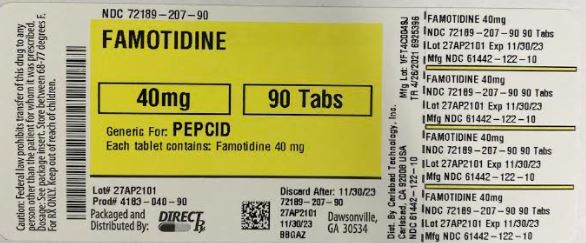
Famotidine 40 mg Tablet, 30-count — NDC 72189-207-30 (Billing 72189-0207-30)
This is a package of 30 tablets of Famotidine 40 mg Tablet from direct rx, marketed since Jun 2021 and currently FDA-listed. It is the main listing for this product, which comes in 2 package sizes.
NDC database record
One package, one record: these facts belong to NDC 72189-207-30 alone.
- Record
- FDA NDC Directory package listing · Human prescription drug
- Code segments
- 72189 labeler · 207 product · 30 package
- Package marketed since
- Jun 3, 2021
- Sample package
- No — commercial package
- Listing certified through
- Dec 31, 2026
- Billing quantity
- 30 EA per package
- Barcode (UPC-A, from the NDC)
- 3 7218920730 4
- FDA record last changed
- Jul 24, 2026
Other active recalls for Famotidine (different manufacturers) — 2 · tap to view
Identity & classification
Regulatory identifiers FDA, NLM and CMS codes for this package
Drug-database identifiers Medi-Span GPI and First Databank GCN / HICL / AHFS classification
- GSN (GCN sequence number): 011678
- GCN: 46431
- GPI-14 (Medi-Span): 49200030000340
- HICL (First Databank): 004521
- AHFS class code: 04:92.00.00
- RxCUI (RxNorm): 284245
Where does this data come from?
- FDA openFDA NDC Directory · synced Oct 8, 2026
- FDA label on DailyMed · label index refreshed Oct 6, 2026
- RxNorm (NLM RxNav) · catalog refreshed Oct 1, 2026
- Medi-Span GPI (licensed)
- First Databank (licensed) · refreshed Oct 8, 2026
RxNorm drug class
This medicine belongs to the Histamine-2 Receptor Antagonist class.
Where does this data come from?
- RxClass (NLM) · catalog refreshed Oct 1, 2026
Clinical
- It reduces stomach acid. Over-the-counter versions relieve and prevent heartburn from acid indigestion and sour stomach. Prescription versions treat ulcers, GERD and erosive esopha...
- With the over-the-counter tablets, swallow one with water and do not chew it. To prevent heartburn, take it shortly before a food or drink that triggers it. Do not take more than 2...
- Headache, dizziness, constipation and diarrhea are the most common, and they are usually mild. Call your doctor if you have confusion, hallucinations, seizures, a rash with swellin...
- Not always. Famotidine can lower absorption of some drugs that need stomach acid and can raise tizanidine levels. Tell me or your doctor everything you take before you start.
Patient education
Supplement & herbal interactions
Some supplements/herbs that may interact with Famotidine — tap one for details:
Famotidine may be associated with lower levels of 6 nutrients — worth a chat with your pharmacist, not a cause for alarm.
Where does this data come from?
- MedlinePlus (NLM) · refreshed Oct 1, 2026
- FDA label on DailyMed · label index refreshed Oct 6, 2026
Ask a licensed pharmacist directly — free, answered by our team.
Pricing
A drug doesn't have one price. Each row is a different public payment system, and none is what you'd pay at the counter — that depends on your insurance. The ⓘ on each row explains what it measures.
| Price system | Per each | Per package |
|---|---|---|
| Retail pharmacies payNADAC · weekly | Not in the retail survey — common for institutional, discontinued, or low-volume packs. | |
| Medicaid paysCMS SDUD · 12 mo | No recent Medicaid claims on file for this NDC — rare and low-volume NDCs are suppressed in the public data. | |
| Medicare drug plans payPart D · Q2 2026 | $0.0827 | $2.48 / 30 tablets |
Where does this data come from?
- CMS NADAC weekly file
- CMS ASP pricing files · refreshed Sep 20, 2026
- CMS Medicaid State Drug Utilization Data · refreshed Oct 8, 2026
- CMS Part D plan pricing files · refreshed Sep 24, 2026
- VA National Acquisition Center price file
Packaging — all sizes for this product
| Package NDC | Description | Marketing start | Marketing end | Status |
|---|---|---|---|---|
| 72189-0207-30 You're viewing this Main listing | 30 TABLET in 1 BOTTLE | 2021-06-03 | — | Active |
| 72189-0207-90 72189-207-90 | 90 TABLET in 1 BOTTLE | 2021-06-03 | — | Active |
You're viewing the smallest of 2 pack sizes for this product.
Pack size FAQ
What quantity is in this package?
How does this package differ from NDC 72189-0207-90?
What NDC number is used to bill for this package of Famotidine 40 mg Tablet?
Therapeutic equivalents
| Product | Labeler | Pack | NADAC/unit | TE | Status | Price vs. this |
|---|---|---|---|---|---|---|
| Famotidine 40 mg 00172-5729-60 | Teva | 100 tablets | $0.048 | AB | Availability likely | — |
| Famotidine 40 mg 31722-0018-01 | Camber | 100 tablets | $0.048 | AB | Availability likely | — |
| Famotidine 40 mg 50268-0304-15 | AvPAK | 50 tablets | $0.048 | AB | Availability likely | — |
| Famotidine 40 mg 61442-0122-01 | Carlsbad | 2400 tablets | $0.048 | AB | Availability likely | — |
| famotidine 40 mg 62135-0808-90 | Chartwell | 90 tablets | $0.048 | AB | Availability likely | — |
| Famotidine 40 mg 64980-0624-01 | Rising | 100 tablets | $0.048 | AB | Availability likely | — |
| Famotidine 40 mg 65862-0860-01 | Aurobindo | 100 tablets | $0.048 | — | Availability likely | — |
| Famotidine 40 mg 67877-0843-01 | Ascend | 100 tablets | $0.048 | AB | Discontinued | — |
| Famotidine 40 mg 67877-0889-01 | Ascend | 100 tablets | $0.048 | AB | Availability likely | — |
| Famotidine 40 mg 68001-0398-00 | BluePoint | 100 tablets | $0.048 | AB | Availability likely | — |
| Famotidine 40 mg 69367-0401-10 | Westminster | 1000 tablets | $0.048 | AB | Availability likely | — |
| Famotidine 40 mg 70710-1684-00 | Zydus | 1000 tablets | $0.048 | AB | Availability likely | — |
| Famotidine 40 mg 70756-0052-11 | Lifestar | 100 tablets | $0.048 | AB | Availability likely | — |
| Famotidine 40 mg 72205-0146-05 | Novadoz | 500 tablets | $0.048 | AB | Availability likely | — |
| Pepcid 40 mg 00187-4440-10 | Bausch | 100 tablets | — | AB | FDA listed | — |
| Famotidine 40 mg 00615-8559-05 | NCS | 15 tablets | — | AB | FDA listed | — |
| Famotidine 40 mg 10267-5690-01 | Contract | 100 tablets | — | AB | FDA listed | — |
| Famotidine 40 mg 43063-0533-30 | PD-Rx | 30 tablets | — | AB | FDA listed | — |
| Famotidine 40 mg 43063-0696-30 | PD-Rx | 30 tablets | — | AB | FDA listed | — |
| Famotidine 40 mg 46708-0294-10 | Alembic | 100 tablets | — | AB | FDA listed | — |
| Famotidine 40 mg 50090-1432-00 | A-S | 30 tablets | — | AB | FDA listed | — |
| Famotidine 40 mg 50090-6790-00 | A-S | 30 tablets | — | AB | FDA listed | — |
| Famotidine 40 mg 50090-6916-00 | A-S | 90 tablets | — | AB | FDA listed | — |
| Famotidine 40 mg 50090-7196-00 | A-S | 90 tablets | — | AB | FDA listed | — |
| Famotidine 40 mg 50090-7966-00 | A-S | 90 tablets | — | AB | FDA listed | — |
| Famotidine 40 mg 50090-7981-00 | A-S | 30 tablets | — | AB | FDA listed | — |
| Famotidine 40 mg 50090-7982-00 | A-S | 90 tablets | — | AB | FDA listed | — |
| Famotidine 40 mg 51407-0684-01 | Golden | 3600 tablets | — | AB | FDA listed | — |
| Famotidine 40 mg 51655-0102-26 | Northwind | 90 tablets | — | AB | FDA listed | — |
| Famotidine 40 mg 55111-0120-01 | Dr.Reddy's | 100 tablets | — | AB | FDA listed | — |
| Famotidine 40 mg 60760-0736-60 | St. | 60 tablets | — | AB | FDA listed | — |
| Famotidine 40 mg 60760-0843-07 | ST. | 7 tablets | — | AB | FDA listed | — |
| Famotidine 40 mg 60760-0937-07 | ST. | 7 tablets | — | AB | FDA listed | — |
| Famotidine 40 mg 62332-0002-10 | Alembic | 100 tablets | — | AB | FDA listed | — |
| Famotidine 40 mg 63187-0908-30 | Proficient | 30 tablets | — | AB | FDA listed | — |
| Famotidine 40 mg 63629-2014-01 | Bryant | 1000 tablets | — | AB | FDA listed | — |
| Famotidine 40 mg 63629-2015-01 | Bryant | 100 tablets | — | AB | FDA listed | — |
| Famotidine 40 mg 63629-2782-01 | Bryant | 30 tablets | — | AB | FDA listed | — |
| Famotidine 40 mg 68071-3413-03 | NuCare | 30 tablets | — | AB | FDA listed | — |
| Famotidine 40 mg 68071-3521-03 | NuCare | 30 tablets | — | AB | FDA listed | — |
| Famotidine 40 mg 68071-3584-03 | NuCare | 30 tablets | — | AB | FDA listed | — |
| Famotidine 40 mg 68071-4197-03 | NuCare | 30 tablets | — | AB | FDA listed | — |
| Famotidine 40 mg 68788-8518-03 | Preferred | 30 tablets | — | AB | FDA listed | — |
| Famotidine 40 mg 68788-8733-03 | Preferred | 30 tablets | — | AB | FDA listed | — |
| Famotidine 40 mg 70518-4084-01 | REMEDYREPACK | 90 tablets | — | AB | FDA listed | — |
| Famotidine 40 mg 70518-4394-00 | REMEDYREPACK | 90 tablets | — | AB | FDA listed | — |
| Famotidine 40 mg 70771-1703-00 | Zydus | 1000 tablets | — | AB | FDA listed | — |
| Famotidine 40 mg 71205-0257-30 | Proficient | 30 tablets | — | AB | FDA listed | — |
| Famotidine 40 mg 71205-0634-30 | Proficient | 30 tablets | — | AB | FDA listed | — |
| Famotidine 40 mg 71205-0781-30 | Proficient | 30 tablets | — | AB | FDA listed | — |
| Famotidine 40 mg 71335-0231-01 | Bryant | 30 tablets | — | AB | FDA listed | — |
| Famotidine 40 mg 71335-2442-01 | Bryant | 30 tablets | — | AB | FDA listed | — |
| Famotidine 40 mg 71335-2527-01 | Bryant | 30 tablets | — | AB | FDA listed | — |
| Famotidine 40 mg 71335-9615-01 | Bryant | 30 tablets | — | AB | FDA listed | — |
| Famotidine 40 mg 71335-9724-01 | Bryant | 30 tablets | — | AB | FDA listed | — |
| Famotidine 40 mg 72162-1737-00 | Bryant | 1000 tablets | — | AB | FDA listed | — |
| Famotidine 40 mgthis 72189-0207-30 | direct | 30 tablets | — | AB | FDA listed | — |
| Famotidine 40 mg 72789-0345-30 | PD-Rx | 30 tablets | — | AB | FDA listed | — |
| Famotidine 40 mg 72789-0427-90 | PD-Rx | 90 tablets | — | AB | FDA listed | — |
| Famotidine 40 mg 72789-0453-30 | PD-Rx | 30 tablets | — | AB | FDA listed | — |
| Famotidine 40 mg 72865-0215-01 | XLCare | 100 tablets | — | AB | FDA listed | — |
| Famotidine 40 mg 76420-0713-01 | Asclemed | 100 tablets | — | AB | FDA listed | — |
| Famotidine 40 mg 82804-0228-30 | Proficient | 30 tablets | — | AB | FDA listed | — |
| Famotidine 40 mg 82804-0981-00 | Proficient | 100 tablets | — | AB | FDA listed | — |
| Famotidine 40 mg 85766-0222-01 | Sportpharm | 100 tablets | — | AB | FDA listed | — |
| Famotidine 40 mg 85534-0092-00 | HAWAII | 30 tablets | — | AB | FDA listed | — |
| Famotidine 40 mg 68788-4144-03 | Preferred | 30 tablets | — | AB | FDA listed | — |
| Famotidine 40 mg 72789-0589-30 | PD-Rx | 30 tablets | — | AB | FDA listed | — |
| Famotidine 40 mg 67296-2330-02 | Redpharm | 20 tablets | — | AB | FDA listed | — |
| Famotidine 40 mg 53401-0036-53 | Aphena | 60 tablets | — | AB | FDA listed | — |
Where does this data come from?
- FDA openFDA NDC Directory · synced Oct 8, 2026
- FDA Orange Book · refreshed Oct 3, 2026
- CMS NADAC weekly file
Availability & generic status
This product is an FDA-approved generic. Other versions of the same drug are listed under Therapeutic equivalents, least expensive first.
Where does this data come from?
- FDA Orange Book · refreshed Oct 3, 2026
Inactive Ingredients / Excipients
Inactive ingredients, also called excipients, are components of the drug product other than the active ingredient. They may include fillers, dyes, coatings, preservatives, flavors, or other formulation ingredients.
🧪 Avoiding an ingredient? See Famotidine inactive ingredients by manufacturer: every current product's list side by side, so you can ask your pharmacy for the version that does not list it.
💡 Tap an ingredient (hover on desktop) to see what it is and why it’s used.
-
UNII OP1R32D61U
Microcrystalline cellulose is a purified form of cellulose, a natural fiber from plant sources. It acts as a binder and filler in tablets and capsules, helping hold ingredients together and give the medicine its shape and size.
-
UNII 70097M6I30
Magnesium stearate is a salt made from magnesium and stearic acid, a fatty substance. It's used in tablets and capsules as a lubricant and glidant to help ingredients flow smoothly during manufacturing and prevent sticking.
-
UNII VH2XOU12IE
Polydextrose is a synthetic polymer made from dextrose (sugar) that acts as a bulking agent and filler in medicines. It helps give tablets and capsules proper volume and texture while often adding slight sweetness.
-
UNII 5856J3G2A2
A starch-based powder made from potatoes and processed with sodium. It acts as a disintegrant, helping the tablet or capsule break apart quickly in the stomach so the medicine can be absorbed.
-
UNII O8232NY3SJ
A plant-based carbohydrate derived from corn kernels. It acts as a filler to add bulk, a binder to hold ingredients together, and a disintegrant to help the tablet break apart in your stomach for absorption.
-
UNII 7SEV7J4R1U
A powder made from a naturally occurring mineral. In medicines, talc works as a glidant and anti-caking agent, helping tablets and capsules flow smoothly during manufacturing and preventing clumping.
-
UNII 15FIX9V2JP
Titanium dioxide is a bright white mineral powder commonly used as a colorant and opacifying agent. It makes pills and tablets white or lighter in color and helps make coatings non-transparent.
7 inactive ingredients listed in the exact product block matched to this NDC.
Where does this data come from?
ingredient classCode="IACT" elements from the exact product block matched by this NDC. Label-section narrative from DailyMed / the openFDA label index is shown separately when available.- FDA label on DailyMed · label index refreshed Oct 6, 2026
- FDA openFDA NDC Directory · synced Oct 8, 2026
Inactive ingredient FAQ
Are inactive ingredients the same for every manufacturer?
Why might an inactive ingredient be missing?
Can inactive ingredients matter?
Manufacturer & labeler
More NDCs from direct rx labeler code 72189
- Irbesartan 75 mg Tablet NDC 72189-201-90
- Np Thyroid 60 levothyroxine liothyronine 9 ug; 38 ug Tablet NDC 72189-202-90
- Phentermine Hydrochloride 37.5 mg Tablet NDC 72189-203-30
- Progesterone 100 mg Capsule NDC 72189-204-90
- Irbesartan 150 mg Tablet NDC 72189-205-90
- Levothyroxine Sodium 100 ug Tablet NDC 72189-206-30
- Hydrocortisone 10 mg/g Cream NDC 72189-209-28
- Warfarin Sodium 10 mg Tablet NDC 72189-210-71
- Lidocaine 50 mg/g Ointment NDC 72189-211-50
- Junel FE 20 ug; 1 mg Tablet NDC 72189-215-28
- Primidone 50 mg Tablet NDC 72189-216-60
- Progesterone 200 mg Capsule NDC 72189-217-90
Where does this data come from?
- FDA openFDA NDC Directory · synced Oct 8, 2026
- Drugs@FDA
Full prescribing information FDA SPL
🎯 Indications and Usage ▾
Famotidine tablets are indicated in adult and pediatric patients 40 kg and above for the treatment of: • active duodenal ulcer. • active gastric ulcer. • symptomatic non-erosive gastroesophageal reflux disease (GERD). • erosive esophagitis due to GERD, diagnosed by biopsy. Famotidine tablets are indicated in adults for the: • treatment of pathological hypersecretory conditions (e.g., Zollinger- Ellison Syndrome, multiple endocrine neoplasias). • reduction of the risk of duodenal ulcer recurrence.
⏱️ Dosage and Administration ▾
2.1Recommended Dosage Table 1 shows the recommended dosage of Famotidine 20 mg and 40 mg tablets in adults and pediatric patients weighing 40 kg or greater with normal renal function. The use of Famotidine 20 mg and 40 mg tablets is not recommended for use in pediatric patients weighing less than 40 kg because the lowest available strength (20 mg) exceeds the recommended dose for these patients. Use another famotidine formulation for pediatric patients weighing less than 40 kg.
Table 1: Recommended Dosage and Duration of Famotidine Tablets in Adults and Pediatric Patients 40kg and Greater with Normal Renal Function Indication Recommended Dosage Recommended Duration Active duodenal ulcer (DU) 40mg once daily; or 20mg twice daily a Up to 8 weeks b,c Active gastric ulcer 40mg once daily Up to 8 weeks Symptomatic non-erosive GERD 20mg twice daily Up to 6 weeks c Erosive esophagitis diagnosed by endoscopy 20mg tiwce daily; or 40mg twice daily a Up to 12 weeks Pathological hypersecretory conditions d Starting dosage: 20mg every 6 hours; adjust dosage to individual patient needs Maximum dosage 160mg every 6 hours As clinically indicated Reduction of the risk of DU recurrence d 20mg once daily 1 year c or as clinidally indicated aBoth dosages demonstrated effectiveness in clinical trials [see Clinical Studies (14)]. bIn clinical trials, the majority of patients healed within 4 weeks.
For patients who do not heal after 4 weeks, consider an additional 2 to 4 weeks of treatment [see Clinical Studies (14.1)]. cLonger treatment durations have not been studied in clinical trials [see Clinical Studies (14.1, 14.2, 14.3)]. dIn pediatric patients, the safety and effectiveness of Famotidine have not been established for the reduction of the risk of duodenal ulcer recurrence or for treatment of pathological hypersecretory conditions [see Use in Specific Populations (8.4)].
2.2Dosage in Renal Impairment Dosage adjustments of Famotidine are recommended for patients with moderate to severe renal impairment (creatinine clearance less than 60 mL/min) [see Use in Specific Populations (8.6)]. Table 2 shows the recommended maximum dosage of Famotidine 20 mg or 40 mg tablets for patients with renal impairment, by indication. Use the lowest effective dose.
Some dosage adjustments may require switching to other formulations of famotidine (e.g., oral suspension, lower dose tablet). Table 2: Recommended Maximum Dosage of Famotidine Tablets in Adults and Pediatric Patients 40 kg and Greater with Moderate and Severe Renal Impairment Indication Creatinine clearence 30 to 60mL/minute Creatinine clearence less than 30 mL/minute Active duodenal ulcer (DU) 20mg once daily; or 40mg every other day 20mg every other day a Active gastric ulcer 20mg once daily; or 40mg every other day 20mg every other day a Symptomatic non-erosive GERD 20mg once daily 20mg every other day a Erosive esophagitis diagnosed by endoscopy a 20mg once daily; or 40mg every other day b 20mg every other day a,b Pathological hypersecretory conditions a Avoid use d Reduction of the risk of DU recurrence c 20mg every other day a (see footnote) e An alternate dosage regimen is 10 mg once daily.
Since 20 mg or 40 mg tablet strength cannot be used for this dosage regimen, use an alternate famotidine formulation. b Dosage adjustments for renal impairment are provided for both dosing regimens (20 mg twice daily and 40 mg twice daily) which showed effectiveness for the treatment of erosive esophagitis in clinical trials [see Clinical Studies (14.4)]. c In pediatric patients, the safety and effectiveness of Famotidine have not been established for the reduction of the risk of duodenal ulcer recurrence or for treatment of pathological hypersecretory conditions [see Use in Specific Populations (8.4)]. d Doses required to treat pathological hypersecretory conditions may exceed the maximum doses evaluated in patients with impaired renal function.
The risk for increased adverse reactions in renally-impaired p… [Excerpted — this section continues on DailyMed.]
💊 Dosage Forms and Strengths ▾
• 20 mg tablets: A white, round, film-coated tablet engraved with CTI 121 on one side. • 40 mg tablets: A white, round, film-coated tablet engraved with CTI 122 on one side.
⛔ Contraindications ▾
Famotidine tablets are contraindicated in patients with a history of serious hypersensitivity reactions (e.g., anaphylaxis) to famotidine or other H2 receptor antagonists.
⚠️ Warnings and Cautions ▾
5.1Central Nervous System Adverse Reactions Central nervous system (CNS) adverse reactions, including confusion, delirium, hallucinations, disorientation, agitation, seizures, and lethargy, have been reported in elderly patients and patients with moderate and severe renal impairment treated with Famotidine. Since famotidine blood levels are higher in patients with renal impairment than in patients with normal renal function, dosage adjustments are recommended in patients with renal impairment [see Dosage and Administration (2.2), Clinical Pharmacology (12.3)].
5.2Concurrent Gastric Malignancy In adults, symptomatic response to therapy with Famotidine does not preclude the presence of gastric malignancy. Consider evaluation for gastric malignancy in adult patients who have a suboptimal response or an early symptomatic relapse after completing treatment with Famotidine.
🤒 Adverse Reactions ▾
6.1Clinical Trial Experience Because clinical trials are conducted under widely varying conditions, adverse reaction rates observed in the clinical trials of a drug cannot be directly compared to rates in the clinical trials of another drug and may not reflect the rates observed in practice. Famotidine was studied in 7 US and international placebo- and-active-controlled trials in approximately 2500 patients [see Clinical Studies (14)]. A total of 1442 patients were treated with Famotidine, including 302 treated with 40 mg twice daily, 456 treated with 20 mg twice daily, 461 treated with 40 mg once daily, and 396 treated with 20 mg once daily.
The population was 17-91 years old, fairly well distributed between gender and race, however the predominant race treated was Caucasian. The following adverse reactions occurred in greater than or equal to 1% of Famotidine-treated patients: headache, dizziness and constipation. The following other adverse reactions were reported in less than 1% of patients in clinical trials: Body as a Whole: fever, asthenia, fatigue Cardiovascular: palpitations Gastrointestinal: elevated liver enzymes, vomiting, nausea, abdominal discomfort, anorexia, dry mouth Hematologic: thrombocytopenia Hypersensitivity: orbital edema, rash, conjunctival injection, bronchospasm Musculoskeletal: musculoskeletal pain, arthralgia Nervous System/Psychiatric: seizure, hallucinations, depression, anxiety, decreased libido, insomnia, somnolence Skin: pruritus, dry skin, flushing Special Senses: tinnitus, taste disorder Other: impotence
6.2Postmarketing Experience The following adverse reactions have been reported during post-approval use of famotidine. Because these reactions are reported voluntarily from a population of uncertain size, it is not always possible to estimate their frequency or establish a causal relationship to drug exposure. Cardiovascular: arrhythmia, AV block, prolonged QT interval Gastrointestinal: cholestatic jaundice, hepatitis Hematologic: agranulocytosis, pancytopenia, leukopenia Hypersensitivity: anaphylaxis, angioedema, facial edema, urticaria Musculoskeletal: rhabdomyolysis, muscle cramps Nervous System/Psychiatric: confusion, agitation, paresthesia Respiratory: interstitial pneumonia Skin: toxic epidermal necrolysis/Stevens-Johnson syndrome
🔄 Drug Interactions ▾
7.1Drugs Dependent on Gastric pH for Absorption Famotidine can reduce the absorption of other drugs, due to its effect on reducing intragastric acidity, leading to loss of efficacy of the concomitant drug. Concomitant administration of Famotidine with dasatinib, delavirdine mesylate, cefditoren, and fosamprenavir is not recommended. See the prescribing information for other drugs dependent on gastric pH for absorption for administration instructions, including atazanavir, erlotinib, ketoconazole, itraconazole, ledipasvir/sofosbuvir, nilotinib, and rilpivirine.
7.2Tizanidine (CYP1A2 Substrate) Although not studied clinically, famotidine is considered a weak CYP1A2 inhibitor and may lead to substantial increases in blood concentrations of tizanidine, a CYP1A2 substrate. Avoid concomitant use with Famotidine. If concomitant use is necessary, monitor for hypotension, bradycardia or excessive drowsiness. Refer to the full prescribing information for tizanidine.
👥 Use in Specific Populations ▾
8.1Pregnancy Risk Summary Available data with H2-receptor antagonists, including famotidine, in pregnant women are insufficient to establish a drug associated risk of major birth defects, miscarriage or adverse maternal or fetal outcomes. In animal reproduction studies, no adverse development effects were observed with oral administration of famotidine at doses up to approximately 243 and 122 times, respectively, the recommended human dose of 80 mg per day for the treatment of erosive esophagitis (see Data). The estimated background risk for major birth defects and miscarriage for the indicated population is unknown.
All pregnancies have a background risk of birth defect, loss, or other adverse outcomes. In the U.S. general population, the background risk of major birth defects and miscarriage in clinically recognized pregnancies is 2 to 4% and 15 to 20%, respectively. Data Animal Data Reproductive studies have been performed in rats and rabbits at oral doses of up to 2000 and 500 mg/kg/day, respectively, and in both species at intravenous doses of up to 200 mg/kg/day, and have revealed no significant evidence of impaired fertility or harm to the fetus due to Famotidine.
While no direct fetotoxic effects have been observed, sporadic abortions occurring only in mothers displaying marked decreased food intake were seen in some rabbits at oral doses of 200 mg/kg/day (about 49 times the recommended human dose of 80 mg per day, based on body surface area) or higher.
8.2Lactation Risk Summary There are limited data available on the presence of famotidine in human breast milk. There were no effects on the breastfed infant. There are no data on famotidine effects on milk production.
Famotidine is present in the milk of lactating rats (see Data). The developmental and health benefits of breastfeeding should be considered along with the mother’s clinical need for famotidine and any potential adverse effects on the breastfed child from Famotidine or from the underlying maternal condition. Data Animal Data Transient growth depression was observed in young rats suckling from mothers treated with maternotoxic doses of famotidine at least 600 times the usual human dose.
8.4Pediatric Use The safety and effectiveness of Famotidine have been established in pediatric patients for the treatment of peptic ulcer disease (i.e., duodenal ulcer, gastric ulcer) and GERD (i.e., symptomatic non-erosive GERD, erosive esophagitis as diagnosed by endoscopy). The use of Famotidine and the recommended dosage of Famotidine in these pediatric patients is supported by evidence from adequate and well-controlled studies of Famotidine in adults and published pharmacokinetic and pharmacodynamic data in pediatric patients [see Dosage and Administration (2.1), Clinical Pharmacology (12.2, 12.3)].
In pediatric patients, the safety and effectiveness for the treatment of pathological hypersecretory conditions and reduction of risk of duodenal ulcer recurrence have not been established. Famotidine 20 and 40 mg tablets are not recommended for use in pediatric patients weighing less than 40 kg because these tablet strengths exceed the recommended dose for these patients [see Dosage and Administration (2.1)]. For pediatric patients weighing less than 40 kg, consider another famotidine formulation (e.g., oral suspension, lower dose tablet).
8.5Geriatric Use Of the 1442 Famotidine-treated patients in clinical studies, approximately 10% were 65 and older. In these studies, no overall differences in safety or effectiveness were observed between elderly and younger patients. In postmarketing experience, CNS adverse reactions have been reported in elderly patients with and without renal impairment receiving Famotidine [see Warnings and Precautions (5.1)].
Famotidine is known to be substantially excreted by the kidney, and the risk of adverse reactions to Famotidine may be greater in elderly patients, particularly those with impaired renal function [see Use in Specific Populati… [Excerpted — this section continues on DailyMed.]
🆘 Overdosage ▾
The types of adverse reactions in overdosage of Famotidine are similar to the adverse reactions encountered with use of recommended dosages [see Adverse Reactions (6.1)]. In the event of overdosage, treatment should be symptomatic and supportive. Unabsorbed material should be removed from the gastrointestinal tract, the patient should be monitored, and supportive therapy should be employed.
Due to low binding to plasma proteins, famotidine is eliminated by hemodialysis. There is limited experience on the usefulness of hemodialysis as a treatment for Famotidine overdosage.
📦 How Supplied / Storage and Handling ▾
Famotidine 20 mg tablets are white, round, film-coated tablets engraved with CTI 121 on one side, supplied as follows: Famotidine 40 mg tablets are white, round, film-coated tablets engraved with CTI 122 on one side, supplied as follows: Storage Store at 25°C (77°F); excursions permitted to 15° to 30°C (59° to 86°F) [see USP controlled room temperature]. Dispense in a tight, light-resistant container.
📋 Description ▾
The active ingredient in Famotidine tablets is a histamine-2 (H2) receptor antagonist. Famotidine is N’-(aminosulfonyl)-3-[[[2-[(diaminomethylene)amino]-4-thiazolyl]methyl]thio]propanimidamide. The empirical formula of famotidine is C8H15N7O2S3 and its molecular weight is 337.43.
Its structural formula is: [Formula] Each Famotidine tablet for oral administration contains either 20 mg or 40 mg of famotidine and the following inactive ingredients: hypromellose, microcrystalline cellulose, magnesium stearate, modified corn starch, polydextrose, polyethylene glycol, talc, sodium starch glycolate, titanium dioxide and triacetin. Famotidine is a white to pale yellow crystalline compound that is freely soluble in glacial acetic acid, slightly soluble in methanol, very slightly soluble in water, and practically insoluble in ethanol.
🔬 Clinical Studies ▾
14.1Active Duodenal Ulcer In a U.S. multicenter, double-blind trial in adult outpatients with endoscopically confirmed duodenal ulcer (DU), orally-administered Famotidine was compared to placebo. As shown in Table 4, 70% of patients treated with Famotidine 40 mg tablets at bedtime were healed by Week 4. Most patients DU healed within 4 weeks.
Patients not healed by Week 4 were continued in the trial. By Week 8, 83% of patients treated with Famotidine had healed DU, compared to 45% of patients treated with placebo. The incidence of DU healing with Famotidine was greater than with placebo at each time point based on proportion of endoscopically confirmed healed DUs.
Trials have not assessed the safety of Famotidine in uncomplicated active DU for periods of more than 8 weeks. Table 4: Patients with Endoscopically-Confirmed Healed Duodenal Ulcers Famotidine Tablets 40mg at bedtime (N=89) Famotidine Tablets 20mg twice daily (N=84) Placebo at bedtime (N=97) Week 2 32% a 38% a 17% Week 4 70% 67% a 31% ap<0.001 vs. placebo In this study, time to relief of daytime and nocturnal pain was shorter for patients receiving Famotidine than for patients receiving placebo; patients receiving Famotidine also took less antacid than patients receiving placebo.
14.2Active Gastric Ulcer In both a U.S. and an international multicenter, double-blind trials in patients with endoscopically-confirmed active gastric ulcer (GU), orally-administered Famotidine 40 mg at bedtime was compared to placebo. Antacids were permitted during the trials, but consumption was not significantly different between the Famotidine and placebo groups. As shown in Table 5, the incidence of GU healing confirmed by endoscopy (dropouts counted as unhealed) with Famotidine was greater than placebo at Weeks 6 and 8 in the U.S. trial, and at Weeks 4, 6 and 8 in the international trial.
In these trials, most Famotidine-treated patients healed within 6 weeks. Trials have not assessed the safety of Famotidine in uncomplicated active GU for periods of more than 8 weeks. Table 5: Patients with Endoscopically-Confirmed Healed Gastric Ulcers Famotidine 40mg at bedtime (N-74) Placebo at bedtime (N=75) Famotidine 40mg at bedtime (N=149) Placebo at bedtime (N=145) Week 4 45% 39% 47% a 31% Week 6 66% a 44% 65% a 46% Week 8 78% b 64% 80% a 54% ap≤0.01 vs. placebo bp≤0.05 vs. placebo Time to complete relief of daytime and nighttime pain was statistically significantly shorter for patients receiving Famotidine than for patients receiving placebo; however, neither trial demonstrated a statistically significant difference in the proportion of patients whose pain was relieved by the end of the trial (Week 8).
14.3Symptomatic Gastroesophageal Reflux Disease (GERD) Orally-administered Famotidine was compared to placebo in a U.S. trial that enrolled patients with symptoms of GERD and without endoscopic evidence of esophageal erosion or ulceration. As shown in Table 6, patients treated with Famotidine 20 mg twice daily had greater improvement in symptomatic GERD than patients treated with 40 mg at bedtime or placebo. Table 6: Patients with Improvement of Symptomatic GERD (N=376) Famotidine 20mg twice daily (N=154) Famotidine 40mg at bedtime (N=149) Placebo at bedtime (N=73) Week 6 82% a 69% 62% ap≤0.01 vs. placebo
14.4Erosive Esophagitis Due to GERD Healing of endoscopically-verified erosion and symptomatic improvement were studied in a U.S. and an international double-blind trials. Healing was defined as complete resolution of all erosions visible with endoscopy. The U.S. trial comparing orally-administered Famotidine 40 mg twice daily to placebo and orally administered Famotidine 20 mg twice daily showed a significantly greater percentage of healing of erosive esophagitis for Famotidine 40 mg tablets twice daily at Weeks 6 and 12 (Table 7).
Table 7: Patients with Endoscopic Healing of Erosive Esophagitis - U.S. Study (N=318) Famotidine 40mg twice daily (N=127) Famotidine 20mg twice daily (N=125) P… [Excerpted — this section continues on DailyMed.]
🧪 Nonclinical Toxicology ▾
13.1Carcinogenesis, Mutagenesis, Impairment of Fertility Carcinogenic potential of famotidine was assessed in a 106-week oral carcinogenicity study in rats and a 92-week oral carcinogenicity study in mice. In the 106-week study in rats and the 92-week study in mice at oral doses of up to 2000 mg/kg/day (approximately 243 and 122 times, respectively, based on body surface area, the recommended human dose of 80 mg per day for the treatment of erosive esophagitis), there was no evidence of carcinogenic potential for famotidine.
Famotidine was negative in the microbial mutagen test (Ames test) using Salmonella typhimurium and Escherichia coli with or without rat liver enzyme activation at concentrations up to 10,000 mcg/plate. In in vivo studies in mice, with a micronucleus test and a chromosomal aberration test, no evidence of a mutagenic effect was observed. In studies with rats given oral doses of up to 2000 mg/kg/day (approximately 243 times, based on body surface area, the recommended human dose of 80 mg per day) fertility and reproductive performance were not affected.
📄 Package Label / Principal Display Panel ▾
207
Medicare Part D spend CMS · PART D · 2026 (Q1)
About this NDC listing & data coverage
What data is (and isn’t) available for this NDC — tap to expand
| NDC identity (package / product / labeler codes) | ✓ Available |
| Labeler | ✓ Available |
| Product & package description | ✓ Available |
| Marketing category & status | ✓ Available |
| Active ingredient / dosage form / route | ✓ Available |
| FDA label (SPL via DailyMed) | ✓ Available |
| Package photos | ✓ Available |
| Inactive ingredients (structured) | ✓ Available |
| NADAC pharmacy acquisition price (CMS) | — Not published for this NDC CMS publishes NADAC only for NDCs reported in its retail-pharmacy survey. |
| Orange Book / therapeutic-equivalence data | ✓ Available |
| HCPCS J-code billing crosswalk | — Not published for this NDC Most self-administered / retail products have no J-code — that is normal. |
| Medicaid utilization (CMS SDUD) | — Not published for this NDC CMS reports utilization only for NDCs with Medicaid claims above its privacy threshold. |