
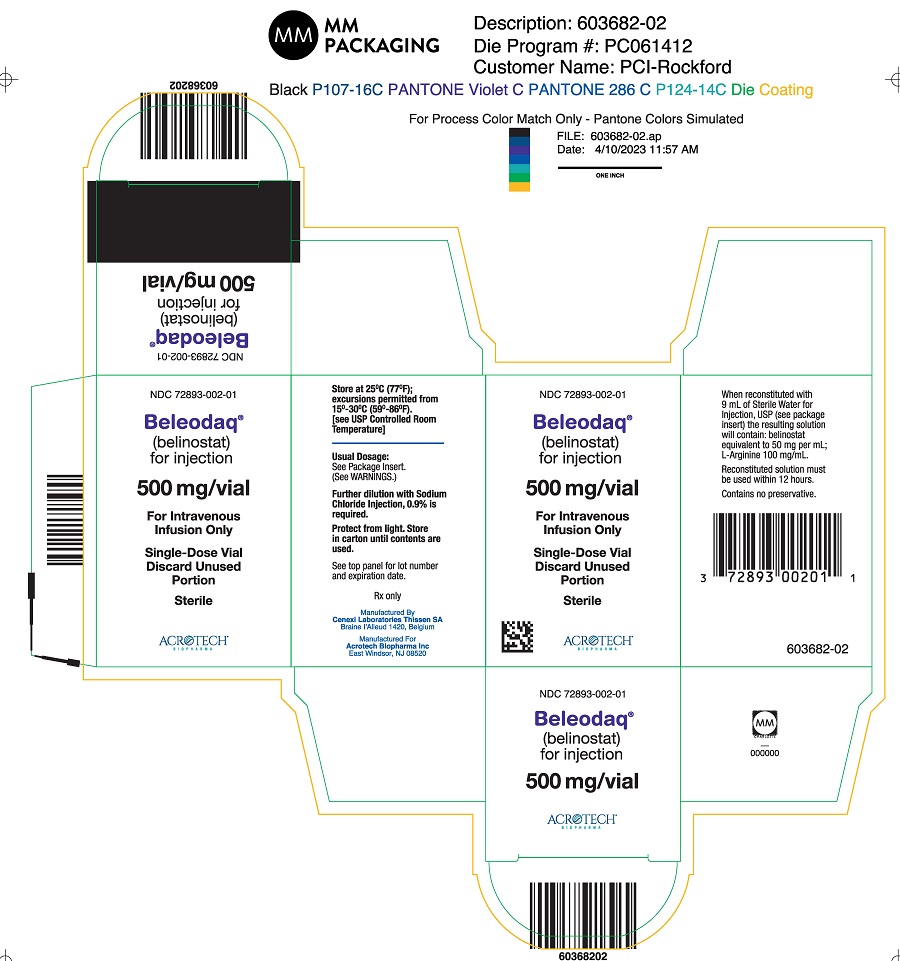
Beleodaq Belinostat 500 mg/10mL Injection, Powder, Lyophilized, For Solution — NDC 72893-002-01 (Billing 72893-0002-01)
This is a package of Beleodaq Belinostat 500 mg/10mL Injection, Powder, Lyophilized, For Solution from Acrotech Biopharma Inc, marketed since Jul 2014 and currently FDA-listed. It is this product's only package size.
NDC database record
One package, one record: these facts belong to NDC 72893-002-01 alone.
- Record
- FDA NDC Directory package listing · Human prescription drug
- Code segments
- 72893 labeler · 002 product · 01 package
- Package marketed since
- Jul 21, 2014
- Sample package
- No — commercial package
- Listing certified through
- Dec 31, 2026
- Barcode (UPC)
- 0372893002011
- Medicaid fills, this package
- 190 prescriptions in the last four reported quarters
- FDA record last changed
- Jul 24, 2026
Identity & classification
Regulatory identifiers FDA, NLM and CMS codes for this package
Drug-database identifiers Medi-Span GPI and First Databank GCN / HICL / AHFS classification
- GSN (GCN sequence number): 072560
- GCN: 36826
- GPI-14 (Medi-Span): 21531520002120
- HICL (First Databank): 041264
- AHFS class code: 10:00.00.00
- RxCUI (RxNorm): 1543547
Where does this data come from?
- FDA openFDA NDC Directory · synced Oct 8, 2026
- FDA label on DailyMed · label index refreshed Oct 6, 2026
- RxNorm (NLM RxNav) · catalog refreshed Oct 1, 2026
- Medi-Span GPI (licensed)
- First Databank (licensed) · refreshed Oct 8, 2026
RxNorm drug class
This medicine belongs to the Histone Deacetylase Inhibitor class.
Where does this data come from?
- RxClass (NLM) · catalog refreshed Oct 1, 2026
Clinical
Belinostat is used to treat peripheral T-cell lymphoma (PTCL; a form of cancer that begins in a certain type of cells in the immune system) that has not improved or that has come back after treatment with other medications. Belinostat is in a class of medications called histone deacetylase inhibitors. It works by killing cancer cells.
Read the full MedlinePlus article ↗- It treats adults with peripheral T-cell lymphoma (PTCL) that has returned or has not responded to earlier treatment. It was approved based on how many tumors shrank. It has not bee...
- It is given through a vein (IV) over about 30 minutes, once a day for 5 days, in a 21-day cycle. Your team may delay or lower doses if side effects appear. Follow the schedule your...
- Nausea, tiredness, fever, anemia and vomiting are the most common. Constipation, diarrhea and shortness of breath also occur. Tell your team, since anti-nausea and anti-diarrhea me...
- Call about fever, chills or cough, which can signal infection. Also call about unusual bleeding or bruising, yellowing of the skin or eyes, or severe stomach symptoms. Serious infe...
Patient education
Supplement & herbal interactions
Some supplements/herbs that may interact with Belinostat — tap one for details:
Where does this data come from?
- MedlinePlus (NLM) · refreshed Oct 1, 2026
- FDA label on DailyMed · label index refreshed Oct 6, 2026
Ask a licensed pharmacist directly — free, answered by our team.
Pricing
A drug doesn't have one price. Each row is a different public payment system, and none is what you'd pay at the counter — that depends on your insurance. The ⓘ on each row explains what it measures.
| Price system | Per mL | Per package |
|---|---|---|
| Retail pharmacies payNADAC · weekly | Not in the retail survey — common for institutional, discontinued, or low-volume packs. | |
| Medicaid paysCMS SDUD · 12 mo | $1,467.97 | $14,679.74 / 10 ml |
| Medicare drug plans payPart D · quarterly | No Part D plan price is available for this NDC in our data. | |
| Medicare Part B allowsASP · J9032 | $54.446 / J9032 unit | — |
Where does this data come from?
- CMS NADAC weekly file
- CMS ASP pricing files · refreshed Sep 20, 2026
- CMS Medicaid State Drug Utilization Data · through Q4 2025
- CMS Part D plan pricing files · refreshed Sep 24, 2026
- VA National Acquisition Center price file
Billing & reimbursement
Where does this data come from?
- CMS ASP NDC-HCPCS crosswalk · refreshed Sep 22, 2026
- DMEPDAC NDC-HCPCS crosswalk
- openFDA NSDE billing units · refreshed Oct 7, 2026
Packaging — all sizes for this product
| Package NDC | Description | Marketing start | Marketing end | Status |
|---|---|---|---|---|
| 72893-0002-01 You're viewing this Main listing | 1 VIAL in 1 CARTON / 10 mL in 1 VIAL | 2014-07-21 | — | Active |
Therapeutic equivalents
| Product | Labeler | Pack | NADAC/unit | TE | Status | Price vs. this |
|---|---|---|---|---|---|---|
| Beleodaq 500 mg/10mLthis 72893-0002-01 | Acrotech | 1 vial | — | — | FDA listed | — |
Where does this data come from?
- FDA openFDA NDC Directory · synced Oct 8, 2026
- FDA Orange Book · refreshed Oct 3, 2026
- CMS NADAC weekly file
Availability & generic status
We did not find an FDA-approved generic match for this exact strength, form and route. Patent/protection dates below may affect future generic timing.
Why the date isn’t exact: Generic timing can change because patents may be challenged, settled, licensed, added, removed, or worked around with a narrower label — and FDA approval does not always mean a pharmacy can get the generic today.
🛈 What do these terms mean?
- Patent
- Legal protection listed in the Orange Book that may delay generic approval or launch. Issued by the U.S. Patent & Trademark Office.
- Substance patent
- Covers the active drug molecule itself — the hardest to design around. A generic generally can’t launch until it expires.
- Formulation (product) patent
- Covers a specific formulation or dosage form. A generic can sometimes work around it with a different formulation.
- Method-of-use patent
- A patent covering one specific approved use of the drug — not necessarily the whole molecule. A generic can sometimes launch with a “skinny label” that carves out the protected use and keeps the others.
- Skinny label
- A generic label that omits a still-patented use when the FDA allows it — letting a generic reach the market for the unprotected uses.
- Exclusivity
- FDA-granted marketing protection, separate from patents — e.g. 5-yr new chemical entity, 7-yr orphan drug, or a +6-month pediatric extension.
- Paragraph IV
- A generic applicant’s formal challenge to a listed patent. It can potentially lead to earlier generic entry, but often involves litigation or a settlement.
- RLD / RS
- Reference Listed Drug — the brand product the FDA uses as the reference for generic applications. Reference Standard — the product the FDA expects generics to compare against in bioequivalence testing.
- TE / AB rating
- FDA therapeutic-equivalence rating. An AB rating generally means the FDA considers a generic therapeutically equivalent to — and substitutable for — the brand.
- LOE (loss of exclusivity)
- The latest patent or exclusivity currently listed — the loss-of-exclusivity / latest-listed-protection date shown on this page. Paragraph-IV challenges and settlements can move the real date earlier; FDA approval and a manufacturer’s decision to market can move it later.
Built from the FDA Orange Book. The bars above are scaled to each protection’s expiry; the red LOE marker is the last one to lapse.
| Patent | Type | Use code | Expires |
|---|---|---|---|
| US 6888027 ↗ | Drug substance | U-1544 | Aug 10, 2026 |
| US 8835501 ↗ | Drug product | — | Oct 27, 2027 |
Is there a generic version of BELEODAQ 500 MG VIAL?
The FDA approved a generic — why can’t I get it at my pharmacy yet?
Why do different websites show different generic release dates?
What does “FDA listed” mean?
What does a patent or protection date mean here?
What does “current Orange Book estimate” mean?
Can a generic come out before the last patent expires?
Can a generic come out after the listed dates?
What is the difference between patents and exclusivity?
Why are there multiple patent dates?
Where does this data come from?
- FDA Orange Book · refreshed Oct 3, 2026
Inactive Ingredients / Excipients
Inactive ingredients, also called excipients, are components of the drug product other than the active ingredient. They may include fillers, dyes, coatings, preservatives, flavors, or other formulation ingredients.
🧪 Avoiding an ingredient? See Belinostat Injection inactive ingredients by manufacturer: every current product's list side by side, so you can ask your pharmacy for the version that does not list it.
💡 Tap an ingredient (hover on desktop) to see what it is and why it’s used.
-
1000 mg / 10 mL
UNII 94ZLA3W45F
Arginine is an amino acid used in medicines as a buffer and pH adjuster. It helps maintain the proper acidity level and stability of liquid formulations.
1 inactive ingredient listed in the exact product block matched to this NDC.
Where does this data come from?
ingredient classCode="IACT" elements from the exact product block matched by this NDC. Label-section narrative from DailyMed / the openFDA label index is shown separately when available.- FDA label on DailyMed · label index refreshed Oct 6, 2026
- FDA openFDA NDC Directory · synced Oct 8, 2026
Inactive ingredient FAQ
Are inactive ingredients the same for every manufacturer?
Why might an inactive ingredient be missing?
Can inactive ingredients matter?
Manufacturer & labeler
More NDCs from Acrotech Biopharma Inc labeler code 72893
- EVOMELA Melphalan 50 mg/10mL Injection, Powder, Lyophilized, For Solution NDC 72893-001-01
- Folotyn pralatrexate 20 mg/mL Injection NDC 72893-003-01
- KHAPZORY levoleucovorin 175 mg/3.5mL Injection, Powder, Lyophilized, For Solution NDC 72893-004-01
- Folotyn pralatrexate 40 mg/2mL Injection NDC 72893-005-01
- Zevalin ibritumomab tiuxetan Kit NDC 72893-007-04
- RYZNEUTA efbemalenograstim alfa-vuxw 20 mg/mL Injection NDC 72893-016-02
- ADQUEY Difamilast 10 mg/g Ointment NDC 72893-017-07
Where does this data come from?
- FDA openFDA NDC Directory · synced Oct 8, 2026
- Drugs@FDA
Full prescribing information FDA SPL
🎯 Indications and Usage ▾
1 INDICATIONS AND USAGE Beleodaq is indicated for the treatment of adult patients with relapsed or refractory peripheral T-cell lymphoma (PTCL). This indication is approved under accelerated approval based on tumor response rate and duration of response [ see Clinical Studies ( 14 )]. An improvement in survival or disease-related symptoms has not been established.
Continued approval for this indication may be contingent upon verification and description of clinical benefit in the confirmatory trial. Beleodaq is a histone deacetylase inhibitor indicated for the treatment of adult patients with relapsed or refractory peripheral T-cell lymphoma (PTCL). This indication is approved under accelerated approval based on tumor response rate and duration of response.
An improvement in survival or disease-related symptoms has not been established. Continued approval for this indication may be contingent upon verification and description of clinical benefit in the confirmatory trial.( 1 )
⏱️ Dosage and Administration ▾
2 DOSAGE AND ADMINISTRATION Recommended dosage of Beleodaq is 1,000 mg/m 2 administered over 30 minutes by intravenous infusion once daily on days 1 through 5 of a 21-day cycle. Cycles can be repeated until disease progression or unacceptable toxicity. ( 2.1 ) Treatment discontinuation or interruption with or without dosage reductions by 25% may be needed to manage adverse reactions ( 2.2 ) Reduce dosage in patients with moderate hepatic or renal impairment.
( 2.3 , 2.4 , 8.6 , 8.7 ) Avoid use in patients with severe hepatic or renal impairment. ( 2.3 , 2.4 , 8.6 , 8.7 ) Modify dosage in patients known to be homozygous for the UGT1A1*28 allele. ( 2.5 ) See the full prescribing information for preparation and administration instructions.
( 2.7 )
2.1Recommended Dosage The recommended dosage of Beleodaq is 1,000 mg/m 2 administered over 30 minutes by intravenous infusion once daily on Days 1 through 5 of a 21-day cycle. Cycles can be repeated every 21 days until disease progression or unacceptable toxicity.
2.2Dosage Modification for Hematologic and Non-Hematologic Toxicities Table 1 displays the recommended Beleodaq dosage modifications for hematologic and non-hematologic toxicities. Base dosage adjustments for thrombocytopenia and neutropenia on platelet and absolute neutrophil nadir (lowest value) counts in the preceding cycle of therapy. • Absolute neutrophil count (ANC) should be greater than or equal to 1 x 10 9 /L and the platelet count should be greater than or equal to 50 x 10 9 /L prior to the start of each cycle and prior to resuming treatment following toxicity.
Resume subsequent treatment with Beleodaq according to the guidelines described in Table 1 below. Discontinue Beleodaq in patients who have recurrent ANC nadirs less than 0.5 x 10 9 /L and/or recurrent platelet count nadirs less than 25 x 10 9 /L after two dosage reductions. • Other toxicities must be NCI-CTCAE Grade 2 or less prior to re-treatment. Monitor complete blood counts at baseline and weekly.
Perform serum chemistry tests, including renal and hepatic functions prior to the start of the first dose of each cycle. Table 1: Dosage Modifications for Hematologic and Non-Hematologic Toxicities Dosage Modification Dosage Modifications due to Hematologic Toxicities Platelet count ≥ 25 x 10 9 /L and nadir ANC ≥ 0.5 x 10 9 /L No Change Nadir ANC < 0.5 x 10 9 /L (any platelet count) Decrease dosage by 25% (750 mg/m 2 ) Platelet count < 25 x 10 9 /L (any nadir ANC) Dosage Modifications due to Non-Hematologic Toxicities Any CTCAE Grade 3 or 4 adverse reaction ª Decrease dosage by 25% (750 mg/m 2 ) Recurrence of CTCAE Grade 3 or 4 adverse reaction after two dosage reductions Discontinue Beleodaq ªFor nausea, vomiting, and diarrhea, dose modification may not be necessary if the duration is less than 7 days with supportive management
2.3Recommended Dosage in Patients with Hepatic Impairment Beleodaq dosage in patients with moderate hepatic impairment (total bilirubin > 1.5 to 3 x ULN, any aspartate aminotransferase (AST)) is 500 mg/m 2 administered over 30 minutes by intravenous infusion once daily on Days 1 through 5 of a 21-day cycle. Avoid use of Beleodaq in patients with severe hepatic impairment (total bilirubin > 3 x ULN, any AST). No dosage adjustment is recommended for patients with mild hepatic impairment (total bilirubin ≤ 1.5 x ULN, any AST).
Hepatic impairment is defined per the National Cancer Institute Organ Dysfunction Working Group.
2.4Recommended Dosage in Patients with Renal Impairment Beleodaq dosage in patients with moderate renal impairment (creatinine clearance [CLcr] 30 to <60 mL/min) is 500 mg/m 2 administered over 30 minutes by intravenous infusion once daily on Days 1 through 5 of a 21-day cycle. Avoid use of Beleodaq in patients with severe renal impairment (CLcr < 30 mL/min). No dosage adjustment is recommended for patients with mild renal impairment (CLcr 60 to < 90 mL/min).
2.5Dosage Modification for Patients with Reduced UGT1A1 Act… [Excerpted — this section continues on DailyMed.]
💊 Dosage Forms and Strengths ▾
3 DOSAGE FORMS AND STRENGTHS For injection: 500 mg, lyophilized powder in single-dose vial for reconstitution For injection: 500 mg, lyophilized powder in single-dose vial for reconstitution ( 3 )
⛔ Contraindications ▾
4 CONTRAINDICATIONS None None. ( 4 )
⚠️ Warnings and Cautions ▾
5 WARNINGS AND PRECAUTIONS Hematologic Toxicity : Thrombocytopenia, leukopenia (neutropenia and lymphopenia), and anemia: Monitor blood counts and modify dosage for hematologic toxicities. ( 2.2 , 5.1 ) Infection : Serious and fatal infections (e.g., pneumonia and sepsis) ( 5.2 ) Hepatotoxicity : Beleodaq may cause hepatic toxicity and liver function test abnormalities. Monitor liver function tests and omit or modify dosage for hepatic toxicities.
( 2.2 , 5.3 ) Tumor lysis syndrome : Monitor patients with advanced stage disease and/or high tumor burden and take appropriate precautions ( 5.4 ) Gastrointestinal Toxicity : Nausea, vomiting and diarrhea occur with Beleodaq and may require antiemetic and antidiarrheal medications ( 5.5 ). Embryo-Fetal Toxicity : Can cause fetal harm. ( 5.6 )
5.1Hematologic Toxicity Beleodaq can cause thrombocytopenia, leukopenia (neutropenia and lymphopenia), and/or anemia; monitor blood counts weekly during treatment, and modify dosage as necessary [see Dosage and Administration ( 2.2 ) and Adverse Reactions( 6.1 )] .
5.2Infections Serious and sometimes fatal infections, including pneumonia and sepsis, have occurred with Beleodaq. Do not administer Beleodaq to patients with an active infection. Patients with a history of extensive or intensive chemotherapy may be at higher risk of life threatening infections [see Adverse Reactions ( 6.1 )].
5.3Hepatotoxicity Beleodaq can cause fatal hepatotoxicity and liver function test abnormalities [see Adverse Reactions ( 6.1 )] . Monitor liver function tests before treatment and before the start of each cycle. Interrupt or adjust dosage until recovery, or permanently discontinue Beleodaq based on the severity of the hepatic toxicity [see Dosage and Administration ( 2.2) and Clinical Pharmacology ( 12.3 )].
5.4Tumor Lysis Syndrome Tumor lysis syndrome has occurred in Beleodaq-treated patients in the clinical trial of patients with relapsed or refractory PTCL [see Clinical Studies ( 14 ) ] . Monitor patients with advanced stage disease and/or high tumor burden and take appropriate precautions [see Adverse Reactions ( 6.1 ) ] .
5.5Gastrointestinal Toxicity Nausea, vomiting and diarrhea occur with Beleodaq [see Adverse Reactions ( 6.1 )] and may require the use of antiemetic and antidiarrheal medications.
5.6Embryo-fetal Toxicity Based on its mechanism of action and findings of genotoxicity, Beleodaq can cause fetal harm when administered to a pregnant woman [see Clinical Pharmacology ( 12.1 ) and Nonclinical Toxicology ( 13.1 )] . Advise pregnant women of the risk to a fetus. Advise females of reproductive potential to use an effective method of contraception during treatment with Beleodaq and for 6 months after the last dose [see Use in Specific Populations ( 8.1 , 8.3 ) .
Advise males with female partners of reproductive potential to use effective contraception during treatment with Beleodaq and for 3 months after the last dose.
5.1Hematologic Toxicity Beleodaq can cause thrombocytopenia, leukopenia (neutropenia and lymphopenia), and/or anemia; monitor blood counts weekly during treatment, and modify dosage as necessary [see Dosage and Administration ( 2.2 ) and Adverse Reactions( 6.1 )] .
5.2Infections Serious and sometimes fatal infections, including pneumonia and sepsis, have occurred with Beleodaq. Do not administer Beleodaq to patients with an active infection. Patients with a history of extensive or intensive chemotherapy may be at higher risk of life threatening infections [see Adverse Reactions ( 6.1 )].
5.3Hepatotoxicity Beleodaq can cause fatal hepatotoxicity and liver function test abnormalities [see Adverse Reactions ( 6.1 )] . Monitor liver function tests before treatment and before the start of each cycle. Interrupt or adjust dosage until recovery, or permanently discontinue Beleodaq based on the severity of the hepatic toxicity [see Dosage and Administration ( 2.2) and Clinical Pharmacology ( 12.3 )].
5.4Tumor Lysis Syndrome Tumor… [Excerpted — this section continues on DailyMed.]
🤒 Adverse Reactions ▾
6 ADVERSE REACTIONS The following clinically significant adverse reactions are described in more detail in other sections of the prescribing information. • Hematologic Toxicity [see Warnings and Precautions ( 5.1 )] • Infection [see Warnings and Precautions ( 5.2 )] • Hepatotoxicity [see Warnings and Precautions ( 5.3 )] • Tumor Lysis Syndrome [see Warnings and Precautions ( 5.4 )] • Gastrointestinal Toxicity [see Warnings and Precautions ( 5.5 )] The most common adverse reactions (>25%) are nausea, fatigue, pyrexia, anemia, and vomiting.
( 6 ) To report SUSPECTED ADVERSE REACTIONS, contact Acrotech Biopharma Inc at 1-888-292-9617 or FDA at 1-800-FDA-1088 or www.fda.gov/medwatch
6.1Clinical Trials Experience Because clinical trials are conducted under widely varying conditions, adverse reaction rates observed in the clinical trials of Beleodaq may not reflect the rates observed in practice. Adverse Reactions in Patients with Peripheral T-Cell Lymphoma The safety of Beleodaq was evaluated in 129 patients with relapsed or refractory PTCL in the single arm clinical trial in which patients were administered Beleodaq at a dosage of 1,000 mg/m 2 administered over 30 minutes by IV infusion once daily on Days 1 through 5 of a 21-day cycle [see Clinical Studies ( 14 ) ] .
The median duration of treatment was 2 cycles (range 1 – 33 cycles). The most common adverse reactions observed in the trial of patients with relapsed or refractory PTCL treated with Beleodaq were nausea, fatigue, pyrexia, anemia, and vomiting [see Clinical Studies ( 14 ) ] . Table 3 summarizes the adverse reactions regardless of causality from the trial in patients with relapsed or refractory PTCL.
Table 3: Adverse Reactions Occurring in ≥ 10% of Patients with Relapsed or Refractory PTCL (NCI CTC Grade 1-4) Adverse Reactions Percentage of Patients (%) (N=129) All Grades Grade 3 or 4 All Adverse Reactions 97 61 Nausea 42 1 Fatigue 37 5 Pyrexia 35 2 Anemia 32 11 Vomiting 29 1 Constipation 23 1 Diarrhea 23 2 Dyspnea 22 6 Rash 20 1 Peripheral Edema 20 0 Cough 19 0 Thrombocytopenia 16 7 Pruritus 16 3 Chills 16 1 Increased Blood Lactate Dehydrogenase 16 2 Decreased Appetite 15 2 Headache 15 0 Infusion Site Pain 14 0 Hypokalemia 12 4 Prolonged QT 11 4 Abdominal pain 11 1 Hypotension 10 3 Phlebitis 10 1 Dizziness 10 0 Note: Adverse reactions are listed by order of incidence in the “All Grades” category first, then by incidence in “the Grade 3 or 4” category; Measured by National Cancer Institute Common Terminology Criteria for Adverse Events (NCI-CTCAE) version
3.0Serious Adverse Reactions Sixty-one patients (47.3%) experienced serious adverse reactions while taking Beleodaq or within 30 days after their last dose of Beleodaq. The most common serious adverse reactions (> 2%) were pneumonia, pyrexia, infection, anemia, increased creatinine, thrombocytopenia, and multi-organ failure. One treatment-related death associated with hepatic failure was reported in the trial.
One patient with baseline hyperuricemia and bulky disease experienced Grade 4 tumor lysis syndrome during the first cycle of treatment and died due to multi-organ failure. A treatment-related death from ventricular fibrillation was reported in another monotherapy clinical trial with Beleodaq. ECG analysis did not identify QTc prolongation.
Discontinuations due to Adverse Reactions Twenty-five patients (19.4%) discontinued treatment with Beleodaq due to adverse reactions. The adverse reactions reported most frequently as the reason for discontinuation of treatment included anemia, febrile neutropenia, fatigue, and multi-organ failure. Dosage Modifications due to Adverse Reactions In the trial, dosage adjustments due to adverse reactions occurred in 12% of Beleodaq-treated patients.
6.1Clinical Trials Experience Because clinical trials are conducted under widely varying conditions, adverse reaction rates observed in the clinical trials of Beleodaq may not reflect the rates observed in practice. Adverse Reactio… [Excerpted — this section continues on DailyMed.]
🔄 Drug Interactions ▾
7 DRUG INTERACTIONS UGT1A1 Inhibitors: Avoid use or modify dosage if use is unavoidable. ( 2.6 , 7.1 )
7.1UGT1A1 Inhibitors Avoid concomitant administration of Beleodaq with UGT1A1inhibitors. If concomitant use of a UGT1A1 inhibitor is unavoidable, modify the Beleodaq dose [see Dosage and Administration ( 2.6 )] . Belinostat is primarily metabolized by UGT1A1. Concomitant use with a UGT1A1 inhibitor increases belinostat exposure [see Clinical Pharmacology ( 12.3 )] , which may increase the risk of Beleodaq adverse reactions.
7.1UGT1A1 Inhibitors Avoid concomitant administration of Beleodaq with UGT1A1inhibitors. If concomitant use of a UGT1A1 inhibitor is unavoidable, modify the Beleodaq dose [see Dosage and Administration ( 2.6 )] . Belinostat is primarily metabolized by UGT1A1. Concomitant use with a UGT1A1 inhibitor increases belinostat exposure [see Clinical Pharmacology ( 12.3 )] , which may increase the risk of Beleodaq adverse reactions.
👥 Use in Specific Populations ▾
8 USE IN SPECIFIC POPULATIONS Lactation: Advised not to breastfeed. ( 8.2 )
8.1Pregnancy Risk Summary Based on its mechanism of action, Beleodaq can cause teratogenicity and/or embryo-fetal lethality because it is genotoxic and targets actively dividing cells [see Clinical Pharmacology ( 12.1 ) and Nonclinical Toxicology ( 13.1 )] . There are no available data on Beleodaq use in pregnant women to evaluate for a drug-associated risk of major birth defects, miscarriage or adverse maternal or fetal outcomes. No animal reproduction studies were conducted with Beleodaq.
Advise pregnant women of the potential risk to a fetus. The estimated background risk of major birth defects and miscarriage for the indicated population(s) is unknown. All pregnancies have a background risk of birth defect, loss, or other adverse outcomes.
In the U.S. general population, the estimated background risk of major birth defects and miscarriage in clinically recognized pregnancies is 2-4% and 15-20%, respectively.
8.2Lactation Risk Summary There are no data on the presence of belinostat in human milk, the effects on the breastfed child, or the effects on milk production. Because of the potential for serious adverse reactions in the breastfed child , advise patients that breastfeeding is not recommended during treatment with Beleodaq, and for 2 weeks after the last dose
8.3Females and Males of Reproductive Potential Beleodaq can cause embryo-fetal harm when administered to a pregnant woman [see Use in Specific Populations ( 8.1 )] . Pregnancy Testing Pregnancy testing is recommended for females of reproductive potential prior to initiating Beleodaq. Contraception Females Advise females of reproductive potential to use effective contraception during treatment with Beleodaq and for 6 months after the last dose.
Males Based on genotoxicity findings, advise males with female partners of reproductive potential to use effective contraception during treatment with Beleodaq and for 3 months after the last dose [ see Nonclinical Toxicology ( 13.1 )]. Infertility Males Based on findings from animal studies, Beleodaq may impair male fertility. The reversibility of the effect on fertility is unknown [ see Nonclinical Toxicology ( 13.1 )].
8.4Pediatric Use The safety and effectiveness of Beleodaq in pediatric patients have not been established.
8.5Geriatric Use In the single-arm trial, 48% of patients (N = 62) were ≥ 65 years of age and 10% of patients (N=13) were ≥ 75 years of age [see Clinical Studies (14)]. The median age of the trial population was 63 years. Patients ≥ 65 years of age had a higher response rate to Beleodaq treatment than patients < 65 years of age (36% versus 16%) while no meaningful differences in response rate were observed between patients ≥ 75 years of age and those < 75 years of age.
No clinically meaningful differences in serious adverse reactions were observed in patients based on age (< 65 years compared with ≥ 65 years or < 75 years of age compared with ≥ 75 years of age).
8.6Use in Patients with Hepatic Impairment No dosage adjustment is recommended for patients with mild hepatic impairment (total bilirubin ≤ 1.5 x ULN, any AST). Reduce the Beleodaq dosage in patients with moderate hepatic impairment (total bilirubin > 1.5 to 3 x ULN, any AST) [see Dosage and Administration ( 2.3 )]. Avoid use of Beleodaq in patients with severe hepatic impairment (total bilirubin > 3 x ULN, any AST) [see Clinical Pharmacology ( 12.3 )] .
Belinostat is metabolized in the liver, moderate hepatic impairment (total bilirubin > 1.5 to 3 x ULN, any AST) and severe hepatic impairment (total bilirubin > 3 x ULN, any AST) increases belinostat exposure [see Clinical Pharmacology ( 12.3 )], which may increase the risk of Beleodaq adverse reactions.
8.7Use in Patients with Renal Impairment No dosage adjustment is recommended for patients with mild renal impairment (CLcr 60 to < 90 mL/min). Reduce the Beleodaq dosage in patients with moderate renal impairment… [Excerpted — this section continues on DailyMed.]
🤰 Pregnancy ▾
8.1Pregnancy Risk Summary Based on its mechanism of action, Beleodaq can cause teratogenicity and/or embryo-fetal lethality because it is genotoxic and targets actively dividing cells [see Clinical Pharmacology ( 12.1 ) and Nonclinical Toxicology ( 13.1 )] . There are no available data on Beleodaq use in pregnant women to evaluate for a drug-associated risk of major birth defects, miscarriage or adverse maternal or fetal outcomes. No animal reproduction studies were conducted with Beleodaq.
Advise pregnant women of the potential risk to a fetus. The estimated background risk of major birth defects and miscarriage for the indicated population(s) is unknown. All pregnancies have a background risk of birth defect, loss, or other adverse outcomes.
In the U.S. general population, the estimated background risk of major birth defects and miscarriage in clinically recognized pregnancies is 2-4% and 15-20%, respectively.
🧒 Pediatric Use ▾
8.4Pediatric Use The safety and effectiveness of Beleodaq in pediatric patients have not been established.
🧓 Geriatric Use ▾
8.5Geriatric Use In the single-arm trial, 48% of patients (N = 62) were ≥ 65 years of age and 10% of patients (N=13) were ≥ 75 years of age [see Clinical Studies (14)]. The median age of the trial population was 63 years. Patients ≥ 65 years of age had a higher response rate to Beleodaq treatment than patients < 65 years of age (36% versus 16%) while no meaningful differences in response rate were observed between patients ≥ 75 years of age and those < 75 years of age.
No clinically meaningful differences in serious adverse reactions were observed in patients based on age (< 65 years compared with ≥ 65 years or < 75 years of age compared with ≥ 75 years of age).
🆘 Overdosage ▾
10 OVERDOSAGE No specific information is available on the treatment of overdosage of Beleodaq. There is no antidote for Beleodaq and it is not known if Beleodaq is dialyzable. If an overdose occurs, general supportive measures should be instituted as deemed necessary by the treating physician. The elimination half-life of belinostat is 1.1 hours [see Clinical Pharmacology ( 12.3) ] .
🧬 Clinical Pharmacology ▾
12 CLINICAL PHARMACOLOGY
12.1Mechanism of Action Beleodaq is a histone deacetylase (HDAC) inhibitor. HDACs catalyze the removal of acetyl groups from the lysine residues of histones and some non-histone proteins. In vitro , belinostat caused the accumulation of acetylated histones and other proteins, inducing cell cycle arrest and/or apoptosis of some transformed cells.
Belinostat shows preferential cytotoxicity towards tumor cells compared to normal cells. Belinostat inhibited the enzymatic activity of histone deacetylases at nanomolar concentrations (<250 nM).
12.2Pharmacodynamics Belinostat exposure-response relationships and the time course of pharmacodynamic response are not fully characterized. Cardiac Electrophysiology Multiple clinical trials have been conducted with Beleodaq, in many of which ECG data were collected and analyzed by a central laboratory. Analysis of clinical ECG and belinostat plasma concentration data demonstrated no meaningful effect of Beleodaq on cardiac repolarization.
None of the trials showed any clinically relevant changes caused by Beleodaq on heart rate, PR duration or QRS duration as measures of autonomic state, atrio-ventricular conduction or depolarization; there were no cases of Torsades de Pointes.
12.3Pharmacokinetics The pharmacokinetic characteristics of belinostat were analyzed from pooled data from phase 1/2 clinical studies that used doses of belinostat ranging from 150 to 1200 mg/m 2 (0.15 to 1.2 times the approved recommended dosage). Distribution The mean belinostat volume of distribution approaches total body water, indicating that belinostat has limited body tissue distribution. In vitro plasma studies have shown that between 92.9% and 95.8% of belinostat is bound to protein in an equilibrium dialysis assay, and was independent of belinostat plasma concentrations from 500 to 25,000 ng/mL.
Elimination Belinostat elimination half-life is 1.1 hours with a total mean plasma clearance of 1240 mL/min. The total clearance approximates average hepatic blood flow (1500 mL/min), suggesting high hepatic extraction (clearance being flow dependent). Metabolism Belinostat is primarily metabolized by hepatic UGT1A1.
Belinostat also undergoes hepatic metabolism by CYP2A6, CYP2C9, and CYP3A4 enzymes. Excretion Following a single dose of radiolabeled belinostat (100 μCi, 1500 mg) administered as a 30-minute intravenous infusion in patients with recurrent or progressive malignancy, fecal excretion accounted for a mean (± SD) of 9.7% (± 6.5%) of the administered radioactive belinostat dose over 168 hours. The mean (± SD) of the administered radioactive belinostat dose that was excreted in urine over 168 hours was 84.8% (± 9.8%), of which unchanged belinostat accounted for only 1.7%.
Specific Populations Hepatic Impairment Belinostat steady state clearance decreased and AUC increased as a function of the degree of liver dysfunction, but were unchanged for C max , half‐life and apparent volume of distribution. Mean belinostat clearance was reduced by 18% in mild (total bilirubin ≤ ULN and AST >ULN, or total bilirubin ˃1 to 1.5 x ULN), 24% in moderate (total bilirubin ˃ 1.5 to 3 times ULN and any value for AST) and 33% in severe hepatic impairment (total bilirubin ˃ 3 to 10 times ULN and any value for AST).
Increases in belinostat exposure were correlated with worsening liver function, but there was no obvious relationship between exposure and DLTs during the first cycle of therapy. Renal Impairment Belinostat C max increased by 1.7-fold, AUC 0-∞ by 1.3-fold and CL tot was unchanged in patients with mild renal impairment (CLcr 60 to <90 ml/min). Belinostat C max and AUC 0-∞ increased by 1.7-fold and CL tot decreased by 26% in patients with moderate renal impairment (CLcr 30 < 60 ml/min).
The effect of severe renal impairment (CLcr < 30 mL/min) on belinostat pharmacokinetics is unknown. Drug Interaction Studies Clinical Studies and Model-Informed Approaches UGT1A1 inhibitors : Belinostat t 1/2 inc… [Excerpted — this section continues on DailyMed.]
🧬 Mechanism of Action ▾
12.1Mechanism of Action Beleodaq is a histone deacetylase (HDAC) inhibitor. HDACs catalyze the removal of acetyl groups from the lysine residues of histones and some non-histone proteins. In vitro , belinostat caused the accumulation of acetylated histones and other proteins, inducing cell cycle arrest and/or apoptosis of some transformed cells.
Belinostat shows preferential cytotoxicity towards tumor cells compared to normal cells. Belinostat inhibited the enzymatic activity of histone deacetylases at nanomolar concentrations (<250 nM).
📦 How Supplied / Storage and Handling ▾
16 HOW SUPPLIED/STORAGE AND HANDLING How Supplied Beleodaq (belinostat) for injection is supplied in single vial cartons; each clear vial contains sterile, lyophilized powder equivalent to 500 mg belinostat. NDC 72893-002-01: Individual carton of Beleodaq single-dose vial containing 500 mg belinostat. Storage and Handling Store Beleodaq (belinostat) for injection at room temperature 20°C to 25°C (68°F to 77°F).
Excursions are permitted between 15°C and 30°C (59°F and 86°F). Retain in original package until use. [see USP Controlled Room Temperature]. Beleodaq is a hazardous drug.Follow special handling and disposal procedures.
1
📋 Description ▾
11 DESCRIPTION Beleodaq is a histone deacetylase inhibitor with a sulfonamide-hydroxamide structure. The chemical name of belinostat is (2E)- N -hydroxy-3-[3-(phenylsulfamoyl)phenyl]prop-2-enamide. The structural formula is as follows: The molecular formula is C 15 H 14 N 2 O 4 S and the molecular weight is 318.35 g/mol.
Belinostat is a white to off-white powder. It is slightly soluble in distilled water (0.14 mg/mL) and polyethylene glycol 400 (about 1.5 mg/mL), and is freely soluble in ethanol (> 200 mg/mL). The pKa values are 7.87 and 8.71 by potentiometry and 7.86 and 8.59 by UV.
Beleodaq (belinostat) for injection is supplied as a sterile lyophilized yellow powder containing 500 mg belinostat as the active ingredient. Each vial also contains 1000 mg L-Arginine, USP as an inactive ingredient. The drug product is supplied in a single-dose clear glass vial with a coated stopper and aluminum crimp seal with “flip-off” cap.
Beleodaq is intended for intravenous administration after reconstitution with 9 mL Sterile Water for injection, and the reconstituted solution is further diluted with 250 mL of sterile 0.9% Sodium Chloride injection prior to infusion [see Dosage and Administration ( 2) ] . Structure
💬 Information for Patients ▾
17 PATIENT COUNSELING INFORMATION Physicians should discuss the FDA approved Patient Information Leaflet with patients prior to treatment with Beleodaq. Instruct patients to read the Patient Information Leaflet carefully. Advise the patient or the caregiver to read the FDA-approved patient labeling (Patient Information).
Advise patients or their caregivers: To report symptoms of nausea, vomiting and diarrhea so that appropriate antiemetic and antidiarrheal medications can be administered [see Warnings and Precautions ( 5.5 ) ]. To report any symptoms of thrombocytopenia, leukopenia (neutropenia and lymphopenia), and anemia [see Warnings and Precautions ( 5.1 ) ]. To immediately report symptoms of infection (e.g., pyrexia) [see Warnings and Precautions ( 5.2 ) and Adverse Reactions ( 6.1 ) ].
Of the potential risk to the fetus and for women to avoid pregnancy and use effective contraception while receiving Beleodaq and for 6 months after the last dose [ see Warnings and Precautions ( 5.6 ) ]. Advise males with female partners of reproductive potential to use effective contraception during treatment with Beleodaq and for 3 months after the last dose. To avoid breastfeeding while receiving Beleodaq and for 2 weeks after the last dose [see Use in Specific Populations ( 8.2 ) ].
To understand the importance of monitoring liver function test abnormalities and to immediately report potential symptoms of liver injury [see Dosage and Administration ( 2.2 ) and Warnings and Precautions ( 5.3 ) ]. Manufactured by: Cenexi Laboratories Thissen SA Braine I'Alleud, 1420, Belgium Manufactured for: Acrotech Biopharma Inc East Windsor, NJ 08520 USA Beleodaq is a registered trademark of Acrotech Biopharma Inc. All rights are reserved.
U.S. Patent: 6,888,027
🧬 Pharmacokinetics ▾
12.3Pharmacokinetics The pharmacokinetic characteristics of belinostat were analyzed from pooled data from phase 1/2 clinical studies that used doses of belinostat ranging from 150 to 1200 mg/m 2 (0.15 to 1.2 times the approved recommended dosage). Distribution The mean belinostat volume of distribution approaches total body water, indicating that belinostat has limited body tissue distribution. In vitro plasma studies have shown that between 92.9% and 95.8% of belinostat is bound to protein in an equilibrium dialysis assay, and was independent of belinostat plasma concentrations from 500 to 25,000 ng/mL.
Elimination Belinostat elimination half-life is 1.1 hours with a total mean plasma clearance of 1240 mL/min. The total clearance approximates average hepatic blood flow (1500 mL/min), suggesting high hepatic extraction (clearance being flow dependent). Metabolism Belinostat is primarily metabolized by hepatic UGT1A1.
Belinostat also undergoes hepatic metabolism by CYP2A6, CYP2C9, and CYP3A4 enzymes. Excretion Following a single dose of radiolabeled belinostat (100 μCi, 1500 mg) administered as a 30-minute intravenous infusion in patients with recurrent or progressive malignancy, fecal excretion accounted for a mean (± SD) of 9.7% (± 6.5%) of the administered radioactive belinostat dose over 168 hours. The mean (± SD) of the administered radioactive belinostat dose that was excreted in urine over 168 hours was 84.8% (± 9.8%), of which unchanged belinostat accounted for only 1.7%.
Specific Populations Hepatic Impairment Belinostat steady state clearance decreased and AUC increased as a function of the degree of liver dysfunction, but were unchanged for C max , half‐life and apparent volume of distribution. Mean belinostat clearance was reduced by 18% in mild (total bilirubin ≤ ULN and AST >ULN, or total bilirubin ˃1 to 1.5 x ULN), 24% in moderate (total bilirubin ˃ 1.5 to 3 times ULN and any value for AST) and 33% in severe hepatic impairment (total bilirubin ˃ 3 to 10 times ULN and any value for AST).
Increases in belinostat exposure were correlated with worsening liver function, but there was no obvious relationship between exposure and DLTs during the first cycle of therapy. Renal Impairment Belinostat C max increased by 1.7-fold, AUC 0-∞ by 1.3-fold and CL tot was unchanged in patients with mild renal impairment (CLcr 60 to <90 ml/min). Belinostat C max and AUC 0-∞ increased by 1.7-fold and CL tot decreased by 26% in patients with moderate renal impairment (CLcr 30 < 60 ml/min).
The effect of severe renal impairment (CLcr < 30 mL/min) on belinostat pharmacokinetics is unknown. Drug Interaction Studies Clinical Studies and Model-Informed Approaches UGT1A1 inhibitors : Belinostat t 1/2 increased by 1.5-fold, AUC 0-inf increased by 1.4-fold, C max decreased by 33%, and renal excretion increased by 2.5-fold following concomitant administration with atazanavir (UGT1A1 inhibitor), but there was minimal change in steady state clearance. There was minimal change in belinostat glucuronide C max , AUC 0-24 ; however, belinostat glucuronide excretion decreased by 48%.
Warfarin : No clinically significant differences in the pharmacokinetics of R- or S-warfarin were observed when used concomitantly with belinostat. In Vitro Studies CYP450 Enzymes : Belinostat and its metabolites are CYP2C8 and CYP2C9 inhibitors. Transporter Systems : Belinostat is a glycoprotein (P-gp) substrate but is not a P-gp inhibitor.
🧬 Pharmacodynamics ▾
12.2Pharmacodynamics Belinostat exposure-response relationships and the time course of pharmacodynamic response are not fully characterized. Cardiac Electrophysiology Multiple clinical trials have been conducted with Beleodaq, in many of which ECG data were collected and analyzed by a central laboratory. Analysis of clinical ECG and belinostat plasma concentration data demonstrated no meaningful effect of Beleodaq on cardiac repolarization.
None of the trials showed any clinically relevant changes caused by Beleodaq on heart rate, PR duration or QRS duration as measures of autonomic state, atrio-ventricular conduction or depolarization; there were no cases of Torsades de Pointes.
🔬 Clinical Studies ▾
14 CLINICAL STUDIES Relapsed or Refractory Peripheral T-cell Lymphoma (PTCL) In an open-label, single-arm, non-randomized international trial conducted at 62 centers, 129 patients with relapsed or refractory PTCL were treated with Beleodaq 1,000 mg/m 2 administered over 30 minutes via IV infusion once daily on Days 1 through 5 of a 21-day cycle. There were 120 patients who had histologically confirmed PTCL by central review evaluable for efficacy. Patients were treated with repeat cycles every three weeks until disease progression or unacceptable toxicity.
Efficacy was evaluated using response rate (complete response and partial response) as assessed by an independent review committee (IRC) using the International Workshop Criteria (IWC) (Cheson 2007). Response assessments were evaluated every 6 weeks for the first 12 months and then every 12 weeks until 2 years from the start of study treatment. Duration of response was measured from the first day of documented response to disease progression or death.
Response and progression of disease were evaluated by the IRC using the IWC. Table 4 summarizes the baseline demographic and disease characteristics of the study population, who were evaluable for efficacy. Table 4 Baseline Patient Characteristics (PTCL Population) Characteristics Evaluable Patients (N=120) Age (years) Median (range) 64 (29-81) Sex, % Male Female 52 48 Race, % White Black Asian Latin Other 88 6 3 3 2 PTCL Subtype Based on Central Diagnosis, % PTCL Unspecified (NOS) Angioimmunoblastic T-cell lymphoma (AITL) ALK-1 negative anaplastic large cell lymphoma (ALCL) Other 64 18 11 7 Baseline Platelet Count, % ≥100,000/μL <100,000/μL 83 17 ECOG Performance Status, % 0 1 2 3 34 43 22 1 Median Time (months) from Initial PTCL Diagnosis (Range) 12 (2.6 - 266.4) Median Number of Prior Systemic Therapies (Range) 2 (1-8) In all evaluable patients (N = 120) treated with Beleodaq, the overall response rate per central review using IWC was 25.8% (N = 31) ( Table 5 ) with rates of 23.4% for PTCL, NOS and 45.5% for AITL, the two largest subtypes enrolled.
Table 5: Response Analysis per Central Assessment Using IWC in Patients with Relapsed or Refractory PTCL Evaluable Patients (N=120) Response Rate N (%) (95% CI) CR+PR 31 (25.8) 18.3-34.6 CR 13 (10.8) 5.9-17.8 PR 18 (15.0) 9.1-22.7 CI=confidence interval, CR=complete response, PR=partial response The median duration of response based on the first date of response to disease progression or death was 8.4 months (95% CI: 4.5 - 29.4). Of the responders, the median time to response was 5.6 weeks (range 4.3 - 50.4 weeks). Nine patients (7.5%) were able to proceed to a stem cell transplant after treatment with Beleodaq.
🧪 Nonclinical Toxicology ▾
13 NONCLINICAL TOXICOLOGY
13.1Carcinogenesis, Mutagenesis, Impairment of Fertility Carcinogenicity studies have not been performed with belinostat. Belinostat was genotoxic in a bacterial reverse mutation test (AMES assay), an in vitro mouse lymphoma cell mutagenesis assay, and an in vivo rat micronucleus assay. Beleodaq may impair male fertility.
Fertility studies using belinostat were not conducted. However, belinostat effects on male reproductive organs observed during the 24-week repeat-dose dog toxicology study included reduced organ weights of the testes/epididymides that correlated with a delay in testicular maturation.
📄 Carcinogenesis, Mutagenesis, Impairment of Fertility ▾
13.1Carcinogenesis, Mutagenesis, Impairment of Fertility Carcinogenicity studies have not been performed with belinostat. Belinostat was genotoxic in a bacterial reverse mutation test (AMES assay), an in vitro mouse lymphoma cell mutagenesis assay, and an in vivo rat micronucleus assay. Beleodaq may impair male fertility.
Fertility studies using belinostat were not conducted. However, belinostat effects on male reproductive organs observed during the 24-week repeat-dose dog toxicology study included reduced organ weights of the testes/epididymides that correlated with a delay in testicular maturation.
📚 References ▾
15 REFERENCES 1 OSHA Hazardous Drugs. OSHA . http://www.osha.gov/SLTC/hazardousdrugs/index.html
📄 Patient Package Insert ▾
SPL PATIENT PACKAGE INSERT SECTION PATIENT INFORMATION BELEODAQ ® (Bē-lēo-dak) (belinostat) for injection, for intravenous use Read this Patient Information before you receive treatment with Beleodaq and each time you receive Beleodaq. There may be new information. This leaflet does not take the place of talking to your doctor about your medical condition or your treatment.
What is Beleodaq? Beleodaq is a prescription medicine used to treat people with a type of cancer called peripheral T-cell Lymphoma (PTCL) that comes back or does not respond to cancer treatment. It is not known if Beleodaq is safe and effective in children.
What should I tell my doctor before receiving Beleodaq? Before receiving Beleodaq, tell your doctor about all of your medical conditions, including if you: have an infection have had chemotherapy treatment have liver or kidney problems have nausea, vomiting, or diarrhea are pregnant or plan to become pregnant. Beleodaq can harm your unborn baby.
You should not become pregnant while receiving Beleodaq. Tell your doctor right away if you become pregnant while receiving Beleodaq. are breastfeeding or plan to breastfeed. It is not known if Beleodaq passes into your breast milk.
You and your doctor should decide if you will receive Beleodaq or breastfeed. You should not do both. Tell your doctor about all the medicines you take, including prescription and over-the-counter medicines, vitamins, and herbal supplements.
How will I receive Beleodaq? Beleodaq will be given to you by intravenous (IV) injection into your vein, usually over 30 minutes. Beleodaq is given one time a day on Days 1 through 5 of a 21-day cycle of treatment.
You should have regular blood tests before and during your treatment with Beleodaq. Your doctor may change your dose of Beleodaq, change when you receive your treatment, or stop treatment if you have certain side effects while receiving Beleodaq. What are the possible side effects of Beleodaq?
Beleodaq may cause serious side effects, including: • Low blood cell counts. Your doctor will do blood tests to check your blood counts during your treatment with Beleodaq. o Low platelet counts can cause unusual bleeding or bruising under your skin. o Low red blood cell counts may make you feel weak, tired, or you get tired easily, you look pale, or you feel short of breath. o Low white blood cell counts can cause you to get infections, which may be serious. • Serious infections. People receiving Beleodaq may develop serious infections that can sometimes lead to death.
You may have a greater risk of life-threatening infections if you have had chemotherapy in the past. Tell your doctor right away if you have any of the following signs or symptoms of an infection: fever, flu-like symptoms, cough, shortness of breath, burning with urination, muscle aches, or worsening skin problems. • Liver problems. Beleodaq may cause liver problems which can lead to death.
Your doctor will do blood tests during your treatment with Beleodaq to check for liver problems. Tell your doctor right away if you have any of the following signs or symptoms of liver problems: yellowing of the skin or the white part of your eyes (jaundice), dark urine, itching, or pain in the right upper stomach area. • Tumor Lysis Syndrome (TLS). TLS is caused by a fast breakdown of cancer cells.
Your doctor will check you for TLS during treatment with Beleodaq. • Nausea, vomiting, and diarrhea are common with Beleodaq and can sometimes be serious. Tell your doctor if you develop nausea, vomiting or diarrhea. Your doctor may prescribe medicines to help prevent or treat these side effects.
Common side effects of Beleodaq include fatigue, fever, and low red blood cell count. Tell your doctor if you have any side effect that bothers you or that does not go away. These are not all the possible side effects of Beleodaq.
Call your doctor for medical advice about side effects. You can report side effects to FDA at 1-800-FDA-1088. General information… [Excerpted — this section continues on DailyMed.]
📄 Recent Major Changes ▾
Dosage and Administration ( 2.3 , 2.4 , 2.6 ) 11/2024
📄 Package Label / Principal Display Panel ▾
PACKAGE/LABEL PRINCIPAL DISPLAY PANEL Carton Label NDC 72893-002-01 Beleodaq® (belinostat) for injection 500 mg/vial For Intravenous Infusion Only Single-Dose Vial Vial Label NDC 72893-002-01 Beleodaq® (belinostat) for injection 500 mg/vial For Intravenous Infusion Only Single-Dose Vial carton label vial label
Medicaid utilization & spend
Reported adverse events (FAERS)
Top reported reactions
Age at onset
Reporter sex
Serious outcomes
Where does this data come from?
About this NDC listing & data coverage
What data is (and isn’t) available for this NDC — tap to expand
| NDC identity (package / product / labeler codes) | ✓ Available |
| Labeler | ✓ Available |
| Product & package description | ✓ Available |
| Marketing category & status | ✓ Available |
| Active ingredient / dosage form / route | ✓ Available |
| FDA label (SPL via DailyMed) | ✓ Available |
| Package photos | ✓ Available |
| Inactive ingredients (structured) | ✓ Available |
| NADAC pharmacy acquisition price (CMS) | — Not published for this NDC CMS publishes NADAC only for NDCs reported in its retail-pharmacy survey. |
| Orange Book / therapeutic-equivalence data | ✓ Available |
| HCPCS J-code billing crosswalk | ✓ Available |
| Medicaid utilization (CMS SDUD) | ✓ Available |