
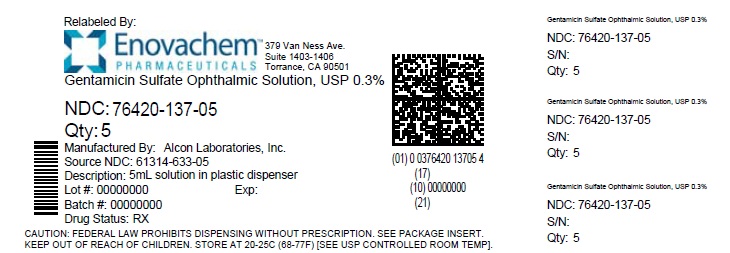
Gentamicin Sulfate 3 mg/mL Solution, 5 mL — NDC 76420-137-05 (Billing 76420-0137-05)
This is a package of 5 mL of Gentamicin Sulfate 3 mg/mL Solution from Asclemed USA, Inc., marketed since Apr 1996 and currently FDA-listed. It is this product's only package size.
NDC database record
One package, one record: these facts belong to NDC 76420-137-05 alone.
- Record
- FDA NDC Directory package listing · Human prescription drug
- Code segments
- 76420 labeler · 137 product · 05 package
- Package marketed since
- Mar 4, 2022
- Sample package
- No — commercial package
- Listing certified through
- Dec 31, 2026
- Barcode (UPC-A, from the NDC)
- 3 7642013705 4
- FDA record last changed
- Jul 24, 2026
Identity & classification
Regulatory identifiers FDA, NLM and CMS codes for this package
- RxCUI (RxNorm): 310467
Where does this data come from?
- FDA openFDA NDC Directory · synced Oct 8, 2026
- FDA label on DailyMed · label index refreshed Oct 8, 2026
- RxNorm (NLM RxNav) · catalog refreshed Oct 1, 2026
- Medi-Span GPI (licensed)
- First Databank (licensed) · refreshed Oct 8, 2026
RxNorm drug class
This medicine belongs to the Aminoglycoside Antibacterial class.
Where does this data come from?
- RxClass (NLM) · catalog refreshed Oct 1, 2026
Clinical
- It treats bacterial infections of the eye and nearby structures. That includes conjunctivitis, keratitis, corneal ulcers, blepharitis and tear-sac infections, when caused by bacter...
- What is gentamicin eye medicine used for?
- You put one or two drops into the affected eye(s), usually about every four hours. For severe infections, your prescriber may have you use it more often. Follow your prescriber's d...
- Burning or irritation when the drops go in is the most common, along with some eye redness or irritation. These are usually local to the eye. Call your doctor if your eye gets wors...
Patient education
Supplement & herbal interactions
Gentamicin (IV) may be associated with lower levels of 8 nutrients — worth a chat with your pharmacist, not a cause for alarm.
Where does this data come from?
- MedlinePlus (NLM) · refreshed Oct 8, 2026
- FDA label on DailyMed · label index refreshed Oct 8, 2026
Ask a licensed pharmacist directly — free, answered by our team.
Pricing
A drug doesn't have one price. Each row is a different public payment system, and none is what you'd pay at the counter — that depends on your insurance. The ⓘ on each row explains what it measures.
| Price system | Per mL | Per package |
|---|---|---|
| Retail pharmacies payNADAC · weekly | Not in the retail survey — common for institutional, discontinued, or low-volume packs. | |
| Medicaid paysCMS SDUD · 12 mo | No recent Medicaid claims on file for this NDC — rare and low-volume NDCs are suppressed in the public data. | |
| Medicare drug plans payPart D · Q2 2026 | $1.94 | $9.69 / 5 ml |
Where does this data come from?
- CMS NADAC weekly file
- CMS ASP pricing files · refreshed Sep 20, 2026
- CMS Medicaid State Drug Utilization Data · refreshed Oct 8, 2026
- CMS Part D plan pricing files · refreshed Sep 24, 2026
- VA National Acquisition Center price file
Packaging — all sizes for this product
| Package NDC | Description | Marketing start | Marketing end | Status |
|---|---|---|---|---|
| 76420-0137-05 You're viewing this Main listing | 5 mL in 1 BOTTLE, PLASTIC | 2022-03-04 | — | Active |
Therapeutic equivalents
| Product | Labeler | Pack | NADAC/unit | TE | Status | Price vs. this |
|---|---|---|---|---|---|---|
| Gentamicin Sulfate 3 mg/mL 24208-0580-60 | Bausch | 1 bottle | $0.790 | AT | Availability likely | — |
| Gentamicin Sulfate 3 mg/mL 61314-0633-05 | Sandoz | 5 ml | $0.790 | AT | Availability likely | — |
| Gentamicin Sulfate 3 mg/mL 50090-0569-00 | A-S | 1 bottle | — | AT | FDA listed | — |
| gentamicin sulfate 3 mg/mL 61919-0106-05 | DIRECT | 5 ml | — | — | FDA listed | — |
| Gentamicin Sulfate 3 mg/mL 63187-0560-05 | Proficient | 1 bottle | — | AT | FDA listed | — |
| Gentamicin Sulfate 3 mg/mL 63187-0764-05 | Proficient | 1 bottle | — | — | FDA listed | — |
| Gentamicin Sulfate 3 mg/mL 66267-0971-05 | NuCare | 1 bottle | — | — | FDA listed | — |
| Gentamicin Sulfate 3 mg/mL 68071-3554-05 | NuCare | 1 bottle | — | AT | FDA listed | — |
| Gentamicin Sulfate 3 mg/mL 68071-4775-05 | NuCare | 5 ml | — | AT | FDA listed | — |
| Gentamicin Sulfate 3 mg/mL 68071-4827-05 | NuCare | 5 ml | — | — | FDA listed | — |
| Gentamicin Sulfate 3 mg/mL 68788-8592-05 | Preferred | 1 bottle | — | AT | FDA listed | — |
| Gentamicin Sulfate 3 mg/mL 71205-0333-05 | Proficient | 5 ml | — | AT | FDA listed | — |
| Gentamicin Sulfate Opth Solution 3 mg/mL 72189-0359-05 | Direct_Rx | 5 ml | — | AT | FDA listed | — |
| Gentamicin Sulfate 3 mg/mLthis 76420-0137-05 | Asclemed | 5 ml | — | AT | FDA listed | — |
| Gentamicin Sulfate 3 mg/mL 76420-0254-05 | Asclemed | 1 bottle | — | AT | FDA listed | — |
Where does this data come from?
- FDA openFDA NDC Directory · synced Oct 8, 2026
- FDA Orange Book · refreshed Oct 3, 2026
- CMS NADAC weekly file
Availability & generic status
This product is an FDA-approved generic. Other versions of the same drug are listed under Therapeutic equivalents, least expensive first.
Where does this data come from?
- FDA Orange Book · refreshed Oct 3, 2026
Inactive Ingredients / Excipients
Inactive ingredients, also called excipients, are components of the drug product other than the active ingredient. They may include fillers, dyes, coatings, preservatives, flavors, or other formulation ingredients.
🧪 Avoiding an ingredient? See Gentamicin Ophthalmic inactive ingredients by manufacturer: every current product's list side by side, so you can ask your pharmacy for the version that does not list it.
💡 Tap an ingredient (hover on desktop) to see what it is and why it’s used.
-
UNII F5UM2KM3W7
Benzalkonium chloride is a chemical compound that works as a preservative and antimicrobial agent in medications. It prevents bacterial and fungal growth in liquid formulations to keep the product safe during storage and use.
-
UNII QTT17582CB
A strong acid used to adjust and maintain the proper pH level in liquid medicines, ensuring stability and preventing breakdown of active ingredients.
-
UNII 451W47IQ8X
Sodium chloride is common table salt. It's used in medicines as a buffer to maintain proper pH, as a filler to add bulk, or to adjust the osmotic balance in liquid formulations.
-
UNII 55X04QC32I
A strong alkaline chemical used to adjust and maintain the pH balance of liquid medicines. It helps keep the medicine stable and ensures it stays effective during storage.
-
UNII SE337SVY37
A mineral salt used as a buffer to help maintain the medicine's pH level and prevent breakdown of active ingredients. It also acts as a thickening agent in liquid formulations.
-
UNII Y27PUL9H56
Tyloxapol is a synthetic detergent and surfactant used in medications as a solubilizer and emulsifier. It helps dissolve or blend ingredients that don't naturally mix well, improving how the medicine disperses in liquid formulations.
-
UNII 059QF0KO0R
Water is a liquid solvent that dissolves and mixes ingredients together in liquid medicines, syrups, and injections. It helps distribute the active drug evenly throughout the product.
7 inactive ingredients listed in the exact product block matched to this NDC.
Where does this data come from?
ingredient classCode="IACT" elements from the exact product block matched by this NDC. Label-section narrative from DailyMed / the openFDA label index is shown separately when available.- FDA label on DailyMed · label index refreshed Oct 8, 2026
- FDA openFDA NDC Directory · synced Oct 8, 2026
Inactive ingredient FAQ
Are inactive ingredients the same for every manufacturer?
Why might an inactive ingredient be missing?
Can inactive ingredients matter?
Manufacturer & labeler
More NDCs from Asclemed USA, Inc. labeler code 76420
- MECLIZINE HYDROCHLORIDE Meclizine Hydrocloride 25 mg Tablet NDC 76420-130-10
- Lidocaine 50 mg/g Ointment NDC 76420-131-50
- Diclofenac Sodium 30 mg/g Gel NDC 76420-132-01
- Hydrocodone Bitartrate and Acetaminophen 5 mg; 325 mg Tablet NDC 76420-133-01
- Diclofenac Sodium 16.05 mg/mL Solution/ Drops NDC 76420-134-05
- Oxycodone and Acetaminophen 5 mg; 325 mg Tablet NDC 76420-136-30
- Amoxicillin 875 mg Tablet, Coated NDC 76420-138-20
- Zylotrol Lidocaine HCl 4%, Menthol 1% 4 g/100g; 1 g/100g Gel NDC 76420-145-04
- Indomethacin 25 mg Capsule NDC 76420-148-14
- Finasteride 1 mg Tablet, Film Coated NDC 76420-151-30
- Finasteride 5 mg Tablet, Film Coated NDC 76420-154-30
- Ibuprofen 1 g/g Powder NDC 76420-156-06
Where does this data come from?
- FDA openFDA NDC Directory · synced Oct 8, 2026
- Drugs@FDA
Full prescribing information FDA SPL
🎯 Indications and Usage ▾
INDICATIONS AND USAGE Gentamicin Sulfate Ophthalmic Solution is indicated in the topical treatment of ocular bacterial infections, including conjunctivitis, keratitis, keratoconjunctivitis, corneal ulcers, blepharitis, blepharoconjunctivitis, acute meibomianitis, and dacryocystitis caused by susceptible strains of the following microorganisms: Staphylococcus aureus, Staphylococcus epidermidis, Streptococcus pyogenes, Streptococcus pneumoniae, Enterobacter aerogenes, Escherichia coli, Haemophilus influenzae, Klebsiella pneumoniae, Neisseria gonorrhoeae, Pseudomonas aeruginosa, and Serratia marcescens.
⏱️ Dosage and Administration ▾
DOSAGE AND ADMINISTRATION Instill one or two drops into the affected eye(s) every four hours. In severe infections, dosage may be increased to as much as two drops once every hour.
⛔ Contraindications ▾
CONTRAINDICATIONS Gentamicin Sulfate Ophthalmic Solution is contraindicated in patients with known hypersensitivity to any of the components.
⚠️ Warnings ▾
WARNINGS NOT FOR INJECTION INTO THE EYE. Gentamicin Sulfate Ophthalmic Solution is not for injection. It should never be injected subconjunctivally, nor should it be directly introduced into the anterior chamber of the eye.
🤒 Adverse Reactions ▾
ADVERSE REACTIONS Bacterial and fungal corneal ulcers have developed during treatment with gentamicin ophthalmic preparations. The most frequently reported adverse reactions are ocular burning and irritation upon drug instillation, non-specific conjunctivitis, conjunctival epithelial defects, and conjunctival hyperemia. Other adverse reactions which have occurred rarely are allergic reactions, thrombocytopenic purpura, and hallucinations.
To report SUSPECTED ADVERSE REACTIONS, contact Sandoz Inc. at 1-800-525-8747 or FDA at 1-800-FDA-1088 or www.fda.gov/medwatch.
🤰 Pregnancy ▾
Pregnancy Pregnancy Category C. Gentamicin has been shown to depress body weights, kidney weights, and median glomerular counts in newborn rats when administered systemically to pregnant rats in daily doses approximately 500 times the maximum recommended ophthalmic human dose. There are no adequate and well-controlled studies in pregnant women.
Gentamicin should be used during pregnancy only if the potential benefit justifies the potential risk to the fetus.
🧒 Pediatric Use ▾
Pediatric Use Safety and effectiveness in neonates have not been established.
🧬 Clinical Pharmacology ▾
CLINICAL PHARMACOLOGY Microbiology: Gentamicin sulfate is active in vitro against many strains of the following microorganisms: Staphylococcus aureus, Staphylococcus epidermidis, Streptococcus pyogenes, Streptococcus pneumoniae, Enterobacter aerogenes, Escherichia coli, Haemophilus influenzae, Klebsiella pneumoniae, Neisseria gonorrhoeae, Pseudomonas aeruginosa, and Serratia marcescens.
📦 How Supplied / Storage and Handling ▾
HOW SUPPLIED Gentamicin Sulfate Ophthalmic Solution: 5 mL in plastic dispenser. NDC 76420-137-05 (relabeled from NDC 61314-633-05) STORAGE Protect from light and store away from heat. Store at controlled room temperature 15° to 25°C (59° to 77°F).
📋 Description ▾
DESCRIPTION Gentamicin Sulfate is a water-soluble antibiotic of the aminoglycoside group. Gentamicin Sulfate Ophthalmic Solution is a sterile, aqueous solution buffered to approximately pH 7 for ophthalmic use. Gentamicin is obtained from cultures of Micromonospora purpurea .
It is a mixture of the sulfate salts of gentamicin C 1 , C 2 , and C 1A . All three components appear to have similar antimicrobial activities. Gentamicin sulfate occurs as white powder and is soluble in water and insoluble in alcohol.
The structure is as follows: Established name: Gentamicin Sulfate Chemical name: 0-3-Deoxy-4-C-methyl-3-(methylamino)-β-L-arabinopyranosyl-(1→6)-0-[2,6-diamino-2,3,4,6-tetradeoxy-α-D-erythro-hexopyranosyl-(1→4)]-2-deoxy-D-streptamine. Ingredients: Each mL contains: Active: Gentamicin Sulfate USP (equivalent to 3 mg gentamicin). Preservative: Benzalkonium Chloride 0.1 mg (0.01%).
Inactives: Sodium Chloride, Dried Sodium Phosphate, Tyloxapol, Sodium Hydroxide and/or Hydrochloric Acid (to adjust pH) and Purified Water. chemicalstructure
💬 Information for Patients ▾
Information for Patients To avoid contamination, do not touch tip of container to the eye, eyelid, or any surface.
⚠️ Precautions ▾
PRECAUTIONS General Prolonged use of topical antibiotics may give rise to overgrowth of non-susceptible organisms including fungi. Bacterial resistance to gentamicin may also develop. If purulent discharge, inflammation or pain becomes aggravated, the patient should discontinue use of the medication and consult a physician.
If irritation or hypersensitivity to any component of the drug develops, the patient should discontinue use of this preparation, and appropriate therapy should be instituted. Information for Patients To avoid contamination, do not touch tip of container to the eye, eyelid, or any surface. Carcinogenesis, Mutagenesis, Impairment of Fertility There are no published carcinogenicity or impairment of fertility studies on gentamicin.
Aminoglycoside antibiotics have been found to be non-mutagenic. Pregnancy Pregnancy Category C. Gentamicin has been shown to depress body weights, kidney weights, and median glomerular counts in newborn rats when administered systemically to pregnant rats in daily doses approximately 500 times the maximum recommended ophthalmic human dose.
There are no adequate and well-controlled studies in pregnant women. Gentamicin should be used during pregnancy only if the potential benefit justifies the potential risk to the fetus. Pediatric Use Safety and effectiveness in neonates have not been established.
📄 Carcinogenesis, Mutagenesis, Impairment of Fertility ▾
Carcinogenesis, Mutagenesis, Impairment of Fertility There are no published carcinogenicity or impairment of fertility studies on gentamicin. Aminoglycoside antibiotics have been found to be non-mutagenic.
📄 Package Label / Principal Display Panel ▾
PRINCIPAL DISPLAY PANEL gentamicincarton
Medicare Part D spend CMS · PART D · 2026 (Q1)
About this NDC listing & data coverage
What data is (and isn’t) available for this NDC — tap to expand
| NDC identity (package / product / labeler codes) | ✓ Available |
| Labeler | ✓ Available |
| Product & package description | ✓ Available |
| Marketing category & status | ✓ Available |
| Active ingredient / dosage form / route | ✓ Available |
| FDA label (SPL via DailyMed) | ✓ Available |
| Package photos | ✓ Available |
| Inactive ingredients (structured) | ✓ Available |
| NADAC pharmacy acquisition price (CMS) | — Not published for this NDC CMS publishes NADAC only for NDCs reported in its retail-pharmacy survey. |
| Orange Book / therapeutic-equivalence data | ✓ Available |
| HCPCS J-code billing crosswalk | — Not published for this NDC Most self-administered / retail products have no J-code — that is normal. |
| Medicaid utilization (CMS SDUD) | — Not published for this NDC CMS reports utilization only for NDCs with Medicaid claims above its privacy threshold. |