
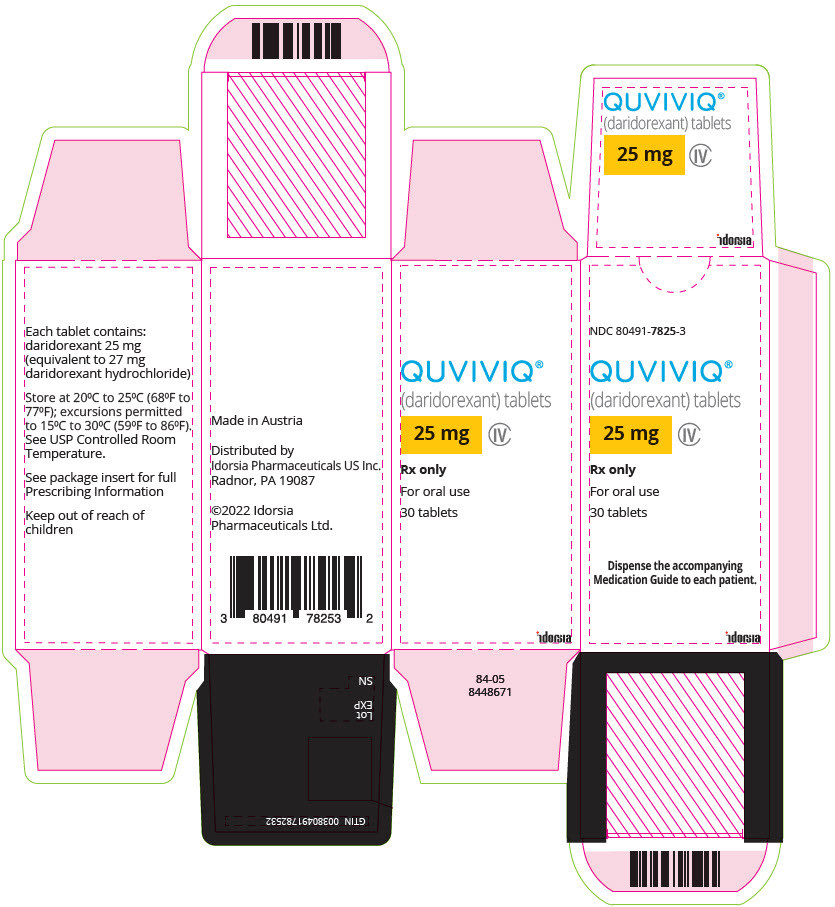
QUVIVIQ Daridorexant 25 mg Tablet, Film Coated, 30-count
🆔 Identity & classification
Where does this data come from?
🏷️ RxNorm drug class
This medicine belongs to the Orexin Receptor Antagonist class.
Where does this data come from?
🏭 Manufacturer & labeler
Where does this data come from?
🩺 Clinical
Daridorexant is used to treat people who have trouble falling asleep or staying asleep (insomnia). Daridorexant is in a class of medications called orexin receptor antagonists. It works by blocking the action of a certain natural substance in the brain that causes wakefulness.
Read the full MedlinePlus article ↗- Quviviq works differently from older sleep medications like benzodiazepines. Instead of generally sedating your brain, it specifically blocks the brain chemicals (called orexins) t...
- What exactly does Quviviq do — is it like a typical sleeping pill?
- Take Quviviq within 30 minutes of getting into bed — and only when you have at least 7 full hours before you need to be up. If you take it with or right after a meal, especially a...
- When exactly should I take it, and does it matter if I eat first?
Patient education
Supplement & herbal interactions
Some supplements/herbs that may interact with Daridorexant — tap one for details:
Where does this data come from?
Ask a licensed pharmacist directly — free, answered by our team.
💊 What it looks like
Where does this data come from?
🧪 Inactive Ingredients / Excipients
Inactive ingredients, also called excipients, are components of the drug product other than the active ingredient. They may include fillers, dyes, coatings, preservatives, flavors, or other formulation ingredients.
💡 Tap an ingredient (hover on desktop) to see what it is and why it’s used.
-
UNII 1K09F3G675
Ferric oxide red is an inorganic iron compound used as a colorant in medicines. It gives tablets, capsules, or other dosage forms a red or reddish tint for identification and appearance.
-
UNII XM0M87F357
A dark iron oxide compound that gives medicines their black or dark color. It's used as a colorant in tablets and capsules to help identify the product and make it visually distinctive.
-
UNII PDC6A3C0OX
Glycerin is a clear, thick liquid derived from plant oils or fats. It acts as a humectant to retain moisture, a sweetener, and a solvent in medications.
-
UNII 3NXW29V3WO
Hypromellose is a plant-based thickener made from cellulose. It's used in medicines as a binder to hold ingredients together, a coating for tablets, and a thickener for liquids.
-
UNII 70097M6I30
Magnesium stearate is a salt made from magnesium and stearic acid, a fatty substance. It's used in tablets and capsules as a lubricant and glidant to help ingredients flow smoothly during manufacturing and prevent sticking.
-
UNII 3OWL53L36A
A natural sugar alcohol derived from seaweed or synthesized in the lab. It's used as a filler to add bulk, a sweetener in sugar-free formulas, and a disintegrant to help tablets break apart in the stomach.
-
UNII 7T9FYH5QMK
A plant-derived powder that serves as a binder and filler in tablets and capsules. It helps hold ingredients together, adds bulk, and aids in smooth tablet disintegration when swallowed.
-
UNII PNR0YF693Y
A plant-based powder made from purified wood cellulose. It acts as a filler to add bulk, a binder to hold ingredients together, and a disintegrant to help the tablet break apart in the stomach.
-
UNII U725QWY32X
Povidone K30 is a synthetic polymer made from petroleum. It acts as a binder to hold tablet ingredients together and as a disintegrant to help the tablet break apart in the stomach so the medicine can be absorbed.
-
UNII ETJ7Z6XBU4
Silicon dioxide is a naturally occurring mineral used as a glidant and anti-caking agent. It helps powder ingredients flow smoothly and prevents clumping during manufacturing and storage.
-
UNII 7SEV7J4R1U
A powder made from a naturally occurring mineral. In medicines, talc works as a glidant and anti-caking agent, helping tablets and capsules flow smoothly during manufacturing and preventing clumping.
-
UNII 15FIX9V2JP
Titanium dioxide is a bright white mineral powder commonly used as a colorant and opacifying agent. It makes pills and tablets white or lighter in color and helps make coatings non-transparent.
-
UNII 059QF0KO0R
Water is a liquid solvent that dissolves and mixes ingredients together in liquid medicines, syrups, and injections. It helps distribute the active drug evenly throughout the product.
13 inactive ingredients listed in the exact product block matched to this NDC.
Where does this data come from?
ingredient classCode="IACT" elements from the exact product block matched by this NDC. Label-section narrative from DailyMed / the openFDA label index is shown separately when available.Inactive ingredient FAQ
Are inactive ingredients the same for every manufacturer?
Why might an inactive ingredient be missing?
Can inactive ingredients matter?
💲 Pricing
A drug doesn't have one price. Each row is a different public payment system, and none is what you'd pay at the counter — that depends on your insurance. The ⓘ on each row explains what it measures.
| Price system | Per ea | Per package |
|---|---|---|
| Retail pharmacies payNADAC · weekly | $16.716 | $501.48 / 30 tablets |
| Medicaid paysCMS SDUD · 12 mo | $16.40 | $491.87 / 30 tablets |
| Medicare drug plans payPart D · Q2 2026 | $17.83 | $534.86 / 30 tablets |
Where does this data come from?
🔁 Therapeutic equivalents
| Product | Labeler | Pack | NADAC/unit | TE | Status | Price vs. this |
|---|---|---|---|---|---|---|
| Quviviq 25 mgthis 80491-7825-03 | Idorsia | 30 tablets | $16.716 | — | Availability likely | — |
Where does this data come from?
⏳ Availability & generic status
We did not find an FDA-approved generic match for this exact strength, form and route. Patent/protection dates below may affect future generic timing.
Why the date isn’t exact: Generic timing can change because patents may be challenged, settled, licensed, added, removed, or worked around with a narrower label — and FDA approval does not always mean a pharmacy can get the generic today.
🛈 What do these terms mean?
- Patent
- Legal protection listed in the Orange Book that may delay generic approval or launch. Issued by the U.S. Patent & Trademark Office.
- Substance patent
- Covers the active drug molecule itself — the hardest to design around. A generic generally can’t launch until it expires.
- Formulation (product) patent
- Covers a specific formulation or dosage form. A generic can sometimes work around it with a different formulation.
- Method-of-use patent
- A patent covering one specific approved use of the drug — not necessarily the whole molecule. A generic can sometimes launch with a “skinny label” that carves out the protected use and keeps the others.
- Skinny label
- A generic label that omits a still-patented use when the FDA allows it — letting a generic reach the market for the unprotected uses.
- Exclusivity
- FDA-granted marketing protection, separate from patents — e.g. 5-yr new chemical entity, 7-yr orphan drug, or a +6-month pediatric extension.
- Paragraph IV
- A generic applicant’s formal challenge to a listed patent. It can potentially lead to earlier generic entry, but often involves litigation or a settlement.
- RLD / RS
- Reference Listed Drug — the brand product the FDA uses as the reference for generic applications. Reference Standard — the product the FDA expects generics to compare against in bioequivalence testing.
- TE / AB rating
- FDA therapeutic-equivalence rating. An AB rating generally means the FDA considers a generic therapeutically equivalent to — and substitutable for — the brand.
- LOE (loss of exclusivity)
- The latest patent or exclusivity currently listed — the loss-of-exclusivity / latest-listed-protection date shown on this page. Paragraph-IV challenges and settlements can move the real date earlier; FDA approval and a manufacturer’s decision to market can move it later.
Built from the FDA Orange Book. The bars above are scaled to each protection’s expiry; the red LOE marker is the last one to lapse.
| Patent | Type | Use code | Expires |
|---|---|---|---|
| US 9732075 ↗ | Drug substance | U-620 | Jun 3, 2033 |
| US 9732075 ↗ | Drug substance | U-620 | Jun 3, 2033 |
| US 10023560 ↗ | Method of use | U-620 | Dec 2, 2034 |
| US 10023560 ↗ | Method of use | U-620 | Dec 2, 2034 |
| US 9790208 ↗ | Drug substance | — | Dec 2, 2034 |
| US 9790208 ↗ | Drug substance | — | Dec 2, 2034 |
| Code | What it grants | Expires |
|---|---|---|
| M-200 | New indication / labeling change (3-year) | Sep 30, 2027 |
| M-310 | New indication / labeling change (3-year) | Sep 30, 2027 |
| NCE | New Chemical Entity (5-year) | Apr 7, 2027 |
| M-200 | New indication / labeling change (3-year) | Sep 30, 2027 |
| M-310 | New indication / labeling change (3-year) | Sep 30, 2027 |
| NCE | New Chemical Entity (5-year) | Apr 7, 2027 |
Is there a generic version of QUVIVIQ 25 MG TABLET?
The FDA approved a generic — why can’t I get it at my pharmacy yet?
Why do different websites show different generic release dates?
What does “FDA listed” mean?
What does a patent or protection date mean here?
What does “current Orange Book estimate” mean?
Can a generic come out before the last patent expires?
Can a generic come out after the listed dates?
What is the difference between patents and exclusivity?
Why are there multiple patent dates?
Where does this data come from?
🗺️ Medicaid utilization & spend
💊 Medicaid utilization by pack size
📊 Medicare Part D spend CMS · PART D · 2026 (Q1)
🔬 Reported adverse events (FAERS)
Top reported reactions
Age at onset
Reporter sex
Serious outcomes
Where does this data come from?
📦 Packaging — all sizes for this product
| Package NDC | Description | Per unit | Per pack | Marketing start | Status |
|---|---|---|---|---|---|
| 80491-7825-03 You're viewing this | 1 BOTTLE in 1 CARTON (80491-7825-3) / 30 TABLET, FILM COATED in 1 BOTTLE | $16.72 / ea | $501.48 | 2022-04-07 | Active |
| 80491-7825-02 | 1 BLISTER PACK in 1 CARTON (80491-7825-2) / 7 TABLET, FILM COATED in 1 BLISTER PACK | — | — | 2023-05-01 | Active |
In Medicaid, this is the most-dispensed pack of this product — about 100% of fills over the last four reported quarters. See all packs ↓
Pack size FAQ
What quantity is in NDC 80491-7825-03?
What is the difference between NDC 80491-7825-03 and NDC 80491-7825-02?
What NDC number is used to bill for this package of QUVIVIQ Daridorexant 25 mg Tablet, Film Coated?
Prices are the latest CMS NADAC pharmacy acquisition cost per NDC; per-pack figures are per-unit × pack quantity, shown only when the pack is denominated in the same measure NADAC prices.
📄 Full prescribing information FDA SPL
🎯 Indications and Usage ▾
1 INDICATIONS AND USAGE QUVIVIQ is indicated for the treatment of adult patients with insomnia, characterized by difficulties with sleep onset and/or sleep maintenance [see Clinical Studies (14.1) ] . QUVIVIQ is an orexin receptor antagonist indicated for the treatment of adult patients with insomnia, characterized by difficulties with sleep onset and/or sleep maintenance. ( 1 )
⏱️ Dosage and Administration ▾
2 DOSAGE AND ADMINISTRATION The recommended dosage is 25 mg to 50 mg once per night, taken orally within 30 minutes before going to bed, with at least 7 hours remaining prior to planned awakening. ( 2.1 ) Time to sleep onset may be delayed if taken with or soon after a meal. ( 2.1 ) Hepatic Impairment: ( 2.3 ) Moderate hepatic impairment: Maximum recommended dosage is 25 mg no more than once per night. Severe hepatic impairment: Not recommended.
2.1Recommended Dosage The recommended dosage range is 25 mg to 50 mg of QUVIVIQ taken orally no more than once per night within 30 minutes of going to bed (with at least 7 hours remaining prior to planned awakening). Time to sleep onset may be delayed if taken with or soon after a meal [see Clinical Pharmacology (12.3) ] .
2.2Dosage Recommendations for Concomitant Use with CYP3A4 Inhibitors or CYP3A4 Inducers Co-administration with Strong CYP3A4 Inhibitors Avoid concomitant use of QUVIVIQ with strong inhibitors of CYP3A4 [see Drug Interactions (7.1) , Clinical Pharmacology (12.3) ] . Co-administration with Moderate CYP3A4 Inhibitors The recommended dosage of QUVIVIQ is 25 mg no more than once per night when used with moderate inhibitors of CYP3A4 [see Drug Interactions (7.1) , Clinical Pharmacology (12.3) ] . Co-administration with Strong or Moderate CYP3A4 Inducers Avoid concomitant use of QUVIVIQ with strong or moderate CYP3A4 inducers [see Drug Interactions (7.1) ] .
2.3Dosage Recommendations for Patients with Hepatic Impairment The maximum recommended dosage in patients with moderate hepatic impairment (Child-Pugh score 7–9) is 25 mg of QUVIVIQ no more than once per night [see Use in Specific Populations (8.6) , Clinical Pharmacology (12.3) ] . QUVIVIQ is not recommended in patients with severe hepatic impairment (Child-Pugh score ≥ 10) [see Use in Specific Populations (8.6) ] .
💊 Dosage Forms and Strengths ▾
3 DOSAGE FORMS AND STRENGTHS QUVIVIQ (daridorexant) tablets are available as: 25 mg: light purple, arc-triangle shaped, film-coated tablet debossed with "25" on one side and "i" (Idorsia logo) on the other side, containing 25 mg daridorexant. 50 mg: light orange, arc-triangle shaped, film-coated tablet debossed with "50" on one side and "i" (Idorsia logo) on the other side, containing 50 mg daridorexant. Tablets: 25 mg, 50 mg. ( 3 )
⛔ Contraindications ▾
4 CONTRAINDICATIONS QUVIVIQ is contraindicated: in patients with narcolepsy. in patients with a history of hypersensitivity to daridorexant or any components of QUVIVIQ. Angioedema with pharyngeal involvement has been reported [see Adverse Reactions (6.2) ] . Narcolepsy. ( 4 ) Known hypersensitivity to daridorexant or other components of QUVIVIQ. ( 4 )
⚠️ Warnings and Cautions ▾
5 WARNINGS AND PRECAUTIONS CNS-Depressant Effects and Daytime Impairment: Impairs alertness and motor coordination including morning impairment. Risk increases when used with other central nervous system (CNS) depressants. For patients taking QUVIVIQ, caution against next-day driving and other activities requiring complete mental alertness.
( 5.1 ) Worsening of Depression/Suicidal Ideation: Worsening of depression or suicidal thinking may occur. ( 5.2 ) Sleep Paralysis, Hypnagogic/Hypnopompic Hallucinations, and Cataplexy-like Symptoms: May occur with use of QUVIVIQ. ( 5.3 ) Complex Sleep Behaviors: Behaviors including sleepwalking, sleep driving, and engaging in other activities while not fully awake may occur.
Discontinue immediately if complex sleep behavior occurs. ( 5.4 ) Compromised Respiratory Function: Effect on respiratory function should be considered. ( 5.5 , 8.7 ) Need to Evaluate for Co-morbid Diagnoses: Reevaluate if insomnia persists after 7 to 10 days.
( 5.6 )
5.1CNS-Depressant Effects and Daytime Impairment QUVIVIQ is a central nervous system (CNS) depressant that can impair daytime wakefulness even when used as prescribed. CNS-depressant effects may persist in some patients for up to several days after discontinuing QUVIVIQ. Prescribers should advise patients about the potential for next-day somnolence.
Driving ability was impaired in some subjects taking QUVIVIQ 50 mg [see Clinical Studies (14.2) ] . The risk of daytime impairment is increased if QUVIVIQ is taken with less than a full night of sleep remaining or if a higher than recommended dose is taken [see Dosage and Administration (2.1) ] . If QUVIVIQ is taken in these circumstances, caution patients against driving and other activities requiring complete mental alertness.
Co-administration with other CNS depressants (e.g., benzodiazepines, opioids, tricyclic antidepressants, alcohol) increases the risk of CNS depression, which can cause daytime impairment. Dosage adjustments of QUVIVIQ and of concomitant CNS depressants may be necessary when administered together because of potentially additive effects. The use of QUVIVIQ with other drugs to treat insomnia is not recommended .
Advise patients not to consume alcohol in combination with QUVIVIQ because co-administration of QUVIVIQ with alcohol resulted in additive effects on psychomotor performance [see Drug Interactions (7.1) ]. Because QUVIVIQ can cause drowsiness, patients, particularly the elderly, are at a higher risk of falls.
5.2Worsening of Depression/Suicidal Ideation Patients with psychiatric disorders, including insomnia, are at increased risk of suicide. In primarily depressed patients treated with hypnotics, worsening of depression and suicidal thoughts and actions (including completed suicides) have been reported. As with other hypnotics, QUVIVIQ should be administered with caution in patients exhibiting symptoms of depression.
Monitoring of suicide risk and protective measures may be required.
5.3Sleep Paralysis, Hypnagogic/Hypnopompic Hallucinations, and Cataplexy-like Symptoms Sleep paralysis, an inability to move or speak for up to several minutes during sleep-wake transitions, and hypnagogic/hypnopompic hallucinations, including vivid and disturbing perceptions, can occur with the use of QUVIVIQ [see Adverse Reactions (6.1) ] . Prescribers should explain the nature of these events to patients when prescribing QUVIVIQ. Symptoms similar to mild cataplexy have been reported with orexin receptor antagonists.
Such symptoms can include periods of leg weakness lasting from seconds to a few minutes, can occur either at night or during the day, and may not be associated with an identified triggering event (e.g., laughter or surprise).
5.4Complex Sleep Behaviors Complex sleep behaviors, including sleepwalking, sleep driving, and engaging in other activities while not fully awake (e.g., preparing and eating food, making phone calls, having sex), have been reported to occur with the use of hypn…
🤒 Adverse Reactions ▾
6 ADVERSE REACTIONS The following are discussed in detail in other sections of the labeling: CNS-Depressant Effects and Daytime Impairment [see Warnings and Precautions (5.1) ] Worsening of Depression/Suicidal Ideation [see Warnings and Precautions (5.2) ] Sleep Paralysis, Hypnagogic/Hypnopompic Hallucinations, and Cataplexy-like Symptoms [see Warnings and Precautions (5.3) ] Complex Sleep Behaviors [see Warnings and Precautions (5.4) ] Patients with Compromised Respiratory Function [see Warnings and Precautions (5.5) ] The most common adverse reactions (reported in ≥ 5% of patients treated with QUVIVIQ and at an incidence ≥ than placebo) were headache and somnolence or fatigue.
( 6.1 ) To report SUSPECTED ADVERSE REACTIONS, contact Idorsia Pharmaceuticals Ltd at toll-free phone 1-833-400-9611 or FDA at 1-800-FDA-1088 or www.fda.gov/medwatch.
6.1Clinical Trials Experience Because clinical trials are conducted under widely varying conditions, adverse reaction rates observed in clinical trials of a drug cannot be directly compared to rates in clinical trials of another drug and may not reflect the rates observed in practice. The safety of QUVIVIQ was evaluated in three placebo-controlled clinical studies (two 3-month studies of identical design [Study 1 and Study 2], and a 9-month extension study [Study 3]). Study 1 evaluated 50 mg and 25 mg doses of QUVIVIQ, while Study 2 evaluated a 25 mg dose and a 10 mg dose of QUVIVIQ.
The 10 mg dose is not an approved dose. A total of 1232 patients (including approximately 40% elderly patients [≥ 65 years old]), received QUVIVIQ 50 mg (N = 308); 25 mg (N = 618); or 10 mg (an unapproved dose) (N = 306). A total of 576 patients were treated with QUVIVIQ for at least 6 months and 331 for at least 12 months.
Most Common Adverse Reactions The most common reported adverse reaction (in at least 5% of patients and greater than placebo) during double-blind treatment in Study 1 was headache. Table 1 shows adverse reactions that occurred in at least 2% of patients treated with QUVIVIQ and more frequently than in patients who received placebo in Study 1. Table 1 Adverse Reactions Reported in ≥ 2% of QUVIVIQ-treated Patients and Greater than in Placebo-treated Patients in a 3-Month Placebo-Controlled Study (Study 1) QUVIVIQ QUVIVIQ Placebo 25 mg 50 mg (N=310) (N=308) (N=309) % % % Nervous System Disorders Headache The following terms were combined: Headache includes: headache, tension headache, migraine, migraine with aura, head discomfort Somnolence or fatigue includes: somnolence, sedation, fatigue, hypersomnia, lethargy Dizziness includes: dizziness, vertigo, labyrinthitis Nausea includes: nausea, vomiting, procedural nausea 6 7 5 Somnolence or fatigue 6 5 4 Dizziness 2 3 2 Gastro-intestinal disorders Nausea 0 3 2 Other Adverse Reactions Observed During Clinical Trials (Study 1 and Study 2) Other adverse reactions of < 2% frequency but greater than placebo are shown below.
The following do not include adverse reactions 1) for which a drug cause was remote, 2) that were so general as to be uninformative, or 3) that were not considered to have clinically significant implications. Sleep paralysis was reported in 0.5% and 0.3% of patients receiving QUVIVIQ 25 mg and 50 mg, respectively, compared to no reports for placebo. Hypnagogic and hypnopompic hallucinations were reported in 0.6% of patients receiving QUVIVIQ 25 mg compared to no cases with QUVIVIQ 50 mg or placebo.
6.2Post-Marketing Experience The following adverse reactions have been identified during post-approval use of QUVIVIQ. Because these reactions are reported voluntarily from a population of uncertain size, it is not always possible to reliably estimate their frequency or establish a causal relationship to drug exposure. Psychiatric disorders : Nightmares or abnormal dreams Immune system disorders: Hypersensitivity (including angioedema, rash, urticaria)
🔄 Drug Interactions ▾
7 DRUG INTERACTIONS Strong CYP3A4 inhibitors: Avoid concomitant use. ( 2.2 , 7.1 ) Moderate CYP3A4 inhibitors: Maximum recommended dose is 25 mg. ( 2.2 , 7.1 ) Moderate or Strong CYP3A4 inducers: Avoid concomitant use. ( 7.1 )
7.1Effects of Other Drugs on QUVIVIQ Table 2 describes clinically significant drug interactions where the concomitant use of other drugs affects QUVIVIQ. Table 2 Effects of Other Drugs on QUVIVIQ Strong or Moderate CYP3A4 Inhibitors Clinical Implications: Concomitant use with a strong or moderate CYP3A4 inhibitor increases exposure to daridorexant [see Clinical Pharmacology (12.3) ] , which may increase the risk of QUVIVIQ adverse reactions. Prevention or Management: The recommended dose of QUVIVIQ is 25 mg when used with a moderate CYP3A4 inhibitor [see Dosage and Administration (2.2) ] .
Concomitant use of QUVIVIQ with a strong inhibitor of CYP3A4 is not recommended [see Dosage and Administration (2.2) ] . Strong and Moderate CYP3A4 Inducers Clinical Implications: Concomitant use with a strong or moderate CYP3A4 inducer decreases exposure to daridorexant [see Clinical Pharmacology (12.3) ] , which may reduce the efficacy of QUVIVIQ. Prevention or Management: Concomitant use of QUVIVIQ with a strong or moderate inducer of CYP3A4 is not recommended [see Dosage and Administration (2.2) ] .
Alcohol and Other CNS Depressants Clinical Implications: Concomitant use of alcohol or other CNS depressants with QUVIVIQ may lead to additive impairment of psychomotor performance and risk of CNS depression [see Clinical Pharmacology (12.2) ] . Prevention or Management: Avoid alcohol consumption with QUVIVIQ [see Warnings and Precautions (5.1) ] . Use with caution in patients receiving CNS depressants.
Consider dose adjustment of QUVIVIQ and/or the CNS depressant(s) if used concomitantly [see Warnings and Precautions (5.1) ] .
7.2Effects of QUVIVIQ on Other Drugs Table 3 describes clinically significant drug interactions where the concomitant use of QUVIVIQ affects other drugs. Table 3 Effects of QUVIVIQ on Other Drugs CYP3A4 Substrates Clinical Implications: Concomitant use of QUVIVIQ with CYP3A4 substrates increases the exposure to CYP3A4 substrate [see Clinical Pharmacology (12.3) ] . Prevention or Management: Use with caution in patients receiving CYP3A4 substrates with narrow therapeutic index.
P-gp Substrates Clinical Implications: Concomitant use of QUVIVIQ with P-gp substrates increases the exposure to P-gp substrate [see Clinical Pharmacology (12.3) ] . Prevention or Management: Use with caution in patients receiving P-gp substrates with a narrow therapeutic index.
👥 Use in Specific Populations ▾
8 USE IN SPECIFIC POPULATIONS
8.1Pregnancy Pregnancy Exposure Registry There will be a pregnancy exposure registry that monitors pregnancy outcomes in women exposed to QUVIVIQ during pregnancy. Pregnant women exposed to QUVIVIQ and healthcare providers are encouraged to call Idorsia Pharmaceuticals Ltd at 1-833-400-9611. Risk Summary There are no available data on QUVIVIQ use in pregnant women to evaluate for drug-associated risks of major birth defects, miscarriage, or other adverse maternal or fetal outcomes.
In animal reproduction studies, oral administration of daridorexant to pregnant rats and rabbits during the period of organogenesis did not cause fetal toxicity or malformation at doses up to 8 and 10 times the maximum recommended human dose (MRHD) of 50 mg, respectively, based on AUC. Oral administration of daridorexant to pregnant and lactating rats did not cause any maternal or developmental toxicity at doses up to 9 times the MRHD, based on AUC (see Data ) . The estimated background risk of major birth defects and miscarriage for the indicated population is unknown.
All pregnancies have a background risk of birth defect, loss, or other adverse outcomes. In the U.S. general population, the estimated background risk of major birth defects and miscarriage in clinically recognized pregnancies is 2% to 4% and 15% to 20%, respectively. Data Animal Data Daridorexant was administered orally to pregnant rats during the period of organogenesis at doses of 30, 100, and 300 mg/kg/day, which are approximately 1, 3, and 8 times the MRHD of 50 mg, respectively, based on AUC.
Daridorexant did not cause any maternal or embryofetal toxicities or fetal malformation at doses up to 300 mg/kg/day. The NOAEL for maternal and fetal toxicity is 300 mg/kg/day, which is approximately 8 times the MRHD of 50 mg, based on AUC. Daridorexant was administered orally to pregnant rabbits during the period of organogenesis at doses of 30, 60, and 120 mg/kg/day, which are approximately 3, 4, and 10 times the MRHD of 50 mg, respectively, based on AUC.
Daridorexant did not cause any fetal toxicity or malformation at doses up to 120 mg/kg/day. Daridorexant caused maternal toxicities of decreased weight gain and food consumption at the dose of 120 mg/kg/day. The NOAELs for maternal and fetal toxicity are 60 and 120 mg/kg/day, respectively, which are approximately 4 and 10 times the MRHD of 50 mg, respectively, based on AUC.
Daridorexant was administered orally to pregnant rats during gestation and lactation at doses of 50, 100, and 300 mg/kg/day, which are approximately 1, 3, and 9 times the MRHD of 50 mg, respectively, based on AUC. Daridorexant did not cause any maternal or developmental toxicities at doses up to 300 mg/kg/day. The NOAEL for maternal and developmental toxicity is 300 mg/kg/day, which is approximately 9 times the MRHD of 50 mg, based on AUC.
8.2Lactation Risk Summary Daridorexant is present in human breast milk in low amounts. In a clinical lactation study, daridorexant was detected in human milk at a mean daily infant dose of 0.0016 mg/kg, with a relative infant dose of <1% the maternal weight-adjusted dose (see Data ). There are no data on the effects of daridorexant on the breastfed infant or its effects on milk production.
Infants exposed to QUVIVIQ through breastmilk should be monitored for excessive sedation. The developmental and health benefits of breastfeeding should be considered along with the mother's clinical need for QUVIVIQ and any potential adverse effects on the breastfed infant from QUVIVIQ or from the underlying maternal condition. Data A lactation study in 10 healthy adult lactating women evaluated the concentrations of daridorexant in plasma and breast milk following a single dose of 50 mg daridorexant.
The calculated mean daily infant dose is 0.0016 mg/kg based on an assumed infant body weight of 6 kg, and the relative infant dose is 0.22% of the maternal weight-adjusted dose. Approximately 87% of the total amount…
🤰 Pregnancy ▾
8.1Pregnancy Pregnancy Exposure Registry There will be a pregnancy exposure registry that monitors pregnancy outcomes in women exposed to QUVIVIQ during pregnancy. Pregnant women exposed to QUVIVIQ and healthcare providers are encouraged to call Idorsia Pharmaceuticals Ltd at 1-833-400-9611. Risk Summary There are no available data on QUVIVIQ use in pregnant women to evaluate for drug-associated risks of major birth defects, miscarriage, or other adverse maternal or fetal outcomes.
In animal reproduction studies, oral administration of daridorexant to pregnant rats and rabbits during the period of organogenesis did not cause fetal toxicity or malformation at doses up to 8 and 10 times the maximum recommended human dose (MRHD) of 50 mg, respectively, based on AUC. Oral administration of daridorexant to pregnant and lactating rats did not cause any maternal or developmental toxicity at doses up to 9 times the MRHD, based on AUC (see Data ) . The estimated background risk of major birth defects and miscarriage for the indicated population is unknown.
All pregnancies have a background risk of birth defect, loss, or other adverse outcomes. In the U.S. general population, the estimated background risk of major birth defects and miscarriage in clinically recognized pregnancies is 2% to 4% and 15% to 20%, respectively. Data Animal Data Daridorexant was administered orally to pregnant rats during the period of organogenesis at doses of 30, 100, and 300 mg/kg/day, which are approximately 1, 3, and 8 times the MRHD of 50 mg, respectively, based on AUC.
Daridorexant did not cause any maternal or embryofetal toxicities or fetal malformation at doses up to 300 mg/kg/day. The NOAEL for maternal and fetal toxicity is 300 mg/kg/day, which is approximately 8 times the MRHD of 50 mg, based on AUC. Daridorexant was administered orally to pregnant rabbits during the period of organogenesis at doses of 30, 60, and 120 mg/kg/day, which are approximately 3, 4, and 10 times the MRHD of 50 mg, respectively, based on AUC.
Daridorexant did not cause any fetal toxicity or malformation at doses up to 120 mg/kg/day. Daridorexant caused maternal toxicities of decreased weight gain and food consumption at the dose of 120 mg/kg/day. The NOAELs for maternal and fetal toxicity are 60 and 120 mg/kg/day, respectively, which are approximately 4 and 10 times the MRHD of 50 mg, respectively, based on AUC.
Daridorexant was administered orally to pregnant rats during gestation and lactation at doses of 50, 100, and 300 mg/kg/day, which are approximately 1, 3, and 9 times the MRHD of 50 mg, respectively, based on AUC. Daridorexant did not cause any maternal or developmental toxicities at doses up to 300 mg/kg/day. The NOAEL for maternal and developmental toxicity is 300 mg/kg/day, which is approximately 9 times the MRHD of 50 mg, based on AUC.
🧒 Pediatric Use ▾
8.4Pediatric Use The safety and effectiveness of QUVIVIQ have not been established in pediatric patients.
🧓 Geriatric Use ▾
8.5Geriatric Use No dose adjustment is required in patients over the age of 65 years. Of the total number of subjects in the clinical studies of QUVIVIQ with insomnia (N = 1854), approximately 39% (N = 727) were ≥ 65 years and 5.9% (N = 110) were ≥ 75 years. The likelihood of somnolence and fatigue increased with patient age.
Because QUVIVIQ can increase somnolence and drowsiness, patients, particularly the elderly, are at higher risk of falls [see Warnings and Precautions (5.1) ] .
🆘 Overdosage ▾
10 OVERDOSAGE There is limited clinical experience with QUVIVIQ overdose. In clinical pharmacology studies, healthy subjects were administered single doses of up to 200 mg (4 times the maximum recommended dose) of QUVIVIQ. The following adverse reactions were observed: somnolence, muscle weakness, cataplexy-like symptoms, sleep paralysis, disturbance in attention, fatigue, headache, and constipation.
There is no specific antidote to an overdosage of QUVIVIQ. In the event of an overdose, general symptomatic and supportive medical care, along with immediate gastric lavage where appropriate, should be provided and patients should be carefully monitored. Dialysis is unlikely to be effective as daridorexant is highly protein bound.
Consider contacting the Poison Help Line (1-800-222-1222) or a medical toxicologist for additional overdosage management recommendations.
🧬 Clinical Pharmacology ▾
12 CLINICAL PHARMACOLOGY
12.1Mechanism of Action The mechanism of action of daridorexant in the treatment of insomnia is presumed to be through antagonism of orexin receptors. The orexin neuropeptide signaling system plays a role in wakefulness. Blocking the binding of wake-promoting neuropeptides orexin A and orexin B to receptors OX1R and OX2R is thought to suppress wake drive.
12.2Pharmacodynamics Daridorexant binds to and inhibits the orexin receptors OX1R and OX2R (Ki = 0.47 and 0.93 nM, respectively). Cardiac Electrophysiology At a dose 4 times the maximum recommended dose, QUVIVIQ does not prolong the QTc interval to any clinically relevant extent. Alcohol Co-administration of a single 50 mg dose of QUVIVIQ with alcohol at a blood level of 0.6 g/L led to additive effects on impairment of psychomotor performance (postural stability and alertness).
Daridorexant did not affect alcohol concentrations and alcohol did not affect daridorexant concentrations [see Warnings and Precautions (5.1 , 5.4) , Drug Interactions (7.1) ]. Citalopram No clinically significant effect on psychomotor performance was observed when 50 mg QUVIVIQ was co-administered with 20 mg citalopram in healthy subjects at steady state.
12.3Pharmacokinetics Daridorexant plasma exposure is dose proportional from 25 mg to 50 mg. The daridorexant pharmacokinetic profile is similar following multiple-dose and single-dose administration with no accumulation. Absorption Daridorexant reaches peak plasma concentrations within 1–2 hours (T max ).
Daridorexant has an absolute bioavailability of 62%. Effect of food In healthy subjects, a high-fat and high-calorie meal delayed the T max by 1.3 hours and decreased the C max by 16%, but did not affect the total exposure (AUC). Distribution Daridorexant has a volume of distribution of 31 L.
Daridorexant is 99.7% bound to plasma proteins. The blood to plasma ratio is 0.64. Elimination The terminal half-life of daridorexant is approximately 8 hours.
Metabolism Daridorexant undergoes extensive metabolism and is primarily metabolized by CYP3A4 (89%). Other CYP enzymes individually contribute to less than 3% of metabolic clearance of daridorexant. Excretion The primary route of daridorexant excretion is via feces (approximately 57%), followed by urine (approximately 28%), primarily as metabolites.
Trace amounts of parent drug were found in feces and urine. Specific Populations Age, sex, race (White, Black, Asian), body size, and mild to severe renal impairment (Cockcroft-Gault < 30 mL/min, not on dialysis) did not have a clinically significant effect on the pharmacokinetics of daridorexant. The effect of severe hepatic impairment (Child-Pugh score ≥ 10) on the pharmacokinetics of daridorexant has not been studied.
Effects of hepatic impairment and renal impairment on the exposure to daridorexant are summarized in Figure 1. Figure 1 Effects of hepatic impairment and renal impairment on daridorexant PK Daridorexant dose: 25 mg. Data are GMRs and 90% CIs.
Hepatic impairment PK variables are based on the unbound fraction of daridorexant. Reference = matched healthy subjects. AUC = area under the plasma concentration-time curve from zero to infinity; CI = confidence interval; C max = maximum plasma concentration; GMR = geometric mean ratio; PK = pharmacokinetics.
Figure 1 Drug Interaction Studies The effects of other compounds on the exposure to daridorexant are summarized in Figure 2. The effects of daridorexant on the exposure to other compounds are summarized in Figure 3. Effect of Other Compounds on QUVIVIQ Figure 2 Effect of co-administered compounds on the PK of daridorexant Daridorexant 50 mg was administered with interacting drugs, except with diltiazem (25 mg daridorexant).
Interacting drugs were administered in multiple-dose fashion, except famotidine (single dose) and alcohol (5 h infusion at 0.6 g/L). Based on PBPK analysis: Concomitant use of itraconazole (a strong CYP3A4 inhibitor) increased daridorexant AUC by more…
🧬 Mechanism of Action ▾
12.1Mechanism of Action The mechanism of action of daridorexant in the treatment of insomnia is presumed to be through antagonism of orexin receptors. The orexin neuropeptide signaling system plays a role in wakefulness. Blocking the binding of wake-promoting neuropeptides orexin A and orexin B to receptors OX1R and OX2R is thought to suppress wake drive.
📦 How Supplied / Storage and Handling ▾
16 HOW SUPPLIED/STORAGE AND HANDLING
16.1How Supplied QUVIVIQ tablets are available as: 25 mg, light purple, arc-triangle shaped film-coated tablets debossed with "25" on one side, and "i" on the other side. NDC 80491-7825-3, bottle of 30 with child-resistant closure 50 mg: light orange, arc-triangle shaped film-coated tablets debossed with "50" on one side, and "i" on the other side. NDC 80491-7850-3, bottle of 30 with child-resistant closure
16.2Storage and Handling Store at 20°C to 25°C (68°F to 77°F), excursions permitted between 15°C and 30°C (59°F and 86°F) [see USP Controlled Room Temperature].
📦 Storage and Handling ▾
16.2Storage and Handling Store at 20°C to 25°C (68°F to 77°F), excursions permitted between 15°C and 30°C (59°F and 86°F) [see USP Controlled Room Temperature].
📋 Description ▾
11 DESCRIPTION QUVIVIQ contains daridorexant, an orexin receptor antagonist, present as daridorexant hydrochloride salt. The chemical name of daridorexant hydrochloride is (S)-(2-(5-chloro-4-methyl-1 H -benzo[ d ]imidazol-2-yl)-2-methylpyrrolidin-1-yl)(5-methoxy-2-(2 H -1,2,3-triazol-2-yl)phenyl)methanone hydrochloride. The molecular formula is C 23 H 23 N 6 O 2 Cl * HCl.
The molecular weight is 487.38 g/mol. The structural formula is: Daridorexant hydrochloride is a white to light yellowish powder that is very slightly soluble in water. QUVIVIQ tablets are intended for oral administration.
Each film-coated tablet contains daridorexant 25 mg or 50 mg, equivalent to 27 mg or 54 mg of daridorexant hydrochloride, respectively. The inactive ingredients are croscarmellose sodium, magnesium stearate, mannitol, microcrystalline cellulose, povidone, and silicon dioxide. In addition, the film coating contains the following inactive ingredients: glycerin, hypromellose, iron oxide black, iron oxide red, microcrystalline cellulose, talc, titanium dioxide, and, in the 50 mg tablet only, iron oxide yellow.
Chemical Structure
💬 Information for Patients ▾
17 PATIENT COUNSELING INFORMATION Advise the patient to read the FDA-approved patient labeling (Medication Guide). Administration Instructions Advise patients to take QUVIVIQ only in the evening within 30 minutes before going to bed and only if they can stay in bed for a full night (at least 7 hours) before being active again [see Dosage and Administration (2.1) ] . Advise patients that the effect of QUVIVIQ may be delayed if taken with or soon after a meal [see Dosage and Administration (2.1) , Clinical Pharmacology (12.3) ] .
CNS-Depressant Effects and Daytime Impairment Advise patients that QUVIVIQ can impair daytime wakefulness even when used as prescribed. The risk of daytime impairment is increased if QUVIVIQ is taken with less than a full night of sleep remaining or if a higher than recommended dose is taken. If QUVIVIQ is taken in these circumstances, caution patients against driving and other activities requiring complete mental alertness.
Advise patients that increased drowsiness may increase the risk of falls in some patients [see Warnings and Precautions (5.1) , Clinical Studies (14.2) ] . Worsening of Depression/Suicidal Ideation Tell patients to report any worsening of depression or suicidal thoughts immediately [see Warnings and Precautions (5.2) ] . Sleep Paralysis, Hypnagogic/Hypnopompic Hallucinations, and Cataplexy-Like Symptoms Advise patients and their families that QUVIVIQ may cause sleep paralysis, which is an inability to move or speak for several minutes during sleep-wake transitions and hypnagogic/hypnopompic hallucinations, including vivid and disturbing perceptions.
Symptoms similar to mild cataplexy have occurred with orexin receptor antagonists [see Warnings and Precautions (5.3) ] . Complex Sleep Behaviors Instruct patients and their families that hypnotics may cause complex sleep behaviors, including sleepwalking, sleep driving, preparing and eating food, making phone calls, or having sex while not being fully awake. Tell patients to discontinue QUVIVIQ and notify their healthcare provider immediately if they develop any of these symptoms [see Warnings and Precautions (5.4) ].
Concomitant Medications Ask patients about alcohol consumption, medicines they are taking, and drugs they may be taking without a prescription. Advise patients to avoid consuming alcohol with QUVIVIQ [see Warnings and Precautions (5.1) , Drug Interactions (7.1) , Clinical Pharmacology (12.2) ] . Pregnancy Advise patients that there is a pregnancy exposure registry that monitors pregnancy outcomes in women exposed to QUVIVIQ during pregnancy [see Use in Specific Populations (8.1) ].
Tolerance, Abuse, and Dependence Tell patients not to increase the dose of QUVIVIQ on their own, and to inform you if they believe the drug "does not work" [see Drug Abuse and Dependence (9) ] .
💬 Medication Guide ▾
MEDICATION GUIDE QUVIVIQ ® (cue-VIH-vick) (daridorexant) tablets, for oral use, CIV This Medication Guide has been approved by the U.S. Food and Drug Administration. IDRSQUMG09302024 Revised: 9/2024 What is the most important information I should know about QUVIVIQ?
QUVIVIQ may cause serious side effects, including: Decreased awareness and alertness. The morning after you take QUVIVIQ, your ability to drive safely and think clearly may be decreased. You may also have sleepiness during the day.
Sleepiness may increase your risk for falls. Do not take more QUVIVIQ than prescribed. Do not take QUVIVIQ unless you are able to stay in bed for a full night (at least 7 hours) before you must be active again.
Take QUVIVIQ in the evening within 30 minutes before going to bed. See " What are the possible side effects of QUVIVIQ? " for more information about side effects. What is QUVIVIQ?
QUVIVIQ is a prescription medicine for adults who have trouble falling asleep or staying asleep (insomnia). It is not known if QUVIVIQ is safe and effective for use in children. QUVIVIQ is a federally controlled substance (CIV) because it can be abused or lead to dependence.
Keep QUVIVIQ in a safe place to prevent misuse and abuse. Selling or giving away QUVIVIQ may harm others and is against the law. Who should not take QUVIVIQ?
Do not take QUVIVIQ: If you fall asleep often at unexpected times (narcolepsy). If you are allergic to daridorexant, or any ingredients in QUVIVIQ. See the end of this Medication Guide for a complete list of ingredients in QUVIVIQ.
Before taking QUVIVIQ, tell your healthcare provider about all of your medical conditions, including if you: have a history of depression, mental illness, or suicidal thoughts or actions have a history of drug or alcohol abuse or addiction have a history of a sudden onset of muscle weakness (cataplexy) have a history of daytime sleepiness have lung or breathing problems, including sleep apnea have liver problems are pregnant or plan to become pregnant. It is not known if QUVIVIQ can harm your unborn baby. Pregnancy Registry : There is a pregnancy registry for women who are exposed to QUVIVIQ during pregnancy.
The purpose of this registry is to collect information about the health of you and your baby. For more information or to participate in the registry, call 1-833-400-9611. Talk with your healthcare provider about the risk to your unborn baby if you take QUVIVIQ during pregnancy. are breastfeeding or plan to breastfeed.
QUVIVIQ passes into your breast milk. Talk to your healthcare provider about the best way to feed your baby during treatment with QUVIVIQ. Tell your healthcare provider about all of the medicines you take , including prescription and over-the-counter medicines, vitamins, and herbal supplements.
Taking QUVIVIQ with certain medicines can cause serious side effects. QUVIVIQ may affect the way other medicines work and other medicines may affect the way QUVIVIQ works. Do not take QUVIVIQ with other medicines that can make you sleepy unless your healthcare provider tells you to.
Know the medicines you take. Keep a list of them to show your healthcare provider and pharmacist when you get a new medicine. How should I take QUVIVIQ?
Take QUVIVIQ exactly as your healthcare provider tells you to take it. Do not change your dose of QUVIVIQ without first talking to your healthcare provider. Take QUVIVIQ one time each night , within 30 minutes before going to bed.
Only take QUVIVIQ when you can stay in bed for a full night (at least 7 hours). QUVIVIQ may take longer to work if you take it with or right after a meal. Call your healthcare provider if your insomnia (sleep problem) worsens or is not improved within 7 to 10 days.
This may mean that there is another condition causing your sleep problem. If you take too much QUVIVIQ, call your healthcare provider, or contact your Poison Help Line at 1-800-222-1222, or go to the nearest hospital emergency room right away. What should I avoid while taking…