
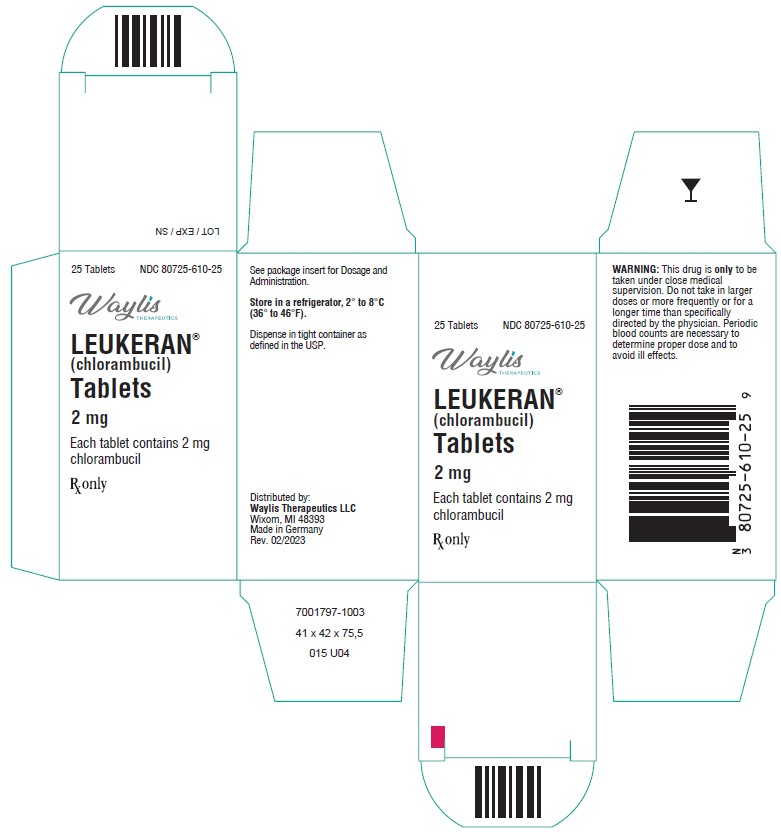
Leukeran chlorambucil 2 mg Tablet, Film Coated, 25-count — NDC 80725-610-25 (Billing 80725-0610-25)
This is a package of 25 tablets of Leukeran chlorambucil 2 mg Tablet, Film Coated from Waylis Therapeutics LLC, marketed since May 2023 and currently FDA-listed. It is this product's only package size.
NDC database record
One package, one record: these facts belong to NDC 80725-610-25 alone.
- Record
- FDA NDC Directory package listing · Human prescription drug
- Code segments
- 80725 labeler · 610 product · 25 package
- Package marketed since
- May 15, 2023
- Sample package
- No — commercial package
- Listing certified through
- Dec 31, 2026
- Billing quantity
- 25 EA per package
- Barcode (UPC-A, from the NDC)
- 3 8072561025 9
- FDA record last changed
- Jul 24, 2026
Identity & classification
Regulatory identifiers FDA, NLM and CMS codes for this package
Drug-database identifiers Medi-Span GPI and First Databank GCN / HICL / AHFS classification
- GSN (GCN sequence number): 008772
- GCN: 38370
- GPI-14 (Medi-Span): 21101010000305
- HICL (First Databank): 003894
- AHFS class code: 10:00.00.00
- RxCUI (RxNorm): 105553
Where does this data come from?
- FDA openFDA NDC Directory · synced Oct 1, 2026
- FDA label on DailyMed · label index refreshed Oct 3, 2026
- RxNorm (NLM RxNav) · catalog refreshed Oct 1, 2026
- Medi-Span GPI (licensed)
- First Databank (licensed) · refreshed Oct 1, 2026
RxNorm drug class
This medicine belongs to the Alkylating Drug class.
Where does this data come from?
- RxClass (NLM) · catalog refreshed Oct 1, 2026
Clinical
Chlorambucil is used treat a certain type of chronic lymphocytic leukemia (CLL; a type of cancer of the white blood cells). Chlorambucil is also used to treat non-Hodgkin's lymphoma (NHL) and Hodgkin's disease (types of cancer that begin in certain white blood cells that normally fight infection). Chlorambucil is in a class of medications called alkylating agents. It works by slowing or stopping the growth of cancer cells in your body.
Read the full MedlinePlus article ↗- It treats chronic lymphocytic leukemia and certain lymphomas, including Hodgkin’s disease. It isn’t a cure, but it can help control these cancers and provide useful relief.
- Leukeran is a tablet you swallow. The daily dose can be taken all at once. Food lowers how much is absorbed, so ask me or your doctor about timing with meals. Take it exactly as pr...
- The most common one is lower blood counts. Nausea, vomiting, diarrhea and mouth sores are less common. Your doctor will check your blood regularly.
- Call right away for a rash, hives, swelling, seizures, confusion, yellow skin or eyes, breathing problems, fever, or unusual bruising or bleeding.
Patient education
Supplement & herbal interactions
Some supplements/herbs that may interact with Chlorambucil — tap one for details:
Chlorambucil may be associated with lower levels of 1 nutrient — worth a chat with your pharmacist, not a cause for alarm.
Where does this data come from?
- MedlinePlus (NLM) · refreshed Oct 1, 2026
- FDA label on DailyMed · label index refreshed Oct 3, 2026
Ask a licensed pharmacist directly — free, answered by our team.
Pricing
A drug doesn't have one price. Each row is a different public payment system, and none is what you'd pay at the counter — that depends on your insurance. The ⓘ on each row explains what it measures.
| Price system | Per each | Per package |
|---|---|---|
| Retail pharmacies payNADAC · weekly | Not in the retail survey — common for institutional, discontinued, or low-volume packs. | |
| Medicaid paysCMS SDUD · 12 mo | No recent Medicaid claims on file for this NDC — rare and low-volume NDCs are suppressed in the public data. | |
| Medicare drug plans payPart D · Q2 2026 | $585.38 | $14,634.47 / 25 tablets |
Where does this data come from?
- CMS NADAC weekly file
- CMS ASP pricing files · refreshed Sep 20, 2026
- CMS Medicaid State Drug Utilization Data · refreshed Oct 4, 2026
- CMS Part D plan pricing files · refreshed Sep 24, 2026
- VA National Acquisition Center price file
Packaging — all sizes for this product
| Package NDC | Description | Marketing start | Marketing end | Status |
|---|---|---|---|---|
| 80725-0610-25 You're viewing this Main listing | 25 TABLET, FILM COATED in 1 BOTTLE | 2023-05-15 | — | Active |
Therapeutic equivalents
| Product | Labeler | Pack | NADAC/unit | TE | Status | Price vs. this |
|---|---|---|---|---|---|---|
| Leukeran 2 mgthis 80725-0610-25 | Waylis | 25 tablets | — | — | FDA listed | — |
Where does this data come from?
- FDA openFDA NDC Directory · synced Oct 1, 2026
- FDA Orange Book · refreshed Oct 3, 2026
- CMS NADAC weekly file
Availability & generic status
We did not find an FDA-approved generic match for this exact strength, form and route.
Where does this data come from?
- FDA Orange Book · refreshed Oct 3, 2026
What it looks like
Where does this data come from?
- FDA label on DailyMed · label index refreshed Oct 3, 2026
Inactive Ingredients / Excipients
Inactive ingredients, also called excipients, are components of the drug product other than the active ingredient. They may include fillers, dyes, coatings, preservatives, flavors, or other formulation ingredients.
💡 Tap an ingredient (hover on desktop) to see what it is and why it’s used.
-
UNII 3SY5LH9PMK
Anhydrous lactose is a milk sugar with no water content. It acts as a filler and binder in tablets and capsules, adding bulk and helping ingredients stick together.
-
UNII OP1R32D61U
Microcrystalline cellulose is a purified form of cellulose, a natural fiber from plant sources. It acts as a binder and filler in tablets and capsules, helping hold ingredients together and give the medicine its shape and size.
-
UNII 1K09F3G675
Ferric oxide red is an inorganic iron compound used as a colorant in medicines. It gives tablets, capsules, or other dosage forms a red or reddish tint for identification and appearance.
-
UNII EX438O2MRT
Ferric oxide yellow is a naturally occurring iron compound used as a colorant in medications. It gives tablets, capsules, and other forms a yellow or golden hue for identification and appearance.
-
UNII 3NXW29V3WO
Hypromellose is a plant-based thickener made from cellulose. It's used in medicines as a binder to hold ingredients together, a coating for tablets, and a thickener for liquids.
-
UNII 3WJQ0SDW1A
Polyethylene glycol is a synthetic liquid or solid polymer used in medicines as a solvent, lubricant, and humectant. It helps dissolve active ingredients, reduces friction during manufacturing, and retains moisture in the final product.
-
UNII ETJ7Z6XBU4
Silicon dioxide is a naturally occurring mineral used as a glidant and anti-caking agent. It helps powder ingredients flow smoothly and prevents clumping during manufacturing and storage.
-
UNII 4ELV7Z65AP
Stearic acid is a fatty acid derived from plant or animal sources. It acts as a binder and lubricant in tablets and capsules, helping them hold together and flow smoothly during manufacturing.
-
UNII 15FIX9V2JP
Titanium dioxide is a bright white mineral powder commonly used as a colorant and opacifying agent. It makes pills and tablets white or lighter in color and helps make coatings non-transparent.
9 inactive ingredients listed in the exact product block matched to this NDC.
Where does this data come from?
ingredient classCode="IACT" elements from the exact product block matched by this NDC. Label-section narrative from DailyMed / the openFDA label index is shown separately when available.- FDA label on DailyMed · label index refreshed Oct 3, 2026
- FDA openFDA NDC Directory · synced Oct 1, 2026
Inactive ingredient FAQ
Are inactive ingredients the same for every manufacturer?
Why might an inactive ingredient be missing?
Can inactive ingredients matter?
Manufacturer & labeler
More NDCs from Waylis Therapeutics LLC labeler code 80725
- Coreg CR Carvedilol Phosphate 10 mg Capsule, Extended Release NDC 80725-383-13
- Coreg CR Carvedilol Phosphate 20 mg Capsule, Extended Release NDC 80725-385-13
- Coreg CR Carvedilol Phosphate 40 mg Capsule, Extended Release NDC 80725-387-13
- Coreg CR Carvedilol Phosphate 80 mg Capsule, Extended Release NDC 80725-388-13
- Lovaza OMEGA-3-ACID ETHYL ESTERS 1 g Capsule NDC 80725-420-12
- Eulexin Flutamide 125 mg Capsule NDC 80725-600-18
- Myleran busulfan 2 mg Tablet, Film Coated NDC 80725-620-25
- Tabloid thioguanine 40 mg Tablet NDC 80725-630-25
- Avodart dutasteride .5 mg Capsule, Liquid Filled NDC 80725-712-04
- Jalyn DUTASTERIDE and TAMSULOSIN HYDROCHLORIDE .5 mg; .4 mg Capsule NDC 80725-809-13
- HYDREA Hydroxyurea 500 mg Capsule NDC 80725-810-10
- DROXIA Hydroxyurea 200 mg Capsule NDC 80725-820-60
Where does this data come from?
- FDA openFDA NDC Directory · synced Oct 1, 2026
- Drugs@FDA
Full prescribing information FDA SPL
🚨 Boxed Warning ▾
WARNING LEUKERAN (chlorambucil) can severely suppress bone marrow function. Chlorambucil is a carcinogen in humans. Chlorambucil is probably mutagenic and teratogenic in humans. Chlorambucil produces human infertility (see WARNINGS and PRECAUTIONS).
🎯 Indications and Usage ▾
INDICATIONS AND USAGE LEUKERAN (chlorambucil) is indicated in the treatment of chronic lymphatic (lymphocytic) leukemia, malignant lymphomas including lymphosarcoma, giant follicular lymphoma, and Hodgkin’s disease. It is not curative in any of these disorders but may produce clinically useful palliation.
⏱️ Dosage and Administration ▾
DOSAGE AND ADMINISTRATION The usual oral dosage is 0.1 to 0.2 mg/kg body weight daily for 3 to 6 weeks as required. This usually amounts to 4 to 10 mg per day for the average patient. The entire daily dose may be given at one time.
These dosages are for initiation of therapy or for short courses of treatment. The dosage must be carefully adjusted according to the response of the patient and must be reduced as soon as there is an abrupt fall in the white blood cell count. Patients with Hodgkin’s disease usually require 0.2 mg/kg daily, whereas patients with other lymphomas or chronic lymphocytic leukemia usually require only 0.1 mg/kg daily.
When lymphocytic infiltration of the bone marrow is present, or when the bone marrow is hypoplastic, the daily dose should not exceed 0.1 mg/kg (about 6 mg for the average patient). Alternate schedules for the treatment of chronic lymphocytic leukemia employing intermittent, biweekly, or once-monthly pulse doses of chlorambucil have been reported. Intermittent schedules of chlorambucil begin with an initial single dose of 0.4 mg/kg.
Doses are generally increased by 0.1 mg/kg until control of lymphocytosis or toxicity is observed. Subsequent doses are modified to produce mild hematologic toxicity. It is felt that the response rate of chronic lymphocytic leukemia to the biweekly or once-monthly schedule of chlorambucil administration is similar or better to that previously reported with daily administration and that hematologic toxicity was less than or equal to that encountered in studies using daily chlorambucil.
Radiation and cytotoxic drugs render the bone marrow more vulnerable to damage, and chlorambucil should be used with particular caution within 4 weeks of a full course of radiation therapy or chemotherapy. However, small doses of palliative radiation over isolated foci remote from the bone marrow will not usually depress the neutrophil and platelet count. In these cases chlorambucil may be given in the customary dosage.
It is presently felt that short courses of treatment are safer than continuous maintenance therapy, although both methods have been effective. It must be recognized that continuous therapy may give the appearance of “maintenance” in patients who are actually in remission and have no immediate need for further drug. If maintenance dosage is used, it should not exceed 0.1 mg/kg daily and may well be as low as 0.03 mg/kg daily.
A typical maintenance dose is 2 mg to 4 mg daily, or less, depending on the status of the blood counts. It may, therefore, be desirable to withdraw the drug after maximal control has been achieved, since intermittent therapy reinstituted at time of relapse may be as effective as continuous treatment. Procedures for proper handling and disposal of anticancer drugs should be used.
Several guidelines on this subject have been published. 1-4 There is no general agreement that all of the procedures recommended in the guidelines are necessary or appropriate. SPECIAL POPULATIONS Hepatic Impairment: Patients with hepatic impairment should be closely monitored for toxicity.
As chlorambucil is primarily metabolized in the liver, dose reduction may be considered in patients with hepatic impairment when treated with LEUKERAN. However, there are insufficient data in patients with hepatic impairment to provide a specific dosing recommendation.
⛔ Contraindications ▾
CONTRAINDICATIONS Chlorambucil should not be used in patients whose disease has demonstrated a prior resistance to the agent. Patients who have demonstrated hypersensitivity to chlorambucil should not be given the drug. There may be cross-hypersensitivity (skin rash) between chlorambucil and other alkylating agents.
⚠️ Warnings ▾
WARNINGS Because of its carcinogenic properties, chlorambucil should not be given to patients with conditions other than chronic lymphatic leukemia or malignant lymphomas. Convulsions, infertility, leukemia, and secondary malignancies have been observed when chlorambucil was employed in the therapy of malignant and non-malignant diseases. There are many reports of acute leukemia arising in patients with both malignant and non-malignant diseases following chlorambucil treatment.
In many instances, these patients also received other chemotherapeutic agents or some form of radiation therapy. The quantitation of the risk of chlorambucil-induction of leukemia or carcinoma in humans is not possible. Evaluation of published reports of leukemia developing in patients who have received chlorambucil (and other alkylating agents) suggests that the risk of leukemogenesis increases with both chronicity of treatment and large cumulative doses.
However, it has proved impossible to define a cumulative dose below which there is no risk of the induction of secondary malignancy. The potential benefits from chlorambucil therapy must be weighed on an individual basis against the possible risk of the induction of a secondary malignancy. Chlorambucil has been shown to cause chromatid or chromosome damage in humans.
Both reversible and permanent sterility have been observed in both sexes receiving chlorambucil. A high incidence of sterility has been documented when chlorambucil is administered to prepubertal and pubertal males. Prolonged or permanent azoospermia has also been observed in adult males.
While most reports of gonadal dysfunction secondary to chlorambucil have related to males, the induction of amenorrhea in females with alkylating agents is well documented and chlorambucil is capable of producing amenorrhea. Autopsy studies of the ovaries from women with malignant lymphoma treated with combination chemotherapy including chlorambucil have shown varying degrees of fibrosis, vasculitis, and depletion of primordial follicles. Rare instances of skin rash progressing to erythema multiforme, toxic epidermal necrolysis, or Stevens-Johnson syndrome have been reported.
Chlorambucil should be discontinued promptly in patients who develop skin reactions. Pregnancy Chlorambucil can cause fetal harm when administered to a pregnant woman. Unilateral renal agenesis has been observed in 2 offspring whose mothers received chlorambucil during the first trimester.
Urogenital malformations, including absence of a kidney, were found in fetuses of rats given chlorambucil. There are no adequate and well-controlled studies in pregnant women. If this drug is used during pregnancy, or if the patient becomes pregnant while taking this drug, the patient should be apprised of the potential hazard to the fetus.
Women of childbearing potential should be advised to avoid becoming pregnant.
🤒 Adverse Reactions ▾
ADVERSE REACTIONS To report SUSPECTED ADVERSE REACTIONS, contact Waylis Therapeutics LLC Toll-Free at 1-888-514-4727 or FDA at 1-800-FDA-1088 or www.fda.gov/medwatch. Hematologic The most common side effect is bone marrow suppression, anemia, leukopenia, neutropenia, thrombocytopenia, or pancytopenia. Although bone marrow suppression frequently occurs, it is usually reversible if the chlorambucil is withdrawn early enough.
However, irreversible bone marrow failure has been reported. Gastrointestinal Gastrointestinal disturbances such as nausea and vomiting, diarrhea, and oral ulceration occur infrequently. CNS Tremors, muscular twitching, myoclonia, confusion, agitation, ataxia, flaccid paresis, and hallucinations have been reported as rare adverse experiences to chlorambucil which resolve upon discontinuation of drug.
Rare, focal and/or generalized seizures have been reported to occur in both children and adults at both therapeutic daily doses and pulse-dosing regimens, and in acute overdose (see PRECAUTIONS: General). Dermatologic Allergic reactions such as urticaria and angioneurotic edema have been reported following initial or subsequent dosing. Skin hypersensitivity (including rare reports of skin rash progressing to erythema multiforme, toxic epidermal necrolysis, and Stevens-Johnson syndrome) has been reported (see WARNINGS).
Miscellaneous Other reported adverse reactions include: pulmonary fibrosis, hepatotoxicity and jaundice, drug fever, peripheral neuropathy, interstitial pneumonia, sterile cystitis, infertility, leukemia, and secondary malignancies (see WARNINGS).
🔄 Drug Interactions ▾
Drug Interactions There are no known drug/drug interactions with chlorambucil.
🤰 Pregnancy ▾
Pregnancy Chlorambucil can cause fetal harm when administered to a pregnant woman. Unilateral renal agenesis has been observed in 2 offspring whose mothers received chlorambucil during the first trimester. Urogenital malformations, including absence of a kidney, were found in fetuses of rats given chlorambucil.
There are no adequate and well-controlled studies in pregnant women. If this drug is used during pregnancy, or if the patient becomes pregnant while taking this drug, the patient should be apprised of the potential hazard to the fetus. Women of childbearing potential should be advised to avoid becoming pregnant.
Pregnancy Teratogenic Effects: See WARNINGS section.
🧒 Pediatric Use ▾
Pediatric Use The safety and effectiveness in pediatric patients have not been established.
🧓 Geriatric Use ▾
Geriatric Use Clinical studies of chlorambucil did not include sufficient numbers of subjects aged 65 and over to determine whether they respond differently from younger subjects. Other reported clinical experience has not identified differences in responses between the elderly and younger patients. In general, dose selection for an elderly patient should be cautious, usually starting at the low end of the dosing range, reflecting the greater frequency of decreased hepatic, renal, or cardiac function, and of concomitant disease or other drug therapy.
Use in Patients with Renal Impairment: The impact of renal impairment on chlorambucil elimination has not been formally studied. The renal elimination of unchanged chlorambucil and its major active metabolites, phenylacetic acid mustard, represents less than 1% of the administered dose. In addition, no dose adjustment was required in 2 dialysis patients on chlorambucil.
Therefore, renal impairment is not expected to significantly impact the elimination of chlorambucil. Use in Patients with Hepatic Impairment: No formal studies have been conducted in patients with hepatic impairment. As chlorambucil is primarily metabolized in the liver, patients with hepatic impairment should be closely monitored for toxicity and dose reduction may be considered in patients with hepatic impairment when treated with LEUKERAN (see DOSAGE AND ADMINISTRATION).
🆘 Overdosage ▾
OVERDOSAGE Reversible pancytopenia was the main finding of inadvertent overdoses of chlorambucil. Neurological toxicity ranging from agitated behavior and ataxia to multiple grand mal seizures has also occurred. As there is no known antidote, the blood picture should be closely monitored and general supportive measures should be instituted, together with appropriate blood transfusions, if necessary.
Chlorambucil is not dialyzable. Oral LD 50 single doses in mice are 123 mg/kg. In rats, a single intraperitoneal dose of 12.5 mg/kg of chlorambucil produces typical nitrogen-mustard effects; these include atrophy of the intestinal mucous membrane and lymphoid tissues, severe lymphopenia becoming maximal in 4 days, anemia, and thrombocytopenia.
After this dose, the animals begin to recover within 3 days and appear normal in about a week, although the bone marrow may not become completely normal for about 3 weeks. An intraperitoneal dose of 18.5 mg/kg kills about 50% of the rats with development of convulsions. As much as 50 mg/kg has been given orally to rats as a single dose, with recovery.
Such a dose causes bradycardia, excessive salivation, hematuria, convulsions, and respiratory dysfunction.
🧬 Clinical Pharmacology ▾
CLINICAL PHARMACOLOGY Mechanism of Action Chlorambucil, an aromatic nitrogen mustard derivative, is an alkylating agent. Chlorambucil interferes with DNA replication and induces cellular apoptosis via the accumulation of cytosolic p53 and subsequent activation of Bax, an apoptosis promoter. PHARMACOKINETICS In a study of 12 patients given single oral doses of 0.2 mg/kg of LEUKERAN, the mean dose-adjusted (±SD) plasma chlorambucil C max was 492 ± 160 ng/mL, the AUC was 883 ± 329 ng.h/mL, the mean elimination half-life (t½) was 1.3 ± 0.5 hours, and the T max was 0.83 ± 0.53 hours.
For the major metabolite, phenylacetic acid mustard (PAAM), the mean dose-adjusted (± SD) plasma C max was 306 ± 73 ng/mL, the AUC was 1204 ± 285 ng.h/mL, mean t½ was 1.8 ± 0.4 hours, and the T max was 1.9 ± 0.7 hours. After single oral doses of 0.6 to 1.2 mg/kg, peak plasma chlorambucil levels (C max ) are reached within 1 hour and the terminal elimination half-life (t ½ ) of the parent drug is estimated at 1.5 hours. Absorption: Chlorambucil is rapidly and completely (>70%) absorbed from the gastrointestinal tract.
Consistent with the rapid, predictable absorption of chlorambucil, the inter-individual variability in the plasma pharmacokinetics of chlorambucil has been shown to be relatively small following oral dosages of between 15 and 70 mg (2-fold intra-patient variability, and a 2 to 4 fold interpatient variability in AUC). The absorption of chlorambucil is reduced when taken after food. In a study of ten patients, food intake increased the median T max by 2-fold and reduced the dose-adjusted C max and AUC values by 55% and 20%, respectively.
Distribution: The apparent volume of distribution averaged
0.31L/kg following a single 0.2 mg/kg oral dose of chlorambucil in 11 cancer patients with chronic lymphocytic leukemia. Chlorambucil and its metabolites are extensively bound to plasma and tissue proteins. In vitro, chlorambucil is 99% bound to plasma proteins, specifically albumin.
Cerebrospinal fluid levels of chlorambucil have not been determined. Metabolism: Chlorambucil is extensively metabolized in the liver primarily to phenylacetic acid mustard, which has antineoplastic activity. Chlorambucil and its major metabolite undergo oxidative degradation to monohydroxy and dihydroxy derivatives.
Excretion: After a single dose of radiolabeled chlorambucil ( 14 C), approximately 20% to 60% of the radioactivity appears in the urine after 24 hours. Again, less than 1% of the urinary radioactivity is in the form of chlorambucil or phenylacetic acid mustard.
🧬 Mechanism of Action ▾
Mechanism of Action Chlorambucil, an aromatic nitrogen mustard derivative, is an alkylating agent. Chlorambucil interferes with DNA replication and induces cellular apoptosis via the accumulation of cytosolic p53 and subsequent activation of Bax, an apoptosis promoter.
📦 How Supplied / Storage and Handling ▾
HOW SUPPLIED LEUKERAN is supplied as brown, film-coated, round, biconvex tablets containing 2 mg chlorambucil in amber glass bottles with child-resistant closures. One side is engraved with “GX EG3” and the other side is engraved with an “L.” Bottle of 25 (NDC 80725-610-25) Store in a refrigerator, 2° to 8°C (36° to 46°F).
📋 Description ▾
DESCRIPTION LEUKERAN (chlorambucil) was first synthesized by Everett et al. It is a bifunctional alkylating agent of the nitrogen mustard type that has been found active against selected human neoplastic diseases. Chlorambucil is known chemically as 4-[bis(2-chlorethyl)amino]benzenebutanoic acid and has the following structural formula: Chlorambucil hydrolyzes in water and has a pKa of 5.8.
LEUKERAN (chlorambucil) is available in tablet form for oral administration. Each film-coated tablet contains 2 mg chlorambucil and the inactive ingredients colloidal silicon dioxide, hypromellose, lactose (anhydrous), macrogol/PEG 400, microcrystalline cellulose, red iron oxide, stearic acid, titanium dioxide, and yellow iron oxide. chlorambucil chemical structure
💬 Information for Patients ▾
INFORMATION FOR PATIENTS Patients should be informed that the major toxicities of chlorambucil are related to hypersensitivity, drug fever, myelosuppression, hepatotoxicity, infertility, seizures, gastrointestinal toxicity, and secondary malignancies. Patients should never be allowed to take the drug without medical supervision and should consult their physician if they experience skin rash, bleeding, fever, jaundice, persistent cough, seizures, nausea, vomiting, amenorrhea, or unusual lumps/masses. Women of childbearing potential should be advised to avoid becoming pregnant.
⚠️ Precautions ▾
PRECAUTIONS General Many patients develop a slowly progressive lymphopenia during treatment. The lymphocyte count usually rapidly returns to normal levels upon completion of drug therapy. Most patients have some neutropenia after the third week of treatment and this may continue for up to 10 days after the last dose.
Subsequently, the neutrophil count usually rapidly returns to normal. Severe neutropenia appears to be related to dosage and usually occurs only in patients who have received a total dosage of 6.5 mg/kg or more in one course of therapy with continuous dosing. About one quarter of all patients receiving the continuous-dose schedule, and one third of those receiving this dosage in 8 weeks or less may be expected to develop severe neutropenia.
While it is not necessary to discontinue chlorambucil at the first evidence of a fall in neutrophil count, it must be remembered that the fall may continue for 10 days after the last dose, and that as the total dose approaches 6.5 mg/kg, there is a risk of causing irreversible bone marrow damage. The dose of chlorambucil should be decreased if leukocyte or platelet counts fall below normal values and should be discontinued for more severe depression. Chlorambucil should not be given at full dosages before 4 weeks after a full course of radiation therapy or chemotherapy because of the vulnerability of the bone marrow to damage under these conditions.
If the pretherapy leukocyte or platelet counts are depressed from bone marrow disease process prior to institution of therapy, the treatment should be instituted at a reduced dosage. Persistently low neutrophil and platelet counts or peripheral lymphocytosis suggest bone marrow infiltration. If confirmed by bone marrow examination, the daily dosage of chlorambucil should not exceed 0.1 mg/kg.
Chlorambucil appears to be relatively free from gastrointestinal side effects or other evidence of toxicity apart from the bone marrow depressant action. In humans, single oral doses of 20 mg or more may produce nausea and vomiting. Children with nephrotic syndrome and patients receiving high pulse doses of chlorambucil may have an increased risk of seizures.
As with any potentially epileptogenic drug, caution should be exercised when administering chlorambucil to patients with a history of seizure disorder or head trauma, or who are receiving other potentially epileptogenic drugs. Administration of live vaccines to immunocompromised patients should be avoided. INFORMATION FOR PATIENTS Patients should be informed that the major toxicities of chlorambucil are related to hypersensitivity, drug fever, myelosuppression, hepatotoxicity, infertility, seizures, gastrointestinal toxicity, and secondary malignancies.
Patients should never be allowed to take the drug without medical supervision and should consult their physician if they experience skin rash, bleeding, fever, jaundice, persistent cough, seizures, nausea, vomiting, amenorrhea, or unusual lumps/masses. Women of childbearing potential should be advised to avoid becoming pregnant. Laboratory Tests Patients must be followed carefully to avoid life-endangering damage to the bone marrow during treatment.
Weekly examination of the blood should be made to determine hemoglobin levels, total and differential leukocyte counts, and quantitative platelet counts. Also, during the first 3 to 6 weeks of therapy, it is recommended that white blood cell counts be made 3 or 4 days after each of the weekly complete blood counts. Galton et al have suggested that in following patients it is helpful to plot the blood counts on a chart at the same time that body weight, temperature, spleen size, etc., are recorded.
It is considered dangerous to allow a patient to go more than 2 weeks without hematological and clinical examination during treatment. Drug Interactions There are no known drug/drug interactions with chlorambucil. Carcinogenesis, Mutagenesis, Impairment of Fertility See WARNINGS section for information… [Excerpted — this section continues on DailyMed.]
🍼 Nursing Mothers ▾
Lactation It is not known whether this drug is excreted in human milk. Because many drugs are excreted in human milk and because of the potential for serious adverse reactions in nursing infants from chlorambucil, a decision should be made whether to discontinue nursing or to discontinue the drug, taking into account the importance of the drug to the mother.
🧬 Pharmacokinetics ▾
PHARMACOKINETICS In a study of 12 patients given single oral doses of 0.2 mg/kg of LEUKERAN, the mean dose-adjusted (±SD) plasma chlorambucil C max was 492 ± 160 ng/mL, the AUC was 883 ± 329 ng.h/mL, the mean elimination half-life (t½) was 1.3 ± 0.5 hours, and the T max was 0.83 ± 0.53 hours. For the major metabolite, phenylacetic acid mustard (PAAM), the mean dose-adjusted (± SD) plasma C max was 306 ± 73 ng/mL, the AUC was 1204 ± 285 ng.h/mL, mean t½ was 1.8 ± 0.4 hours, and the T max was 1.9 ± 0.7 hours. After single oral doses of 0.6 to 1.2 mg/kg, peak plasma chlorambucil levels (C max ) are reached within 1 hour and the terminal elimination half-life (t ½ ) of the parent drug is estimated at 1.5 hours.
Absorption: Chlorambucil is rapidly and completely (>70%) absorbed from the gastrointestinal tract. Consistent with the rapid, predictable absorption of chlorambucil, the inter-individual variability in the plasma pharmacokinetics of chlorambucil has been shown to be relatively small following oral dosages of between 15 and 70 mg (2-fold intra-patient variability, and a 2 to 4 fold interpatient variability in AUC). The absorption of chlorambucil is reduced when taken after food.
In a study of ten patients, food intake increased the median T max by 2-fold and reduced the dose-adjusted C max and AUC values by 55% and 20%, respectively. Distribution: The apparent volume of distribution averaged
0.31L/kg following a single 0.2 mg/kg oral dose of chlorambucil in 11 cancer patients with chronic lymphocytic leukemia. Chlorambucil and its metabolites are extensively bound to plasma and tissue proteins. In vitro, chlorambucil is 99% bound to plasma proteins, specifically albumin.
Cerebrospinal fluid levels of chlorambucil have not been determined. Metabolism: Chlorambucil is extensively metabolized in the liver primarily to phenylacetic acid mustard, which has antineoplastic activity. Chlorambucil and its major metabolite undergo oxidative degradation to monohydroxy and dihydroxy derivatives.
Excretion: After a single dose of radiolabeled chlorambucil ( 14 C), approximately 20% to 60% of the radioactivity appears in the urine after 24 hours. Again, less than 1% of the urinary radioactivity is in the form of chlorambucil or phenylacetic acid mustard.
📄 Carcinogenesis, Mutagenesis, Impairment of Fertility ▾
Carcinogenesis, Mutagenesis, Impairment of Fertility See WARNINGS section for information on carcinogenesis, mutagenesis, and impairment of fertility.
📚 References ▾
REFERENCES 1. NIOSH Alert: Preventing occupational exposures to antineoplastic and other hazardous drugs in healthcare settings. 2004.
U.S. Department of Health and Human Services, Public Health Service, Centers for Disease Control and Prevention, National Institute for Occupational Safety and Health, DHHS (NIOSH) Publication No. 2004-165.
2. OSHA Technical Manual, TED 1-0.15A, Section VI: Chapter 2. Controlling Occupational Exposure to Hazardous Drugs.
OSHA, 1999. http://www.osha.gov/dts/osta/otm/otm_vi/otm_vi_2.html 3. American Society of Health-System Pharmacists. ASHP guidelines on handling hazardous drugs.
Am J Health-Syst Pharm. (2006) 63:1172-1193. 4.
Polovich, M., White, J. M., & Kelleher, L.O. (eds.) 2005.
Chemotherapy and biotherapy guidelines and recommendations for practice (2nd. ed.) Pittsburgh, PA: Oncology Nursing Society.
📄 Package Label / Principal Display Panel ▾
PACKAGE LABEL PRINCIPAL DISPLAY PANEL Principal Display Panel NDC 80725-610-25 LEUKERAN ® (chlorambucil) Tablets 2 mg 25 Tablets Each tablet contains 2 mg chlorambucil. Rx Only. Leukeran 2mg 25 ct. Carton Leukeran 2mg 25 ct. Label carton label
Medicare Part D spend CMS · PART D · 2026 (Q1)
Reported adverse events (FAERS)
Top reported reactions
Age at onset
Reporter sex
Serious outcomes
Where does this data come from?
About this NDC listing & data coverage
What data is (and isn’t) available for this NDC — tap to expand
| NDC identity (package / product / labeler codes) | ✓ Available |
| Labeler | ✓ Available |
| Product & package description | ✓ Available |
| Marketing category & status | ✓ Available |
| Active ingredient / dosage form / route | ✓ Available |
| FDA label (SPL via DailyMed) | ✓ Available |
| Package photos | ✓ Available |
| Inactive ingredients (structured) | ✓ Available |
| NADAC pharmacy acquisition price (CMS) | — Not published for this NDC CMS publishes NADAC only for NDCs reported in its retail-pharmacy survey. |
| Orange Book / therapeutic-equivalence data | — Not published for this NDC Applies only to products approved under an NDA/ANDA; many listings are out of scope. |
| HCPCS J-code billing crosswalk | — Not published for this NDC Most self-administered / retail products have no J-code — that is normal. |
| Medicaid utilization (CMS SDUD) | — Not published for this NDC CMS reports utilization only for NDCs with Medicaid claims above its privacy threshold. |