
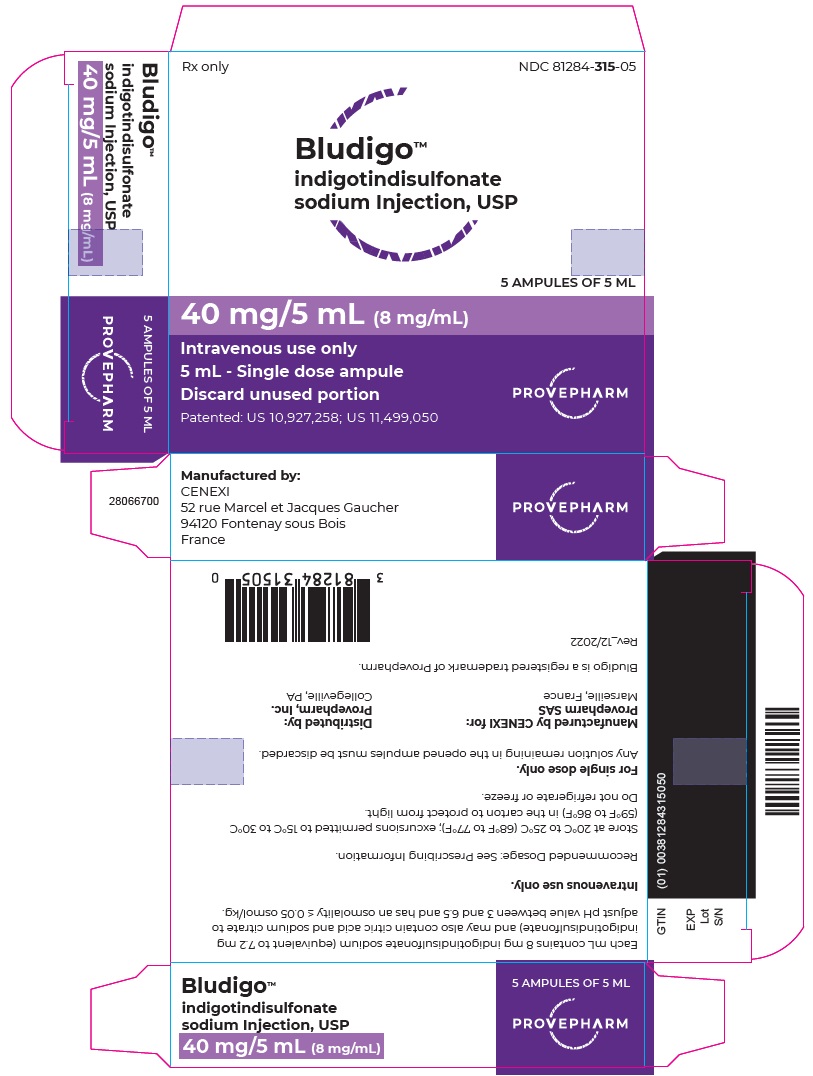
BLUDIGO indigotindisulfonate sodium 8 mg/mL Injection — NDC 81284-315-05 (Billing 81284-0315-05)
This is a package of BLUDIGO indigotindisulfonate sodium 8 mg/mL Injection from Provepharm Inc., marketed since Sep 2022 and currently FDA-listed. It is this product's only package size.
NDC database record
One package, one record: these facts belong to NDC 81284-315-05 alone.
- Record
- FDA NDC Directory package listing · Human prescription drug
- Code segments
- 81284 labeler · 315 product · 05 package
- Package marketed since
- Sep 6, 2022
- Sample package
- No — commercial package
- Listing certified through
- Dec 31, 2026
- Barcode (UPC)
- 0381284315050
- Medicaid fills, this package
- 22 prescriptions in the last four reported quarters
- FDA record last changed
- Jul 24, 2026
Identity & classification
Regulatory identifiers FDA, NLM and CMS codes for this package
Drug-database identifiers Medi-Span GPI and First Databank GCN / HICL / AHFS classification
- GSN (GCN sequence number): 083598
- GCN: 52592
- HICL (First Databank): 003691
- AHFS class code: 36:40.00.00
Where does this data come from?
- FDA openFDA NDC Directory · synced Oct 8, 2026
- FDA label on DailyMed · label index refreshed Oct 8, 2026
- RxNorm (NLM RxNav) · catalog refreshed Oct 8, 2026
- Medi-Span GPI (licensed)
- First Databank (licensed) · refreshed Oct 8, 2026
Clinical
Patient education
Supplement & herbal interactions
Where does this data come from?
- MedlinePlus (NLM) · refreshed Oct 8, 2026
- FDA label on DailyMed · label index refreshed Oct 8, 2026
Ask a licensed pharmacist directly — free, answered by our team.
Pricing
A drug doesn't have one price. Each row is a different public payment system, and none is what you'd pay at the counter — that depends on your insurance. The ⓘ on each row explains what it measures.
| Price system | Per each | Per package |
|---|---|---|
| Retail pharmacies payNADAC · weekly | Not in the retail survey — common for institutional, discontinued, or low-volume packs. | |
| Medicaid paysCMS SDUD · 12 mo | $60.89 | $304.47 / 5 ampules |
| Medicare drug plans payPart D · quarterly | No Part D plan price is available for this NDC in our data. | |
Where does this data come from?
- CMS NADAC weekly file
- CMS ASP pricing files · refreshed Sep 20, 2026
- CMS Medicaid State Drug Utilization Data · through Q1 2026
- CMS Part D plan pricing files · refreshed Sep 24, 2026
- VA National Acquisition Center price file
Packaging — all sizes for this product
| Package NDC | Description | Marketing start | Marketing end | Status |
|---|---|---|---|---|
| 81284-0315-05 You're viewing this Main listing | 5 AMPULE in 1 CARTON / 5 mL in 1 AMPULE | 2022-09-06 | — | Active |
Therapeutic equivalents
| Product | Labeler | Pack | NADAC/unit | TE | Status | Price vs. this |
|---|---|---|---|---|---|---|
| Bludigo 8 mg/mL 25021-0840-05 | Sagent | 5 ampules | — | — | FDA listed | — |
| Bludigo 8 mg/mLthis 81284-0315-05 | Provepharm | 5 ampules | — | — | FDA listed | — |
Where does this data come from?
- FDA openFDA NDC Directory · synced Oct 8, 2026
- FDA Orange Book · refreshed Oct 9, 2026
- CMS NADAC weekly file
Availability & generic status
We did not find an FDA-approved generic match for this exact strength, form and route. Patent/protection dates below may affect future generic timing.
Why the date isn’t exact: Generic timing can change because patents may be challenged, settled, licensed, added, removed, or worked around with a narrower label — and FDA approval does not always mean a pharmacy can get the generic today.
Our estimate: 2032 to 2033 a wide window
How sure: Probable. More likely than not, but it can still move.
Why then: The patent fight is likely to end in an agreement that sets the launch. The terms are not public yet.
That is before the December 2037 date above, which is common: a court ruling or a deal with the brand’s maker often lets a generic in before the last patent runs out.
See the full forecast for generic Bludigo →🛈 What do these terms mean?
- Patent
- Legal protection listed in the Orange Book that may delay generic approval or launch. Issued by the U.S. Patent & Trademark Office.
- Substance patent
- Covers the active drug molecule itself — the hardest to design around. A generic generally can’t launch until it expires.
- Formulation (product) patent
- Covers a specific formulation or dosage form. A generic can sometimes work around it with a different formulation.
- Method-of-use patent
- A patent covering one specific approved use of the drug — not necessarily the whole molecule. A generic can sometimes launch with a “skinny label” that carves out the protected use and keeps the others.
- Skinny label
- A generic label that omits a still-patented use when the FDA allows it — letting a generic reach the market for the unprotected uses.
- Exclusivity
- FDA-granted marketing protection, separate from patents — e.g. 5-yr new chemical entity, 7-yr orphan drug, or a +6-month pediatric extension.
- Paragraph IV
- A generic applicant’s formal challenge to a listed patent. It can potentially lead to earlier generic entry, but often involves litigation or a settlement.
- RLD / RS
- Reference Listed Drug — the brand product the FDA uses as the reference for generic applications. Reference Standard — the product the FDA expects generics to compare against in bioequivalence testing.
- TE / AB rating
- FDA therapeutic-equivalence rating. An AB rating generally means the FDA considers a generic therapeutically equivalent to — and substitutable for — the brand.
- LOE (loss of exclusivity)
- The latest patent or exclusivity currently listed — the loss-of-exclusivity / latest-listed-protection date shown on this page. Paragraph-IV challenges and settlements can move the real date earlier; FDA approval and a manufacturer’s decision to market can move it later.
Built from the FDA Orange Book. The bars above are scaled to each protection’s expiry; the red LOE marker is the last one to lapse.
| Patent | Type | Use code | Expires |
|---|---|---|---|
| US 11845867 ↗ | Drug substance | — | Nov 25, 2036 |
| US 10927258 ↗ | Drug substance | — | Dec 23, 2037 |
| US 11499050 ↗ | Drug substance | — | Dec 23, 2037 |
| Code | What it grants | Expires |
|---|---|---|
| NCE | New Chemical Entity (5-year) | Jul 8, 2027 |
Is there a generic version of BLUDIGO 40 MG/5 ML AMPULE?
The FDA approved a generic — why can’t I get it at my pharmacy yet?
Why do different websites show different generic release dates?
What does “FDA listed” mean?
What does a patent or protection date mean here?
What does “current Orange Book estimate” mean?
Can a generic come out before the last patent expires?
Can a generic come out after the listed dates?
What is the difference between patents and exclusivity?
Why are there multiple patent dates?
Where does this data come from?
- FDA Orange Book · refreshed Oct 9, 2026
Inactive Ingredients / Excipients
Inactive ingredients, also called excipients, are components of the drug product other than the active ingredient. They may include fillers, dyes, coatings, preservatives, flavors, or other formulation ingredients.
💡 Tap an ingredient (hover on desktop) to see what it is and why it’s used.
-
UNII 2968PHW8QP
A weak organic acid derived from citrus fruits or made through fermentation. It works as a buffer to control pH, a preservative to extend shelf life, and a flavoring agent in medications.
-
UNII 1Q73Q2JULR
Sodium citrate is a salt derived from citric acid. It works as a buffer to maintain the medicine's pH level and may also help improve taste or act as a preservative in the formulation.
2 inactive ingredients listed in the exact product block matched to this NDC.
Where does this data come from?
ingredient classCode="IACT" elements from the exact product block matched by this NDC. Label-section narrative from DailyMed / the openFDA label index is shown separately when available.- FDA label on DailyMed · label index refreshed Oct 8, 2026
- FDA openFDA NDC Directory · synced Oct 8, 2026
Inactive ingredient FAQ
Are inactive ingredients the same for every manufacturer?
Why might an inactive ingredient be missing?
Can inactive ingredients matter?
Manufacturer & labeler
More NDCs from Provepharm Inc. labeler code 81284
- PIPERACILLIN AND TAZOBACTAM 4 g/20mL; .5 g/20mL Injection, Powder, Lyophilized, For Solution NDC 81284-153-10
- Piperacillin and Tazobactam 12 g/60mL; 1.5 g/60mL Injection, Powder, Lyophilized, For Solution NDC 81284-154-01
- Piperacillin and Tazobactam 36 g/180mL; 4.5 g/180mL Injection, Powder, Lyophilized, For Solution NDC 81284-155-01
- Phenylephrine hydrochloride 10 mg/mL Injection NDC 81284-211-25
- Phenylephrine hydrochloride 10 mg/mL Injection NDC 81284-212-10
- Phenylephrine hydrochloride 10 mg/mL Injection NDC 81284-213-01
- Dihydroergotamine Mesylate 1 mg/mL Injection, Solution NDC 81284-411-05
- tranexamic acid 100 mg/mL Injection, Solution NDC 81284-611-10
- tranexamic acid 100 mg/mL Injection, Solution NDC 81284-612-10
- ANTICHOLIUM physostigmine salicylate .4 mg/mL Injection NDC 81284-831-05
Where does this data come from?
- FDA openFDA NDC Directory · synced Oct 8, 2026
- Drugs@FDA
Full prescribing information FDA SPL
🎯 Indications and Usage ▾
1 INDICATIONS AND USAGE BLUDIGO is indicated for use as a visualization aid in the cystoscopic assessment of the integrity of the ureters in adults following urological and gynecological open, robotic, or endoscopic surgical procedures. BLUDIGO is a diagnostic dye indicated for use as a visualization aid in the cystoscopic assessment of the integrity of the ureters in adults following urological and gynecological open, robotic, or endoscopic surgical procedures. ( 1 )
⏱️ Dosage and Administration ▾
2 DOSAGE AND ADMINISTRATION Recommended dose is 5 mL given intravenously over 1 minute. ( 2.1 ) Monitor blood pressure and heart rhythm during and after injection. ( 2.2 )
2.1Recommended Dosage The recommended dose of BLUDIGO is 5 mL given as an intravenous injection over 1 minute. The blue color is detectable at the ureteral orifices within 4 minutes to 9 minutes after the intravenous injection.
2.2Important Administration Instructions Monitor blood pressure and cardiac rhythm during and following the injection [see Warnings and Precautions ( 5.1 )]. Use immediately after opening ampule. Withdraw the contents of the ampule through a 5 micron or smaller filter straw/filter needle to ensure that the withdrawn solution contains no particulates.
The withdrawn solution should be inspected visually for particulate matter and discoloration prior to administration. Do not administer with infusion assemblies used with other diluents or drugs. Discard any unused portion.
💊 Dosage Forms and Strengths ▾
3 DOSAGE FORMS AND STRENGTHS Injection: 40 mg/5 mL (8 mg/mL) indigotindisulfonate sodium as a dark blue or bluish-purple solution in a single-dose amber glass ampule. Injection: 40 mg/5 mL (8 mg/mL) indigotindisulfonate sodium in a single-dose ampule ( 3 )
⛔ Contraindications ▾
4 CONTRAINDICATIONS BLUDIGO is contraindicated in patients with known hypersensitivity to indigotindisulfonate or any of its components [see Warnings and Precautions ( 5.2 )]. Known hypersensitivity to indigotindisulfonate or any of its components. ( 4 )
⚠️ Warnings and Cautions ▾
5 WARNINGS AND PRECAUTIONS Cardiovascular Reactions: Severe or life-threatening cardiovascular reactions including cardiac arrest, arrhythmia, asystole, atrioventricular block second degree, hypotension, elevation in blood pressure, bradycardia, and tachycardia have been reported. Closely monitor blood pressure and cardiac rhythm during and following the BLUDIGO injection. Interrupt administration if reactions are observed.
( 5.1 ) Hypersensitivity Reactions: Serious anaphylactic reactions with hypotension, dyspnea, bronchospasm, urticaria, or erythema have been reported. Monitor patients for anaphylactic reactions and have emergency equipment and trained personnel readily available. ( 5.2 ) Interference with Oximetry Measurements: Anesthesiologists should be aware of the potential for artifactual reduction in SpO 2 when anesthetized patients are administered BLUDIGO.
( 5.3 )
5.1Cardiovascular Reactions Severe or life-threatening cardiovascular reactions including cardiac arrest, arrhythmia, asystole, second degree atrioventricular block, hypotension, elevation in blood pressure, bradycardia, and tachycardia have been reported generally within 60 minutes following administration of indigotindisulfonate sodium injection products and required urgent intervention [see Adverse Reactions ( 6.2 )]. Indigotindisulfonate may cause vasoconstriction by interference with vasodilation mediated by nitric oxide dependent mechanisms and by direct vasoconstriction.
Indigotindisulfonate may also cause hypotension. Patients with hypertension, heart rate and conduction disorders, or medications causing bradycardia may be at increased risk for elevated blood pressure, hypotension, and bradycardia. Closely monitor blood pressure and cardiac rhythm during and following the injection of BLUDIGO.
Interrupt administration if reactions are observed.
5.2Hypersensitivity Reactions Serious anaphylactic reactions with hypotension, dyspnea, bronchospasm, urticaria, or erythema have been reported with the use of indigotindisulfonate sodium injection products [see Adverse Reactions ( 6.2 )] . BLUDIGO is contraindicated in patients with known hypersensitivity to indigotindisulfonate [see Contraindications ( 4 )] . Monitor patients for anaphylactic reactions and have emergency equipment and trained personnel readily available.
5.3Interference with Oximetry Measurements Indigotindisulfonate has been reported to interfere with light absorption and transiently interfere with pulse oximetric methods. Anesthesiologists should be aware of the potential for artifactual reduction in SpO 2 when anesthetized patients are administered BLUDIGO.
🤒 Adverse Reactions ▾
6 ADVERSE REACTIONS Clinically significant adverse reactions are described elsewhere in the labeling: Cardiovascular Reactions [see Warnings and Precautions ( 5.1 )] Hypersensitivity Reactions [see Warnings and Precautions ( 5.2 )] Adverse reactions (≥ 1%) are constipation, nausea, vomiting, abdominal pain, pyrexia, ALT increase, and dysuria. ( 6.1 ) To report SUSPECTED ADVERSE REACTIONS, contact PROVEPHARM Inc at 1–833-727-6556 or FDA at 1-800-FDA-1088 or www.fda.gov/medwatch.
6.1Clinical Trials Experience Because clinical trials are conducted under widely varying conditions, adverse reaction rates observed in the clinical trials of a drug cannot be directly compared to rates in the clinical trials of another drug and may not reflect the rates observed in practice. The safety of BLUDIGO was evaluated in a randomized, intra-patient controlled, blind to dose of BLUDIGO, clinical trial. A total of 118 adult patients undergoing endoscopic urological or gynecological procedures were treated intravenously; 58 (49%) of these patients received one dose of BLUDIGO 2.5 mL and 60 (51%) of patients received one dose of BLUDIGO 5 mL.
The 2.5 mL dose is not approved [see Dosage and Administration ( 2.1 )] . The mean age of patients was 51 years and 35 (30%) patients were 65 years of age or older. The majority of patients were White 105 (89%) and female 87 (74%).
The adverse reactions (≥1%) reported in the clinical trial are provided in Table 1. Table 1. Adverse Reactions Reported at ≥1% of Patients Receiving BLUDIGO 5 mL Intravenously BLUDIGO 5 mL (N=60) n (%) Constipation 3 (5.0) Nausea 2 (3.3) Vomiting 2 (3.3) Abdominal Pain 2 (3.3) Pyrexia 2 (3.3) ALT increase 2 (3.3) Dysuria 1 (1.7)
6.2Postmarketing Experience The following adverse reactions have been identified following the use of indigotindisulfonate sodium injection products. Because these reactions are reported voluntarily from a population of uncertain size, it is not always possible to reliably estimate their frequency or establish a causal relationship to drug exposure. Cardiovascular disorders: cardiac arrest, arrhythmia, asystole, atrioventricular block second degree, hypotension, elevation in blood pressure, bradycardia, tachycardia General disorders and administration site conditions: injection site discoloration Immune system disorders: anaphylactic reactions with hypotension, dyspnea, bronchospasm, urticaria, erythema
👥 Use in Specific Populations ▾
8 USE IN SPECIFIC POPULATIONS Renal Impairment: BLUDIGO is not recommended for use in patients with eGFR<30 mL/min. ( 8.6 )
8.1Pregnancy Risk Summary Available data from case reports, case series, observational studies and clinical experience with indigotindisulfonate sodium injection use in pregnant women over several decades have not identified a drug associated risk of adverse maternal and fetal adverse effects. Indigotindisulfonate sodium injection use during the first trimester of pregnancy is rare; thus, the data are insufficient to evaluate for a drug associated risk of major birth defects and miscarriage. The majority of the published data were from intra-amniotic injections.
Animal reproduction studies using the intravenous route of administration have not been conducted. Oral administration of indigotindisulfonate sodium to pregnant rats and rabbits produced no evidence of fetal harm. However, oral availability is low (3%) so that the risk of intravenous administration of indigotindisulfonate sodium during pregnancy cannot be evaluated from the data available .
The estimated background risk of major birth defects and miscarriage for the indicated population is unknown. All pregnancies have a background risk of birth defects, loss, or other adverse outcomes. In the U.S. general population, the estimated background risk of major birth defects and miscarriage in clinically recognized pregnancies is 2 to 4% and 15 to 20%, respectively.
8.2Lactation Risk Summary It is not known if indigotindisulfonate is present in animal or human milk. The transfer of indigotindisulfonate into breastmilk is likely to be low and adverse effects on the breastfed infant are not expected [see Clinical Pharmacology ( 12.3 )] . There are no data on the effect of indigotindisulfonate on the breastfed infant or milk production.
The developmental and health benefits of breastfeeding should be considered along with the mother’s clinical need for BLUDIGO and any potential adverse effects on the breastfed infant from BLUDIGO or from the underlying maternal condition.
8.4Pediatric Use The safety and effectiveness of BLUDIGO have not been established in pediatric patients.
8.5Geriatric Use Of the total number of subjects in the clinical study of BLUDIGO, 23 (20%) were 65 to 74 years of age, and 12 (10%) were 75 and older. No overall differences in safety or effectiveness were observed between these subjects and younger subjects, and other reported clinical experience has not identified differences in responses between the elderly and younger patients, but greater sensitivity of some older individuals cannot be ruled out.
8.6Renal Impairment Indigotindisulfonate is known to be excreted by the kidney through tubular secretion. No dedicated pharmacokinetic study using BLUDIGO in patients with varying degree of renal impairment has been conducted. Based on subgroup analyses in the randomized clinical trial, dose adjustment is not needed in patients with mild to moderate renal impairment (estimated glomerular filtration rate (eGFR) 30 to 89 mL/min derived from the Modification of Diet in Renal Disease formula).
BLUDIGO has not been studied in patients with eGFR < 30 mL/min and is not recommended for use in these patients.
🤰 Pregnancy ▾
8.1Pregnancy Risk Summary Available data from case reports, case series, observational studies and clinical experience with indigotindisulfonate sodium injection use in pregnant women over several decades have not identified a drug associated risk of adverse maternal and fetal adverse effects. Indigotindisulfonate sodium injection use during the first trimester of pregnancy is rare; thus, the data are insufficient to evaluate for a drug associated risk of major birth defects and miscarriage. The majority of the published data were from intra-amniotic injections.
Animal reproduction studies using the intravenous route of administration have not been conducted. Oral administration of indigotindisulfonate sodium to pregnant rats and rabbits produced no evidence of fetal harm. However, oral availability is low (3%) so that the risk of intravenous administration of indigotindisulfonate sodium during pregnancy cannot be evaluated from the data available .
The estimated background risk of major birth defects and miscarriage for the indicated population is unknown. All pregnancies have a background risk of birth defects, loss, or other adverse outcomes. In the U.S. general population, the estimated background risk of major birth defects and miscarriage in clinically recognized pregnancies is 2 to 4% and 15 to 20%, respectively.
🧒 Pediatric Use ▾
8.4Pediatric Use The safety and effectiveness of BLUDIGO have not been established in pediatric patients.
🧓 Geriatric Use ▾
8.5Geriatric Use Of the total number of subjects in the clinical study of BLUDIGO, 23 (20%) were 65 to 74 years of age, and 12 (10%) were 75 and older. No overall differences in safety or effectiveness were observed between these subjects and younger subjects, and other reported clinical experience has not identified differences in responses between the elderly and younger patients, but greater sensitivity of some older individuals cannot be ruled out.
🧬 Clinical Pharmacology ▾
12 CLINICAL PHARMACOLOGY
12.1Mechanism of Action Indigotindisulfonate is a dye excreted by the kidney through tubular secretion and enhances visualization of the ureteral orifices by its deep blue color.
12.2Pharmacodynamics The blue color is detectable at the ureteral orifices within 4 minutes to 9 minutes after the intravenous injection.
12.3Pharmacokinetics The pharmacokinetic properties of BLUDIGO are presented in Table 2. Table 2. Pharmacokinetics of Indigotindisulfonate in Healthy Adults Following Intravenous Administration of BLUDIGO 5 mL (40 mg) BLUDIGO 5 mL (40 mg) General Information C max (CV%), μg/mL 6.33 (58.4) AUC 0-INF (CV%), μg·h/mL 1.15 (36.4) Distribution Mean (CV%) Volume of Distribution, L 10.7 (36.1) Protein Binding, in vitro About 90% Elimination Mean (CV%) Elimination Half-life, minutes 12 (34.1) Mean (CV%) Clearance, L/hour Urinary 7.08 (66.3) Total 40.2 (45.1) Metabolism Primary Metabolic Pathways Oxidative metabolism Excretion Urine (CV%) a 16.0% (44.0) Feces <2% a Unchanged drug C max = maximum plasma concentration; AUC 0-INF =area under the plasma concentration-time curve from time of administration extrapolated to infinity; CV=coefficient of variation
🧬 Mechanism of Action ▾
12.1Mechanism of Action Indigotindisulfonate is a dye excreted by the kidney through tubular secretion and enhances visualization of the ureteral orifices by its deep blue color.
📦 How Supplied / Storage and Handling ▾
16 HOW SUPPLIED/STORAGE AND HANDLING How Supplied BLUDIGO (indigotindisulfonate sodium injection, USP) 40 mg/5 mL (8 mg/mL) is a dark blue or bluish-purple solution supplied in a carton of 5 single-dose amber glass ampules (NDC 81284-315-05). Storage and Handling Store at 20°C to 25°C (68°F to 77°F); excursions permitted to 15°C to 30°C (59° to 86°F) [See USP Controlled Room Temperature]. Store in original carton to protect from light.
Do not refrigerate or freeze. Use immediately after opening ampule. Discard unused portion.
📋 Description ▾
11 DESCRIPTION BLUDIGO (indigotindisulfonate sodium injection, USP) is a sterile deep blue or bluish-purple diagnostic dye for intravenous use. Each mL contains 8 mg indigotindisulfonate sodium (equivalent to 7.2 mg indigotindisulfonate) and may also contain citric acid and sodium citrate to adjust pH value between 3 and 6.5 and has an osmolality ≤ 0.05 osmol/kg. Indigotindisulfonate sodium is also known as indigo carmine.
The chemical name of indigotindisulfonate sodium is Disodium 3,3’-dioxo-[Δ 2,2’ -biindoline]-5,5’-disulfonate. Its molecular formula is C 16 H 8 N 2 Na 2 O 8 S 2 and its molecular weight is 466.35 g/mol. Its structural formula is: indigotindisulfonate sodium image description
💬 Information for Patients ▾
17 PATIENT COUNSELING INFORMATION Cardiovascular Reactions Advise the patient of the possibility of developing elevated blood pressure, hypotension, bradycardia, tachycardia, or atrioventricular block during or after the administration of BLUDIGO [see Warnings and Precautions ( 5.1 )]. Injection Site and Urine Discoloration Inform the patient that BLUDIGO may cause a blue discoloration of injection site and urine and that the discoloration should resolve within 48 hours. Advise the patient to inform the healthcare provider if the discoloration of the injection site is associated with other symptoms [see Adverse Reactions ( 6.2 )].
Manufactured for: PROVEPHARM SAS 13013 Marseille, FRANCE Manufactured by: CENEXI 52 rue Marcel et Jacques Gaucher 94120 Fontenay sous Bois, FRANCE Distributed by: PROVEPHARM INC. Collegeville, PA 19426, USA
🧬 Pharmacokinetics ▾
12.3Pharmacokinetics The pharmacokinetic properties of BLUDIGO are presented in Table 2. Table 2. Pharmacokinetics of Indigotindisulfonate in Healthy Adults Following Intravenous Administration of BLUDIGO 5 mL (40 mg) BLUDIGO 5 mL (40 mg) General Information C max (CV%), μg/mL 6.33 (58.4) AUC 0-INF (CV%), μg·h/mL 1.15 (36.4) Distribution Mean (CV%) Volume of Distribution, L 10.7 (36.1) Protein Binding, in vitro About 90% Elimination Mean (CV%) Elimination Half-life, minutes 12 (34.1) Mean (CV%) Clearance, L/hour Urinary 7.08 (66.3) Total 40.2 (45.1) Metabolism Primary Metabolic Pathways Oxidative metabolism Excretion Urine (CV%) a 16.0% (44.0) Feces <2% a Unchanged drug C max = maximum plasma concentration; AUC 0-INF =area under the plasma concentration-time curve from time of administration extrapolated to infinity; CV=coefficient of variation
🧬 Pharmacodynamics ▾
12.2Pharmacodynamics The blue color is detectable at the ureteral orifices within 4 minutes to 9 minutes after the intravenous injection.
🔬 Clinical Studies ▾
14 CLINICAL STUDIES The safety and efficacy of BLUDIGO were evaluated in a randomized intra-patient controlled, blind to dose of BLUDIGO, multi-center study ( NCT04228445 ) in 118 adult patients undergoing endoscopic urological or gynecological surgical procedures including cystoscopic (58%), robotic (28%), and transvaginal (14%) approaches. The majority of patients were white (89%), female (74%), and younger than 65 years of age (70%). Mean age was 51 years, and age ranged from 20 to 88 years.
Patients were randomized in a 1:1 ratio to receive 2.5 mL or 5 mL of BLUDIGO intravenously prior to the end of the surgical procedure. Each patient underwent cystoscopy and received 5 mL of sodium chloride injection 0.9% followed by the randomized BLUDIGO dose for visualization of urinary flow from the ureteral orifices. The 2.5 mL dose is not approved [see Dosage and Administration ( 2.1 )].
The ureteral orifices and urine flow were observed and video recorded from 0 to 10 minutes post injection, with separate recordings made following sodium chloride injection and BLUDIGO. The conspicuity of the urine flow from the ureteral orifices was assessed in a randomized, blinded fashion by two independent central reviewers using a 5-point scale (1 = no urine flow observed; 2 = weak urine flow, little color contrast; 3 = Color contrast or significant urine flow; 4 = strong urine flow with good color contrast; and 5 = strong urine flow with striking contrast in color) once after sodium chloride injection and twice after BLUDIGO resulting in paired data.
The surgeons also reviewed and scored conspicuity of the urine flow from the ureteral orifices. The responder for a ureter is defined as the difference in conspicuity score between BLUDIGO and sodium chloride injection being at least one point difference and the conspicuity score following BLUDIGO alone being greater than or equal to three. The reviewer agreement with the responder endpoint is acceptable.
The proportion of responders along with its 95% confidence interval by ureter and reviewer or surgeon is summarized in Table 3. Table 3. Summary of Proportion of Responders by Ureter and Reviewer or Surgeon in Patients Receiving BLUDIGO 5 mL BLUDIGO 5 mL Left Ureter (n=49) Right Ureter (n=49) Reviewer 1 % Responder* 95% CL** 63% (48%, 77%) 76% (61%, 87%) Reviewer 2 % responder 95% CL 78% (63%, 88%) 82% (68%, 91%) Surgeon % responder 95% CL 71% (57%, 83%) 82% (68%, 91%) *responder: IC conspicuity score ≥ 3 and difference (IC – Saline) in conspicuity score ≥1, missing data is imputed as non-responder ** two-sided 95% confidence limits for the proportion of responder, calculated using the Clopper-Pearson (Exact) method
🧪 Nonclinical Toxicology ▾
13 NONCLINICAL TOXICOLOGY
13.1Carcinogenesis, Mutagenesis, Impairment of Fertility Carcinogenicity Carcinogenicity studies in animals have not been conducted with indigotindisulfonate sodium using the intravenous route of administration. Long-term studies in mice with oral and subcutaneous administration of indigotindisulfonate sodium revealed no carcinogenic effects. Mutagenesis Although indigotindisulfonate sodium has been evaluated in a number of Ames assay studies, an Ames assay study that follows all currently recommended guidelines has not been performed.
Indigotindisulfonate was not genotoxic in all those Ames assays. The mutagenicity of indigotindisulfonate was inconclusive in the in vitro mouse L5187Y Lymphoma TK +/- assay. Orally administered indigotindisulfonate was not mutagenic in the in vivo mouse micronucleus test.
An in vivo micronucleus test with indigotindisulfonate sodium using the intravenous route of administration has not been conducted. Fertility Fertility studies with indigotindisulfonate sodium using the intravenous route of administration have not been conducted.
📄 Carcinogenesis, Mutagenesis, Impairment of Fertility ▾
13.1Carcinogenesis, Mutagenesis, Impairment of Fertility Carcinogenicity Carcinogenicity studies in animals have not been conducted with indigotindisulfonate sodium using the intravenous route of administration. Long-term studies in mice with oral and subcutaneous administration of indigotindisulfonate sodium revealed no carcinogenic effects. Mutagenesis Although indigotindisulfonate sodium has been evaluated in a number of Ames assay studies, an Ames assay study that follows all currently recommended guidelines has not been performed.
Indigotindisulfonate was not genotoxic in all those Ames assays. The mutagenicity of indigotindisulfonate was inconclusive in the in vitro mouse L5187Y Lymphoma TK +/- assay. Orally administered indigotindisulfonate was not mutagenic in the in vivo mouse micronucleus test.
An in vivo micronucleus test with indigotindisulfonate sodium using the intravenous route of administration has not been conducted. Fertility Fertility studies with indigotindisulfonate sodium using the intravenous route of administration have not been conducted.
📄 Package Label / Principal Display Panel ▾
PRINCIPAL DISPLAY PANEL - CARTON Rx only NDC 81284- 315 -05 Bludigo ® indigotindisulfonate sodium Injection, USP 5 AMPULES OF 5 ML 40 mg/5 mL (8 mg/mL) Intravenous use only 5 mL - Single dose ampule Discard unused portion Patented: US 10,927,258; US 11,499,050 US 11,845,867 PROVEPHARM Carton Label
PRINCIPAL DISPLAY PANEL - VIAL NDC 81284- 315 -00 Rev_12/2022 Bludigo ® indigotindisulfonate sodium Injection, USP 40 mg/5 mL (8 mg/mL) Intravenous use only Single dose ampule Rx only Discard unused portion Manufactured by Cenexi for: Provepharm SAS Distributed by: Provepharm, Inc. 28069319 Vial Label
Medicaid utilization & spend
Reported adverse events (FAERS)
Top reported reactions
Age at onset
Reporter sex
Where does this data come from?
About this NDC listing & data coverage
What data is (and isn’t) available for this NDC — tap to expand
| NDC identity (package / product / labeler codes) | ✓ Available |
| Labeler | ✓ Available |
| Product & package description | ✓ Available |
| Marketing category & status | ✓ Available |
| Active ingredient / dosage form / route | ✓ Available |
| FDA label (SPL via DailyMed) | ✓ Available |
| Package photos | ✓ Available |
| Inactive ingredients (structured) | ✓ Available |
| NADAC pharmacy acquisition price (CMS) | — Not published for this NDC CMS publishes NADAC only for NDCs reported in its retail-pharmacy survey. |
| Orange Book / therapeutic-equivalence data | ✓ Available |
| HCPCS J-code billing crosswalk | — Not published for this NDC Most self-administered / retail products have no J-code — that is normal. |
| Medicaid utilization (CMS SDUD) | ✓ Available |