
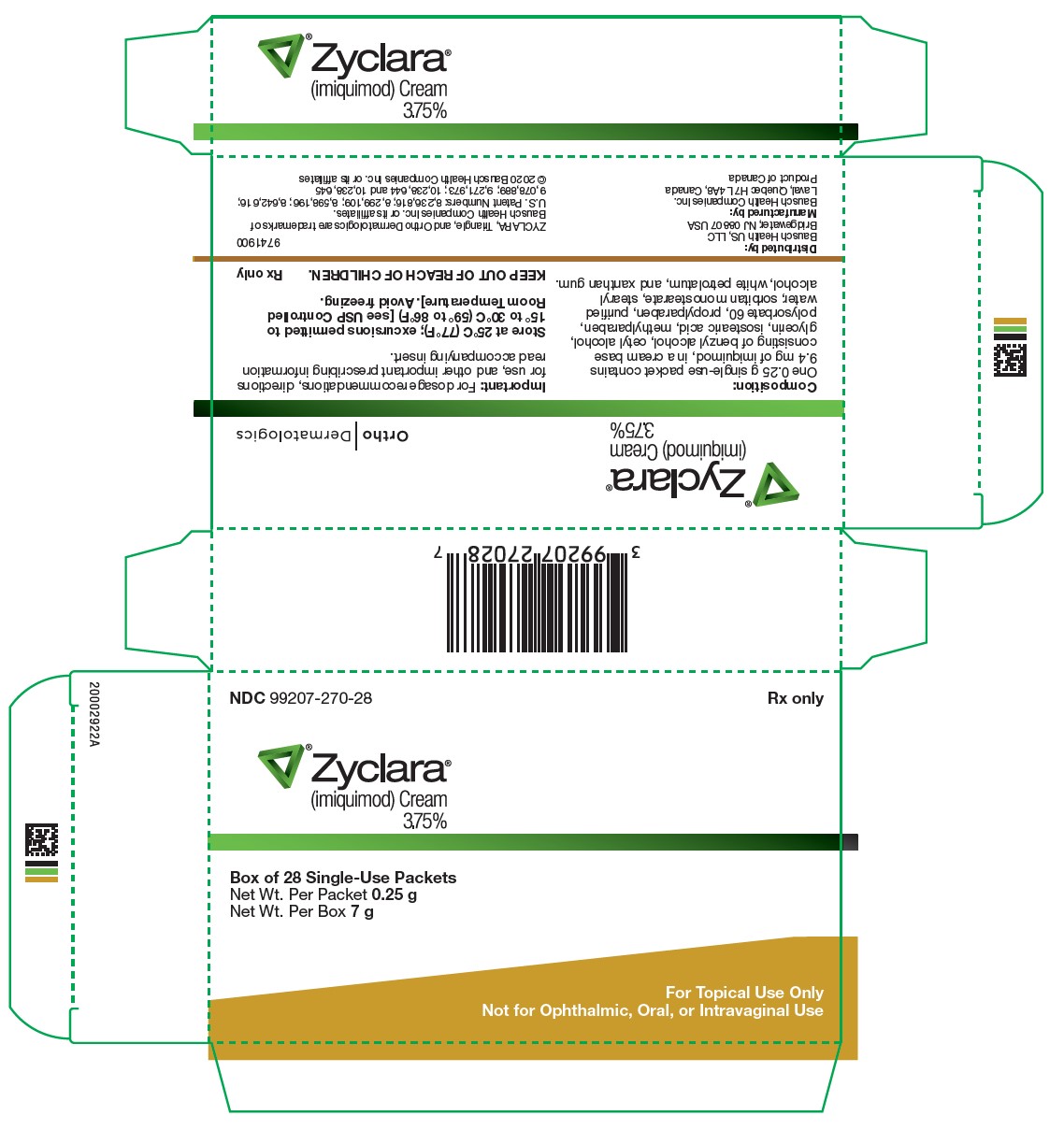
Zyclara imiquimod 37.5 mg/g Cream, 4 packets — NDC 99207-270-01 (Billing 99207-0270-01)
This is a package of 4 packets of Zyclara imiquimod 37.5 mg/g Cream from Bausch Health US, LLC, marketed since Nov 2011 and currently FDA-listed. It is the main listing for this product, which comes in 2 package sizes.
NDC database record
One package, one record: these facts belong to NDC 99207-270-01 alone.
- Record
- FDA NDC Directory package listing · Human prescription drug
- Code segments
- 99207 labeler · 270 product · 01 package
- Package marketed since
- Nov 28, 2011
- Sample package
- No — commercial package
- Listing certified through
- Dec 31, 2027
- Barcode (UPC-A, from the NDC)
- 3 9920727001 0
- FDA record last changed
- Jul 24, 2026
Identity & classification
Regulatory identifiers FDA, NLM and CMS codes for this package
Drug-database identifiers Medi-Span GPI and First Databank GCN / HICL / AHFS classification
- GPI-14 (Medi-Span): 90773040003715
- RxCUI (RxNorm): 967017
Where does this data come from?
- FDA openFDA NDC Directory · synced Oct 8, 2026
- FDA label on DailyMed · label index refreshed Oct 8, 2026
- RxNorm (NLM RxNav) · catalog refreshed Oct 1, 2026
- Medi-Span GPI (licensed)
- First Databank (licensed) · refreshed Oct 8, 2026
RxNorm drug class
This medicine belongs to the Antivirals class.
Where does this data come from?
- RxClass (NLM) · catalog refreshed Oct 1, 2026
Clinical
Imiquimod cream is used to treat certain types of actinic keratoses (flat, scaly growths on the skin caused by too much sun exposure), superficial basal cell carcinoma (a type of skin cancer), and warts on the skin of the genital and anal areas. Imiquimod is in a class of medications called immune response modifiers. It may work by increasing the activity of the body's immune system. Imiquimod cream does not cure warts, and new warts may appear during treatment. It is not known whether imiquimod cream prevents the spread of warts to other people.
Read the full MedlinePlus article ↗- Imiquimod 5% cream treats actinic keratosis on the face or scalp, certain superficial basal cell carcinomas, and external genital or perianal warts. Which one you use it for decide...
- Wash the area with mild soap and let it dry. Put the cream on before bed and rub it in until it vanishes. Wash it off with mild soap and water after the recommended hours. Wash you...
- Yes, local skin reactions are very common. Expect redness, itching, burning, flaking and crusting. If the skin weeps, breaks open, or you feel flu-like, call your doctor. A rest pe...
- Is it normal for my skin to get red and sore?
Patient education
Supplement & herbal interactions
Some supplements/herbs that may interact with Imiquimod — tap one for details:
Where does this data come from?
- MedlinePlus (NLM) · refreshed Oct 8, 2026
- FDA label on DailyMed · label index refreshed Oct 8, 2026
Ask a licensed pharmacist directly — free, answered by our team.
Pricing
A drug doesn't have one price. Each row is a different public payment system, and none is what you'd pay at the counter — that depends on your insurance. The ⓘ on each row explains what it measures.
| Price system | Per g | Per package |
|---|---|---|
| Retail pharmacies payNADAC · weekly | Not in the retail survey — common for institutional, discontinued, or low-volume packs. | |
| Medicaid paysCMS SDUD · 12 mo | No recent Medicaid claims on file for this NDC — rare and low-volume NDCs are suppressed in the public data. | |
| Medicare drug plans payPart D · quarterly | No Part D plan price is available for this NDC in our data. | |
Where does this data come from?
- CMS NADAC weekly file
- CMS ASP pricing files · refreshed Sep 20, 2026
- CMS Medicaid State Drug Utilization Data · refreshed Oct 8, 2026
- CMS Part D plan pricing files · refreshed Sep 24, 2026
- VA National Acquisition Center price file
Packaging — all sizes for this product
| Package NDC | Description | Marketing start | Marketing end | Status |
|---|---|---|---|---|
| 99207-0270-01 You're viewing this Main listing | 4 PACKET in 1 CARTON / .25 g in 1 PACKET | 2011-11-28 | — | Active |
| 99207-0270-28 99207-270-28 | 28 PACKET in 1 CARTON / .25 g in 1 PACKET | 2011-11-28 | — | Discontinued by firm |
Pack size FAQ
What quantity is in this package?
How does this package differ from NDC 99207-0270-28?
What NDC number is used to bill for this package of Zyclara imiquimod 37.5 mg/g Cream?
Therapeutic equivalents
| Product | Labeler | Pack | NADAC/unit | TE | Status | Price vs. this |
|---|---|---|---|---|---|---|
| Imiquimod 37.5 mg/g 51672-4174-06 | Sun | 28 packets | $36.229 | AB | Availability likely | — |
| Imiquimod 37.5 mg/g 00093-3133-31 | Teva | 1 bottle | $113.121 | — | Availability likely | — |
| Imiquimod 37.5 mg/g 68682-0272-75 | Oceanside | 1 bottle | — | — | FDA listed | — |
| Zyclara 37.5 mg/gthis 99207-0270-01 | Bausch | 4 packets | — | — | FDA listed | — |
| Zyclara 37.5 mg/g 99207-0271-01 | Bausch | 1 bottle | — | — | FDA listed | — |
| Imiquimod 37.5 mg/g 87519-0004-75 | Anvi | 1 bottle | — | AB | FDA listed | — |
Where does this data come from?
- FDA openFDA NDC Directory · synced Oct 8, 2026
- FDA Orange Book · refreshed Oct 3, 2026
- CMS NADAC weekly file
Availability & generic status
FDA-approved generic versions are listed, and recent pricing/market data suggests they may be available — see Therapeutic equivalents.
Why the date isn’t exact: Generic timing can change because patents may be challenged, settled, licensed, added, removed, or worked around with a narrower label — and FDA approval does not always mean a pharmacy can get the generic today.
🛈 What do these terms mean?
- Patent
- Legal protection listed in the Orange Book that may delay generic approval or launch. Issued by the U.S. Patent & Trademark Office.
- Substance patent
- Covers the active drug molecule itself — the hardest to design around. A generic generally can’t launch until it expires.
- Formulation (product) patent
- Covers a specific formulation or dosage form. A generic can sometimes work around it with a different formulation.
- Method-of-use patent
- A patent covering one specific approved use of the drug — not necessarily the whole molecule. A generic can sometimes launch with a “skinny label” that carves out the protected use and keeps the others.
- Skinny label
- A generic label that omits a still-patented use when the FDA allows it — letting a generic reach the market for the unprotected uses.
- Exclusivity
- FDA-granted marketing protection, separate from patents — e.g. 5-yr new chemical entity, 7-yr orphan drug, or a +6-month pediatric extension.
- Paragraph IV
- A generic applicant’s formal challenge to a listed patent. It can potentially lead to earlier generic entry, but often involves litigation or a settlement.
- RLD / RS
- Reference Listed Drug — the brand product the FDA uses as the reference for generic applications. Reference Standard — the product the FDA expects generics to compare against in bioequivalence testing.
- TE / AB rating
- FDA therapeutic-equivalence rating. An AB rating generally means the FDA considers a generic therapeutically equivalent to — and substitutable for — the brand.
- LOE (loss of exclusivity)
- The latest patent or exclusivity currently listed — the loss-of-exclusivity / latest-listed-protection date shown on this page. Paragraph-IV challenges and settlements can move the real date earlier; FDA approval and a manufacturer’s decision to market can move it later.
Built from the FDA Orange Book. The bars above are scaled to each protection’s expiry; the red LOE marker is the last one to lapse.
| Patent | Type | Use code | Expires |
|---|---|---|---|
| US 8236816 ↗ | Method of use | U-68 | Dec 11, 2029 |
| US 8222270 ↗ | Method of use | U-68 | Dec 11, 2029 |
| US 10238645 ↗ | Method of use | U-172 | Aug 18, 2029 |
| US 10238645 ↗ | Method of use | U-1455 | Aug 18, 2029 |
| US 8299109 ↗ | Method of use | U-68 | Dec 11, 2029 |
| US 8598196 ↗ | Method of use | U-172 | Aug 18, 2029 |
| US 11318130 ↗ | Method of use | U-68 | Dec 11, 2029 |
| US 11202752 ↗ | Method of use | U-1455 | Apr 30, 2030 |
| US 11202752 ↗ | Method of use | U-172 | Apr 30, 2030 |
| US 10238644 ↗ | Method of use | U-68 | Dec 11, 2029 |
| US 11850245 ↗ | Method of use | U-1455 | Apr 30, 2030 |
| US 11850245 ↗ | Method of use | U-172 | Apr 30, 2030 |
| US 10918635 ↗ | Method of use | U-172 | Apr 30, 2030 |
| US 10918635 ↗ | Method of use | U-1455 | Apr 30, 2030 |
| US 8598196 ↗ | Method of use | U-1455 | Aug 18, 2029 |
Is there a generic version of this drug?
The FDA approved a generic — why can’t I get it at my pharmacy yet?
Why do different websites show different generic release dates?
What does “FDA listed” mean?
What does a patent or protection date mean here?
What does “current Orange Book estimate” mean?
Can a generic come out before the last patent expires?
Can a generic come out after the listed dates?
What is the difference between patents and exclusivity?
Why are there multiple patent dates?
Where does this data come from?
- FDA Orange Book · refreshed Oct 3, 2026
Inactive Ingredients / Excipients
Inactive ingredients, also called excipients, are components of the drug product other than the active ingredient. They may include fillers, dyes, coatings, preservatives, flavors, or other formulation ingredients.
🧪 Avoiding an ingredient? See Imiquimod Topical inactive ingredients by manufacturer: every current product's list side by side, so you can ask your pharmacy for the version that does not list it.
💡 Tap an ingredient (hover on desktop) to see what it is and why it’s used.
-
UNII LKG8494WBH
Benzyl alcohol is a clear liquid used as a preservative and solvent in medicines. It helps prevent bacterial and fungal growth and dissolves other ingredients to create uniform liquid formulations.
-
UNII 936JST6JCN
Cetyl alcohol is a waxy, fatty substance derived from plant or animal sources. It acts as an emulsifier and thickener in medicines, helping blend oil and water components and giving products a smooth, creamy texture.
-
UNII PDC6A3C0OX
Glycerin is a clear, thick liquid derived from plant oils or fats. It acts as a humectant to retain moisture, a sweetener, and a solvent in medications.
-
UNII X33R8U0062
Isostearic acid is a fatty acid derived from vegetable oils. It acts as an emulsifier and lubricant in medicines, helping blend ingredients together and reducing friction during tablet or capsule manufacturing.
-
UNII A2I8C7HI9T
Methylparaben is a preservative derived from benzoic acid that prevents growth of bacteria, fungi, and mold in medicines. It extends the product's shelf life and maintains safety during storage.
-
UNII 4T6H12BN9U
Petrolatum is a purified mineral oil-based jelly derived from petroleum. In medicines, it acts as an emollient, lubricant, and moisture barrier to soften skin, reduce friction, and help prevent water loss from formulations.
-
UNII CAL22UVI4M
A synthetic emulsifier derived from sorbitol and fatty acids. It helps mix oil and water-based ingredients together and improves the texture and stability of the medicine.
-
UNII Z8IX2SC1OH
Propylparaben is a chemical preservative used to prevent bacterial and fungal growth in medicines and personal care products. It helps extend shelf life and maintain product safety during storage.
-
UNII NVZ4I0H58X
A waxy substance made from sorbitol and stearic acid. It acts as an emulsifier and stabilizer, helping keep oil and water mixed together and preventing separation in the medicine.
-
UNII 2KR89I4H1Y
Stearyl alcohol is a waxy, fatty substance derived from natural oils or made synthetically. It acts as an emulsifier and thickener in medicines, helping mix ingredients together and give the product the right texture.
-
UNII 059QF0KO0R
Water is a liquid solvent that dissolves and mixes ingredients together in liquid medicines, syrups, and injections. It helps distribute the active drug evenly throughout the product.
-
UNII TTV12P4NEE
Xanthan gum is a thickening and stabilizing ingredient made from fermented corn or other sugars. It's added to medicines to improve texture, prevent separation of liquids and solids, and help the product stay consistent.
12 inactive ingredients listed in the exact product block matched to this NDC.
Where does this data come from?
ingredient classCode="IACT" elements from the exact product block matched by this NDC. Label-section narrative from DailyMed / the openFDA label index is shown separately when available.- FDA label on DailyMed · label index refreshed Oct 8, 2026
- FDA openFDA NDC Directory · synced Oct 8, 2026
Inactive ingredient FAQ
Are inactive ingredients the same for every manufacturer?
Why might an inactive ingredient be missing?
Can inactive ingredients matter?
Manufacturer & labeler
More NDCs from Bausch Health US, LLC labeler code 99207
Where does this data come from?
- FDA openFDA NDC Directory · synced Oct 8, 2026
- Drugs@FDA
Full prescribing information FDA SPL
🎯 Indications and Usage ▾
1 INDICATIONS AND USAGE • ZYCLARA 2.5% and 3.75% is indicated for the topical treatment of clinically typical, visible, or palpable actinic keratoses (AK) of the face or balding scalp in immunocompetent adults. ( 1.1 ) • ZYCLARA, 3.75% is indicated for the topical treatment of external genital and perianal warts (EGW) in immunocompetent patients 12 years of age or older. ( 1.2 )
1.1Actinic Keratosis ZYCLARA, 2.5% and 3.75% are indicated for the topical treatment of clinically typical, visible or palpable actinic keratoses (AK) of the face or balding scalp in immunocompetent adults.
1.2External Genital Warts ZYCLARA, 3.75% is indicated for the topical treatment of external genital and perianal warts (EGW) in immunocompetent patients 12 years of age and older.
⏱️ Dosage and Administration ▾
2 DOSAGE AND ADMINISTRATION • For topical use only; not for oral, ophthalmic, intra-anal or intravaginal use. ( 2.1 ) • AK : Apply a thin layer once daily at bedtime to affected area (either entire face or balding scalp) for two 2-week treatment cycles separated by a 2-week no-treatment period. Apply up to 0.5 grams at each application.
( 2.2 ) • EGW : Apply a thin layer once daily at bedtime until total clearance or up to 8 weeks. Apply up to 0.25 grams at each application. ( 2.3 )
2.1Important Dosage and Administration Instructions ZYCLARA is for topical use only. ZYCLARA is not for oral, ophthalmic, intra-anal or intravaginal use. Instruct patients on proper application technique.
Wash hands before and after applying ZYCLARA. Prime the ZYCLARA pump bottle before first use by repeatedly depressing the actuator until the cream is dispensed. It is not necessary to repeat this priming process during treatment.
If a ZYCLARA dose is missed, apply the next dose at the regularly scheduled time. Avoid contact with the eyes, lips, nostrils, or inside the anus and vagina. Prescribe no more than 2 boxes (56 packets) or two 7.5 g bottle pumps of ZYCLARA for the entire treatment course for AK or EGW.
Discard partially used packets and do not reuse. Discard pump bottles after completion of a full treatment course.
2.2Dosage and Administration for Actinic Keratosis Use ZYCLARA, 2.5% or 3.75% for the treatment of AK. Apply a thin layer of ZYCLARA once daily before bedtime to the area with AK (either entire face or balding scalp) for two 2-week treatment cycles separated by a 2-week no-treatment period. Rub in until the cream is no longer visible.
Apply up to 0.5 grams (two packets or two full actuations of the pump) of ZYCLARA at each application. Leave ZYCLARA on the skin for approximately 8 hours and then remove with mild soap and water. For local skin reactions, a dosage interruption of several days may be taken if required based on the patient’s discomfort or severity of the local skin reaction [see Warnings and Precautions (5.1 )] .
Do not extend either 2-week treatment cycle due to missed doses or rest periods. Assess response to treatment after resolution of local skin reactions. A transient increase in lesion counts may be observed during treatment; however, continue dosing as prescribed.
Continue treatment for the full treatment course even if all AK appear to be gone.
2.3Dosage and Administration for External Genital Warts Use ZYCLARA, 3.75% for the treatment of EGW. Apply a thin layer of ZYCLARA cream once daily before bedtime to EGW until total clearance or for up to 8 weeks. To treat the wart area, use up to 0.25 grams (one packet or one full actuation of the pump) at each application.
Leave ZYCLARA on the skin for approximately 8 hours and then remove with mild soap and water. For local skin reactions, a dosage interruption of several days may be taken if required by the patient's discomfort or severity of the local skin reaction; resume treatment once the reaction subsides [see Warnings and Precautions (5.1) ] . Non-occlusive dressings such as cotton gauze or cotton underwear may be used in the management of skin reactions.
Inform uncircumcised patients treating warts under the foreskin to retract the foreskin and clean the area daily. ZYCLARA may weaken condoms and vaginal diaphragms, therefore, concurrent use is not recommended.
💊 Dosage Forms and Strengths ▾
3 DOSAGE FORMS AND STRENGTHS ZYCLARA is a white to faintly yellow cream available as: • Cream: 2.5%, in pump bottles. Each pump bottle, when actuated after priming, delivers 0.235 grams of cream. • Cream: 3.75%, in unit-dose packets and pump bottles. Each packet contains 0.25 grams of cream and each pump bottle, when actuated after priming, delivers 0.235 grams of cream. Cream: 2.5% in pump bottles; 3.75% in pump bottles or unit-dose packets ( 3 )
⛔ Contraindications ▾
4 CONTRAINDICATIONS None. None. ( 4 )
⚠️ Warnings and Cautions ▾
5 WARNINGS AND PRECAUTIONS • Local Skin Reactions : Intense local inflammatory reactions can occur (e.g., skin weeping, erosion). Dosage interruption may be required. Severe vulvar swelling may occur and lead to urinary retention; interrupt dosing or discontinue for severe vulvar swelling.
( 2.2 , 2.3 , 5.1 ) • Systemic Reactions : Flu-like signs and symptoms have occurred. Consider dosage interruption for systemic reactions. ( 5.2 ) • Ultraviolet Light Exposure Risks: Avoid or minimize exposure to sunlight and sunlamps.
Wear protective clothing. ( 5.3 )
5.1Local Skin Reactions Local skin reactions including skin weeping or erosion have been reported with use of ZYCLARA and can occur after a few applications [ see Adverse Reactions (6) ]. Concomitant use of ZYCLARA and any other imiquimod products, in the same treatment area, may increase the risk for and severity of local skin reactions. ZYCLARA Cream has the potential to exacerbate inflammatory conditions of the skin, including chronic graft versus host disease.
Severe local inflammatory reactions of the female external genitalia can lead to severe vulvar swelling and to urinary retention. Avoid sexual (genital, anal, oral) contact while ZYCLARA is on the skin. To reduce the risk of local skin reactions and manage local skin reactions that occur with ZYCLARA treatment: • Avoid concomitant use of ZYCLARA with any other imiquimod product in the same treatment area. • Avoid application of ZYCLARA to skin that is not intact (i.e., any area with an abrasion, cut, burn, rash, infection, or other condition that has altered skin integrity). • An interruption of dosing may be required for local skin reactions [ see Dosage and Administration (2.2 , 2.3 )].
Interrupt dosing or discontinue ZYCLARA for severe vulvar swelling [see Dosage and Administration (2.3 )]. • If severe local skin reactions occur, instruct patients to remove ZYCLARA by washing the treatment area with mild soap and water.
5.2Systemic Reactions Flu-like signs and symptoms have been reported with use of ZYCLARA and may accompany, or even precede, local skin reactions [see Adverse Reactions (6) ] . Signs and symptoms may include fatigue, nausea, fever, myalgias, arthralgias, malaise and chills. Concomitant use of ZYCLARA and any other imiquimod products may increase the risk for and severity of systemic reactions.
Lymphadenopathy occurred in 2% of subjects with AK treated with ZYCLARA, 3.75% and in 3% of subjects treated with ZYCLARA, 2.5% and in no patients in the vehicle arm [see Adverse Reactions (6.1 )]. This reaction resolved in all subjects by 4 weeks after completion of treatment. Consider an interruption of dosing if systemic reactions occur .
5.3Ultraviolet Light Exposure Risks ZYCLARA may cause heightened sunburn susceptibility. Avoid or minimize exposure to sunlight (including sunlamps) during use of ZYCLARA. Instruct patients to use sunscreen and wear protective clothing (e.g., a hat). Advise patients not to use ZYCLARA until fully recovered from a sunburn.
5.4Immune Cell Activation in Autoimmune Disease Imiquimod activates immune cells [see Clinical Pharmacology (12.2) ] . Carefully monitor patients with pre-existing autoimmune conditions who are using ZYCLARA.
🤒 Adverse Reactions ▾
6 ADVERSE REACTIONS The following clinically significant adverse reactions are described elsewhere in the labeling: • Local Skin Reactions [see Warnings and Precautions (5.1) ] • Systemic Reactions [see Warnings and Precautions (5.2) ] Most common adverse reactions (≥4%) are local skin reactions (erythema, scabbing/crusting, flaking/scaling/dryness, edema, erosion/ulceration, exudate), headache, application site pain, application site irritation, application site pruritus, fatigue, influenza-like illness, and nausea.
( 6.1 ) To report SUSPECTED ADVERSE REACTIONS, contact Bausch Health US, LLC at 1-800-321-4576 or FDA at 1-800-FDA-1088 or www.fda.gov/medwatch.
6.1Clinical Trials Experience Because clinical trials are conducted under widely varying conditions, adverse reaction rates observed in the clinical trials of a drug cannot be directly compared to rates in the clinical trials of another drug and may not reflect the rates observed in practice. Actinic Keratosis The data described below reflect exposure to ZYCLARA or vehicle in 479 subjects with AK enrolled in two double-blind, vehicle-controlled trials (Studies AK1 and AK2) [ Clinical Studies (14.1 )] . Subjects applied up to two packets of ZYCLARA, 3.75%, ZYCLARA, 2.5%, or vehicle once daily, to the skin of the affected area (either entire face or balding scalp) for two 2-week treatment cycles separated by a 2-week no treatment period.
Selected adverse reactions are listed in Table 1. Table 1: Selected Adverse Reactions Occurring in ≥2% of ZYCLARA-Treated Subjects with AK and at a Greater Frequency than Vehicle in Studies AK1 and AK2 Adverse Reaction ZYCLARA, 3.75% (N=160) ZYCLARA, 2.5% (N=160) Vehicle (N=159) Headache 10 (6%) 3 (2%) 5 (3%) Application site pruritus 7 (4%) 6 (4%) 1 (<1%) Fatigue 7 (4%) 2 (1%) 0 Nausea 6 (4%) 1 (1%) 2 (1%) Application site irritation 5 (3%) 4 (3%) 0 Application site pain 5 (3%) 2 (1%) 0 Pyrexia 5 (3%) 0 0 Anorexia 4 (3%) 0 0 Dizziness 4 (3%) 1 (<1%) 0 Herpes simplex 4 (3%) 0 1 (<1%) Lymphadenopathy 3 (2%) 4 (3%) 0 Diarrhea 3 (2%) 2 (1%) 0 Arthralgia 2 (1%) 4 (3%) 0 Influenza like illness 1 (<1%) 6 (4%) 0 Oral herpes 0 4 (3%) 0 Cheilitis 0 3 (2%) 0 Local skin reactions were recorded as adverse reactions if they extended beyond the treatment area, or required any medical intervention, or resulted in patient discontinuation from the trial.
The incidence and severity of selected local skin reactions are shown in Table 2. Table 2: Local Skin Reactions in the Treatment Area in ZYCLARA-Treated Subjects with AK as Assessed by the Investigator in Studies AK1 and AK2 All Grades* (%) Severe (%) ZYCLARA, 3.75% (N=160) ZYCLARA, 2.5% (N=160) Vehicle (N=159) Erythema Mild, moderate, or severe Severe erythema 96% 25% 96% 14% 78% 0% Scabbing/Crusting Severe scabbing/crusting 93% 14% 84% 9% 45% 0% Flaking/Scaling/Dryness Severe flaking/scaling/dryness 91% 8% 88% 4% 77% 1% Edema Severe edema 75% 6% 63% 4% 19% 0% Erosion/Ulceration Severe erosion/ulceration 62% 11% 52% 9% 9% 0% Exudate Severe exudate 51% 6% 39% 1% 4% 0% In the AK trials, 11% (17/160) of subjects in the ZYCLARA, 3.75% arm, 7% (11/160) of subjects in the ZYCLARA, 2.5% arm, and 0% in the vehicle arm required rest periods due to adverse local skin reactions.
Other adverse reactions observed in subjects treated with ZYCLARA included: application site bleeding, application site swelling, chills, dermatitis, herpes zoster, insomnia, lethargy, myalgia, pancytopenia, pruritus, squamous cell carcinoma, and vomiting. External Genital Warts In two double-blind, placebo-controlled trials 602 subjects with EGW applied up to one packet of ZYCLARA, 3.75% or vehicle to all warts once daily for up to 8 weeks (Studies EGW1 and EGW2) [see Clinical Studies (14.2 )] . The most frequently reported adverse reactions were application site reactions and local skin reactions.
Selected adverse reactions are listed in Table 3. Table 3: Selected Adverse Reactions Occurring in ≥2% of ZYCLARA-Treated Subjects with EGW and… [Excerpted — this section continues on DailyMed.]
👥 Use in Specific Populations ▾
8 USE IN SPECIFIC POPULATIONS
8.1Pregnancy Risk Summary Available data from case reports and case series have not established a drug-associated risk of major birth defects, miscarriage, or adverse maternal or fetal outcomes when imiquimod is used during pregnancy. There are no controlled or large-scale epidemiologic studies and no exposure registries with imiquimod use in pregnant women. In animal reproduction studies, there were no adverse developmental effects observed after oral administration of imiquimod in pregnant rats and intravenous administration of imiquimod in pregnant rabbits during organogenesis at doses up to 28 times and 115 times, respectively, the maximum recommended human dose (MRHD) ( see Data).
The background risk of major birth defects and miscarriage for the indicated population is unknown. All pregnancies have a background risk of birth defects, loss, and other adverse outcomes. In the U.S. general population, the estimated background risk of major birth defects and miscarriage in clinically recognized pregnancies is 2 to 4% and 15 to 20%, respectively.
Data Animal Data The MRHD was set at two packets per treatment of ZYCLARA, 3.75%, (18.75 mg imiquimod) for the animal multiples of human exposure presented in this label. Systemic embryofetal development studies were conducted in rats and rabbits. Oral doses of 1, 5, and 20 mg/kg/day imiquimod were administered during the period of organogenesis to pregnant female rats.
In the presence of maternal toxicity, fetal effects noted at 20 mg/kg/day (163 times the MRHD based on AUC comparison) included increased resorptions, decreased fetal body weights, delays in skeletal ossification, bent limb bones, and two fetuses in one litter (2 of 1567 fetuses) demonstrated exencephaly, protruding tongues, and low-set ears. No treatment-related effects on embryofetal toxicity or malformation were noted at 5 mg/kg/day (28 times the MRHD based on AUC comparison). Intravenous doses of 0.5, 1, and 2 mg/kg/day imiquimod were administered during the period of organogenesis to pregnant female rabbits.
No treatment-related effects on embryofetal toxicity or malformation were noted at 2 mg/kg/day (2.1 times the MRHD based on BSA comparison), the highest dose evaluated in this study, or 1 mg/kg/day (115 times the MRHD based on AUC comparison). A combined fertility and peri- and postnatal development study was conducted in rats. Oral doses of 1, 1.5, 3, and 6 mg/kg/day imiquimod were administered to male rats from 70 days prior to mating through the mating period and to female rats from 14 days prior to mating through parturition and lactation.
No effects on growth, fertility, reproduction, or postnatal development were noted at doses up to 6 mg/kg/day (25 times the MRHD based on AUC comparison), the highest dose evaluated in this study. In the absence of maternal toxicity, bent limb bones were noted in the F1 fetuses at a dose of 6 mg/kg/day (25 times the MRHD based on AUC comparison). This fetal effect was also noted in the oral rat embryofetal development study conducted with imiquimod.
No treatment-related malformations were noted at 3 mg/kg/day (12 times the MRHD based on AUC comparison).
8.2Lactation Risk Summary There is no information regarding the presence of topically administered imiquimod in human milk, the effects on the breastfed infant, or the effects on milk production. Systemic concentration following topical administration of imiquimod cream is low; therefore, transfer of ZYCLARA into breastmilk is likely to be low [see Clinical Pharmacology (12.3) ]. The developmental and health benefits of breastfeeding should be considered along with the mother's clinical need for ZYCLARA and any potential adverse effects on the breastfed infant from ZYCLARA or from the underlying maternal condition.
Clinical Considerations Avoid application of ZYCLARA to areas with increased risk for potential ingestion by or ocular exposure to the breastfeeding child.
8.4Pediatric Use Act… [Excerpted — this section continues on DailyMed.]
🤰 Pregnancy ▾
8.1Pregnancy Risk Summary Available data from case reports and case series have not established a drug-associated risk of major birth defects, miscarriage, or adverse maternal or fetal outcomes when imiquimod is used during pregnancy. There are no controlled or large-scale epidemiologic studies and no exposure registries with imiquimod use in pregnant women. In animal reproduction studies, there were no adverse developmental effects observed after oral administration of imiquimod in pregnant rats and intravenous administration of imiquimod in pregnant rabbits during organogenesis at doses up to 28 times and 115 times, respectively, the maximum recommended human dose (MRHD) ( see Data).
The background risk of major birth defects and miscarriage for the indicated population is unknown. All pregnancies have a background risk of birth defects, loss, and other adverse outcomes. In the U.S. general population, the estimated background risk of major birth defects and miscarriage in clinically recognized pregnancies is 2 to 4% and 15 to 20%, respectively.
Data Animal Data The MRHD was set at two packets per treatment of ZYCLARA, 3.75%, (18.75 mg imiquimod) for the animal multiples of human exposure presented in this label. Systemic embryofetal development studies were conducted in rats and rabbits. Oral doses of 1, 5, and 20 mg/kg/day imiquimod were administered during the period of organogenesis to pregnant female rats.
In the presence of maternal toxicity, fetal effects noted at 20 mg/kg/day (163 times the MRHD based on AUC comparison) included increased resorptions, decreased fetal body weights, delays in skeletal ossification, bent limb bones, and two fetuses in one litter (2 of 1567 fetuses) demonstrated exencephaly, protruding tongues, and low-set ears. No treatment-related effects on embryofetal toxicity or malformation were noted at 5 mg/kg/day (28 times the MRHD based on AUC comparison). Intravenous doses of 0.5, 1, and 2 mg/kg/day imiquimod were administered during the period of organogenesis to pregnant female rabbits.
No treatment-related effects on embryofetal toxicity or malformation were noted at 2 mg/kg/day (2.1 times the MRHD based on BSA comparison), the highest dose evaluated in this study, or 1 mg/kg/day (115 times the MRHD based on AUC comparison). A combined fertility and peri- and postnatal development study was conducted in rats. Oral doses of 1, 1.5, 3, and 6 mg/kg/day imiquimod were administered to male rats from 70 days prior to mating through the mating period and to female rats from 14 days prior to mating through parturition and lactation.
No effects on growth, fertility, reproduction, or postnatal development were noted at doses up to 6 mg/kg/day (25 times the MRHD based on AUC comparison), the highest dose evaluated in this study. In the absence of maternal toxicity, bent limb bones were noted in the F1 fetuses at a dose of 6 mg/kg/day (25 times the MRHD based on AUC comparison). This fetal effect was also noted in the oral rat embryofetal development study conducted with imiquimod.
No treatment-related malformations were noted at 3 mg/kg/day (12 times the MRHD based on AUC comparison).
🧒 Pediatric Use ▾
8.4Pediatric Use Actinic Keratosis The safety and effectiveness of ZYCLARA for the treatment of AK in pediatric patients have not been established. External Genital Warts The safety and effectiveness of ZYCLARA for the treatment of EGW in pediatric patients 12 years of age and older have been established. Use of ZYCLARA for this indication is supported by evidence from adequate and well controlled trials in adults and pediatric subjects [see Clinical Studies (14.2 )] .
The safety and effectiveness of ZYCLARA for the treatment of EGW in pediatric patients less than 12 years of age have not been established. Molluscum Contagiosum The safety and effectiveness of ZYCLARA for the treatment of molluscum contagiosum (MC) in pediatric patients have not been established. Safety and effectiveness of imiquimod cream, 5% was not demonstrated in two randomized, vehicle-controlled, double-blind trials involving 702 pediatric subjects with MC (470 exposed to imiquimod cream; median age 5 years, range 2-12 years).
Adverse reactions reported in pediatric subjects with MC (and not previously reported) included otitis media (5% imiquimod cream vs. 3% vehicle) and conjunctivitis (3% imiquimod cream vs. 2% vehicle).
In a pharmacokinetics trial in subjects aged 2 to 12 years with extensive MC involving a least 10% of total body surface area; among the 20 subjects with evaluable laboratory assessments, the median white blood cell (WBC) count decreased by 1.4 x 10 9 /L and the median absolute neutrophil count decreased by 1.42 x 10 9 /L.
🧓 Geriatric Use ▾
8.5Geriatric Use Of the 320 subjects treated with ZYCLARA in the AK clinical trials, 150 subjects (47%) were 65 years of age or older. No overall differences in safety or effectiveness of ZYCLARA have been observed between subjects 65 years of age and older and younger adult subjects. Of the 400 subjects treated with ZYCLARA in the EGW clinical studies, 5 subjects (1%) were 65 years or older.
Clinical studies of ZYCLARA for EGW did not include sufficient numbers of subjects aged 65 years of age and older to determine whether they respond differently from younger adult subjects.
🆘 Overdosage ▾
10 OVERDOSAGE Topical overdosing of ZYCLARA could result in an increased incidence of severe local skin reactions and may increase the risk for systemic reactions. Hypotension was reported in a clinical trial following multiple oral imiquimod doses of >200 mg (equivalent to ingestion of the imiquimod content of more than 21 packets or pump actuations of ZYCLARA, 3.75% or more than 32 pump actuations of ZYCLARA, 2.5%). The hypotension resolved following oral or intravenous fluid administration.
Consider contacting the Poison Help line (1-800-222-1222) or a medical toxicologist for additional overdosage management recommendations.
🧬 Clinical Pharmacology ▾
12 CLINICAL PHARMACOLOGY
12.1Mechanism of Action The mechanism of action of ZYCLARA in the treatment of AK and EGW is unknown.
12.2Pharmacodynamics The pharmacodynamics of ZYCLARA are unknown. Imiquimod is a Toll-like receptor 7 agonist that activates immune cells. Topical application to skin is associated with increases in markers for cytokines and immune cells.
Actinic Keratosis In a trial of 18 subjects with AK comparing imiquimod cream, 5% to vehicle, increases from baseline in Week 2 biomarker levels were reported for CD3, CD4, CD8, CD11c, and CD68 for imiquimod cream, 5% treated subjects; however, the clinical relevance of these findings is unknown. External Genital Warts Imiquimod has no direct antiviral activity in cell culture.
12.3Pharmacokinetics Absorption Following dosing with two packets of ZYCLARA, 3.75% once daily (18.75 mg imiquimod/day) for up to 3 weeks, systemic absorption of imiquimod was observed in all subjects when ZYCLARA was applied to the face and/or scalp in 17 subjects with at least 10 AK lesions. The mean peak serum imiquimod concentration at the end of the trial was approximately 0.323 ng/mL. The median time to maximal concentrations (T max ) occurred at 9 hours after dosing.
Based on the plasma half-life of imiquimod observed at the end of the trial, 29.3±17.0 hours, steady-state concentrations can be anticipated to occur by Day 7 with once-daily dosing. Systemic absorption of imiquimod (up to 9.4 mg [one packet]) across the affected skin of 18 subjects with EGW was observed with once daily dosing for 3 weeks in all subjects. The subjects had either a minimum of 8 warts (range 8-93) or a surface area involvement of greater than 100 mm 2 (range 15-620 mm 2 ) at trial entry.
The mean peak serum imiquimod concentration at Day 21 was 0.488 +/- 0.368 ng/mL. The median time to maximal concentrations (T max ) occurred 12 hours after dosing. Based on the plasma half-life of imiquimod observed at the end of the trial, 24.1 +/- 12.4 hours, steady-state concentrations can be anticipated to occur by Day 7 with once daily dosing.
Because of the small number of subjects present (13 males, 5 females) it was not possible to select out or do an analysis of absorption based on sex/site of application.
🧬 Mechanism of Action ▾
12.1Mechanism of Action The mechanism of action of ZYCLARA in the treatment of AK and EGW is unknown.
📦 How Supplied / Storage and Handling ▾
16 HOW SUPPLIED/STORAGE AND HANDLING How Supplied ZYCLARA (imiquimod) cream is white to faintly yellow in color. ZYCLARA, 2.5% and 3.75% is supplied as white plastic 30 mL pump bottles, equipped with a white cap. The 7.5 g pump bottle delivers no fewer than 28 full actuations: • 2.5% cream, NDC 99207-276-75 • 3.75% cream, NDC 99207-271-75 ZYCLARA, 3.75% is also supplied in unit-dose plastic laminate packets which contain 0.25 g of cream: • 3.75% cream, box of 28 packets, NDC 99207-270-28 Storage and Handling Store at 25°C (77°F); excursions permitted to 15° to 30°C (59° to 86°F) [see USP Controlled Room Temperature].
Avoid freezing. Store ZYCLARA pump bottles upright.
📦 Storage and Handling ▾
Storage and Handling Store at 25°C (77°F); excursions permitted to 15° to 30°C (59° to 86°F) [see USP Controlled Room Temperature]. Avoid freezing. Store ZYCLARA pump bottles upright.
📋 Description ▾
11 DESCRIPTION ZYCLARA (imiquimod) cream, 2.5% or 3.75% is for topical administration. Each gram contains 25 mg or 37.5 mg of imiquimod, respectively, in a white to faintly yellow oil-in-water cream base consisting of benzyl alcohol, cetyl alcohol, glycerin, isostearic acid, methylparaben, polysorbate 60, propylparaben, purified water, sorbitan monostearate, stearyl alcohol, white petrolatum, and xanthan gum. Chemically, imiquimod is 1-(2-methylpropyl)-1 H -imidazol[4,5-c]quinolin-4-amine.
Imiquimod has a molecular formula of C 14 H 16 N 4 and a molecular weight of 240.3. Its structural formula is: chem structure
💬 Information for Patients ▾
17 PATIENT COUNSELING INFORMATION Advise the patient to read the FDA-approved patient labeling (Patient Information). Important Administration Instructions Inform all patients of the following [see Dosage and Administration (2.1) ] : • ZYCLARA is for topical use only and avoid contact with the eyes, lips, nostrils, or inside the anus and vagina. Instruct patients to rinse their mouth or eyes with water right away if contact with these areas occur. • Wash their hands before and after applying ZYCLARA. • If a ZYCLARA dose is missed, apply the next dose at the regularly scheduled time. • Discard and do not reuse partially used packets. • Discard pump bottles after completion of a full treatment course.
Inform patients with EGW of the following [see Dosage and Administration (2.3) and Warnings and Precautions (5.1 )]: • Uncircumcised patients treating warts under the foreskin should retract the foreskin and clean the area daily. • ZYCLARA may weaken condoms and vaginal diaphragms; therefore, concurrent use is not recommended. • Avoid sexual (genital, anal, oral) contact while ZYCLARA is on the skin. • Do not bandage or otherwise occlude the treatment area. Lactation Advise breastfeeding women to avoid application of ZYCLARA to areas with increased risk for potential ingestion by or ocular exposure to the breastfeeding child [see Use in Specific Populations (8.2) ].
Local Skin Reactions Inform patients of the following [see Dosage and Administration (2.2 , 2.3 ) and Warnings and Precautions (5.1) ] : • Local skin reactions may occur during treatment with ZYCLARA, ranging from mild to severe in intensity and extending beyond the application site onto the surrounding skin, and may require an interruption of dosing. • For female patients being treated for EGW, apply ZYCLARA at the opening of the vagina, avoiding intravaginal application because local skin reactions may cause difficulty in passing urine. • If severe local skin reactions occur, remove ZYCLARA by washing the treatment area with mild soap and water. • Contact their healthcare provider promptly if they experience any sign or symptom at the application site that restricts or prohibits their daily activity or makes continued application of ZYCLARA difficult. • Because of local skin reactions, during treatment and until healed, the treatment area is likely to appear noticeably different from normal skin.
Local Hypopigmentation and Hyperpigmentation Inform patients that localized hypopigmentation and hyperpigmentation have been reported following use of imiquimod cream and these skin color changes may be permanent in some patients [see Adverse Reactions (6.2) ] . Systemic Reactions Inform patients that they may experience flu-like systemic signs and symptoms during treatment with ZYCLARA and these symptoms may require an interruption of dosing [see Warnings and Precautions (5.2) ] . Ultraviolet Light Exposure Risks Instruct patients to avoid or minimize exposure to natural or artificial sunlight (tanning beds or UVA/B treatment) while using ZYCLARA.
Instruct patients to use protective clothing and to not use ZYCLARA if sunburned [see Warnings and Precautions (5.3) ] . Distributed by: Bausch Health US, LLC Bridgewater, NJ 08807 USA Manufactured by: Bausch Health Companies Inc. Laval, Quebec H7L 4A8, Canada Patented.
See https://patents.ortho-dermatologics.com for US patent information. ZYCLARA is a trademark of Bausch Health Companies Inc. or its affiliates. © 2024 Bausch Health Companies Inc. or its affiliates 9740701
🧬 Pharmacokinetics ▾
12.3Pharmacokinetics Absorption Following dosing with two packets of ZYCLARA, 3.75% once daily (18.75 mg imiquimod/day) for up to 3 weeks, systemic absorption of imiquimod was observed in all subjects when ZYCLARA was applied to the face and/or scalp in 17 subjects with at least 10 AK lesions. The mean peak serum imiquimod concentration at the end of the trial was approximately 0.323 ng/mL. The median time to maximal concentrations (T max ) occurred at 9 hours after dosing.
Based on the plasma half-life of imiquimod observed at the end of the trial, 29.3±17.0 hours, steady-state concentrations can be anticipated to occur by Day 7 with once-daily dosing. Systemic absorption of imiquimod (up to 9.4 mg [one packet]) across the affected skin of 18 subjects with EGW was observed with once daily dosing for 3 weeks in all subjects. The subjects had either a minimum of 8 warts (range 8-93) or a surface area involvement of greater than 100 mm 2 (range 15-620 mm 2 ) at trial entry.
The mean peak serum imiquimod concentration at Day 21 was 0.488 +/- 0.368 ng/mL. The median time to maximal concentrations (T max ) occurred 12 hours after dosing. Based on the plasma half-life of imiquimod observed at the end of the trial, 24.1 +/- 12.4 hours, steady-state concentrations can be anticipated to occur by Day 7 with once daily dosing.
Because of the small number of subjects present (13 males, 5 females) it was not possible to select out or do an analysis of absorption based on sex/site of application.
🧬 Pharmacodynamics ▾
12.2Pharmacodynamics The pharmacodynamics of ZYCLARA are unknown. Imiquimod is a Toll-like receptor 7 agonist that activates immune cells. Topical application to skin is associated with increases in markers for cytokines and immune cells.
Actinic Keratosis In a trial of 18 subjects with AK comparing imiquimod cream, 5% to vehicle, increases from baseline in Week 2 biomarker levels were reported for CD3, CD4, CD8, CD11c, and CD68 for imiquimod cream, 5% treated subjects; however, the clinical relevance of these findings is unknown. External Genital Warts Imiquimod has no direct antiviral activity in cell culture.
🔬 Clinical Studies ▾
14 CLINICAL STUDIES
14.1Actinic Keratosis In two double-blind, randomized, vehicle-controlled clinical trials, 479 subjects with AK were treated with ZYCLARA, 3.75%, ZYCLARA, 2.5%, or vehicle (Studies AK1 and AK2). Trials enrolled subjects 18 years of age or older with 5 to 20 typical visible or palpable AK lesions of the face or scalp. ZYCLARA or vehicle was applied to either the entire face (excluding ears) or balding scalp once daily for two 2-week treatment cycles separated by a 2-week no-treatment period.
Subjects then continued in the trial for an 8-week follow-up period during which they returned for clinical observations and safety monitoring. Trial subjects ranged from 36 to 90 years of age and 54% had Fitzpatrick skin type I or II. All ZYCLARA-treated subjects were White.
On a scheduled dosing day, up to two packets of the trial cream were applied to the entire treatment area prior to normal sleeping hours and left on for approximately 8 hours. Efficacy was assessed by AK lesion counts at the 8-week post-treatment visit. All AKs in the treatment area were counted, including baseline lesions as well as lesions which appeared during therapy.
Complete clearance required absence of any lesions including those that appeared during therapy in the treatment area. Complete and partial clearance rates are shown in Tables 5 and 6 below. Partial clearance rate was defined as the percentage of subjects in whom the number of baseline AKs was reduced by 75% or more.
The partial clearance rate was measured relative to the numbers of AK lesions at baseline. Table 5: Rate of Subjects with Complete Clearance of AK at 8 Weeks Post-Treatment ZYCLARA, 3.75% ZYCLARA, 2.5% Vehicle Study AK1 26% (21/81) 23% (19/81) 3% (2/80) Study AK2 46% (36/79) 38% (30/79) 10% (8/79) Table 6: Rate of Subjects with Partial Clearance (≥75%) of AK at 8 Weeks Post-Treatment ZYCLARA, 3.75% ZYCLARA, 2.5% Vehicle Study AK1 46% (37/81) 42% (34/81) 19% (15/80) Study AK2 73% (58/79) 54% (43/79) 27% (21/79) During treatment, 86% (138/160) of ZYCLARA, 3.75% subjects and 84% (135/160) of ZYCLARA, 2.5% subjects experienced a transient increase in lesions evaluated as AK relative to the number present at baseline within the treatment area.
14.2External Genital Warts In two double-blind, randomized, placebo-controlled clinical trials, 601 subjects with EGW were treated with ZYCLARA, 3.75% or a matching vehicle (Studies EGW1 and EGW2). Trials enrolled subjects aged from 15 to 81 years. The baseline wart area ranged from 6 to 5,579 mm 2 (median 60 mm 2 ) and the baseline wart count ranged from 2 to 48 warts.
Most subjects had two or more treated anatomic areas at baseline. Anatomic areas included: inguinal, perineal, and perianal areas (both sexes); the glans penis, penis shaft, scrotum, and foreskin (in males); and the vulva (in females). Up to one packet of trial cream was applied once daily.
The trial cream was applied to all warts prior to normal sleeping hours and left on for approximately 8 hours. Subjects continued applying the trial cream for up to 8 weeks, stopping if they achieved complete clearance of all (baseline and new) warts in all anatomic areas. Subjects who achieved complete clearance of all warts at any time up to the Week 16 visit entered a 12-week follow-up period to assess recurrence.
Complete clearance was defined as clearance of all warts (baseline and new) in all anatomic areas within 16 weeks from baseline. The complete clearance rates are shown in Table 7. The proportions of subjects who achieved complete clearance at or before a given week (cumulative proportion) for the combined studies are shown in Figure 1.
Complete clearance rates by sex for the combined studies are shown in Table 8. Table 7: Percent of Subjects with Complete Clearance of EGW Within 16 Weeks from Baseline ZYCLARA, 3.75% Vehicle Study EGW1 53/195 (27%) 10/97 (10%) Study EGW2 60/204 (29%) 9/105 (9%) Figure 1: Cumulative Proportion of Subjects Achieving Complete Clearance of… [Excerpted — this section continues on DailyMed.]
🧪 Nonclinical Toxicology ▾
13 NONCLINICAL TOXICOLOGY
13.1Carcinogenesis, Mutagenesis, Impairment of Fertility In an oral (gavage) rat carcinogenicity study, imiquimod was administered to Wistar rats on a 2 times per week (up to 6 mg/kg/day) or daily (3 mg/kg/day) dosing schedule for 24 months. No treatment-related tumors were noted in the oral rat carcinogenicity study up to the highest doses tested in this study of 6 mg/kg administered 2 times per week in female rats (7.1 times the MRHD based on weekly AUC comparison), 4 mg/kg administered 2 times per week in male rats (6.1 times the MRHD based on weekly AUC comparison) or 3 mg/kg administered 7 times per week to male and female rats (12 times the MRHD based on weekly AUC comparison).
In a dermal mouse carcinogenicity study, imiquimod cream (up to 5 mg/kg/application imiquimod or 0.3% imiquimod cream) was applied to the backs of mice 3 times per week for 24 months. A statistically significant increase in the incidence of liver adenomas and carcinomas was noted in high dose male mice compared to control male mice (21 times the MRHD based on weekly AUC comparison). An increased number of skin papillomas was observed in vehicle cream control group animals at the treated site only.
Imiquimod revealed no evidence of mutagenic or clastogenic potential based on the results of five in vitro genotoxicity tests (Ames assay, mouse lymphoma L5178Y assay, Chinese hamster ovary cell chromosome aberration assay, human lymphocyte chromosome aberration assay and SHE cell transformation assay) and three in vivo genotoxicity tests (rat and hamster bone marrow cytogenetics assay and a mouse dominant lethal test). Daily oral administration of imiquimod to rats, throughout mating, gestation, parturition and lactation, demonstrated no effects on growth, fertility or reproduction, at doses up to 25 times the MRHD based on AUC comparison.
📄 Carcinogenesis, Mutagenesis, Impairment of Fertility ▾
13.1Carcinogenesis, Mutagenesis, Impairment of Fertility In an oral (gavage) rat carcinogenicity study, imiquimod was administered to Wistar rats on a 2 times per week (up to 6 mg/kg/day) or daily (3 mg/kg/day) dosing schedule for 24 months. No treatment-related tumors were noted in the oral rat carcinogenicity study up to the highest doses tested in this study of 6 mg/kg administered 2 times per week in female rats (7.1 times the MRHD based on weekly AUC comparison), 4 mg/kg administered 2 times per week in male rats (6.1 times the MRHD based on weekly AUC comparison) or 3 mg/kg administered 7 times per week to male and female rats (12 times the MRHD based on weekly AUC comparison).
In a dermal mouse carcinogenicity study, imiquimod cream (up to 5 mg/kg/application imiquimod or 0.3% imiquimod cream) was applied to the backs of mice 3 times per week for 24 months. A statistically significant increase in the incidence of liver adenomas and carcinomas was noted in high dose male mice compared to control male mice (21 times the MRHD based on weekly AUC comparison). An increased number of skin papillomas was observed in vehicle cream control group animals at the treated site only.
Imiquimod revealed no evidence of mutagenic or clastogenic potential based on the results of five in vitro genotoxicity tests (Ames assay, mouse lymphoma L5178Y assay, Chinese hamster ovary cell chromosome aberration assay, human lymphocyte chromosome aberration assay and SHE cell transformation assay) and three in vivo genotoxicity tests (rat and hamster bone marrow cytogenetics assay and a mouse dominant lethal test). Daily oral administration of imiquimod to rats, throughout mating, gestation, parturition and lactation, demonstrated no effects on growth, fertility or reproduction, at doses up to 25 times the MRHD based on AUC comparison.
📄 Patient Package Insert ▾
Patient Information PATIENT INFORMATION ZYCLARA [zi-clar-a] (imiquimod) Cream Important: For use on the skin only (topical). Do not use ZYCLARA Cream in or near your lips, mouth, eyes or inside your anus, vagina, or nose. What is ZYCLARA Cream? • ZYCLARA Cream, 2.5% and 3.75% are prescription medicines used on the skin (topical) to treat actinic keratosis on the face or balding scalp in adults with a normal immune system. • ZYCLARA Cream, 3.75% is a prescription medicine used on the skin (topical) to treat warts on the outside of the genitals (external) and around the outside of the anus (perianal) in people 12 years and older.
It is not known if ZYCLARA Cream is safe and effective in the treatment of: • human papilloma virus (HPV) disease of the urethra, the inside of the vagina (intravaginal), cervix, rectum, or inside of the anus (intra-anal) • actinic keratosis, when treated with more than one 2-cycle treatment course in the same affected area • people with extreme sensitivity to sunlight (xeroderma pigmentosum) • a type of skin cancer called superficial basal cell carcinoma • people who have a weakened immune system It is not known if ZYCLARA Cream is safe and effective for the treatment of actinic keratosis in children less than 18 years of age.
It is not known if ZYCLARA Cream is safe and effective in children less than 12 years of age for external genital and perianal warts. Before using ZYCLARA Cream, tell your healthcare provider about all of your medical conditions, including if you: • have problems with your immune system, including autoimmune disease or long-lasting (chronic) graft versus host disease • are being treated or have been treated with other medicines or surgery. You should not use ZYCLARA Cream until your skin has healed from other treatments. • have other skin problems or sunburn. • are pregnant or plan to become pregnant.
It is not known if ZYCLARA Cream can harm your unborn baby. • are breastfeeding or plan to breastfeed. It is not known if ZYCLARA Cream passes into your breast milk. If you breastfeed during treatment with ZYCLARA Cream, avoid contact of your treated skin with your baby’s mouth or eyes.
Talk to your healthcare provider about the best way to feed your baby if you use ZYCLARA Cream. Tell your healthcare provider about all the medicines you take, including prescription and over-the-counter medicines, vitamins, and herbal supplements. How should I use ZYCLARA Cream? • Use ZYCLARA Cream exactly as your healthcare provider tells you to use it. • Your healthcare provider should show you how to apply ZYCLARA Cream. • Apply ZYCLARA Cream 1 time a day just before your bedtime.
Do not use more ZYCLARA Cream than you need to cover the affected area. Using too much ZYCLARA Cream, or using it too often, or for too long can increase your chances for having a severe skin reaction or other side effects. • Your healthcare provider may prescribe ZYCLARA Cream in a packet or pump. ZYCLARA Cream packet: o Open a packet of ZYCLARA Cream just before use. o After applying ZYCLARA Cream, the opened packet should be thrown away even if all the ZYCLARA Cream was not used.
ZYCLARA Cream pump: o Remove the cap. o Before using the pump for the first time only , prime the pump by pressing the top of the pump all the way down repeatedly until the cream appears. The cream obtained from priming should be dispensed into a tissue and then thrown away (discarded). The pump is now primed and is ready to use.
You will not have to repeat this priming process during your treatment. o When dispensing the cream, slightly tilt the pump as shown. o Firmly press the top of the pump all the way down to dispense the cream onto your hand or fingertip. Applying ZYCLARA Cream: • Wash the area where ZYCLARA Cream will be applied with mild soap and water. • Allow the area to dry. • Wash your hands well. • Apply a thin layer of ZYCLARA Cream only to the affected area(s) to be treated. • Rub ZYCLARA Cream in all the way until you cannot… [Excerpted — this section continues on DailyMed.]
📄 Package Label / Principal Display Panel ▾
PRINCIPAL DISPLAY PANEL - 28 Single-Use Packets Carton NDC 99207-270-28 Rx only Zyclara ® (imiquimod) Cream 3.75% Box of 28 Single Use Packets Net Wt. Per Packet 0.25 g Net Wt. Per Box 7 g For Topical Use Only Not for Ophthalmic, Oral or Intravaginal Use 9741901 20002922B carton
PRINCIPAL DISPLAY PANEL - 7.5 g, 3.75% Pump Bottle Carton NDC 99207-271-75 Zyclara ® (imiquimod) Cream 3.75% Pump For Topical Use Only Not for Ophthalmic, Oral, or Intravaginal Use Store upright Delivers no fewer than 28 full actuations Rx only Net Wt. 7.5 g 9740302 20002042D carton
PRINCIPAL DISPLAY PANEL - 7.5 g, 2.5% Pump Bottle Carton NDC 99207-276-75 Zyclara ® (imiquimod) Cream 2.5% Pump For Topical Use Only Not for Ophthalmic, Oral, or Intravaginal Use Store Upright Delivers no fewer than 28 full actuations Rx only Net Wt. 7.5 g 9740102 20002041D carton
Medicare Part D spend CMS · PART D · 2026 (Q1)
Reported adverse events (FAERS)
Top reported reactions
Age at onset
Reporter sex
Serious outcomes
Where does this data come from?
About this NDC listing & data coverage
What data is (and isn’t) available for this NDC — tap to expand
| NDC identity (package / product / labeler codes) | ✓ Available |
| Labeler | ✓ Available |
| Product & package description | ✓ Available |
| Marketing category & status | ✓ Available |
| Active ingredient / dosage form / route | ✓ Available |
| FDA label (SPL via DailyMed) | ✓ Available |
| Package photos | ✓ Available |
| Inactive ingredients (structured) | ✓ Available |
| NADAC pharmacy acquisition price (CMS) | — Not published for this NDC CMS publishes NADAC only for NDCs reported in its retail-pharmacy survey. |
| Orange Book / therapeutic-equivalence data | ✓ Available |
| HCPCS J-code billing crosswalk | — Not published for this NDC Most self-administered / retail products have no J-code — that is normal. |
| Medicaid utilization (CMS SDUD) | — Not published for this NDC CMS reports utilization only for NDCs with Medicaid claims above its privacy threshold. |