
Are Oral Rehydration Products Like Liquid I.V. Safe For Diabetics?
Our pharmacist discusses whether or not oral rehydration products, like Liquid I.V. and DripDrops, are safe to take if you have diabetes.


Can a diabetic who is dehydrated take oral rehydration sachets?
Aug 14, 2022- Oral rehydration products like Liquid I.V. are safe for people with diabetes but contain varying amounts of sugar that need to be counted as carbohydrates in your diet.
- Check the nutrition facts label of any rehydration product you're considering, as sugar content ranges from as little as one gram to 11 grams per serving.
- If you use insulin based on carbohydrate counting, you'll need to account for the sugar and total carbohydrates in these products as part of your insulin dosing.
Answer
Hello and thanks for reaching out to us!
There are a large number of oral rehydration products on the market, most of which are powdered products that come in single-use packets or sachets, so it's tough to give a one-size-fits-all answer. Some of the more popular products available include:
- Liquid I.V.
- HydroMATE
- DripDrops
- Nuun
Essentially all of these products contain electrolytes (such as sodium and potassium), vitamins, and sugar. The sugar contained in these products may be in a variety of forms, such as sucrose or glucose, but they are all simple sugars. Products range from as little as one gram of sugar per serving to 11 grams.
In regard to how safe they are to use if you are diabetic, you really just need to be aware of the sugar content contained in the specific product you plan on taking.
Diabetics need to be aware of the number of carbohydrates they are getting via their diet, and sugar counts as a carbohydrate. This is especially important if you are a diabetic that injects insulin based on the specific number of carbohydrates you take in at a given time (i.e. inject insulin via a sliding scale).
Additionally, if you track any other aspects of your dietary intake (such as sodium), be sure to note that as well. Liquid I.V., for example, contains 500mg of sodium per serving, which is around 22% of your daily value (in those not on a sodium-restricted diet).
Overall, these products are safe to use if you have diabetes, but you just must take into consideration the sugar content.
Sugar In Rehydration products
I pulled a few examples of oral rehydration products to give you an idea of their sugar content. The following is the nutrition facts from Liquid I.V.
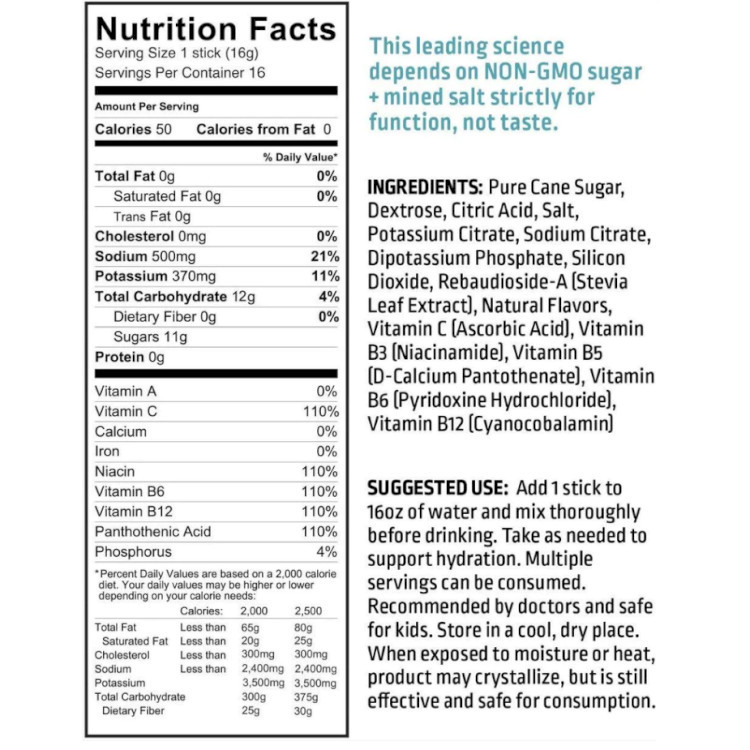
As you can see, Liquid I.V. contains 11 grams of sugar (and 12 grams of total carbohydrates per stick). The carbohydrates in this product are from the addition of cane sugar and dextrose.
Let's use DripDrops for another example. Below are the nutrition facts for the several available flavors of DripDrops:

Like Liquid I.V., the first ingredient in DripDrops is sugar, although it does contain slightly less, at 7 grams per serving.
There are plenty of additional products on the market similar to Liquid I.V. and DripDrops, and the point here is that you should be sure to check the nutrition facts to see how much sugar any particular product contains.
Final Words
Thanks again for reaching out to us!
Hopefully, this answer helped provide some guidance. The types of rehydration products I talked about here are extremely popular and are generally safe to use for most people.
There certainly are some considerations though. For diabetics, in particular, it is important to take into consideration what these contain, especially the sugar content, but, again, they aren't inherently unsafe for diabetics to use.
Glossary — Terms in This Answer
- Oral rehydration products
- Beverages or powders designed to restore fluids and electrolytes to the body after dehydration.
- Electrolytes
- Minerals like sodium and potassium that help your body maintain proper fluid balance and nerve function.
- Sodium
- A mineral and electrolyte that helps regulate fluid balance and blood pressure in the body.
- Potassium
- A mineral and electrolyte that helps regulate heart rhythm and muscle function.
- Glucose
- A simple sugar that serves as a primary energy source for the body.
- Sucrose
- A simple sugar commonly known as table sugar, made from sugar cane or sugar beets.
- Carbohydrates
- Nutrients that the body breaks down into sugar for energy, and which diabetics must carefully monitor.
- Dextrose
- A simple sugar derived from corn that is chemically identical to glucose and used in many food products.
Dr. Brian Staiger, PharmD
Doctor of Pharmacy, board certified clinical pharmacist (BCPS), American Herbalist Guild, Medication Therapy Management certified
Brian Staiger, PharmD, BCPS, is a licensed pharmacist with more than 13 years of experience across retail pharmacy, clinical pharmacy, medication safety, pharmacy program development, and healthcare administration. He is the founder of HelloPharmacist.com, where he helps patients...
More answers from Brian →