
Bayberry by Herbalist & Alchemist Ingredients, Side Effects and Drug Interactions
Dietary Supplement Liquid Botanical
Bayberry by Herbalist & Alchemist is a single-ingredient bayberry supplement. It is marketed to support healthy mucous membranes.
UPC 6 67056 10193 0 Match it to the barcode on your bottle

Medically reviewed by Dr. Brian Staiger, PharmD, BCPS
Also reviewed by the HelloPharmacist Editorial Team
Updated Details about this page
- Label on file from the NIH Dietary Supplement Label Database, dated May 24, 2018.
- The interaction, evidence and safety records come from the Natural Medicines database, which we license, read against this label by our own system; the pharmacy team’s sections are written from those records.
- Dr. Brian Staiger, PharmD, BCPS, is a clinical pharmacist and pharmacotherapy specialist.
- Editorial policy Our sources
AI is used only to summarize verified clinical information, never the open internet. Our AI policy
Summary: The HelloPharmacist Team’s Take
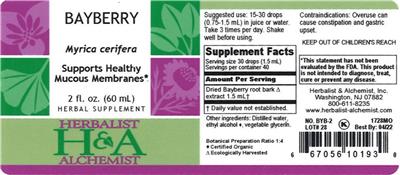
This summary is for Bayberry by Herbalist & Alchemist
- Form
- Liquid
- Serving Size
- 0.75 mL
- Servings
- 40 per container
- Container Holds
- 2 fl. Oz.; 60 mL
- What is Bayberry?A single-ingredient supplement from Herbalist & Alchemist, in liquid form. It is marketed to support healthy mucous membranes.
- Active Ingredients dried Bayberry root bark extract 1.5 mL One active ingredient. We check it for drug interactions and side effects. The full Supplement Facts
- Drug Interactions None documented for the ingredient we could check, which is not a guarantee that none exist. Ask your pharmacist before adding it to a prescription.
- Possible Side EffectsStomach upsetNauseaVomiting From its one active ingredient, Bayberry. Not studied in this exact product.
- AllergensNone of its ingredient names point to a major food allergen, and the label text we have carries no allergen statement
- Barcode (UPC)6 67056 10193 0Match it to the barcode on your bottle to be sure this is your product. Not your product? Search for it here
Who Might Consider It
- This supplement may appeal to people who want a plant-based liquid for the purpose listed on its label, but the research for that use is limited.
Who Should Be Careful
- Anyone who is pregnant, breastfeeding, has stomach, digestive, or liver problems, or has a history of plant allergies should be especially careful.
- Talk it over with your own doctor or pharmacist before deciding whether it is right for you.
More Before You Take It Show both answersHide Pregnancy and Breastfeeding The Label’s Directions
-
Pregnant or breastfeeding?
- Pregnancy and Breastfeeding
- ! When used orally or topically because of possible carcinogenic, or mineralocorticoid activities; avoid using.
-
How does the label say to take it?
“Suggested Use: 15-30 drops (0.75-1.5 mL) in juice or water. Take 3 times per day. Shake well before using.”
The maker’s words. Your pharmacist or doctor may advise differently.
Everything the label says
A Note From the HelloPharmacist Team
Research does not yet show whether bayberry supports healthy mucous membranes, because none of its ingredients is graded for that use. Its most reported side effects are stomach upset, nausea, and vomiting, which come from the bayberry root bark extract. No interactions are documented for that extract, but that is not a guarantee, so the full picture depends on your own medications.
Ask Anything About This Supplement
Name a drug you take, or ask about side effects, ingredients or pregnancy.
There’s a lot of information about this supplement on this page! Ask anything in plain English for a quick answer drawn from it.
AI answers come from this label and our own records, never the open internet. AI can make mistakes, so always check with your doctor or pharmacist. How we use AI
Ask the Pharmacist
A licensed pharmacist will answer your question by email — free, as soon as they can.
Got it — thank you!
A licensed pharmacist will answer as soon as they can. Keep an eye on your email (worth checking spam, just in case).
What’s Inside Bayberry by Herbalist & Alchemist
One Active Ingredient: Dried Bayberry root bark extract
Supplement Facts
| Amount Per Serving | % Daily Value | |
|---|---|---|
| dried Bayberry root bark extract | 1.5 mL | † |
Other ingredients: distilled Water, Ethyl Alcohol, Vegetable Glycerin
† Daily Value not established.
Daily Values for adults and children 4 or more years of age.
As the label prints it, from the NIH Dietary Supplement Label Database.
Each Ingredient and Its Drug Interactions
Tap one for more about it and its full guide.
-
Dried Bayberry root bark extract 1.5 mL No known drug interactions
Bayberry is a traditional herb used mainly as an astringent for diarrhea, sore throats, and minor skin or gum problems, but there is very little modern human research to confirm it works.
- Its bark contains tannins and other compounds that may cause stomach upset and could be harmful in large amounts.
- Talk to your pharmacist or doctor before using it, and avoid it during pregnancy and breastfeeding.
Other Ingredients (Inactive)
The capsule or tablet itself, fillers, coatings and flavors. Not part of the drug interaction check; the allergen check below reads them.
- Distilled Water
- Ethyl Alcohol
- Vegetable Glycerin
Allergens in Bayberry
None of its ingredient names point to a major food allergen, and the label text we have carries no allergen statement.
Not named in the ingredients
- Milk
- Egg
- Fish
- Shellfish
- Tree nuts
- Peanuts
- Wheat or other gluten grains
- Soy
- Sesame
From the label text and ingredient names on file; we do not test products. With a serious allergy, check your bottle and ask the maker or your pharmacist.
What the Label Says
The maker’s own words, from the label. We do not verify or endorse them.
- General statements
-
“Supports healthy mucous membranes”
“Botanical preparation ratio 1:4”
- FDA Statement of Identity
-
“Herbal Supplement”
- General
-
“NO. BYB-2 1728MO”
- Seals and symbols
-
“OK”
- Formulation
-
“Myrica cerifera”
“OK”
The Bayberry Label on File
The label scan on file at the NIH Dietary Supplement Label Database, dated May 2018. Always read the label on the bottle you have.
Product Facts
- Brand
- Herbalist & Alchemist
- Barcode (UPC)
- 667056101930
- Net contents
- 2 fl. Oz.; 60 mL
- Market status
- On market
- Date entered into DSLD
- May 24, 2018
- DSLD ID
- 173771
- Product type
- Botanical
- Supplement form
- Liquid
- Dietary claims / uses
- All Other, Structure/Function
- Intended target group(s)
- Adult (18 - 50 Years), Kosher
Is this label outdated? Report a formula or label change and our pharmacy team will review it.
Bayberry by Herbalist & Alchemist Side Effects
Reported with Bayberry, its active ingredient
- Most often
- Stomach upset, nausea and vomiting
- !Rare but serious
- Reported with Bayberry See details
HelloPharmacist Team Summary: Bayberry by Herbalist & Alchemist Side Effects
Bayberry is generally well tolerated by many people, but it is most likely to cause an upset stomach, nausea, or vomiting.
- Taking large amounts raises the chance of stomach irritation.
- Less commonly, liver damage and allergic reactions have been reported, so stop and call your doctor right away if you notice yellowing skin, dark urine, swelling, or trouble breathing.
Side Effects Reported With Bayberry
Bayberry Warnings: Who Should Be Careful
HelloPharmacist Team Summary: Bayberry by Herbalist & Alchemist Warnings
If you are pregnant or breastfeeding, bayberry is best avoided, since it is rated possibly unsafe in pregnancy and there isn't enough safety information for breastfeeding.
- If you have stomach or digestive conditions, liver problems, or a history of plant allergies, take extra care.
- Children should not be given bayberry without medical advice.
- Talk it over with your own doctor or pharmacist before starting.
These warnings are for Bayberry, its one active ingredient.
-
Liver Disease
- People with stomach or digestive conditions, liver problems, or a history of allergies to plants should be especially cautious.
-
Children
- Children should not be given bayberry without medical advice.
-
Other Cautions
- To be safe, avoid it in both situations.
-
What the Label Warns
- “Contraindications: Overuse can cause constipation and gastric upset.”
- “Keep out of children's reach”
The maker’s wording, from the product label.
-
Pregnant or Breastfeeding
The rating for pregnancy and for breastfeeding, and what it covers.
Pregnancy and Breastfeeding The record rates both the same
-
When used orally or topically because of possible carcinogenic, or mineralocorticoid activities; avoid using.
Our pharmacy team’s notes
- Bayberry is rated possibly unsafe during pregnancy and is best avoided while pregnant.
- It is also best avoided while breastfeeding, because there isn't enough safety information to know otherwise.
Ratings and the words beside them are from the Natural Medicines database, which we license.
The full record, with its sources, in the Bayberry guide -
Rare but Serious Side Effects
-
!
Bayberry
As with any plant product, allergic reactions are also possible.
Reported possible effects also include vomiting and, less commonly, liver damage, which is thought to be linked to its tannin content.
When to get help: a serious allergic reaction, with trouble breathing or swelling of the face, lips or throat, needs emergency care: call 911. For any other side effect that worries you, call your doctor or pharmacist.
These reports describe each ingredient, not studies of this exact product. Not medical advice: a side effect you notice after starting a supplement is worth a word with your pharmacist or doctor.
Bayberry by Herbalist & Alchemist Drug Interactions
None documented for the ingredient we could check, which is not a guarantee that none exist.
This supplement has one active ingredient, dried Bayberry root bark extract, and we checked it against every drug in our records.
We don’t currently list a documented drug interaction for the ingredients we could check in Bayberry. This doesn’t guarantee none exist, so confirm with your pharmacist before combining a supplement with your drugs.
Does It Work? Bayberry by Herbalist & Alchemist
What the research says so far. A grade is the research so far, never an endorsement.
HelloPharmacist Team Summary: Does Bayberry by Herbalist & Alchemist Work?
It is marketed to support healthy mucous membranes, the moist linings inside your body.
- None of its ingredients is graded for that use, so there isn't enough research to know whether it helps.
- Bayberry is not graded for any other use on this page either.
- Because the grades are for each ingredient on its own, the lack of a grade here tells you about the research available, not about how this combination will work for you.
Each ingredient’s guide carries its graded uses: Bayberry.
About Herbalist & Alchemist
Manufacturer and brand details for Bayberry, from the product label.
Herbalist & Alchemist has 296 products in our supplement database, 281 of them on the market, with labels on file since 2016. Our database is built from the NIH’s Dietary Supplement Label Database and our pharmacy team’s own additions, so it covers the labels filed there, not every product the brand sells.
- Name
- Herbalist & Alchemist, Inc.
- City
- Washington
- State
- NJ
- ZipCode
- 07882
- Phone Number
- 800-611-8235
- Web Address
- www.herbalist-alchemist.com
Bayberry by Herbalist & Alchemist: Common Questions
Does Bayberry by Herbalist & Alchemist interact with any drugs?
What are the side effects of Bayberry by Herbalist & Alchemist?
Who should be careful taking Bayberry by Herbalist & Alchemist?
Where does the information about Bayberry by Herbalist & Alchemist come from?
Is Bayberry by Herbalist & Alchemist safe to take during pregnancy?
Can children take Bayberry by Herbalist & Alchemist?
Written and reviewed by the HelloPharmacist Editorial Team. Our editorial policy
Still Have a Question About Bayberry?
Our pharmacists answer drug and supplement questions, free, by email.
Label information is sourced from the NIH Dietary Supplement Label Database and reflects the product version on file; always read your actual product label. This page is for education only and is not a substitute for professional medical advice. Confirm with your pharmacist or doctor before combining supplements and drugs.
Who Reviews This Page
The pharmacist behind it, and how it is checked.
Dr. Brian Staiger, PharmD, BCPS
Clinical pharmacist and founder of HelloPharmacist
A licensed pharmacist for more than 13 years, he built the system behind this page: it reads the label on file, matches each active ingredient to its record in the Natural Medicines database, checks those records against every drug we cover, and our pharmacy team writes the take and the interaction summary from those records.
- 13+ Years in PharmacyRetail and clinical pharmacy, medication safety and healthcare administration.
- Board Certified (BCPS)A pharmacotherapy specialist, certified by the Board of Pharmacy Specialties.
- Herbalist TrainingCertificates in medical ethnobotany, for the herbs and supplements people take.
Where This Page Comes From
Bayberry’s label data comes from the NIH Dietary Supplement Label Database; the ingredient interaction data is from the Natural Medicines database, reviewed by our pharmacists.
- NIH Dietary Supplement Label Database (DSLD)
- The official product label on file for this supplement.
- Natural Medicines (Therapeutic Research Center)
- The evidence-graded clinical reference behind the ingredient interaction, evidence and safety records, which we license.
- HelloPharmacist Editorial Team
- Content is reviewed by the HelloPharmacist Editorial Team, the pharmacists on our staff and those we contract. See our data sources and editorial standards for how this information is built and checked.
- The Pharmacy Team’s Take and Summaries
- Generated from HelloPharmacist’s pharmacist-curated databases and editorial rules. Clinical methodology reviewed by Dr. Brian Staiger, PharmD, BCPS. Last generated Nov 24, 2026. How we use AI
The References Behind the Interaction Records
Every citation the ingredients’ records rest on is listed in that ingredient’s guide, in context: Bayberry, 3 references .
Parts of this content are provided by the Therapeutic Research Center, LLC.
DISCLAIMER: Currently this does not check for drug-drug interactions. This is not an all-inclusive comprehensive list of potential interactions and is for informational purposes only. Not all interactions are known or well-reported in the scientific literature, and new interactions are continually being reported. Input is needed from a qualified healthcare provider including a pharmacist before starting any therapy. Application of clinical judgment is necessary.
© 2021 Therapeutic Research Center, LLC
Keep Exploring
- Supplement interaction checkerCheck any supplement or product against your drugs
- Drug–drug interactionsCheck two or more of your drugs against each other
- Browse drugs A to ZEvery drug we have checked against herbs and supplements
- NDC and pricing lookupFind a drug’s NDCs, packaging and costs
- Ask a pharmacistA free, personal answer from our licensed team