
Chia Ingredients & Drug Interactions
by Herbal Terra
What is this page for?
First and foremost: checking Chia against your medications. The heart of this page is the interaction checker and the full interaction report — how this product’s ingredients may interact with prescription and over-the-counter medicines you may be taking.
Around that, we add a pharmacist’s high-level view of the product as a whole — what’s inside, the evidence for its stated use, how transparent the label is, and what safety data exists — so you can see the full picture in one place. It’s educational information from our licensed clinical databases and the clinical staff at HelloPharmacist — not medical advice — and we don’t sell or endorse products. Our editorial policy
Chia is a dietary supplement by Herbal Terra with 1 active ingredient. Its ingredients are commonly taken for source of fiber and omega-3 fats, digestive health and regularity, heart health and cholesterol.We don’t currently list a known drug interaction for its mapped ingredients — but that doesn’t guarantee none exist, so always confirm with your pharmacist.
HelloPharmacist Scorecard of Chia by Herbal Terra
Our pharmacy team’s full take, with four database checks built into the cards below — a summary of what is known, not a grade of the product itself.
What’s inside
Full disclosure
This product has one active ingredient: certified organic chia seed liquid extract (Salvia hispanica). Chia is a seed that's been eaten as food for centuries.
The extract is prepared in a menstruum (a liquid carrier used to make herbal concentrates).
Does it work?
Couldn't assess
The evidence for chia on weight loss and cholesterol is rated possibly ineffective — meaning studies haven't shown it works well for those goals. For itching (pruritus), there isn't enough reliable evidence to say either way.
If you're hoping this will trim pounds or lower lipid levels, the data we have doesn't support that claim.
How safe is it?
Well-documented data
Chia is generally well tolerated in food amounts. Most people don't report problems, though some have noticed mild stomach upset like flatulence or soft stools when consuming it regularly.
Very rarely, someone with a seed sensitivity could have a serious allergic reaction (anaphylaxis). The real caution here is about concentrated supplement doses.
Most of what we know about chia comes from eating it as food, not from taking concentrated extracts in high amounts. The product label advises sticking to food portions and checking with your doctor before using supplement-strength amounts long-term.
We don't have pregnancy or breastfeeding safety data on file for chia — talk with your doctor or pharmacist if you're pregnant or nursing and considering this.
Meds to double-check
No known interactions
No interactions are documented in our data for the ingredient we could check. Run your exact medications through the search tool on this page if you want to confirm.
The bottom line
Scorecard at a glanceFully disclosed formula with no assessable stated purpose. No medication interactions are currently documented, and safety information is well characterized.
Chia is a food people eat safely every day, and this extract is generally well tolerated. Just know the evidence doesn't back claims that it helps you lose weight or lower cholesterol.
If you're pregnant, breastfeeding, have a seed allergy, or take any medications, run it by your doctor or pharmacist before starting — especially at higher doses than you'd eat as food.
Educational only — not medical advice; always confirm with your pharmacist. Our editorial policy · How we use AI
Assessment coverage: 1 of 1 active ingredient matched to our full ingredient reviews (monographs). Based on the product label dated Sep 25, 2020.
This Scorecard evaluates available label information, ingredient evidence, and known medication-safety considerations. It does not independently verify product identity, purity, potency, contamination, or manufacturing quality. How these ratings are computed
General information
Key facts about Chia, straight from the product label.
| Brand | Herbal Terra |
|---|---|
| Barcode (UPC) | 7429523080079 |
| Net contents | 4 Fluid Ounce(s); 120 mL |
| Market status | On market |
| Date entered into DSLD | Sep 25, 2020 |
| DSLD ID | 234309 |
| Product type | Botanical |
| Supplement form | Liquid |
| Dietary claims / uses | All Other, Structure/Function |
| Intended target group(s) | Adult (18 - 50 Years), Organic, Gluten Free, Sugar Free |
Everything in this section is reproduced from the manufacturer’s own product label — it’s the label speaking, not HelloPharmacist. We show it so you can see exactly what the maker states; we don’t verify or endorse those statements.
Supplement Facts
The label details for Chia by Herbal Terra, sourced from the NIH Dietary Supplement Label Database.
Supplement Facts
| Ingredient | Amount | % DV |
|---|---|---|
| certified organic Chia (Salvia hispanica) dried seed liquid extract | 970 mg | -- |
Other ingredients: Menstruum
Tap any ingredient to jump to its full detail below.
These statements are the manufacturer’s wording, reproduced from the product label — the label is saying it, not HelloPharmacist. We don’t verify or endorse them.
Formulation
Origin of plant material: Mexico.
Manufactured in the USA in an FDA registered facility
Sugar free
Dried herb/menstruum ratio: 1:3 Expertly extracted Laboratory tested 330 mg/1 mL Premium product Super concentrated liquid herbal extract
Non GMO
No artificial ingredients, GMO, gluten, color additives, fillers, preservatives or binders. Natural Gluten Free
Suggested/Recommended/Usage/Directions
Direction Shake well before use. Adults take up to 30 drops (1 mL, one full squeeze of the dropper bulb) in 3-4 fl. oz of juice or water up to 4 times a day. We recommend to seek expert medical advice before taking this or any other herbal supplements.
FDA Disclaimer Statement
Notice This product has not been evaluated by the FDA and is not intended to diagnose, treat, cure, or prevent any disease.
Precautions
Caution May have contraindications.
Do not use if you are allergic to any ingredients.
Consult a physician before using during pregnancy, if nursing, or if you are on any medications.
Keep out of the reach of children.
Storage
Store in a cool, dry, dark place.
Formula
Salvia hispanica
FDA Statement of Identity
Herbal Supplement
Seals/Symbols
Made in USA Made in an FDA registered facility Natural Gluten Free
Is this label outdated? Report a formula or label change and our pharmacy team will review it.
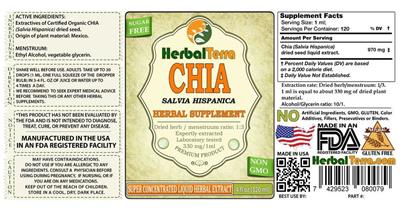
Chia by Herbal Terra label
The label scan from the NIH Dietary Supplement Label Database. Tap to enlarge.
Label images are published by the NIH Dietary Supplement Label Database for the version of this product on file. Always read your actual product label.
View the full label (PDF)The Ingredients in Chia by Herbal Terra
This is the 1 active ingredient this product is made of. Select it to open its full monograph.
Serving size1 mL Dosage formLiquid Servings per container120 Amounts shown are per serving.
Certified organic Chia (Salvia hispanica) dried seed liquid extract
No knowninteractions
Chia seeds are a nutritious whole food rich in fiber, plant-based omega-3 fats (ALA), and protein. They are generally safe as part of a healthy diet,...
Certified organic Chia (Salvia hispanica) dried seed liquid extract monograph & interactionsOther (inactive) ingredients: Menstruum. These complete the product’s ingredient list but are not active constituents.
Chia by Herbal Terra Drug Interactions
We don’t currently list any known drug interactions for the mapped ingredients in Chia. This doesn’t guarantee none exist — always confirm with your pharmacist before combining a supplement with your medications.
Brand information
Manufacturer and brand details for Chia, from the product label.
Chia by Herbal Terra: Common Questions
Does Chia by Herbal Terra interact with any medications?
How can one product interact with so many drugs?
Where does this information come from?
Will this help me lose weight?
What are the side effects?
Is chia safe to eat as food?
Can I take this while pregnant or breastfeeding?
Will this lower my cholesterol?
Written and reviewed by the HelloPharmacist editorial staff. Our editorial policy
Not sure if Chia is safe with your meds?
Our pharmacists answer your medication & supplement questions — free.
Label information is sourced from the NIH Dietary Supplement Label Database and reflects the product version on file; always read your actual product label. This page is for education only and is not a substitute for professional medical advice. Confirm with your pharmacist or doctor before combining supplements and medications.
The Full Monographs Behind Chia’s Ingredients
Every ingredient we hold a full HelloPharmacist monograph for — uses, evidence, safety, and the complete interaction list.
Sources & How We Checked
Chia's label data comes from the NIH Dietary Supplement Label Database; the ingredient interaction data is from the Natural Medicines database, reviewed by our pharmacists.
- NIH Dietary Supplement Label Database (DSLD) — The official product label on file for this supplement.
- Natural Medicines (Therapeutic Research Center) — Evidence-graded clinical reference behind the ingredient interaction data.
Content is written and reviewed by licensed HelloPharmacist pharmacists. See our data sources and editorial standards for how this information is built and checked.
The 12 references behind this product’s interaction data
Every citation that drives the interaction findings for this product’s ingredients, from the evidence-graded Natural Medicines (TRC Healthcare) database. Open an ingredient to browse its citations — links open the study on PubMed or the publisher’s site.
Chia 12 references
- Kolonel LN, Nomura AM, Cooney RV. Dietary fat and prostate cancer: current status. J Natl Cancer Inst 1999;91:414-28. PubMed
- Ramon JM, Bou R, Romea S, et al. Dietary fat intake and prostate cancer risk: a case-control study in Spain. Cancer Causes Control 2000;11:679-85. PubMed
- De Stefani E, Deneo-Pellegrini H, Boffetta P, et al. Alpha-linolenic acid and risk of prostate cancer: a case-control study in Uruguay. Cancer Epidemiol Biomarkers Prev 2000;9:335-8.
- Giovannucci E, Rimm EB, Colditz GA, et al. A prospective study of dietary fat and risk of prostate cancer. J Natl Cancer Inst 1993;85:1571-9. PubMed
- Laaksonen DE, Laukkanen JA, Niskanen L, et al. Serum linoleic and total polyunsaturated fatty acids in relation to prostate and other cancers: a population-based cohort study. Int J Cancer 2004;111:444-50.. PubMed
- Leitzmann MF, Stampfer MJ, Michaud DS, et al. Dietary intake of n-3 and n-6 fatty acids and the risk of prostate cancer. Am J Clin Nutr 2004;80:204-16. PubMed
- Brouwer IA, Katan MB, Zock PL. Dietary alpha-linolenic acid is associated with reduced risk of fatal coronary heart disease, but increased prostate cancer risk: a meta-analysis. J Nutr 2004;134:919-22.
- Chavarro JE, Stampfer MJ, Li H, et al. A prospective study of polyunsaturated fatty acid levels in blood and prostate cancer risk. Cancer Epidemiol Biomarkers Prev 2007;16:1364-70. PubMed
- Brouwer IA, Geleijnse JM, Klaasen VM, Smit LA, Giltay EJ, de Goede J, Heijboer AC, Kromhout D, Katan MB. Effect of alpha linolenic acid supplementation on serum prostate specific antigen (PSA): results from the alpha omega trial. PLoS One. 2013 Dec 11;8(1 PubMed
- García Jiménez S, Pastor Vargas C, de las Heras M, Sanz Maroto A, Vivanco F, Sastre J. Allergen characterization of chia seeds (Salvia hispanica), a new allergenic food. J Investig Allergol Clin Immunol. 2015;25(1):55-6.
- Vuksan V, Jenkins AL, Brissette C, et al. Salba-chia (Salvia hispanica L.) in the treatment of overweight and obese patients with type 2 diabetes: a double-blind randomized controlled trial. Nutr Metab Cardiovasc Dis 2017;27(2):138-46. PubMed
- Zbinden-Foncea H, Ramos-Navarro C, Hevia-Larraín V, et al. Neither Chia Flour nor Whey Protein Supplementation Further Improves Body Composition or Strength Gains after a Resistance Training Program in Young Subjects with a Habitual High Daily Protein Int
Parts of this content are provided by the Therapeutic Research Center, LLC.
DISCLAIMER: Currently this does not check for drug-drug interactions. This is not an all-inclusive comprehensive list of potential interactions and is for informational purposes only. Not all interactions are known or well-reported in the scientific literature, and new interactions are continually being reported. Input is needed from a qualified healthcare provider including a pharmacist before starting any therapy. Application of clinical judgment is necessary.
© 2021 Therapeutic Research Center, LLC