
Chrysanthemum, Ju Hua Ingredients & Drug Interactions
by Herbal Terra
What is this page for?
First and foremost: checking Chrysanthemum, Ju Hua against your medications. The heart of this page is the interaction checker and the full interaction report — how this product’s ingredients may interact with prescription and over-the-counter medicines you may be taking.
Around that, we add a pharmacist’s high-level view of the product as a whole — what’s inside, the evidence for its stated use, how transparent the label is, and what safety data exists — so you can see the full picture in one place. It’s educational information from our licensed clinical databases and the clinical staff at HelloPharmacist — not medical advice — and we don’t sell or endorse products. Our editorial policy
Chrysanthemum, Ju Hua is a dietary supplement by Herbal Terra with 1 active ingredient. Its ingredients are commonly taken for eye irritation and tired eyes, cooling and 'heat-clearing' in traditional chinese medicine, cold and flu symptoms.We don’t currently list a known drug interaction for its mapped ingredients — but that doesn’t guarantee none exist, so always confirm with your pharmacist.
HelloPharmacist Scorecard of Chrysanthemum, Ju Hua by Herbal Terra
Our pharmacy team’s full take, with four database checks built into the cards below — a summary of what is known, not a grade of the product itself.
What’s inside
Full disclosure
The one active ingredient is chrysanthemum flower extract, dry, which is made from the chrysanthemum flower. The inactive ingredients listed are alcohol, water, and glycerin.
Does it work?
Couldn't assess
Our data rates the evidence for chrysanthemum as insufficient reliable evidence to rate for angina, headache, the common cold, diabetes, and HIV/AIDS. In other words, we don't have enough reliable research to say whether it works for any of these uses.
How safe is it?
Well-documented data
Our safety notes say chrysanthemum is generally well tolerated as a tea, but it can cause allergic reactions in sensitive people. The most common adverse effects are skin reactions such as allergic reactions, contact dermatitis, eczema, and hives, while asthma is listed as a rare serious effect.
Our data also says safety during pregnancy has not been established, and there isn't enough reliable information on safety while breastfeeding. Our safety notes say it is best avoided unless your doctor approves, so talk with your own doctor or pharmacist before using it in either situation.
Meds to double-check
No known interactions
No interactions are documented in our data for chrysanthemum flower extract, the one ingredient in this product. That means we found no documented interactions, but it is not a guarantee that none exist.
Check your exact medications with the search tool on this page, and confirm with your own doctor or pharmacist before combining them.
The bottom line
Scorecard at a glanceFully disclosed formula with no assessable stated purpose. No medication interactions are currently documented, and safety information is well characterized.
This product may be of interest to people looking for a chrysanthemum tea-style liquid who have no known sensitivity to chrysanthemum or related plants. Anyone with allergies, especially to ragweed-type plants or other members of the daisy family, should be careful, since our data lists allergic reactions as the main concern.
Pregnant or breastfeeding people should talk it over with their own doctor or pharmacist first.
Educational only — not medical advice; always confirm with your pharmacist. Our editorial policy · How we use AI
Assessment coverage: 1 of 1 active ingredient matched to our full ingredient reviews (monographs). Based on the product label dated Dec 21, 2024.
This Scorecard evaluates available label information, ingredient evidence, and known medication-safety considerations. It does not independently verify product identity, purity, potency, contamination, or manufacturing quality. How these ratings are computed
General information
Key facts about Chrysanthemum, Ju Hua, straight from the product label.
| Brand | Herbal Terra |
|---|---|
| Barcode (UPC) | 7386004961992 |
| Net contents | 2 Fluid Ounce(s); 60 mL |
| Market status | On market |
| Date entered into DSLD | Dec 21, 2024 |
| DSLD ID | 324929 |
| Product type | Botanical |
| Supplement form | Liquid |
| Dietary claims / uses | All Other, Structure/Function |
| Intended target group(s) | Adult (18 - 50 Years), Gluten Free, Sugar Free |
Everything in this section is reproduced from the manufacturer’s own product label — it’s the label speaking, not HelloPharmacist. We show it so you can see exactly what the maker states; we don’t verify or endorse those statements.
Supplement Facts
The label details for Chrysanthemum, Ju Hua by Herbal Terra, sourced from the NIH Dietary Supplement Label Database.
Supplement Facts
| Ingredient | Amount | % DV |
|---|---|---|
| Chrysanthemum Flower Extract, Dry | 983 mg | -- |
Other ingredients: Alcohol, Water, Glycerin
Tap any ingredient to jump to its full detail below.
These statements are the manufacturer’s wording, reproduced from the product label — the label is saying it, not HelloPharmacist. We don’t verify or endorse them.
Suggested/Recommended/Usage/Directions
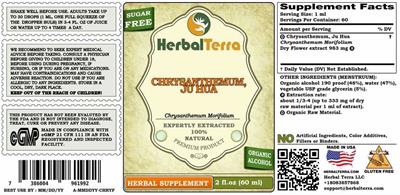
Shake well before use. Adults take up to 30 drops (1 mL, one full squeeze of the dropper bulb) in 3-4 fl. oz. of juice or water up to 4 times a day.
Precautions
We recommend to seek expert medical advice before taking. May have contraindications and cause adverse reaction.
Consult a physician before giving to children under 18, before using during pregnancy, if nursing, or if you are on any medications.
Consult a physician before giving to children under 18, before using during pregnancy, if nursing, or if you are on any medications. Keep out of the reach of children!
Do not use if you are allergic to any ingredients.
Storage
Store in a cool, dry, dark place.
FDA Disclaimer Statement
This product has not been evaluated by the FDA and is not intended to diagnose, treat, cure or prevent any disease.
Formulation
cGMP Made in compliance with cGMP 21 CFR 111 in an FDA registered and inspected facility.
Sugar free
Expertly extracted 100% natural Premium product
Organic alcohol
No artificial ingredients, color additives, fillers or binders.
Natural Gluten free
Formula
Chrysanthemum morifolium
Organic alcohol
FDA Statement of Identity
Herbal Supplement
Seals/Symbols
Made in USA
Is this label outdated? Report a formula or label change and our pharmacy team will review it.
Chrysanthemum, Ju Hua by Herbal Terra label
The label scan from the NIH Dietary Supplement Label Database. Tap to enlarge.
Label images are published by the NIH Dietary Supplement Label Database for the version of this product on file. Always read your actual product label.
View the full label (PDF)The Ingredients in Chrysanthemum, Ju Hua by Herbal Terra
This is the 1 active ingredient this product is made of. Select it to open its full monograph.
Serving size1 mL Dosage formLiquid Servings per container60 Amounts shown are per serving.
Chrysanthemum Flower Extract, Dry
No knowninteractions
Chrysanthemum flowers are most often used as a soothing tea in traditional Chinese medicine and as a folk remedy for eye irritation, colds, and minor...
Chrysanthemum Flower Extract, Dry monograph & interactionsOther (inactive) ingredients: Alcohol, Water, Glycerin. These complete the product’s ingredient list but are not active constituents.
Chrysanthemum, Ju Hua by Herbal Terra Drug Interactions
We don’t currently list any known drug interactions for the mapped ingredients in Chrysanthemum, Ju Hua. This doesn’t guarantee none exist — always confirm with your pharmacist before combining a supplement with your medications.
Brand information
Manufacturer and brand details for Chrysanthemum, Ju Hua, from the product label.
Herbal Terra
See all Herbal Terra products- Name
- Herbal Terra LLC
- Phone Number
- +18083857868
- Web Address
- herbalterra.com
Chrysanthemum, Ju Hua by Herbal Terra: Common Questions
Does Chrysanthemum, Ju Hua by Herbal Terra interact with any medications?
How can one product interact with so many drugs?
Where does this information come from?
Is it safe to take during pregnancy?
Can chrysanthemum cause allergic reactions?
Does chrysanthemum work for colds or diabetes?
Written and reviewed by the HelloPharmacist editorial staff. Our editorial policy
Not sure if Chrysanthemum, Ju Hua is safe with your meds?
Our pharmacists answer your medication & supplement questions — free.
Label information is sourced from the NIH Dietary Supplement Label Database and reflects the product version on file; always read your actual product label. This page is for education only and is not a substitute for professional medical advice. Confirm with your pharmacist or doctor before combining supplements and medications.
The Full Monographs Behind Chrysanthemum, Ju Hua’s Ingredients
Every ingredient we hold a full HelloPharmacist monograph for — uses, evidence, safety, and the complete interaction list.
Sources & How We Checked
Chrysanthemum, Ju Hua's label data comes from the NIH Dietary Supplement Label Database; the ingredient interaction data is from the Natural Medicines database, reviewed by our pharmacists.
- NIH Dietary Supplement Label Database (DSLD) — The official product label on file for this supplement.
- Natural Medicines (Therapeutic Research Center) — Evidence-graded clinical reference behind the ingredient interaction data.
Content is written and reviewed by licensed HelloPharmacist pharmacists. See our data sources and editorial standards for how this information is built and checked.
The 25 references behind this product’s interaction data
Every citation that drives the interaction findings for this product’s ingredients, from the evidence-graded Natural Medicines (TRC Healthcare) database. Open an ingredient to browse its citations — links open the study on PubMed or the publisher’s site.
Chrysanthemum 25 references
- Kuno Y, Kawabe Y, Sakakibara S. Allergic contact dermatitis associated with photosensitivity, from alantolactone in a chrysanthemum farmer. Contact Dermatitis 1999;40:224-5. PubMed
- deJong NW, Vermeulen AM, van Wijik RG, deGroot H. Occupational allergy caused by flowers. Allergy 1998;53:204-9. PubMed
- Camplimi P, Sertoli A, Fabbri P, Panconesi E. Alantolactone sensitivity in chrysanthemum contact dermatitis. Contact Dermatitis 1978;4:93-102. PubMed
- Bleumink E, Mitchell JC, Geismann TA, Towers GH. Contact hypersensitivity to sesquiterpene lactones in Chrysanthemum dermatitis. Contact Dermatitis 1976;2:81-8.
- Lamminpaa A, Estlander T, Jolanki R, Kanerva L. Occupational allergic contact dermatitis caused by decorative plants. Contact Dermatitis 1996;34:330-5. PubMed
- Hausen BM. The sensitizing capacity of Compositae plants. III. Test results and cross-reactions in Compositae-sensitive patients. Dermatologica 1979;159:1-11. DOI
- Kuno, Y., Kawabe, Y., and Sakakibara, S. Allergic contact dermatitis associated with photosensitivity, from alantolactone in a chrysanthemum farmer. Contact Dermatitis 1999;40(4):224-225. PubMed
- Schulz, K. H., Hausen, B. M., Wallhofer, L., and Schmidt-Loffler, P. Chrysanthemum allergy. Pt. II: Experimental studies on the causative agents. Arch.Dermatol.Forsch. 1975;251(3):235-244.
- Singhal, V. and Reddy, B. S. Common contact sensitizers in Delhi. J Dermatol 2000;27(7):440-445. PubMed
- Kuroume, T., Todokoro, M., Tomidokoro, H., Kanbe, Y., and Matsumura, T. Chrysanthemum pollinosis in Japan. Int.Arch.Allergy Appl.Immunol. 1975;48(6):800-811.
- Groenewoud, G. C., de Jong, N. W., Burdorf, A., de Groot, H., and van Wyk, R. G. Prevalence of occupational allergy to Chrysanthemum pollen in greenhouses in the Netherlands. Allergy 2002;57(9):835-840.
- Jovanovic, M. and Poljacki, M. [Compositae dermatitis]. Med Pregl. 2003;56(1-2):43-49. PubMed
- Hashimoto, Y., Kawada, A., Aragane, Y., and Tezuka, T. Occupational contact dermatitis from chrysanthemum in a mortician. Contact Dermatitis 2003;49(2):106-107. PubMed
- Groenewoud, G. C., de Groot, H., and van Wijk, R. G. Impact of occupational and inhalant allergy on rhinitis-specific quality of life in employees of bell pepper greenhouses in the Netherlands. Ann Allergy Asthma Immunol 2006;96(1):92-97. PubMed
- Sharma, S. C. and Kaur, S. Airborne contact dermatitis from Compositae plants in northern India. Contact Dermatitis 1989;21(1):1-5. PubMed
- Sharma, S. C., Tanwar, R. C., and Kaur, S. Contact dermatitis from chrysanthemums in India. Contact Dermatitis 1989;21(2):69-71. PubMed
- Tanaka, T., Moriwaki, S. I., and Horio, T. Occupational dermatitis with simultaneous immediate and delayed allergy to chrysanthemum. Contact Dermatitis 1987;16(3):152-154. PubMed
- Frain-Bell, W., Hetherington, A., and Johnson, B. E. Contact allergic sensitivity to chrysanthemum and the photosensitivity dermatitis and actinic reticuloid syndrome. Br.J.Dermatol. 1979;101(5):491-501. PubMed
- Diener, C., Schlenvoigt, G., Jager, L., Prater, E., and Schubert, H. Allergens of chrysanthemum pollen. Allergol.Immunopathol.(Madr.) 1986;14(1):49-53.
- Zeller, W., de Gols, M., and Hausen, B. M. The sensitizing capacity of Compositae plants. VI. Guinea pig sensitization experiments with ornamental plants and weeds using different methods. Arch Dermatol.Res 1985;277(1):28-35. PubMed
- Schmidt, R. J. When is a chrysanthemum dermatitis not a chrysanthemum dermatitis? The case for describing florists' chrysanthemums as Dendranthema cultivars. Contact Dermatitis 1985;13(2):115-119.
- Schmidt, R. J. and Kingston, T. Chrysanthemum dermatitis in South Wales; diagnosis by patch testing with feverfew (Tanacetum parthenium) extract. Contact Dermatitis 1985;13(2):120-121.
- Mitchell, J. C., Geissman, T. A., Dupuis, G., and Towers, G. H. Allergic contact dermatitis caused by Artemisia and Chrysanthemum species. The role of sesquiterpene lactones. J.Invest Dermatol. 1971;56(2):98-101. PubMed
- Sugai, T., Takahashi, Y., and Okuno, F. Chrysanthemum dermatitis in Japan. Contact Dermatitis 1980;6(2):155. PubMed
- Wakelin, S. H., Marren, P., Young, E., and Shaw, S. Compositae sensitivity and chronic hand dermatitis in a seven-year-old boy. Br J Dermatol 1997;137(2):289-291. PubMed
Parts of this content are provided by the Therapeutic Research Center, LLC.
DISCLAIMER: Currently this does not check for drug-drug interactions. This is not an all-inclusive comprehensive list of potential interactions and is for informational purposes only. Not all interactions are known or well-reported in the scientific literature, and new interactions are continually being reported. Input is needed from a qualified healthcare provider including a pharmacist before starting any therapy. Application of clinical judgment is necessary.
© 2021 Therapeutic Research Center, LLC