
Cinnamon Ingredients & Drug Interactions
by Herb Pharm
What is this page for?
First and foremost: checking Cinnamon against your medications. The heart of this page is the interaction checker and the full interaction report — how this product’s ingredients may interact with prescription and over-the-counter medicines you may be taking.
Around that, we add a pharmacist’s high-level view of the product as a whole — what’s inside, the evidence for its stated use, how transparent the label is, and what safety data exists — so you can see the full picture in one place. It’s educational information from our licensed clinical databases and the clinical staff at HelloPharmacist — not medical advice — and we don’t sell or endorse products. Our editorial policy
Cinnamon is a dietary supplement by Herb Pharm with 1 active ingredient. Its ingredients are commonly taken for blood sugar support, digestive upset, antioxidant support.Based on those ingredients, 442 medications have a known interaction with it, the most serious rated moderate. The ingredients most likely to interact are Cinnamon Bark Extract. Use the checker below to test your specific medication, or read the full HelloPharmacist Interaction Report.
Check Your Meds Against Cinnamon by Herb Pharm
Ask about any prescription or over-the-counter medication and we check it for interactions with Cinnamon by Herb Pharm — and tell you which ingredient is responsible.
AI summaries are generated from our interaction database for education only — always confirm with your pharmacist. How we use AI
Ask the Pharmacist
A licensed pharmacist will answer your question by email — free, usually within 24 hours.
Got it — thank you!
A licensed pharmacist will answer within 24 hours. Keep an eye on your email (worth checking spam, just in case).
HelloPharmacist Scorecard of Cinnamon by Herb Pharm
Our pharmacy team’s full take, with four database checks built into the cards below — a summary of what is known, not a grade of the product itself.
What’s inside
Full disclosure
This product contains one active ingredient: cinnamon bark extract (from cassia cinnamon). The extract also includes cane alcohol, distilled water, and glycerin as inactive ingredients that help preserve and deliver the active compound.
Does it work?
Not established
The evidence we hold for cinnamon doesn't establish that it works for any of the conditions it's often used for — amenorrhea (absent periods), angina (chest pain), common cold, diabetes, diarrhea, or high cholesterol. Each of these carries a rating of insufficient reliable evidence, which means the science isn't settled yet.
How safe is it?
Well-documented data
Cinnamon is generally well tolerated in food amounts. At supplement doses — especially high doses or long-term use — there's concern about liver damage because of coumarin, a natural compound in the bark.
In clinical trials, people taking cinnamon 360 mg to 12 grams daily for three months did not show significant changes in liver enzymes, but very high doses of coumarin (50–7,000 mg daily from any source) can cause liver injury that reverses when you stop. A rash occurred in one trial participant, and in rare cases, people with a cinnamon allergy have developed skin reactions even from dietary cinnamon.
One person also experienced a low blood sugar seizure (hypoglycemia) during a trial, though it's unclear whether cinnamon caused it.
Meds to double-check
Moderate interaction found
Check your diabetes medications (insulin, sulfonylureas, metformin, and others) before starting — cinnamon may lower blood sugar. Also flag any medications that can harm the liver (hepatotoxic drugs) with your pharmacist.
Both interactions are Moderate severity.
The bottom line
Scorecard at a glanceFully disclosed formula with no established evidence rating for its marketed use. Moderate medication interactions have been identified, and safety information is well characterized.
Consider cinnamon if you're interested in trying it for general wellness, but understand that we don't yet have strong evidence it works for specific conditions. Be cautious if you take diabetes medications or drugs that strain the liver — check with your pharmacist first.
Avoid high-dose supplement amounts during pregnancy; food amounts are likely fine.
Educational only — not medical advice; always confirm with your pharmacist. Our editorial policy · How we use AI
Assessment coverage: 1 of 1 active ingredient matched to our full ingredient reviews (monographs). Based on the product label dated Aug 22, 2025.
This Scorecard evaluates available label information, ingredient evidence, and known medication-safety considerations. It does not independently verify product identity, purity, potency, contamination, or manufacturing quality. How these ratings are computed
General information
Key facts about Cinnamon, straight from the product label.
| Brand | Herb Pharm |
|---|---|
| Barcode (UPC) | 090700001339 |
| Net contents | 4 Fluid Ounce(s); 120 mL |
| Market status | On market |
| Date entered into DSLD | Aug 22, 2025 |
| DSLD ID | 336565 |
| Product type | Botanical |
| Supplement form | Liquid |
| Dietary claims / uses | All Other, Structure/Function |
| Intended target group(s) | Adult (18 - 50 Years), Organic, Gluten Free |
Everything in this section is reproduced from the manufacturer’s own product label — it’s the label speaking, not HelloPharmacist. We show it so you can see exactly what the maker states; we don’t verify or endorse those statements.
Supplement Facts
The label details for Cinnamon by Herb Pharm, sourced from the NIH Dietary Supplement Label Database.
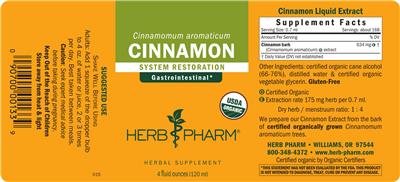
Supplement Facts
| Ingredient | Amount | % DV |
|---|---|---|
| Cinnamon Bark Extract | 634 mg | -- |
Other ingredients: Cane Alcohol, Water, Distilled, Glycerin
Tap any ingredient to jump to its full detail below.
These statements are the manufacturer’s wording, reproduced from the product label — the label is saying it, not HelloPharmacist. We don’t verify or endorse them.
Suggested/Recommended/Usage/Directions
Suggested Use Shake well before using Adults: Add 1 squeeze of the dropper bulb to 4 oz. of water or juice, 2 or 3 times per day. Best taken between meals.
Precautions
Caution: Seek expert medical advice before taking during pregnancy.
Keep out of the reach of children
Storage
Store away from heat & light
Formula
Cinnamomum aromaticum
Cinnamon Liquid Extract
We prepare our Cinnamon Extract from the bark of certified organically grown Cinnamomum aromaticum trees.
Formulation
System restoration Gastrointestinal
USDA Organic
Gluten-free
We prepare our Cinnamon Extract from the bark of certified organically grown Cinnamomum aromaticum trees. Certified organic by Organic certifiers
Seals/Symbols
USDA Organic
FDA Statement of Identity
Herbal Supplement
FDA Disclaimer Statement
This statement has not been evaluated by the FDA. This product is not intended to diagnose, treat, cure or prevent any disease.
Is this label outdated? Report a formula or label change and our pharmacy team will review it.
Cinnamon by Herb Pharm label
The label scan from the NIH Dietary Supplement Label Database. Tap to enlarge.
Label images are published by the NIH Dietary Supplement Label Database for the version of this product on file. Always read your actual product label.
View the full label (PDF)The Ingredients in Cinnamon by Herb Pharm
This is the 1 active ingredient this product is made of. Select it to open its full monograph.
Serving size0.7 mL Dosage formLiquid Servings per container168 Amounts shown are per serving.
Cinnamon Bark Extract
Interacts with442 drugs
Cassia cinnamon is the common, inexpensive cinnamon used in cooking, and it is also taken as a supplement, most often for blood sugar support. The evi...
Cinnamon Bark Extract monograph & interactionsOther (inactive) ingredients: Cane Alcohol, Water, Distilled, Glycerin. These complete the product’s ingredient list but are not active constituents.
Cinnamon by Herb Pharm Drug Interactions
HelloPharmacist Interaction Report
Herb Pharm Cinnamon is a single-ingredient liquid extract of cinnamon bark.
It has documented interactions with two medication types, both Moderate severity.
Read the full breakdown — every affected drug type, severity by severity
Cinnamon may lower blood sugar (glucose) levels and could add to the effect of diabetes medications. If you take insulin or other drugs to manage blood sugar, dose adjustments might become necessary — this is something to discuss with your doctor or pharmacist before starting this product.
Large doses of cinnamon over a long time might stress the liver, especially when combined with medications that are already hard on the liver (hepatotoxic drugs). Cinnamon bark contains coumarin, a compound that can damage liver tissue in high amounts.
Altogether, these interactions span 425 individual medications. Run your exact prescriptions through the medication checker on this page before you begin.
Check your own medications below · Editorial policy · How we use AI
Want to check YOUR meds against Cinnamon?
Ask about interactions with your drugs in plain English — “Can I take it with lisinopril?” — and we find you the answer in seconds, ingredient by ingredient.
Go to the checkerIngredients driving the most interactions
Individual Drug Interactions
The ingredients in Cinnamon interact with 442 drugs. Click any drug to see the details.
1 of the 1 ingredient in Cinnamon interact with drugs. Each result below shows which ingredient is responsible. Cinnamon Bark Extract
6-mercaptopurinePurinethol
How 6-mercaptopurine interacts with Cinnamon — through 1 ingredient. Tap an ingredient for the detail:
Cinnamon Bark ExtractHepatotoxic Drugs Moderate
Interaction Summary
Theoretically, large doses of cassia cinnamon might cause additive effects when used with hepatotoxic drugs.
Read the full Cinnamon Bark Extract + 6-mercaptopurine interactionAbacavir Sulfate, Dolutegravir, LamivudineTriumeq
How Abacavir Sulfate, Dolutegravir, Lamivudine interacts with Cinnamon — through 1 ingredient. Tap an ingredient for the detail:
Cinnamon Bark ExtractHepatotoxic Drugs Moderate
Interaction Summary
Theoretically, large doses of cassia cinnamon might cause additive effects when used with hepatotoxic drugs.
Read the full Cinnamon Bark Extract + Abacavir Sulfate, Dolutegravir, Lamivudine interactionAbacavir, LamivudineEpzicom
How Abacavir, Lamivudine interacts with Cinnamon — through 1 ingredient. Tap an ingredient for the detail:
Cinnamon Bark ExtractHepatotoxic Drugs Moderate
Interaction Summary
Theoretically, large doses of cassia cinnamon might cause additive effects when used with hepatotoxic drugs.
Read the full Cinnamon Bark Extract + Abacavir, Lamivudine interactionAbiraterone
How Abiraterone interacts with Cinnamon — through 1 ingredient. Tap an ingredient for the detail:
Cinnamon Bark ExtractHepatotoxic Drugs Moderate
Interaction Summary
Theoretically, large doses of cassia cinnamon might cause additive effects when used with hepatotoxic drugs.
Read the full Cinnamon Bark Extract + Abiraterone interactionAbiraterone AcetateYonsa, Zytiga
How Abiraterone Acetate interacts with Cinnamon — through 1 ingredient. Tap an ingredient for the detail:
Cinnamon Bark ExtractHepatotoxic Drugs Moderate
Interaction Summary
Theoretically, large doses of cassia cinnamon might cause additive effects when used with hepatotoxic drugs.
Read the full Cinnamon Bark Extract + Abiraterone Acetate interactionAcarboseGlucobay, Prandase, Precose
How Acarbose interacts with Cinnamon — through 1 ingredient. Tap an ingredient for the detail:
Cinnamon Bark ExtractAntidiabetes Drugs, Hepatotoxic Drugs Moderate
Interaction Summary
Theoretically, cassia cinnamon may have additive effects with antidiabetes drugs.
Read the full Cinnamon Bark Extract + Acarbose interactionAcebutololRhotral, Sectral
How Acebutolol interacts with Cinnamon — through 1 ingredient. Tap an ingredient for the detail:
Cinnamon Bark ExtractHepatotoxic Drugs Moderate
Interaction Summary
Theoretically, large doses of cassia cinnamon might cause additive effects when used with hepatotoxic drugs.
Read the full Cinnamon Bark Extract + Acebutolol interactionAcetaminophenChildren's Tylenol, Children's Tylenol Meltaways, Tylenol, Tylenol Ex Strength
How Acetaminophen interacts with Cinnamon — through 1 ingredient. Tap an ingredient for the detail:
Cinnamon Bark ExtractHepatotoxic Drugs Moderate
Interaction Summary
Theoretically, large doses of cassia cinnamon might cause additive effects when used with hepatotoxic drugs.
Read the full Cinnamon Bark Extract + Acetaminophen interactionAcetaminophen, AspirinGemnisyn
How Acetaminophen, Aspirin interacts with Cinnamon — through 1 ingredient. Tap an ingredient for the detail:
Cinnamon Bark ExtractHepatotoxic Drugs Moderate
Interaction Summary
Theoretically, large doses of cassia cinnamon might cause additive effects when used with hepatotoxic drugs.
Read the full Cinnamon Bark Extract + Acetaminophen, Aspirin interactionAcetaminophen, Aspirin, CaffeineExcedrin, Excedrin Extra Strength, Excedrin Migraine
How Acetaminophen, Aspirin, Caffeine interacts with Cinnamon — through 1 ingredient. Tap an ingredient for the detail:
Cinnamon Bark ExtractHepatotoxic Drugs Moderate
Interaction Summary
Theoretically, large doses of cassia cinnamon might cause additive effects when used with hepatotoxic drugs.
Read the full Cinnamon Bark Extract + Acetaminophen, Aspirin, Caffeine interactionAcetaminophen, Brompheniramine, PhenylpropanolamineDimetapp Cold and Flu
How Acetaminophen, Brompheniramine, Phenylpropanolamine interacts with Cinnamon — through 1 ingredient. Tap an ingredient for the detail:
Cinnamon Bark ExtractHepatotoxic Drugs Moderate
Interaction Summary
Theoretically, large doses of cassia cinnamon might cause additive effects when used with hepatotoxic drugs.
Read the full Cinnamon Bark Extract + Acetaminophen, Brompheniramine, Phenylpropanolamine interactionAcetaminophen, ButalbitalAxocet, Bancap, Bucet, Butex Forte, Esgic CF, Orbivan CF +5 more
How Acetaminophen, Butalbital interacts with Cinnamon — through 1 ingredient. Tap an ingredient for the detail:
Cinnamon Bark ExtractHepatotoxic Drugs Moderate
Interaction Summary
Theoretically, large doses of cassia cinnamon might cause additive effects when used with hepatotoxic drugs.
Read the full Cinnamon Bark Extract + Acetaminophen, Butalbital interactionAcetaminophen, Butalbital, CaffeineEsgic, Esgic Plus, Fiogesic, Fioricet, Repan, Tecnal +1 more
How Acetaminophen, Butalbital, Caffeine interacts with Cinnamon — through 1 ingredient. Tap an ingredient for the detail:
Cinnamon Bark ExtractHepatotoxic Drugs Moderate
Interaction Summary
Theoretically, large doses of cassia cinnamon might cause additive effects when used with hepatotoxic drugs.
Read the full Cinnamon Bark Extract + Acetaminophen, Butalbital, Caffeine interactionAcetaminophen, Butalbital, Caffeine, CodeineEsgic with Codeine, Fioricet w/ Codeine
How Acetaminophen, Butalbital, Caffeine, Codeine interacts with Cinnamon — through 1 ingredient. Tap an ingredient for the detail:
Cinnamon Bark ExtractHepatotoxic Drugs Moderate
Interaction Summary
Theoretically, large doses of cassia cinnamon might cause additive effects when used with hepatotoxic drugs.
Read the full Cinnamon Bark Extract + Acetaminophen, Butalbital, Caffeine, Codeine interactionAcetaminophen, Butalbital, CodeineBancap w/ Codeine
How Acetaminophen, Butalbital, Codeine interacts with Cinnamon — through 1 ingredient. Tap an ingredient for the detail:
Cinnamon Bark ExtractHepatotoxic Drugs Moderate
Interaction Summary
Theoretically, large doses of cassia cinnamon might cause additive effects when used with hepatotoxic drugs.
Read the full Cinnamon Bark Extract + Acetaminophen, Butalbital, Codeine interactionAcetaminophen, Butalbital, Codeine PhosphatePhrenilin #3
How Acetaminophen, Butalbital, Codeine Phosphate interacts with Cinnamon — through 1 ingredient. Tap an ingredient for the detail:
Cinnamon Bark ExtractHepatotoxic Drugs Moderate
Interaction Summary
Theoretically, large doses of cassia cinnamon might cause additive effects when used with hepatotoxic drugs.
Read the full Cinnamon Bark Extract + Acetaminophen, Butalbital, Codeine Phosphate interactionAcetaminophen, Caffeine, Chlorpheniramine, Hydrocodone, PhenylephrineHycomine Compound
How Acetaminophen, Caffeine, Chlorpheniramine, Hydrocodone, Phenylephrine interacts with Cinnamon — through 1 ingredient. Tap an ingredient for the detail:
Cinnamon Bark ExtractHepatotoxic Drugs Moderate
Interaction Summary
Theoretically, large doses of cassia cinnamon might cause additive effects when used with hepatotoxic drugs.
Read the full Cinnamon Bark Extract + Acetaminophen, Caffeine, Chlorpheniramine, Hydrocodone, Phenylephrine interactionAcetaminophen, Caffeine, CodeineGesic C15, Gesic C30, Gesic C8, Lenoltec 1, Lenoltec 2, Lenoltec 3 +1 more
How Acetaminophen, Caffeine, Codeine interacts with Cinnamon — through 1 ingredient. Tap an ingredient for the detail:
Cinnamon Bark ExtractHepatotoxic Drugs Moderate
Interaction Summary
Theoretically, large doses of cassia cinnamon might cause additive effects when used with hepatotoxic drugs.
Read the full Cinnamon Bark Extract + Acetaminophen, Caffeine, Codeine interactionAcetaminophen, Caffeine, Codeine, SalicylamideCodalan No.1, Codalan No.2, Codalan No.3
How Acetaminophen, Caffeine, Codeine, Salicylamide interacts with Cinnamon — through 1 ingredient. Tap an ingredient for the detail:
Cinnamon Bark ExtractHepatotoxic Drugs Moderate
Interaction Summary
Theoretically, large doses of cassia cinnamon might cause additive effects when used with hepatotoxic drugs.
Read the full Cinnamon Bark Extract + Acetaminophen, Caffeine, Codeine, Salicylamide interactionAcetaminophen, Caffeine, DihydrocodeineDHC Plus, Panlor DC, Panlor SS
How Acetaminophen, Caffeine, Dihydrocodeine interacts with Cinnamon — through 1 ingredient. Tap an ingredient for the detail:
Cinnamon Bark ExtractHepatotoxic Drugs Moderate
Interaction Summary
Theoretically, large doses of cassia cinnamon might cause additive effects when used with hepatotoxic drugs.
Read the full Cinnamon Bark Extract + Acetaminophen, Caffeine, Dihydrocodeine interactionAcetaminophen, Caffeine, IsomethepteneMigralam
How Acetaminophen, Caffeine, Isometheptene interacts with Cinnamon — through 1 ingredient. Tap an ingredient for the detail:
Cinnamon Bark ExtractHepatotoxic Drugs Moderate
Interaction Summary
Theoretically, large doses of cassia cinnamon might cause additive effects when used with hepatotoxic drugs.
Read the full Cinnamon Bark Extract + Acetaminophen, Caffeine, Isometheptene interactionAcetaminophen, Caffeine, PyrilamineMidol Max Strength Menstrual
How Acetaminophen, Caffeine, Pyrilamine interacts with Cinnamon — through 1 ingredient. Tap an ingredient for the detail:
Cinnamon Bark ExtractHepatotoxic Drugs Moderate
Interaction Summary
Theoretically, large doses of cassia cinnamon might cause additive effects when used with hepatotoxic drugs.
Read the full Cinnamon Bark Extract + Acetaminophen, Caffeine, Pyrilamine interactionAcetaminophen, Chlorpheniramine Maleate, Dextromethorphan HbrVicks Formula 44M Cough, Cold & Flu Relief
How Acetaminophen, Chlorpheniramine Maleate, Dextromethorphan Hbr interacts with Cinnamon — through 1 ingredient. Tap an ingredient for the detail:
Cinnamon Bark ExtractHepatotoxic Drugs Moderate
Interaction Summary
Theoretically, large doses of cassia cinnamon might cause additive effects when used with hepatotoxic drugs.
Read the full Cinnamon Bark Extract + Acetaminophen, Chlorpheniramine Maleate, Dextromethorphan Hbr interactionAcetaminophen, Chlorpheniramine, Codeine, PhenylephrineColrex
How Acetaminophen, Chlorpheniramine, Codeine, Phenylephrine interacts with Cinnamon — through 1 ingredient. Tap an ingredient for the detail:
Cinnamon Bark ExtractHepatotoxic Drugs Moderate
Interaction Summary
Theoretically, large doses of cassia cinnamon might cause additive effects when used with hepatotoxic drugs.
Read the full Cinnamon Bark Extract + Acetaminophen, Chlorpheniramine, Codeine, Phenylephrine interactionAcetaminophen, Chlorpheniramine, DextromethorphanCoricidin II Extra Strength Cold and Flu
How Acetaminophen, Chlorpheniramine, Dextromethorphan interacts with Cinnamon — through 1 ingredient. Tap an ingredient for the detail:
Cinnamon Bark ExtractHepatotoxic Drugs Moderate
Interaction Summary
Theoretically, large doses of cassia cinnamon might cause additive effects when used with hepatotoxic drugs.
Read the full Cinnamon Bark Extract + Acetaminophen, Chlorpheniramine, Dextromethorphan interactionAcetaminophen, Chlorpheniramine, Dextromethorphan HydrobromideCoricidin HBP Maximum Strength Flu
How Acetaminophen, Chlorpheniramine, Dextromethorphan Hydrobromide interacts with Cinnamon — through 1 ingredient. Tap an ingredient for the detail:
Cinnamon Bark ExtractHepatotoxic Drugs Moderate
Interaction Summary
Theoretically, large doses of cassia cinnamon might cause additive effects when used with hepatotoxic drugs.
Read the full Cinnamon Bark Extract + Acetaminophen, Chlorpheniramine, Dextromethorphan Hydrobromide interactionAcetaminophen, Chlorpheniramine, Dextromethorphan, PhenylpropanolamineMulti Symptom Cold Relief
How Acetaminophen, Chlorpheniramine, Dextromethorphan, Phenylpropanolamine interacts with Cinnamon — through 1 ingredient. Tap an ingredient for the detail:
Cinnamon Bark ExtractHepatotoxic Drugs Moderate
Interaction Summary
Theoretically, large doses of cassia cinnamon might cause additive effects when used with hepatotoxic drugs.
Read the full Cinnamon Bark Extract + Acetaminophen, Chlorpheniramine, Dextromethorphan, Phenylpropanolamine interactionAcetaminophen, Chlorpheniramine, Dextromethorphan, PseudoephedrineChildren's Tylenol Cold Plus Cough, Tylenol Cold Ex Strength
How Acetaminophen, Chlorpheniramine, Dextromethorphan, Pseudoephedrine interacts with Cinnamon — through 1 ingredient. Tap an ingredient for the detail:
Cinnamon Bark ExtractHepatotoxic Drugs Moderate
Interaction Summary
Theoretically, large doses of cassia cinnamon might cause additive effects when used with hepatotoxic drugs.
Read the full Cinnamon Bark Extract + Acetaminophen, Chlorpheniramine, Dextromethorphan, Pseudoephedrine interactionAcetaminophen, Chlorpheniramine, Guaifenesin, Phenylephrine, SalicylamideRhinogesic GG
How Acetaminophen, Chlorpheniramine, Guaifenesin, Phenylephrine, Salicylamide interacts with Cinnamon — through 1 ingredient. Tap an ingredient for the detail:
Cinnamon Bark ExtractHepatotoxic Drugs Moderate
Interaction Summary
Theoretically, large doses of cassia cinnamon might cause additive effects when used with hepatotoxic drugs.
Read the full Cinnamon Bark Extract + Acetaminophen, Chlorpheniramine, Guaifenesin, Phenylephrine, Salicylamide interactionAcetaminophen, Chlorpheniramine, PhenylephrineAlka-Seltzer PLUS, Histex SR, Protid
How Acetaminophen, Chlorpheniramine, Phenylephrine interacts with Cinnamon — through 1 ingredient. Tap an ingredient for the detail:
Cinnamon Bark ExtractHepatotoxic Drugs Moderate
Interaction Summary
Theoretically, large doses of cassia cinnamon might cause additive effects when used with hepatotoxic drugs.
Read the full Cinnamon Bark Extract + Acetaminophen, Chlorpheniramine, Phenylephrine interactionEach ingredient & the kinds of drugs it affects
For each ingredient in Cinnamon with known interactions, here are the types of medications it can affect. Open any type for the detail — or search your exact drug in the checker above.
Cinnamon Bark Extract
Antidiabetes Drugs
Theoretically, cassia cinnamon may have additive effects with antidiabetes drugs.
Cassia cinnamon may lower blood glucose levels, and have additive effects in patients treated with antidiabetic agents. Dose adjustments to diabetes medications might be necessary.
Hepatotoxic Drugs
Theoretically, large doses of cassia cinnamon might cause additive effects when used with hepatotoxic drugs.
There is some concern that ingesting large amounts of cassia cinnamon for an extended duration might cause hepatotoxicity in some people. Cassia cinnamon contains coumarin, which can cause hepatotoxicity in animal models. In humans, very high doses of coumarin from 50-7000 mg/day can result in hepatotoxicity that resolves when coumarin use is discontinued. Lower amounts might also cause liver problems in sensitive people, such as those with liver disease or those taking potentially hepatotoxic agents.
Brand information
Manufacturer and brand details for Cinnamon, from the product label.
Herb Pharm
See all Herb Pharm products- Name
- Herb Pharm
- City
- Williams
- State
- OR
- ZipCode
- 97544
- Phone Number
- 800-348-4372
- Web Address
- www.herb-pharm.com
Cinnamon by Herb Pharm: Common Questions
Does Cinnamon by Herb Pharm interact with any medications?
How can one product interact with so many drugs?
Where does this information come from?
Is cinnamon safe to use while pregnant or breastfeeding?
Can cinnamon actually help with diabetes?
What are the side effects?
Is this product just ground cinnamon, or is it more concentrated?
What's coumarin, and should I worry about it?
Written and reviewed by the HelloPharmacist editorial staff. Our editorial policy
Not sure if Cinnamon is safe with your meds?
Our pharmacists answer your medication & supplement questions — free.
Label information is sourced from the NIH Dietary Supplement Label Database and reflects the product version on file; always read your actual product label. This page is for education only and is not a substitute for professional medical advice. Confirm with your pharmacist or doctor before combining supplements and medications.
The Full Monographs Behind Cinnamon’s Ingredients
Every ingredient we hold a full HelloPharmacist monograph for — uses, evidence, safety, and the complete interaction list.
Sources & How We Checked
Cinnamon's label data comes from the NIH Dietary Supplement Label Database; the ingredient interaction data is from the Natural Medicines database, reviewed by our pharmacists.
- NIH Dietary Supplement Label Database (DSLD) — The official product label on file for this supplement.
- Natural Medicines (Therapeutic Research Center) — Evidence-graded clinical reference behind the ingredient interaction data.
Content is written and reviewed by licensed HelloPharmacist pharmacists. See our data sources and editorial standards for how this information is built and checked.
The 20 references behind this product’s interaction data
Every citation that drives the interaction findings for this product’s ingredients, from the evidence-graded Natural Medicines (TRC Healthcare) database. Open an ingredient to browse its citations — links open the study on PubMed or the publisher’s site.
Cassia Cinnamon 20 references
- Electronic Code of Federal Regulations. Title 21. Part 182 -- Substances Generally Recognized As Safe. Available at: https://www.accessdata.fda.gov/scripts/cdrh/cfdocs/cfcfr/CFRSearch.cfm?CFRPart=182
- Khan A, Safdar M, Ali Khan M, et al. Cinnamon improves glucose and lipids of people with type 2 diabetes. Diabetes Care 2003;26:3215-8. PubMed
- De Benito V, Alzaga R. Occupational allergic contact dermatitis from cassia (Chinese cinnamon) as a flavouring agent in coffee. Contact Dermatitis 1999;40:165. PubMed
- Drake TE, Maibach HI. Allergic contact dermatitis and stomatitis caused by a cinnamic aldehyde-flavored toothpaste. Arch Dermatol 1976;112:202-3.
- Press release. Cinnamon capsules to reduce blood sugar are medicinal products! Efficacy has not been scientifically proven - some products contain high levels of coumarin. Federal Institute of Risk Assessment (BfM), Germany, November 11, 2006. Available a
- Felter SP, Vassallo JD, Carlton BD, Daston GP. A safety assessment of coumarin taking into account species-specificity of toxicokinetics. Food Chem Toxicol 2006;44:462-75. PubMed
- Crawford P. Effectiveness of cinnamon for lowering hemoglobin A1C in patients with type 2 diabetes: a randomized, controlled trial. J Am Board Fam Med 2009;22:507-12. PubMed
- Akilen, R., Tsiami, A., Devendra, D., and Robinson, N. Glycated haemoglobin and blood pressure-lowering effect of cinnamon in multi-ethnic Type 2 diabetic patients in the UK: a randomized, placebo-controlled, double-blind clinical trial. Diabet.Med. 2010; PubMed
- Lu T, Sheng H Wu J Cheng Y Zhu J Chen Y. Cinnamon extract improves fasting blood glucose and glycosylated hemoglobin level in Chinese patients with type 2 diabetes. Nutr Res. 2012;32(6):408-412. PubMed
- Choi, J., Lee, K. T., Ka, H., Jung, W. T., Jung, H. J., and Park, H. J. Constituents of the essential oil of the Cinnamomum cassia stem bark and the biological properties. Arch Pharm Res 2001;24(5):418-423.
- Altschuler JA, Casella SJ, MacKenzie TA, Curtis KM. The effect of cinnamon on A1C among adolescents with type 1 diabetes. Diabetes Care 2007;30(4):813-6. PubMed
- Stoecker BR, Zhan Z, Luo R, et al. Cinnamon extract lowers blood glucose in hyperglycemic subjects. FASEB J. 2010;22:722.1 (Abstract only). DOI
- Admani S, Hill H, Jacob SE. Cinnamon Sugar Scrub Dermatitis: "Natural" Is Not Always Best. Pediatr Dermatol. 2017;34(1):e42-e43. PubMed
- Isaac-Renton M, Li MK, Parsons LM. Cinnamon spice and everything not nice: many features of intraoral allergy to cinnamic aldehyde. Dermatitis. 2015;26(3):116-21. PubMed
- Vandersall A, Katta R. Eyelid dermatitis as a manifestation of systemic contact dermatitis to cinnamon. Dermatitis. 2015 Jul-Aug;26(4):189. PubMed
- Wickenberg J, Lindstedt S, Nilsson J, Hlebowicz J. Cassia cinnamon does not change the insulin sensitivity or the liver enzymes in subjects with impaired glucose tolerance. Nutr J 2014 Sep 24;13:96. PubMed
- Brancheau D, Patel B, Zughaib M. Do cinnamon supplements cause acute hepatitis? Am J Case Rep 2015;16:250-4. PubMed
- Shekarchizadeh-Esfahani P, Heydarpour F, Izadi F, Jalili C. The effect of cinnamon supplementation on liver enzymes in adults: A systematic review and meta-analysis of randomized controlled trials. Complement Ther Med 2021;58:102699. PubMed
- Bernaola J, Valverde-Monge M, Otal-Buesa M, Cullen D, Heras-Mendaza F. Cinnamon allergic contact cheilitis. Contact Dermatitis 2023;88(5):418-419. PubMed
- Patel K, Howard M, Tate B. Cheilitis caused by allergic contact dermatitis to cinnamon in chai tea: A case report. Contact Dermatitis 2023;88(3):239-240. PubMed
Parts of this content are provided by the Therapeutic Research Center, LLC.
DISCLAIMER: Currently this does not check for drug-drug interactions. This is not an all-inclusive comprehensive list of potential interactions and is for informational purposes only. Not all interactions are known or well-reported in the scientific literature, and new interactions are continually being reported. Input is needed from a qualified healthcare provider including a pharmacist before starting any therapy. Application of clinical judgment is necessary.
© 2021 Therapeutic Research Center, LLC