
GABA 250 mg Ingredients & Drug Interactions
by Kirkman
What is this page for?
First and foremost: checking GABA 250 mg against your medications. The heart of this page is the interaction checker and the full interaction report — how this product’s ingredients may interact with prescription and over-the-counter medicines you may be taking.
Around that, we add a pharmacist’s high-level view of the product as a whole — what’s inside, the evidence for its stated use, how transparent the label is, and what safety data exists — so you can see the full picture in one place. It’s educational information from our licensed clinical databases and the clinical staff at HelloPharmacist — not medical advice — and we don’t sell or endorse products. Our editorial policy
GABA 250 mg is a dietary supplement by Kirkman with 1 active ingredient. Its ingredients are commonly taken for anxiety and stress, sleep problems, relaxation.Based on those ingredients, 419 medications have a known interaction with it, the most serious rated moderate. The ingredients most likely to interact are Gamma Amino Butyric Acid. Use the checker below to test your specific medication, or read the full HelloPharmacist Interaction Report.
Check Your Meds Against GABA 250 mg by Kirkman
Ask about any prescription or over-the-counter medication and we check it for interactions with GABA 250 mg by Kirkman — and tell you which ingredient is responsible.
AI summaries are generated from our interaction database for education only — always confirm with your pharmacist. How we use AI
Ask the Pharmacist
A licensed pharmacist will answer your question by email — free, usually within 24 hours.
Got it — thank you!
A licensed pharmacist will answer within 24 hours. Keep an eye on your email (worth checking spam, just in case).
HelloPharmacist Scorecard of GABA 250 mg by Kirkman
Our pharmacy team’s full take, with four database checks built into the cards below — a summary of what is known, not a grade of the product itself.
What’s inside
Full disclosure
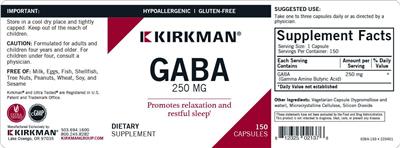
Kirkman's GABA contains one active ingredient: gamma-aminobutyric acid (GABA), a naturally occurring compound in the brain that plays a role in nerve signaling. Each capsule delivers 250 mg.
The capsule itself is made from hypromellose (a plant-based film former), along with microcrystalline cellulose, silicon dioxide, and water as inactive ingredients.
Does it work?
Not established
The evidence for GABA's effectiveness is still being established. Our data shows insufficient reliable evidence to rate it for anxiety, ADHD, athletic performance, cerebral palsy, and chronic bronchitis — the conditions it's most commonly used for.
This doesn't mean it doesn't work; it means the research to support those claims isn't yet solid enough to draw firm conclusions.
How safe is it?
Well-documented data
GABA appears to be generally well tolerated when taken by mouth short-term, though long-term safety hasn't been well studied. The most common side effects reported orally include drowsiness, nausea, gastric upset, minor throat burning, and muscle weakness.
However, a thorough safety evaluation hasn't been completed. Our data notes caution with long-term use and advises against it unless your doctor recommends otherwise.
There isn't enough safety information on file regarding pregnancy, and the data advises against use while breastfeeding.
Meds to double-check
Moderate interaction found
Check with your doctor or pharmacist before taking this product if you're on blood pressure medications (antihypertensives) — GABA may lower your blood pressure too much. Also double-check if you take CNS depressants like sleep aids, benzodiazepines, or opioids, since GABA might add to their sedative effects.
The bottom line
Scorecard at a glanceFully disclosed formula with no established evidence rating for its marketed use. Moderate medication interactions have been identified, and safety information is well characterized.
GABA might be worth considering if you're curious about it for anxiety or relaxation, but the research backing its use isn't strong yet. If you take blood pressure medications or sleep aids, talk with your doctor or pharmacist before starting — the combination could be risky.
Long-term safety data is limited, so discuss it with your own healthcare provider to decide if it's right for you.
Educational only — not medical advice; always confirm with your pharmacist. Our editorial policy · How we use AI
Assessment coverage: 1 of 1 active ingredient matched to our full ingredient reviews (monographs). Based on the product label dated Aug 22, 2024.
This Scorecard evaluates available label information, ingredient evidence, and known medication-safety considerations. It does not independently verify product identity, purity, potency, contamination, or manufacturing quality. How these ratings are computed
General information
Key facts about GABA 250 mg, straight from the product label.
| Brand | Kirkman |
|---|---|
| Barcode (UPC) | 812325021376 |
| Net contents | 150 Capsule(s) |
| Market status | On market |
| Date entered into DSLD | Aug 22, 2024 |
| DSLD ID | 317726 |
| Product type | Non-nutrient/non-botanical |
| Supplement form | Capsule |
| Dietary claims / uses | All Other, Structure/Function |
| Intended target group(s) | Children 4 or More Years of Age, Adult (18 - 50 Years), No Allergies, Gluten Free, Dairy Free |
Everything in this section is reproduced from the manufacturer’s own product label — it’s the label speaking, not HelloPharmacist. We show it so you can see exactly what the maker states; we don’t verify or endorse those statements.
Supplement Facts
The label details for GABA 250 mg by Kirkman, sourced from the NIH Dietary Supplement Label Database.
Supplement Facts
| Ingredient | Amount | % DV |
|---|---|---|
| Gamma Amino Butyric Acid | 250 mg | -- |
Other ingredients: Hypromellose, Water, Microcrystalline Cellulose, Silicon Dioxide
Tap any ingredient to jump to its full detail below.
These statements are the manufacturer’s wording, reproduced from the product label — the label is saying it, not HelloPharmacist. We don’t verify or endorse them.
Storage
Important: Store in a cool dry place and tightly capped.
Precautions
Keep out of the reach of children. Caution: Formulated for adults and children four years and older. For children under four, consult a physician.
Formulation
Free of: Milk, eggs, fish, shellfish, tree nuts, peanuts, wheat or soy and sesame
Hypoallergenic Promotes relaxation and restful sleep
Gluten-Free
Brand IP Statement(s)
Kirkman and Ultra Tested are Registered in U.S. Patent and Trademark Office.
Seals/Symbols
Ultra Tested cGMP
FDA Statement of Identity
Dietary Supplement
Suggested/Recommended/Usage/Directions
Suggested Use: Take one to three capsules daily or as directed by a physician.
FDA Disclaimer Statement
These statements have not been evaluated by the Food and Drug Administration. This product is not intended to diagnose, treat, cure, or prevent any disease.
Is this label outdated? Report a formula or label change and our pharmacy team will review it.
GABA 250 mg by Kirkman label
The label scan from the NIH Dietary Supplement Label Database. Tap to enlarge.
Label images are published by the NIH Dietary Supplement Label Database for the version of this product on file. Always read your actual product label.
View the full label (PDF)The Ingredients in GABA 250 mg by Kirkman
This is the 1 active ingredient this product is made of. Select it to open its full monograph.
Serving size1 Capsule(s) Dosage formCapsule Servings per container150 Amounts shown are per serving.
Gamma Amino Butyric Acid
Interacts with419 drugs
GABA is a calming chemical messenger (neurotransmitter) that your body makes on its own, and it is sold as a supplement for stress, anxiety, and sleep...
Gamma Amino Butyric Acid monograph & interactionsOther (inactive) ingredients: Hypromellose, Water, Microcrystalline Cellulose, Silicon Dioxide. These complete the product’s ingredient list but are not active constituents.
GABA 250 mg by Kirkman Drug Interactions
HelloPharmacist Interaction Report
Kirkman's GABA 250 mg may interact with medications through its single active ingredient, gamma-aminobutyric acid (GABA).
The most serious concern is with blood pressure drugs (antihypertensives) — GABA can lower blood pressure, and combining it with these medications might increase the risk of dangerously low blood pressure (hypotension). This is a Moderate severity risk.
Read the full breakdown — every affected drug type, severity by severity
GABA may also cause additive drowsiness or sedation if you take it with CNS depressants — medications like benzodiazepines, sleep aids, or opioids. The clinical relevance of this interaction isn't entirely clear, but it's a Minor concern worth watching.
Altogether, these interactions span 419 individual medications. Before starting GABA, check with your doctor or pharmacist to see if any of your current prescriptions fall into these categories.
Check your own medications below · Editorial policy · How we use AI
Want to check YOUR meds against GABA 250 mg?
Ask about interactions with your drugs in plain English — “Can I take it with lisinopril?” — and we find you the answer in seconds, ingredient by ingredient.
Go to the checkerIngredients driving the most interactions
Individual Drug Interactions
The ingredients in GABA 250 mg interact with 419 drugs. Click any drug to see the details.
1 of the 1 ingredient in GABA 250 mg interact with drugs. Each result below shows which ingredient is responsible. Gamma Amino Butyric Acid
Sacubitril, ValsartanEntresto
How Sacubitril, Valsartan interacts with GABA 250 mg — through 1 ingredient. Tap an ingredient for the detail:
Gamma Amino Butyric AcidAntihypertensive Drugs Moderate
Interaction Summary
Theoretically, taking GABA with antihypertensive drugs might increase the risk of hypotension.
Read the full Gamma Amino Butyric Acid + Sacubitril, Valsartan interactionSelexipagUptravi
How Selexipag interacts with GABA 250 mg — through 1 ingredient. Tap an ingredient for the detail:
Gamma Amino Butyric AcidAntihypertensive Drugs Moderate
Interaction Summary
Theoretically, taking GABA with antihypertensive drugs might increase the risk of hypotension.
Read the full Gamma Amino Butyric Acid + Selexipag interactionSitaxsentan SodiumThelin
How Sitaxsentan Sodium interacts with GABA 250 mg — through 1 ingredient. Tap an ingredient for the detail:
Gamma Amino Butyric AcidAntihypertensive Drugs Moderate
Interaction Summary
Theoretically, taking GABA with antihypertensive drugs might increase the risk of hypotension.
Read the full Gamma Amino Butyric Acid + Sitaxsentan Sodium interactionSodium NitroprussideNipride RTU
How Sodium Nitroprusside interacts with GABA 250 mg — through 1 ingredient. Tap an ingredient for the detail:
Gamma Amino Butyric AcidAntihypertensive Drugs Moderate
Interaction Summary
Theoretically, taking GABA with antihypertensive drugs might increase the risk of hypotension.
Read the full Gamma Amino Butyric Acid + Sodium Nitroprusside interactionSpironolactoneAldactone, Carospir, Spiroton
How Spironolactone interacts with GABA 250 mg — through 1 ingredient. Tap an ingredient for the detail:
Gamma Amino Butyric AcidAntihypertensive Drugs Moderate
Interaction Summary
Theoretically, taking GABA with antihypertensive drugs might increase the risk of hypotension.
Read the full Gamma Amino Butyric Acid + Spironolactone interactionTalinololTalinolol
How Talinolol interacts with GABA 250 mg — through 1 ingredient. Tap an ingredient for the detail:
Gamma Amino Butyric AcidAntihypertensive Drugs Moderate
Interaction Summary
Theoretically, taking GABA with antihypertensive drugs might increase the risk of hypotension.
Read the full Gamma Amino Butyric Acid + Talinolol interactionTelmisartanMicardis
How Telmisartan interacts with GABA 250 mg — through 1 ingredient. Tap an ingredient for the detail:
Gamma Amino Butyric AcidAntihypertensive Drugs Moderate
Interaction Summary
Theoretically, taking GABA with antihypertensive drugs might increase the risk of hypotension.
Read the full Gamma Amino Butyric Acid + Telmisartan interactionTelmisartan, AmlodipineTwynsta
How Telmisartan, Amlodipine interacts with GABA 250 mg — through 1 ingredient. Tap an ingredient for the detail:
Gamma Amino Butyric AcidAntihypertensive Drugs Moderate
Interaction Summary
Theoretically, taking GABA with antihypertensive drugs might increase the risk of hypotension.
Read the full Gamma Amino Butyric Acid + Telmisartan, Amlodipine interactionTerazosinHytrin, Terazosin
How Terazosin interacts with GABA 250 mg — through 1 ingredient. Tap an ingredient for the detail:
Gamma Amino Butyric AcidAntihypertensive Drugs Moderate
Interaction Summary
Theoretically, taking GABA with antihypertensive drugs might increase the risk of hypotension.
Read the full Gamma Amino Butyric Acid + Terazosin interactionTimololBlocadren, Timol, Timoptic
How Timolol interacts with GABA 250 mg — through 1 ingredient. Tap an ingredient for the detail:
Gamma Amino Butyric AcidAntihypertensive Drugs Moderate
Interaction Summary
Theoretically, taking GABA with antihypertensive drugs might increase the risk of hypotension.
Read the full Gamma Amino Butyric Acid + Timolol interactionTorsemideDemadex, Soaanz
How Torsemide interacts with GABA 250 mg — through 1 ingredient. Tap an ingredient for the detail:
Gamma Amino Butyric AcidAntihypertensive Drugs Moderate
Interaction Summary
Theoretically, taking GABA with antihypertensive drugs might increase the risk of hypotension.
Read the full Gamma Amino Butyric Acid + Torsemide interactionTrandolaprilMavik
How Trandolapril interacts with GABA 250 mg — through 1 ingredient. Tap an ingredient for the detail:
Gamma Amino Butyric AcidAntihypertensive Drugs Moderate
Interaction Summary
Theoretically, taking GABA with antihypertensive drugs might increase the risk of hypotension.
Read the full Gamma Amino Butyric Acid + Trandolapril interactionTrandolapril, VerapamilTarka
How Trandolapril, Verapamil interacts with GABA 250 mg — through 1 ingredient. Tap an ingredient for the detail:
Gamma Amino Butyric AcidAntihypertensive Drugs Moderate
Interaction Summary
Theoretically, taking GABA with antihypertensive drugs might increase the risk of hypotension.
Read the full Gamma Amino Butyric Acid + Trandolapril, Verapamil interactionTreprostinil
How Treprostinil interacts with GABA 250 mg — through 1 ingredient. Tap an ingredient for the detail:
Gamma Amino Butyric AcidAntihypertensive Drugs Moderate
Interaction Summary
Theoretically, taking GABA with antihypertensive drugs might increase the risk of hypotension.
Read the full Gamma Amino Butyric Acid + Treprostinil interactionTreprostinil (inh)Tyvaso
How Treprostinil (inh) interacts with GABA 250 mg — through 1 ingredient. Tap an ingredient for the detail:
Gamma Amino Butyric AcidAntihypertensive Drugs Moderate
Interaction Summary
Theoretically, taking GABA with antihypertensive drugs might increase the risk of hypotension.
Read the full Gamma Amino Butyric Acid + Treprostinil (inh) interactionTreprostinil (oral)Orenitram, Remodulin
How Treprostinil (oral) interacts with GABA 250 mg — through 1 ingredient. Tap an ingredient for the detail:
Gamma Amino Butyric AcidAntihypertensive Drugs Moderate
Interaction Summary
Theoretically, taking GABA with antihypertensive drugs might increase the risk of hypotension.
Read the full Gamma Amino Butyric Acid + Treprostinil (oral) interactionTriamtereneDyrenium
How Triamterene interacts with GABA 250 mg — through 1 ingredient. Tap an ingredient for the detail:
Gamma Amino Butyric AcidAntihypertensive Drugs Moderate
Interaction Summary
Theoretically, taking GABA with antihypertensive drugs might increase the risk of hypotension.
Read the full Gamma Amino Butyric Acid + Triamterene interactionTrichlormethiazideAq 4B Aquazide, Marazide II, Metahydrin, Naqua
How Trichlormethiazide interacts with GABA 250 mg — through 1 ingredient. Tap an ingredient for the detail:
Gamma Amino Butyric AcidAntihypertensive Drugs Moderate
Interaction Summary
Theoretically, taking GABA with antihypertensive drugs might increase the risk of hypotension.
Read the full Gamma Amino Butyric Acid + Trichlormethiazide interactionTrimethaphanArfonad
How Trimethaphan interacts with GABA 250 mg — through 1 ingredient. Tap an ingredient for the detail:
Gamma Amino Butyric AcidAntihypertensive Drugs Moderate
Interaction Summary
Theoretically, taking GABA with antihypertensive drugs might increase the risk of hypotension.
Read the full Gamma Amino Butyric Acid + Trimethaphan interactionUreaUreaphil
How Urea interacts with GABA 250 mg — through 1 ingredient. Tap an ingredient for the detail:
Gamma Amino Butyric AcidAntihypertensive Drugs Moderate
Interaction Summary
Theoretically, taking GABA with antihypertensive drugs might increase the risk of hypotension.
Read the full Gamma Amino Butyric Acid + Urea interactionValsartanDiovan, Prexxartan
How Valsartan interacts with GABA 250 mg — through 1 ingredient. Tap an ingredient for the detail:
Gamma Amino Butyric AcidAntihypertensive Drugs Moderate
Interaction Summary
Theoretically, taking GABA with antihypertensive drugs might increase the risk of hypotension.
Read the full Gamma Amino Butyric Acid + Valsartan interactionVerapamilCalan, Calan SR, Covera HS, Isoptin, Isoptin SR, Veramil +3 more
How Verapamil interacts with GABA 250 mg — through 1 ingredient. Tap an ingredient for the detail:
Gamma Amino Butyric AcidAntihypertensive Drugs Moderate
Interaction Summary
Theoretically, taking GABA with antihypertensive drugs might increase the risk of hypotension.
Read the full Gamma Amino Butyric Acid + Verapamil interactionEach ingredient & the kinds of drugs it affects
For each ingredient in GABA 250 mg with known interactions, here are the types of medications it can affect. Open any type for the detail — or search your exact drug in the checker above.
Gamma Amino Butyric Acid
Antihypertensive Drugs
Theoretically, taking GABA with antihypertensive drugs might increase the risk of hypotension.
Some clinical research shows that GABA can decrease blood pressure in patients with hypertension.
Cns Depressants
Theoretically, GABA might have additive sedative effects when used in conjunction with CNS depressants. However, it is unclear if this concern is clinically relevant.
Endogenous GABA has well-established relaxant effects and GABA(A) receptors have an established physiological role in sleep. However, the effects of GABA supplements are unclear, as it is unknown whether exogenous GABA crosses the blood-brain barrier. Although there have been limited reports of drowsiness or tiredness with GABA supplements, these effects have not been widely reported in clinical studies. Additionally, intravenous GABA 0.1-1 mg/kg has been shown to induce anxiety in a dose-dependent manner.
Brand information
Manufacturer and brand details for GABA 250 mg, from the product label.
Kirkman
See all Kirkman products- Name
- Kirkman
- City
- Lake Oswego
- State
- OR
- ZipCode
- 97035
- Phone Number
- 1.800.245.8282
- Web Address
- kirkmangroup.com
GABA 250 mg by Kirkman: Common Questions
Does GABA 250 mg by Kirkman interact with any medications?
How can one product interact with so many drugs?
Where does this information come from?
What's GABA supposed to do?
What side effects might I notice?
Is it safe to take long-term?
Can I take it while pregnant or breastfeeding?
How much of GABA actually gets into your body?
Written and reviewed by the HelloPharmacist editorial staff. Our editorial policy
Not sure if GABA 250 mg is safe with your meds?
Our pharmacists answer your medication & supplement questions — free.
Label information is sourced from the NIH Dietary Supplement Label Database and reflects the product version on file; always read your actual product label. This page is for education only and is not a substitute for professional medical advice. Confirm with your pharmacist or doctor before combining supplements and medications.
The Full Monographs Behind GABA 250 mg’s Ingredients
Every ingredient we hold a full HelloPharmacist monograph for — uses, evidence, safety, and the complete interaction list.
Sources & How We Checked
GABA 250 mg's label data comes from the NIH Dietary Supplement Label Database; the ingredient interaction data is from the Natural Medicines database, reviewed by our pharmacists.
- NIH Dietary Supplement Label Database (DSLD) — The official product label on file for this supplement.
- Natural Medicines (Therapeutic Research Center) — Evidence-graded clinical reference behind the ingredient interaction data.
Content is written and reviewed by licensed HelloPharmacist pharmacists. See our data sources and editorial standards for how this information is built and checked.
The 12 references behind this product’s interaction data
Every citation that drives the interaction findings for this product’s ingredients, from the evidence-graded Natural Medicines (TRC Healthcare) database. Open an ingredient to browse its citations — links open the study on PubMed or the publisher’s site.
Gamma-aminobutyric Acid (gaba) 12 references
- Cavagnini F, Invitti C, Pinto M, et al. Effect of acute and repeated administration of gamma aminobutyric acid (GABA) on growth hormone and prolactin secretion in man. Acta Endocrinol (Copenh) 1980;93:149-54.
- Nurnberger JI Jr, Berrettini WH, Simmons-Alling S, et al. Intravenous GABA administration is anxiogenic in man. Psychiatry Res 1986;19:113-7. PubMed
- Gershman RN, Vasilenko MA, Iliushina GG, et al. [Gammalon in the rehabilitation in infantile cerebral palsy]. Pediatr.Akus.Ginekol. 1977;(6):26-7.
- Loeb C, Benassi E, Bo, GP, et al. Preliminary evaluation of the effect of GABA and phosphatidylserine in epileptic patients. Epilepsy Res. 1987;1:209-12 . PubMed
- Inoue K, Shirai T, Ochiai H, et al. Blood-pressure-lowering effect of a novel fermented milk containing gamma-aminobutyric acid (GABA) in mild hypertensives. Eur J Clin Nutr 2003;57:490-95.
- ELLIOTT, K. A. and JASPER, H. H. Gammaaminobutyric acid. Physiol Rev. 1959;39(2):383-406.
- Winsky-Sommerer, R. Role of GABAA receptors in the physiology and pharmacology of sleep. Eur.J.Neurosci. 2009;29(9):1779-1794.
- Meldrum, B. S. GABAergic mechanisms in the pathogenesis and treatment of epilepsy. Br.J.Clin.Pharmacol. 1989;27 Suppl 1:3S-11S. PubMed
- Loeb, C., Marinari, U. M., Benassi, E., Besio, G., Cottalasso, D., Cupello, A., Maffini, M., Mainardi, P., Pronzato, M. A., and Scotto, P. A. Phosphatidylserine increases in vivo the synaptosomal uptake of exogenous GABA in rats. Exp.Neurol. 1988;99(2):4 PubMed
- Melis, G. B., Paoletti, A. M., Mais, V., and Fioretti, P. Interference of dopamine infusion on gamma-amino butyric acid (GABA)-stimulated prolactin increase. J.Endocrinol.Invest 1980;3(4):445-448.
- Boonstra E, de Kleijn R, Colzato LS, Alkemade A, Forstmann BU, Nieuwenhuis S. Neurotransmitters as food supplements: the effects of GABA on brain and behavior. Front Psychol. 2015 Oct 6;6:1520. doi: 10.3389/fpsyg.2015.01520. eCollection 2015. PubMed
- de Bie TH, Witkamp RF, Balvers MG, Jongsma MA. Effects of ?-aminobutyric acid supplementation on glucose control in adults with prediabetes: A double-blind, randomized, placebo-controlled trial. Am J Clin Nutr 2023;118(3):708-719. PubMed
See these in context on the Gamma-aminobutyric Acid (gaba) monograph →
Parts of this content are provided by the Therapeutic Research Center, LLC.
DISCLAIMER: Currently this does not check for drug-drug interactions. This is not an all-inclusive comprehensive list of potential interactions and is for informational purposes only. Not all interactions are known or well-reported in the scientific literature, and new interactions are continually being reported. Input is needed from a qualified healthcare provider including a pharmacist before starting any therapy. Application of clinical judgment is necessary.
© 2021 Therapeutic Research Center, LLC