
Gastrozyme Ingredients & Drug Interactions
by DNA Dynamic Nutritional Associates
What is this page for?
First and foremost: checking Gastrozyme against your medications. The heart of this page is the interaction checker and the full interaction report — how this product’s ingredients may interact with prescription and over-the-counter medicines you may be taking.
Around that, we add a pharmacist’s high-level view of the product as a whole — what’s inside, the evidence for its stated use, how transparent the label is, and what safety data exists — so you can see the full picture in one place. It’s educational information from our licensed clinical databases and the clinical staff at HelloPharmacist — not medical advice — and we don’t sell or endorse products. Our editorial policy
Gastrozyme is a dietary supplement by DNA Dynamic Nutritional Associates with 21 active ingredients. Its ingredients are commonly taken for digestion and bloating, muscle soreness and exercise recovery, inflammation and swelling.Based on those ingredients, 1,328 medications have a known interaction with it, the most serious rated moderate. The ingredients most likely to interact are Licorice, Fennel, Dandelion. Use the checker below to test your specific medication, or read the full HelloPharmacist Interaction Report.
Check Your Meds Against Gastrozyme by DNA Dynamic Nutritional Associates
Ask about any prescription or over-the-counter medication and we check it for interactions with Gastrozyme by DNA Dynamic Nutritional Associates — and tell you which ingredient is responsible.
AI summaries are generated from our interaction database for education only — always confirm with your pharmacist. How we use AI
Ask the Pharmacist
A licensed pharmacist will answer your question by email — free, usually within 24 hours.
Got it — thank you!
A licensed pharmacist will answer within 24 hours. Keep an eye on your email (worth checking spam, just in case).
HelloPharmacist Scorecard of Gastrozyme by DNA Dynamic Nutritional Associates
Our pharmacy team’s full take, with four database checks built into the cards below — a summary of what is known, not a grade of the product itself.
What’s inside
Low disclosure
Gastrozyme contains 21 ingredients, 13 of which are active. The digestive enzymes include amylase, protease, pepsin, lipase, and pancreatin—substances that break down carbohydrates, proteins, and fats to aid digestion.
Choline bitartrate supports overall cell function. Herbal and plant-based actives—dandelion, parsley, licorice, rosemary, thyme, and fennel—are included for digestive support, along with betaine hydrochloride (which increases stomach acid), inositol, and L-methionine.
The product also contains organ substances (liver, duodenum, pancreas) and ox bile for biliary support. The remaining ingredients are inactive: gelatin capsule, microcrystalline cellulose, magnesium stearate, silicon dioxide, and water—all common capsule fillers and binders.
Does it work?
Not established
Evidence for this product's effectiveness is limited. Inositol is possibly effective for metabolic syndrome and polycystic ovary syndrome (PCOS), and possibly effective for preventing preterm labor.
Licorice is possibly effective for canker sores and atopic dermatitis (eczema). Rosemary is possibly effective for memory.
For the other active ingredients—including the digestive enzymes, dandelion, parsley, choline, fennel, thyme, betaine hydrochloride, and L-methionine—the evidence we hold is rated insufficient to establish effectiveness for the conditions they are traditionally used for, meaning reliable clinical proof is not yet available.
How safe is it?
Well-documented data
Most ingredients are generally well tolerated at common doses. L-methionine in food amounts is safe, though high-dose supplements require medical guidance and aren't proven safe in pregnancy or breastfeeding.
Protease and pepsin are generally well tolerated but may cause digestive upset or allergic reactions; safety is not established in pregnancy and is not recommended in breastfeeding. Lipase is generally well tolerated but should be used only under medical guidance for serious digestive conditions; there is little pregnancy and breastfeeding data.
Choline at normal doses is generally well tolerated; high doses (above 3.5 grams daily) can cause fishy body odor, nausea, and vomiting. Dandelion, parsley, rosemary, thyme, and fennel are all safe in food amounts but concentrated extracts carry risks of allergic reaction, digestive upset, or (in parsley and fennel) serious adverse effects at very high doses.
Licorice in small amounts is fine, but the compound glycyrrhizin at high doses or long-term use can cause serious problems including potassium loss and high blood pressure; licorice is best avoided in pregnancy and breastfeeding. Betaine hydrochloride may irritate the stomach and is unsafe for people with ulcers or gastritis; it is best avoided in pregnancy and not recommended in breastfeeding.
Inositol is generally well tolerated with mild digestive side effects; pregnancy and breastfeeding safety is not fully established.
Meds to double-check
Moderate interaction found
Before taking Gastrozyme, double-check these medication types with the search tool: blood thinners and antiplatelet drugs (anticoagulants/antiplatelets); diabetes medications; potassium-sparing diuretics and other diuretics; lithium; heart medications like digoxin; cancer drugs such as cisplatin and paclitaxel; stomach acid-reducing drugs (H2-blockers, antacids, PPIs); estrogen and contraceptive drugs; certain antibiotics including quinolones and ciprofloxacin; anticholinergic and cholinergic drugs; and warfarin or other blood thinners specifically. Altogether, these interactions span 1,309 individual medications.
The bottom line
Scorecard at a glanceFormula with limited ingredient disclosure with no established evidence rating for its marketed use. Moderate medication interactions have been identified, and safety information is well characterized.
Gastrozyme is a multi-ingredient digestive enzyme and herbal blend. If you take any blood thinners, diabetes medications, heart medications, acid-reflux drugs, contraceptives, or estrogen therapy, check your specific medications with the tool below before starting this product—several ingredients carry documented interactions.
Talk to your pharmacist about whether it's right for you, especially if you have stomach ulcers, gastritis, or take prescription medications.
Educational only — not medical advice; always confirm with your pharmacist. Our editorial policy · How we use AI
Assessment coverage: 14 of 21 active ingredients matched to our full ingredient reviews (monographs). Based on the product label dated Aug 22, 2025.
This Scorecard evaluates available label information, ingredient evidence, and known medication-safety considerations. It does not independently verify product identity, purity, potency, contamination, or manufacturing quality. How these ratings are computed
General information
Key facts about Gastrozyme, straight from the product label.
| Brand | DNA Dynamic Nutritional Associates |
|---|---|
| Net contents | 90 Capsule(s) |
| Market status | On market |
| Date entered into DSLD | Aug 22, 2025 |
| DSLD ID | 337282 |
| Product type | Other Combinations |
| Supplement form | Capsule |
| Dietary claims / uses | All Other |
| Intended target group(s) | Adult (18 - 50 Years), Sugar Free |
Everything in this section is reproduced from the manufacturer’s own product label — it’s the label speaking, not HelloPharmacist. We show it so you can see exactly what the maker states; we don’t verify or endorse those statements.
Supplement Facts
The label details for Gastrozyme by DNA Dynamic Nutritional Associates, sourced from the NIH Dietary Supplement Label Database.
Supplement Facts
| Ingredient | Amount | % DV |
|---|---|---|
| L-Methionine | 0 NP | -- |
| Amylase | 0 NP | -- |
| Protease | 0 NP | -- |
| Lipase | 0 NP | -- |
| Choline Bitartrate | 0 NP | -- |
| Cellulase | 0 NP | -- |
| Dandelion | 0 NP | -- |
| Inositol | 0 NP | -- |
| L-Glutamic Acid Hydrochloride | 0 NP | -- |
| Betaine Hydrochloride | 0 NP | -- |
| Parsley | 0 NP | -- |
| Pepsin | 0 NP | -- |
| Licorice | 0 NP | -- |
| Pancreatin | 0 NP | -- |
| Rosemary | 0 NP | -- |
| Proprietary Enzyme Blend | 146 mg | -- |
| Ox Bile | 0 NP | -- |
| Thyme | 0 NP | -- |
| Fennel | 0 NP | -- |
| Proprietary Herbal Digestion Blend | 395 mg | -- |
| Proprietary Organ Support Blend | 220 mg | -- |
| Liver Substance | 0 NP | -- |
| Duodenum | 0 NP | -- |
| Pancreas Substance | 0 NP | -- |
Other ingredients: Gelatin, Water, Microcrystalline Cellulose, Magnesium Stearate, Silicon Dioxide
Tap any ingredient to jump to its full detail below.
These statements are the manufacturer’s wording, reproduced from the product label — the label is saying it, not HelloPharmacist. We don’t verify or endorse them.
Suggested/Recommended/Usage/Directions
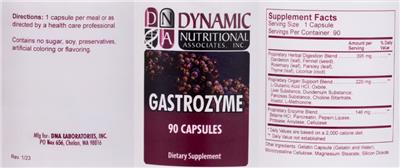
Directions: 1 capsule per meal or as directed by a health care professional.
Formulation
Contains no sugar, soy, preservatives, artificial coloring or flavoring.
FDA Statement of Identity
Dietary Supplement
Is this label outdated? Report a formula or label change and our pharmacy team will review it.
Gastrozyme by DNA Dynamic Nutritional Associates label
The label scan from the NIH Dietary Supplement Label Database. Tap to enlarge.
Label images are published by the NIH Dietary Supplement Label Database for the version of this product on file. Always read your actual product label.
View the full label (PDF)The Ingredients in Gastrozyme by DNA Dynamic Nutritional Associates
These are the 21 active ingredients this product is made of. Select any to open its full monograph.
Serving size1 Capsule(s) Dosage formCapsule Servings per container90 Amounts shown are per serving.
Most supplement products combine several ingredients, and a medication can interact with the product through any one of them. Each ingredient below shows whether it has known drug interactions.
Proprietary Enzyme Blend
- › Amylase
- › Protease
- › Lipase
- › Cellulase
- › Betaine Hydrochloride
- › Pepsin
- › Pancreatin
Proprietary Organ Support Blend
- › L-Methionine
- › Choline Bitartrate
- › Inositol
- › L-Glutamic Acid Hydrochloride
- › Ox Bile
- › Liver Substance
- › Duodenum
- › Pancreas Substance
Other (inactive) ingredients: Gelatin, Water, Microcrystalline Cellulose, Magnesium Stearate, Silicon Dioxide. These complete the product’s ingredient list but are not active constituents.
Gastrozyme by DNA Dynamic Nutritional Associates Drug Interactions
HelloPharmacist Interaction Report
Gastrozyme by DNA Dynamic Nutritional Associates contains several ingredients with documented interactions with medications.
The most serious is licorice, which carries multiple Moderate-severity interactions affecting heart medications, blood thinners, cancer drugs, and others through various mechanisms including enzyme inhibition and metabolism changes.
Read the full breakdown — every affected drug type, severity by severity
Dandelion, parsley, rosemary, thyme, and fennel all carry Moderate-severity interactions with blood thinners (anticoagulants/antiplatelets) and diabetes medications, plus additional effects: dandelion also interacts with potassium-sparing diuretics, lithium, and certain antibiotics; parsley affects diuretics and a barbiturate; rosemary affects aspirin-type drugs; thyme affects estrogen therapy and anticholinergic drugs; and fennel affects contraceptives, estrogen therapy, and the antibiotic ciprofloxacin. Betaine hydrochloride and choline carry Minor interactions with acid-reflux medications and atropine, respectively.
L-methionine, protease, pepsin, and lipase were checked and no interactions are documented in our data, though this is not a guarantee none exist. Several other ingredients—amylase, cellulase, L-glutamic acid hydrochloride, pancreatin, ox bile, liver substance, duodenum, and pancreas substance—could not be checked because we hold no data for them.
Additionally, use the medication search tool on this page to check your exact drugs against this product's ingredients.
Check your own medications below · Editorial policy · How we use AI
Want to check YOUR meds against Gastrozyme?
Ask about interactions with your drugs in plain English — “Can I take it with lisinopril?” — and we find you the answer in seconds, ingredient by ingredient.
Go to the checkerIngredients driving the most interactions
Individual Drug Interactions
The ingredients in Gastrozyme interact with 1,328 drugs. Click any drug to see the details.
10 of the 21 ingredients in Gastrozyme interact with drugs. Each result below shows which ingredient is responsible. Licorice Fennel Dandelion Parsley Thyme Rosemary Inositol Betaine Hydrochloride Choline Bitartrate Liver Substance
Acetaminophen, Chlorpheniramine, Dextromethorphan, PhenylpropanolamineMulti Symptom Cold Relief
How Acetaminophen, Chlorpheniramine, Dextromethorphan, Phenylpropanolamine interacts with Gastrozyme — through 6 ingredients. Tap an ingredient for the detail:
FennelCytochrome P450 3a4 (cyp3a4) Substrates Moderate
Interaction Summary
Theoretically, fennel might increase levels of drugs metabolized by CYP3A4.
Read the full Fennel + Acetaminophen, Chlorpheniramine, Dextromethorphan, Phenylpropanolamine interactionDandelionCytochrome P450 1a2 (cyp1a2) Substrates, Glucuronidated Drugs Moderate
Interaction Summary
Theoretically, dandelion might increase levels of drugs metabolized by CYP1A2.
Read the full Dandelion + Acetaminophen, Chlorpheniramine, Dextromethorphan, Phenylpropanolamine interactionParsleyCytochrome P450 1a2 (cyp1a2) Substrates Moderate
Interaction Summary
Theoretically, parsley might increase serum levels of CYP1A2 substrates.
Read the full Parsley + Acetaminophen, Chlorpheniramine, Dextromethorphan, Phenylpropanolamine interactionThymeAnticholinergic Drugs Moderate
Interaction Summary
Theoretically, concurrent use of anticholinergic drugs and thyme essential oil might reduce the effects of anticholinergic drugs.
Read the full Thyme + Acetaminophen, Chlorpheniramine, Dextromethorphan, Phenylpropanolamine interactionLicoriceCytochrome P450 1a2 (cyp1a2) Substrates, Cytochrome P450 3a4 (cyp3a4) Substrates Moderate
Interaction Summary
Theoretically, licorice might decrease the levels and clinical effects of CYP1A2 substrates.
Read the full Licorice + Acetaminophen, Chlorpheniramine, Dextromethorphan, Phenylpropanolamine interactionRosemaryCytochrome P450 1a2 (cyp1a2) Substrates Minor
Interaction Summary
Theoretically, rosemary might decrease the levels and clinical effects of CYP1A2 substrates.
Read the full Rosemary + Acetaminophen, Chlorpheniramine, Dextromethorphan, Phenylpropanolamine interactionAcetaminophen, Chlorpheniramine, Dextromethorphan, PseudoephedrineChildren's Tylenol Cold Plus Cough, Tylenol Cold Ex Strength
How Acetaminophen, Chlorpheniramine, Dextromethorphan, Pseudoephedrine interacts with Gastrozyme — through 6 ingredients. Tap an ingredient for the detail:
LicoriceCytochrome P450 3a4 (cyp3a4) Substrates, Cytochrome P450 1a2 (cyp1a2) Substrates Moderate
Interaction Summary
Theoretically, licorice might increase or decrease levels of drugs metabolized by CYP3A4.
Read the full Licorice + Acetaminophen, Chlorpheniramine, Dextromethorphan, Pseudoephedrine interactionDandelionCytochrome P450 1a2 (cyp1a2) Substrates, Glucuronidated Drugs Moderate
Interaction Summary
Theoretically, dandelion might increase levels of drugs metabolized by CYP1A2.
Read the full Dandelion + Acetaminophen, Chlorpheniramine, Dextromethorphan, Pseudoephedrine interactionFennelCytochrome P450 3a4 (cyp3a4) Substrates Moderate
Interaction Summary
Theoretically, fennel might increase levels of drugs metabolized by CYP3A4.
Read the full Fennel + Acetaminophen, Chlorpheniramine, Dextromethorphan, Pseudoephedrine interactionThymeAnticholinergic Drugs Moderate
Interaction Summary
Theoretically, concurrent use of anticholinergic drugs and thyme essential oil might reduce the effects of anticholinergic drugs.
Read the full Thyme + Acetaminophen, Chlorpheniramine, Dextromethorphan, Pseudoephedrine interactionParsleyCytochrome P450 1a2 (cyp1a2) Substrates Moderate
Interaction Summary
Theoretically, parsley might increase serum levels of CYP1A2 substrates.
Read the full Parsley + Acetaminophen, Chlorpheniramine, Dextromethorphan, Pseudoephedrine interactionRosemaryCytochrome P450 1a2 (cyp1a2) Substrates Minor
Interaction Summary
Theoretically, rosemary might decrease the levels and clinical effects of CYP1A2 substrates.
Read the full Rosemary + Acetaminophen, Chlorpheniramine, Dextromethorphan, Pseudoephedrine interactionAcetaminophen, Chlorpheniramine, Guaifenesin, Phenylephrine, SalicylamideRhinogesic GG
How Acetaminophen, Chlorpheniramine, Guaifenesin, Phenylephrine, Salicylamide interacts with Gastrozyme — through 6 ingredients. Tap an ingredient for the detail:
DandelionGlucuronidated Drugs, Cytochrome P450 1a2 (cyp1a2) Substrates Moderate
Interaction Summary
Theoretically, dandelion might increase the clearance of drugs that are UDP-glucuronosyltransferase substrates.
Read the full Dandelion + Acetaminophen, Chlorpheniramine, Guaifenesin, Phenylephrine, Salicylamide interactionParsleyCytochrome P450 1a2 (cyp1a2) Substrates Moderate
Interaction Summary
Theoretically, parsley might increase serum levels of CYP1A2 substrates.
Read the full Parsley + Acetaminophen, Chlorpheniramine, Guaifenesin, Phenylephrine, Salicylamide interactionThymeAnticholinergic Drugs Moderate
Interaction Summary
Theoretically, concurrent use of anticholinergic drugs and thyme essential oil might reduce the effects of anticholinergic drugs.
Read the full Thyme + Acetaminophen, Chlorpheniramine, Guaifenesin, Phenylephrine, Salicylamide interactionLicoriceCytochrome P450 1a2 (cyp1a2) Substrates, Cytochrome P450 3a4 (cyp3a4) Substrates Moderate
Interaction Summary
Theoretically, licorice might decrease the levels and clinical effects of CYP1A2 substrates.
Read the full Licorice + Acetaminophen, Chlorpheniramine, Guaifenesin, Phenylephrine, Salicylamide interactionFennelCytochrome P450 3a4 (cyp3a4) Substrates Moderate
Interaction Summary
Theoretically, fennel might increase levels of drugs metabolized by CYP3A4.
Read the full Fennel + Acetaminophen, Chlorpheniramine, Guaifenesin, Phenylephrine, Salicylamide interactionRosemaryCytochrome P450 1a2 (cyp1a2) Substrates Minor
Interaction Summary
Theoretically, rosemary might decrease the levels and clinical effects of CYP1A2 substrates.
Read the full Rosemary + Acetaminophen, Chlorpheniramine, Guaifenesin, Phenylephrine, Salicylamide interactionAcetaminophen, Chlorpheniramine, PhenylephrineAlka-Seltzer PLUS, Histex SR, Protid
How Acetaminophen, Chlorpheniramine, Phenylephrine interacts with Gastrozyme — through 6 ingredients. Tap an ingredient for the detail:
DandelionCytochrome P450 1a2 (cyp1a2) Substrates, Glucuronidated Drugs Moderate
Interaction Summary
Theoretically, dandelion might increase levels of drugs metabolized by CYP1A2.
Read the full Dandelion + Acetaminophen, Chlorpheniramine, Phenylephrine interactionFennelCytochrome P450 3a4 (cyp3a4) Substrates Moderate
Interaction Summary
Theoretically, fennel might increase levels of drugs metabolized by CYP3A4.
Read the full Fennel + Acetaminophen, Chlorpheniramine, Phenylephrine interactionThymeAnticholinergic Drugs Moderate
Interaction Summary
Theoretically, concurrent use of anticholinergic drugs and thyme essential oil might reduce the effects of anticholinergic drugs.
Read the full Thyme + Acetaminophen, Chlorpheniramine, Phenylephrine interactionParsleyCytochrome P450 1a2 (cyp1a2) Substrates Moderate
Interaction Summary
Theoretically, parsley might increase serum levels of CYP1A2 substrates.
Read the full Parsley + Acetaminophen, Chlorpheniramine, Phenylephrine interactionLicoriceCytochrome P450 3a4 (cyp3a4) Substrates, Cytochrome P450 1a2 (cyp1a2) Substrates Moderate
Interaction Summary
Theoretically, licorice might increase or decrease levels of drugs metabolized by CYP3A4.
Read the full Licorice + Acetaminophen, Chlorpheniramine, Phenylephrine interactionRosemaryCytochrome P450 1a2 (cyp1a2) Substrates Minor
Interaction Summary
Theoretically, rosemary might decrease the levels and clinical effects of CYP1A2 substrates.
Read the full Rosemary + Acetaminophen, Chlorpheniramine, Phenylephrine interactionAcetaminophen, Chlorpheniramine, Phenylephrine, SalicylamideRhinogesic, Rhinogesic JR
How Acetaminophen, Chlorpheniramine, Phenylephrine, Salicylamide interacts with Gastrozyme — through 6 ingredients. Tap an ingredient for the detail:
LicoriceCytochrome P450 1a2 (cyp1a2) Substrates, Cytochrome P450 3a4 (cyp3a4) Substrates Moderate
Interaction Summary
Theoretically, licorice might decrease the levels and clinical effects of CYP1A2 substrates.
Read the full Licorice + Acetaminophen, Chlorpheniramine, Phenylephrine, Salicylamide interactionDandelionCytochrome P450 1a2 (cyp1a2) Substrates, Glucuronidated Drugs Moderate
Interaction Summary
Theoretically, dandelion might increase levels of drugs metabolized by CYP1A2.
Read the full Dandelion + Acetaminophen, Chlorpheniramine, Phenylephrine, Salicylamide interactionFennelCytochrome P450 3a4 (cyp3a4) Substrates Moderate
Interaction Summary
Theoretically, fennel might increase levels of drugs metabolized by CYP3A4.
Read the full Fennel + Acetaminophen, Chlorpheniramine, Phenylephrine, Salicylamide interactionParsleyCytochrome P450 1a2 (cyp1a2) Substrates Moderate
Interaction Summary
Theoretically, parsley might increase serum levels of CYP1A2 substrates.
Read the full Parsley + Acetaminophen, Chlorpheniramine, Phenylephrine, Salicylamide interactionThymeAnticholinergic Drugs Moderate
Interaction Summary
Theoretically, concurrent use of anticholinergic drugs and thyme essential oil might reduce the effects of anticholinergic drugs.
Read the full Thyme + Acetaminophen, Chlorpheniramine, Phenylephrine, Salicylamide interactionRosemaryCytochrome P450 1a2 (cyp1a2) Substrates Minor
Interaction Summary
Theoretically, rosemary might decrease the levels and clinical effects of CYP1A2 substrates.
Read the full Rosemary + Acetaminophen, Chlorpheniramine, Phenylephrine, Salicylamide interactionAcetaminophen, Chlorpheniramine, PhenylpropanolamineAlumadrine, Conex, Sinadrin Max Strength, Sinulin
How Acetaminophen, Chlorpheniramine, Phenylpropanolamine interacts with Gastrozyme — through 6 ingredients. Tap an ingredient for the detail:
ThymeAnticholinergic Drugs Moderate
Interaction Summary
Theoretically, concurrent use of anticholinergic drugs and thyme essential oil might reduce the effects of anticholinergic drugs.
Read the full Thyme + Acetaminophen, Chlorpheniramine, Phenylpropanolamine interactionDandelionGlucuronidated Drugs, Cytochrome P450 1a2 (cyp1a2) Substrates Moderate
Interaction Summary
Theoretically, dandelion might increase the clearance of drugs that are UDP-glucuronosyltransferase substrates.
Read the full Dandelion + Acetaminophen, Chlorpheniramine, Phenylpropanolamine interactionParsleyCytochrome P450 1a2 (cyp1a2) Substrates Moderate
Interaction Summary
Theoretically, parsley might increase serum levels of CYP1A2 substrates.
Read the full Parsley + Acetaminophen, Chlorpheniramine, Phenylpropanolamine interactionLicoriceCytochrome P450 1a2 (cyp1a2) Substrates, Cytochrome P450 3a4 (cyp3a4) Substrates Moderate
Interaction Summary
Theoretically, licorice might decrease the levels and clinical effects of CYP1A2 substrates.
Read the full Licorice + Acetaminophen, Chlorpheniramine, Phenylpropanolamine interactionFennelCytochrome P450 3a4 (cyp3a4) Substrates Moderate
Interaction Summary
Theoretically, fennel might increase levels of drugs metabolized by CYP3A4.
Read the full Fennel + Acetaminophen, Chlorpheniramine, Phenylpropanolamine interactionRosemaryCytochrome P450 1a2 (cyp1a2) Substrates Minor
Interaction Summary
Theoretically, rosemary might decrease the levels and clinical effects of CYP1A2 substrates.
Read the full Rosemary + Acetaminophen, Chlorpheniramine, Phenylpropanolamine interactionAcetaminophen, Chlorpheniramine, Phenylpropanolamine, OpiumHista-Derfule
How Acetaminophen, Chlorpheniramine, Phenylpropanolamine, Opium interacts with Gastrozyme — through 6 ingredients. Tap an ingredient for the detail:
DandelionCytochrome P450 1a2 (cyp1a2) Substrates, Glucuronidated Drugs Moderate
Interaction Summary
Theoretically, dandelion might increase levels of drugs metabolized by CYP1A2.
Read the full Dandelion + Acetaminophen, Chlorpheniramine, Phenylpropanolamine, Opium interactionFennelCytochrome P450 3a4 (cyp3a4) Substrates Moderate
Interaction Summary
Theoretically, fennel might increase levels of drugs metabolized by CYP3A4.
Read the full Fennel + Acetaminophen, Chlorpheniramine, Phenylpropanolamine, Opium interactionParsleyCytochrome P450 1a2 (cyp1a2) Substrates Moderate
Interaction Summary
Theoretically, parsley might increase serum levels of CYP1A2 substrates.
Read the full Parsley + Acetaminophen, Chlorpheniramine, Phenylpropanolamine, Opium interactionThymeAnticholinergic Drugs Moderate
Interaction Summary
Theoretically, concurrent use of anticholinergic drugs and thyme essential oil might reduce the effects of anticholinergic drugs.
Read the full Thyme + Acetaminophen, Chlorpheniramine, Phenylpropanolamine, Opium interactionLicoriceCytochrome P450 3a4 (cyp3a4) Substrates, Cytochrome P450 1a2 (cyp1a2) Substrates Moderate
Interaction Summary
Theoretically, licorice might increase or decrease levels of drugs metabolized by CYP3A4.
Read the full Licorice + Acetaminophen, Chlorpheniramine, Phenylpropanolamine, Opium interactionRosemaryCytochrome P450 1a2 (cyp1a2) Substrates Minor
Interaction Summary
Theoretically, rosemary might decrease the levels and clinical effects of CYP1A2 substrates.
Read the full Rosemary + Acetaminophen, Chlorpheniramine, Phenylpropanolamine, Opium interactionAcetaminophen, Chlorpheniramine, Phenylpropanolamine, PhenyltoloxamineNorel Plus
How Acetaminophen, Chlorpheniramine, Phenylpropanolamine, Phenyltoloxamine interacts with Gastrozyme — through 6 ingredients. Tap an ingredient for the detail:
LicoriceCytochrome P450 1a2 (cyp1a2) Substrates, Cytochrome P450 3a4 (cyp3a4) Substrates Moderate
Interaction Summary
Theoretically, licorice might decrease the levels and clinical effects of CYP1A2 substrates.
Read the full Licorice + Acetaminophen, Chlorpheniramine, Phenylpropanolamine, Phenyltoloxamine interactionFennelCytochrome P450 3a4 (cyp3a4) Substrates Moderate
Interaction Summary
Theoretically, fennel might increase levels of drugs metabolized by CYP3A4.
Read the full Fennel + Acetaminophen, Chlorpheniramine, Phenylpropanolamine, Phenyltoloxamine interactionDandelionCytochrome P450 1a2 (cyp1a2) Substrates, Glucuronidated Drugs Moderate
Interaction Summary
Theoretically, dandelion might increase levels of drugs metabolized by CYP1A2.
Read the full Dandelion + Acetaminophen, Chlorpheniramine, Phenylpropanolamine, Phenyltoloxamine interactionThymeAnticholinergic Drugs Moderate
Interaction Summary
Theoretically, concurrent use of anticholinergic drugs and thyme essential oil might reduce the effects of anticholinergic drugs.
Read the full Thyme + Acetaminophen, Chlorpheniramine, Phenylpropanolamine, Phenyltoloxamine interactionParsleyCytochrome P450 1a2 (cyp1a2) Substrates Moderate
Interaction Summary
Theoretically, parsley might increase serum levels of CYP1A2 substrates.
Read the full Parsley + Acetaminophen, Chlorpheniramine, Phenylpropanolamine, Phenyltoloxamine interactionRosemaryCytochrome P450 1a2 (cyp1a2) Substrates Minor
Interaction Summary
Theoretically, rosemary might decrease the levels and clinical effects of CYP1A2 substrates.
Read the full Rosemary + Acetaminophen, Chlorpheniramine, Phenylpropanolamine, Phenyltoloxamine interactionAcetaminophen, Chlorpheniramine, PseudoephedrineAlka-Seltzer PLUS Liquid Gels, Children's Tylenol Cold, Codimal, Comtrex, Extra Strength Tylenol Allergy Sinus, Lorsin +3 more
How Acetaminophen, Chlorpheniramine, Pseudoephedrine interacts with Gastrozyme — through 6 ingredients. Tap an ingredient for the detail:
DandelionGlucuronidated Drugs, Cytochrome P450 1a2 (cyp1a2) Substrates Moderate
Interaction Summary
Theoretically, dandelion might increase the clearance of drugs that are UDP-glucuronosyltransferase substrates.
Read the full Dandelion + Acetaminophen, Chlorpheniramine, Pseudoephedrine interactionParsleyCytochrome P450 1a2 (cyp1a2) Substrates Moderate
Interaction Summary
Theoretically, parsley might increase serum levels of CYP1A2 substrates.
Read the full Parsley + Acetaminophen, Chlorpheniramine, Pseudoephedrine interactionThymeAnticholinergic Drugs Moderate
Interaction Summary
Theoretically, concurrent use of anticholinergic drugs and thyme essential oil might reduce the effects of anticholinergic drugs.
Read the full Thyme + Acetaminophen, Chlorpheniramine, Pseudoephedrine interactionLicoriceCytochrome P450 3a4 (cyp3a4) Substrates, Cytochrome P450 1a2 (cyp1a2) Substrates Moderate
Interaction Summary
Theoretically, licorice might increase or decrease levels of drugs metabolized by CYP3A4.
Read the full Licorice + Acetaminophen, Chlorpheniramine, Pseudoephedrine interactionFennelCytochrome P450 3a4 (cyp3a4) Substrates Moderate
Interaction Summary
Theoretically, fennel might increase levels of drugs metabolized by CYP3A4.
Read the full Fennel + Acetaminophen, Chlorpheniramine, Pseudoephedrine interactionRosemaryCytochrome P450 1a2 (cyp1a2) Substrates Minor
Interaction Summary
Theoretically, rosemary might decrease the levels and clinical effects of CYP1A2 substrates.
Read the full Rosemary + Acetaminophen, Chlorpheniramine, Pseudoephedrine interactionAcetaminophen, ChlorzoxazoneAcetazone Forte, Extra Strength Tylenol Aches & Strains, Parafon Forte
How Acetaminophen, Chlorzoxazone interacts with Gastrozyme — through 4 ingredients. Tap an ingredient for the detail:
DandelionCytochrome P450 1a2 (cyp1a2) Substrates, Glucuronidated Drugs Moderate
Interaction Summary
Theoretically, dandelion might increase levels of drugs metabolized by CYP1A2.
Read the full Dandelion + Acetaminophen, Chlorzoxazone interactionParsleyCytochrome P450 1a2 (cyp1a2) Substrates Moderate
Interaction Summary
Theoretically, parsley might increase serum levels of CYP1A2 substrates.
Read the full Parsley + Acetaminophen, Chlorzoxazone interactionRosemaryCytochrome P450 1a2 (cyp1a2) Substrates Minor
Interaction Summary
Theoretically, rosemary might decrease the levels and clinical effects of CYP1A2 substrates.
Read the full Rosemary + Acetaminophen, Chlorzoxazone interactionLicoriceCytochrome P450 1a2 (cyp1a2) Substrates Minor
Interaction Summary
Theoretically, licorice might decrease the levels and clinical effects of CYP1A2 substrates.
Read the full Licorice + Acetaminophen, Chlorzoxazone interactionAcetaminophen, Chlorzoxazone, CodeineAcetazone Forte C8, Parafon Forte C8
How Acetaminophen, Chlorzoxazone, Codeine interacts with Gastrozyme — through 4 ingredients. Tap an ingredient for the detail:
DandelionCytochrome P450 1a2 (cyp1a2) Substrates, Glucuronidated Drugs Moderate
Interaction Summary
Theoretically, dandelion might increase levels of drugs metabolized by CYP1A2.
Read the full Dandelion + Acetaminophen, Chlorzoxazone, Codeine interactionParsleyCytochrome P450 1a2 (cyp1a2) Substrates Moderate
Interaction Summary
Theoretically, parsley might increase serum levels of CYP1A2 substrates.
Read the full Parsley + Acetaminophen, Chlorzoxazone, Codeine interactionLicoriceCytochrome P450 1a2 (cyp1a2) Substrates Minor
Interaction Summary
Theoretically, licorice might decrease the levels and clinical effects of CYP1A2 substrates.
Read the full Licorice + Acetaminophen, Chlorzoxazone, Codeine interactionRosemaryCytochrome P450 1a2 (cyp1a2) Substrates Minor
Interaction Summary
Theoretically, rosemary might decrease the levels and clinical effects of CYP1A2 substrates.
Read the full Rosemary + Acetaminophen, Chlorzoxazone, Codeine interactionAcetaminophen, CodeineTylenol No.3, Tylenol w/ Codeine
How Acetaminophen, Codeine interacts with Gastrozyme — through 4 ingredients. Tap an ingredient for the detail:
DandelionGlucuronidated Drugs, Cytochrome P450 1a2 (cyp1a2) Substrates Moderate
Interaction Summary
Theoretically, dandelion might increase the clearance of drugs that are UDP-glucuronosyltransferase substrates.
Read the full Dandelion + Acetaminophen, Codeine interactionParsleyCytochrome P450 1a2 (cyp1a2) Substrates Moderate
Interaction Summary
Theoretically, parsley might increase serum levels of CYP1A2 substrates.
Read the full Parsley + Acetaminophen, Codeine interactionLicoriceCytochrome P450 1a2 (cyp1a2) Substrates Minor
Interaction Summary
Theoretically, licorice might decrease the levels and clinical effects of CYP1A2 substrates.
Read the full Licorice + Acetaminophen, Codeine interactionRosemaryCytochrome P450 1a2 (cyp1a2) Substrates Minor
Interaction Summary
Theoretically, rosemary might decrease the levels and clinical effects of CYP1A2 substrates.
Read the full Rosemary + Acetaminophen, Codeine interactionAcetaminophen, Codeine, DoxylamineMersyndol
How Acetaminophen, Codeine, Doxylamine interacts with Gastrozyme — through 5 ingredients. Tap an ingredient for the detail:
DandelionCytochrome P450 1a2 (cyp1a2) Substrates, Glucuronidated Drugs Moderate
Interaction Summary
Theoretically, dandelion might increase levels of drugs metabolized by CYP1A2.
Read the full Dandelion + Acetaminophen, Codeine, Doxylamine interactionParsleyCytochrome P450 1a2 (cyp1a2) Substrates Moderate
Interaction Summary
Theoretically, parsley might increase serum levels of CYP1A2 substrates.
Read the full Parsley + Acetaminophen, Codeine, Doxylamine interactionThymeAnticholinergic Drugs Moderate
Interaction Summary
Theoretically, concurrent use of anticholinergic drugs and thyme essential oil might reduce the effects of anticholinergic drugs.
Read the full Thyme + Acetaminophen, Codeine, Doxylamine interactionRosemaryCytochrome P450 1a2 (cyp1a2) Substrates Minor
Interaction Summary
Theoretically, rosemary might decrease the levels and clinical effects of CYP1A2 substrates.
Read the full Rosemary + Acetaminophen, Codeine, Doxylamine interactionLicoriceCytochrome P450 1a2 (cyp1a2) Substrates Minor
Interaction Summary
Theoretically, licorice might decrease the levels and clinical effects of CYP1A2 substrates.
Read the full Licorice + Acetaminophen, Codeine, Doxylamine interactionAcetaminophen, Codeine, MethocarbamolAcetaminophen, Codeine, Methocarbamol, Robaxacet 8
How Acetaminophen, Codeine, Methocarbamol interacts with Gastrozyme — through 4 ingredients. Tap an ingredient for the detail:
DandelionCytochrome P450 1a2 (cyp1a2) Substrates, Glucuronidated Drugs Moderate
Interaction Summary
Theoretically, dandelion might increase levels of drugs metabolized by CYP1A2.
Read the full Dandelion + Acetaminophen, Codeine, Methocarbamol interactionParsleyCytochrome P450 1a2 (cyp1a2) Substrates Moderate
Interaction Summary
Theoretically, parsley might increase serum levels of CYP1A2 substrates.
Read the full Parsley + Acetaminophen, Codeine, Methocarbamol interactionLicoriceCytochrome P450 1a2 (cyp1a2) Substrates Minor
Interaction Summary
Theoretically, licorice might decrease the levels and clinical effects of CYP1A2 substrates.
Read the full Licorice + Acetaminophen, Codeine, Methocarbamol interactionRosemaryCytochrome P450 1a2 (cyp1a2) Substrates Minor
Interaction Summary
Theoretically, rosemary might decrease the levels and clinical effects of CYP1A2 substrates.
Read the full Rosemary + Acetaminophen, Codeine, Methocarbamol interactionAcetaminophen, Dexbrompheniramine, PseudoephedrineSinadrin Plus
How Acetaminophen, Dexbrompheniramine, Pseudoephedrine interacts with Gastrozyme — through 4 ingredients. Tap an ingredient for the detail:
DandelionGlucuronidated Drugs, Cytochrome P450 1a2 (cyp1a2) Substrates Moderate
Interaction Summary
Theoretically, dandelion might increase the clearance of drugs that are UDP-glucuronosyltransferase substrates.
Read the full Dandelion + Acetaminophen, Dexbrompheniramine, Pseudoephedrine interactionParsleyCytochrome P450 1a2 (cyp1a2) Substrates Moderate
Interaction Summary
Theoretically, parsley might increase serum levels of CYP1A2 substrates.
Read the full Parsley + Acetaminophen, Dexbrompheniramine, Pseudoephedrine interactionLicoriceCytochrome P450 1a2 (cyp1a2) Substrates Minor
Interaction Summary
Theoretically, licorice might decrease the levels and clinical effects of CYP1A2 substrates.
Read the full Licorice + Acetaminophen, Dexbrompheniramine, Pseudoephedrine interactionRosemaryCytochrome P450 1a2 (cyp1a2) Substrates Minor
Interaction Summary
Theoretically, rosemary might decrease the levels and clinical effects of CYP1A2 substrates.
Read the full Rosemary + Acetaminophen, Dexbrompheniramine, Pseudoephedrine interactionAcetaminophen, DextromethorphanTylenol Cough Ex Strength
How Acetaminophen, Dextromethorphan interacts with Gastrozyme — through 5 ingredients. Tap an ingredient for the detail:
DandelionCytochrome P450 1a2 (cyp1a2) Substrates, Glucuronidated Drugs Moderate
Interaction Summary
Theoretically, dandelion might increase levels of drugs metabolized by CYP1A2.
Read the full Dandelion + Acetaminophen, Dextromethorphan interactionFennelCytochrome P450 3a4 (cyp3a4) Substrates Moderate
Interaction Summary
Theoretically, fennel might increase levels of drugs metabolized by CYP3A4.
Read the full Fennel + Acetaminophen, Dextromethorphan interactionParsleyCytochrome P450 1a2 (cyp1a2) Substrates Moderate
Interaction Summary
Theoretically, parsley might increase serum levels of CYP1A2 substrates.
Read the full Parsley + Acetaminophen, Dextromethorphan interactionLicoriceCytochrome P450 1a2 (cyp1a2) Substrates, Cytochrome P450 3a4 (cyp3a4) Substrates Moderate
Interaction Summary
Theoretically, licorice might decrease the levels and clinical effects of CYP1A2 substrates.
Read the full Licorice + Acetaminophen, Dextromethorphan interactionRosemaryCytochrome P450 1a2 (cyp1a2) Substrates Minor
Interaction Summary
Theoretically, rosemary might decrease the levels and clinical effects of CYP1A2 substrates.
Read the full Rosemary + Acetaminophen, Dextromethorphan interactionAcetaminophen, Dextromethorphan, Doxylamine, PseudoephedrineVicks NyQuil
How Acetaminophen, Dextromethorphan, Doxylamine, Pseudoephedrine interacts with Gastrozyme — through 6 ingredients. Tap an ingredient for the detail:
LicoriceCytochrome P450 3a4 (cyp3a4) Substrates, Cytochrome P450 1a2 (cyp1a2) Substrates Moderate
Interaction Summary
Theoretically, licorice might increase or decrease levels of drugs metabolized by CYP3A4.
Read the full Licorice + Acetaminophen, Dextromethorphan, Doxylamine, Pseudoephedrine interactionFennelCytochrome P450 3a4 (cyp3a4) Substrates Moderate
Interaction Summary
Theoretically, fennel might increase levels of drugs metabolized by CYP3A4.
Read the full Fennel + Acetaminophen, Dextromethorphan, Doxylamine, Pseudoephedrine interactionDandelionCytochrome P450 1a2 (cyp1a2) Substrates, Glucuronidated Drugs Moderate
Interaction Summary
Theoretically, dandelion might increase levels of drugs metabolized by CYP1A2.
Read the full Dandelion + Acetaminophen, Dextromethorphan, Doxylamine, Pseudoephedrine interactionParsleyCytochrome P450 1a2 (cyp1a2) Substrates Moderate
Interaction Summary
Theoretically, parsley might increase serum levels of CYP1A2 substrates.
Read the full Parsley + Acetaminophen, Dextromethorphan, Doxylamine, Pseudoephedrine interactionThymeAnticholinergic Drugs Moderate
Interaction Summary
Theoretically, concurrent use of anticholinergic drugs and thyme essential oil might reduce the effects of anticholinergic drugs.
Read the full Thyme + Acetaminophen, Dextromethorphan, Doxylamine, Pseudoephedrine interactionRosemaryCytochrome P450 1a2 (cyp1a2) Substrates Minor
Interaction Summary
Theoretically, rosemary might decrease the levels and clinical effects of CYP1A2 substrates.
Read the full Rosemary + Acetaminophen, Dextromethorphan, Doxylamine, Pseudoephedrine interactionAcetaminophen, Dextromethorphan, Guaifenesin, PhenylephrineConar-A
How Acetaminophen, Dextromethorphan, Guaifenesin, Phenylephrine interacts with Gastrozyme — through 5 ingredients. Tap an ingredient for the detail:
ParsleyCytochrome P450 1a2 (cyp1a2) Substrates Moderate
Interaction Summary
Theoretically, parsley might increase serum levels of CYP1A2 substrates.
Read the full Parsley + Acetaminophen, Dextromethorphan, Guaifenesin, Phenylephrine interactionDandelionGlucuronidated Drugs, Cytochrome P450 1a2 (cyp1a2) Substrates Moderate
Interaction Summary
Theoretically, dandelion might increase the clearance of drugs that are UDP-glucuronosyltransferase substrates.
Read the full Dandelion + Acetaminophen, Dextromethorphan, Guaifenesin, Phenylephrine interactionLicoriceCytochrome P450 1a2 (cyp1a2) Substrates, Cytochrome P450 3a4 (cyp3a4) Substrates Moderate
Interaction Summary
Theoretically, licorice might decrease the levels and clinical effects of CYP1A2 substrates.
Read the full Licorice + Acetaminophen, Dextromethorphan, Guaifenesin, Phenylephrine interactionFennelCytochrome P450 3a4 (cyp3a4) Substrates Moderate
Interaction Summary
Theoretically, fennel might increase levels of drugs metabolized by CYP3A4.
Read the full Fennel + Acetaminophen, Dextromethorphan, Guaifenesin, Phenylephrine interactionRosemaryCytochrome P450 1a2 (cyp1a2) Substrates Minor
Interaction Summary
Theoretically, rosemary might decrease the levels and clinical effects of CYP1A2 substrates.
Read the full Rosemary + Acetaminophen, Dextromethorphan, Guaifenesin, Phenylephrine interactionAcetaminophen, Dextromethorphan, Guaifenesin, PhenylpropanolamineAnatuss
How Acetaminophen, Dextromethorphan, Guaifenesin, Phenylpropanolamine interacts with Gastrozyme — through 5 ingredients. Tap an ingredient for the detail:
DandelionCytochrome P450 1a2 (cyp1a2) Substrates, Glucuronidated Drugs Moderate
Interaction Summary
Theoretically, dandelion might increase levels of drugs metabolized by CYP1A2.
Read the full Dandelion + Acetaminophen, Dextromethorphan, Guaifenesin, Phenylpropanolamine interactionFennelCytochrome P450 3a4 (cyp3a4) Substrates Moderate
Interaction Summary
Theoretically, fennel might increase levels of drugs metabolized by CYP3A4.
Read the full Fennel + Acetaminophen, Dextromethorphan, Guaifenesin, Phenylpropanolamine interactionParsleyCytochrome P450 1a2 (cyp1a2) Substrates Moderate
Interaction Summary
Theoretically, parsley might increase serum levels of CYP1A2 substrates.
Read the full Parsley + Acetaminophen, Dextromethorphan, Guaifenesin, Phenylpropanolamine interactionLicoriceCytochrome P450 3a4 (cyp3a4) Substrates, Cytochrome P450 1a2 (cyp1a2) Substrates Moderate
Interaction Summary
Theoretically, licorice might increase or decrease levels of drugs metabolized by CYP3A4.
Read the full Licorice + Acetaminophen, Dextromethorphan, Guaifenesin, Phenylpropanolamine interactionRosemaryCytochrome P450 1a2 (cyp1a2) Substrates Minor
Interaction Summary
Theoretically, rosemary might decrease the levels and clinical effects of CYP1A2 substrates.
Read the full Rosemary + Acetaminophen, Dextromethorphan, Guaifenesin, Phenylpropanolamine interactionAcetaminophen, Dextromethorphan, Guaifenesin, PseudoephedrineRobitussin Cold, Severe Cold, Suphedrine Cold/Cough
How Acetaminophen, Dextromethorphan, Guaifenesin, Pseudoephedrine interacts with Gastrozyme — through 5 ingredients. Tap an ingredient for the detail:
LicoriceCytochrome P450 1a2 (cyp1a2) Substrates, Cytochrome P450 3a4 (cyp3a4) Substrates Moderate
Interaction Summary
Theoretically, licorice might decrease the levels and clinical effects of CYP1A2 substrates.
Read the full Licorice + Acetaminophen, Dextromethorphan, Guaifenesin, Pseudoephedrine interactionDandelionCytochrome P450 1a2 (cyp1a2) Substrates, Glucuronidated Drugs Moderate
Interaction Summary
Theoretically, dandelion might increase levels of drugs metabolized by CYP1A2.
Read the full Dandelion + Acetaminophen, Dextromethorphan, Guaifenesin, Pseudoephedrine interactionFennelCytochrome P450 3a4 (cyp3a4) Substrates Moderate
Interaction Summary
Theoretically, fennel might increase levels of drugs metabolized by CYP3A4.
Read the full Fennel + Acetaminophen, Dextromethorphan, Guaifenesin, Pseudoephedrine interactionParsleyCytochrome P450 1a2 (cyp1a2) Substrates Moderate
Interaction Summary
Theoretically, parsley might increase serum levels of CYP1A2 substrates.
Read the full Parsley + Acetaminophen, Dextromethorphan, Guaifenesin, Pseudoephedrine interactionRosemaryCytochrome P450 1a2 (cyp1a2) Substrates Minor
Interaction Summary
Theoretically, rosemary might decrease the levels and clinical effects of CYP1A2 substrates.
Read the full Rosemary + Acetaminophen, Dextromethorphan, Guaifenesin, Pseudoephedrine interactionAcetaminophen, Dextromethorphan, Phenylpropanolamine, PyrilamineTheracaps
How Acetaminophen, Dextromethorphan, Phenylpropanolamine, Pyrilamine interacts with Gastrozyme — through 6 ingredients. Tap an ingredient for the detail:
DandelionGlucuronidated Drugs, Cytochrome P450 1a2 (cyp1a2) Substrates Moderate
Interaction Summary
Theoretically, dandelion might increase the clearance of drugs that are UDP-glucuronosyltransferase substrates.
Read the full Dandelion + Acetaminophen, Dextromethorphan, Phenylpropanolamine, Pyrilamine interactionParsleyCytochrome P450 1a2 (cyp1a2) Substrates Moderate
Interaction Summary
Theoretically, parsley might increase serum levels of CYP1A2 substrates.
Read the full Parsley + Acetaminophen, Dextromethorphan, Phenylpropanolamine, Pyrilamine interactionThymeAnticholinergic Drugs Moderate
Interaction Summary
Theoretically, concurrent use of anticholinergic drugs and thyme essential oil might reduce the effects of anticholinergic drugs.
Read the full Thyme + Acetaminophen, Dextromethorphan, Phenylpropanolamine, Pyrilamine interactionLicoriceCytochrome P450 1a2 (cyp1a2) Substrates, Cytochrome P450 3a4 (cyp3a4) Substrates Moderate
Interaction Summary
Theoretically, licorice might decrease the levels and clinical effects of CYP1A2 substrates.
Read the full Licorice + Acetaminophen, Dextromethorphan, Phenylpropanolamine, Pyrilamine interactionFennelCytochrome P450 3a4 (cyp3a4) Substrates Moderate
Interaction Summary
Theoretically, fennel might increase levels of drugs metabolized by CYP3A4.
Read the full Fennel + Acetaminophen, Dextromethorphan, Phenylpropanolamine, Pyrilamine interactionRosemaryCytochrome P450 1a2 (cyp1a2) Substrates Minor
Interaction Summary
Theoretically, rosemary might decrease the levels and clinical effects of CYP1A2 substrates.
Read the full Rosemary + Acetaminophen, Dextromethorphan, Phenylpropanolamine, Pyrilamine interactionAcetaminophen, Dextromethorphan, PseudoephedrineAlka-Seltzer PLUS Flu Liquid Gels, Non Aspirin Cold Caps, Tylenol Cold, Tylenol Flu Daytime Ex Strength, Tylenol Flu Ex Strength
How Acetaminophen, Dextromethorphan, Pseudoephedrine interacts with Gastrozyme — through 5 ingredients. Tap an ingredient for the detail:
FennelCytochrome P450 3a4 (cyp3a4) Substrates Moderate
Interaction Summary
Theoretically, fennel might increase levels of drugs metabolized by CYP3A4.
Read the full Fennel + Acetaminophen, Dextromethorphan, Pseudoephedrine interactionDandelionCytochrome P450 1a2 (cyp1a2) Substrates, Glucuronidated Drugs Moderate
Interaction Summary
Theoretically, dandelion might increase levels of drugs metabolized by CYP1A2.
Read the full Dandelion + Acetaminophen, Dextromethorphan, Pseudoephedrine interactionParsleyCytochrome P450 1a2 (cyp1a2) Substrates Moderate
Interaction Summary
Theoretically, parsley might increase serum levels of CYP1A2 substrates.
Read the full Parsley + Acetaminophen, Dextromethorphan, Pseudoephedrine interactionLicoriceCytochrome P450 3a4 (cyp3a4) Substrates, Cytochrome P450 1a2 (cyp1a2) Substrates Moderate
Interaction Summary
Theoretically, licorice might increase or decrease levels of drugs metabolized by CYP3A4.
Read the full Licorice + Acetaminophen, Dextromethorphan, Pseudoephedrine interactionRosemaryCytochrome P450 1a2 (cyp1a2) Substrates Minor
Interaction Summary
Theoretically, rosemary might decrease the levels and clinical effects of CYP1A2 substrates.
Read the full Rosemary + Acetaminophen, Dextromethorphan, Pseudoephedrine interactionAcetaminophen, Dichloralantipyrine, IsomethepteneAmidrine, Midchlor, Migquin, Migratine
How Acetaminophen, Dichloralantipyrine, Isometheptene interacts with Gastrozyme — through 4 ingredients. Tap an ingredient for the detail:
DandelionCytochrome P450 1a2 (cyp1a2) Substrates, Glucuronidated Drugs Moderate
Interaction Summary
Theoretically, dandelion might increase levels of drugs metabolized by CYP1A2.
Read the full Dandelion + Acetaminophen, Dichloralantipyrine, Isometheptene interactionParsleyCytochrome P450 1a2 (cyp1a2) Substrates Moderate
Interaction Summary
Theoretically, parsley might increase serum levels of CYP1A2 substrates.
Read the full Parsley + Acetaminophen, Dichloralantipyrine, Isometheptene interactionLicoriceCytochrome P450 1a2 (cyp1a2) Substrates Minor
Interaction Summary
Theoretically, licorice might decrease the levels and clinical effects of CYP1A2 substrates.
Read the full Licorice + Acetaminophen, Dichloralantipyrine, Isometheptene interactionRosemaryCytochrome P450 1a2 (cyp1a2) Substrates Minor
Interaction Summary
Theoretically, rosemary might decrease the levels and clinical effects of CYP1A2 substrates.
Read the full Rosemary + Acetaminophen, Dichloralantipyrine, Isometheptene interactionAcetaminophen, Dichloralphenazone, IsomethepteneMidrin
How Acetaminophen, Dichloralphenazone, Isometheptene interacts with Gastrozyme — through 4 ingredients. Tap an ingredient for the detail:
DandelionGlucuronidated Drugs, Cytochrome P450 1a2 (cyp1a2) Substrates Moderate
Interaction Summary
Theoretically, dandelion might increase the clearance of drugs that are UDP-glucuronosyltransferase substrates.
Read the full Dandelion + Acetaminophen, Dichloralphenazone, Isometheptene interactionParsleyCytochrome P450 1a2 (cyp1a2) Substrates Moderate
Interaction Summary
Theoretically, parsley might increase serum levels of CYP1A2 substrates.
Read the full Parsley + Acetaminophen, Dichloralphenazone, Isometheptene interactionLicoriceCytochrome P450 1a2 (cyp1a2) Substrates Minor
Interaction Summary
Theoretically, licorice might decrease the levels and clinical effects of CYP1A2 substrates.
Read the full Licorice + Acetaminophen, Dichloralphenazone, Isometheptene interactionRosemaryCytochrome P450 1a2 (cyp1a2) Substrates Minor
Interaction Summary
Theoretically, rosemary might decrease the levels and clinical effects of CYP1A2 substrates.
Read the full Rosemary + Acetaminophen, Dichloralphenazone, Isometheptene interactionAcetaminophen, Dichlorophenazone, IsometheptaneIsocom
How Acetaminophen, Dichlorophenazone, Isometheptane interacts with Gastrozyme — through 4 ingredients. Tap an ingredient for the detail:
DandelionCytochrome P450 1a2 (cyp1a2) Substrates, Glucuronidated Drugs Moderate
Interaction Summary
Theoretically, dandelion might increase levels of drugs metabolized by CYP1A2.
Read the full Dandelion + Acetaminophen, Dichlorophenazone, Isometheptane interactionParsleyCytochrome P450 1a2 (cyp1a2) Substrates Moderate
Interaction Summary
Theoretically, parsley might increase serum levels of CYP1A2 substrates.
Read the full Parsley + Acetaminophen, Dichlorophenazone, Isometheptane interactionRosemaryCytochrome P450 1a2 (cyp1a2) Substrates Minor
Interaction Summary
Theoretically, rosemary might decrease the levels and clinical effects of CYP1A2 substrates.
Read the full Rosemary + Acetaminophen, Dichlorophenazone, Isometheptane interactionLicoriceCytochrome P450 1a2 (cyp1a2) Substrates Minor
Interaction Summary
Theoretically, licorice might decrease the levels and clinical effects of CYP1A2 substrates.
Read the full Licorice + Acetaminophen, Dichlorophenazone, Isometheptane interactionAcetaminophen, DiphenhydramineTylenol PM, Tylenol PM Ex Strength
How Acetaminophen, Diphenhydramine interacts with Gastrozyme — through 5 ingredients. Tap an ingredient for the detail:
DandelionCytochrome P450 1a2 (cyp1a2) Substrates, Glucuronidated Drugs Moderate
Interaction Summary
Theoretically, dandelion might increase levels of drugs metabolized by CYP1A2.
Read the full Dandelion + Acetaminophen, Diphenhydramine interactionParsleyCytochrome P450 1a2 (cyp1a2) Substrates Moderate
Interaction Summary
Theoretically, parsley might increase serum levels of CYP1A2 substrates.
Read the full Parsley + Acetaminophen, Diphenhydramine interactionThymeAnticholinergic Drugs Moderate
Interaction Summary
Theoretically, concurrent use of anticholinergic drugs and thyme essential oil might reduce the effects of anticholinergic drugs.
Read the full Thyme + Acetaminophen, Diphenhydramine interactionLicoriceCytochrome P450 1a2 (cyp1a2) Substrates Minor
Interaction Summary
Theoretically, licorice might decrease the levels and clinical effects of CYP1A2 substrates.
Read the full Licorice + Acetaminophen, Diphenhydramine interactionRosemaryCytochrome P450 1a2 (cyp1a2) Substrates Minor
Interaction Summary
Theoretically, rosemary might decrease the levels and clinical effects of CYP1A2 substrates.
Read the full Rosemary + Acetaminophen, Diphenhydramine interactionAcetaminophen, Diphenhydramine, PseudoephedrineChildren's Tylenol Allergy, Cold Control, Contac Night Allergy Relief
How Acetaminophen, Diphenhydramine, Pseudoephedrine interacts with Gastrozyme — through 5 ingredients. Tap an ingredient for the detail:
ThymeAnticholinergic Drugs Moderate
Interaction Summary
Theoretically, concurrent use of anticholinergic drugs and thyme essential oil might reduce the effects of anticholinergic drugs.
Read the full Thyme + Acetaminophen, Diphenhydramine, Pseudoephedrine interactionDandelionGlucuronidated Drugs, Cytochrome P450 1a2 (cyp1a2) Substrates Moderate
Interaction Summary
Theoretically, dandelion might increase the clearance of drugs that are UDP-glucuronosyltransferase substrates.
Read the full Dandelion + Acetaminophen, Diphenhydramine, Pseudoephedrine interactionParsleyCytochrome P450 1a2 (cyp1a2) Substrates Moderate
Interaction Summary
Theoretically, parsley might increase serum levels of CYP1A2 substrates.
Read the full Parsley + Acetaminophen, Diphenhydramine, Pseudoephedrine interactionLicoriceCytochrome P450 1a2 (cyp1a2) Substrates Minor
Interaction Summary
Theoretically, licorice might decrease the levels and clinical effects of CYP1A2 substrates.
Read the full Licorice + Acetaminophen, Diphenhydramine, Pseudoephedrine interactionRosemaryCytochrome P450 1a2 (cyp1a2) Substrates Minor
Interaction Summary
Theoretically, rosemary might decrease the levels and clinical effects of CYP1A2 substrates.
Read the full Rosemary + Acetaminophen, Diphenhydramine, Pseudoephedrine interactionAcetaminophen, Doxylamine, PseudoephedrineEx Strength Tylenol Sinus Nighttime
How Acetaminophen, Doxylamine, Pseudoephedrine interacts with Gastrozyme — through 5 ingredients. Tap an ingredient for the detail:
DandelionCytochrome P450 1a2 (cyp1a2) Substrates, Glucuronidated Drugs Moderate
Interaction Summary
Theoretically, dandelion might increase levels of drugs metabolized by CYP1A2.
Read the full Dandelion + Acetaminophen, Doxylamine, Pseudoephedrine interactionParsleyCytochrome P450 1a2 (cyp1a2) Substrates Moderate
Interaction Summary
Theoretically, parsley might increase serum levels of CYP1A2 substrates.
Read the full Parsley + Acetaminophen, Doxylamine, Pseudoephedrine interactionThymeAnticholinergic Drugs Moderate
Interaction Summary
Theoretically, concurrent use of anticholinergic drugs and thyme essential oil might reduce the effects of anticholinergic drugs.
Read the full Thyme + Acetaminophen, Doxylamine, Pseudoephedrine interactionRosemaryCytochrome P450 1a2 (cyp1a2) Substrates Minor
Interaction Summary
Theoretically, rosemary might decrease the levels and clinical effects of CYP1A2 substrates.
Read the full Rosemary + Acetaminophen, Doxylamine, Pseudoephedrine interactionLicoriceCytochrome P450 1a2 (cyp1a2) Substrates Minor
Interaction Summary
Theoretically, licorice might decrease the levels and clinical effects of CYP1A2 substrates.
Read the full Licorice + Acetaminophen, Doxylamine, Pseudoephedrine interactionAcetaminophen, HydrocodoneAnexsia, Anodynos DHC, Azdone, Co-Gesic, Doucet, Lorcet +9 more
How Acetaminophen, Hydrocodone interacts with Gastrozyme — through 5 ingredients. Tap an ingredient for the detail:
LicoriceCytochrome P450 1a2 (cyp1a2) Substrates, Cytochrome P450 3a4 (cyp3a4) Substrates Moderate
Interaction Summary
Theoretically, licorice might decrease the levels and clinical effects of CYP1A2 substrates.
Read the full Licorice + Acetaminophen, Hydrocodone interactionFennelCytochrome P450 3a4 (cyp3a4) Substrates Moderate
Interaction Summary
Theoretically, fennel might increase levels of drugs metabolized by CYP3A4.
Read the full Fennel + Acetaminophen, Hydrocodone interactionDandelionCytochrome P450 1a2 (cyp1a2) Substrates, Glucuronidated Drugs Moderate
Interaction Summary
Theoretically, dandelion might increase levels of drugs metabolized by CYP1A2.
Read the full Dandelion + Acetaminophen, Hydrocodone interactionParsleyCytochrome P450 1a2 (cyp1a2) Substrates Moderate
Interaction Summary
Theoretically, parsley might increase serum levels of CYP1A2 substrates.
Read the full Parsley + Acetaminophen, Hydrocodone interactionRosemaryCytochrome P450 1a2 (cyp1a2) Substrates Minor
Interaction Summary
Theoretically, rosemary might decrease the levels and clinical effects of CYP1A2 substrates.
Read the full Rosemary + Acetaminophen, Hydrocodone interactionAcetaminophen, IbuprofenCombogesic
How Acetaminophen, Ibuprofen interacts with Gastrozyme — through 6 ingredients. Tap an ingredient for the detail:
DandelionGlucuronidated Drugs, Cytochrome P450 1a2 (cyp1a2) Substrates +1 Moderate
Interaction Summary
Theoretically, dandelion might increase the clearance of drugs that are UDP-glucuronosyltransferase substrates.
Read the full Dandelion + Acetaminophen, Ibuprofen interactionParsleyAnticoagulant/antiplatelet Drugs, Cytochrome P450 1a2 (cyp1a2) Substrates Moderate
Interaction Summary
Theoretically, parsley might increase the risk of bleeding when taken with anticoagulant or antiplatelet drugs.
Read the full Parsley + Acetaminophen, Ibuprofen interactionThymeAnticoagulant/antiplatelet Drugs Moderate
Interaction Summary
Theoretically, thyme leaf extract might have additive effects with anticoagulant or antiplatelet drugs.
Read the full Thyme + Acetaminophen, Ibuprofen interactionLicoriceCytochrome P450 2c9 (cyp2c9) Substrates, Cytochrome P450 1a2 (cyp1a2) Substrates Moderate
Interaction Summary
Theoretically, licorice might increase or decrease levels of drugs metabolized by CYP2C9.
Read the full Licorice + Acetaminophen, Ibuprofen interactionFennelAnticoagulant/antiplatelet Drugs Moderate
Interaction Summary
Theoretically, fennel might increase the risk of bleeding when used with antiplatelet or anticoagulant drugs.
Read the full Fennel + Acetaminophen, Ibuprofen interactionRosemaryCytochrome P450 1a2 (cyp1a2) Substrates, Anticoagulant/antiplatelet Drugs Moderate
Interaction Summary
Theoretically, rosemary might decrease the levels and clinical effects of CYP1A2 substrates.
Read the full Rosemary + Acetaminophen, Ibuprofen interactionEach ingredient & the kinds of drugs it affects
For each ingredient in Gastrozyme with known interactions, here are the types of medications they can affect. Open any type for the detail — or search your exact drug in the checker above.
Licorice
Antihypertensive Drugs
Theoretically, licorice might reduce the effects of antihypertensive drugs.
In human research, licorice increases blood pressure in a dose-dependent manner.
Cisplatin (Platinol-Aq)
Theoretically, licorice might reduce the effects of cisplatin.
In animal research, licorice diminished the therapeutic efficacy of cisplatin.
Corticosteroids
Theoretically, concomitant use of licorice and corticosteroids might increase the side effects of corticosteroids.
Case reports suggest that concomitant use of licorice and oral corticosteroids, such as hydrocortisone, can potentiate the duration of activity and increase blood levels of corticosteroids. Additionally, in one case report, a patient with neurogenic orthostatic hypertension stabilized on fludrocortisone 0.1 mg twice daily developed pseudohyperaldosteronism after recent consumption of large amounts of black licorice.
Cytochrome P450 2B6 (Cyp2B6) Substrates
Theoretically, licorice might increase levels of drugs metabolized by CYP2B6.
In vitro research shows that licorice extract and glabridin, a licorice constituent, inhibit CYP2B6 isoenzymes. Licorice extract from the species G. uralensis seems to inhibit CYP2B6 isoenzymes to a greater degree than G. glabra extract in vitro. Theoretically, these species of licorice might increase levels of drugs metabolized by CYP2B6; however, these interactions have not yet been reported in humans.
Cytochrome P450 2C19 (Cyp2C19) Substrates
Theoretically, licorice might increase levels of drugs metabolized by CYP2C19.
In vitro, licorice extracts from the species G. glabra and G. uralensis inhibit CYP2C19 isoenzymes in vitro. Theoretically, these species of licorice might increase levels of drugs metabolized by CYP2C19; however, this interaction has not yet been reported in humans.
Cytochrome P450 2C8 (Cyp2C8) Substrates
Theoretically, licorice might increase levels of drugs metabolized by CYP2C8.
In vitro, licorice extract from the species G. glabra and G. uralensis inhibits CYP2C8 isoenzymes. Theoretically, these species of licorice might increase levels of drugs metabolized by CYP2C8; however, this interaction has not yet been reported in humans.
Cytochrome P450 2C9 (Cyp2C9) Substrates
Theoretically, licorice might increase or decrease levels of drugs metabolized by CYP2C9.
There is conflicting evidence about the effect of licorice on CYP2C9 enzyme activity. In vitro research shows that extracts from the licorice species G. glabra and G. uralensis moderately inhibit CYP2C9 isoenzymes. However, evidence from an animal model shows that licorice extract from the species G. uralensis can induce hepatic CYP2C9 activity. Until more is known, licorice should be used cautiously in people taking CYP2C9 substrates.
Cytochrome P450 3A4 (Cyp3A4) Substrates
Theoretically, licorice might increase or decrease levels of drugs metabolized by CYP3A4.
Pharmacokinetic research shows that the licorice constituent glycyrrhizin, taken in a dosage of 150 mg orally twice daily for 14 days, modestly decreases the area under the concentration-time curve of midazolam by about 20%. Midazolam is a substrate of CYP3A4, suggesting that glycyrrhizin modestly induces CYP3A4 activity. Animal research also shows that licorice extract from the species G. uralensis induces CYP3A4 activity. However, licorice extract from G. glabra species appear to inhibit CYP3A4-induced metabolism of testosterone in vitro. It is thought that the G. glabra inhibits CYP3A4 due to its constituent glabridin, which is a moderate CYP3A4 inhibitor in vitro and not present in other licorice species. Until more is known, licorice should be used cautiously in people taking CYP3A4 substrates.
Digoxin (Lanoxin)
Theoretically, concomitant use of licorice with digoxin might increase the risk of cardiac toxicity.
Overuse or misuse of licorice with cardiac glycoside therapy might increase the risk of cardiac toxicity due to potassium loss.
Diuretic Drugs
Theoretically, concomitant use of licorice with diuretic drugs might increase the risk of hypokalemia.
Overuse of licorice might compound diuretic-induced potassium loss. In one case report, a 72-year-old male with a past medical history of hypertension, type 2 diabetes, hyperlipidemia, arrhythmia, stroke, and hepatic dysfunction was hospitalized with severe hypokalemia and uncontrolled hypertension due to pseudohyperaldosteronism. This was thought to be provoked by concomitant daily consumption of a product containing 225 mg of glycyrrhizin, a constituent of licorice, and hydrochlorothiazide 12.5 mg for 1 month.
Estrogens
Theoretically, licorice might increase or decrease the effects of estrogen therapy.
Theoretically, licorice might interfere with estrogen therapy due to estrogenic and anti-estrogenic effects.
Loop Diuretics
Theoretically, loop diuretics might increase the mineralocorticoid effects of licorice.
Theoretically, loop diuretics might enhance the mineralocorticoid effects of licorice by inhibiting the enzyme that converts cortisol to cortisone; however, bumetanide (Bumex) does not appear to have this effect.
Midazolam (Versed)
Theoretically, licorice might decrease levels of midazolam.
In humans, the licorice constituent glycyrrhizin appears to moderately induce the metabolism of midazolam. This is likely due to induction of cytochrome P450 3A4 by licorice. Until more is known, licorice should be used cautiously in people taking midazolam.
P-Glycoprotein Substrates
Theoretically, licorice might decrease the absorption of P-glycoprotein substrates.
In vitro research shows that licorice can increase P-glycoprotein activity.
Paclitaxel (Abraxane, Onxol)
Theoretically, licorice might decrease plasma levels and clinical effects of paclitaxel.
Multiple doses of licorice taken concomitantly with paclitaxel might reduce the effectiveness of paclitaxel. Animal research shows that licorice 3 grams/kg given orally for 14 days before intravenous administration of paclitaxel decreases the exposure to paclitaxel and increases its clearance. Theoretically, this occurs because licorice induces cytochrome P450 3A4 enzymes, which metabolize paclitaxel. Notably, a single dose of licorice did not affect exposure or clearance of paclitaxel.
Warfarin (Coumadin)
Theoretically, licorice might decrease plasma levels and clinical effects of warfarin.
Licorice seems to increase metabolism and decrease levels of warfarin in animal models. This is likely due to induction of cytochrome P450 2C9 (CYP2C9) metabolism by licorice. Advise patients taking warfarin to avoid taking licorice.
Cytochrome P450 1A2 (Cyp1A2) Substrates
Theoretically, licorice might decrease the levels and clinical effects of CYP1A2 substrates.
In vitro research shows that licorice induces CYP1A2 enzymes.
Methotrexate (Trexall, Others)
Theoretically, licorice might increase levels of methotrexate.
Animal research suggests that intravenous administration of glycyrrhizin, a licorice constituent, and high-dose methotrexate may delay methotrexate excretion and increase systemic exposure, leading to transient elevations in liver enzymes and total bilirubin. This interaction has not yet been reported in humans.
Fennel
Anticoagulant/Antiplatelet Drugs
Theoretically, fennel might increase the risk of bleeding when used with antiplatelet or anticoagulant drugs.
Animal research suggests that fennel oil has antithrombotic and antiplatelet effects.
Ciprofloxacin (Cipro)
Theoretically, fennel might decrease the levels and clinical effects of ciprofloxacin.
Animal research shows that fennel reduces ciprofloxacin bioavailability by nearly 50%, possibly due to the metal cations such as calcium, iron, and magnesium contained in fennel. This study also found that fennel increased tissue distribution and slowed elimination of ciprofloxacin.
Contraceptive Drugs
Theoretically, taking large amounts of fennel might decrease the effects of contraceptive drugs due to competition for estrogen receptors.
Some constituents of fennel have estrogenic activity.
Cytochrome P450 3A4 (Cyp3A4) Substrates
Theoretically, fennel might increase levels of drugs metabolized by CYP3A4.
In vitro research suggests that fennel inhibits CYP3A4 enzyme activity. This effect has not been reported in humans.
Estrogens
Theoretically, taking large amounts of fennel might interfere with hormone replacement therapy due to competition for estrogen receptors.
Some constituents of fennel have estrogenic activity.
Tamoxifen (Nolvadex)
Theoretically, taking large amounts of fennel might decrease the antiestrogenic effect of tamoxifen.
Some constituents of fennel have estrogenic activity, which may interfere with the antiestrogenic activity of tamoxifen.
Dandelion
Anticoagulant/Antiplatelet Drugs
Theoretically, taking dandelion root along with anticoagulant or antiplatelet drugs might increase the risk of bruising and bleeding.
In vitro research suggests that dandelion root inhibits platelet aggregation.
Antidiabetes Drugs
Theoretically, dandelion might increase the risk for hypoglycemia when used with antidiabetes drugs.
Laboratory research suggests that dandelion extract may have moderate alpha-glucosidase inhibitor activity and might also increase insulin secretion. Also, in a case report, a 58-year-old woman with type 2 diabetes who was being treated with insulin developed hypoglycemia 2 weeks after beginning to eat salads containing dandelion.
Cytochrome P450 1A2 (Cyp1A2) Substrates
Theoretically, dandelion might increase levels of drugs metabolized by CYP1A2.
Laboratory research suggests that dandelion might inhibit CYP1A2. So far, this interaction has not been reported in humans. However, until more is known, watch for an increase in the levels of drugs metabolized by CYP1A2 in patients taking dandelion.
Glucuronidated Drugs
Theoretically, dandelion might increase the clearance of drugs that are UDP-glucuronosyltransferase substrates.
There is some preliminary evidence that dandelion might induce UDP-glucuronosyltransferase, a phase II enzyme.
Lithium
Theoretically, through diuretic effects, dandelion might reduce excretion and increase levels of lithium.
Animal research suggests that dandelion has diuretic properties. As diuretics can increase serum lithium levels, the dose of lithium might need to be decreased when taken with dandelion.
Potassium-Sparing Diuretics
Theoretically, dandelion might increase the risk of hyperkalemia when taken with potassium-sparing diuretics.
Dandelion contains significant amounts of potassium.
Quinolone Antibiotics
Theoretically, dandelion might lower fluoroquinolone levels.
Animal research shows that dandelion reduces absorption of ciprofloxacin and can lower levels by 73%. However, this effect has not been reported in humans.
Parsley
Anticoagulant/Antiplatelet Drugs
Theoretically, parsley might increase the risk of bleeding when taken with anticoagulant or antiplatelet drugs.
Animal research suggests that parsley has antiplatelet effects.
Antidiabetes Drugs
Theoretically, parsley might increase the risk of hypoglycemia when taken with antidiabetes drugs.
Animal research suggests that parsley might decrease blood glucose. Monitor blood glucose levels closely. Dose adjustments might be necessary.
Cytochrome P450 1A2 (Cyp1A2) Substrates
Theoretically, parsley might increase serum levels of CYP1A2 substrates.
Laboratory research suggests that parsley can inhibit CYP1A2.
Diuretic Drugs
Theoretically, parsley might enhance or interfere with the effects of diuretic drugs.
Animal research suggests that parsley seed extract increases urine elimination. Parsley leaf and root might also interfere with diuretic therapy due their purported aquaretic effects.
Pentobarbital (Nembutal)
Theoretically, parsley might increase the duration of pentobarbital effects.
Animal research suggests that parsley juice prolongs the action of pentobarbital, perhaps by decreasing cytochrome P450 levels. It is not known if this occurs in humans or if this applies to other barbiturates or sedatives.
Sirolimus (Rapamune)
Theoretically, large quantities of parsley might increase sirolimus levels.
In one case report, an adult female with a history of kidney transplant presented with elevated blood sirolimus levels, approximately 4-7 times greater than previous measures, after daily consumption of a juice containing approximately 30 grams of parsley for 7 days. Sirolimus levels returned to normal a week after the parsley juice was discontinued.
Warfarin (Coumadin)
Theoretically, large amounts of parsley leaf and root might decrease the effects of warfarin.
Parlsey contains vitamin K.
Aspirin
Theoretically, aspirin might increase the severity of allergic reactions to parsley.
In one case, severe urticaria and swelling were reported after taking aspirin with parsley in an individual with a known mild parsley allergy.
Thyme
Anticholinergic Drugs
Theoretically, concurrent use of anticholinergic drugs and thyme essential oil might reduce the effects of anticholinergic drugs.
In vitro evidence suggests that thyme essential oil and specific essential oil constituents like thymohydroquinone and carvacrol can inhibit acetylcholinesterase (AChE). However, this effect has not been observed in humans.
Anticoagulant/Antiplatelet Drugs
Theoretically, thyme leaf extract might have additive effects with anticoagulant or antiplatelet drugs.
In vitro and animal research suggests that thyme leaf extract has antiplatelet effects. However, this effect has not been observed in humans.
Cholinergic Drugs
Theoretically, concurrent use of cholinergic drugs and thyme essential oil might cause additive cholinergic effects.
In vitro evidence suggests that thyme essential oil and specific essential oil constituents like thymohydroquinone and carvacrol can inhibit acetylcholinesterase (AChE). However, this effect has not been observed in humans.
Estrogens
Theoretically, thyme might competitively inhibit the effects of estrogen replacement therapy.
In vitro research shows that thyme has estrogen receptor-binding activity and phytoestrogen content. However, this effect has not been observed in humans.
Rosemary
Anticoagulant/Antiplatelet Drugs
Theoretically, rosemary may increase the risk of bleeding if used with anticoagulant or antiplatelet drugs.
In vitro and animal research suggests that rosemary inhibits platelet aggregation.
Antidiabetes Drugs
Theoretically, taking rosemary with antidiabetes drugs might increase the risk of hypoglycemia.
Animal research shows that rosemary extract can decrease blood glucose levels in diabetic models. However, research in humans is conflicting. Although rosemary powder decreased blood glucose levels in healthy adults, no change in blood glucose levels was seen in adults with type 2 diabetes, most of whom were taking antidiabetes drugs.
Aspirin
Theoretically, rosemary might have additive effects with salicylate-containing drugs such as aspirin.
Rosemary is reported to contain salicylates.
Choline Magnesium Trisalicylate (Trilisate)
Theoretically, rosemary might have additive effects with salicylate-containing drugs such as choline magnesium trisalicylate.
Rosemary is reported to contain salicylate.
Salsalate (Disalcid)
Theoretically, rosemary might have additive effects with salicylate-containing drugs such as salsalate.
Rosemary is reported to contain salicylate.
Cytochrome P450 1A2 (Cyp1A2) Substrates
Theoretically, rosemary might decrease the levels and clinical effects of CYP1A2 substrates.
In vitro research shows that rosemary induces CYP1A2 enzymes. This effect has not been reported in humans.
Inositol
Antidiabetes Drugs
Theoretically, taking inositol with antidiabetes drugs might increase the risk of hypoglycemia.
Clinical research shows that inositol lowers blood glucose levels and glycated hemoglobin (HbA1c) levels in patients with diabetes.
Betaine Hydrochloride
Antacids
Betaine hydrochloride increases stomach acidity and could decrease the effects of antacids.
In human research, betaine hydrochloride increases stomach acidity. Antacids are taken to decrease stomach acidity. Theoretically, taking betaine hydrochloride along with antacids might decrease the effects of the antacids.
H2-Blockers
Betaine hydrochloride increases stomach acidity and could decrease the effects of H2-blockers.
In human research, betaine hydrochloride increases stomach acidity. H2-blockers are used to decrease stomach acidity. Theoretically, taking betaine hydrochloride along with H2-blockers might decrease the effects of H2-blockers.
Proton Pump Inhibitors (Ppis)
Betaine hydrochloride increases stomach acidity and could decrease the effects of PPIs.
In human research, betaine hydrochloride increases stomach acidity. PPIs are used to decrease stomach acidity. Theoretically, taking betaine hydrochloride along with PPIs might decrease the effects of PPIs
Choline Bitartrate
Atropine
Theoretically, choline might decrease the effects of atropine in the brain.
Animal research shows that administering choline one hour before administering atropine can attenuate atropine-induced decreases in brain levels of acetylcholine. Theoretically, concomitant use of choline and atropine may decrease the effects of atropine.
Liver Substance
Iron
Liver extract can contain heme iron. Taking liver extract with iron-containing medications or supplements may increase total iron intake and could increase the risk of gastrointestinal adverse effects or excessive iron accumulation. The risk is greater with high doses, prolonged use, or in individuals with hemochromatosis or another iron-overload disorder. Review the iron content of the liver extract and the total elemental iron dose. Avoid unnecessary duplicate iron supplementation and consider monitoring ferritin and transferrin saturation when clinically appropriate.
Warfarin (Coumadin)
Liver extract products may contain small and variable amounts of vitamin K. Theoretically, starting, stopping, or substantially changing the amount of liver extract used could reduce the anticoagulant effect of warfarin and lower the INR. However, this interaction has not been directly studied or reported in humans, and the vitamin K content of liver extract products is generally not standardized. Consider monitoring the INR after a meaningful change in liver extract use.
Brand information
Manufacturer and brand details for Gastrozyme, from the product label.
DNA Dynamic Nutritional Associates
See all DNA Dynamic Nutritional Associates products- Name
- DNA Laboratories, Inc.
- Street Address
- P.O. Box 656
- City
- Chelan
- State
- WA
- ZipCode
- 98816
Gastrozyme by DNA Dynamic Nutritional Associates: Common Questions
Does Gastrozyme by DNA Dynamic Nutritional Associates interact with any medications?
How can one product interact with so many drugs?
Where does this information come from?
Does Gastrozyme actually help with digestion?
Is it safe to take Gastrozyme if I'm pregnant or breastfeeding?
What does betaine hydrochloride do in this product?
Can I take Gastrozyme with my blood thinner?
Does Gastrozyme interact with diabetes medication?
What's in the 'Proprietary Enzyme Blend' and 'Proprietary Herbal Digestion Blend'?
Written and reviewed by the HelloPharmacist editorial staff. Our editorial policy
Not sure if Gastrozyme is safe with your meds?
Our pharmacists answer your medication & supplement questions — free.
Label information is sourced from the NIH Dietary Supplement Label Database and reflects the product version on file; always read your actual product label. This page is for education only and is not a substitute for professional medical advice. Confirm with your pharmacist or doctor before combining supplements and medications.
The Full Monographs Behind Gastrozyme’s Ingredients
Every ingredient we hold a full HelloPharmacist monograph for — uses, evidence, safety, and the complete interaction list.
Proteolytic Enzymes (proteases)
Proteolytic enzymes are proteins that help break down other proteins, and common examples include bromelain (from pineapple), papain (from papaya), trypsin, chymotrypsin, and pancreatin. Peo...
Read the full Proteolytic Enzymes (proteases) monograph → Herb & supplement monographLipase
Lipase is a digestive enzyme that helps your body break down dietary fats. It is well established as part of prescription pancreatic enzyme therapy for people who cannot make enough of their...
Read the full Lipase monograph → Herb & supplement monographBetaine Hydrochloride
Interacts with 36 drugsBetaine hydrochloride is a supplement used to temporarily increase stomach acid in people who may have low acid levels. Evidence for its benefits is limited and mostly based on tradition rat...
Read the full Betaine Hydrochloride monograph → Herb & supplement monographDandelion
Interacts with 457 drugsDandelion is a common plant used in food and traditional medicine, often promoted as a natural 'water pill' and digestive aid. Human evidence for these uses is very limited, so its benefits...
Read the full Dandelion monograph → Herb & supplement monographParsley
Interacts with 443 drugsParsley is a popular culinary herb that is safe to eat in normal food amounts and is a good source of vitamins K and C. It is traditionally used as a diuretic and for digestion, but solid hu...
Read the full Parsley monograph → Herb & supplement monographLicorice
Interacts with 1,040 drugsLicorice root is a traditional remedy used for sore throats, coughs, and digestive complaints, but solid human evidence is limited for most uses. Regular licorice contains glycyrrhizin, whic...
Read the full Licorice monograph → Herb & supplement monographRosemary
Interacts with 372 drugsRosemary is a fragrant Mediterranean herb that is safe and flavorful in normal food amounts. Some early research suggests possible benefits for memory, mood, and hair growth, but the evidenc...
Read the full Rosemary monograph → Herb & supplement monographThyme
Interacts with 379 drugsThyme is a common kitchen herb that has long been used for coughs, sore throats, and digestive complaints. It is generally safe in the amounts found in food, and some cough products that com...
Read the full Thyme monograph → Herb & supplement monographFennel
Interacts with 740 drugsFennel is a Mediterranean herb widely used as a food and spice, and traditionally taken for digestive complaints, colic, and menstrual cramps. Some small studies suggest possible benefit for...
Read the full Fennel monograph → Herb & supplement monographMethionine
Methionine is an essential amino acid that your body needs for protein building and many basic chemical reactions. Most people get enough from a normal diet, and supplements are generally no...
Read the full Methionine monograph → Herb & supplement monographCholine
Interacts with 16 drugsCholine is an essential nutrient your body needs for liver function, brain health, and nerve signaling, and many people get enough from foods like eggs, meat, and fish. Supplements may help...
Read the full Choline monograph → Herb & supplement monographInositol
Interacts with 86 drugsInositol is a sugar alcohol made naturally in the body and found in many foods, and it is sold as a supplement (often myo-inositol) mainly for PCOS, mood, and metabolic concerns. The stronge...
Read the full Inositol monograph → Herb & supplement monographLiver Extract
Interacts with 3 drugsLiver extract is a dried or concentrated form of animal liver that is naturally rich in iron, vitamin B12, vitamin A, and other nutrients. It was once used to treat certain anemias before pu...
Read the full Liver Extract monograph →Sources & How We Checked
Gastrozyme's label data comes from the NIH Dietary Supplement Label Database; the ingredient interaction data is from the Natural Medicines database, reviewed by our pharmacists.
- NIH Dietary Supplement Label Database (DSLD) — The official product label on file for this supplement.
- Natural Medicines (Therapeutic Research Center) — Evidence-graded clinical reference behind the ingredient interaction data.
Content is written and reviewed by licensed HelloPharmacist pharmacists. See our data sources and editorial standards for how this information is built and checked.
The 245 references behind this product’s interaction data
Every citation that drives the interaction findings for this product’s ingredients, from the evidence-graded Natural Medicines (TRC Healthcare) database. Open an ingredient to browse its citations — links open the study on PubMed or the publisher’s site.
Methionine 12 references
- La Vecchia C, Negri E, Franceschi S, Decarli A. Case-control study on influence of methionine, nitrite, and salt on gastric carcinogenesis in northern Italy. Nutr Cancer 1997;27:65-8. PubMed
- Btaiche IF, Khalidi N. Parenteral nutrition-associated liver complications in children. Pharmacotherapy 2002;22:188-211.. PubMed
- Cottington EM, LaMantia C, Stabler SP, et al. Adverse event associated with methionine loading test: a case report. Arterioscler Thromb Vasc Biol 2002;22:1046-50.. PubMed
- Anon. Should methionine be added to paracetamol formulations? Drug Ther Perspect 1997;10:11-3. DOI
- Smulders, Y. M., Rakic, M., Slaats, E. H., Treskes, M., Sijbrands, E. J., Odekerken, D. A., Stehouwer, C. D., and Silberbusch, J. Fasting and post-methionine homocysteine levels in NIDDM. Determinants and correlations with retinopathy, albuminuria, and c
- McAuley, D. F., Hanratty, C. G., McGurk, C., Nugent, A. G., and Johnston, G. D. Effect of methionine supplementation on endothelial function, plasma homocysteine, and lipid peroxidation. J.Toxicol.Clin.Toxicol. 1999;37(4):435-440. PubMed
- Hanratty, C. G., McGrath, L. T., McAuley, D. F., Young, I. S., and Johnston, G. D. The effects of oral methionine and homocysteine on endothelial function. Heart 2001;85(3):326-330. PubMed
- Ward, M., McNulty, H., McPartlin, J., Strain, J. J., Weir, D. G., and Scott, J. M. Effect of supplemental methionine on plasma homocysteine concentrations in healthy men: a preliminary study. Int.J.Vitam.Nutr.Res. 2001;71(1):82-86. PubMed
- Yaghmai, R., Kashani, A. H., Geraghty, M. T., Okoh, J., Pomper, M., Tangerman, A., Wagner, C., Stabler, S. P., Allen, R. H., Mudd, S. H., and Braverman, N. Progressive cerebral edema associated with high methionine levels and betaine therapy in a patient
- Talukdar R, Murthy HV, Reddy DN. Role of methionine containing antioxidant combination in the management of pain in chronic pancreatitis: a systematic review and meta-analysis. Pancreatology 2015;15(2):136-44. PubMed
- Food and Nutrition Board, Institute of Medicine. Dietary Reference Intakes for Energy, Carbohydrate, Fiber, Fat, Fatty Acids, Cholesterol, Protein, and Amino Acids. Washington, DC: The National Academies Press, 2005. Available at: https://doi.org/10.17226 DOI
- Khairan P, Sobue T, Eshak ES, et al. Association of B Vitamins and Methionine Intake with the Risk of Gastric Cancer: The Japan Public Health Center-based Prospective Study. Cancer Prev Res (Phila) 2022;15(2):101-110. PubMed
Proteolytic Enzymes (proteases) 3 references
- Weeks JA, Harper RA, Simon RA, Burdick JD. Assessment of sensitization risk of a laundry pre-spotter containing protease. Cutan Ocul Toxicol. 2011;30(4):272-9. PubMed
- Marquès LI, Lara S, Abós T, Bartolomé B. Occupational rhinitis due to pepsin. J Investig Allergol Clin Immunol. 2006;16(2):136-7. DOI
- Cartier A, Malo JL, Pineau L, Dolovich J. Occupational asthma due to pepsin. J Allergy Clin Immunol. 1984;73(5 Pt 1):574-7. PubMed
See these in context on the Proteolytic Enzymes (proteases) monograph →
Lipase 1 reference
- Casper C, Hascoet JM, Ertl T, et al. Recombinant bile salt-stimulated lipase in preterm infant feeding: A randomized phase 3 study. PLoS One. 2016;11(5):e0156071. PubMed
Choline 14 references
- Yates AA, Schlicker SA, Suitor CW. Dietary reference intakes: The new basis for recommendations for calcium and related nutrients, B vitamins, and choline. J Am Diet Assoc 1998;98:699-706. PubMed
- Cho E, Willett WC, Colditz GA, et al. Dietary choline and betaine and the risk of distal colorectal adenoma in women. J Natl Cancer Inst 2007;99:1224-31. PubMed
- Schmidt, C., Abicht, A., Krampfl, K., Voss, W., Stucka, R., Mildner, G., Petrova, S., Schara, U., Mortier, W., Bufler, J., Huebner, A., and Lochmuller, H. Congenital myasthenic syndrome due to a novel missense mutation in the gene encoding choline acetyl
- Tamminga, C., Smith, R. C., Chang, S., Haraszti, J. S., and Davis, J. M. Depression associated with oral choline. Lancet 10-23-1976;2(7991):905. PubMed
- Wood, J. L. and Allison, R. G. Effects of consumption of choline and lecithin on neurological and cardiovascular systems. Fed.Proc. 1982;41(14):3015-3021.
- Growdon, J. H. and Gelenberg, A. J. Choline and lecithin administration to patients with tardive dyskinesia. Trans.Am.Neurol.Assoc. 1978;103:95-99.
- Smith, C. M., Swash, M., Exton-Smith, A. N., Phillips, M. J., Overstall, P. W., Piper, M. E., and Bailey, M. R. Choline therapy in Alzheimer's disease. Lancet 8-5-1978;2(8084):318. PubMed
- Morrison, L. M. and W. F. Gonzales. Choline in coronary atherosclerosis. Amer.Heart J. 1950;39:729.
- Christie, J. G. Blackburn 1. M. Glen A. I. M. Zeisel S. Shering A. & Yates C. M. Effects of choline and lecithin on CSF choline levels and on cognitive functioning in patients with presenile dementia of the Alzheimer type. Nutrition and the brain 1979;5
- Sidhu N, Davies S, Nadarajah A, et al. Oral choline supplementation for postoperative pain. Br J Anaesth 2013;111(2):249-55. PubMed
- Wozniak JR, Fuglestad AJ, Eckerle JK, et al. Choline supplementation in children with fetal alcohol spectrum disorders has high feasibility and tolerability. Nutr Res. 2013;33(11):897-904. PubMed
- Wozniak JR, Fuglestad AJ, Eckerle JK, et al. Choline supplementation in children with fetal alcohol disorders: a randomized, double-blind, placebo-controlled trial. Am J Clin Nutr. 2015;102(5): 1113-25.
- Ross RG, Hunter SK, McCarthy L, et al. Perinatal choline effects on neonatal pathophysiology related to later schizophrenia risk. Am J Psychiatry. 2013;170(3):290-8. PubMed
- Food and Nutrition Board, Institute of Medicine. Choline. Dietary Reference Intakes: Thiamin, Riboflavin, Niacin, Vitamin B-6, Vitamin B-12, Pantothenic Acid, Biotin, and Choline. Washington D.C.: National Academy Press; 1998:390-422.
Dandelion 27 references
- Maliakal PP, Wanwimolruk S. Effect of herbal teas on hepatic drug metabolizing enzymes in rats. J Pharm Pharmacol 2001;53:1323-9. PubMed
- Williams CA, Goldstone F, Greenham J. Flavonoids, cinnamic acids and coumarins from the different tissues and medicinal preparations of Taraxacum officinale. Phytochemistry 1996;42:121-7. PubMed
- Hussain Z, Waheed A, Qureshi RA, et al. The effect of medicinal plants of Islamabad and Murree region of Pakistan on insulin secretion from INS-1 cells. Phytother Res 2004;18:73-7. PubMed
- Racz-Kotilla E, Racz G, Solomon A. The action of Taraxacum officinale extracts on the body weight and diuresis of laboratory animals. Planta Med 1974;26:212-7. PubMed
- Zhu M, Wong PY, Li RC. Effects of taraxacum mongolicum on the bioavailability and disposition of ciprofloxacin in rats. J Pharm Sci 1999;88:632-4. PubMed
- Jovanovic M, Mimica-Dukic N, Poljacki M, Boza P. Erythema multiforme due to contact with weeds: a recurrence after patch testing. Contact Dermatitis 2003;48:17-25. PubMed
- Chivato T, Juan F, Montoro A, Laguna R. Anaphylaxis induced by ingestion of a pollen compound. J Investig Allergol Clin Immunol 1996;6:208-9.
- Cohen SH, Yunginger JW, Rosenberg N, Fink JN. Acute allergic reaction after composite pollen ingestion. J Allergy Clin Immunol 1979;64:270-4. PubMed
- Lovell CR, Rowan M. Dandelion dermatitis. Contact Dermatitis 1991;25:185-8. PubMed
- Agarwal SC, Crook JR, Pepper CB. Herbal remedies -- how safe are they? A case report of polymorphic ventricular tachycardia/ventricular fibrillation induced by herbal medication used for obesity. Int J Cardiol 2006;106:260-1. PubMed
- Martín-Muñoz MF, Bartolome B, Caminoa M, et al. Bee pollen: a dangerous food for allergic children. Identification of responsible allergens. Allergol Immunopathol (Madr) 2010;38:263-5. PubMed
- Neef H, Cilli F, Declerck PJ, et al. Platelet anti-aggregating activity of Taraxacum officinale Weber. Phytotherapy Research 1996;10:s138-s140.
- Cuzzolin L, Zaffani S, and Benoni G. Safety implications regarding use of phytomedicines. Eur.J Clin Pharmacol. 2006;62:37-42. PubMed
- Posadzki, P., Watson, L. K., and Ernst, E. Adverse effects of herbal medicines: an overview of systematic reviews. Clin Med 2013;13(1):7-12. PubMed
- Wakelin, S. H., Marren, P., Young, E., and Shaw, S. Compositae sensitivity and chronic hand dermatitis in a seven-year-old boy. Br J Dermatol 1997;137(2):289-291. PubMed
- Ingber, A. Seasonal allergic contact dermatitis from Taraxacum officinale (dandelion) in an Israeli florist. Contact Dermatitis 2000;43(1):49.
- Rodriguez, B., Rodriguez, A., de Barrio, M., Tornero, P., and Baeza, M. L. Asthma induced by canary food mix. Allergy Asthma Proc. 2003;24(4):265-268.
- Syhaieva, I. A. [Efficiency of specific immunotherapy in treatment of patients with seasonal allergic rhinitis]. Lik.Sprava. 2006;(1-2):51-53.
- Catania, M. A., Oteri, A., Caiello, P., Russo, A., Salvo, F., Giustini, E. S., Caputi, A. P., and Polimeni, G. Hemorrhagic cystitis induced by an herbal mixture. South.Med.J. 2010;103(1):90-92. PubMed
- Goksu, E., Eken, C., Karadeniz, O., and Kucukyilmaz, O. First report of hypoglycemia secondary to dandelion (Taraxacum officinale) ingestion. Am J Emerg.Med 2010;28(1):111-112. PubMed
- Fernandez-Gonzalez, D., Gonzalez-Parrado, Z., Vega-Maray, A. M., Valencia-Barrera, R. M., Camazon-Izquierdo, B., De, Nuntiis P., and Mandrioli, P. Platanus pollen allergen, Pla a 1: quantification in the atmosphere and influence on a sensitizing populati
- Liang, K. L., Su, M. C., Shiao, J. Y., Wu, S. H., Li, Y. H., and Jiang, R. S. Role of pollen allergy in Taiwanese patients with allergic rhinitis. J Formos.Med Assoc. 2010;109(12):879-885. PubMed
- Yang, Y., Zhao, Y., Wang, C. S., Wang, X. D., and Zhang, L. [Prevalence of sensitization to aeroallergens in 10 030 patients with allergic rhinitis]. Zhonghua Er.Bi Yan.Hou Tou.Jing.Wai Ke Za Zhi 2011;46(11):914-920.
- Davies, M. G. and Kersey, P. J. Contact allergy to yarrow and dandelion. Contact Dermatitis 1986;14(4):256-257. PubMed
- Collins JM and Miller DR. Dandelion green bezoar following antrectomy and vagotomy - case report. J Kansas Med Soc 1966;67(6):303-304.
- Moriarty B, Pinney JH, Owen-Casey MP, Rustin MH, Deroide F, Laing C, Davenport A. Digital necrosis from dandelion tea. Br J Dermatol. 2013 Jul;169(1):227-30. PubMed
- Onal S, Timur S, Okutucu B, Zihnioglu F. Inhibition of alphaglucosidase by aqueous extracts of some potent antidiabetic medicinal herbs. Prep Biochem Biotechnol 2005;35:29-36.
Inositol 14 references
- Palatnik A, Frolov K, Fux M, Benjamin J. Double-blind, controlled, crossover trial of inositol versus fluvoxamine for the treatment of panic disorder. J Clin Psychopharmacol 2001;21:335-9.. PubMed
- Allan SJ, Kavanagh GM, Herd RM, Savin JA. The effect of inositol supplements on the psoriasis of patients taking lithium: a randomized, placebo-controlled trial. Br J Dermatol 2004;150:966-9. PubMed
- Machado-Vieira R, Viale CI, Kapczinski F. Mania associated with an energy drink: the possible role of caffeine, taurine, and inositol. Can J Psychiatry 2001;46:454-5. PubMed
- Kamenov Z, Kolarov G, Gateva A, Carlomagno G, Genazzani AD. Ovulation induction with myo-inositol alone and in combination with clomiphene citrate in polycystic ovarian syndrome patients with insulin resistance. Gynecol Endocrinol 2015;31(2):131-5. PubMed
- Matarrelli B, Vitacolonna E, D'Angelo M, et al. Effect of dietary myo-inositol supplementation in pregnancy on the incidence of maternal gestational diabetes mellitus and fetal outcomes: a randomized controlled trial. J Matern Fetal Neonatal Med 2013;26(1 PubMed
- Mukai T, Kishi T, Matsuda Y, Iwata N. A meta-analysis of inositol for depression and anxiety disorders. Hum Psychopharmacol 2014;29(1):55-63. PubMed
- Farren M, Daly N, McKeating A, Kinsley B, Turner MJ, Daly S. The Prevention of Gestational Diabetes Mellitus With Antenatal Oral Inositol Supplementation: A Randomized Controlled Trial. Diabetes Care. 2017;40(6):759-63. PubMed
- Zheng X, Liu Z, Zhang Y, et al. Relationship Between Myo-Inositol Supplementary and Gestational Diabetes Mellitus: A Meta-Analysis. Medicine (Baltimore). 2015;94(42):e1604. PubMed
- Crawford TJ, Crowther CA, Alsweiler J, Brown J. Antenatal dietary supplementation with myo-inositol in women during pregnancy for preventing gestational diabetes. Cochrane Database Syst Rev. 2015;(12):CD011507. PubMed
- Maurizi AR, Menduni M, Del Toro R, et al. A pilot study of D-chiro-inositol plus folic acid in overweight patients with type 1 diabetes. Acta Diabetol. 2017;54(4):361-65. PubMed
- Leppink EW, Redden SA, Grant JE. A double-blind, placebo-controlled study of inositol in trichotillomania. Int Clin Psychopharmacol. 2017;32(2):107-14. PubMed
- Lam S, Mandrekar SJ, Gesthalter Y. A Randomized Phase IIb Trial of myo-Inositol in Smokers with Bronchial Dysplasia. Cancer Prev Res (Phila). 2016;9(12):906-14.
- Wozniak J, Faraone SV, Chan J, et al. A randomized clinical trial of high eicosapentaenoic acid omega-3 fatty acids and inositol as monotherapy and in combination in the treatment of pediatric bipolar spectrum disorders: a pilot study. J Clin Psychiatry. PubMed
- Vitale SG, Corrado F, Caruso S, et al. Myo-inositol supplementation to prevent gestational diabetes in overweight non-obese women: bioelectrical impedance analysis, metabolic aspects, obstetric and neonatal outcomes - a randomized and open-label, placebo-
Betaine Hydrochloride 2 references
- Yago MR, Frymoyer A, Benet LZ, Smelick GS, Frassetto LA, Ding X, Dean B, Salphati L, Budha N, Jin JY, Dresser MJ, Ware JA. The use of betaine HCl to enhance dasatinib absorption in healthy volunteers with rabeprazole-induced hypochlorhydria. AAPS J. 2014 PubMed
- Yago MR, Frymoyer AR, Smelick GS, Frassetto LA, Budha NR, Dresser MJ, Ware JA, Benet LZ. Gastric reacidification with betaine HCl in healthy volunteers with rabeprazole-induced hypochlorhydria. Mol Pharm. 2013 Nov 4;10(11):4032-7. PubMed
See these in context on the Betaine Hydrochloride monograph →
Parsley 21 references
- Newall CA, Anderson LA, Philpson JD. Herbal Medicine: A Guide for Healthcare Professionals. London, UK: The Pharmaceutical Press, 1996.
- Leung AY, Foster S. Encyclopedia of Common Natural Ingredients Used in Food, Drugs and Cosmetics. 2nd ed. New York, NY: John Wiley & Sons, 1996.
- McGuffin M, Hobbs C, Upton R, Goldberg A, eds. American Herbal Products Association's Botanical Safety Handbook. Boca Raton, FL: CRC Press, LLC 1997.
- Brinker F. Herb Contraindications and Drug Interactions. 2nd ed. Sandy, OR: Eclectic Medical Publications, 1998.
- Robbers JE, Tyler VE. Tyler's Herbs of Choice: The Therapeutic Use of Phytomedicinals. New York, NY: The Haworth Herbal Press, 1999.
- Foster S, Tyler VE. Tyler's Honest Herbal, 4th ed., Binghamton, NY: Haworth Herbal Press, 1999. DOI
- Eberhard P, Gall HM, Muller I, Moller R. Dramatic augmentation of a food allergy by acetylsalicylic acid. J Allergy Clin Immunol 2000;105:844 PubMed
- Tunali T, Yarat A, Yanardag R, et al. Effect of parsley (Petroselinum crispum) on the skin of STZ induced diabetic rats. Phytother Res 1999;13:138-41.. DOI
- Chuang CH, Doyle P, Wang JD, et al. Herbal medicines used during the first trimester and major congenital malformations: an analysis of data from a pregnancy cohort study. Drug Saf 2006;29:537-48. PubMed
- Ciganda C, and Laborde A. Herbal infusions used for induced abortion. J Toxicol.Clin Toxicol. 2003;41:235-239. PubMed
- Jakovljevic, V., Raskovic, A., Popovic, M., and Sabo, J. The effect of celery and parsley juices on pharmacodynamic activity of drugs involving cytochrome P450 in their metabolism. Eur.J Drug Metab Pharmacokinet. 2002;27(3):153-156. PubMed
- Kreydiyyeh, S. I. and Usta, J. Diuretic effect and mechanism of action of parsley. J Ethnopharmacol 2002;79(3):353-357. PubMed
- Yanardag, R., Bolkent, S., Tabakoglu-Oguz, A., and Ozsoy-Sacan, O. Effects of Petroselinum crispum extract on pancreatic B cells and blood glucose of streptozotocin-induced diabetic rats. Biol Pharm Bull. 2003;26(8):1206-1210. PubMed
- Bolkent, S., Yanardag, R., Ozsoy-Sacan, O., and Karabulut-Bulan, O. Effects of parsley (Petroselinum crispum) on the liver of diabetic rats: a morphological and biochemical study. Phytother.Res 2004;18(12):996-999.
- Ozsoy-Sacan, O., Yanardag, R., Orak, H., Ozgey, Y., Yarat, A., and Tunali, T. Effects of parsley (Petroselinum crispum) extract versus glibornuride on the liver of streptozotocin-induced diabetic rats. J Ethnopharmacol 3-8-2006;104(1-2):175-181. PubMed
- Peterson, S., Lampe, J. W., Bammler, T. K., Gross-Steinmeyer, K., and Eaton, D. L. Apiaceous vegetable constituents inhibit human cytochrome P-450 1A2 (hCYP1A2) activity and hCYP1A2-mediated mutagenicity of aflatoxin B1. Food Chem.Toxicol. 2006;44(9):147 PubMed
- Gadi, D., Bnouham, M., Aziz, M., Ziyyat, A., Legssyer, A., Legrand, C., Lafeve, F. F., and Mekhfi, H. Parsley extract inhibits in vitro and ex vivo platelet aggregation and prolongs bleeding time in rats. J Ethnopharmacol 8-17-2009;125(1):170-174. PubMed
- Arslan S, Ucar R, Caliskaner AZ. A Cases of Near-fatal Anaphylaxis: Parsley "Over-use" as an Herbal Remedy. Med Arch. 2014;68(6):426-7.
- Foti C, Cassano N, Mistrello G, Amato S, Romita P, Vena GA. Contact urticaria to raw arugula and parsley. Ann Allergy Asthma Immunol. 2011 May;106(5):447-8. PubMed
- Farzaei MH, Abbasabadi Z, Ardekani MR, Rahimi R, Farzaei F. Parsley: a review of ethnopharmacology, phytochemistry and biological activities. J Tradit Chin Med. 2013;33(6):815-26. PubMed
- Kurtaran M, Koc NS, Aksun MS, Yildirim T, Yilmaz SR, Erdem Y. Petroselinum crispum, a commonly consumed food, affects sirolimus level in a renal transplant recipient: a case report. Ther Adv Drug Saf 2021;12:20420986211009358.
Licorice 92 references
- Farese RV Jr, Biglieri EG, Shackleton CH, et al. Licorice-induced hypermineralocorticoidism. N Engl J Med 1991;325:1223-7. PubMed
- Sigurjonsdottir HA, Ragnarsson J, Franzson L, Sigurdsson G. Is blood pressure commonly raised by moderate consumption of liquorice? J Hum Hypertens 1995;9:345-8.
- Armanini D, Lewicka S, Pratesi C, et al. Further studies on the mechanism of the mineralocorticoid action of licorice in humans. J Endocrinol Invest 1996;19:624-9. PubMed
- Zhang YD, Lorenzo B, Reidenberg MM. Inhibition of 11 beta hydroxysteroid dehydrogenase obtained from guinea pig kidney by furosemide, naringenin and some other compounds. J Steroid Biochem Mol Biol 1994;49:81-5.
- Strandberg TE, Jarvenpaa AL, Vanhanen H, McKeigue PM. Birth outcome in relation to licorice consumption during pregnancy. Am J Epidemiol 2001;153:1085-8. PubMed
- Sigurjonsdottir HA, Franzson L, Manhem K, et al. Liquorice-induced rise in blood pressure: a linear dose-response relationship. J Hum Hypertens 2001;15:549-52. PubMed
- Amato P, Christophe S, Mellon PL. Estrogenic activity of herbs commonly used as remedies for menopausal symptoms. Menopause 2002;9:145-50. PubMed
- Kent UM, Aviram M, Rosenblat M, Hollenberg PF. The licorice root derived isoflavan glabridin inhibits the activities of human cytochrome P450S 3A4, 2B6, and 2C9. Drug Metab Dispos 2002;30:709-15.. PubMed
- Yoshida S, Takayama Y. Licorice-induced hypokalemia as a treatable cause of dropped head syndrome. Clin Neurol Neurosurg 2003;105:286-7.. PubMed
- Strandberg TE, Andersson S, Jarvenpaa AL, et al. Preterm birth and licorice consumption during pregnancy. Am J Epidemiol 2002;156:803-5.. PubMed
- Hussain RM. The sweet cake that reaches parts other cakes can't! Postgrad Med J 2003;79:115-6.. PubMed
- Morris DJ, Davis E, Latif SA. Licorice, tobacco chewing, and hypertension. N Engl J Med 1990;322:849-50. PubMed
- Quinkler M, Stewart PM. Hypertension and the cortisol-cortisone shuttle. J Clin Endocrinol Metab 2003;88:2384-92. PubMed
- Westman EC, Guthrie GP. Licorice, tobacco chewing, and hypertension. N Engl J Med 1990;322:850. PubMed
- Mu Y, Zhang J, Zhang S, et al. Traditional Chinese medicines Wu Wei Zi (Schisandra chinensis Baill) and Gan Cao (Glycyrrhiza uralensis Fisch) activate pregnane X receptor and increase warfarin clearance in rats. J Pharmacol Exp Ther 2006;316:1369-77. PubMed
- Yasue H, Itoh T, Mizuno Y, Harada E. Severe hypokalemia, rhabdomyolysis, muscle paralysis, and respiratory impairment in a hypertensive patient taking herbal medicines containing licorice. Intern Med 2007;46:575-8. PubMed
- Brayley J, Jones J. Life-threatening hypokalemia associated with excessive licorice ingestion (letter). Am J Psychiatry 1994;151:617-8. PubMed
- de Klerk GJ, Nieuwenhuis G, Beutler JJ. Hypokalaemia and hypertension associated with use of liquorice flavoured chewing gum. BMJ 1997;314:731-2.
- Dellow EL, Unwin RJ, Honour JW. Pontefract cakes can be bad for you: refractory hypertension and liquorice excess. Nephol Dial Transplant 1999;14:218-20. PubMed
- Elinav E, Chajek-Shaul T. Licorice consumption causing severe hypokalemic paralysis. Mayo Clin Proc 2003;78:767-8. PubMed
- Eriksson JW, Carlberg B, Hillom V. Life-threatening ventricular tachycardia due to liquorice-induced hypokalemia. J Intern Med 1999;245:307-10.
- Janse A, van Iersel M, Hoefnagels WH, Olde Rikker MG. The old lady who liked liquorice: hypertension due to chronic intoxication in a memory-impaired patient. Neth J Med 2005;63:149-50.
- Lin SH, Yang SS, Chau T, Halperin ML. An unusual cause of hypokalemic paralysis: chronic licorice ingestion. Am J Med Sci 2003;325:153-6. PubMed
- van den Bosch AE, van der Klooster JM, Zuidgeest DM, et al. Severe hypokalemic paralysis and rhabdomyolysis due to ingestion of liquorice. Neth J Med 2005;63:146-8.
- van Uum SH. Liquorice and hypertension. Neth J Med 2005;63:119-20.
- Russo S, Mastropasqua M, Mosetti MA, et al. Low doses of liquorice can induce hypertension encephalopathy. Am J Nephrol 2000;20:145-8. PubMed
- Stormer FC, Reistad R, Alexander J. Glycyrrhizic acid in liquorice - evaluation of health hazard. Food Chem Toxicol 1993;31:303-12. PubMed
- Sontia B, Mooney J, Gaudet L, Touyz RM. Pseudohyperaldosteronism, liquorice, and hypertension. J Clin Hypertens (Greenwich) 2008;10:153-7. PubMed
- Francini-Pesenti F, Puato M, Piccoli A, Brocadello F. Liquorice-induced hypokalaemia and water retention in the absence of hypertension. Phytother Res 2008;22:563-5. PubMed
- Lapi F, Gallo E, Bernasconi S, et al. Myopathies associated with red yeast rice and liquorice: spontaneous reports from the Italian Surveillance System of Natural Health Products. Br J Clin Pharmacol 2008;66:572-4. PubMed
- Chen MF, Shimada F, Kato H, Yano S, Kanaoka M. Effect of glycyrrhizin on the pharmacokinetics of prednisolone following low dosage of prednisolone hemisuccinate. Endocrinol Jpn 1990;37:331-41. PubMed
- Teelucksingh S, Mackie AD, Burt D, McIntyre MA, Brett L, Edwards CR. Potentiation of hydrocortisone activity in skin by glycyrrhetinic acid. Lancet 1990;335(8697):1060-3. PubMed
- Heidemann HT, Kreuzfelder E. Hypokalemic rhabdomyolysis with myoglobinuria due to licorice ingestion and diuretic treatment. Klin Wochenschr 1983;61:303-5. PubMed
- Hukkanen J, Ukkola O, Savolainen MJ. Effects of low-dose liquorice alone or in combination with hydrochlorothiazide on the plasma potassium in healthy volunteers. Blood Press 2009;18:192-5. PubMed
- Bisogni V, Rossi GP, Calò LA. Apparent mineralcorticoid excess syndrome, an often forgotten or unrecognized cause of hypokalemia and hypertension: case report and appraisal of the pathophysiology. Blood Press. 2014 Jun;23(3):189-92. PubMed
- Dehours E, Vallé B, Rougé-Bugat ME, Florent B, Bounes V, Franchitto N. Suspected hypokalaemia following liquorice ingestion on board ship. J Telemed Telecare. 2013 Jun;19(4):227-8. PubMed
- Kormann R, Languille E, Amiot HM, Hertig A. Dying for a cup of tea. BMJ Case Rep. 2012 Oct 19;2012. PubMed
- Panduranga P, Al-Rawahi N. Licorice-induced severe hypokalemia with recurrent torsade de pointes. Ann Noninvasive Electrocardiol. 2013 Nov;18(6):593-6. PubMed
- Räikkönen K, Seckl JR, Heinonen K, Pyhälä R, Feldt K, Jones A, Pesonen AK, Phillips DI, Lahti J, Järvenpää AL, Eriksson JG, Matthews KA, Strandberg TE, Kajantie E. Maternal prenatal licorice consumption alters hypothalamic-pituitary-adrenocortical axis fu
- Robles BJ, Sandoval AR, Dardon JD, Blas CA. Lethal liquorice lollies (liquorice abuse causing pseudohyperaldosteronism). BMJ Case Rep. 2013 Sep 19;2013. PubMed
- Chamberlain, J. J. and Abolnik, I. Z. Pulmonary edema following a licorice binge. West J Med 1997;167(3):184-185.
- Barrella, M., Lauria, G., Quatrale, R., and Paolino, E. Hypokaliemic rhabdomyolysis associated with liquorice ingestion: report of an atypical case. Ital.J Neurol.Sci 1997;18(4):217-220. PubMed
- Fugh-Berman, A. Herb-drug interactions. Lancet 2000;355(9198):134-138. PubMed
- Hasegawa, J., Suyama, Y., Kinugawa, T., Morisawa, T., and Kishimoto, Y. Echocardiographic findings of the heart resembling dilated cardiomyopathy during hypokalemic myopathy due to licorice-induced pseudoaldosteronism. Cardiovasc.Drugs Ther 1998;12(6):59 PubMed
- van Rossum, T. G., Vulto, A. G., Hop, W. C., Brouwer, J. T., Niesters, H. G., and Schalm, S. W. Intravenous glycyrrhizin for the treatment of chronic hepatitis C: a double-blind, randomized, placebo-controlled phase I/II trial. J Gastroenterol Hepatol 199 PubMed
- Lozano, P., Flores, D., Martinez, S., Artigues, I., Rimbau, E. M., and Gomez, F. Upper limb ischemia induced by chronic licorice ingestion. J Cardiovasc.Surg (Torino) 2000;41(4):631-632.
- Brouwers, A. J. and van der, Meulen J. ['Licorice hypertension' also caused by licorice tea]. Ned.Tijdschr Geneeskd. 4-14-2001;145(15):744-747.
- van Rossum, T. G., Vulto, A. G., Hop, W. C., and Schalm, S. W. Glycyrrhizin-induced reduction of ALT in European patients with chronic hepatitis C. Am J Gastroenterol 2001;96(8):2432-2437. PubMed
- Sigurjonsdottir, H. A., Manhem, K., Axelson, M., and Wallerstedt, S. Subjects with essential hypertension are more sensitive to the inhibition of 11 beta-HSD by liquorice. J Hum Hypertens 2003;17(2):125-131.
- Shintani, S., Murase, H., Tsukagoshi, H., and Shiigai, T. Glycyrrhizin (licorice)-induced hypokalemic myopathy. Report of 2 cases and review of the literature. Eur Neurol 1992;32(1):44-51. PubMed
- Chen, M. F., Shimada, F., Kato, H., Yano, S., and Kanaoka, M. Effect of oral administration of glycyrrhizin on the pharmacokinetics of prednisolone. Endocrinol Jpn 1991;38(2):167-174. PubMed
- Lee, C. K., Park, K. K., Lim, S. S., Park, J. H., and Chung, W. Y. Effects of the licorice extract against tumor growth and cisplatin-induced toxicity in a mouse xenograft model of colon cancer. Biol Pharm Bull 2007;30(11):2191-2195. PubMed
- Isaia, G. C., Pellissetto, C., Ravazzoli, M., and Tamone, C. Acute adrenal crisis and hypercalcemia in a patient assuming high liquorice doses. Minerva Med 2008;99(1):91-94.
- Bocker, D. and Breithardt, G. [Induction of arrhythmia by licorice abuse]. Z Kardiol 1991;80(6):389-391.
- Tacconi, P., Paribello, A., Cannas, A., and Marrosu, M. G. Carpal tunnel syndrome triggered by excessive licorice consumption. J Peripher.Nerv.Syst. 2009;14(1):64-65. PubMed
- Tu, J. H., He, Y. J., Chen, Y., Fan, L., Zhang, W., Tan, Z. R., Huang, Y. F., Guo, D., Hu, D. L., Wang, D., and Hong-Hao Zhou. Effect of glycyrrhizin on the activity of CYP3A enzyme in humans. Eur J Clin Pharmacol 2010;66(8):805-810. PubMed
- Goultschin, J., Palmon, S., Shapira, L., Brayer, L., and Gedalia, I. Effect of glycyrrhizin-containing toothpaste on dental plaque reduction and gingival health in humans. A pilot study. J Clin Periodontol 1991;18(3):210-212. PubMed
- Scali, M., Pratesi, C., Zennaro, M. C., Zampollo, V., and Armanini, D. Pseudohyperaldosteronism from liquorice-containing laxatives. J Endocrinol Invest 1990;13(10):847-848. PubMed
- Chatterjee, N., Domoto-Reilly, K., Fecci, P. E., Schwamm, L. H., and Singhal, A. B. Licorice-associated reversible cerebral vasoconstriction with PRES. Neurology 2010;75(21):1939-1941. PubMed
- Imtiaz, K. E. Sweet root, bitter pill: liquorice-induced hyperaldosteronism. QJM 2011;104(12):1093-1095. PubMed
- van Beers, E. J., Stam, J., and van den Bergh, W. M. Licorice consumption as a cause of posterior reversible encephalopathy syndrome: a case report. Crit Care 2011;15(1):R64. PubMed
- MacKenzie, M. A., Hoefnagels, W. H., Jansen, R. W., Benraad, T. J., and Kloppenborg, P. W. The influence of glycyrrhetinic acid on plasma cortisol and cortisone in healthy young volunteers. J Clin Endocrinol Metab 1990;70(6):1637-1643. PubMed
- Bardhan, K. D., Cumberland, D. C., Dixon, R. A., and Holdsworth, C. D. Clinical trial of deglycyrrhizinised liquorice in gastric ulcer. Gut 1978;19(9):779-782. PubMed
- Koster, M. and David, G. K. Reversible severe hypertension due to licorice ingestion. N Engl J Med 1968;278(25):1381-1383. PubMed
- Corse, F. M., Galgani, S., Gasparini, C., Giacanelli, M., and Piazza, G. Acute hypokalemic myopathy due to chronic licorice ingestion: report of a case. Ital J Neurol Sci 1983;4(4):493-497. PubMed
- Berlango Jimenez A., Jimenez Murillo L., Montero Perez F. J., Munoz Avila J. A., Torres Murillo J., and Calderon de la Barca Gazquez J. M. [Acute rhabdomyolysis and tetraparesis secondary to hypokalemia due to ingested licorice]. An Med Interna 1995;12(1)
- Bernardi, M., D'Intino, P. E., Trevisani, F., Cantelli-Forti, G., Raggi, M. A., Turchetto, E., and Gasbarrini, G. Effects of prolonged ingestion of graded doses of licorice by healthy volunteers. Life Sci 1994;55(11):863-872. PubMed
- van der Zwan A. Hypertension encephalopathy after liquorice ingestion. Clin Neurol Neurosurg 1993;95(1):35-37. PubMed
- Werner, S., Brismar, K., and Olsson, S. Hyperprolactinaemia and liquorice. Lancet 2-10-1979;1(8111):319.
- Nishioka, K. and Seguchi, T. Contact allergy due to oil-soluble licorice extracts in cosmetic products. Contact Dermatitis 1999;40(1):56. PubMed
- Yoshino T, Yanagawa T, Watanabe K. Risk factors for pseudoaldosteronism with rhabdomyolysis caused by consumption of drugs containing licorice and differences between incidence of these conditions in Japan and other countries: case report and literature r
- Li G, Simmler C, Chen L, et al. Cytochrome P450 inhibition by three licorice species and fourteen licorice constituents. Eur J Pharm Sci. 2017;109:182-190. PubMed
- Li J, Fan X, Wang Q. Hypertensive crisis with 2 target organ impairment induced by glycyrrhizin: a case report. Medicine (Baltimore) 2018;97(11):e0073. PubMed
- Foster CA, Church KS, Poddar M, Van Uum SH, Spaic T. Licorice-induced hypertension: a case of pseudohyperaldosteronism due to jelly bean ingestion. Postgrad Med 2017;129(3):329-31. PubMed
- Gallacher SD, Tsokolas G, Dimitropoulos I. Liquorice-induced apparent mineralocorticoid excess presenting in the emergency department. Clin Med (Lond) 2017;17(1):43-5. PubMed
- Dai DW, Singh I, Hershman JM. Lozenge-induced hypermineralcorticoid state--a unique case of licorice lozenges resulting in hypertension and hypokalemia. J Clin Hypertens (Greenwich) 2016;18(2):159-60.
- O'Connell K, Kinsella J, McMahon C, Holian J, O'Riordan S. Posterior reversible encephalopathy syndrome (PRES) associated with liquorice consumption. Ir J Med Sci 2016;185(4):945-7. PubMed
- Hataya Y, Oba A, Yamashita T, Komatsu Y. Hyponatremia in an elderly patient due to isolated hypoaldosteronism occurring after licorice withdrawal. Intern Med 2017;56(2):175-9. PubMed
- Ha Y, Wang T, Li J, et al. Herb-Drug Interaction Potential of Licorice Extract and Paclitaxel: A Pharmacokinetic Study in Rats. Eur J Drug Metab Pharmacokinet. 2020;45(2):257-264. PubMed
- Edelman ER, Butala NM, Avery LL, Lundquist AL, Dighe AS. Case 30-2020: A 54-Year-Old Man with Sudden Cardiac Arrest. N Engl J Med. 2020;383(13):1263-1275. PubMed
- Wang H, Dong L, Qu F, et al. Effects of glycyrrhizin on the pharmacokinetics of nobiletin in rats and its potential mechanism. Pharm Biol. 2020 Dec;58(1):352-356. PubMed
- Attou R, Redant S, Honore PM, Preseau T, Hantson P, De Bels D. Liquorice intoxication can lead to cardiac arrest! Case Rep Emerg Med. 2020;2020:3727682. PubMed
- Benge E, Shah P, Yamaguchi L, Josef V. Trick or Treat? Licorice-Induced Hypokalemia: A Case Report. Cureus 2020;12(11):e11656. PubMed
- Abe K, Higurashi T, Takahashi M, et al. Concomitant Use of High-dose Methotrexate and Glycyrrhizin Affects Pharmacokinetics of Methotrexate, Resulting in Hepatic Toxicity. In Vivo 2021;35(4):2163-2169. PubMed
- Awad N, Makar G, Burroughs V, Ravi P, Burroughs SR. Licorice-induced apparent mineralocorticoid excess causing persistent hypertension and hypokalemia. Acta Endocrinol (Buchar) 2020;16(4):508-510. PubMed
- Patel P, Aknouk M, Dawson A, et al. How Much Is Too Much? Exploring Pseudohyperaldosteronism in Glycyrrhizic Acid Toxicity From Chronic Licorice Root Consumption. Cureus 2021;13(7):e16454. PubMed
- Fan ZJ, Liu JM, Li XX, et al. Glycyrrhizin-Induced Pseudohyperaldosteronism: A Case Report. Chin J Integr Med 2022. PubMed
- Gatica-Ortega ME, Pastor-Nieto MA. Allergic contact dermatitis to Glycyrrhiza inflata root extract in an anti-acne cosmetic product. Contact Dermatitis 2021;85(4):454-455.
- Wang JB, Huang A, Wang Y, et al. Corticosteroid plus glycyrrhizin therapy for chronic drug- or herb-induced liver injury achieves biochemical and histological improvements: a randomised open-label trial. Aliment Pharmacol Ther 2022;55(10):1297-1310. PubMed
- Puaratanaarunkon T, Washrawirul C, Chuenboonngarm N, Noppakun N, Asawanonda P, Kumtornrut C. Efficacy and safety of a facial serum containing snail secretion filtrate, Calendula officinalis, and Glycyrrhiza glaba root extract in the treatment of maskne: A
- Haron MH, Dale O, Martin K, et al. Evaluation of the Herb-Drug Interaction Potential of Commonly Used Botanicals on the US Market with Regard to PXR- and AhR-Mediated Influences on CYP3A4 and CYP1A2. J Diet Suppl 2022. PubMed
- Han EJ, Park JS. Lethal Arrhythmia Induced by Licorice. J Korean Med Sci 2023;38(12):e107. PubMed
Rosemary 20 references
- Newall CA, Anderson LA, Philpson JD. Herbal Medicine: A Guide for Healthcare Professionals. London, UK: The Pharmaceutical Press, 1996.
- Foster S, Tyler VE. Tyler's Honest Herbal: A Sensible Guide to the Use of Herbs and Related Remedies. 3rd ed., Binghamton, NY: Haworth Herbal Press, 1993.
- The Review of Natural Products by Facts and Comparisons. St. Louis, MO: Wolters Kluwer Co., 1999.
- McGuffin M, Hobbs C, Upton R, Goldberg A, eds. American Herbal Products Association's Botanical Safety Handbook. Boca Raton, FL: CRC Press, LLC 1997.
- Gruenwald J, Brendler T, Jaenicke C. PDR for Herbal Medicines. 1st ed. Montvale, NJ: Medical Economics Company, Inc., 1998.
- Cartier LC, Lehrer A, Malo JL. Occupational asthma caused by aromatic herbs. Allergy 1996;51:647-9. DOI
- Burkhard PR, Burkhardt K, Haenggeli CA, Landis T. Plant-induced seizures: reappearance of an old problem. J Neurol 1999;246:667-70. PubMed
- Swain AR, Dutton SP, Truswell AS. Salicylates in foods. J Am Diet.Assoc 1985;85(8):950-60. DOI
- Zhu BT, Loder DP, Cai MX, et al. Dietary administration of an extract from rosemary leaves enhances the liver microsomal metabolism of endogenous estrogens and decreases their uterotropic action in CD-1 mice. Carcinogenesis 1998;19(10):1821-7. PubMed
- Debersac P, Heydel JM, Amiot MJ, et al. Induction of cytochrome P450 and/or detoxication enzymes by various extracts of rosemary: description of specific patterns. Food Chem Toxicol 2001;39(9):907-18. PubMed
- Debersac P, Vernevaut MF, Amiot MJ, et al. Effects of a water-soluble extract of rosemary and its purified component rosmarinic acid on xenobiotic-metabolizing enzymes in rat liver. Food Chem Toxicol 2001;39(2):109-17. PubMed
- Lee JJ, Jin YR, Lee JH, et al. Antiplatelet activity of carnosic acid, a phenolic diterpene from Rosmarinus officinalis. Planta Med 2007;73(2):121-7.
- Yamamoto J, Yamada K, Naemura A, et al. Testing various herbs for antithrombotic effect. Nutrition 2005;21(5):580-7. PubMed
- Naemura A, Ura M, Yamashita T, et al. Long-term intake of rosemary and common thyme herbs inhibits experimental thrombosis without prolongation of bleeding time. Thromb Res 2008;122(4):517-22. PubMed
- Lee JJ, Jin YR, Lim Y, et al. Antiplatelet activity of carnosol is mediated by the inhibition of TXA2 receptor and cytosolic calcium mobilization. Vascul Pharmacol 2006;45:148-53. PubMed
- Bakirel, T., Bakirel, U., Keles, O. U., Ulgen, S. G., and Yardibi, H. In vivo assessment of antidiabetic and antioxidant activities of rosemary (Rosmarinus officinalis) in alloxan-diabetic rabbits. J Ethnopharmacol 2-28-2008;116(1):64-73. PubMed
- Erenmemisoglu, A., Saraymen, R., and Ustun, S. Effect of a Rosmarinus officinalis leave extract on plasma glucose levels in normoglycaemic and diabetic mice. Pharmazie 1997;52(8):645-646.
- Valones MAA, Silva ICG, Gueiros LAM, Leão JC, Caldas AF Jr, Carvalho AAT. Clinical assessment of rosemary-based toothpaste (Rosmarinus officinalis Linn.): A randomized controlled double-blind study. Braz Dent J. 2019;30(2):146-151. PubMed
- Quirarte-Báez SM, Zamora-Perez AL, Reyes-Estrada CA, et al. A shortened treatment with rosemary tea (rosmarinus officinalis) instead of glucose in patients with diabetes mellitus type 2 (TSD). J Popul Ther Clin Pharmacol. 2019;26(4):e18-e28.
- Al Jamal A. Effect of rosemary (Rosmarinus officinalis) on lipid profiles and blood glucose in human diabetic patients (type-2). African J. Biochem. Res. 2014;8(8):147-50. DOI
Thyme 18 references
- Zava DT, Dollbaum CM, Blen M. Estrogen and progestin bioactivity of foods, herbs, and spices. Proc Soc Exp Biol Med 1998;217:369-78. PubMed
- Electronic Code of Federal Regulations. Title 21. Part 182 -- Substances Generally Recognized As Safe. Available at: https://www.accessdata.fda.gov/scripts/cdrh/cfdocs/cfcfr/CFRSearch.cfm?CFRPart=182
- Okazaki K, Kawazoe K, Takaishi Y. Human platelet aggregation inhibitors from thyme (Thymus vulgaris L.). Phytother Res 2002;16:398-9. .
- Spiewak R, Skorska C, Dutkiewicz J. Occupational airborne contact dermatitis caused by thyme dust. Contact Dermatitis 2001;44:235-9. . PubMed
- Ernst E, Marz R, Sieder C. A controlled multi-centre study of herbal versus synthetic secretolytic drugs for acute bronchitis. Phytomedicine 1997;4:287-93. PubMed
- Yamamoto J, Yamada K, Naemura A, et al. Testing various herbs for antithrombotic effect. Nutrition 2005;21(5):580-7. PubMed
- Tognolini, M., Barocelli, E., Ballabeni, V., Bruni, R., Bianchi, A., Chiavarini, M., and Impicciatore, M. Comparative screening of plant essential oils: phenylpropanoid moiety as basic core for antiplatelet activity. Life Sci. 2-23-2006;78(13):1419-1432. PubMed
- Mackiewicz, B., Skorska, C., Dutkiewicz, J., Michnar, M., Milanowski, J., Prazmo, Z., Krysinska-Traczyk, E., and Cisak, E. Allergic alveolitis due to herb dust exposure. Ann Agric Environ Med 1999;6(2):167-170.
- Martinez-Gonzalez, M. C., Goday Bujan, J. J., Martinez, Gomez W., and Fonseca, Capdevila E. Concomitant allergic contact dermatitis due to Rosmarinus officinalis (rosemary) and Thymus vulgaris (thyme). Contact Dermatitis 2007;56(1):49-50.
- Jukic, M., Politeo, O., Maksimovic, M., Milos, M., and Milos, M. In vitro acetylcholinesterase inhibitory properties of thymol, carvacrol and their derivatives thymoquinone and thymohydroquinone. Phytother.Res 2007;21(3):259-261.
- Marzian, O. [Treatment of acute bronchitis in children and adolescents. Non-interventional postmarketing surveillance study confirms the benefit and safety of a syrup made of extracts from thyme and ivy leaves]. MMW.Fortschr.Med 6-28-2007;149(27-28 Suppl
- Cuzzolin, L. and Benoni, G. Attitudes and knowledge toward natural products safety in the pharmacy setting: an Italian study. Phytother.Res 2009;23(7):1018-1023. PubMed
- Berova, N., Stransky, L., and Krasteva, M. Studies on contact dermatitis in stomatological staff. Dermatol.Monatsschr. 1990;176(1):15-18.
- Smeenk, G., Kerckhoffs, H. P., and Schreurs, P. H. Contact allergy to a reaction product in Hirudoid cream: an example of compound allergy. Br.J Dermatol. 1987;116(2):223-231.
- Le Roy, R., Grosshans, E., and Foussereau, J. [Investigation of contact allergies in 100 cases of ulcus cruris (author's transl)]. Derm.Beruf.Umwelt. 1981;29(6):168-170.
- Lorenzi, S., Placucci, F., Vincenzi, C., Bardazzi, F., and Tosti, A. Allergic contact dermatitis due to thymol. Contact Dermatitis 1995;33(6):439-440. PubMed
- Bahadoran P, Rokni FK, Fahami F. Investigating the therapeutic effect of vaginal cream containing garlic and thyme compared to clotrimazole cream for the treatment of mycotic vaginitis. Iran J Nurs Midwifery Res 2010;15(Suppl 1):343-9.
- Erol S, Aydin B, Dilli D, Okumus N, Zenciroglu A, Gündüz M. An interesting newborn case of fructose 1-6 diphosphatase deficiency triggered after thyme juice ingestion. Clin Lab. 2014;60(1):151-3. PubMed
Fennel 17 references
- Leung AY, Foster S. Encyclopedia of Common Natural Ingredients Used in Food, Drugs and Cosmetics. 2nd ed. New York, NY: John Wiley & Sons, 1996.
- Brinker F. Herb Contraindications and Drug Interactions. 2nd ed. Sandy, OR: Eclectic Medical Publications, 1998.
- Zhu M, Wong PY, Li RC. Effect of oral administration of fennel (Foeniculum vulgare) on ciprofloxacin absorption and disposition in the rat. J Pharm Pharmacol 1999;51:1391-6.
- Gral N, Beani JC, Bonnot D, et al. [Plasma levels of psoralens after celery ingestion]. Ann Dermatol Venereol 1993;120:599-603.
- Burkhard PR, Burkhardt K, Haenggeli CA, Landis T. Plant-induced seizures: reappearance of an old problem. J Neurol 1999;246:667-70. PubMed
- Rosti L, Nardini A, Bettinelli ME, Rosti D. Toxic effects of a herbal tea mixture in two newborns. Acta Paediatrica 1994;83:683. PubMed
- Cuzzolin L, Zaffani S, and Benoni G. Safety implications regarding use of phytomedicines. Eur.J Clin Pharmacol. 2006;62:37-42. PubMed
- Tognolini, M., Ballabeni, V., Bertoni, S., Bruni, R., Impicciatore, M., and Barocelli, E. Protective effect of Foeniculum vulgare essential oil and anethole in an experimental model of thrombosis. Pharmacol.Res 2007;56(3):254-260. PubMed
- Subehan, Usia, T., Iwata, H., Kadota, S., and Tezuka, Y. Mechanism-based inhibition of CYP3A4 and CYP2D6 by Indonesian medicinal plants. J Ethnopharmacol. 5-24-2006;105(3):449-455. PubMed
- Tognolini, M., Barocelli, E., Ballabeni, V., Bruni, R., Bianchi, A., Chiavarini, M., and Impicciatore, M. Comparative screening of plant essential oils: phenylpropanoid moiety as basic core for antiplatelet activity. Life Sci. 2-23-2006;78(13):1419-1432. PubMed
- Subehan, Zaidi, S. F., Kadota, S., and Tezuka, Y. Inhibition on human liver cytochrome P450 3A4 by constituents of fennel (Foeniculum vulgare): identification and characterization of a mechanism-based inactivator. J Agric.Food Chem. 12-12-2007;55(25):101 PubMed
- LEVY, S. B. Bronchial asthma due to ingestion of fennel and fennel seed. Ann.Allergy 1948;6(4):415.
- Ottolenghi, A., De Chiara, A., Arrigoni, S., Terracciano, L., and De Amici, M. [Diagnosis of food allergy caused by fruit and vegetables in children with atopic dermatitis]. Pediatr Med Chir 1995;17(6):525-530.
- Trabace L, Tucci P, Ciuffreda L, et al. "Natural" relief of pregnancy-related symptoms and neonatal outcomes: above all do no harm. J Ethnopharmacol. 2015;174:396-402. PubMed
- Denaxa D, Arkwright PD. Fennel as a cause of immediate hypersensitivity to toothpaste. Ann Allergy Asthma Immunol. 2020;125(1):99-100. PubMed
- Lee HW, Ang L, Lee MS, Alimoradi Z, Kim E. Fennel for reducing pain in primary dysmenorrhea: a systematic review and meta-analysis of randomized controlled trials. Nutrients 2020;12(11):3438. PubMed
- Mathew T, John SK, Javali M, Vasireddy M, Nadig R, Sarma GRK. Substance use related cluster headache: A case series. Headache 2022;62(7):908-910. PubMed
Liver Extract 4 references
- Lewis CJ. Letter to reiterate certain public health and safety concerns to firms manufacturing or importing dietary supplements that contain specific bovine tissues. FDA. Available at: www.cfsan.fda.gov/~dms/dspltr05.html.
- Kaslow JE, Rucker L, Onishi R. Liver extract-folic acid-cyanocobalamin vs placebo for chronic fatigue syndrome. Arch Intern Med 1989;149:2501-3. DOI
- Ebinuma, H., Saito, H., Tada, S., Masuda, T., Kamiya, T., Nishida, J., Yoshioka, M., and Ishii, H. Additive therapeutic effects of the liver extract preparation mixture adelavin-9 on interferon-beta treatment for chronic hepatitis C. Hepatogastroenterolog
- Saito, H., Ebinuma, H., Tada, S., Tsunematsu, S., Atsukawa, K., Masuda, T., Tsuchiya, M., and Ishii, H. Enhancing effect of the liver extract and flavin adenin dinucleotide mixture on anti-viral efficacy of interferon in patients with chronic hepatitis C. PubMed
Parts of this content are provided by the Therapeutic Research Center, LLC.
DISCLAIMER: Currently this does not check for drug-drug interactions. This is not an all-inclusive comprehensive list of potential interactions and is for informational purposes only. Not all interactions are known or well-reported in the scientific literature, and new interactions are continually being reported. Input is needed from a qualified healthcare provider including a pharmacist before starting any therapy. Application of clinical judgment is necessary.
© 2021 Therapeutic Research Center, LLC