
Gluten Resolve Ingredients & Drug Interactions
by Priority One Nutritional Supplements
What is this page for?
First and foremost: checking Gluten Resolve against your medications. The heart of this page is the interaction checker and the full interaction report — how this product’s ingredients may interact with prescription and over-the-counter medicines you may be taking.
Around that, we add a pharmacist’s high-level view of the product as a whole — what’s inside, the evidence for its stated use, how transparent the label is, and what safety data exists — so you can see the full picture in one place. It’s educational information from our licensed clinical databases and the clinical staff at HelloPharmacist — not medical advice — and we don’t sell or endorse products. Our editorial policy
Gluten Resolve is a dietary supplement by Priority One Nutritional Supplements with 11 active ingredients. Its ingredients are commonly taken for digestive support for protein digestion, wound cleaning (debridement of dead tissue), sore throat and inflammation.Based on those ingredients, 623 medications have a known interaction with it, the most serious rated moderate. The ingredients most likely to interact are Parsley, Bifidobacterium bifidum, Lactobacillus acidophilus. Use the checker below to test your specific medication, or read the full HelloPharmacist Interaction Report.
Check Your Meds Against Gluten Resolve by Priority One Nutritional Supplements
Ask about any prescription or over-the-counter medication and we check it for interactions with Gluten Resolve by Priority One Nutritional Supplements — and tell you which ingredient is responsible.
AI summaries are generated from our interaction database for education only — always confirm with your pharmacist. How we use AI
Ask the Pharmacist
A licensed pharmacist will answer your question by email — free, usually within 24 hours.
Got it — thank you!
A licensed pharmacist will answer within 24 hours. Keep an eye on your email (worth checking spam, just in case).
HelloPharmacist Scorecard of Gluten Resolve by Priority One Nutritional Supplements
Our pharmacy team’s full take, with four database checks built into the cards below — a summary of what is known, not a grade of the product itself.
What’s inside
Full disclosure
Gluten Resolve contains 11 active ingredients: three digestive enzymes (protease, lipase, and lactase), three probiotics (Bifidobacterium bifidum, Lactobacillus acidophilus, and a blend that includes other enzymes), parsley, papain (an enzyme from papaya), and four other enzymes—cellulase, sucrase, amylase, and prolyl endopeptidase. Together they're designed to help break down proteins, fats, carbohydrates, and gluten peptides in the digestive tract.
The capsule also contains two inactive ingredients: maltodextrin and a vegetarian capsule shell.
Does it work?
Strong evidence
Lactase in this product is effective for lactose intolerance. The two probiotics—Bifidobacterium bifidum and Lactobacillus acidophilus—are possibly effective for irritable bowel syndrome (IBS); L. acidophilus is also possibly effective for Helicobacter pylori infection, antibiotic-associated diarrhea, and bacterial vaginosis.
For the other ingredients—papain, parsley, protease, cellulase, sucrase, amylase, prolyl endopeptidase, and lipase—evidence for the conditions they're marketed for (like gluten breakdown and digestion support) hasn't been established in the data we hold, or the evidence is insufficient to rate them.
How safe is it?
Well-documented data
Papain is generally well tolerated as a food but may irritate the digestive tract and cause allergic reactions in sensitive people; it's possibly unsafe in pregnancy and there's not enough data to know if it's safe while breastfeeding. Parsley is safe in normal food amounts but medicinal doses may stimulate the uterus and should be avoided in pregnancy; it's likely unsafe in large concentrated amounts.
Both probiotics are possibly safe in pregnancy but lactation safety data is on file—talk with your doctor about either if you're pregnant or nursing. Protease and lactase carry general cautions for pregnancy and breastfeeding due to limited safety data.
Lipase is generally well tolerated in adults; pregnancy and breastfeeding safety hasn't been well studied. Digestive upset, bloating, flatulence, and allergic reactions are possible with any of these ingredients in sensitive people.
Meds to double-check
Moderate interaction found
Before taking Gluten Resolve, double-check with your doctor or pharmacist if you take warfarin or other anticoagulant or antiplatelet drugs (blood thinners)—both papain and parsley may increase bleeding risk. Antibiotics need to be separated from this product because the probiotics may lose effectiveness.
Diabetes drugs, diuretics, sedatives like pentobarbital, and immunosuppressants like sirolimus all have documented Moderate interactions with parsley. If you're unsure whether your medications are affected, use the interaction checker on this page or ask your pharmacist.
The bottom line
Scorecard at a glanceFully disclosed formula with strong clinical evidence behind its ingredients' uses. Moderate medication interactions have been identified, and safety information is well characterized.
Gluten Resolve may help with lactose intolerance and possibly support IBS and a few bacterial infections through its probiotics. If you take warfarin, anticoagulants, antibiotics, diabetes medications, diuretics, or immunosuppressants, this product is not safe without talking it over first—the interactions are real and potentially serious.
Talk with your doctor or pharmacist about whether Gluten Resolve fits your health picture and medication list before you start.
Educational only — not medical advice; always confirm with your pharmacist. Our editorial policy · How we use AI
Assessment coverage: 7 of 11 active ingredients matched to our full ingredient reviews (monographs). Based on the product label dated Nov 22, 2022.
This Scorecard evaluates available label information, ingredient evidence, and known medication-safety considerations. It does not independently verify product identity, purity, potency, contamination, or manufacturing quality. How these ratings are computed
General information
Key facts about Gluten Resolve, straight from the product label.
| Brand | Priority One Nutritional Supplements |
|---|---|
| Barcode (UPC) | 815354020617 |
| Net contents | 90 Vegetarian Capsule(s) |
| Market status | On market |
| Date entered into DSLD | Nov 22, 2022 |
| DSLD ID | 277363 |
| Product type | Other Combinations |
| Supplement form | Capsule |
| Dietary claims / uses | All Other, Structure/Function |
| Intended target group(s) | Vegetarian, Adult (18 - 50 Years), Gluten Free |
Everything in this section is reproduced from the manufacturer’s own product label — it’s the label speaking, not HelloPharmacist. We show it so you can see exactly what the maker states; we don’t verify or endorse those statements.
Supplement Facts
The label details for Gluten Resolve by Priority One Nutritional Supplements, sourced from the NIH Dietary Supplement Label Database.
Supplement Facts
| Ingredient | Amount | % DV |
|---|---|---|
| Papain | 240 mg | -- |
| Bifidobacterium bifidum | 7.5 mg | -- |
| Lactobacillus acidophilus | 1.5 mg | -- |
| Parsley | 3 mg | -- |
| Protease | 105 mg | -- |
| Lactase | 15 mg | -- |
| Cellulase | 27 mg | -- |
| Sucrase | 105 mg | -- |
| Amylase | 30 mg | -- |
| Prolyl Endopeptidase | 300 mg | -- |
| Lipase | 30 mg | -- |
Other ingredients: Maltodextrin, Vegetarian Capsule
Tap any ingredient to jump to its full detail below.
These statements are the manufacturer’s wording, reproduced from the product label — the label is saying it, not HelloPharmacist. We don’t verify or endorse them.
Precautions
Warning: Not suitable to replace a gluten-free diet. This product does not treat or prevent celiac disease.
If you are pregnant or breast feeding, consult your physician before using this product.
Keep out of reach of children.
Suggested/Recommended/Usage/Directions
Recommendations: Take three (3) capsules daily, or as directed by your physician.
Storage
Keep container tightly closed, store in a cool, dry place.
Formulation
Contains no preservatives.
Vegetarian formulation
Digestive support for a gluten-free lifestyle.
Non-GMO
General Statements
Bisphenol-A (BPA) & Phthalate Free
For professional use only.
Seals/Symbols
GMP Certified
Brand IP Statement(s)
Priority One Nutritional Supplements Inc since 1988
Tolerase G is a trademark of DSM.
FDA Statement of Identity
A Dietary Supplement
FDA Disclaimer Statement
This statement has not been evaluated by the FDA. This product is not intended to diagnose, treat, cure, or prevent any disease.
Is this label outdated? Report a formula or label change and our pharmacy team will review it.
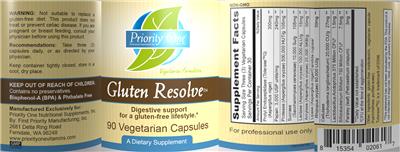
Gluten Resolve by Priority One Nutritional Supplements label
The label scan from the NIH Dietary Supplement Label Database. Tap to enlarge.
Label images are published by the NIH Dietary Supplement Label Database for the version of this product on file. Always read your actual product label.
View the full label (PDF)The Ingredients in Gluten Resolve by Priority One Nutritional Supplements
These are the 11 active ingredients this product is made of. Select any to open its full monograph.
Serving size3 Vegetarian Capsule(s) Dosage formCapsule Servings per container30 Amounts shown are per serving.
Most supplement products combine several ingredients, and a medication can interact with the product through any one of them. Each ingredient below shows whether it has known drug interactions.
Papain
Interacts with2 drugs
Papain is a protein-digesting enzyme from the papaya plant that is used in digestive supplements and some topical products. While it has clear food an...
Papain monograph & interactionsBifidobacterium bifidum
Interacts with182 drugs
Bifidobacterium bifidum is a 'friendly' bacteria (probiotic) that naturally lives in the human gut and is taken to support digestion and gut balance....
Bifidobacterium bifidum monograph & interactionsLactobacillus acidophilus
Interacts with182 drugs
Lactobacillus acidophilus is a 'friendly' bacterium used as a probiotic to support gut and vaginal health. It is generally well tolerated in healthy p...
Lactobacillus acidophilus monograph & interactionsParsley
Interacts with443 drugs
Parsley is a popular culinary herb that is safe to eat in normal food amounts and is a good source of vitamins K and C. It is traditionally used as a...
Parsley monograph & interactionsProtease
No knowninteractions
Proteolytic enzymes are proteins that help break down other proteins, and common examples include bromelain (from pineapple), papain (from papaya), tr...
Protease monograph & interactionsLactase
No knowninteractions
Lactase is a digestive enzyme supplement that helps people who lack enough natural lactase break down lactose, the sugar in milk and dairy. It can red...
Lactase monograph & interactionsCellulase
Sucrase
Amylase
Prolyl Endopeptidase
Lipase
No knowninteractions
Lipase is a digestive enzyme that helps your body break down dietary fats. It is well established as part of prescription pancreatic enzyme therapy fo...
Lipase monograph & interactionsOther (inactive) ingredients: Maltodextrin, Vegetarian Capsule. These complete the product’s ingredient list but are not active constituents.
Gluten Resolve by Priority One Nutritional Supplements Drug Interactions
HelloPharmacist Interaction Report
Gluten Resolve by Priority One Nutritional Supplements interacts with medications through its papain, parsley, and probiotic ingredients (Bifidobacterium bifidum and Lactobacillus acidophilus).
The most serious documented interaction is a Moderate-severity effect with warfarin—papain may increase warfarin's blood-thinning effects, with one case report showing a patient's INR (a measure of how thin your blood is) spike to 7.4 after taking a papain-containing supplement.
Read the full breakdown — every affected drug type, severity by severity
Parsley in this product carries multiple Moderate interactions with anticoagulants and blood thinners due to its vitamin K content and antiplatelet effects. It also theoretically affects diabetes drugs (increasing low blood sugar risk), diuretics (water pills), some sedatives like pentobarbital, and immunosuppressants like sirolimus.
Aspirin may worsen allergic reactions to parsley (Minor severity). Both probiotics (Bifidobacterium bifidum and Lactobacillus acidophilus) interact with antibiotics at Moderate severity—taking them together may reduce the probiotics' effectiveness because antibiotics can kill the live organisms.
Additionally, we could not check cellulase, sucrase, amylase, or prolyl endopeptidase—no interaction data is on file for these ingredients. Altogether, these interactions span 623 individual medications.
Before starting Gluten Resolve, run your exact medications through the interaction checker on this page, or talk with your doctor or pharmacist about whether it's safe alongside anything you're currently taking.
Check your own medications below · Editorial policy · How we use AI
Want to check YOUR meds against Gluten Resolve?
Ask about interactions with your drugs in plain English — “Can I take it with lisinopril?” — and we find you the answer in seconds, ingredient by ingredient.
Go to the checkerIngredients driving the most interactions
Individual Drug Interactions
The ingredients in Gluten Resolve interact with 623 drugs. Click any drug to see the details.
4 of the 11 ingredients in Gluten Resolve interact with drugs. Each result below shows which ingredient is responsible. Parsley Bifidobacterium bifidum Lactobacillus acidophilus Papain
AbciximabReoPro
How Abciximab interacts with Gluten Resolve — through 1 ingredient. Tap an ingredient for the detail:
ParsleyAnticoagulant/antiplatelet Drugs Moderate
Interaction Summary
Theoretically, parsley might increase the risk of bleeding when taken with anticoagulant or antiplatelet drugs.
Read the full Parsley + Abciximab interactionAbrocitinibCibinqo
How Abrocitinib interacts with Gluten Resolve — through 1 ingredient. Tap an ingredient for the detail:
ParsleyAnticoagulant/antiplatelet Drugs Moderate
Interaction Summary
Theoretically, parsley might increase the risk of bleeding when taken with anticoagulant or antiplatelet drugs.
Read the full Parsley + Abrocitinib interactionAcarboseGlucobay, Prandase, Precose
How Acarbose interacts with Gluten Resolve — through 1 ingredient. Tap an ingredient for the detail:
ParsleyAntidiabetes Drugs Moderate
Interaction Summary
Theoretically, parsley might increase the risk of hypoglycemia when taken with antidiabetes drugs.
Read the full Parsley + Acarbose interactionAcenocoumarolSintrom
How Acenocoumarol interacts with Gluten Resolve — through 1 ingredient. Tap an ingredient for the detail:
ParsleyAnticoagulant/antiplatelet Drugs Moderate
Interaction Summary
Theoretically, parsley might increase the risk of bleeding when taken with anticoagulant or antiplatelet drugs.
Read the full Parsley + Acenocoumarol interactionAcetaminophenChildren's Tylenol, Children's Tylenol Meltaways, Tylenol, Tylenol Ex Strength
How Acetaminophen interacts with Gluten Resolve — through 1 ingredient. Tap an ingredient for the detail:
ParsleyCytochrome P450 1a2 (cyp1a2) Substrates Moderate
Interaction Summary
Theoretically, parsley might increase serum levels of CYP1A2 substrates.
Read the full Parsley + Acetaminophen interactionAcetaminophen, AspirinGemnisyn
How Acetaminophen, Aspirin interacts with Gluten Resolve — through 1 ingredient. Tap an ingredient for the detail:
ParsleyCytochrome P450 1a2 (cyp1a2) Substrates, Anticoagulant/antiplatelet Drugs +1 Moderate
Interaction Summary
Theoretically, parsley might increase serum levels of CYP1A2 substrates.
Read the full Parsley + Acetaminophen, Aspirin interactionAcetaminophen, Aspirin, CaffeineExcedrin, Excedrin Extra Strength, Excedrin Migraine
How Acetaminophen, Aspirin, Caffeine interacts with Gluten Resolve — through 1 ingredient. Tap an ingredient for the detail:
ParsleyAspirin, Cytochrome P450 1a2 (cyp1a2) Substrates +1 Moderate
Interaction Summary
Theoretically, aspirin might increase the severity of allergic reactions to parsley.
Read the full Parsley + Acetaminophen, Aspirin, Caffeine interactionAcetaminophen, Brompheniramine, PhenylpropanolamineDimetapp Cold and Flu
How Acetaminophen, Brompheniramine, Phenylpropanolamine interacts with Gluten Resolve — through 1 ingredient. Tap an ingredient for the detail:
ParsleyCytochrome P450 1a2 (cyp1a2) Substrates Moderate
Interaction Summary
Theoretically, parsley might increase serum levels of CYP1A2 substrates.
Read the full Parsley + Acetaminophen, Brompheniramine, Phenylpropanolamine interactionAcetaminophen, ButalbitalAxocet, Bancap, Bucet, Butex Forte, Esgic CF, Orbivan CF +5 more
How Acetaminophen, Butalbital interacts with Gluten Resolve — through 1 ingredient. Tap an ingredient for the detail:
ParsleyCytochrome P450 1a2 (cyp1a2) Substrates Moderate
Interaction Summary
Theoretically, parsley might increase serum levels of CYP1A2 substrates.
Read the full Parsley + Acetaminophen, Butalbital interactionAcetaminophen, Butalbital, CaffeineEsgic, Esgic Plus, Fiogesic, Fioricet, Repan, Tecnal +1 more
How Acetaminophen, Butalbital, Caffeine interacts with Gluten Resolve — through 1 ingredient. Tap an ingredient for the detail:
ParsleyCytochrome P450 1a2 (cyp1a2) Substrates Moderate
Interaction Summary
Theoretically, parsley might increase serum levels of CYP1A2 substrates.
Read the full Parsley + Acetaminophen, Butalbital, Caffeine interactionAcetaminophen, Butalbital, Caffeine, CodeineEsgic with Codeine, Fioricet w/ Codeine
How Acetaminophen, Butalbital, Caffeine, Codeine interacts with Gluten Resolve — through 1 ingredient. Tap an ingredient for the detail:
ParsleyCytochrome P450 1a2 (cyp1a2) Substrates Moderate
Interaction Summary
Theoretically, parsley might increase serum levels of CYP1A2 substrates.
Read the full Parsley + Acetaminophen, Butalbital, Caffeine, Codeine interactionAcetaminophen, Butalbital, CodeineBancap w/ Codeine
How Acetaminophen, Butalbital, Codeine interacts with Gluten Resolve — through 1 ingredient. Tap an ingredient for the detail:
ParsleyCytochrome P450 1a2 (cyp1a2) Substrates Moderate
Interaction Summary
Theoretically, parsley might increase serum levels of CYP1A2 substrates.
Read the full Parsley + Acetaminophen, Butalbital, Codeine interactionAcetaminophen, Butalbital, Codeine PhosphatePhrenilin #3
How Acetaminophen, Butalbital, Codeine Phosphate interacts with Gluten Resolve — through 1 ingredient. Tap an ingredient for the detail:
ParsleyCytochrome P450 1a2 (cyp1a2) Substrates Moderate
Interaction Summary
Theoretically, parsley might increase serum levels of CYP1A2 substrates.
Read the full Parsley + Acetaminophen, Butalbital, Codeine Phosphate interactionAcetaminophen, Caffeine, Chlorpheniramine, Hydrocodone, PhenylephrineHycomine Compound
How Acetaminophen, Caffeine, Chlorpheniramine, Hydrocodone, Phenylephrine interacts with Gluten Resolve — through 1 ingredient. Tap an ingredient for the detail:
ParsleyCytochrome P450 1a2 (cyp1a2) Substrates Moderate
Interaction Summary
Theoretically, parsley might increase serum levels of CYP1A2 substrates.
Read the full Parsley + Acetaminophen, Caffeine, Chlorpheniramine, Hydrocodone, Phenylephrine interactionAcetaminophen, Caffeine, CodeineGesic C15, Gesic C30, Gesic C8, Lenoltec 1, Lenoltec 2, Lenoltec 3 +1 more
How Acetaminophen, Caffeine, Codeine interacts with Gluten Resolve — through 1 ingredient. Tap an ingredient for the detail:
ParsleyCytochrome P450 1a2 (cyp1a2) Substrates Moderate
Interaction Summary
Theoretically, parsley might increase serum levels of CYP1A2 substrates.
Read the full Parsley + Acetaminophen, Caffeine, Codeine interactionAcetaminophen, Caffeine, Codeine, SalicylamideCodalan No.1, Codalan No.2, Codalan No.3
How Acetaminophen, Caffeine, Codeine, Salicylamide interacts with Gluten Resolve — through 1 ingredient. Tap an ingredient for the detail:
ParsleyCytochrome P450 1a2 (cyp1a2) Substrates Moderate
Interaction Summary
Theoretically, parsley might increase serum levels of CYP1A2 substrates.
Read the full Parsley + Acetaminophen, Caffeine, Codeine, Salicylamide interactionAcetaminophen, Caffeine, DihydrocodeineDHC Plus, Panlor DC, Panlor SS
How Acetaminophen, Caffeine, Dihydrocodeine interacts with Gluten Resolve — through 1 ingredient. Tap an ingredient for the detail:
ParsleyCytochrome P450 1a2 (cyp1a2) Substrates Moderate
Interaction Summary
Theoretically, parsley might increase serum levels of CYP1A2 substrates.
Read the full Parsley + Acetaminophen, Caffeine, Dihydrocodeine interactionAcetaminophen, Caffeine, IsomethepteneMigralam
How Acetaminophen, Caffeine, Isometheptene interacts with Gluten Resolve — through 1 ingredient. Tap an ingredient for the detail:
ParsleyCytochrome P450 1a2 (cyp1a2) Substrates Moderate
Interaction Summary
Theoretically, parsley might increase serum levels of CYP1A2 substrates.
Read the full Parsley + Acetaminophen, Caffeine, Isometheptene interactionAcetaminophen, Caffeine, PyrilamineMidol Max Strength Menstrual
How Acetaminophen, Caffeine, Pyrilamine interacts with Gluten Resolve — through 1 ingredient. Tap an ingredient for the detail:
ParsleyDiuretic Drugs, Cytochrome P450 1a2 (cyp1a2) Substrates Moderate
Interaction Summary
Theoretically, parsley might enhance or interfere with the effects of diuretic drugs.
Read the full Parsley + Acetaminophen, Caffeine, Pyrilamine interactionAcetaminophen, Chlorpheniramine Maleate, Dextromethorphan HbrVicks Formula 44M Cough, Cold & Flu Relief
How Acetaminophen, Chlorpheniramine Maleate, Dextromethorphan Hbr interacts with Gluten Resolve — through 1 ingredient. Tap an ingredient for the detail:
ParsleyCytochrome P450 1a2 (cyp1a2) Substrates Moderate
Interaction Summary
Theoretically, parsley might increase serum levels of CYP1A2 substrates.
Read the full Parsley + Acetaminophen, Chlorpheniramine Maleate, Dextromethorphan Hbr interactionAcetaminophen, Chlorpheniramine, Codeine, PhenylephrineColrex
How Acetaminophen, Chlorpheniramine, Codeine, Phenylephrine interacts with Gluten Resolve — through 1 ingredient. Tap an ingredient for the detail:
ParsleyCytochrome P450 1a2 (cyp1a2) Substrates Moderate
Interaction Summary
Theoretically, parsley might increase serum levels of CYP1A2 substrates.
Read the full Parsley + Acetaminophen, Chlorpheniramine, Codeine, Phenylephrine interactionAcetaminophen, Chlorpheniramine, DextromethorphanCoricidin II Extra Strength Cold and Flu
How Acetaminophen, Chlorpheniramine, Dextromethorphan interacts with Gluten Resolve — through 1 ingredient. Tap an ingredient for the detail:
ParsleyCytochrome P450 1a2 (cyp1a2) Substrates Moderate
Interaction Summary
Theoretically, parsley might increase serum levels of CYP1A2 substrates.
Read the full Parsley + Acetaminophen, Chlorpheniramine, Dextromethorphan interactionAcetaminophen, Chlorpheniramine, Dextromethorphan HydrobromideCoricidin HBP Maximum Strength Flu
How Acetaminophen, Chlorpheniramine, Dextromethorphan Hydrobromide interacts with Gluten Resolve — through 1 ingredient. Tap an ingredient for the detail:
ParsleyCytochrome P450 1a2 (cyp1a2) Substrates Moderate
Interaction Summary
Theoretically, parsley might increase serum levels of CYP1A2 substrates.
Read the full Parsley + Acetaminophen, Chlorpheniramine, Dextromethorphan Hydrobromide interactionAcetaminophen, Chlorpheniramine, Dextromethorphan, PhenylpropanolamineMulti Symptom Cold Relief
How Acetaminophen, Chlorpheniramine, Dextromethorphan, Phenylpropanolamine interacts with Gluten Resolve — through 1 ingredient. Tap an ingredient for the detail:
ParsleyCytochrome P450 1a2 (cyp1a2) Substrates Moderate
Interaction Summary
Theoretically, parsley might increase serum levels of CYP1A2 substrates.
Read the full Parsley + Acetaminophen, Chlorpheniramine, Dextromethorphan, Phenylpropanolamine interactionAcetaminophen, Chlorpheniramine, Dextromethorphan, PseudoephedrineChildren's Tylenol Cold Plus Cough, Tylenol Cold Ex Strength
How Acetaminophen, Chlorpheniramine, Dextromethorphan, Pseudoephedrine interacts with Gluten Resolve — through 1 ingredient. Tap an ingredient for the detail:
ParsleyCytochrome P450 1a2 (cyp1a2) Substrates Moderate
Interaction Summary
Theoretically, parsley might increase serum levels of CYP1A2 substrates.
Read the full Parsley + Acetaminophen, Chlorpheniramine, Dextromethorphan, Pseudoephedrine interactionAcetaminophen, Chlorpheniramine, Guaifenesin, Phenylephrine, SalicylamideRhinogesic GG
How Acetaminophen, Chlorpheniramine, Guaifenesin, Phenylephrine, Salicylamide interacts with Gluten Resolve — through 1 ingredient. Tap an ingredient for the detail:
ParsleyCytochrome P450 1a2 (cyp1a2) Substrates Moderate
Interaction Summary
Theoretically, parsley might increase serum levels of CYP1A2 substrates.
Read the full Parsley + Acetaminophen, Chlorpheniramine, Guaifenesin, Phenylephrine, Salicylamide interactionAcetaminophen, Chlorpheniramine, PhenylephrineAlka-Seltzer PLUS, Histex SR, Protid
How Acetaminophen, Chlorpheniramine, Phenylephrine interacts with Gluten Resolve — through 1 ingredient. Tap an ingredient for the detail:
ParsleyCytochrome P450 1a2 (cyp1a2) Substrates Moderate
Interaction Summary
Theoretically, parsley might increase serum levels of CYP1A2 substrates.
Read the full Parsley + Acetaminophen, Chlorpheniramine, Phenylephrine interactionAcetaminophen, Chlorpheniramine, Phenylephrine, SalicylamideRhinogesic, Rhinogesic JR
How Acetaminophen, Chlorpheniramine, Phenylephrine, Salicylamide interacts with Gluten Resolve — through 1 ingredient. Tap an ingredient for the detail:
ParsleyCytochrome P450 1a2 (cyp1a2) Substrates Moderate
Interaction Summary
Theoretically, parsley might increase serum levels of CYP1A2 substrates.
Read the full Parsley + Acetaminophen, Chlorpheniramine, Phenylephrine, Salicylamide interactionAcetaminophen, Chlorpheniramine, PhenylpropanolamineAlumadrine, Conex, Sinadrin Max Strength, Sinulin
How Acetaminophen, Chlorpheniramine, Phenylpropanolamine interacts with Gluten Resolve — through 1 ingredient. Tap an ingredient for the detail:
ParsleyCytochrome P450 1a2 (cyp1a2) Substrates Moderate
Interaction Summary
Theoretically, parsley might increase serum levels of CYP1A2 substrates.
Read the full Parsley + Acetaminophen, Chlorpheniramine, Phenylpropanolamine interactionAcetaminophen, Chlorpheniramine, Phenylpropanolamine, OpiumHista-Derfule
How Acetaminophen, Chlorpheniramine, Phenylpropanolamine, Opium interacts with Gluten Resolve — through 1 ingredient. Tap an ingredient for the detail:
ParsleyCytochrome P450 1a2 (cyp1a2) Substrates Moderate
Interaction Summary
Theoretically, parsley might increase serum levels of CYP1A2 substrates.
Read the full Parsley + Acetaminophen, Chlorpheniramine, Phenylpropanolamine, Opium interactionEach ingredient & the kinds of drugs it affects
For each ingredient in Gluten Resolve with known interactions, here are the types of medications they can affect. Open any type for the detail — or search your exact drug in the checker above.
Parsley
Anticoagulant/Antiplatelet Drugs
Theoretically, parsley might increase the risk of bleeding when taken with anticoagulant or antiplatelet drugs.
Animal research suggests that parsley has antiplatelet effects.
Antidiabetes Drugs
Theoretically, parsley might increase the risk of hypoglycemia when taken with antidiabetes drugs.
Animal research suggests that parsley might decrease blood glucose. Monitor blood glucose levels closely. Dose adjustments might be necessary.
Cytochrome P450 1A2 (Cyp1A2) Substrates
Theoretically, parsley might increase serum levels of CYP1A2 substrates.
Laboratory research suggests that parsley can inhibit CYP1A2.
Diuretic Drugs
Theoretically, parsley might enhance or interfere with the effects of diuretic drugs.
Animal research suggests that parsley seed extract increases urine elimination. Parsley leaf and root might also interfere with diuretic therapy due their purported aquaretic effects.
Pentobarbital (Nembutal)
Theoretically, parsley might increase the duration of pentobarbital effects.
Animal research suggests that parsley juice prolongs the action of pentobarbital, perhaps by decreasing cytochrome P450 levels. It is not known if this occurs in humans or if this applies to other barbiturates or sedatives.
Sirolimus (Rapamune)
Theoretically, large quantities of parsley might increase sirolimus levels.
In one case report, an adult female with a history of kidney transplant presented with elevated blood sirolimus levels, approximately 4-7 times greater than previous measures, after daily consumption of a juice containing approximately 30 grams of parsley for 7 days. Sirolimus levels returned to normal a week after the parsley juice was discontinued.
Warfarin (Coumadin)
Theoretically, large amounts of parsley leaf and root might decrease the effects of warfarin.
Parlsey contains vitamin K.
Aspirin
Theoretically, aspirin might increase the severity of allergic reactions to parsley.
In one case, severe urticaria and swelling were reported after taking aspirin with parsley in an individual with a known mild parsley allergy.
Bifidobacterium bifidum
Antibiotic Drugs
Theoretically, taking Bifidobacterium. bifidum with antibiotic drugs might decrease the effectiveness of B. bifidum.
Since B. bifidum preparations usually contain live and active organisms, simultaneously taking antibiotics might kill a significant number of the organisms. Tell patients to separate administration of antibiotics and B. bifidum preparations by at least 2 hours.
Lactobacillus acidophilus
Antibiotic Drugs
Theoretically, taking Lactobacillus acidophilus with antibiotic drugs might decrease the effectiveness of L. acidophilus.
L. acidophilus preparations usually contain live and active organisms. Therefore, simultaneously taking antibiotics might kill a significant number of the organisms. Tell patients to separate administration of antibiotics and L. acidophilus preparations by at least two hours.
Papain
Warfarin (Coumadin)
Theoretically, papain might increase the effects and side effects of warfarin.
In one case report, a patient previously stable on warfarin was found to have an international normalization ratio (INR) of 7.4, which was attributed to ingestion of a supplement containing papain from papaya extract.
Brand information
Manufacturer and brand details for Gluten Resolve, from the product label.
Priority One Nutritional Supplements
See all Priority One Nutritional Supplements products- Name
- Priority One Nutritional Supplements, Inc.
- Web Address
- www.priorityonevitamins.com
Gluten Resolve by Priority One Nutritional Supplements: Common Questions
Does Gluten Resolve by Priority One Nutritional Supplements interact with any medications?
How can one product interact with so many drugs?
Where does this information come from?
Can I take Gluten Resolve if I'm pregnant or breastfeeding?
Will this help me digest gluten better?
What are the most common side effects?
Is there lactose in this product?
Can I take this with antibiotics?
Is this product vegan or vegetarian?
Written and reviewed by the HelloPharmacist editorial staff. Our editorial policy
Not sure if Gluten Resolve is safe with your meds?
Our pharmacists answer your medication & supplement questions — free.
Label information is sourced from the NIH Dietary Supplement Label Database and reflects the product version on file; always read your actual product label. This page is for education only and is not a substitute for professional medical advice. Confirm with your pharmacist or doctor before combining supplements and medications.
The Full Monographs Behind Gluten Resolve’s Ingredients
Every ingredient we hold a full HelloPharmacist monograph for — uses, evidence, safety, and the complete interaction list.
Papain
Interacts with 2 drugsPapain is a protein-digesting enzyme from the papaya plant that is used in digestive supplements and some topical products. While it has clear food and laboratory uses, strong human evidence...
Read the full Papain monograph → Herb & supplement monographBifidobacterium Bifidum
Interacts with 182 drugsBifidobacterium bifidum is a 'friendly' bacteria (probiotic) that naturally lives in the human gut and is taken to support digestion and gut balance. Some evidence suggests probiotics may he...
Read the full Bifidobacterium Bifidum monograph → Herb & supplement monographLactobacillus Acidophilus
Interacts with 182 drugsLactobacillus acidophilus is a 'friendly' bacterium used as a probiotic to support gut and vaginal health. It is generally well tolerated in healthy people, and there is reasonable evidence...
Read the full Lactobacillus Acidophilus monograph → Herb & supplement monographParsley
Interacts with 443 drugsParsley is a popular culinary herb that is safe to eat in normal food amounts and is a good source of vitamins K and C. It is traditionally used as a diuretic and for digestion, but solid hu...
Read the full Parsley monograph → Herb & supplement monographProteolytic Enzymes (proteases)
Proteolytic enzymes are proteins that help break down other proteins, and common examples include bromelain (from pineapple), papain (from papaya), trypsin, chymotrypsin, and pancreatin. Peo...
Read the full Proteolytic Enzymes (proteases) monograph → Herb & supplement monographLactase
Lactase is a digestive enzyme supplement that helps people who lack enough natural lactase break down lactose, the sugar in milk and dairy. It can reduce gas, bloating, cramping, and diarrhe...
Read the full Lactase monograph → Herb & supplement monographLipase
Lipase is a digestive enzyme that helps your body break down dietary fats. It is well established as part of prescription pancreatic enzyme therapy for people who cannot make enough of their...
Read the full Lipase monograph →Sources & How We Checked
Gluten Resolve's label data comes from the NIH Dietary Supplement Label Database; the ingredient interaction data is from the Natural Medicines database, reviewed by our pharmacists.
- NIH Dietary Supplement Label Database (DSLD) — The official product label on file for this supplement.
- Natural Medicines (Therapeutic Research Center) — Evidence-graded clinical reference behind the ingredient interaction data.
Content is written and reviewed by licensed HelloPharmacist pharmacists. See our data sources and editorial standards for how this information is built and checked.
The 59 references behind this product’s interaction data
Every citation that drives the interaction findings for this product’s ingredients, from the evidence-graded Natural Medicines (TRC Healthcare) database. Open an ingredient to browse its citations — links open the study on PubMed or the publisher’s site.
Papain 11 references
- The Review of Natural Products by Facts and Comparisons. St. Louis, MO: Wolters Kluwer Co., 1999.
- Shaw D, Leon C, Kolev S, Murray V. Traditional remedies and food supplements: a 5-year toxicological study (1991-1995). Drug Saf 1997;17:342-56.
- Shuttleworth D, Hill S, Marks R, Connelly DM. Relief of experimentally induced pruritus with a novel eutectic mixture of local anaesthetic agents. Br J Dermatol 1988;119:535-40.
- Mansfield LE, Ting S, Haverly RW, Yoo TJ. The incidence and clinical implications of hypersensitivity to papain in an allergic population, confirmed by blinded oral challenge. Ann Allergy 1985;55:541-3.
- Martin, T., Uhder, K., Kurek, R., Roeddiger, S., Schneider, L., Vogt, H. G., Heyd, R., and Zamboglou, N. Does prophylactic treatment with proteolytic enzymes reduce acute toxicity of adjuvant pelvic irradiation? Results of a double-blind randomized trial PubMed
- Walker-Renard, P. Update on the medicinal management of phytobezoars. Am J Gastroenterol. 1993;88(10):1663-1666.
- Tymoszuk D, Wiszniewska M, Walusiak-Skorupa J. Papain-induced occupational rhinoconjunctivitis and asthma - A case report. Med Pr 2016;67(1):109-12. PubMed
- Soto-Mera MT, López-Rico MR, Filgueira JF, et al. Occupational allergy to papain. Allergy 2000;55(10):983-4. PubMed
- Tarlo SM, Shaikh W, Bell B, et al. Papain-induced allergic reactions. Clin Allergy 1978;8(3):207-15. PubMed
- Baur X, König G, Bencze K, Fruhmann G. Clinical symptoms and results of skin test, RAST and bronchial provocation test in thirty-three papain workers: Evidence for strong immunogenic potency and clinically relevant proteolytic e?ects of airborne papain. C
- Novey HS, Keenan WJ, Fairshter RD, Wells ID, Wilson AF, Culver BD. Pulmonary disease in workers exposed to papain: clinico-physiological and immunological studies. Clin Allergy 1980;10(6):721-31. PubMed
Bifidobacterium Bifidum 7 references
- Pierce A. The American Pharmaceutical Association Practical Guide to Natural Medicines. New York: The Stonesong Press, 1999:19.
- Xiao JZ, Takahashi S, Odamaki T, et al. Antibiotic susceptibility of bifidobacterial strains distributed in the Japanese market. Biosci Biotechnol Biochem. 2010;74(2):336-42. PubMed
- Rerksuppaphol S, Rerksuppaphol L. Randomized controlled trial of probiotics to reduce common cold in schoolchildren. Pediatr Int. 2012;54(5):682-7. PubMed
- Karamali M, Dadkhah F, Sadrkhanlou M, et al. Effects of probiotic supplementation on glycaemic control and lipid profiles in gestational diabetes: a randomized, double-blind, placebo-controlled trial. Diabetes Metab 2016;42(4):234-41. PubMed
- Badehnoosh B, Karamali M, Zarrati M, et al. The effects of probiotic supplementation on biomarkers of inflammation, oxidative stress and pregnancy outcomes in gestational diabetes. J Matern Fetal Neonatal Med. 2018 May;31(9):1128-1136.
- Pruccoli G, Silvestro E, Pace Napoleone C, Aidala E, Garazzino S, Scolfaro C. Are probiotics safe? Bifidobacterium bacteremia in a child with severe heart failure. Infez Med. 2019;27(2):175-178.
- Esaiassen E, Hjerde E, Cavanagh JP, Simonsen GS, Klingenberg C; Norwegian Study Group on Invasive Bifidobacterial Infections. Bifidobacterium bacteremia: Clinical characteristics and a genomic approach to assess pathogenicity. J Clin Microbiol. 2017;55(7) PubMed
See these in context on the Bifidobacterium Bifidum monograph →
Lactobacillus Acidophilus 15 references
- Pierce A. The American Pharmaceutical Association Practical Guide to Natural Medicines. New York: The Stonesong Press, 1999:19.
- Begtrup LM, de Muckadell OB, Kjeldsen J, Christensen RD, Jarbøl DE. Long-term treatment with probiotics in primary care patients with irritable bowel syndrome--a randomised, double-blind, placebo controlled trial. Scand J Gastroenterol 2013;48(10):1127-35 PubMed
- Chatterjee S, Kar P, Das T, Ray S, Gangulyt S, Rajendiran C, Mitra M. Randomised placebo-controlled double blind multicentric trial on efficacy and safety of Lactobacillus acidophilus LA-5 and Bifidobacterium BB-12 for prevention of antibiotic-associated
- Shavakhi A, Tabesh E, Yaghoutkar A, Hashemi H, Tabesh F, Khodadoostan M,Minakari M, Shavakhi S, Gholamrezaei A. The effects of multistrain probiotic compound on bismuth-containing quadruple therapy for Helicobacter pylori infection: a randomized placebo-c
- Karamali M, Dadkhah F, Sadrkhanlou M, et al. Effects of probiotic supplementation on glycaemic control and lipid profiles in gestational diabetes: a randomized, double-blind, placebo-controlled trial. Diabetes Metab 2016;42(4):234-41. PubMed
- Badehnoosh B, Karamali M, Zarrati M, et al. The effects of probiotic supplementation on biomarkers of inflammation, oxidative stress and pregnancy outcomes in gestational diabetes. J Matern Fetal Neonatal Med. 2018 May;31(9):1128-1136.
- Kumar S, Kumar R, Rohilla L, Jacob N, Yadav J, Sachdeva N. A high potency multi-strain probiotic improves glycemic control in children with new-onset type 1 diabetes mellitus: A randomized, double-blind, and placebo-controlled pilot study. Pediatr Diabete
- Shahriari A, Karimi E, Shahriari M, Aslani N, Khooshideh M, Arab A. The effect of probiotic supplementation on the risk of gestational diabetes mellitus among high-risk pregnant women: A parallel double-blind, randomized, placebo-controlled clinical trial PubMed
- Xiao SD, Zhang DZ, Lu H, et al. Multicenter, randomized, controlled trial of heat-killed Lactobacillus acidophilus LB in patients with chronic diarrhea. Adv Ther. 2003;20(5):253-60.
- Rossi F, Amadoro C, Gasperi M, Colavita G. Lactobacilli infection case reports in the last three years and safety implications. Nutrients. 2022;14(6):1178. PubMed
- Ozer M, Goksu SY, Shahverdiani A, Mustafa M. Lactobacillus acidophilus-induced endocarditis and associated splenic abscess. Case Rep Infect Dis 2020;2020:1382709.
- Sadrin S, Sennoune S, Gout B, et al. A 2-strain mixture of Lactobacillus acidophilus in the treatment of irritable bowel syndrome: A placebo-controlled randomized clinical trial. Dig Liver Dis 2020;52(5):534-540. PubMed
- Stoffer JN, Slingsby TJ, Giuliari GP. Lactobacillus acidophilus endophthalmitis after intravitreal bevacizumab injection requiring intraocular lens explantation. Can J Ophthalmol 2022;57(1):e21-e22. PubMed
- Cukovic-Cavka S, Likic R, Francetic I, Rustemovic N, Opacic M, Vucelic B. Lactobacillus acidophilus as a cause of liver abscess in a NOD2/CARD15-positive patient with Crohn's disease. Digestion 2006;73(2-3):107-10.
- Hui J, Ren Y, Wang Y, Han Q. Lactobacillus acidophilus endophthalmitis postcataract operation: A case report with a literature review. Ocul Immunol Inflamm 2023.
See these in context on the Lactobacillus Acidophilus monograph →
Parsley 21 references
- Newall CA, Anderson LA, Philpson JD. Herbal Medicine: A Guide for Healthcare Professionals. London, UK: The Pharmaceutical Press, 1996.
- Leung AY, Foster S. Encyclopedia of Common Natural Ingredients Used in Food, Drugs and Cosmetics. 2nd ed. New York, NY: John Wiley & Sons, 1996.
- McGuffin M, Hobbs C, Upton R, Goldberg A, eds. American Herbal Products Association's Botanical Safety Handbook. Boca Raton, FL: CRC Press, LLC 1997.
- Brinker F. Herb Contraindications and Drug Interactions. 2nd ed. Sandy, OR: Eclectic Medical Publications, 1998.
- Robbers JE, Tyler VE. Tyler's Herbs of Choice: The Therapeutic Use of Phytomedicinals. New York, NY: The Haworth Herbal Press, 1999.
- Foster S, Tyler VE. Tyler's Honest Herbal, 4th ed., Binghamton, NY: Haworth Herbal Press, 1999. DOI
- Eberhard P, Gall HM, Muller I, Moller R. Dramatic augmentation of a food allergy by acetylsalicylic acid. J Allergy Clin Immunol 2000;105:844 PubMed
- Tunali T, Yarat A, Yanardag R, et al. Effect of parsley (Petroselinum crispum) on the skin of STZ induced diabetic rats. Phytother Res 1999;13:138-41.. DOI
- Chuang CH, Doyle P, Wang JD, et al. Herbal medicines used during the first trimester and major congenital malformations: an analysis of data from a pregnancy cohort study. Drug Saf 2006;29:537-48. PubMed
- Ciganda C, and Laborde A. Herbal infusions used for induced abortion. J Toxicol.Clin Toxicol. 2003;41:235-239. PubMed
- Jakovljevic, V., Raskovic, A., Popovic, M., and Sabo, J. The effect of celery and parsley juices on pharmacodynamic activity of drugs involving cytochrome P450 in their metabolism. Eur.J Drug Metab Pharmacokinet. 2002;27(3):153-156. PubMed
- Kreydiyyeh, S. I. and Usta, J. Diuretic effect and mechanism of action of parsley. J Ethnopharmacol 2002;79(3):353-357. PubMed
- Yanardag, R., Bolkent, S., Tabakoglu-Oguz, A., and Ozsoy-Sacan, O. Effects of Petroselinum crispum extract on pancreatic B cells and blood glucose of streptozotocin-induced diabetic rats. Biol Pharm Bull. 2003;26(8):1206-1210. PubMed
- Bolkent, S., Yanardag, R., Ozsoy-Sacan, O., and Karabulut-Bulan, O. Effects of parsley (Petroselinum crispum) on the liver of diabetic rats: a morphological and biochemical study. Phytother.Res 2004;18(12):996-999.
- Ozsoy-Sacan, O., Yanardag, R., Orak, H., Ozgey, Y., Yarat, A., and Tunali, T. Effects of parsley (Petroselinum crispum) extract versus glibornuride on the liver of streptozotocin-induced diabetic rats. J Ethnopharmacol 3-8-2006;104(1-2):175-181. PubMed
- Peterson, S., Lampe, J. W., Bammler, T. K., Gross-Steinmeyer, K., and Eaton, D. L. Apiaceous vegetable constituents inhibit human cytochrome P-450 1A2 (hCYP1A2) activity and hCYP1A2-mediated mutagenicity of aflatoxin B1. Food Chem.Toxicol. 2006;44(9):147 PubMed
- Gadi, D., Bnouham, M., Aziz, M., Ziyyat, A., Legssyer, A., Legrand, C., Lafeve, F. F., and Mekhfi, H. Parsley extract inhibits in vitro and ex vivo platelet aggregation and prolongs bleeding time in rats. J Ethnopharmacol 8-17-2009;125(1):170-174. PubMed
- Arslan S, Ucar R, Caliskaner AZ. A Cases of Near-fatal Anaphylaxis: Parsley "Over-use" as an Herbal Remedy. Med Arch. 2014;68(6):426-7.
- Foti C, Cassano N, Mistrello G, Amato S, Romita P, Vena GA. Contact urticaria to raw arugula and parsley. Ann Allergy Asthma Immunol. 2011 May;106(5):447-8. PubMed
- Farzaei MH, Abbasabadi Z, Ardekani MR, Rahimi R, Farzaei F. Parsley: a review of ethnopharmacology, phytochemistry and biological activities. J Tradit Chin Med. 2013;33(6):815-26. PubMed
- Kurtaran M, Koc NS, Aksun MS, Yildirim T, Yilmaz SR, Erdem Y. Petroselinum crispum, a commonly consumed food, affects sirolimus level in a renal transplant recipient: a case report. Ther Adv Drug Saf 2021;12:20420986211009358.
Proteolytic Enzymes (proteases) 3 references
- Weeks JA, Harper RA, Simon RA, Burdick JD. Assessment of sensitization risk of a laundry pre-spotter containing protease. Cutan Ocul Toxicol. 2011;30(4):272-9. PubMed
- Marquès LI, Lara S, Abós T, Bartolomé B. Occupational rhinitis due to pepsin. J Investig Allergol Clin Immunol. 2006;16(2):136-7. DOI
- Cartier A, Malo JL, Pineau L, Dolovich J. Occupational asthma due to pepsin. J Allergy Clin Immunol. 1984;73(5 Pt 1):574-7. PubMed
See these in context on the Proteolytic Enzymes (proteases) monograph →
Lactase 1 reference
- Laukkanen A, Ruoppi P, Remes S, Koistinen T, Mäkinen-Kiljunen S. Lactase-induced occupational protein contact dermatitis and allergic rhinoconjunctivitis. Contact Dermatitis. 2007;57(2):89-93. PubMed
Lipase 1 reference
- Casper C, Hascoet JM, Ertl T, et al. Recombinant bile salt-stimulated lipase in preterm infant feeding: A randomized phase 3 study. PLoS One. 2016;11(5):e0156071. PubMed
Parts of this content are provided by the Therapeutic Research Center, LLC.
DISCLAIMER: Currently this does not check for drug-drug interactions. This is not an all-inclusive comprehensive list of potential interactions and is for informational purposes only. Not all interactions are known or well-reported in the scientific literature, and new interactions are continually being reported. Input is needed from a qualified healthcare provider including a pharmacist before starting any therapy. Application of clinical judgment is necessary.
© 2021 Therapeutic Research Center, LLC