
Kudzu Root 1,226 mg Ingredients & Drug Interactions
by Nature's Way
What is this page for?
First and foremost: checking Kudzu Root 1,226 mg against your medications. The heart of this page is the interaction checker and the full interaction report — how this product’s ingredients may interact with prescription and over-the-counter medicines you may be taking.
Around that, we add a pharmacist’s high-level view of the product as a whole — what’s inside, the evidence for its stated use, how transparent the label is, and what safety data exists — so you can see the full picture in one place. It’s educational information from our licensed clinical databases and the clinical staff at HelloPharmacist — not medical advice — and we don’t sell or endorse products. Our editorial policy
Kudzu Root 1,226 mg is a dietary supplement by Nature's Way with 2 active ingredients. Its ingredients are commonly taken for alcohol cravings and reduction, menopausal symptoms, heart and blood vessel health.Based on those ingredients, 586 medications have a known interaction with it, the most serious rated moderate. The ingredients most likely to interact are Kudzu. Use the checker below to test your specific medication, or read the full HelloPharmacist Interaction Report.
Check Your Meds Against Kudzu Root 1,226 mg by Nature's Way
Ask about any prescription or over-the-counter medication and we check it for interactions with Kudzu Root 1,226 mg by Nature's Way — and tell you which ingredient is responsible.
AI summaries are generated from our interaction database for education only — always confirm with your pharmacist. How we use AI
Ask the Pharmacist
A licensed pharmacist will answer your question by email — free, usually within 24 hours.
Got it — thank you!
A licensed pharmacist will answer within 24 hours. Keep an eye on your email (worth checking spam, just in case).
HelloPharmacist Scorecard of Kudzu Root 1,226 mg by Nature's Way
Our pharmacy team’s full take, with four database checks built into the cards below — a summary of what is known, not a grade of the product itself.
What’s inside
Low disclosure
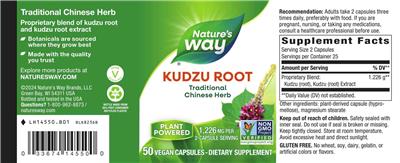
This product contains 2 active ingredients: kudzu root and kudzu root extract, delivering 1,226 mg total per capsule. Both are forms of the same plant and work the same way in your body.
The supplement also contains inactive ingredients (hypromellose and magnesium stearate) that help form and stabilize the capsule.
Does it work?
Moderate evidence
Kudzu is possibly effective for alcohol use disorder based on the evidence we have on file. For hay fever (allergic rhinitis), angina, and back pain, there isn't enough reliable evidence yet to say whether it works.
If you're considering kudzu for any of these, talk with your pharmacist or doctor about what the current science supports.
How safe is it?
Well-documented data
Kudzu is generally well tolerated in short-term studies, but we don't have much data on how safe it is over the long haul. Some people in trials reported nausea, indigestion, bloating, dizziness, or hives, though these happened at about the same rate as placebo.
There's also one case report of a serious allergic skin reaction (rash spreading over the body) from a combination herbal product containing kudzu, so if you develop unusual rashes after starting it, stop and contact your doctor right away. During pregnancy, the safety data advises against it — there's not enough information and kudzu may have hormone-like effects that could affect your baby.
The same goes for breastfeeding: there isn't enough safety data to know if it's okay for your infant.
Meds to double-check
Moderate interaction found
Before taking this product, double-check with your pharmacist if you take any drugs that stress your liver, estrogen therapy, blood thinners or antiplatelet drugs like warfarin or aspirin, methotrexate, tamoxifen, diabetes medications, or caffeine-based products. Altogether, these interactions span 567 individual medications.
The bottom line
Scorecard at a glanceFormula with limited ingredient disclosure with some supporting evidence behind its ingredients' uses. Moderate medication interactions have been identified, and safety information is well characterized.
Kudzu may help with alcohol use disorder and is generally well tolerated short-term, but it interacts with a broad range of medications — especially those affecting your liver, hormones, blood clotting, and blood sugar. Before you take it, check your exact prescriptions with our tool.
If you're pregnant, planning to become pregnant, or breastfeeding, talk with your pharmacist or doctor first.
Educational only — not medical advice; always confirm with your pharmacist. Our editorial policy · How we use AI
Assessment coverage: 2 of 2 active ingredients matched to our full ingredient reviews (monographs). Based on the product label dated Jun 25, 2025.
This Scorecard evaluates available label information, ingredient evidence, and known medication-safety considerations. It does not independently verify product identity, purity, potency, contamination, or manufacturing quality. How these ratings are computed
General information
Key facts about Kudzu Root 1,226 mg, straight from the product label.
| Brand | Nature's Way |
|---|---|
| Barcode (UPC) | 033674145500 |
| Net contents | 50 Vegan Capsule(s) |
| Market status | On market |
| Date entered into DSLD | Jun 25, 2025 |
| DSLD ID | 327989 |
| Product type | Botanical |
| Supplement form | Capsule |
| Dietary claims / uses | All Other |
| Intended target group(s) | Vegan, Vegetarian, Adult (18 - 50 Years), Gluten Free, Dairy Free |
Everything in this section is reproduced from the manufacturer’s own product label — it’s the label speaking, not HelloPharmacist. We show it so you can see exactly what the maker states; we don’t verify or endorse those statements.
Supplement Facts
The label details for Kudzu Root 1,226 mg by Nature's Way, sourced from the NIH Dietary Supplement Label Database.
Supplement Facts
| Ingredient | Amount | % DV |
|---|---|---|
| Proprietary Blend | 1.226 Gram(s) | -- |
| Kudzu | 0 NP | -- |
| Kudzu Root Extract | 0 NP | -- |
Other ingredients: Hypromellose, Magnesium Stearate
Tap any ingredient to jump to its full detail below.
These statements are the manufacturer’s wording, reproduced from the product label — the label is saying it, not HelloPharmacist. We don’t verify or endorse them.
Formula
Traditional chinese herb Proprietary blend of kudzu root and kudzu root extract
Kudzu Root Traditional Chinese Herb 1,226 mg per 2-capsule serving
Formulation
Botanicals are sourced where they grow best Made with the quality you trust
Bottled and tested in the USA
Vegan Gelatin Free
Vegan Gelatin Free
Plant powered
Non GMO Project Verified nongmoproject.org
Gluten Free. No wheat, soy, dairy, gelatin, or artificial colors or flavors.
Brand IP Statement(s)
Copyright 2024 Nature's Way Brands, LLC
General Statements
Explore more products at naturesway.com Questions? 1-800-962-8873 / naturesway.com Bottle made from 50% post-consumer recycled plastic
Seals/Symbols
Vegan Gelatin Free
Non GMO Project Verified nongmoproject.org
FDA Statement of Identity
Dietary Supplement
Suggested/Recommended/Usage/Directions
Recommendation: Adults take 2 capsules three times daily, preferably with food.
Precautions
If you are pregnant, nursing, or taking any medications, consult a healthcare professional before use.
Keep out of reach of children.
Safety sealed with inner seal. Do not use if seal is broken or missing.
Storage
Keep tightly closed. Store at room temperature. Avoid excessive heat and direct sunlight.
Is this label outdated? Report a formula or label change and our pharmacy team will review it.
Kudzu Root 1,226 mg by Nature's Way label
The label scan from the NIH Dietary Supplement Label Database. Tap to enlarge.
Label images are published by the NIH Dietary Supplement Label Database for the version of this product on file. Always read your actual product label.
View the full label (PDF)The Ingredients in Kudzu Root 1,226 mg by Nature's Way
These are the 2 active ingredients this product is made of. Select any to open its full monograph.
Serving size2 Capsule(s) Dosage formCapsule Servings per container25 Amounts shown are per serving.
Most supplement products combine several ingredients, and a medication can interact with the product through any one of them. Each ingredient below shows whether it has known drug interactions.
Proprietary Blend
Other (inactive) ingredients: Hypromellose, Magnesium Stearate. These complete the product’s ingredient list but are not active constituents.
Kudzu Root 1,226 mg by Nature's Way Drug Interactions
HelloPharmacist Interaction Report
Kudzu Root 1,226 mg by Nature's Way does interact with several types of medications, and there are some Moderate-severity concerns you'll want to check before you start.
The most serious involve drugs that affect your liver (hepatotoxic drugs) — kudzu may add to their effects and stress your liver further, so if you take any medication known to be hard on the liver, run it through our checker.
Read the full breakdown — every affected drug type, severity by severity
There are also Moderate interactions with estrogen therapy, blood thinners and antiplatelet drugs (like warfarin or aspirin), caffeine-containing medications, methotrexate (a cancer and autoimmune drug), and tamoxifen (a breast cancer drug). Kudzu appears to have hormone-like activity and may slow how your body clears certain drugs or boost their blood levels.
Additionally, kudzu might lower blood sugar, which means if you take diabetes medications, there's a Minor risk of low blood sugar (hypoglycemia) — your doctor may need to adjust your dose.
Altogether, these interactions span 567 individual medications. Use the medication checker on this page to look up your exact prescriptions before you take this supplement.
Check your own medications below · Editorial policy · How we use AI
Want to check YOUR meds against Kudzu Root 1,226 mg?
Ask about interactions with your drugs in plain English — “Can I take it with lisinopril?” — and we find you the answer in seconds, ingredient by ingredient.
Go to the checkerIngredients driving the most interactions
Individual Drug Interactions
The ingredients in Kudzu Root 1,226 mg interact with 586 drugs. Click any drug to see the details.
1 of the 2 ingredients in Kudzu Root 1,226 mg interact with drugs. Each result below shows which ingredient is responsible. Kudzu
6-mercaptopurinePurinethol
How 6-mercaptopurine interacts with Kudzu Root 1,226 mg — through 1 ingredient. Tap an ingredient for the detail:
Kudzu Root ExtractHepatotoxic Drugs Moderate
Interaction Summary
Theoretically, concomitant use might have additive hepatotoxic effects.
Read the full Kudzu Root Extract + 6-mercaptopurine interactionAbacavir Sulfate, Dolutegravir, LamivudineTriumeq
How Abacavir Sulfate, Dolutegravir, Lamivudine interacts with Kudzu Root 1,226 mg — through 1 ingredient. Tap an ingredient for the detail:
Kudzu Root ExtractHepatotoxic Drugs Moderate
Interaction Summary
Theoretically, concomitant use might have additive hepatotoxic effects.
Read the full Kudzu Root Extract + Abacavir Sulfate, Dolutegravir, Lamivudine interactionAbacavir, LamivudineEpzicom
How Abacavir, Lamivudine interacts with Kudzu Root 1,226 mg — through 1 ingredient. Tap an ingredient for the detail:
Kudzu Root ExtractHepatotoxic Drugs Moderate
Interaction Summary
Theoretically, concomitant use might have additive hepatotoxic effects.
Read the full Kudzu Root Extract + Abacavir, Lamivudine interactionAbciximabReoPro
How Abciximab interacts with Kudzu Root 1,226 mg — through 1 ingredient. Tap an ingredient for the detail:
Kudzu Root ExtractAnticoagulant/antiplatelet Drugs Moderate
Interaction Summary
Theoretically, kudzu may increase the risk of bleeding if used with antiplatelet or anticoagulant drugs.
Read the full Kudzu Root Extract + Abciximab interactionAbiraterone
How Abiraterone interacts with Kudzu Root 1,226 mg — through 1 ingredient. Tap an ingredient for the detail:
Kudzu Root ExtractHepatotoxic Drugs Moderate
Interaction Summary
Theoretically, concomitant use might have additive hepatotoxic effects.
Read the full Kudzu Root Extract + Abiraterone interactionAbiraterone AcetateYonsa, Zytiga
How Abiraterone Acetate interacts with Kudzu Root 1,226 mg — through 1 ingredient. Tap an ingredient for the detail:
Kudzu Root ExtractHepatotoxic Drugs Moderate
Interaction Summary
Theoretically, concomitant use might have additive hepatotoxic effects.
Read the full Kudzu Root Extract + Abiraterone Acetate interactionAbrocitinibCibinqo
How Abrocitinib interacts with Kudzu Root 1,226 mg — through 1 ingredient. Tap an ingredient for the detail:
Kudzu Root ExtractAnticoagulant/antiplatelet Drugs Moderate
Interaction Summary
Theoretically, kudzu may increase the risk of bleeding if used with antiplatelet or anticoagulant drugs.
Read the full Kudzu Root Extract + Abrocitinib interactionAcarboseGlucobay, Prandase, Precose
How Acarbose interacts with Kudzu Root 1,226 mg — through 1 ingredient. Tap an ingredient for the detail:
Kudzu Root ExtractAntidiabetes Drugs, Hepatotoxic Drugs Moderate
Interaction Summary
Theoretically, taking kudzu with antidiabetes drugs might increase the risk of hypoglycemia.
Read the full Kudzu Root Extract + Acarbose interactionAcebutololRhotral, Sectral
How Acebutolol interacts with Kudzu Root 1,226 mg — through 1 ingredient. Tap an ingredient for the detail:
Kudzu Root ExtractHepatotoxic Drugs Moderate
Interaction Summary
Theoretically, concomitant use might have additive hepatotoxic effects.
Read the full Kudzu Root Extract + Acebutolol interactionAcenocoumarolSintrom
How Acenocoumarol interacts with Kudzu Root 1,226 mg — through 1 ingredient. Tap an ingredient for the detail:
Kudzu Root ExtractAnticoagulant/antiplatelet Drugs Moderate
Interaction Summary
Theoretically, kudzu may increase the risk of bleeding if used with antiplatelet or anticoagulant drugs.
Read the full Kudzu Root Extract + Acenocoumarol interactionAcetaminophenChildren's Tylenol, Children's Tylenol Meltaways, Tylenol, Tylenol Ex Strength
How Acetaminophen interacts with Kudzu Root 1,226 mg — through 1 ingredient. Tap an ingredient for the detail:
Kudzu Root ExtractHepatotoxic Drugs Moderate
Interaction Summary
Theoretically, concomitant use might have additive hepatotoxic effects.
Read the full Kudzu Root Extract + Acetaminophen interactionAcetaminophen, AspirinGemnisyn
How Acetaminophen, Aspirin interacts with Kudzu Root 1,226 mg — through 1 ingredient. Tap an ingredient for the detail:
Kudzu Root ExtractHepatotoxic Drugs, Anticoagulant/antiplatelet Drugs Moderate
Interaction Summary
Theoretically, concomitant use might have additive hepatotoxic effects.
Read the full Kudzu Root Extract + Acetaminophen, Aspirin interactionAcetaminophen, Aspirin, CaffeineExcedrin, Excedrin Extra Strength, Excedrin Migraine
How Acetaminophen, Aspirin, Caffeine interacts with Kudzu Root 1,226 mg — through 1 ingredient. Tap an ingredient for the detail:
Kudzu Root ExtractAnticoagulant/antiplatelet Drugs, Hepatotoxic Drugs +1 Moderate
Interaction Summary
Theoretically, kudzu may increase the risk of bleeding if used with antiplatelet or anticoagulant drugs.
Read the full Kudzu Root Extract + Acetaminophen, Aspirin, Caffeine interactionAcetaminophen, Brompheniramine, PhenylpropanolamineDimetapp Cold and Flu
How Acetaminophen, Brompheniramine, Phenylpropanolamine interacts with Kudzu Root 1,226 mg — through 1 ingredient. Tap an ingredient for the detail:
Kudzu Root ExtractHepatotoxic Drugs Moderate
Interaction Summary
Theoretically, concomitant use might have additive hepatotoxic effects.
Read the full Kudzu Root Extract + Acetaminophen, Brompheniramine, Phenylpropanolamine interactionAcetaminophen, ButalbitalAxocet, Bancap, Bucet, Butex Forte, Esgic CF, Orbivan CF +5 more
How Acetaminophen, Butalbital interacts with Kudzu Root 1,226 mg — through 1 ingredient. Tap an ingredient for the detail:
Kudzu Root ExtractHepatotoxic Drugs Moderate
Interaction Summary
Theoretically, concomitant use might have additive hepatotoxic effects.
Read the full Kudzu Root Extract + Acetaminophen, Butalbital interactionAcetaminophen, Butalbital, CaffeineEsgic, Esgic Plus, Fiogesic, Fioricet, Repan, Tecnal +1 more
How Acetaminophen, Butalbital, Caffeine interacts with Kudzu Root 1,226 mg — through 1 ingredient. Tap an ingredient for the detail:
Kudzu Root ExtractHepatotoxic Drugs, Caffeine Moderate
Interaction Summary
Theoretically, concomitant use might have additive hepatotoxic effects.
Read the full Kudzu Root Extract + Acetaminophen, Butalbital, Caffeine interactionAcetaminophen, Butalbital, Caffeine, CodeineEsgic with Codeine, Fioricet w/ Codeine
How Acetaminophen, Butalbital, Caffeine, Codeine interacts with Kudzu Root 1,226 mg — through 1 ingredient. Tap an ingredient for the detail:
Kudzu Root ExtractCaffeine, Hepatotoxic Drugs Moderate
Interaction Summary
Theoretically, taking kudzu with caffeine might increase levels of caffeine.
Read the full Kudzu Root Extract + Acetaminophen, Butalbital, Caffeine, Codeine interactionAcetaminophen, Butalbital, CodeineBancap w/ Codeine
How Acetaminophen, Butalbital, Codeine interacts with Kudzu Root 1,226 mg — through 1 ingredient. Tap an ingredient for the detail:
Kudzu Root ExtractHepatotoxic Drugs Moderate
Interaction Summary
Theoretically, concomitant use might have additive hepatotoxic effects.
Read the full Kudzu Root Extract + Acetaminophen, Butalbital, Codeine interactionAcetaminophen, Butalbital, Codeine PhosphatePhrenilin #3
How Acetaminophen, Butalbital, Codeine Phosphate interacts with Kudzu Root 1,226 mg — through 1 ingredient. Tap an ingredient for the detail:
Kudzu Root ExtractHepatotoxic Drugs Moderate
Interaction Summary
Theoretically, concomitant use might have additive hepatotoxic effects.
Read the full Kudzu Root Extract + Acetaminophen, Butalbital, Codeine Phosphate interactionAcetaminophen, Caffeine, Chlorpheniramine, Hydrocodone, PhenylephrineHycomine Compound
How Acetaminophen, Caffeine, Chlorpheniramine, Hydrocodone, Phenylephrine interacts with Kudzu Root 1,226 mg — through 1 ingredient. Tap an ingredient for the detail:
Kudzu Root ExtractHepatotoxic Drugs, Caffeine Moderate
Interaction Summary
Theoretically, concomitant use might have additive hepatotoxic effects.
Read the full Kudzu Root Extract + Acetaminophen, Caffeine, Chlorpheniramine, Hydrocodone, Phenylephrine interactionAcetaminophen, Caffeine, CodeineGesic C15, Gesic C30, Gesic C8, Lenoltec 1, Lenoltec 2, Lenoltec 3 +1 more
How Acetaminophen, Caffeine, Codeine interacts with Kudzu Root 1,226 mg — through 1 ingredient. Tap an ingredient for the detail:
Kudzu Root ExtractCaffeine, Hepatotoxic Drugs Moderate
Interaction Summary
Theoretically, taking kudzu with caffeine might increase levels of caffeine.
Read the full Kudzu Root Extract + Acetaminophen, Caffeine, Codeine interactionAcetaminophen, Caffeine, Codeine, SalicylamideCodalan No.1, Codalan No.2, Codalan No.3
How Acetaminophen, Caffeine, Codeine, Salicylamide interacts with Kudzu Root 1,226 mg — through 1 ingredient. Tap an ingredient for the detail:
Kudzu Root ExtractHepatotoxic Drugs, Caffeine Moderate
Interaction Summary
Theoretically, concomitant use might have additive hepatotoxic effects.
Read the full Kudzu Root Extract + Acetaminophen, Caffeine, Codeine, Salicylamide interactionAcetaminophen, Caffeine, DihydrocodeineDHC Plus, Panlor DC, Panlor SS
How Acetaminophen, Caffeine, Dihydrocodeine interacts with Kudzu Root 1,226 mg — through 1 ingredient. Tap an ingredient for the detail:
Kudzu Root ExtractCaffeine, Hepatotoxic Drugs Moderate
Interaction Summary
Theoretically, taking kudzu with caffeine might increase levels of caffeine.
Read the full Kudzu Root Extract + Acetaminophen, Caffeine, Dihydrocodeine interactionAcetaminophen, Caffeine, IsomethepteneMigralam
How Acetaminophen, Caffeine, Isometheptene interacts with Kudzu Root 1,226 mg — through 1 ingredient. Tap an ingredient for the detail:
Kudzu Root ExtractHepatotoxic Drugs, Caffeine Moderate
Interaction Summary
Theoretically, concomitant use might have additive hepatotoxic effects.
Read the full Kudzu Root Extract + Acetaminophen, Caffeine, Isometheptene interactionAcetaminophen, Caffeine, PyrilamineMidol Max Strength Menstrual
How Acetaminophen, Caffeine, Pyrilamine interacts with Kudzu Root 1,226 mg — through 1 ingredient. Tap an ingredient for the detail:
Kudzu Root ExtractCaffeine, Hepatotoxic Drugs Moderate
Interaction Summary
Theoretically, taking kudzu with caffeine might increase levels of caffeine.
Read the full Kudzu Root Extract + Acetaminophen, Caffeine, Pyrilamine interactionAcetaminophen, Chlorpheniramine Maleate, Dextromethorphan HbrVicks Formula 44M Cough, Cold & Flu Relief
How Acetaminophen, Chlorpheniramine Maleate, Dextromethorphan Hbr interacts with Kudzu Root 1,226 mg — through 1 ingredient. Tap an ingredient for the detail:
Kudzu Root ExtractHepatotoxic Drugs Moderate
Interaction Summary
Theoretically, concomitant use might have additive hepatotoxic effects.
Read the full Kudzu Root Extract + Acetaminophen, Chlorpheniramine Maleate, Dextromethorphan Hbr interactionAcetaminophen, Chlorpheniramine, Codeine, PhenylephrineColrex
How Acetaminophen, Chlorpheniramine, Codeine, Phenylephrine interacts with Kudzu Root 1,226 mg — through 1 ingredient. Tap an ingredient for the detail:
Kudzu Root ExtractHepatotoxic Drugs Moderate
Interaction Summary
Theoretically, concomitant use might have additive hepatotoxic effects.
Read the full Kudzu Root Extract + Acetaminophen, Chlorpheniramine, Codeine, Phenylephrine interactionAcetaminophen, Chlorpheniramine, DextromethorphanCoricidin II Extra Strength Cold and Flu
How Acetaminophen, Chlorpheniramine, Dextromethorphan interacts with Kudzu Root 1,226 mg — through 1 ingredient. Tap an ingredient for the detail:
Kudzu Root ExtractHepatotoxic Drugs Moderate
Interaction Summary
Theoretically, concomitant use might have additive hepatotoxic effects.
Read the full Kudzu Root Extract + Acetaminophen, Chlorpheniramine, Dextromethorphan interactionAcetaminophen, Chlorpheniramine, Dextromethorphan HydrobromideCoricidin HBP Maximum Strength Flu
How Acetaminophen, Chlorpheniramine, Dextromethorphan Hydrobromide interacts with Kudzu Root 1,226 mg — through 1 ingredient. Tap an ingredient for the detail:
Kudzu Root ExtractHepatotoxic Drugs Moderate
Interaction Summary
Theoretically, concomitant use might have additive hepatotoxic effects.
Read the full Kudzu Root Extract + Acetaminophen, Chlorpheniramine, Dextromethorphan Hydrobromide interactionAcetaminophen, Chlorpheniramine, Dextromethorphan, PhenylpropanolamineMulti Symptom Cold Relief
How Acetaminophen, Chlorpheniramine, Dextromethorphan, Phenylpropanolamine interacts with Kudzu Root 1,226 mg — through 1 ingredient. Tap an ingredient for the detail:
Kudzu Root ExtractHepatotoxic Drugs Moderate
Interaction Summary
Theoretically, concomitant use might have additive hepatotoxic effects.
Read the full Kudzu Root Extract + Acetaminophen, Chlorpheniramine, Dextromethorphan, Phenylpropanolamine interactionEach ingredient & the kinds of drugs it affects
For each ingredient in Kudzu Root 1,226 mg with known interactions, here are the types of medications it can affect. Open any type for the detail — or search your exact drug in the checker above.
Kudzu
Anticoagulant/Antiplatelet Drugs
Theoretically, kudzu may increase the risk of bleeding if used with antiplatelet or anticoagulant drugs.
Kudzu isoflavones are reported to have antiplatelet activity.
Caffeine
Theoretically, taking kudzu with caffeine might increase levels of caffeine.
In healthy males injected with the kudzu constituent puerarin, caffeine clearance and metabolism is inhibited. This effect has been attributed to inhibition of cytochrome P450 1A2 (CYP1A2) enzyme, which is involved in caffeine metabolism. It is unclear if taking kudzu orally would have this same effect.
Estrogens
Theoretically, kudzu might alter the effects of estrogen therapy.
Some research suggests that kudzu has estrogenic effects. This may enhance or inhibit the effects of estrogen therapy.
Hepatotoxic Drugs
Theoretically, concomitant use might have additive hepatotoxic effects.
There is some concern that kudzu can adversely affect the liver.
Methotrexate (Trexall, Others)
Theoretically, taking kudzu with methotrexate might increase the risk of methotrexate toxicity.
Preclinical research suggests that kudzu extract greatly reduces the elimination and increases the toxicity of methotrexate. Kudzu might inhibit organic anion transporters (OATs) that are responsible for hepatobiliary and renal excretion of anions, similar to the interaction between methotrexate and non-steroidal anti-inflammatory drugs (NSAIDs).
Tamoxifen (Nolvadex)
Theoretically, kudzu might interfere with tamoxifen activity.
Some research suggests that kudzu may have estrogenic effects.
Antidiabetes Drugs
Theoretically, taking kudzu with antidiabetes drugs might increase the risk of hypoglycemia.
Kudzu might lower blood glucose levels and have additive effects in patients treated with antidiabetic agents. The dose of diabetes medications might need to be adjusted.
Brand information
Manufacturer and brand details for Kudzu Root 1,226 mg, from the product label.
Nature's Way
See all Nature's Way products- Name
- Nature's Way Brands, LLC
- City
- Green Bay
- State
- WI
- ZipCode
- 54311
- Phone Number
- 1-800-962-8873
- Web Address
- naturesway.com
Kudzu Root 1,226 mg by Nature's Way: Common Questions
Does Kudzu Root 1,226 mg by Nature's Way interact with any medications?
How can one product interact with so many drugs?
Where does this information come from?
Can I take kudzu while I'm pregnant or breastfeeding?
What side effects might I experience?
Does kudzu really help with alcohol use disorder?
How long can I safely take kudzu?
What's the difference between 'kudzu' and 'kudzu root extract' in this product?
Can I take kudzu with my diabetes medication?
Written and reviewed by the HelloPharmacist editorial staff. Our editorial policy
Not sure if Kudzu Root 1,226 mg is safe with your meds?
Our pharmacists answer your medication & supplement questions — free.
Label information is sourced from the NIH Dietary Supplement Label Database and reflects the product version on file; always read your actual product label. This page is for education only and is not a substitute for professional medical advice. Confirm with your pharmacist or doctor before combining supplements and medications.
The Full Monographs Behind Kudzu Root 1,226 mg’s Ingredients
Every ingredient we hold a full HelloPharmacist monograph for — uses, evidence, safety, and the complete interaction list.
Sources & How We Checked
Kudzu Root 1,226 mg's label data comes from the NIH Dietary Supplement Label Database; the ingredient interaction data is from the Natural Medicines database, reviewed by our pharmacists.
- NIH Dietary Supplement Label Database (DSLD) — The official product label on file for this supplement.
- Natural Medicines (Therapeutic Research Center) — Evidence-graded clinical reference behind the ingredient interaction data.
Content is written and reviewed by licensed HelloPharmacist pharmacists. See our data sources and editorial standards for how this information is built and checked.
The 21 references behind this product’s interaction data
Every citation that drives the interaction findings for this product’s ingredients, from the evidence-graded Natural Medicines (TRC Healthcare) database. Open an ingredient to browse its citations — links open the study on PubMed or the publisher’s site.
Kudzu 21 references
- Woo J, Lau E, Ho SC, et al. Comparison of Pueraria lobata with hormone replacement therapy in treating the adverse health consequences of menopause. Menopause 2003;10:352-61. PubMed
- Akita H, Sowa J, Makiura M, et al. Maculopapular drug eruption due to the Japanese herbal medicine Kakkonto (kudzu or arrowroot decoction). Contact Dermatitis 2003;48:348-9. PubMed
- Luo ZR, Zheng B. [Effect of Puerarin on platelet activating factors CD63 and CD62P, plasminogen activator inhibitor and C-reactive protein in patients with unstable angia pectoris]. Zhongguo Zhong Xi Yi Jie He Za Zhi 2001;21:31-3 .
- Lee KT, Sohn IC, Kim DH, et al. Hypoglycemic and hypolipidemic effects of tectorigenin and kaikasaponin III in the streptozotocin-lnduced diabetic rat and their antioxidant activity in vitro. Arch Pharm Res 2000;23:461-6.
- Yu Z, Zhang G, Zhao H. [Effects of Puerariae isoflavone on blood viscosity, thrombosis and platelet function]. Zhong Yao Cai 1997;20:468-9.
- Hsu FL, Liu IM, Kuo DH, et al. Antihyperglycemic effect of puerarin in streptozotocin-induced diabetic rats. J Nat Prod 2003;66:788-92. PubMed
- Chiang HM, Fang SH, Wen KC, et al. Life-threatening interaction between the root extract of Pueraria lobata and methotrexate in rats. Toxicol Appl Pharmacol 2005;209:263-8.
- Zheng, J., Chen, B., Jiang, B., Zeng, L., Tang, Z. R., Fan, L., and Zhou, H. H. The effects of puerarin on CYP2D6 and CYP1A2 activities in vivo. Arch Pharm Res 2010;33(2):243-246. PubMed
- Hsu, H. H., Chang, C. K., Su, H. C., Liu, I. M., and Cheng, J. T. Stimulatory effect of puerarin on alpha1A-adrenoceptor to increase glucose uptake into cultured C2C12 cells of mice. Planta Med 2002;68(11):999-1003.
- Zheng, G., Zhang, X., Zheng, J., Meng, Q., and Zheng, D. [Estrogen-like effects of puerarin and total isoflavones from Pueraria lobata]. Zhong.Yao Cai. 2002;25(8):566-568.
- Qi, B. L. and Qi, B. M. [Effect of the purariae-isofiavones on estrogen level in normal and ovariectomized rats]. Zhongguo Zhong.Yao Za Zhi. 2002;27(11):850-852.
- Akita, H., Sowa, J., Makiura, M., Akamatsu, H., and Matsunaga, K. Maculopapular drug eruption due to the Japanese herbal medicine Kakkonto (kudzu or arrowroot decoction). Contact Dermatitis 2003;48(6):348-349. PubMed
- Manonai, J., Chittacharoen, A., Theppisai, U., and Theppisai, H. Effect of Pueraria mirifica on vaginal health. Menopause. 2007;14(5):919-924. PubMed
- Chandeying, V. and Sangthawan, M. Efficacy comparison of Pueraria mirifica (PM) against conjugated equine estrogen (CEE) with/without medroxyprogesterone acetate (MPA) in the treatment of climacteric symptoms in perimenopausal women: phase III study. J M
- Virojchaiwong, P., Suvithayasiri, V., and Itharat, A. Comparison of Pueraria mirifica 25 and 50 mg for menopausal symptoms. Arch.Gynecol.Obstet. 2011;284(2):411-419. PubMed
- Hou, Q., Ao, X., Li, G., and Zhang, Y. [Puerarin combined with avandia for diabetic nephropathy]. Zhong.Nan.Da.Xue Xue Bao Yi Xue Ban. 2012;37(1):73-77.
- Kim HJ, Kim H, Ahn JH, Suk JH. Liver injury induced by herbal extracts containing mistletoe and kudzu. J Altern Complement Med 2015;21(3):180-5. PubMed
- Santosh N, Mohan K, Royana S, Yamini TB. Hepatotoxicity of tubers of Indian Kudzu (Pueraria tuberosa) in rats. Food Chem Toxicol. 2010 Apr;48(4):1066-71. PubMed
- Teschke R, Zhang L, Long H, Schwarzenboeck A, Schmidt-Taenzer W, Genthner A, Wolff A, Frenzel C, Schulze J, Eickhoff A. Traditional Chinese Medicine and herbal hepatotoxicity: a tabular compilation of reported cases. Ann Hepatol. 2015 Jan-Feb;14(1):7-19. DOI
- Wang D, Qiu L, Wu X, Wei H, Xu F. Evaluation of kudzu root extract-induced hepatotoxicity. J Ethnopharmacol. 2015 Dec 24;176:321-6. PubMed
- Warinsiriruk P, Tantitham C, Cherdshewasart W, Shobeiri SA, Manonai J. Effects of Pueraria mirifica on vaginal artery vascularization in postmenopausal women with genitourinary syndrome of menopause. Maturitas 2022;160:4-10. PubMed
Parts of this content are provided by the Therapeutic Research Center, LLC.
DISCLAIMER: Currently this does not check for drug-drug interactions. This is not an all-inclusive comprehensive list of potential interactions and is for informational purposes only. Not all interactions are known or well-reported in the scientific literature, and new interactions are continually being reported. Input is needed from a qualified healthcare provider including a pharmacist before starting any therapy. Application of clinical judgment is necessary.
© 2021 Therapeutic Research Center, LLC