
Organic Coriander Ingredients & Drug Interactions
What is this page for?
First and foremost: checking Organic Coriander against your medications. The heart of this page is the interaction checker and the full interaction report — how this product’s ingredients may interact with prescription and over-the-counter medicines you may be taking.
Around that, we add a pharmacist’s high-level view of the product as a whole — what’s inside, the evidence for its stated use, how transparent the label is, and what safety data exists — so you can see the full picture in one place. It’s educational information from our licensed clinical databases and the clinical staff at HelloPharmacist — not medical advice — and we don’t sell or endorse products. Our editorial policy
Organic Coriander is a dietary supplement by Zongle Therapeutics with 1 active ingredient. Its ingredients are commonly taken for digestive upset and gas, appetite stimulation, mild antimicrobial (topical).Based on those ingredients, 717 medications have a known interaction with it, the most serious rated moderate. The ingredients most likely to interact are Coriander. Use the checker below to test your specific medication, or read the full HelloPharmacist Interaction Report.
Check Your Meds Against Organic Coriander by Zongle Therapeutics
Ask about any prescription or over-the-counter medication and we check it for interactions with Organic Coriander by Zongle Therapeutics — and tell you which ingredient is responsible.
AI summaries are generated from our interaction database for education only — always confirm with your pharmacist. How we use AI
Ask the Pharmacist
A licensed pharmacist will answer your question by email — free, usually within 24 hours.
Got it — thank you!
A licensed pharmacist will answer within 24 hours. Keep an eye on your email (worth checking spam, just in case).
HelloPharmacist Scorecard of Organic Coriander by Zongle Therapeutics
Our pharmacy team’s full take, with four database checks built into the cards below — a summary of what is known, not a grade of the product itself.
What’s inside
Full disclosure
This product contains one active ingredient: coriander. It's supplied as a liquid, with coriander oil (steam-distilled) included as the inactive ingredient.
The coriander is organic and comes from Zongle Therapeutics.
Does it work?
Not established
The evidence we hold rates coriander's effectiveness for six conditions — anorexia, anxiety, constipation, diabetes, diarrhea, and dyspepsia — as having insufficient reliable evidence to rate. That means the research isn't established enough in our data to say whether it works for any of these uses.
How safe is it?
Well-documented data
Coriander is generally well tolerated when taken orally or applied to skin. In normal food amounts, it's generally safe for most people.
However, food amounts are likely fine, but concentrated medicinal doses or essential oil should be avoided without medical advice — medicinal doses lack sufficient safety data. Rare serious reactions are possible: a case of anaphylaxis (a severe whole-body allergic reaction) has been reported in someone with prior occupational exposure to coriander dust.
Topically, coriander can cause contact dermatitis, itching, or a burning sensation in sensitive individuals. Occupational exposure to coriander dust has also been linked to rhinitis and asthma symptoms in some people.
Meds to double-check
Moderate interaction found
Before you take this product, double-check with your doctor or pharmacist if you take antidiabetes drugs (blood sugar medications), antihypertensive drugs (blood pressure medications), CNS depressants (sedating or pain medications), or photosensitizing drugs (medications that increase sun sensitivity). All carry Moderate interactions with coriander.
The bottom line
Scorecard at a glanceFully disclosed formula with no established evidence rating for its marketed use. Moderate medication interactions have been identified, and safety information is well characterized.
Coriander is generally well tolerated at food doses, but this medicinal liquid carries documented Moderate interactions with blood sugar, blood pressure, sedating, and photosensitizing medications. If you take any of those drug types — or any prescription medication — check with your doctor or pharmacist before you start.
They can tell you whether it's right for you and whether any dose adjustments are needed.
Educational only — not medical advice; always confirm with your pharmacist. Our editorial policy · How we use AI
Assessment coverage: 1 of 1 active ingredient matched to our full ingredient reviews (monographs). Based on the product label dated Sep 22, 2022.
This Scorecard evaluates available label information, ingredient evidence, and known medication-safety considerations. It does not independently verify product identity, purity, potency, contamination, or manufacturing quality. How these ratings are computed
General information
Key facts about Organic Coriander, straight from the product label.
| Brand | Zongle Therapeutics |
|---|---|
| Barcode (UPC) | 856426006412 |
| Net contents | 1 Fluid Ounce(s); 30 mL |
| Market status | On market |
| Date entered into DSLD | Sep 22, 2022 |
| DSLD ID | 276624 |
| Product type | Botanical |
| Supplement form | Liquid |
| Dietary claims / uses | All Other, Structure/Function |
| Intended target group(s) | Vegan, Vegetarian, Adult (18 - 50 Years), Organic, Gluten Free |
Everything in this section is reproduced from the manufacturer’s own product label — it’s the label speaking, not HelloPharmacist. We show it so you can see exactly what the maker states; we don’t verify or endorse those statements.
Supplement Facts
The label details for Organic Coriander by Zongle Therapeutics, sourced from the NIH Dietary Supplement Label Database.
Supplement Facts
| Ingredient | Amount | % DV |
|---|---|---|
| Coriander | 60 mg | -- |
Other ingredients: Coriander Oil, Steam-Distilled
Tap any ingredient to jump to its full detail below.
These statements are the manufacturer’s wording, reproduced from the product label — the label is saying it, not HelloPharmacist. We don’t verify or endorse them.
Formulation
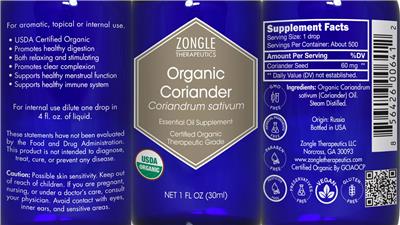
Promotes healthy digestion Both relaxing and stimulating Promotes clear complexion Supports healthy menstrual function Supports healthy immune function
USDA Certified Organic
Therapeutic grade
GMO free Artificial ingredients free Paraben free Pesticide free Preservative free Gluten free
Vegan
Origin: Russia Bottled in USA
Certified Organic by GCIAOCP
Suggested/Recommended/Usage/Directions
For aromatic, topical or internal use. For internal use dilute one drop in 4 fl. oz. of liquid.
FDA Disclaimer Statement
These statements have not been evaluated by the Food and Drug Administration. This product is not intended to diagnose, treat, cure, or prevent any disease.
Precautions
Caution: Possible skin sensitivity.
Keep out of reach of children.
If you are pregnant, nursing, or under a doctor's care, consult your physician.
Avoid contact with eyes, inner ears, and sensitive areas.
Formula
Coriandrum sativum
FDA Statement of Identity
Essential Oil Supplement
Seals/Symbols
USDA Organic
Is this label outdated? Report a formula or label change and our pharmacy team will review it.
Organic Coriander by Zongle Therapeutics label
The label scan from the NIH Dietary Supplement Label Database. Tap to enlarge.
Label images are published by the NIH Dietary Supplement Label Database for the version of this product on file. Always read your actual product label.
View the full label (PDF)The Ingredients in Organic Coriander by Zongle Therapeutics
This is the 1 active ingredient this product is made of. Select it to open its full monograph.
Serving size1 Drop(s) Dosage formLiquid Servings per container500 Amounts shown are per serving.
Coriander
Interacts with717 drugs
Coriander (also called cilantro) is a common cooking herb and spice that has long been used in traditional medicine for digestive complaints. As a foo...
Coriander monograph & interactionsOther (inactive) ingredients: Coriander Oil, Steam-Distilled. These complete the product’s ingredient list but are not active constituents.
Organic Coriander by Zongle Therapeutics Drug Interactions
HelloPharmacist Interaction Report
Zongle Therapeutics Organic Coriander is a single-ingredient liquid product that interacts with several medication types.
Through its coriander content, the most serious documented interaction is with antidiabetes drugs (blood sugar medications), where coriander may increase the risk of low blood sugar (hypoglycemia) — animal research suggests coriander fruit can lower blood glucose levels, and dose adjustments might be necessary if you're taking these medications.
Read the full breakdown — every affected drug type, severity by severity
Coriander also carries Moderate interactions with CNS depressants (sedating medications like benzodiazepines or opioids), where additive sedative effects are theoretically possible; with antihypertensive drugs (blood pressure medications), where coriander may increase the risk of dangerously low blood pressure; and with photosensitizing drugs, where coriander may increase the risk of photosensitivity reactions when you're exposed to sunlight or UV light.
Altogether, these interactions span 717 individual medications. If you take any prescription medication — especially for blood sugar control, blood pressure, anxiety, sleep, or any drug that makes you sun-sensitive — check your exact medications with the search tool on this page before you start.
Check your own medications below · Editorial policy · How we use AI
Want to check YOUR meds against Organic Coriander?
Ask about interactions with your drugs in plain English — “Can I take it with lisinopril?” — and we find you the answer in seconds, ingredient by ingredient.
Go to the checkerIngredients driving the most interactions
Individual Drug Interactions
The ingredients in Organic Coriander interact with 717 drugs. Click any drug to see the details.
1 of the 1 ingredient in Organic Coriander interact with drugs. Each result below shows which ingredient is responsible. Coriander
AcarboseGlucobay, Prandase, Precose
How Acarbose interacts with Organic Coriander — through 1 ingredient. Tap an ingredient for the detail:
CorianderAntidiabetes Drugs Moderate
Interaction Summary
Theoretically, coriander might increase the risk of hypoglycemia when taken with antidiabetes drugs.
Read the full Coriander + Acarbose interactionAcebutololRhotral, Sectral
How Acebutolol interacts with Organic Coriander — through 1 ingredient. Tap an ingredient for the detail:
CorianderAntihypertensive Drugs Moderate
Interaction Summary
Theoretically, coriander might increase the risk of hypotension when taken with antihypertensive drugs.
Read the full Coriander + Acebutolol interactionAcepromazineAtravet
How Acepromazine interacts with Organic Coriander — through 1 ingredient. Tap an ingredient for the detail:
CorianderPhotosensitizing Drugs, Cns Depressants Moderate
Interaction Summary
Theoretically, coriander might increase the risk of photosensitivity when taken with photosensitizing drugs.
Read the full Coriander + Acepromazine interactionAcetaminophen, Brompheniramine, PhenylpropanolamineDimetapp Cold and Flu
How Acetaminophen, Brompheniramine, Phenylpropanolamine interacts with Organic Coriander — through 1 ingredient. Tap an ingredient for the detail:
CorianderPhotosensitizing Drugs Moderate
Interaction Summary
Theoretically, coriander might increase the risk of photosensitivity when taken with photosensitizing drugs.
Read the full Coriander + Acetaminophen, Brompheniramine, Phenylpropanolamine interactionAcetaminophen, Butalbital, Caffeine, CodeineEsgic with Codeine, Fioricet w/ Codeine
How Acetaminophen, Butalbital, Caffeine, Codeine interacts with Organic Coriander — through 1 ingredient. Tap an ingredient for the detail:
CorianderCns Depressants Moderate
Interaction Summary
Theoretically, coriander might cause additive sedative effects when taken with CNS depressants.
Read the full Coriander + Acetaminophen, Butalbital, Caffeine, Codeine interactionAcetaminophen, Butalbital, CodeineBancap w/ Codeine
How Acetaminophen, Butalbital, Codeine interacts with Organic Coriander — through 1 ingredient. Tap an ingredient for the detail:
CorianderCns Depressants Moderate
Interaction Summary
Theoretically, coriander might cause additive sedative effects when taken with CNS depressants.
Read the full Coriander + Acetaminophen, Butalbital, Codeine interactionAcetaminophen, Butalbital, Codeine PhosphatePhrenilin #3
How Acetaminophen, Butalbital, Codeine Phosphate interacts with Organic Coriander — through 1 ingredient. Tap an ingredient for the detail:
CorianderCns Depressants Moderate
Interaction Summary
Theoretically, coriander might cause additive sedative effects when taken with CNS depressants.
Read the full Coriander + Acetaminophen, Butalbital, Codeine Phosphate interactionAcetaminophen, Caffeine, Chlorpheniramine, Hydrocodone, PhenylephrineHycomine Compound
How Acetaminophen, Caffeine, Chlorpheniramine, Hydrocodone, Phenylephrine interacts with Organic Coriander — through 1 ingredient. Tap an ingredient for the detail:
CorianderCns Depressants, Photosensitizing Drugs Moderate
Interaction Summary
Theoretically, coriander might cause additive sedative effects when taken with CNS depressants.
Read the full Coriander + Acetaminophen, Caffeine, Chlorpheniramine, Hydrocodone, Phenylephrine interactionAcetaminophen, Caffeine, CodeineGesic C15, Gesic C30, Gesic C8, Lenoltec 1, Lenoltec 2, Lenoltec 3 +1 more
How Acetaminophen, Caffeine, Codeine interacts with Organic Coriander — through 1 ingredient. Tap an ingredient for the detail:
CorianderCns Depressants Moderate
Interaction Summary
Theoretically, coriander might cause additive sedative effects when taken with CNS depressants.
Read the full Coriander + Acetaminophen, Caffeine, Codeine interactionAcetaminophen, Caffeine, Codeine, SalicylamideCodalan No.1, Codalan No.2, Codalan No.3
How Acetaminophen, Caffeine, Codeine, Salicylamide interacts with Organic Coriander — through 1 ingredient. Tap an ingredient for the detail:
CorianderCns Depressants Moderate
Interaction Summary
Theoretically, coriander might cause additive sedative effects when taken with CNS depressants.
Read the full Coriander + Acetaminophen, Caffeine, Codeine, Salicylamide interactionAcetaminophen, Caffeine, DihydrocodeineDHC Plus, Panlor DC, Panlor SS
How Acetaminophen, Caffeine, Dihydrocodeine interacts with Organic Coriander — through 1 ingredient. Tap an ingredient for the detail:
CorianderCns Depressants Moderate
Interaction Summary
Theoretically, coriander might cause additive sedative effects when taken with CNS depressants.
Read the full Coriander + Acetaminophen, Caffeine, Dihydrocodeine interactionAcetaminophen, Chlorpheniramine Maleate, Dextromethorphan HbrVicks Formula 44M Cough, Cold & Flu Relief
How Acetaminophen, Chlorpheniramine Maleate, Dextromethorphan Hbr interacts with Organic Coriander — through 1 ingredient. Tap an ingredient for the detail:
CorianderPhotosensitizing Drugs Moderate
Interaction Summary
Theoretically, coriander might increase the risk of photosensitivity when taken with photosensitizing drugs.
Read the full Coriander + Acetaminophen, Chlorpheniramine Maleate, Dextromethorphan Hbr interactionAcetaminophen, Chlorpheniramine, Codeine, PhenylephrineColrex
How Acetaminophen, Chlorpheniramine, Codeine, Phenylephrine interacts with Organic Coriander — through 1 ingredient. Tap an ingredient for the detail:
CorianderCns Depressants, Photosensitizing Drugs Moderate
Interaction Summary
Theoretically, coriander might cause additive sedative effects when taken with CNS depressants.
Read the full Coriander + Acetaminophen, Chlorpheniramine, Codeine, Phenylephrine interactionAcetaminophen, Chlorpheniramine, DextromethorphanCoricidin II Extra Strength Cold and Flu
How Acetaminophen, Chlorpheniramine, Dextromethorphan interacts with Organic Coriander — through 1 ingredient. Tap an ingredient for the detail:
CorianderPhotosensitizing Drugs Moderate
Interaction Summary
Theoretically, coriander might increase the risk of photosensitivity when taken with photosensitizing drugs.
Read the full Coriander + Acetaminophen, Chlorpheniramine, Dextromethorphan interactionAcetaminophen, Chlorpheniramine, Dextromethorphan HydrobromideCoricidin HBP Maximum Strength Flu
How Acetaminophen, Chlorpheniramine, Dextromethorphan Hydrobromide interacts with Organic Coriander — through 1 ingredient. Tap an ingredient for the detail:
CorianderPhotosensitizing Drugs Moderate
Interaction Summary
Theoretically, coriander might increase the risk of photosensitivity when taken with photosensitizing drugs.
Read the full Coriander + Acetaminophen, Chlorpheniramine, Dextromethorphan Hydrobromide interactionAcetaminophen, Chlorpheniramine, Dextromethorphan, PhenylpropanolamineMulti Symptom Cold Relief
How Acetaminophen, Chlorpheniramine, Dextromethorphan, Phenylpropanolamine interacts with Organic Coriander — through 1 ingredient. Tap an ingredient for the detail:
CorianderPhotosensitizing Drugs Moderate
Interaction Summary
Theoretically, coriander might increase the risk of photosensitivity when taken with photosensitizing drugs.
Read the full Coriander + Acetaminophen, Chlorpheniramine, Dextromethorphan, Phenylpropanolamine interactionAcetaminophen, Chlorpheniramine, Dextromethorphan, PseudoephedrineChildren's Tylenol Cold Plus Cough, Tylenol Cold Ex Strength
How Acetaminophen, Chlorpheniramine, Dextromethorphan, Pseudoephedrine interacts with Organic Coriander — through 1 ingredient. Tap an ingredient for the detail:
CorianderPhotosensitizing Drugs Moderate
Interaction Summary
Theoretically, coriander might increase the risk of photosensitivity when taken with photosensitizing drugs.
Read the full Coriander + Acetaminophen, Chlorpheniramine, Dextromethorphan, Pseudoephedrine interactionAcetaminophen, Chlorpheniramine, Guaifenesin, Phenylephrine, SalicylamideRhinogesic GG
How Acetaminophen, Chlorpheniramine, Guaifenesin, Phenylephrine, Salicylamide interacts with Organic Coriander — through 1 ingredient. Tap an ingredient for the detail:
CorianderPhotosensitizing Drugs Moderate
Interaction Summary
Theoretically, coriander might increase the risk of photosensitivity when taken with photosensitizing drugs.
Read the full Coriander + Acetaminophen, Chlorpheniramine, Guaifenesin, Phenylephrine, Salicylamide interactionAcetaminophen, Chlorpheniramine, PhenylephrineAlka-Seltzer PLUS, Histex SR, Protid
How Acetaminophen, Chlorpheniramine, Phenylephrine interacts with Organic Coriander — through 1 ingredient. Tap an ingredient for the detail:
CorianderPhotosensitizing Drugs Moderate
Interaction Summary
Theoretically, coriander might increase the risk of photosensitivity when taken with photosensitizing drugs.
Read the full Coriander + Acetaminophen, Chlorpheniramine, Phenylephrine interactionAcetaminophen, Chlorpheniramine, Phenylephrine, SalicylamideRhinogesic, Rhinogesic JR
How Acetaminophen, Chlorpheniramine, Phenylephrine, Salicylamide interacts with Organic Coriander — through 1 ingredient. Tap an ingredient for the detail:
CorianderPhotosensitizing Drugs Moderate
Interaction Summary
Theoretically, coriander might increase the risk of photosensitivity when taken with photosensitizing drugs.
Read the full Coriander + Acetaminophen, Chlorpheniramine, Phenylephrine, Salicylamide interactionAcetaminophen, Chlorpheniramine, PhenylpropanolamineAlumadrine, Conex, Sinadrin Max Strength, Sinulin
How Acetaminophen, Chlorpheniramine, Phenylpropanolamine interacts with Organic Coriander — through 1 ingredient. Tap an ingredient for the detail:
CorianderPhotosensitizing Drugs Moderate
Interaction Summary
Theoretically, coriander might increase the risk of photosensitivity when taken with photosensitizing drugs.
Read the full Coriander + Acetaminophen, Chlorpheniramine, Phenylpropanolamine interactionAcetaminophen, Chlorpheniramine, Phenylpropanolamine, OpiumHista-Derfule
How Acetaminophen, Chlorpheniramine, Phenylpropanolamine, Opium interacts with Organic Coriander — through 1 ingredient. Tap an ingredient for the detail:
CorianderCns Depressants, Photosensitizing Drugs Moderate
Interaction Summary
Theoretically, coriander might cause additive sedative effects when taken with CNS depressants.
Read the full Coriander + Acetaminophen, Chlorpheniramine, Phenylpropanolamine, Opium interactionAcetaminophen, Chlorpheniramine, Phenylpropanolamine, PhenyltoloxamineNorel Plus
How Acetaminophen, Chlorpheniramine, Phenylpropanolamine, Phenyltoloxamine interacts with Organic Coriander — through 1 ingredient. Tap an ingredient for the detail:
CorianderPhotosensitizing Drugs Moderate
Interaction Summary
Theoretically, coriander might increase the risk of photosensitivity when taken with photosensitizing drugs.
Read the full Coriander + Acetaminophen, Chlorpheniramine, Phenylpropanolamine, Phenyltoloxamine interactionAcetaminophen, Chlorpheniramine, PseudoephedrineAlka-Seltzer PLUS Liquid Gels, Children's Tylenol Cold, Codimal, Comtrex, Extra Strength Tylenol Allergy Sinus, Lorsin +3 more
How Acetaminophen, Chlorpheniramine, Pseudoephedrine interacts with Organic Coriander — through 1 ingredient. Tap an ingredient for the detail:
CorianderPhotosensitizing Drugs Moderate
Interaction Summary
Theoretically, coriander might increase the risk of photosensitivity when taken with photosensitizing drugs.
Read the full Coriander + Acetaminophen, Chlorpheniramine, Pseudoephedrine interactionAcetaminophen, Chlorzoxazone, CodeineAcetazone Forte C8, Parafon Forte C8
How Acetaminophen, Chlorzoxazone, Codeine interacts with Organic Coriander — through 1 ingredient. Tap an ingredient for the detail:
CorianderCns Depressants Moderate
Interaction Summary
Theoretically, coriander might cause additive sedative effects when taken with CNS depressants.
Read the full Coriander + Acetaminophen, Chlorzoxazone, Codeine interactionAcetaminophen, CodeineTylenol No.3, Tylenol w/ Codeine
How Acetaminophen, Codeine interacts with Organic Coriander — through 1 ingredient. Tap an ingredient for the detail:
CorianderCns Depressants Moderate
Interaction Summary
Theoretically, coriander might cause additive sedative effects when taken with CNS depressants.
Read the full Coriander + Acetaminophen, Codeine interactionAcetaminophen, Codeine, DoxylamineMersyndol
How Acetaminophen, Codeine, Doxylamine interacts with Organic Coriander — through 1 ingredient. Tap an ingredient for the detail:
CorianderCns Depressants Moderate
Interaction Summary
Theoretically, coriander might cause additive sedative effects when taken with CNS depressants.
Read the full Coriander + Acetaminophen, Codeine, Doxylamine interactionAcetaminophen, Codeine, MethocarbamolAcetaminophen, Codeine, Methocarbamol, Robaxacet 8
How Acetaminophen, Codeine, Methocarbamol interacts with Organic Coriander — through 1 ingredient. Tap an ingredient for the detail:
CorianderCns Depressants Moderate
Interaction Summary
Theoretically, coriander might cause additive sedative effects when taken with CNS depressants.
Read the full Coriander + Acetaminophen, Codeine, Methocarbamol interactionAcetaminophen, Dexbrompheniramine, PseudoephedrineSinadrin Plus
How Acetaminophen, Dexbrompheniramine, Pseudoephedrine interacts with Organic Coriander — through 1 ingredient. Tap an ingredient for the detail:
CorianderPhotosensitizing Drugs Moderate
Interaction Summary
Theoretically, coriander might increase the risk of photosensitivity when taken with photosensitizing drugs.
Read the full Coriander + Acetaminophen, Dexbrompheniramine, Pseudoephedrine interactionAcetaminophen, Dichloralantipyrine, IsomethepteneAmidrine, Midchlor, Migquin, Migratine
How Acetaminophen, Dichloralantipyrine, Isometheptene interacts with Organic Coriander — through 1 ingredient. Tap an ingredient for the detail:
CorianderCns Depressants Moderate
Interaction Summary
Theoretically, coriander might cause additive sedative effects when taken with CNS depressants.
Read the full Coriander + Acetaminophen, Dichloralantipyrine, Isometheptene interactionEach ingredient & the kinds of drugs it affects
For each ingredient in Organic Coriander with known interactions, here are the types of medications it can affect. Open any type for the detail — or search your exact drug in the checker above.
Coriander
Antidiabetes Drugs
Theoretically, coriander might increase the risk of hypoglycemia when taken with antidiabetes drugs.
Evidence from animal research suggests that coriander fruit and coriander extract can reduce blood glucose levels. Monitor blood glucose levels closely. Dose adjustments might be necessary.
Antihypertensive Drugs
Theoretically, coriander might increase the risk of hypotension when taken with antihypertensive drugs.
Evidence from animal research suggests that coriander fruit can lower blood pressure.
Cns Depressants
Theoretically, coriander might cause additive sedative effects when taken with CNS depressants.
Evidence from animal research suggests that coriander fruit extract has sedative effects.
Photosensitizing Drugs
Theoretically, coriander might increase the risk of photosensitivity when taken with photosensitizing drugs.
Evidence from in vitro research suggests that coriandrin, a constituent of coriander, has photosensitizing effects.
Brand information
Manufacturer and brand details for Organic Coriander, from the product label.
Zongle Therapeutics
See all Zongle Therapeutics products- Name
- Zongle Therapeutics LLC
- City
- Norcross
- State
- GA
- ZipCode
- 30093
- Web Address
- www.zongletherapeutics.com
Organic Coriander by Zongle Therapeutics: Common Questions
Does Organic Coriander by Zongle Therapeutics interact with any medications?
How can one product interact with so many drugs?
Where does this information come from?
Is coriander safe in regular food amounts?
Can coriander cause allergic reactions?
Can I use this if I'm on blood pressure or blood sugar medication?
What does this product treat?
What are the side effects?
Written and reviewed by the HelloPharmacist editorial staff. Our editorial policy
Not sure if Organic Coriander is safe with your meds?
Our pharmacists answer your medication & supplement questions — free.
Label information is sourced from the NIH Dietary Supplement Label Database and reflects the product version on file; always read your actual product label. This page is for education only and is not a substitute for professional medical advice. Confirm with your pharmacist or doctor before combining supplements and medications.
The Full Monographs Behind Organic Coriander’s Ingredients
Every ingredient we hold a full HelloPharmacist monograph for — uses, evidence, safety, and the complete interaction list.
Sources & How We Checked
Organic Coriander's label data comes from the NIH Dietary Supplement Label Database; the ingredient interaction data is from the Natural Medicines database, reviewed by our pharmacists.
- NIH Dietary Supplement Label Database (DSLD) — The official product label on file for this supplement.
- Natural Medicines (Therapeutic Research Center) — Evidence-graded clinical reference behind the ingredient interaction data.
Content is written and reviewed by licensed HelloPharmacist pharmacists. See our data sources and editorial standards for how this information is built and checked.
The 12 references behind this product’s interaction data
Every citation that drives the interaction findings for this product’s ingredients, from the evidence-graded Natural Medicines (TRC Healthcare) database. Open an ingredient to browse its citations — links open the study on PubMed or the publisher’s site.
Coriander 12 references
- Brinker F. Herb Contraindications and Drug Interactions. 2nd ed. Sandy, OR: Eclectic Medical Publications, 1998.
- Swanston-Flatt SK, Day C, Bailey CJ, Flatt PR. Traditional plant treatments for diabetes. Studies in normal and streptozotocin diabetic mice. Diabetologia 1990;33:462-4. PubMed
- Gray, A. M. and Flatt, P. R. Insulin-releasing and insulin-like activity of the traditional anti-diabetic plant Coriandrum sativum (coriander). Br.J Nutr. 1999;81(3):203-209.
- Kanerva, L. and Soini, M. Occupational protein contact dermatitis from coriander. Contact Dermatitis 2001;45(6):354-355. PubMed
- Emamghoreishi, M., Khasaki, M., and Aazam, M. F. Coriandrum sativum: evaluation of its anxiolytic effect in the elevated plus-maze. J Ethnopharmacol. 1-15-2005;96(3):365-370. PubMed
- Ebo, D. G., Bridts, C. H., Mertens, M. H., and Stevens, W. J. Coriander anaphylaxis in a spice grinder with undetected occupational allergy. Acta Clin Belg. 2006;61(3):152-156. PubMed
- Eidi, M., Eidi, A., Saeidi, A., Molanaei, S., Sadeghipour, A., Bahar, M., and Bahar, K. Effect of coriander seed (Coriandrum sativum L.) ethanol extract on insulin release from pancreatic beta cells in streptozotocin-induced diabetic rats. Phytother.Res
- Jabeen, Q., Bashir, S., Lyoussi, B., and Gilani, A. H. Coriander fruit exhibits gut modulatory, blood pressure lowering and diuretic activities. J Ethnopharmacol. 2-25-2009;122(1):123-130. PubMed
- van Toorenenbergen, A. W. and Dieges, P. H. Immunoglobulin E antibodies against coriander and other spices. J Allergy Clin Immunol. 1985;76(3):477-481. PubMed
- Ashwood-Smith, M. J., Warrington, P. J., Jenkins, M., Ceska, O., and Romaniuk, P. J. Photobiological properties of a novel, naturally occurring furoisocoumarin, coriandrin. Photochem.Photobiol. 1989;50(6):745-751. PubMed
- Sastre, J., Olmo, M., Novalvos, A., Ibanez, D., and Lahoz, C. Occupational asthma due to different spices. Allergy 1996;51(2):117-120. PubMed
- Beikert FC, Anastasiadou Z, Fritzen B, Frank U, Augustin M. Topical treatment of tinea pedis using 6% coriander oil in unguentum leniens: a randomized, controlled, comparative pilot study. Dermatology. 2013;226(1):47-51. PubMed
Parts of this content are provided by the Therapeutic Research Center, LLC.
DISCLAIMER: Currently this does not check for drug-drug interactions. This is not an all-inclusive comprehensive list of potential interactions and is for informational purposes only. Not all interactions are known or well-reported in the scientific literature, and new interactions are continually being reported. Input is needed from a qualified healthcare provider including a pharmacist before starting any therapy. Application of clinical judgment is necessary.
© 2021 Therapeutic Research Center, LLC