
Pan Ingredients & Drug Interactions
What is this page for?
First and foremost: checking Pan against your medications. The heart of this page is the interaction checker and the full interaction report — how this product’s ingredients may interact with prescription and over-the-counter medicines you may be taking.
Around that, we add a pharmacist’s high-level view of the product as a whole — what’s inside, the evidence for its stated use, how transparent the label is, and what safety data exists — so you can see the full picture in one place. It’s educational information from our licensed clinical databases and the clinical staff at HelloPharmacist — not medical advice — and we don’t sell or endorse products. Our editorial policy
Pan is a dietary supplement by Loomis Enzymes with 10 active ingredients. Its ingredients are commonly taken for digestion and bloating, muscle soreness and exercise recovery, inflammation and swelling.We don’t currently list a known drug interaction for its mapped ingredients — but that doesn’t guarantee none exist, so always confirm with your pharmacist.
HelloPharmacist Scorecard of Pan by Loomis Enzymes
Our pharmacy team’s full take, with four database checks built into the cards below — a summary of what is known, not a grade of the product itself.
What’s inside
Low disclosure
Pan contains 10 active digestive enzymes. The three we can identify are protease (breaks down proteins), lipase (breaks down fats), and lactase (breaks down lactose in dairy).
The product also contains seven other enzymes — amylase, cellulase, invertase, glucoamylase, hemicellulase, alpha-galactosidase, and diastase — designed to help digest different food components. A proprietary enzyme blend is listed as a separate ingredient; its exact makeup isn't disclosed.
The capsule itself is made from cellulose, and the product includes water and phytase as inactive ingredients.
Does it work?
Strong evidence
Lactase in this product is effective for lactose intolerance — that's the main digestive use with solid evidence. The other enzymes — protease, lipase, cellulase, and the rest — don't have established effectiveness ratings in the data we hold.
For conditions like dyspepsia (indigestion) or inflammatory bowel disease, the evidence for any of these enzymes is insufficient to say whether they work. Your own digestion and symptom relief are the best guides to whether it helps you.
How safe is it?
Well-documented data
Protease, lipase, and lactase are generally well tolerated in adults, though some people report digestive upset or, rarely, allergic reactions. Lactase is the only one rated likely safe in pregnancy; the others lack solid safety data in pregnancy and aren't recommended without a doctor's okay.
For breastfeeding, safety data is limited for all three — check with your healthcare provider first. In occupational settings, protease powder has rarely caused allergic rhinitis or asthma with airborne exposure; normal use of the supplement shouldn't pose that risk.
Meds to double-check
No known interactions
No interactions are documented in our data for the ingredients we could check. That said, we don't hold safety data for amylase, cellulase, invertase, glucoamylase, hemicellulase, alpha-galactosidase, or diastase, so if you take medications regularly, it's smart to verify your specific drugs with the search tool below.
The bottom line
Scorecard at a glanceFormula with limited ingredient disclosure with clinical evidence supporting its stated purpose. No medication interactions are currently documented, and safety information is well characterized.
Pan is a broad-spectrum digestive enzyme blend most useful if you have trouble breaking down lactose or if you want general digestive support. If you're pregnant, breastfeeding, or have serious digestive conditions, talk to your doctor or pharmacist before starting.
Check your medications using the tool on this page, especially if you take anything regularly.
Educational only — not medical advice; always confirm with your pharmacist. Our editorial policy · How we use AI
Assessment coverage: 3 of 10 active ingredients matched to our full ingredient reviews (monographs). Based on the product label dated Feb 23, 2025.
This Scorecard evaluates available label information, ingredient evidence, and known medication-safety considerations. It does not independently verify product identity, purity, potency, contamination, or manufacturing quality. How these ratings are computed
General information
Key facts about Pan, straight from the product label.
| Brand | Loomis Enzymes |
|---|---|
| Barcode (UPC) | 697706044430 |
| Net contents | 30 Capsule(s) |
| Market status | On market |
| Date entered into DSLD | Feb 23, 2025 |
| DSLD ID | 327439 |
| Product type | Non-nutrient/non-botanical |
| Supplement form | Capsule |
| Dietary claims / uses | All Other |
| Intended target group(s) | Adult (18 - 50 Years) |
Everything in this section is reproduced from the manufacturer’s own product label — it’s the label speaking, not HelloPharmacist. We show it so you can see exactly what the maker states; we don’t verify or endorse those statements.
Supplement Facts
The label details for Pan by Loomis Enzymes, sourced from the NIH Dietary Supplement Label Database.
Supplement Facts
| Ingredient | Amount | % DV |
|---|---|---|
| Amylase | 0 NP | -- |
| Protease | 0 NP | -- |
| Lipase | 0 NP | -- |
| Lactase | 0 NP | -- |
| Cellulase | 0 NP | -- |
| Invertase | 0 NP | -- |
| Glucoamylase | 0 NP | -- |
| Hemicellulase | 0 NP | -- |
| Alpha-Galactosidase | 0 NP | -- |
| Proprietary Enzyme Blend | 556 mg | -- |
| Diastase | 0 NP | -- |
Other ingredients: Cellulose, Water, Phytase
Tap any ingredient to jump to its full detail below.
These statements are the manufacturer’s wording, reproduced from the product label — the label is saying it, not HelloPharmacist. We don’t verify or endorse them.
Precautions
Keep out of reach of children
Note: Consult your physician before using this product if you are pregnant, nursing, taking medication, or have a medical condition.
Do not use if inner or outer seal is broken, torn, or missing.
Storage
To ensure freshness and potency, keep bottle tightly closed and store in a cool, dry place.
FDA Statement of Identity
A Dietary Supplement
Suggested/Recommended/Usage/Directions
Directions for use: Take 2 capsules, 3 times daily between meals or as directed.
Is this label outdated? Report a formula or label change and our pharmacy team will review it.
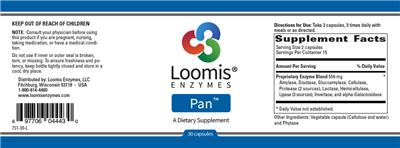
Pan by Loomis Enzymes label
The label scan from the NIH Dietary Supplement Label Database. Tap to enlarge.
Label images are published by the NIH Dietary Supplement Label Database for the version of this product on file. Always read your actual product label.
View the full label (PDF)The Ingredients in Pan by Loomis Enzymes
These are the 10 active ingredients this product is made of. Select any to open its full monograph.
Serving size2 Capsule(s) Dosage formCapsule Servings per container15 Amounts shown are per serving.
Most supplement products combine several ingredients, and a medication can interact with the product through any one of them. Each ingredient below shows whether it has known drug interactions.
Other (inactive) ingredients: Cellulose, Water, Phytase. These complete the product’s ingredient list but are not active constituents.
Pan by Loomis Enzymes Drug Interactions
We don’t currently list any known drug interactions for the mapped ingredients in Pan. This doesn’t guarantee none exist — always confirm with your pharmacist before combining a supplement with your medications.
Brand information
Manufacturer and brand details for Pan, from the product label.
Loomis Enzymes
See all Loomis Enzymes products- Name
- Loomis Enzymes, LLC
- City
- Fitchburg
- State
- Wisconsin
- ZipCode
- 53719
- Phone Number
- 1-800-614-4400
- Web Address
- www.loomisenzymes.com
Pan by Loomis Enzymes: Common Questions
Does Pan by Loomis Enzymes interact with any medications?
How can one product interact with so many drugs?
Where does this information come from?
Will this help my lactose intolerance?
Can I take Pan if I'm pregnant?
What if I'm breastfeeding?
Can I be allergic to these enzymes?
Does Pan work for gas and bloating?
Are there fillers in Pan?
Written and reviewed by the HelloPharmacist editorial staff. Our editorial policy
Not sure if Pan is safe with your meds?
Our pharmacists answer your medication & supplement questions — free.
Label information is sourced from the NIH Dietary Supplement Label Database and reflects the product version on file; always read your actual product label. This page is for education only and is not a substitute for professional medical advice. Confirm with your pharmacist or doctor before combining supplements and medications.
The Full Monographs Behind Pan’s Ingredients
Every ingredient we hold a full HelloPharmacist monograph for — uses, evidence, safety, and the complete interaction list.
Proteolytic Enzymes (proteases)
Proteolytic enzymes are proteins that help break down other proteins, and common examples include bromelain (from pineapple), papain (from papaya), trypsin, chymotrypsin, and pancreatin. Peo...
Read the full Proteolytic Enzymes (proteases) monograph → Herb & supplement monographLipase
Lipase is a digestive enzyme that helps your body break down dietary fats. It is well established as part of prescription pancreatic enzyme therapy for people who cannot make enough of their...
Read the full Lipase monograph → Herb & supplement monographLactase
Lactase is a digestive enzyme supplement that helps people who lack enough natural lactase break down lactose, the sugar in milk and dairy. It can reduce gas, bloating, cramping, and diarrhe...
Read the full Lactase monograph →Sources & How We Checked
Pan's label data comes from the NIH Dietary Supplement Label Database; the ingredient interaction data is from the Natural Medicines database, reviewed by our pharmacists.
- NIH Dietary Supplement Label Database (DSLD) — The official product label on file for this supplement.
- Natural Medicines (Therapeutic Research Center) — Evidence-graded clinical reference behind the ingredient interaction data.
Content is written and reviewed by licensed HelloPharmacist pharmacists. See our data sources and editorial standards for how this information is built and checked.
The 5 references behind this product’s interaction data
Every citation that drives the interaction findings for this product’s ingredients, from the evidence-graded Natural Medicines (TRC Healthcare) database. Open an ingredient to browse its citations — links open the study on PubMed or the publisher’s site.
Proteolytic Enzymes (proteases) 3 references
- Weeks JA, Harper RA, Simon RA, Burdick JD. Assessment of sensitization risk of a laundry pre-spotter containing protease. Cutan Ocul Toxicol. 2011;30(4):272-9. PubMed
- Marquès LI, Lara S, Abós T, Bartolomé B. Occupational rhinitis due to pepsin. J Investig Allergol Clin Immunol. 2006;16(2):136-7. DOI
- Cartier A, Malo JL, Pineau L, Dolovich J. Occupational asthma due to pepsin. J Allergy Clin Immunol. 1984;73(5 Pt 1):574-7. PubMed
See these in context on the Proteolytic Enzymes (proteases) monograph →
Lipase 1 reference
- Casper C, Hascoet JM, Ertl T, et al. Recombinant bile salt-stimulated lipase in preterm infant feeding: A randomized phase 3 study. PLoS One. 2016;11(5):e0156071. PubMed
Lactase 1 reference
- Laukkanen A, Ruoppi P, Remes S, Koistinen T, Mäkinen-Kiljunen S. Lactase-induced occupational protein contact dermatitis and allergic rhinoconjunctivitis. Contact Dermatitis. 2007;57(2):89-93. PubMed
Parts of this content are provided by the Therapeutic Research Center, LLC.
DISCLAIMER: Currently this does not check for drug-drug interactions. This is not an all-inclusive comprehensive list of potential interactions and is for informational purposes only. Not all interactions are known or well-reported in the scientific literature, and new interactions are continually being reported. Input is needed from a qualified healthcare provider including a pharmacist before starting any therapy. Application of clinical judgment is necessary.
© 2021 Therapeutic Research Center, LLC