
Red Yeast Rice 600 mg Ingredients & Drug Interactions
by 21st Century
What is this page for?
First and foremost: checking Red Yeast Rice 600 mg against your medications. The heart of this page is the interaction checker and the full interaction report — how this product’s ingredients may interact with prescription and over-the-counter medicines you may be taking.
Around that, we add a pharmacist’s high-level view of the product as a whole — what’s inside, the evidence for its stated use, how transparent the label is, and what safety data exists — so you can see the full picture in one place. It’s educational information from our licensed clinical databases and the clinical staff at HelloPharmacist — not medical advice — and we don’t sell or endorse products. Our editorial policy
Red Yeast Rice 600 mg is a dietary supplement by 21st Century with 1 active ingredient. Its ingredients are commonly taken for high cholesterol, heart health, metabolic syndrome.Based on those ingredients, 478 medications have a known interaction with it, the most serious rated moderate. The ingredients most likely to interact are Red Yeast Rice, Powder. Use the checker below to test your specific medication, or read the full HelloPharmacist Interaction Report.
Check Your Meds Against Red Yeast Rice 600 mg by 21st Century
Ask about any prescription or over-the-counter medication and we check it for interactions with Red Yeast Rice 600 mg by 21st Century — and tell you which ingredient is responsible.
AI summaries are generated from our interaction database for education only — always confirm with your pharmacist. How we use AI
Ask the Pharmacist
A licensed pharmacist will answer your question by email — free, usually within 24 hours.
Got it — thank you!
A licensed pharmacist will answer within 24 hours. Keep an eye on your email (worth checking spam, just in case).
HelloPharmacist Scorecard of Red Yeast Rice 600 mg by 21st Century
Our pharmacy team’s full take, with four database checks built into the cards below — a summary of what is known, not a grade of the product itself.
What’s inside
Full disclosure
This product contains one active ingredient: red yeast rice powder at 600 mg per capsule. Red yeast rice is a fermented product that naturally contains lovastatin, a compound belonging to the statin drug family—the same class of medications doctors prescribe to manage cholesterol.
The capsule also contains inactive ingredients (cellulose, maltodextrin, magnesium stearate, oat fiber, rice bran, and silicon dioxide) that serve as fillers and binders.
Does it work?
Not established
Red yeast rice is possibly effective for HIV/AIDS-related high cholesterol and for reducing the risk of heart attack. The evidence in our data is limited to these uses, and both are rated as possibly effective rather than proven.
How safe is it?
Well-documented data
Red yeast rice is generally well tolerated, though it does carry the same risks as statin drugs since it contains lovastatin. The most common side effects are abdominal discomfort, diarrhea, dizziness, flatulence, headache, heartburn, muscle pain, and nausea.
Rare but serious risks include liver damage and rhabdomyolysis (severe muscle breakdown), which are more likely if you're taking medications that interact with it or if the product is contaminated. Cases of skin rash, hair loss, and nerve tingling have also been reported.
Red yeast rice is not safe during pregnancy because of its statin-like effects. Safety data during breastfeeding is also insufficient—there is no information on file.
Talk with your pharmacist or doctor before using this product if you're pregnant, breastfeeding, or planning to become pregnant.
Meds to double-check
Moderate interaction found
Before taking this product, double-check with your pharmacist if you use cyclosporine, other statins, CYP3A4 inhibitors, gemfibrozil, high-dose niacin, or any drug that can damage the liver. All carry Moderate risk of muscle injury or worsened side effects when combined with the lovastatin in red yeast rice.
The bottom line
Scorecard at a glanceFully disclosed formula with no established evidence rating for its marketed use. Moderate medication interactions have been identified, and safety information is well characterized.
Red yeast rice may help with cholesterol management in HIV/AIDS-related high cholesterol or heart attack prevention, but it works like a prescription statin and carries similar risks. If you take any medication—especially cyclosporine, other statins, gemfibrozil, or high-dose niacin—check with your pharmacist before starting.
Avoid it if you're pregnant or breastfeeding.
Educational only — not medical advice; always confirm with your pharmacist. Our editorial policy · How we use AI
Assessment coverage: 1 of 1 active ingredient matched to our full ingredient reviews (monographs). Based on the product label dated Mar 25, 2025.
This Scorecard evaluates available label information, ingredient evidence, and known medication-safety considerations. It does not independently verify product identity, purity, potency, contamination, or manufacturing quality. How these ratings are computed
General information
Key facts about Red Yeast Rice 600 mg, straight from the product label.
| Brand | 21st Century |
|---|---|
| Barcode (UPC) | 740985229088 |
| Net contents | 150 Vegetarian Capsule(s) |
| Market status | On market |
| Date entered into DSLD | Mar 25, 2025 |
| DSLD ID | 326342 |
| Product type | Botanical |
| Supplement form | Capsule |
| Dietary claims / uses | All Other, Structure/Function |
| Intended target group(s) | Vegan, Vegetarian, Adult (18 - 50 Years), Women (not pregnant or lactating), Gluten Free, Dairy Free |
Everything in this section is reproduced from the manufacturer’s own product label — it’s the label speaking, not HelloPharmacist. We show it so you can see exactly what the maker states; we don’t verify or endorse those statements.
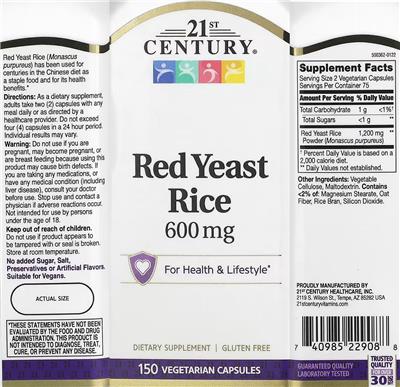
Supplement Facts
The label details for Red Yeast Rice 600 mg by 21st Century, sourced from the NIH Dietary Supplement Label Database.
Supplement Facts
| Ingredient | Amount | % DV |
|---|---|---|
| Total Carbohydrates | 1 Gram(s) | 1% |
| Total Sugars | 1 Gram(s) | -- |
| Red Yeast Rice, Powder | 1200 mg | -- |
Other ingredients: Cellulose, Maltodextrin, Magnesium Stearate, Oat Fiber, Rice Bran, Silicon Dioxide
Tap any ingredient to jump to its full detail below.
These statements are the manufacturer’s wording, reproduced from the product label — the label is saying it, not HelloPharmacist. We don’t verify or endorse them.
Formula
Red Yeast Rice (Monascus purpureus) has been used for centuries in the Chinese diet as a staple food and for its health benefits.
Suggested/Recommended/Usage/Directions
Directions: As a dietary supplement, adults take two (2) capsules with any meal daily or as directed by a healthcare provider.
Precautions
Do not exceed four (4) capsules in a 24 hour period. Individual results may vary. Stop use and contact a physician if adverse reactions occur. Do not use if product appears to be tampered with or seal is broken.
Warning: Do not use if you are pregnant, may become pregnant, or are breast feeding because using this product may cause birth defects. If you are taking any medication, or have any medical condition (including liver disease), consult your doctor before use.
Not intended for use by persons under the age of 18. Keep out of reach of children.
Storage
Store at room temperature.
Formulation
No added sugar, salt, preservatives or artificial flavors.
Suitable for vegans.
For health & lifestyle
Gluten free
Guaranteed quality Laboratory tested
FDA Disclaimer Statement
These statements have not been evaluated by the Food and Drug Administration. This product is not intended to diagnose, treat, cure, or prevent any disease.
FDA Statement of Identity
Dietary Supplement
Seals/Symbols
Trusted Quality For Over 30 Years
Is this label outdated? Report a formula or label change and our pharmacy team will review it.
Red Yeast Rice 600 mg by 21st Century label
The label scan from the NIH Dietary Supplement Label Database. Tap to enlarge.
Label images are published by the NIH Dietary Supplement Label Database for the version of this product on file. Always read your actual product label.
View the full label (PDF)The Ingredients in Red Yeast Rice 600 mg by 21st Century
This is the 1 active ingredient this product is made of. Select it to open its full monograph.
Serving size2 Vegetarian Capsule(s) Dosage formCapsule Servings per container75 Amounts shown are per serving.
Red Yeast Rice, Powder
Interacts with478 drugs
Red yeast rice contains monacolin K, which is chemically identical to the prescription statin lovastatin, and it can lower LDL ('bad') cholesterol. Be...
Red Yeast Rice, Powder monograph & interactionsOther (inactive) ingredients: Cellulose, Maltodextrin, Magnesium Stearate, Oat Fiber, Rice Bran, Silicon Dioxide. These complete the product’s ingredient list but are not active constituents.
Red Yeast Rice 600 mg by 21st Century Drug Interactions
HelloPharmacist Interaction Report
21st Century Red Yeast Rice 600 mg contains lovastatin, a statin drug, which means it can interact with several medication types.
The most serious concern is combining it with cyclosporine (an immunosuppressant), which can raise lovastatin levels dramatically and cause muscle breakdown (myopathy) or a severe muscle condition called rhabdomyolysis.
Read the full breakdown — every affected drug type, severity by severity
You'll also want to check before combining this with other statins, drugs that slow liver metabolism (CYP3A4 inhibitors), gemfibrozil (a cholesterol medication), high-dose niacin, or any hepatotoxic drugs—all of which carry Moderate risk of muscle injury, liver damage, or worsening statin side effects. The lovastatin content in red yeast rice varies by batch, which makes the risk harder to predict.
Alone, red yeast rice appears well tolerated in most people. We have no interaction data on file for the inactive ingredients in this product.
Altogether, these interactions span 459 individual medications. Use the medication checker below to verify your exact prescriptions before starting.
Check your own medications below · Editorial policy · How we use AI
Want to check YOUR meds against Red Yeast Rice 600 mg?
Ask about interactions with your drugs in plain English — “Can I take it with lisinopril?” — and we find you the answer in seconds, ingredient by ingredient.
Go to the checkerIngredients driving the most interactions
Individual Drug Interactions
The ingredients in Red Yeast Rice 600 mg interact with 478 drugs. Click any drug to see the details.
1 of the 1 ingredient in Red Yeast Rice 600 mg interact with drugs. Each result below shows which ingredient is responsible. Red Yeast Rice, Powder
6-mercaptopurinePurinethol
How 6-mercaptopurine interacts with Red Yeast Rice 600 mg — through 1 ingredient. Tap an ingredient for the detail:
Red Yeast Rice, PowderHepatotoxic Drugs Moderate
Interaction Summary
Theoretically, concomitant use might increase the risk of liver damage.
Read the full Red Yeast Rice, Powder + 6-mercaptopurine interactionAbacavir Sulfate, Dolutegravir, LamivudineTriumeq
How Abacavir Sulfate, Dolutegravir, Lamivudine interacts with Red Yeast Rice 600 mg — through 1 ingredient. Tap an ingredient for the detail:
Red Yeast Rice, PowderHepatotoxic Drugs Moderate
Interaction Summary
Theoretically, concomitant use might increase the risk of liver damage.
Read the full Red Yeast Rice, Powder + Abacavir Sulfate, Dolutegravir, Lamivudine interactionAbacavir, LamivudineEpzicom
How Abacavir, Lamivudine interacts with Red Yeast Rice 600 mg — through 1 ingredient. Tap an ingredient for the detail:
Red Yeast Rice, PowderHepatotoxic Drugs Moderate
Interaction Summary
Theoretically, concomitant use might increase the risk of liver damage.
Read the full Red Yeast Rice, Powder + Abacavir, Lamivudine interactionAbametapirXeglyze
How Abametapir interacts with Red Yeast Rice 600 mg — through 1 ingredient. Tap an ingredient for the detail:
Red Yeast Rice, PowderCytochrome P450 3a4 (cyp3a4) Inhibitors Moderate
Interaction Summary
Theoretically, drugs that inhibit the CYP3A4 enzymes might increase levels of lovastatin from red yeast rice.
Read the full Red Yeast Rice, Powder + Abametapir interactionAbiraterone
How Abiraterone interacts with Red Yeast Rice 600 mg — through 1 ingredient. Tap an ingredient for the detail:
Red Yeast Rice, PowderCytochrome P450 3a4 (cyp3a4) Inhibitors, Hepatotoxic Drugs Moderate
Interaction Summary
Theoretically, drugs that inhibit the CYP3A4 enzymes might increase levels of lovastatin from red yeast rice.
Read the full Red Yeast Rice, Powder + Abiraterone interactionAbiraterone AcetateYonsa, Zytiga
How Abiraterone Acetate interacts with Red Yeast Rice 600 mg — through 1 ingredient. Tap an ingredient for the detail:
Red Yeast Rice, PowderHepatotoxic Drugs Moderate
Interaction Summary
Theoretically, concomitant use might increase the risk of liver damage.
Read the full Red Yeast Rice, Powder + Abiraterone Acetate interactionAcarboseGlucobay, Prandase, Precose
How Acarbose interacts with Red Yeast Rice 600 mg — through 1 ingredient. Tap an ingredient for the detail:
Red Yeast Rice, PowderHepatotoxic Drugs Moderate
Interaction Summary
Theoretically, concomitant use might increase the risk of liver damage.
Read the full Red Yeast Rice, Powder + Acarbose interactionAcebutololRhotral, Sectral
How Acebutolol interacts with Red Yeast Rice 600 mg — through 1 ingredient. Tap an ingredient for the detail:
Red Yeast Rice, PowderHepatotoxic Drugs Moderate
Interaction Summary
Theoretically, concomitant use might increase the risk of liver damage.
Read the full Red Yeast Rice, Powder + Acebutolol interactionAcetaminophenChildren's Tylenol, Children's Tylenol Meltaways, Tylenol, Tylenol Ex Strength
How Acetaminophen interacts with Red Yeast Rice 600 mg — through 1 ingredient. Tap an ingredient for the detail:
Red Yeast Rice, PowderHepatotoxic Drugs Moderate
Interaction Summary
Theoretically, concomitant use might increase the risk of liver damage.
Read the full Red Yeast Rice, Powder + Acetaminophen interactionAcetaminophen, AspirinGemnisyn
How Acetaminophen, Aspirin interacts with Red Yeast Rice 600 mg — through 1 ingredient. Tap an ingredient for the detail:
Red Yeast Rice, PowderHepatotoxic Drugs Moderate
Interaction Summary
Theoretically, concomitant use might increase the risk of liver damage.
Read the full Red Yeast Rice, Powder + Acetaminophen, Aspirin interactionAcetaminophen, Aspirin, CaffeineExcedrin, Excedrin Extra Strength, Excedrin Migraine
How Acetaminophen, Aspirin, Caffeine interacts with Red Yeast Rice 600 mg — through 1 ingredient. Tap an ingredient for the detail:
Red Yeast Rice, PowderHepatotoxic Drugs Moderate
Interaction Summary
Theoretically, concomitant use might increase the risk of liver damage.
Read the full Red Yeast Rice, Powder + Acetaminophen, Aspirin, Caffeine interactionAcetaminophen, Brompheniramine, PhenylpropanolamineDimetapp Cold and Flu
How Acetaminophen, Brompheniramine, Phenylpropanolamine interacts with Red Yeast Rice 600 mg — through 1 ingredient. Tap an ingredient for the detail:
Red Yeast Rice, PowderHepatotoxic Drugs Moderate
Interaction Summary
Theoretically, concomitant use might increase the risk of liver damage.
Read the full Red Yeast Rice, Powder + Acetaminophen, Brompheniramine, Phenylpropanolamine interactionAcetaminophen, ButalbitalAxocet, Bancap, Bucet, Butex Forte, Esgic CF, Orbivan CF +5 more
How Acetaminophen, Butalbital interacts with Red Yeast Rice 600 mg — through 1 ingredient. Tap an ingredient for the detail:
Red Yeast Rice, PowderHepatotoxic Drugs Moderate
Interaction Summary
Theoretically, concomitant use might increase the risk of liver damage.
Read the full Red Yeast Rice, Powder + Acetaminophen, Butalbital interactionAcetaminophen, Butalbital, CaffeineEsgic, Esgic Plus, Fiogesic, Fioricet, Repan, Tecnal +1 more
How Acetaminophen, Butalbital, Caffeine interacts with Red Yeast Rice 600 mg — through 1 ingredient. Tap an ingredient for the detail:
Red Yeast Rice, PowderHepatotoxic Drugs Moderate
Interaction Summary
Theoretically, concomitant use might increase the risk of liver damage.
Read the full Red Yeast Rice, Powder + Acetaminophen, Butalbital, Caffeine interactionAcetaminophen, Butalbital, Caffeine, CodeineEsgic with Codeine, Fioricet w/ Codeine
How Acetaminophen, Butalbital, Caffeine, Codeine interacts with Red Yeast Rice 600 mg — through 1 ingredient. Tap an ingredient for the detail:
Red Yeast Rice, PowderHepatotoxic Drugs Moderate
Interaction Summary
Theoretically, concomitant use might increase the risk of liver damage.
Read the full Red Yeast Rice, Powder + Acetaminophen, Butalbital, Caffeine, Codeine interactionAcetaminophen, Butalbital, CodeineBancap w/ Codeine
How Acetaminophen, Butalbital, Codeine interacts with Red Yeast Rice 600 mg — through 1 ingredient. Tap an ingredient for the detail:
Red Yeast Rice, PowderHepatotoxic Drugs Moderate
Interaction Summary
Theoretically, concomitant use might increase the risk of liver damage.
Read the full Red Yeast Rice, Powder + Acetaminophen, Butalbital, Codeine interactionAcetaminophen, Butalbital, Codeine PhosphatePhrenilin #3
How Acetaminophen, Butalbital, Codeine Phosphate interacts with Red Yeast Rice 600 mg — through 1 ingredient. Tap an ingredient for the detail:
Red Yeast Rice, PowderHepatotoxic Drugs Moderate
Interaction Summary
Theoretically, concomitant use might increase the risk of liver damage.
Read the full Red Yeast Rice, Powder + Acetaminophen, Butalbital, Codeine Phosphate interactionAcetaminophen, Caffeine, Chlorpheniramine, Hydrocodone, PhenylephrineHycomine Compound
How Acetaminophen, Caffeine, Chlorpheniramine, Hydrocodone, Phenylephrine interacts with Red Yeast Rice 600 mg — through 1 ingredient. Tap an ingredient for the detail:
Red Yeast Rice, PowderHepatotoxic Drugs Moderate
Interaction Summary
Theoretically, concomitant use might increase the risk of liver damage.
Read the full Red Yeast Rice, Powder + Acetaminophen, Caffeine, Chlorpheniramine, Hydrocodone, Phenylephrine interactionAcetaminophen, Caffeine, CodeineGesic C15, Gesic C30, Gesic C8, Lenoltec 1, Lenoltec 2, Lenoltec 3 +1 more
How Acetaminophen, Caffeine, Codeine interacts with Red Yeast Rice 600 mg — through 1 ingredient. Tap an ingredient for the detail:
Red Yeast Rice, PowderHepatotoxic Drugs Moderate
Interaction Summary
Theoretically, concomitant use might increase the risk of liver damage.
Read the full Red Yeast Rice, Powder + Acetaminophen, Caffeine, Codeine interactionAcetaminophen, Caffeine, Codeine, SalicylamideCodalan No.1, Codalan No.2, Codalan No.3
How Acetaminophen, Caffeine, Codeine, Salicylamide interacts with Red Yeast Rice 600 mg — through 1 ingredient. Tap an ingredient for the detail:
Red Yeast Rice, PowderHepatotoxic Drugs Moderate
Interaction Summary
Theoretically, concomitant use might increase the risk of liver damage.
Read the full Red Yeast Rice, Powder + Acetaminophen, Caffeine, Codeine, Salicylamide interactionAcetaminophen, Caffeine, DihydrocodeineDHC Plus, Panlor DC, Panlor SS
How Acetaminophen, Caffeine, Dihydrocodeine interacts with Red Yeast Rice 600 mg — through 1 ingredient. Tap an ingredient for the detail:
Red Yeast Rice, PowderHepatotoxic Drugs Moderate
Interaction Summary
Theoretically, concomitant use might increase the risk of liver damage.
Read the full Red Yeast Rice, Powder + Acetaminophen, Caffeine, Dihydrocodeine interactionAcetaminophen, Caffeine, IsomethepteneMigralam
How Acetaminophen, Caffeine, Isometheptene interacts with Red Yeast Rice 600 mg — through 1 ingredient. Tap an ingredient for the detail:
Red Yeast Rice, PowderHepatotoxic Drugs Moderate
Interaction Summary
Theoretically, concomitant use might increase the risk of liver damage.
Read the full Red Yeast Rice, Powder + Acetaminophen, Caffeine, Isometheptene interactionAcetaminophen, Caffeine, PyrilamineMidol Max Strength Menstrual
How Acetaminophen, Caffeine, Pyrilamine interacts with Red Yeast Rice 600 mg — through 1 ingredient. Tap an ingredient for the detail:
Red Yeast Rice, PowderHepatotoxic Drugs Moderate
Interaction Summary
Theoretically, concomitant use might increase the risk of liver damage.
Read the full Red Yeast Rice, Powder + Acetaminophen, Caffeine, Pyrilamine interactionAcetaminophen, Chlorpheniramine Maleate, Dextromethorphan HbrVicks Formula 44M Cough, Cold & Flu Relief
How Acetaminophen, Chlorpheniramine Maleate, Dextromethorphan Hbr interacts with Red Yeast Rice 600 mg — through 1 ingredient. Tap an ingredient for the detail:
Red Yeast Rice, PowderHepatotoxic Drugs Moderate
Interaction Summary
Theoretically, concomitant use might increase the risk of liver damage.
Read the full Red Yeast Rice, Powder + Acetaminophen, Chlorpheniramine Maleate, Dextromethorphan Hbr interactionAcetaminophen, Chlorpheniramine, Codeine, PhenylephrineColrex
How Acetaminophen, Chlorpheniramine, Codeine, Phenylephrine interacts with Red Yeast Rice 600 mg — through 1 ingredient. Tap an ingredient for the detail:
Red Yeast Rice, PowderHepatotoxic Drugs Moderate
Interaction Summary
Theoretically, concomitant use might increase the risk of liver damage.
Read the full Red Yeast Rice, Powder + Acetaminophen, Chlorpheniramine, Codeine, Phenylephrine interactionAcetaminophen, Chlorpheniramine, DextromethorphanCoricidin II Extra Strength Cold and Flu
How Acetaminophen, Chlorpheniramine, Dextromethorphan interacts with Red Yeast Rice 600 mg — through 1 ingredient. Tap an ingredient for the detail:
Red Yeast Rice, PowderHepatotoxic Drugs Moderate
Interaction Summary
Theoretically, concomitant use might increase the risk of liver damage.
Read the full Red Yeast Rice, Powder + Acetaminophen, Chlorpheniramine, Dextromethorphan interactionAcetaminophen, Chlorpheniramine, Dextromethorphan HydrobromideCoricidin HBP Maximum Strength Flu
How Acetaminophen, Chlorpheniramine, Dextromethorphan Hydrobromide interacts with Red Yeast Rice 600 mg — through 1 ingredient. Tap an ingredient for the detail:
Red Yeast Rice, PowderHepatotoxic Drugs Moderate
Interaction Summary
Theoretically, concomitant use might increase the risk of liver damage.
Read the full Red Yeast Rice, Powder + Acetaminophen, Chlorpheniramine, Dextromethorphan Hydrobromide interactionAcetaminophen, Chlorpheniramine, Dextromethorphan, PhenylpropanolamineMulti Symptom Cold Relief
How Acetaminophen, Chlorpheniramine, Dextromethorphan, Phenylpropanolamine interacts with Red Yeast Rice 600 mg — through 1 ingredient. Tap an ingredient for the detail:
Red Yeast Rice, PowderHepatotoxic Drugs Moderate
Interaction Summary
Theoretically, concomitant use might increase the risk of liver damage.
Read the full Red Yeast Rice, Powder + Acetaminophen, Chlorpheniramine, Dextromethorphan, Phenylpropanolamine interactionAcetaminophen, Chlorpheniramine, Dextromethorphan, PseudoephedrineChildren's Tylenol Cold Plus Cough, Tylenol Cold Ex Strength
How Acetaminophen, Chlorpheniramine, Dextromethorphan, Pseudoephedrine interacts with Red Yeast Rice 600 mg — through 1 ingredient. Tap an ingredient for the detail:
Red Yeast Rice, PowderHepatotoxic Drugs Moderate
Interaction Summary
Theoretically, concomitant use might increase the risk of liver damage.
Read the full Red Yeast Rice, Powder + Acetaminophen, Chlorpheniramine, Dextromethorphan, Pseudoephedrine interactionAcetaminophen, Chlorpheniramine, Guaifenesin, Phenylephrine, SalicylamideRhinogesic GG
How Acetaminophen, Chlorpheniramine, Guaifenesin, Phenylephrine, Salicylamide interacts with Red Yeast Rice 600 mg — through 1 ingredient. Tap an ingredient for the detail:
Red Yeast Rice, PowderHepatotoxic Drugs Moderate
Interaction Summary
Theoretically, concomitant use might increase the risk of liver damage.
Read the full Red Yeast Rice, Powder + Acetaminophen, Chlorpheniramine, Guaifenesin, Phenylephrine, Salicylamide interactionEach ingredient & the kinds of drugs it affects
For each ingredient in Red Yeast Rice 600 mg with known interactions, here are the types of medications it can affect. Open any type for the detail — or search your exact drug in the checker above.
Red Yeast Rice, Powder
Cyclosporine (Neoral, Sandimmune)
Theoretically, taking red yeast rice in combination with cyclosporine might increase the risk of myopathy.
Red yeast rice contains varying levels of the statin drug lovastatin. Cyclosporine has been reported to increase plasma levels of lovastatin by 5- to 20-fold, resulting in reports of myopathy and rhabdomyolysis.
Cytochrome P450 3A4 (Cyp3A4) Inhibitors
Theoretically, drugs that inhibit the CYP3A4 enzymes might increase levels of lovastatin from red yeast rice.
Red yeast rice contains varying levels of the statin drug lovastatin, which is metabolized by CYP3A4. Combining red yeast rice with CYP3A4 inhibitors might increase serum levels of lovastatin from red yeast rice.
Gemfibrozil (Lopid)
Theoretically, taking red yeast rice in combination with gemfibrozil might increase the risk of rhabdomyolysis.
Red yeast rice contains varying levels of the statin drug lovastatin. Gemfibrozil has been reported to increase the risk of rhabdomyolysis when used in combination with lovastatin.
Hepatotoxic Drugs
Theoretically, concomitant use might increase the risk of liver damage.
Red yeast rice contains varying levels of the drug lovastatin. Lovastatin can cause liver damage in some people. Some clinical research suggests that supplements containing red yeast rice might increase liver enzyme levels in some, but not all, participants. Cases of acute hepatitis have been associated with red yeast rice. Combining it with hepatotoxic drugs might further increase this risk.
Hmg-Coa Reductase Inhibitors ("Statins")
Theoretically, taking red yeast rice with other statins might increase the risk of potential adverse effects.
Red yeast rice contains varying levels of the statin drug lovastatin and might result in supratherapeutic levels when used with other statins. Based on evaluation of data from the US Food and Drug Administration's adverse event reporting system (FAERS), it is recommended that red yeast rice products be avoided in people taking prescription statins.
Niacin
Theoretically, taking red yeast rice in combination with high-dose niacin might increase the risk of rhabdomyolysis.
Red yeast rice contains varying levels of the statin drug lovastatin and has been linked to reports of myopathy. Niacin has been reported to increase the risk of rhabdomyolysis when used in combination with lovastatin.
Brand information
Manufacturer and brand details for Red Yeast Rice 600 mg, from the product label.
21st Century
See all 21st Century products- Name
- 21st Century HealthCare, Inc.
- Street Address
- 2119 S. Wilson St.
- City
- Tempe
- State
- AZ
- ZipCode
- 85282
- Web Address
- 21stcenturyvitamins.com
Red Yeast Rice 600 mg by 21st Century: Common Questions
Does Red Yeast Rice 600 mg by 21st Century interact with any medications?
How can one product interact with so many drugs?
Where does this information come from?
Why does product quality matter with red yeast rice?
What are the most common side effects I might notice?
Can I take this if I'm trying to get pregnant or already pregnant?
What's the difference between this and prescription statins?
Is red yeast rice a replacement for my statin prescription?
Written and reviewed by the HelloPharmacist editorial staff. Our editorial policy
Not sure if Red Yeast Rice 600 mg is safe with your meds?
Our pharmacists answer your medication & supplement questions — free.
Label information is sourced from the NIH Dietary Supplement Label Database and reflects the product version on file; always read your actual product label. This page is for education only and is not a substitute for professional medical advice. Confirm with your pharmacist or doctor before combining supplements and medications.
The Full Monographs Behind Red Yeast Rice 600 mg’s Ingredients
Every ingredient we hold a full HelloPharmacist monograph for — uses, evidence, safety, and the complete interaction list.
Sources & How We Checked
Red Yeast Rice 600 mg's label data comes from the NIH Dietary Supplement Label Database; the ingredient interaction data is from the Natural Medicines database, reviewed by our pharmacists.
- NIH Dietary Supplement Label Database (DSLD) — The official product label on file for this supplement.
- Natural Medicines (Therapeutic Research Center) — Evidence-graded clinical reference behind the ingredient interaction data.
Content is written and reviewed by licensed HelloPharmacist pharmacists. See our data sources and editorial standards for how this information is built and checked.
The 50 references behind this product’s interaction data
Every citation that drives the interaction findings for this product’s ingredients, from the evidence-graded Natural Medicines (TRC Healthcare) database. Open an ingredient to browse its citations — links open the study on PubMed or the publisher’s site.
Red Yeast Rice 50 references
- Hebel SK, ed. Drug Facts and Comparisons. 52nd ed. St. Louis: Facts and Comparisons, 1998.
- Heber D, Yip I, Ashley JM, et al. Cholesterol-lowering effects of a proprietary Chinese red-yeast-rice dietary supplement. Am J Clin Nutr 1999;69:231-6. PubMed
- Wang J, Lu A, Chi J. Multicenter clinical trial of the serum lipid-lowering effects of a monascus purpureus (red yeast) rice preparation from traditional Chinese medicine. Cur Ther Res 1997;58:964-78. DOI
- Wigger-Alberti W, Bauer A, Hipler UC, Elsner P. Anaphylaxis due to Monascus purpureus-fermented rice (red yeast rice). Allergy 1999;54:1330-1.
- Prasad GV, Wong T, Meliton G, Bhaloo S. Rhabdomyolysis due to red yeast rice (Monascus purpureus) in a renal transplant recipient. Transplantation 2002;74:1200-1. PubMed
- Heber D, Lembertas A, Lu QY, et al. An analysis of nine proprietary Chinese red yeast rice dietary supplements: implications of variability in chemical profile and contents. J Altern Complement Med 2001;7:133-9. PubMed
- Mueller PS. Symptomatic myopathy due to red yeast rice. Ann Intern Med 2006;145:474-5. PubMed
- Roselle H, Ekatan A, Tzeng J, et al. Symptomatic hepatitis associated with the use of herbal red yeast rice. Ann Intern Med 2008;149:516-7. PubMed
- Lapi F, Gallo E, Bernasconi S, et al. Myopathies associated with red yeast rice and liquorice: spontaneous reports from the Italian Surveillance System of Natural Health Products. Br J Clin Pharmacol 2008;66:572-74. PubMed
- Becker DJ, Gordon RY, Halbert SC, et al. Red yeast rice for dyslipidemia in statin-intolerant patients: A randomized trial. Ann Intern Med 2009;150:830-9. PubMed
- Halbert SC, French B, Gordon RY, et al. Tolerability of red yeast rice (2,400 mg twice daily) versus pravastatin (20 mg twice daily) in patients with previous statin intolerance. Am J Cardiol 2010;105:198-204. PubMed
- Gordon RY, Cooperman T, Obermeyer W, Becker DJ. Marked variability of monacolin levels in commercial red yeast rice products: buyer beware! Arch Intern Med 2010;170:1722-7. PubMed
- Karl M, Rubenstein M, Rudnick C, Brejda J. A multicenter study of nutraceutical drinks for cholesterol (evaluating effectiveness and tolerability). J Clin Lipidology 2012;6:150-158. PubMed
- Huang, J., Frohlich, J., and Ignaszewski, A. P. The impact of dietary changes and dietary supplements on lipid profile. Can J Cardiol 2011;27(4):488-505. PubMed
- Grieco, A., Miele, L., Pompili, M., Biolato, M., Vecchio, F. M., Grattagliano, I., and Gasbarrini, G. Acute hepatitis caused by a natural lipid-lowering product: when "alternative" medicine is no "alternative" at all. J Hepatol 2009;50(6):1273-1277. PubMed
- Smith, D. J. and Olive, K. E. Chinese red rice-induced myopathy. South.Med J 2003;96(12):1265-1267. PubMed
- Liu, B. H., Wu, T. S., Su, M. C., Chung, C. P., and Yu, F. Y. Evaluation of citrinin occurrence and cytotoxicity in Monascus fermentation products. J Agric.Food Chem. 1-12-2005;53(1):170-175.
- Lin, C. C., Li, T. C., and Lai, M. M. Efficacy and safety of Monascus purpureus Went rice in subjects with hyperlipidemia. Eur J Endocrinol 2005;153(5):679-686. PubMed
- Zhao, S. P., Lu, Z. L., Du, B. M., Chen, Z., Wu, Y. F., Yu, X. H., Zhao, Y. C., Liu, L., Ye, H. J., and Wu, Z. H. Xuezhikang, an extract of cholestin, reduces cardiovascular events in type 2 diabetes patients with coronary heart disease: subgroup analysis
- Lu, Z., Kou, W., Du, B., Wu, Y., Zhao, S., Brusco, O. A., Morgan, J. M., Capuzzi, D. M., and Li, S. Effect of Xuezhikang, an extract from red yeast Chinese rice, on coronary events in a Chinese population with previous myocardial infarction. Am J Cardiol PubMed
- Li, J. J., Lu, Z. L., Kou, W. R., Chen, Z., Wu, Y. F., Yu, X. H., and Zhao, Y. C. Beneficial impact of Xuezhikang on cardiovascular events and mortality in elderly hypertensive patients with previous myocardial infarction from the China Coronary Secondary
- Li, J. J., Lu, Z. L., Kou, W. R., Chen, Z., Wu, Y. F., Yu, X. H., and Zhao, Y. C. Impact of Xuezhikang on coronary events in hypertensive patients with previous myocardial infarction from the China Coronary Secondary Prevention Study (CCSPS). Ann Med 2010 PubMed
- Li, J. J., Lu, Z. L., Kou, W. R., Chen, Z., Wu, Y. F., Yu, X. H., and Zhao, Y. C. Long-term effects of Xuezhikang on blood pressure in hypertensive patients with previous myocardial infarction: data from the Chinese Coronary Secondary Prevention Study (CC
- Liu, Z. L., Liu, J. P., Zhang, A. L., Wu, Q., Ruan, Y., Lewith, G., and Visconte, D. Chinese herbal medicines for hypercholesterolemia. Cochrane Database Syst Rev 2011;(7):CD008305. PubMed
- Chagas, G. M., Kluppel, M. L., Campello, Ade P., Buchi, Dde F., and de Oliveira, M. B. Alterations induced by citrinin in cultured kidney cells. Cell Struct.Funct. 1994;19(2):103-108. PubMed
- Krejci, M. E., Bretz, N. S., and Koechel, D. A. Citrinin produces acute adverse changes in renal function and ultrastructure in pentobarbital-anesthetized dogs without concomitant reductions in [potassium] plasma. Toxicology 1-8-1996;106(1-3):167-177. PubMed
- Blanc PJ, Laussac JP, Le Bars J, et al. Characterization of monascidin A from Monascus as citrinin. Int J Food Microbiol. 1995;27(2-3):201-213. PubMed
- Lu, Z. L., Xu, S., and Kou, W. R. The clinical observation of treatment of hyperlipidemia with different dose of Xuezhikang. National Symposium of Clinical Therapies for Cardiovascular Diseases 1995;1997:53-57.
- Bonovich, K., Colfer, H., Petoskey, M. I., and et al. A multi-center, self-controlled study of cholestin in subjects with elevated cholesterol. Journal of Investigative Medicine 1999;47(2):54A.
- Pisciotta, L., Boscarini, M., and Corio, R. Studi clinici su Normolip5, integratore alimentare per il controllo del colesterolo. Medicina Naturale 2004;68-70.
- Barrat E, Zaïr Y, Sirvent P, et al. Effect on LDL-cholesterol of a large dose of a dietary supplement with plant extracts in subjects with untreated moderate hypercholesterolaemia: a randomised, double-blind, placebo-controlled study. Eur J Nutr. 2013;52( PubMed
- Kumari S, Sherriff JM, Spooner D, Beckett R. Peripheral neuropathy induced by red yeast rice in a patient with a known small bowel gastrointestinal tumour. BMJ Case Rep. 2013;2013. PubMed
- Mazzanti G, Moro PA, Raschi E, Da Cas R, Menniti-Ippolito F. Adverse reactions to dietary supplements containing red yeast rice: assessment of cases from the Italian surveillance system. Br J Clin Pharmacol 2017;83(4):894-908. PubMed
- Gerards MC, Terlou RJ, Yu H, Koks CH, Gerdes VE. Traditional Chinese lipid-lowering agent red yeast rice results in significant LDL reduction but safety is uncertain - a systematic review and meta-analysis. Atherosclerosis. 2015;240(2):415-23. doi: 10.101 PubMed
- Venhuis BJ, van Hunsel F, van de Koppel S, Keizers PH, Jeurissen SM, De Kaste D. Pharmacologically effective red yeast rice preparations marketed as dietary supplements illustrated by a case report. Drug Test Anal. 2016;8(3-4):315-8. doi: 10.1002/dta.1929 PubMed
- Raschi E, Girardi A, Poluzzi E, et al. Adverse events to food supplements containing red yeast rice: comparative analysis of FAERS and CAERS reporting systems. Drug Saf 2018;41(8):745-52. doi: 10.1007/s40264-018-0661-3. PubMed
- Mercurio V, Pucci G, Bosso G, et al. A nutraceutical combination reduces left ventricular mass in subjects with metabolic syndrome and left ventricular hypertrophy: A multicenter, randomized, double-blind, placebo-controlled trial. Clin Nutr. 2020;39(5):1 PubMed
- Prescribing Information. Mevacor (lovastatin). Whitehouse Station, NJ: Merck & Co., Inc., February 2012.
- Cicero AFG, Kennedy C, Knezevic T, et al. Efficacy and Safety of Armolipid Plus(®): An Updated PRISMA Compliant Systematic Review and Meta-Analysis of Randomized Controlled Clinical Trials. Nutrients 2021;13(2):638. PubMed
- Cicero AFG, Bove M, Cincione RI, Fogacci F, Veronesi M. Effect of combined lipid-lowering and antioxidant nutraceutical on plasma lipids, endothelial function, and estimated cardiovascular disease risk in moderately hypercholesterolemic patients: a double
- 7-20-21 FDA Drug Safety Communication. FDA requests removal of strongest warning against using cholesterol-lowering statins during pregnancy; still advises most pregnant patients should stop taking statins. Available at: https://www.fda.gov/drugs/drug-s
- García-García MD, Bellido Muñoz F, Cordero Ruiz P, Caunedo Álvarez Á. Drug-induced liver injury associated to red yeast rice. Rev Esp Enferm Dig 2023. PubMed
- Santos S, Gomes S, Carvalho I, Bonito I, Carmo C. Rhabdomyolysis Related to Red Yeast Rice Ingestion. Cureus 2023;15(1):e33532. PubMed
- Banach M, Norata GD. Rhabdomyolysis or severe acute hepatitis associated with the use of red yeast rice extracts: an update from the adverse event reporting systems. Curr Atheroscler Rep 2023;25(11):879-888. PubMed
- Wang YH, Zhang SS, Li HT, Zhi HW, Wu HY. Rhabdomyolysis-induced acute kidney injury after administration of a red yeast rice supplement: A case report. World J Clin Cases 2023;11(23):5547-5553. PubMed
- Norata GD, Banach M. The Impact of Red Yeast Rice Extract Use on the Occurrence of Muscle Symptoms and Liver Dysfunction: An Update from the Adverse Event Reporting Systems and Available Meta-Analyses. Nutrients 2024;16(3):444. PubMed
- Trogkanis E, Karalexi MA, Sergentanis TN, Kornarou E, Vassilakou T. Safety and Efficacy of the Consumption of the Nutraceutical "Red Yeast Rice Extract" for the Reduction of Hypercholesterolemia in Humans: A Systematic Review and Meta-Analysis. Nutrients PubMed
- Maiguma M, Kihara M, Hamaguchi M, et al. Successful treatment of acute tubulointerstitial nephritis probably due to Benikoji CholesteHelp(®), a supplement containing red yeast rice. CEN Case Rep 2024. PubMed
- Oda K, Murata T, Tanaka F, et al. A case of acute kidney injury and Fanconi syndrome while taking multiple supplements, including Red Yeast Rice Cholesterol Help(®). CEN Case Rep 2024. PubMed
- Miyazaki R, Takahashi Y, Kawamura T, Ueda H, Tsuboi N, Yokoo T. Acute kidney tubular injury after ingestion of red yeast rice supplement. Clin Kidney J 2024;17(6):sfae151. PubMed
Parts of this content are provided by the Therapeutic Research Center, LLC.
DISCLAIMER: Currently this does not check for drug-drug interactions. This is not an all-inclusive comprehensive list of potential interactions and is for informational purposes only. Not all interactions are known or well-reported in the scientific literature, and new interactions are continually being reported. Input is needed from a qualified healthcare provider including a pharmacist before starting any therapy. Application of clinical judgment is necessary.
© 2021 Therapeutic Research Center, LLC