
Thyme Ingredients & Drug Interactions
by Revive
What is this page for?
First and foremost: checking Thyme against your medications. The heart of this page is the interaction checker and the full interaction report — how this product’s ingredients may interact with prescription and over-the-counter medicines you may be taking.
Around that, we add a pharmacist’s high-level view of the product as a whole — what’s inside, the evidence for its stated use, how transparent the label is, and what safety data exists — so you can see the full picture in one place. It’s educational information from our licensed clinical databases and the clinical staff at HelloPharmacist — not medical advice — and we don’t sell or endorse products. Our editorial policy
Thyme is a dietary supplement by Revive with 1 active ingredient. Its ingredients are commonly taken for cough and respiratory congestion, sore throat, digestive upset.Based on those ingredients, 379 medications have a known interaction with it, the most serious rated moderate. The ingredients most likely to interact are Thyme. Use the checker below to test your specific medication, or read the full HelloPharmacist Interaction Report.
Check Your Meds Against Thyme by Revive
Ask about any prescription or over-the-counter medication and we check it for interactions with Thyme by Revive — and tell you which ingredient is responsible.
AI summaries are generated from our interaction database for education only — always confirm with your pharmacist. How we use AI
Ask the Pharmacist
A licensed pharmacist will answer your question by email — free, usually within 24 hours.
Got it — thank you!
A licensed pharmacist will answer within 24 hours. Keep an eye on your email (worth checking spam, just in case).
HelloPharmacist Scorecard of Thyme by Revive
Our pharmacy team’s full take, with four database checks built into the cards below — a summary of what is known, not a grade of the product itself.
What’s inside
Full disclosure
Revive Thyme Liquid contains one active ingredient: thyme. Thyme is an herb that's commonly used in cooking and traditional herbal medicine.
This product has no inactive ingredients listed.
Does it work?
Couldn't assess
The evidence for thyme isn't established in the data we hold. The product's potential uses include bronchitis, common cold, aging skin, and alopecia areata (patchy hair loss), but the research doesn't yet meet the standard to call it effective for any of these conditions.
That doesn't mean it won't help you—just that we don't have enough reliable human studies to say.
How safe is it?
Well-documented data
Thyme is generally well tolerated when used in food or tea. If you take it as a medicine, swallowing concentrated essential oil can be toxic, so avoid that form unless your doctor approves it.
Orally, a small number of people report allergic reactions, diarrhea, dizziness, headache, heartburn, nausea, or vomiting. If you apply thyme topically (on skin), watch for contact dermatitis or skin irritation, especially if you have sensitive skin.
Food amounts are fine, but medicinal doses don't have enough safety data—talk with your doctor or pharmacist first.
Meds to double-check
Moderate interaction found
If you take estrogen replacement therapy, anticoagulants or antiplatelet drugs (blood thinners), anticholinergic drugs, or cholinergic drugs, double-check this product with your pharmacist. These are all Moderate-severity interactions in theory, though they haven't been proven in humans.
The bottom line
Scorecard at a glanceFully disclosed formula with no assessable stated purpose. Moderate medication interactions have been identified, and safety information is well characterized.
Thyme is a familiar herb generally well tolerated in food and tea. If you're taking estrogen replacement, blood thinners, or drugs for nerve or muscle conditions (Alzheimer's, overactive bladder, myasthenia gravis), check with your pharmacist before using medicinal amounts.
Because the evidence for its effectiveness isn't yet established, be clear on why you're considering it and discuss it with your healthcare provider.
Educational only — not medical advice; always confirm with your pharmacist. Our editorial policy · How we use AI
Assessment coverage: 1 of 1 active ingredient matched to our full ingredient reviews (monographs). Based on the product label dated Jul 24, 2025.
This Scorecard evaluates available label information, ingredient evidence, and known medication-safety considerations. It does not independently verify product identity, purity, potency, contamination, or manufacturing quality. How these ratings are computed
General information
Key facts about Thyme, straight from the product label.
Everything in this section is reproduced from the manufacturer’s own product label — it’s the label speaking, not HelloPharmacist. We show it so you can see exactly what the maker states; we don’t verify or endorse those statements.
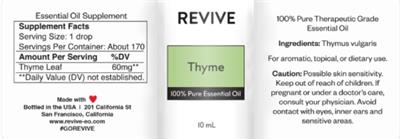
Supplement Facts
The label details for Thyme by Revive, sourced from the NIH Dietary Supplement Label Database.
Supplement Facts
| Ingredient | Amount | % DV |
|---|---|---|
| Thyme | 60 mg | -- |
Tap any ingredient to jump to its full detail below.
These statements are the manufacturer’s wording, reproduced from the product label — the label is saying it, not HelloPharmacist. We don’t verify or endorse them.
FDA Statement of Identity
Essential Oil Supplement
General Statements
Made with love #GOREVIVE
Formulation
Bottled in the USA
For aromatic, topical, or dietary use.
Formula
100% pure essential oil 100% pure therapeutic grade essential oil
Precautions
Caution: Possible skin sensitivity. Avoid contact with eyes, inner ears and sensitive areas.
Keep out of reach of children.
If pregnant or under a doctor's care, consult your physician.
Is this label outdated? Report a formula or label change and our pharmacy team will review it.
Thyme by Revive label
The label scan from the NIH Dietary Supplement Label Database. Tap to enlarge.
Label images are published by the NIH Dietary Supplement Label Database for the version of this product on file. Always read your actual product label.
View the full label (PDF)The Ingredients in Thyme by Revive
This is the 1 active ingredient this product is made of. Select it to open its full monograph.
Serving size1 Drop(s) Dosage formLiquid Servings per container170 Amounts shown are per serving.
Thyme
Interacts with379 drugs
Thyme is a common kitchen herb that has long been used for coughs, sore throats, and digestive complaints. It is generally safe in the amounts found i...
Thyme monograph & interactionsThyme by Revive Drug Interactions
HelloPharmacist Interaction Report
Revive Thyme Liquid has four documented interaction categories, all at Moderate severity.
The biggest concern is estrogens (including hormone replacement therapy): thyme shows estrogen receptor-binding activity in lab studies, which theoretically could interfere with how your body responds to estrogen replacement. However, this hasn't been observed in actual patients.
Read the full breakdown — every affected drug type, severity by severity
Thyme also theoretically may have additive blood-thinning effects with anticoagulants or antiplatelet drugs (like warfarin or aspirin), and in lab work thyme essential oil appears to inhibit a nerve enzyme called acetylcholinesterase. That means it could theoretically reduce the effects of anticholinergic drugs (used for conditions like overactive bladder) or add to the effects of cholinergic drugs (used for Alzheimer's or myasthenia gravis).
Again, these effects haven't been confirmed in humans.
Although these interactions are theoretical, they span 378 individual medications across all drug classes involved. Please check your exact medications with the tool below before starting this product.
Check your own medications below · Editorial policy · How we use AI
Want to check YOUR meds against Thyme?
Ask about interactions with your drugs in plain English — “Can I take it with lisinopril?” — and we find you the answer in seconds, ingredient by ingredient.
Go to the checkerIngredients driving the most interactions
Individual Drug Interactions
The ingredients in Thyme interact with 379 drugs. Click any drug to see the details.
1 of the 1 ingredient in Thyme interact with drugs. Each result below shows which ingredient is responsible. Thyme
Aspirin, Caffeine, Dihydrocodeine BitartrateSynalgos DC
How Aspirin, Caffeine, Dihydrocodeine Bitartrate interacts with Thyme — through 1 ingredient. Tap an ingredient for the detail:
ThymeAnticoagulant/antiplatelet Drugs Moderate
Interaction Summary
Theoretically, thyme leaf extract might have additive effects with anticoagulant or antiplatelet drugs.
Read the full Thyme + Aspirin, Caffeine, Dihydrocodeine Bitartrate interactionAspirin, Caffeine, Dover's PwdAcedoval, Dovacet
How Aspirin, Caffeine, Dover's Pwd interacts with Thyme — through 1 ingredient. Tap an ingredient for the detail:
ThymeAnticoagulant/antiplatelet Drugs Moderate
Interaction Summary
Theoretically, thyme leaf extract might have additive effects with anticoagulant or antiplatelet drugs.
Read the full Thyme + Aspirin, Caffeine, Dover's Pwd interactionAspirin, Caffeine, HydrocodoneDamason-P
How Aspirin, Caffeine, Hydrocodone interacts with Thyme — through 1 ingredient. Tap an ingredient for the detail:
ThymeAnticoagulant/antiplatelet Drugs Moderate
Interaction Summary
Theoretically, thyme leaf extract might have additive effects with anticoagulant or antiplatelet drugs.
Read the full Thyme + Aspirin, Caffeine, Hydrocodone interactionAspirin, Caffeine, Isobutylallylbarbituric Acid, PhenacetinLanorinal
How Aspirin, Caffeine, Isobutylallylbarbituric Acid, Phenacetin interacts with Thyme — through 1 ingredient. Tap an ingredient for the detail:
ThymeAnticoagulant/antiplatelet Drugs Moderate
Interaction Summary
Theoretically, thyme leaf extract might have additive effects with anticoagulant or antiplatelet drugs.
Read the full Thyme + Aspirin, Caffeine, Isobutylallylbarbituric Acid, Phenacetin interactionAspirin, Caffeine, OrphenadrineInvagesic, Invagesic Forte, Norgesic, Norgesic Forte, Orphengesic, Orphengesic Forte
How Aspirin, Caffeine, Orphenadrine interacts with Thyme — through 1 ingredient. Tap an ingredient for the detail:
ThymeAnticoagulant/antiplatelet Drugs Moderate
Interaction Summary
Theoretically, thyme leaf extract might have additive effects with anticoagulant or antiplatelet drugs.
Read the full Thyme + Aspirin, Caffeine, Orphenadrine interactionAspirin, Caffeine, Phenacetin, PropoxypheneMargesic Comp. 65
How Aspirin, Caffeine, Phenacetin, Propoxyphene interacts with Thyme — through 1 ingredient. Tap an ingredient for the detail:
ThymeAnticoagulant/antiplatelet Drugs Moderate
Interaction Summary
Theoretically, thyme leaf extract might have additive effects with anticoagulant or antiplatelet drugs.
Read the full Thyme + Aspirin, Caffeine, Phenacetin, Propoxyphene interactionAspirin, Calcium Carbonate, Magnesium Carbonate, Magnesium OxideBufferin
How Aspirin, Calcium Carbonate, Magnesium Carbonate, Magnesium Oxide interacts with Thyme — through 1 ingredient. Tap an ingredient for the detail:
ThymeAnticoagulant/antiplatelet Drugs Moderate
Interaction Summary
Theoretically, thyme leaf extract might have additive effects with anticoagulant or antiplatelet drugs.
Read the full Thyme + Aspirin, Calcium Carbonate, Magnesium Carbonate, Magnesium Oxide interactionAspirin, CarisoprodolSoma Compound
How Aspirin, Carisoprodol interacts with Thyme — through 1 ingredient. Tap an ingredient for the detail:
ThymeAnticoagulant/antiplatelet Drugs Moderate
Interaction Summary
Theoretically, thyme leaf extract might have additive effects with anticoagulant or antiplatelet drugs.
Read the full Thyme + Aspirin, Carisoprodol interactionAspirin, Carisoprodol, Codeine PhosphateSoma Compound w/ Codeine
How Aspirin, Carisoprodol, Codeine Phosphate interacts with Thyme — through 1 ingredient. Tap an ingredient for the detail:
ThymeAnticoagulant/antiplatelet Drugs Moderate
Interaction Summary
Theoretically, thyme leaf extract might have additive effects with anticoagulant or antiplatelet drugs.
Read the full Thyme + Aspirin, Carisoprodol, Codeine Phosphate interactionAspirin, Chlorpheniramine, PhenylpropanolamineAlka-Seltzer Plus Cold
How Aspirin, Chlorpheniramine, Phenylpropanolamine interacts with Thyme — through 1 ingredient. Tap an ingredient for the detail:
ThymeAnticoagulant/antiplatelet Drugs, Anticholinergic Drugs Moderate
Interaction Summary
Theoretically, thyme leaf extract might have additive effects with anticoagulant or antiplatelet drugs.
Read the full Thyme + Aspirin, Chlorpheniramine, Phenylpropanolamine interactionAspirin, Citric Acid, Sodium BicarbonateAlka-Seltzer Pain Reliever and Antacid
How Aspirin, Citric Acid, Sodium Bicarbonate interacts with Thyme — through 1 ingredient. Tap an ingredient for the detail:
ThymeAnticoagulant/antiplatelet Drugs Moderate
Interaction Summary
Theoretically, thyme leaf extract might have additive effects with anticoagulant or antiplatelet drugs.
Read the full Thyme + Aspirin, Citric Acid, Sodium Bicarbonate interactionAspirin, Codeine PhosphateAspirin w/ Codeine
How Aspirin, Codeine Phosphate interacts with Thyme — through 1 ingredient. Tap an ingredient for the detail:
ThymeAnticoagulant/antiplatelet Drugs Moderate
Interaction Summary
Theoretically, thyme leaf extract might have additive effects with anticoagulant or antiplatelet drugs.
Read the full Thyme + Aspirin, Codeine Phosphate interactionAspirin, Codeine Phosphate, MethocarbamolRobaxisal C
How Aspirin, Codeine Phosphate, Methocarbamol interacts with Thyme — through 1 ingredient. Tap an ingredient for the detail:
ThymeAnticoagulant/antiplatelet Drugs Moderate
Interaction Summary
Theoretically, thyme leaf extract might have additive effects with anticoagulant or antiplatelet drugs.
Read the full Thyme + Aspirin, Codeine Phosphate, Methocarbamol interactionAspirin, Codeine Phosphate, PhenobarbitalPhenaphen
How Aspirin, Codeine Phosphate, Phenobarbital interacts with Thyme — through 1 ingredient. Tap an ingredient for the detail:
ThymeAnticoagulant/antiplatelet Drugs Moderate
Interaction Summary
Theoretically, thyme leaf extract might have additive effects with anticoagulant or antiplatelet drugs.
Read the full Thyme + Aspirin, Codeine Phosphate, Phenobarbital interactionAspirin, Diphenhydramine, PhenylpropanolamineAlka Seltzer Plus Night Time Effervescent
How Aspirin, Diphenhydramine, Phenylpropanolamine interacts with Thyme — through 1 ingredient. Tap an ingredient for the detail:
ThymeAnticoagulant/antiplatelet Drugs, Anticholinergic Drugs Moderate
Interaction Summary
Theoretically, thyme leaf extract might have additive effects with anticoagulant or antiplatelet drugs.
Read the full Thyme + Aspirin, Diphenhydramine, Phenylpropanolamine interactionAspirin, DipyridamoleAggrenox, Asasantin Retard
How Aspirin, Dipyridamole interacts with Thyme — through 1 ingredient. Tap an ingredient for the detail:
ThymeAnticoagulant/antiplatelet Drugs Moderate
Interaction Summary
Theoretically, thyme leaf extract might have additive effects with anticoagulant or antiplatelet drugs.
Read the full Thyme + Aspirin, Dipyridamole interactionAspirin, Ethoheptazine, MeprobamateEquagesic
How Aspirin, Ethoheptazine, Meprobamate interacts with Thyme — through 1 ingredient. Tap an ingredient for the detail:
ThymeAnticoagulant/antiplatelet Drugs Moderate
Interaction Summary
Theoretically, thyme leaf extract might have additive effects with anticoagulant or antiplatelet drugs.
Read the full Thyme + Aspirin, Ethoheptazine, Meprobamate interactionAspirin, HydrocodoneAlor 5 500, Lortab ASA
How Aspirin, Hydrocodone interacts with Thyme — through 1 ingredient. Tap an ingredient for the detail:
ThymeAnticoagulant/antiplatelet Drugs Moderate
Interaction Summary
Theoretically, thyme leaf extract might have additive effects with anticoagulant or antiplatelet drugs.
Read the full Thyme + Aspirin, Hydrocodone interactionAspirin, MeprobamateMicrainin
How Aspirin, Meprobamate interacts with Thyme — through 1 ingredient. Tap an ingredient for the detail:
ThymeAnticoagulant/antiplatelet Drugs Moderate
Interaction Summary
Theoretically, thyme leaf extract might have additive effects with anticoagulant or antiplatelet drugs.
Read the full Thyme + Aspirin, Meprobamate interactionAspirin, MethocarbamolRobaxisal
How Aspirin, Methocarbamol interacts with Thyme — through 1 ingredient. Tap an ingredient for the detail:
ThymeAnticoagulant/antiplatelet Drugs Moderate
Interaction Summary
Theoretically, thyme leaf extract might have additive effects with anticoagulant or antiplatelet drugs.
Read the full Thyme + Aspirin, Methocarbamol interactionAspirin, OmeprazoleYosprala
How Aspirin, Omeprazole interacts with Thyme — through 1 ingredient. Tap an ingredient for the detail:
ThymeAnticoagulant/antiplatelet Drugs Moderate
Interaction Summary
Theoretically, thyme leaf extract might have additive effects with anticoagulant or antiplatelet drugs.
Read the full Thyme + Aspirin, Omeprazole interactionAspirin, OxycodonePercodan
How Aspirin, Oxycodone interacts with Thyme — through 1 ingredient. Tap an ingredient for the detail:
ThymeAnticoagulant/antiplatelet Drugs Moderate
Interaction Summary
Theoretically, thyme leaf extract might have additive effects with anticoagulant or antiplatelet drugs.
Read the full Thyme + Aspirin, Oxycodone interactionAspirin, PentazocineTalwin Compound
How Aspirin, Pentazocine interacts with Thyme — through 1 ingredient. Tap an ingredient for the detail:
ThymeAnticoagulant/antiplatelet Drugs Moderate
Interaction Summary
Theoretically, thyme leaf extract might have additive effects with anticoagulant or antiplatelet drugs.
Read the full Thyme + Aspirin, Pentazocine interactionAtropineSal-Tropine
How Atropine interacts with Thyme — through 1 ingredient. Tap an ingredient for the detail:
ThymeAnticholinergic Drugs Moderate
Interaction Summary
Theoretically, concurrent use of anticholinergic drugs and thyme essential oil might reduce the effects of anticholinergic drugs.
Read the full Thyme + Atropine interactionAtropine Methyl Nitrate, Digestive EnzymesFestalan
How Atropine Methyl Nitrate, Digestive Enzymes interacts with Thyme — through 1 ingredient. Tap an ingredient for the detail:
ThymeAnticholinergic Drugs Moderate
Interaction Summary
Theoretically, concurrent use of anticholinergic drugs and thyme essential oil might reduce the effects of anticholinergic drugs.
Read the full Thyme + Atropine Methyl Nitrate, Digestive Enzymes interactionAtropine SulfateAtropine Sulfate, Isopto Atropine
How Atropine Sulfate interacts with Thyme — through 1 ingredient. Tap an ingredient for the detail:
ThymeAnticholinergic Drugs Moderate
Interaction Summary
Theoretically, concurrent use of anticholinergic drugs and thyme essential oil might reduce the effects of anticholinergic drugs.
Read the full Thyme + Atropine Sulfate interactionAtropine, Benzoic Acid, Hyoscyamine, Methenamine, Methylene Blue, PhenylAtrosept
How Atropine, Benzoic Acid, Hyoscyamine, Methenamine, Methylene Blue, Phenyl interacts with Thyme — through 1 ingredient. Tap an ingredient for the detail:
ThymeAnticholinergic Drugs Moderate
Interaction Summary
Theoretically, concurrent use of anticholinergic drugs and thyme essential oil might reduce the effects of anticholinergic drugs.
Read the full Thyme + Atropine, Benzoic Acid, Hyoscyamine, Methenamine, Methylene Blue, Phenyl interactionAtropine, Benzoic Acid, Hyoscyamine, Methenamine, Methylene Blue, Phenyl SalicylateUrinary Antiseptic 2, Urised
How Atropine, Benzoic Acid, Hyoscyamine, Methenamine, Methylene Blue, Phenyl Salicylate interacts with Thyme — through 1 ingredient. Tap an ingredient for the detail:
ThymeAnticholinergic Drugs Moderate
Interaction Summary
Theoretically, concurrent use of anticholinergic drugs and thyme essential oil might reduce the effects of anticholinergic drugs.
Read the full Thyme + Atropine, Benzoic Acid, Hyoscyamine, Methenamine, Methylene Blue, Phenyl Salicylate interactionAtropine, Chlorpheniramine, Hyoscyamine, Phenylephrine, Phenylpropanolamine, ScopolamineAtrohist Plus, Pro Tuss, Ru-tuss, Stahist
How Atropine, Chlorpheniramine, Hyoscyamine, Phenylephrine, Phenylpropanolamine, Scopolamine interacts with Thyme — through 1 ingredient. Tap an ingredient for the detail:
ThymeAnticholinergic Drugs Moderate
Interaction Summary
Theoretically, concurrent use of anticholinergic drugs and thyme essential oil might reduce the effects of anticholinergic drugs.
Read the full Thyme + Atropine, Chlorpheniramine, Hyoscyamine, Phenylephrine, Phenylpropanolamine, Scopolamine interactionAtropine, DifenoxinMotofen
How Atropine, Difenoxin interacts with Thyme — through 1 ingredient. Tap an ingredient for the detail:
ThymeAnticholinergic Drugs Moderate
Interaction Summary
Theoretically, concurrent use of anticholinergic drugs and thyme essential oil might reduce the effects of anticholinergic drugs.
Read the full Thyme + Atropine, Difenoxin interactionEach ingredient & the kinds of drugs it affects
For each ingredient in Thyme with known interactions, here are the types of medications it can affect. Open any type for the detail — or search your exact drug in the checker above.
Thyme
Anticholinergic Drugs
Theoretically, concurrent use of anticholinergic drugs and thyme essential oil might reduce the effects of anticholinergic drugs.
In vitro evidence suggests that thyme essential oil and specific essential oil constituents like thymohydroquinone and carvacrol can inhibit acetylcholinesterase (AChE). However, this effect has not been observed in humans.
Anticoagulant/Antiplatelet Drugs
Theoretically, thyme leaf extract might have additive effects with anticoagulant or antiplatelet drugs.
In vitro and animal research suggests that thyme leaf extract has antiplatelet effects. However, this effect has not been observed in humans.
Cholinergic Drugs
Theoretically, concurrent use of cholinergic drugs and thyme essential oil might cause additive cholinergic effects.
In vitro evidence suggests that thyme essential oil and specific essential oil constituents like thymohydroquinone and carvacrol can inhibit acetylcholinesterase (AChE). However, this effect has not been observed in humans.
Estrogens
Theoretically, thyme might competitively inhibit the effects of estrogen replacement therapy.
In vitro research shows that thyme has estrogen receptor-binding activity and phytoestrogen content. However, this effect has not been observed in humans.
Brand information
Manufacturer and brand details for Thyme, from the product label.
Revive
See all Revive products- Name
- Revive
- Street Address
- 201 California St
- City
- San Francisco
- State
- California
- Web Address
- www.revive-eo.com
Thyme by Revive: Common Questions
Does Thyme by Revive interact with any medications?
How can one product interact with so many drugs?
Where does this information come from?
Is thyme safe during pregnancy or while breastfeeding?
What are the most common side effects if I take thyme orally?
Will this help my cough or cold?
Is the essential oil safe to swallow?
Does this product have fillers or other inactive ingredients?
Written and reviewed by the HelloPharmacist editorial staff. Our editorial policy
Not sure if Thyme is safe with your meds?
Our pharmacists answer your medication & supplement questions — free.
Label information is sourced from the NIH Dietary Supplement Label Database and reflects the product version on file; always read your actual product label. This page is for education only and is not a substitute for professional medical advice. Confirm with your pharmacist or doctor before combining supplements and medications.
The Full Monographs Behind Thyme’s Ingredients
Every ingredient we hold a full HelloPharmacist monograph for — uses, evidence, safety, and the complete interaction list.
Sources & How We Checked
Thyme's label data comes from the NIH Dietary Supplement Label Database; the ingredient interaction data is from the Natural Medicines database, reviewed by our pharmacists.
- NIH Dietary Supplement Label Database (DSLD) — The official product label on file for this supplement.
- Natural Medicines (Therapeutic Research Center) — Evidence-graded clinical reference behind the ingredient interaction data.
Content is written and reviewed by licensed HelloPharmacist pharmacists. See our data sources and editorial standards for how this information is built and checked.
The 18 references behind this product’s interaction data
Every citation that drives the interaction findings for this product’s ingredients, from the evidence-graded Natural Medicines (TRC Healthcare) database. Open an ingredient to browse its citations — links open the study on PubMed or the publisher’s site.
Thyme 18 references
- Zava DT, Dollbaum CM, Blen M. Estrogen and progestin bioactivity of foods, herbs, and spices. Proc Soc Exp Biol Med 1998;217:369-78. PubMed
- Electronic Code of Federal Regulations. Title 21. Part 182 -- Substances Generally Recognized As Safe. Available at: https://www.accessdata.fda.gov/scripts/cdrh/cfdocs/cfcfr/CFRSearch.cfm?CFRPart=182
- Okazaki K, Kawazoe K, Takaishi Y. Human platelet aggregation inhibitors from thyme (Thymus vulgaris L.). Phytother Res 2002;16:398-9. .
- Spiewak R, Skorska C, Dutkiewicz J. Occupational airborne contact dermatitis caused by thyme dust. Contact Dermatitis 2001;44:235-9. . PubMed
- Ernst E, Marz R, Sieder C. A controlled multi-centre study of herbal versus synthetic secretolytic drugs for acute bronchitis. Phytomedicine 1997;4:287-93. PubMed
- Yamamoto J, Yamada K, Naemura A, et al. Testing various herbs for antithrombotic effect. Nutrition 2005;21(5):580-7. PubMed
- Tognolini, M., Barocelli, E., Ballabeni, V., Bruni, R., Bianchi, A., Chiavarini, M., and Impicciatore, M. Comparative screening of plant essential oils: phenylpropanoid moiety as basic core for antiplatelet activity. Life Sci. 2-23-2006;78(13):1419-1432. PubMed
- Mackiewicz, B., Skorska, C., Dutkiewicz, J., Michnar, M., Milanowski, J., Prazmo, Z., Krysinska-Traczyk, E., and Cisak, E. Allergic alveolitis due to herb dust exposure. Ann Agric Environ Med 1999;6(2):167-170.
- Martinez-Gonzalez, M. C., Goday Bujan, J. J., Martinez, Gomez W., and Fonseca, Capdevila E. Concomitant allergic contact dermatitis due to Rosmarinus officinalis (rosemary) and Thymus vulgaris (thyme). Contact Dermatitis 2007;56(1):49-50.
- Jukic, M., Politeo, O., Maksimovic, M., Milos, M., and Milos, M. In vitro acetylcholinesterase inhibitory properties of thymol, carvacrol and their derivatives thymoquinone and thymohydroquinone. Phytother.Res 2007;21(3):259-261.
- Marzian, O. [Treatment of acute bronchitis in children and adolescents. Non-interventional postmarketing surveillance study confirms the benefit and safety of a syrup made of extracts from thyme and ivy leaves]. MMW.Fortschr.Med 6-28-2007;149(27-28 Suppl
- Cuzzolin, L. and Benoni, G. Attitudes and knowledge toward natural products safety in the pharmacy setting: an Italian study. Phytother.Res 2009;23(7):1018-1023. PubMed
- Berova, N., Stransky, L., and Krasteva, M. Studies on contact dermatitis in stomatological staff. Dermatol.Monatsschr. 1990;176(1):15-18.
- Smeenk, G., Kerckhoffs, H. P., and Schreurs, P. H. Contact allergy to a reaction product in Hirudoid cream: an example of compound allergy. Br.J Dermatol. 1987;116(2):223-231.
- Le Roy, R., Grosshans, E., and Foussereau, J. [Investigation of contact allergies in 100 cases of ulcus cruris (author's transl)]. Derm.Beruf.Umwelt. 1981;29(6):168-170.
- Lorenzi, S., Placucci, F., Vincenzi, C., Bardazzi, F., and Tosti, A. Allergic contact dermatitis due to thymol. Contact Dermatitis 1995;33(6):439-440. PubMed
- Bahadoran P, Rokni FK, Fahami F. Investigating the therapeutic effect of vaginal cream containing garlic and thyme compared to clotrimazole cream for the treatment of mycotic vaginitis. Iran J Nurs Midwifery Res 2010;15(Suppl 1):343-9.
- Erol S, Aydin B, Dilli D, Okumus N, Zenciroglu A, Gündüz M. An interesting newborn case of fructose 1-6 diphosphatase deficiency triggered after thyme juice ingestion. Clin Lab. 2014;60(1):151-3. PubMed
Parts of this content are provided by the Therapeutic Research Center, LLC.
DISCLAIMER: Currently this does not check for drug-drug interactions. This is not an all-inclusive comprehensive list of potential interactions and is for informational purposes only. Not all interactions are known or well-reported in the scientific literature, and new interactions are continually being reported. Input is needed from a qualified healthcare provider including a pharmacist before starting any therapy. Application of clinical judgment is necessary.
© 2021 Therapeutic Research Center, LLC