
Trimethylglycine TMG 1000 mg Ingredients & Drug Interactions
by tnvitamins
What is this page for?
First and foremost: checking Trimethylglycine TMG 1000 mg against your medications. The heart of this page is the interaction checker and the full interaction report — how this product’s ingredients may interact with prescription and over-the-counter medicines you may be taking.
Around that, we add a pharmacist’s high-level view of the product as a whole — what’s inside, the evidence for its stated use, how transparent the label is, and what safety data exists — so you can see the full picture in one place. It’s educational information from our licensed clinical databases and the clinical staff at HelloPharmacist — not medical advice — and we don’t sell or endorse products. Our editorial policy
Trimethylglycine TMG 1000 mg is a dietary supplement by tnvitamins with 1 active ingredient. Its ingredients are commonly taken for high homocysteine levels, liver health (fatty liver), exercise performance and strength.We don’t currently list a known drug interaction for its mapped ingredients — but that doesn’t guarantee none exist, so always confirm with your pharmacist.
HelloPharmacist Scorecard of Trimethylglycine TMG 1000 mg by tnvitamins
Our pharmacy team’s full take, with four database checks built into the cards below — a summary of what is known, not a grade of the product itself.
What’s inside
Full disclosure
This product contains one active ingredient: betaine anhydrous (also called trimethylglycine or TMG). Betaine is a compound that plays a role in your body's methylation process—essentially how cells copy and repair DNA and manage certain amino acids.
The tablet also contains inactive ingredients like microcrystalline cellulose and magnesium stearate, which are binders and flow agents that help hold the tablet together and keep it stable.
Does it work?
Strong evidence
Betaine anhydrous is effective for homocystinuria (an inherited metabolic condition marked by high homocysteine levels). It's possibly effective for high homocysteine levels in the blood (hyperhomocysteinemia) in general.
The evidence for other uses—including nonalcoholic fatty liver (NASH), colorectal adenoma, depression, and reflux (GERD)—is insufficient; we don't have enough reliable data to say whether it works for those.
How safe is it?
Well-documented data
Betaine anhydrous is generally well tolerated at studied doses, but the safety data available is limited. The most common side effects reported are body odor, diarrhea, nausea, vomiting, stomach upset, and elevated cholesterol levels.
A serious side effect—brain swelling (cerebral edema)—is rare but has been reported. Safety during breastfeeding is not well established, so caution is advised if you're nursing.
Because overall safety data is sparse, it's best to check with your doctor or pharmacist before starting unless a doctor has already recommended it for you.
Meds to double-check
No known interactions
No interactions are documented in our data for betaine anhydrous. That said, check your exact medications with the search tool on this page, and talk to your pharmacist if you take anything regularly.
The bottom line
Scorecard at a glanceFully disclosed formula with strong clinical evidence behind its ingredients' uses. No medication interactions are currently documented, and safety information is well characterized.
If your doctor has recommended betaine for homocystinuria or high homocysteine levels, this product may be a fit. If you're considering it for another reason, talk to your pharmacist or doctor first—the evidence for most other uses isn't solid yet.
Because long-term safety data is limited and side effects can occur, it's worth a conversation before you start.
Educational only — not medical advice; always confirm with your pharmacist. Our editorial policy · How we use AI
Assessment coverage: 1 of 1 active ingredient matched to our full ingredient reviews (monographs). Based on the product label dated Aug 22, 2025.
This Scorecard evaluates available label information, ingredient evidence, and known medication-safety considerations. It does not independently verify product identity, purity, potency, contamination, or manufacturing quality. How these ratings are computed
General information
Key facts about Trimethylglycine TMG 1000 mg, straight from the product label.
| Brand | tnvitamins |
|---|---|
| Barcode (UPC) | X004FI1DZF |
| Net contents | 120 Tablet(s) |
| Market status | On market |
| Date entered into DSLD | Aug 22, 2025 |
| DSLD ID | 336950 |
| Product type | Non-nutrient/non-botanical |
| Supplement form | Tablet Or Pill |
| Dietary claims / uses | All Other |
| Intended target group(s) | Adult (18 - 50 Years), Gluten Free, Dairy Free |
Everything in this section is reproduced from the manufacturer’s own product label — it’s the label speaking, not HelloPharmacist. We show it so you can see exactly what the maker states; we don’t verify or endorse those statements.
Supplement Facts
The label details for Trimethylglycine TMG 1000 mg by tnvitamins, sourced from the NIH Dietary Supplement Label Database.
Supplement Facts
| Ingredient | Amount | % DV |
|---|---|---|
| Betaine Anhydrous | 1000 mg | -- |
Other ingredients: Dicalcium Phosphate Dihydrate, Microcrystalline Cellulose, Stearic Acid, Magnesium Stearate, Silicon Dioxide, Croscarmellose Sodium
Tap any ingredient to jump to its full detail below.
These statements are the manufacturer’s wording, reproduced from the product label — the label is saying it, not HelloPharmacist. We don’t verify or endorse them.
Suggested/Recommended/Usage/Directions
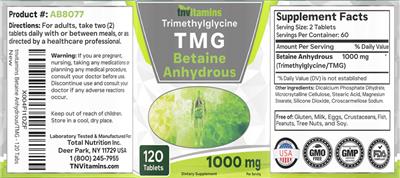
Directions: For adults, take two (2) tablets daily with or between meals, or as directed by a healthcare professional.
Precautions
Warning: If you are pregnant, nursing, taking any medications or planning any medical procedure, consult your doctor before use.
Discontinue use and consult your doctor if any adverse reactions occur.
Keep out of reach of children.
Storage
Store in a cool, dry place.
General Statements
New
Formula
Betaine Anhydrous 1000 mg per serving
FDA Statement of Identity
Dietary Supplement
Formulation
Free of: gluten, milk, eggs, crustaceans, fish, peanuts, tree nuts, and soy. GMO free
Seals/Symbols
Made in the USA Sourced Globally Manufactured in GMP Certified Facilities FDA Compliant
Is this label outdated? Report a formula or label change and our pharmacy team will review it.
Trimethylglycine TMG 1000 mg by tnvitamins label
The label scan from the NIH Dietary Supplement Label Database. Tap to enlarge.
Label images are published by the NIH Dietary Supplement Label Database for the version of this product on file. Always read your actual product label.
View the full label (PDF)The Ingredients in Trimethylglycine TMG 1000 mg by tnvitamins
This is the 1 active ingredient this product is made of. Select it to open its full monograph.
Serving size2 Tablet(s) Dosage formTablet Or Pill Servings per container60 Amounts shown are per serving.
Betaine Anhydrous
No knowninteractions
Betaine anhydrous (also called trimethylglycine) is a compound found in foods like beets, spinach, and whole grains, and is sold as a supplement and a...
Betaine Anhydrous monograph & interactionsOther (inactive) ingredients: Dicalcium Phosphate Dihydrate, Microcrystalline Cellulose, Stearic Acid, Magnesium Stearate, Silicon Dioxide, Croscarmellose Sodium. These complete the product’s ingredient list but are not active constituents.
Trimethylglycine TMG 1000 mg by tnvitamins Drug Interactions
We don’t currently list any known drug interactions for the mapped ingredients in Trimethylglycine TMG 1000 mg. This doesn’t guarantee none exist — always confirm with your pharmacist before combining a supplement with your medications.
Brand information
Manufacturer and brand details for Trimethylglycine TMG 1000 mg, from the product label.
tnvitamins
See all tnvitamins products- Name
- Total Nutrition Inc.
- City
- Deer Park
- State
- NY
- ZipCode
- 11729
- Phone Number
- 1 (800) 245-7955
- Web Address
- TNVitamins.com
Trimethylglycine TMG 1000 mg by tnvitamins: Common Questions
Does Trimethylglycine TMG 1000 mg by tnvitamins interact with any medications?
How can one product interact with so many drugs?
Where does this information come from?
What is betaine anhydrous, and what's it supposed to do?
What side effects should I watch for?
Is it safe to take while breastfeeding?
Can I take this with my regular medications?
Does this actually work for high cholesterol or fatty liver?
Written and reviewed by the HelloPharmacist editorial staff. Our editorial policy
Not sure if Trimethylglycine TMG 1000 mg is safe with your meds?
Our pharmacists answer your medication & supplement questions — free.
Label information is sourced from the NIH Dietary Supplement Label Database and reflects the product version on file; always read your actual product label. This page is for education only and is not a substitute for professional medical advice. Confirm with your pharmacist or doctor before combining supplements and medications.
The Full Monographs Behind Trimethylglycine TMG 1000 mg’s Ingredients
Every ingredient we hold a full HelloPharmacist monograph for — uses, evidence, safety, and the complete interaction list.
Sources & How We Checked
Trimethylglycine TMG 1000 mg's label data comes from the NIH Dietary Supplement Label Database; the ingredient interaction data is from the Natural Medicines database, reviewed by our pharmacists.
- NIH Dietary Supplement Label Database (DSLD) — The official product label on file for this supplement.
- Natural Medicines (Therapeutic Research Center) — Evidence-graded clinical reference behind the ingredient interaction data.
Content is written and reviewed by licensed HelloPharmacist pharmacists. See our data sources and editorial standards for how this information is built and checked.
The 11 references behind this product’s interaction data
Every citation that drives the interaction findings for this product’s ingredients, from the evidence-graded Natural Medicines (TRC Healthcare) database. Open an ingredient to browse its citations — links open the study on PubMed or the publisher’s site.
Betaine Anhydrous 11 references
- Cystadane (betaine anhydrous for oral solution) Package insert. Orphan Medical, Inc. Minnetonka, MN. November 2005.
- Abdelmalek MF, Angulo P, Jorgensen RA, et al. Betaine, a promising new agent for patients with nonalcoholic steatohepatitis: results of a pilot study. Am J Gastroenterol 2001;96:2711-7.. PubMed
- Schwab U, Torronen A, Toppinen L, et al. Betaine supplementation decreases plasma homocysteine concentrations but does not affect body weight, body composition, or resting energy expenditure in human subjects. Am J Clin Nutr 2002;76:961-7. PubMed
- McGregor DO, Dellow WJ, Robson RA, et al. Betaine supplementation decreases post-methionine hyperhomocysteinemia in chronic renal failure. Kidney Int 2002;61:1040-6. PubMed
- Olthof MR, van Vliet T, Verhoef P, et al. Effect of homocysteine-lowering nutrients on blood lipids: results from four randomised, placebo-controlled studies in healthy humans. PloS Med 2005;2:e135. PubMed
- Knopman, D. and Patterson, M. An open-label, 24-week pilot study of the methyl donor betaine in Alzheimer disease patients. Alzheimer Dis.Assoc.Disord. 2001;15(3):162-165. PubMed
- Moat, S. J., Madhavan, A., Taylor, S. Y., Payne, N., Allen, R. H., Stabler, S. P., Goodfellow, J., McDowell, I. F., Lewis, M. J., and Lang, D. High- but not low-dose folic acid improves endothelial function in coronary artery disease. Eur J Clin Invest 2 PubMed
- Abdelmalek, M. F., Sanderson, S. O., Angulo, P., Soldevila-Pico, C., Liu, C., Peter, J., Keach, J., Cave, M., Chen, T., McClain, C. J., and Lindor, K. D. Betaine for nonalcoholic fatty liver disease: results of a randomized placebo-controlled trial. Hepa PubMed
- Ashtary-Larky D, Bagheri R, Ghanavati M, et al. Effects of betaine supplementation on cardiovascular markers: a systematic review and meta-analysis. Crit Rev Food Sci Nutr. 2021 Mar 25:1-18. PubMed
- Zawieja EE, Zawieja B, Chmurzynska A. Betaine supplementation moderately increases total cholesterol levels: a systematic review and meta-analysis. J Diet Suppl. 2021;18(1):105-117. PubMed
- Imbard A, Toumazi A, Magréault S, et al. Efficacy and pharmacokinetics of betaine in CBS and cblC deficiencies: a cross-over randomized controlled trial. Orphanet J Rare Dis 2022;17(1):417. PubMed
Parts of this content are provided by the Therapeutic Research Center, LLC.
DISCLAIMER: Currently this does not check for drug-drug interactions. This is not an all-inclusive comprehensive list of potential interactions and is for informational purposes only. Not all interactions are known or well-reported in the scientific literature, and new interactions are continually being reported. Input is needed from a qualified healthcare provider including a pharmacist before starting any therapy. Application of clinical judgment is necessary.
© 2021 Therapeutic Research Center, LLC