
Triple Lecithin 1200 mg Ingredients & Drug Interactions
by GNC
What is this page for?
First and foremost: checking Triple Lecithin 1200 mg against your medications. The heart of this page is the interaction checker and the full interaction report — how this product’s ingredients may interact with prescription and over-the-counter medicines you may be taking.
Around that, we add a pharmacist’s high-level view of the product as a whole — what’s inside, the evidence for its stated use, how transparent the label is, and what safety data exists — so you can see the full picture in one place. It’s educational information from our licensed clinical databases and the clinical staff at HelloPharmacist — not medical advice — and we don’t sell or endorse products. Our editorial policy
Triple Lecithin 1200 mg is a dietary supplement by GNC with 1 active ingredient. Its ingredients are commonly taken for high cholesterol, liver health, brain and memory support.We don’t currently list a known drug interaction for its mapped ingredients — but that doesn’t guarantee none exist, so always confirm with your pharmacist.
HelloPharmacist Scorecard of Triple Lecithin 1200 mg by GNC
Our pharmacy team’s full take, with four database checks built into the cards below — a summary of what is known, not a grade of the product itself.
What’s inside
Full disclosure
This product has one active ingredient: soy lecithin at 1,200 mg per softgel. Lecithin is a fatty substance found naturally in plants and animals; in supplements it's often used to support cell membrane health and brain function.
The capsule itself contains gelatin and glycerin as inactive ingredients.
Does it work?
Not established
The evidence for lecithin in most uses is sparse. For Alzheimer disease, the data shows it's likely ineffective.
For age-related cognitive decline, anxiety, bipolar disorder, and helping with clogged milk ducts during breastfeeding, there isn't enough reliable evidence to say whether it works or not. The supporting science for lecithin supplement use isn't established in the data we hold.
How safe is it?
Well-documented data
Soy lecithin is generally well tolerated when taken by mouth. The most common side effects are abdominal pain, diarrhea, a feeling of fullness, and nausea — they happen in some people but are usually mild.
If you have an egg or soy allergy, lecithin can trigger allergic skin reactions. During pregnancy and lactation, lecithin is rated likely safe; it's often used to help clogged milk ducts, though you should check with your healthcare provider before starting a supplement.
Meds to double-check
No known interactions
No interactions are documented in our data for the ingredient we could check. Run your exact medications through the checker on this page to be certain.
The bottom line
Scorecard at a glanceFully disclosed formula with no established evidence rating for its marketed use. No medication interactions are currently documented, and safety information is well characterized.
This product may be worth considering if you're interested in lecithin for general cell health, though evidence for specific brain benefits is weak or missing. If you have a soy or egg allergy, skip it.
Talk to your pharmacist before starting, especially if you're pregnant, breastfeeding, or have digestive concerns.
Educational only — not medical advice; always confirm with your pharmacist. Our editorial policy · How we use AI
Assessment coverage: 1 of 1 active ingredient matched to our full ingredient reviews (monographs). Based on the product label dated Sep 25, 2024.
This Scorecard evaluates available label information, ingredient evidence, and known medication-safety considerations. It does not independently verify product identity, purity, potency, contamination, or manufacturing quality. How these ratings are computed
General information
Key facts about Triple Lecithin 1200 mg, straight from the product label.
Everything in this section is reproduced from the manufacturer’s own product label — it’s the label speaking, not HelloPharmacist. We show it so you can see exactly what the maker states; we don’t verify or endorse those statements.
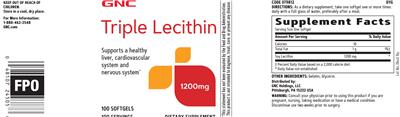
Supplement Facts
The label details for Triple Lecithin 1200 mg by GNC, sourced from the NIH Dietary Supplement Label Database.
Supplement Facts
| Ingredient | Amount | % DV |
|---|---|---|
| Calories | 10 Calorie(s) | -- |
| Total Fat | 1 Gram(s) | 1% |
| Soy Lecithin | 1200 mg | -- |
Other ingredients: Gelatin, Glycerin
Tap any ingredient to jump to its full detail below.
These statements are the manufacturer’s wording, reproduced from the product label — the label is saying it, not HelloPharmacist. We don’t verify or endorse them.
Precautions
Keep out of reach of children.
Warning: Consult your physician prior to using this product if you are pregnant, nursing, taking medication, or have a medical condition.
Discontinue use two weeks prior to surgery.
Storage
Store in a cool, dry place.
General Statements
For more information: 1-888-462-2548 GNC.com
Formulation
Supports a healthy liver, cardiovascular system and nervous system
FDA Statement of Identity
Dietary Supplement
FDA Disclaimer Statement
This statement has not been evaluated by the Food and Drug Administration. This product is not intended to diagnose, treat, cure, or prevent disease.
Suggested/Recommended/Usage/Directions
Directions: As a dietary supplement, take one softgel one or more times daily with a full glass of water, preferably after a meal.
Is this label outdated? Report a formula or label change and our pharmacy team will review it.
Triple Lecithin 1200 mg by GNC label
The label scan from the NIH Dietary Supplement Label Database. Tap to enlarge.
Label images are published by the NIH Dietary Supplement Label Database for the version of this product on file. Always read your actual product label.
View the full label (PDF)The Ingredients in Triple Lecithin 1200 mg by GNC
This is the 1 active ingredient this product is made of. Select it to open its full monograph.
Serving size1 Softgel(s) Dosage formSoftgel Capsule Servings per container100 Amounts shown are per serving.
Soy Lecithin
No knowninteractions
Lecithin is a natural fatty substance found in foods and made by the body that is widely used as a supplement and food emulsifier. Evidence supporting...
Soy Lecithin monograph & interactionsOther (inactive) ingredients: Gelatin, Glycerin. These complete the product’s ingredient list but are not active constituents.
Triple Lecithin 1200 mg by GNC Drug Interactions
We don’t currently list any known drug interactions for the mapped ingredients in Triple Lecithin 1200 mg. This doesn’t guarantee none exist — always confirm with your pharmacist before combining a supplement with your medications.
Brand information
Manufacturer and brand details for Triple Lecithin 1200 mg, from the product label.
GNC
See all GNC products- Name
- GNC Holdings, LLC
- City
- Pittsburgh
- State
- PA
- ZipCode
- 15222
- Phone Number
- 1-888-462-2548
- Web Address
- GNC.com
Triple Lecithin 1200 mg by GNC: Common Questions
Does Triple Lecithin 1200 mg by GNC interact with any medications?
How can one product interact with so many drugs?
Where does this information come from?
Will this interact with my blood pressure or heart medications?
Can I take this if I'm allergic to soy?
What should I expect side-effect-wise?
Is this safe during pregnancy or breastfeeding?
Does lecithin actually help with memory or brain health?
Written and reviewed by the HelloPharmacist editorial staff. Our editorial policy
Not sure if Triple Lecithin 1200 mg is safe with your meds?
Our pharmacists answer your medication & supplement questions — free.
Label information is sourced from the NIH Dietary Supplement Label Database and reflects the product version on file; always read your actual product label. This page is for education only and is not a substitute for professional medical advice. Confirm with your pharmacist or doctor before combining supplements and medications.
The Full Monographs Behind Triple Lecithin 1200 mg’s Ingredients
Every ingredient we hold a full HelloPharmacist monograph for — uses, evidence, safety, and the complete interaction list.
Sources & How We Checked
Triple Lecithin 1200 mg's label data comes from the NIH Dietary Supplement Label Database; the ingredient interaction data is from the Natural Medicines database, reviewed by our pharmacists.
- NIH Dietary Supplement Label Database (DSLD) — The official product label on file for this supplement.
- Natural Medicines (Therapeutic Research Center) — Evidence-graded clinical reference behind the ingredient interaction data.
Content is written and reviewed by licensed HelloPharmacist pharmacists. See our data sources and editorial standards for how this information is built and checked.
The 9 references behind this product’s interaction data
Every citation that drives the interaction findings for this product’s ingredients, from the evidence-graded Natural Medicines (TRC Healthcare) database. Open an ingredient to browse its citations — links open the study on PubMed or the publisher’s site.
Lecithin 9 references
- Buchman AL, Dubin M, Jenden D, et al. Lecithin increases plasma free choline and decreases hepatic steatosis in long-term total parenteral nutrition patients. Gastroenterology 1992;102:1363-70.
- Food and Nutrition Board, Institute of Medicine. Dietary Reference Intakes for Thiamin, Riboflavin, Niacin, Vitamin B6, Folate, Vitamin B12, Pantothenic Acid, Biotin, and Choline (2000). Washington, DC: National Academy Press, 2000. Available at: http://b
- Chatellier G, Lacomblez L. Tacrine (tetrahydroaminoacridine; THA) and lecithin in senile dementia of the Alzheimer type: a multicentre trial. Groupe Francais d'Etude de la Tetrahydroaminoacridine. BMJ 1990;300:495-9.
- Gelenberg AJ, Dorer DJ, Wojcik JD, et al. A crossover study of lecithin treatment of tardive dyskinesia. J Clin Psychiatry 1990;51:149-53.
- Little A, Levy R, Chuaqui-Kidd P, Hand D. A double-blind, placebo controlled trial of high-dose lecithin in Alzheimer's disease. J Neurol Neurosurg Psychiatry 1985;48:736-42. PubMed
- Palm M, Moneret-Vautrin DA, Kanny G, et al. Food allergy to egg and soy lecithins. Allergy 1999;54:1116-7. PubMed
- Drachman DA, Glosser G, Fleming P, et al. Memory decline in the aged: treatment with lecithin and physostigmine. Neurology 1982;32:944-50. PubMed
- Gelenberg, A. J., Doller-Wojcik, J. C., and Growdon, J. H. Choline and lecithin in the treatment of tardive dyskinesia: preliminary results from a pilot study. Am J Psychiatry 1979;136(6):772-776. PubMed
- Electronic Code of Federal Regulations. Title 21, Chapter 1, Subchapter B, Part 184: Direct food substances affirmed as Generally Recognized as Safe. Subpart B - listing of specific substances affirmed as GRAS. Sec. 184.1400 Lecithin. Available at: https:
Parts of this content are provided by the Therapeutic Research Center, LLC.
DISCLAIMER: Currently this does not check for drug-drug interactions. This is not an all-inclusive comprehensive list of potential interactions and is for informational purposes only. Not all interactions are known or well-reported in the scientific literature, and new interactions are continually being reported. Input is needed from a qualified healthcare provider including a pharmacist before starting any therapy. Application of clinical judgment is necessary.
© 2021 Therapeutic Research Center, LLC