
Vegetable Glycerin Ingredients & Drug Interactions
by Hawaii Pharm
What is this page for?
First and foremost: checking Vegetable Glycerin against your medications. The heart of this page is the interaction checker and the full interaction report — how this product’s ingredients may interact with prescription and over-the-counter medicines you may be taking.
Around that, we add a pharmacist’s high-level view of the product as a whole — what’s inside, the evidence for its stated use, how transparent the label is, and what safety data exists — so you can see the full picture in one place. It’s educational information from our licensed clinical databases and the clinical staff at HelloPharmacist — not medical advice — and we don’t sell or endorse products. Our editorial policy
Vegetable Glycerin is a dietary supplement by Hawaii Pharm with 1 active ingredient. Its ingredients are commonly taken for constipation (laxative), dry skin (moisturizer), dry, irritated eyes.We don’t currently list a known drug interaction for its mapped ingredients — but that doesn’t guarantee none exist, so always confirm with your pharmacist.
HelloPharmacist Scorecard of Vegetable Glycerin by Hawaii Pharm
Our pharmacy team’s full take, with four database checks built into the cards below — a summary of what is known, not a grade of the product itself.
What’s inside
Full disclosure
This product contains one active ingredient: glycerin (also called glycerol), a naturally derived compound commonly used in oral and topical forms. The product has no inactive ingredients listed.
Does it work?
Strong evidence
Glycerin has the strongest evidence for constipation, where it's considered likely effective. For ichthyosis (dry, scaly skin) and athletic performance, the evidence is mixed — marked possibly effective.
It's been studied for meningitis, prematurity, and stroke, but those uses are likely ineffective or worse according to the data we hold.
How safe is it?
Well-documented data
Glycerin is generally well tolerated at normal amounts. Taken orally in large doses, it may cause bloating, diarrhea, nausea, vomiting, dizziness, and headache, as well as dehydration concerns — so talk to your doctor before using medicinal amounts.
Topical use can occasionally cause burning, irritation, or itching. There isn't much specific safety data on larger medicinal doses, so check with your doctor before going beyond normal food and topical amounts.
Meds to double-check
No known interactions
No interactions are documented for glycerin in the data we hold. If you're taking any medications, check with your pharmacist or use the tool on this page to be certain.
The bottom line
Scorecard at a glanceFully disclosed formula with strong clinical evidence behind its ingredients' uses. No medication interactions are currently documented, and safety information is well characterized.
Vegetable glycerin is a reasonable choice if you're looking at it for constipation or dry skin, where there's some solid evidence behind it. If you're thinking of using medicinal doses, talk to your doctor first — large amounts can upset your stomach and pull fluid into your gut.
There are no documented interactions with medications in our data, but run it by your pharmacist if you're on anything regularly.
Educational only — not medical advice; always confirm with your pharmacist. Our editorial policy · How we use AI
Assessment coverage: 1 of 1 active ingredient matched to our full ingredient reviews (monographs). Based on the product label dated Jun 16, 2022.
This Scorecard evaluates available label information, ingredient evidence, and known medication-safety considerations. It does not independently verify product identity, purity, potency, contamination, or manufacturing quality. How these ratings are computed
General information
Key facts about Vegetable Glycerin, straight from the product label.
| Brand | Hawaii Pharm |
|---|---|
| Barcode (UPC) | 650905474064 |
| Net contents | 16 fl. Oz.; 473 mL |
| Market status | On market |
| Date entered into DSLD | Jun 16, 2022 |
| DSLD ID | 269069 |
| Product type | Non-nutrient/non-botanical |
| Supplement form | Liquid |
| Dietary claims / uses | All Other |
| Intended target group(s) | Adult (18 - 50 Years), Kosher, Halal |
Everything in this section is reproduced from the manufacturer’s own product label — it’s the label speaking, not HelloPharmacist. We show it so you can see exactly what the maker states; we don’t verify or endorse those statements.
Supplement Facts
The label details for Vegetable Glycerin by Hawaii Pharm, sourced from the NIH Dietary Supplement Label Database.
Tap any ingredient to jump to its full detail below.
These statements are the manufacturer’s wording, reproduced from the product label — the label is saying it, not HelloPharmacist. We don’t verify or endorse them.
Suggested/Recommended/Usage/Directions
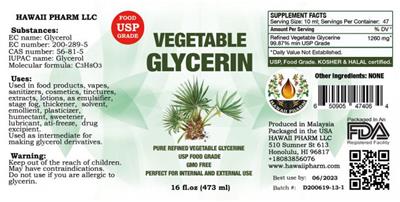
Uses: Used in food products, vapes, sanitizers, cosmetics, tinctures, extracts, lotions, as emulsifiers, stage fog, thickener, solvent, emollient, plasticizer, humectant, sweetener, lubricant, anti-freeze, drug excipient. Used as intermediate for making glycerol derivatives.
Perfect for internal and external use
Precautions
Warning: Keep out of reach of children.
Do not use if you are allergic to glycerin.
Formulation
Pure refined vegetable glycerine USP food grade
GMO free
USP, food grade.
Formula
Kosher and halal certified.
Kosher and halal certified.
Seals/Symbols
Packaged in an FDA registered facility
Is this label outdated? Report a formula or label change and our pharmacy team will review it.
Vegetable Glycerin by Hawaii Pharm label
The label scan from the NIH Dietary Supplement Label Database. Tap to enlarge.
Label images are published by the NIH Dietary Supplement Label Database for the version of this product on file. Always read your actual product label.
View the full label (PDF)The Ingredients in Vegetable Glycerin by Hawaii Pharm
This is the 1 active ingredient this product is made of. Select it to open its full monograph.
Serving size10 mL Dosage formLiquid Servings per container47 Amounts shown are per serving.
Glycerin
No knowninteractions
Glycerol (glycerin) is a sweet, syrupy compound made naturally in the body and widely used in foods, skin products, and medicines. It is well establis...
Glycerin monograph & interactionsOther (inactive) ingredients: None. These complete the product’s ingredient list but are not active constituents.
Vegetable Glycerin by Hawaii Pharm Drug Interactions
We don’t currently list any known drug interactions for the mapped ingredients in Vegetable Glycerin. This doesn’t guarantee none exist — always confirm with your pharmacist before combining a supplement with your medications.
Brand information
Manufacturer and brand details for Vegetable Glycerin, from the product label.
Hawaii Pharm
See all Hawaii Pharm products- Name
- Hawaii Pharm LLC
- Street Address
- 510 Sumner St 613
- City
- Honolulu
- State
- HI
- ZipCode
- 96817
- Phone Number
- 1-808-385-6076
- Web Address
- www.hawaiipharm.com
Vegetable Glycerin by Hawaii Pharm: Common Questions
Does Vegetable Glycerin by Hawaii Pharm interact with any medications?
How can one product interact with so many drugs?
Where does this information come from?
Will glycerin help with constipation?
Can I use this on my skin?
What side effects might I notice if I take it by mouth?
Is there safety data on this product during pregnancy or breastfeeding?
Can this help me with athletic performance?
Written and reviewed by the HelloPharmacist editorial staff. Our editorial policy
Not sure if Vegetable Glycerin is safe with your meds?
Our pharmacists answer your medication & supplement questions — free.
Label information is sourced from the NIH Dietary Supplement Label Database and reflects the product version on file; always read your actual product label. This page is for education only and is not a substitute for professional medical advice. Confirm with your pharmacist or doctor before combining supplements and medications.
The Full Monographs Behind Vegetable Glycerin’s Ingredients
Every ingredient we hold a full HelloPharmacist monograph for — uses, evidence, safety, and the complete interaction list.
Sources & How We Checked
Vegetable Glycerin's label data comes from the NIH Dietary Supplement Label Database; the ingredient interaction data is from the Natural Medicines database, reviewed by our pharmacists.
- NIH Dietary Supplement Label Database (DSLD) — The official product label on file for this supplement.
- Natural Medicines (Therapeutic Research Center) — Evidence-graded clinical reference behind the ingredient interaction data.
Content is written and reviewed by licensed HelloPharmacist pharmacists. See our data sources and editorial standards for how this information is built and checked.
The 8 references behind this product’s interaction data
Every citation that drives the interaction findings for this product’s ingredients, from the evidence-graded Natural Medicines (TRC Healthcare) database. Open an ingredient to browse its citations — links open the study on PubMed or the publisher’s site.
Glycerol 8 references
- McEvoy GK, ed. AHFS Drug Information. Bethesda, MD: American Society of Health-System Pharmacists, 1998.
- Wagner DR. Hyperhydrating with glycerol: implications for athletic performance. J Am Diet Assoc 1999;99:207-12. PubMed
- Yu YL, Kumana CR, Lauder IJ, et al. Treatment of acute cortical infarct with intravenous glycerol. A double-blind, placebo-controlled randomized trial. Stroke 1993;24:1119-24. PubMed
- Frei A, Cottier C, Wunderlich P, Ludin E. Glycerol and dextran combined in the therapy of acute stroke. A placebo-controlled, double-blind trial with a planned interim analysis. Stroke 1987;18:373-9. PubMed
- Balaskas E, Szepietowski JC, Bessis D, Ioannides D, Ponticelli C, Ghienne C, Taberly A, Dupuy P. Randomized, double-blind study with glycerol and paraffin in uremic xerosis. Clin J Am Soc Nephrol. 2011 Apr;6(4):748-52. PubMed
- Blanchet-Bardon C, Tadini G, Machado Matos M, Delarue A. Association of glycerol and paraffin in the treatment of ichthyosis in children: an international, multicentric, randomized, controlled, double-blind study. J Eur Acad Dermatol Venereol. 2012 Aug;26 PubMed
- Kajita N, Kanamori K, Yamamoto S, Yoshida K. Generalized Urticaria Caused by a Glycerin Enema in an Infant. J Investig Allergol Clin Immunol 2022;32(4):318-319. PubMed
- Suzuki R, Fukuyama K, Miyazaki Y, Namiki T. Contact urticaria syndrome and protein contact dermatitis caused by glycerin enema. JAAD Case Reports. 2016;2:108-10. PubMed
Parts of this content are provided by the Therapeutic Research Center, LLC.
DISCLAIMER: Currently this does not check for drug-drug interactions. This is not an all-inclusive comprehensive list of potential interactions and is for informational purposes only. Not all interactions are known or well-reported in the scientific literature, and new interactions are continually being reported. Input is needed from a qualified healthcare provider including a pharmacist before starting any therapy. Application of clinical judgment is necessary.
© 2021 Therapeutic Research Center, LLC