
Vitamin B1 100 mg Ingredients & Drug Interactions
by Bluebonnet
What is this page for?
First and foremost: checking Vitamin B1 100 mg against your medications. The heart of this page is the interaction checker and the full interaction report — how this product’s ingredients may interact with prescription and over-the-counter medicines you may be taking.
Around that, we add a pharmacist’s high-level view of the product as a whole — what’s inside, the evidence for its stated use, how transparent the label is, and what safety data exists — so you can see the full picture in one place. It’s educational information from our licensed clinical databases and the clinical staff at HelloPharmacist — not medical advice — and we don’t sell or endorse products. Our editorial policy
Vitamin B1 100 mg is a dietary supplement by Bluebonnet with 1 active ingredient. Its ingredients are commonly taken for preventing or treating thiamine deficiency, beriberi, wernicke-korsakoff syndrome (alcohol-related).Based on those ingredients, 3 medications have a known interaction with it, the most serious rated minor. The ingredients most likely to interact are Thiamine. Use the checker below to test your specific medication, or read the full HelloPharmacist Interaction Report.
Check Your Meds Against Vitamin B1 100 mg by Bluebonnet
Ask about any prescription or over-the-counter medication and we check it for interactions with Vitamin B1 100 mg by Bluebonnet — and tell you which ingredient is responsible.
AI summaries are generated from our interaction database for education only — always confirm with your pharmacist. How we use AI
Ask the Pharmacist
A licensed pharmacist will answer your question by email — free, usually within 24 hours.
Got it — thank you!
A licensed pharmacist will answer within 24 hours. Keep an eye on your email (worth checking spam, just in case).
HelloPharmacist Scorecard of Vitamin B1 100 mg by Bluebonnet
Our pharmacy team’s full take, with four database checks built into the cards below — a summary of what is known, not a grade of the product itself.
What’s inside
Full disclosure
This product contains one active ingredient: thiamine (also called vitamin B1), which is an essential B vitamin your body needs to convert food into energy and support nerve function. The capsule also contains inactive ingredients like cellulose, hypromellose, purified water, and magnesium stearate, which are binders and fillers that help form and stabilize the capsule.
Does it work?
Strong evidence
Thiamine is effective for treating thiamine deficiency and Wernicke-Korsakoff syndrome (a serious condition caused by severe thiamine lack, often linked to heavy alcohol use). It's possibly effective for period pain (dysmenorrhea).
For other uses listed in the research — mosquito repellent and heart failure — the evidence suggests it's possibly ineffective.
How safe is it?
Well-documented data
Thiamine taken by mouth in normal amounts is generally very well tolerated. Allergic reactions like skin rashes are rare; injected thiamine can rarely cause severe allergic reactions, but that's not relevant to this oral capsule.
Thiamine is needed in pregnancy and while breastfeeding, and supplementing at recommended doses under your doctor's or pharmacist's guidance is safe — just don't exceed the amounts they advise.
Meds to double-check
Minor interactions only
If you take trimethoprim (Proloprim), an antibiotic, check with your pharmacist before using this product — it may raise your thiamine blood levels. No other interactions are documented for the ingredients we checked.
The bottom line
Scorecard at a glanceFully disclosed formula with clinical evidence supporting its stated purpose. Only minor medication interactions are documented, and safety information is well characterized.
This is a straightforward B1 supplement ideal if you have a documented thiamine deficiency or Wernicke-Korsakoff syndrome. If you take trimethoprim or any other prescription medication, check with us first.
Otherwise, it's a low-risk addition to most routines.
Educational only — not medical advice; always confirm with your pharmacist. Our editorial policy · How we use AI
Assessment coverage: 1 of 1 active ingredient matched to our full ingredient reviews (monographs). Based on the product label dated Oct 24, 2024.
This Scorecard evaluates available label information, ingredient evidence, and known medication-safety considerations. It does not independently verify product identity, purity, potency, contamination, or manufacturing quality. How these ratings are computed
General information
Key facts about Vitamin B1 100 mg, straight from the product label.
| Brand | Bluebonnet |
|---|---|
| Barcode (UPC) | 743715004252 |
| Net contents | 100 Vegetable Capsule(s) |
| Market status | On market |
| Date entered into DSLD | Oct 24, 2024 |
| DSLD ID | 315047 |
| Product type | Vitamin |
| Supplement form | Capsule |
| Dietary claims / uses | Nutrient, All Other, Structure/Function |
| Intended target group(s) | Vegan, Vegetarian, Adult (18 - 50 Years), Kosher, No Allergies, Gluten Free |
Everything in this section is reproduced from the manufacturer’s own product label — it’s the label speaking, not HelloPharmacist. We show it so you can see exactly what the maker states; we don’t verify or endorse those statements.
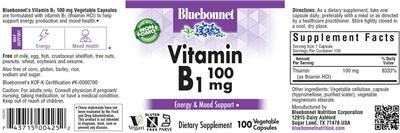
Supplement Facts
The label details for Vitamin B1 100 mg by Bluebonnet, sourced from the NIH Dietary Supplement Label Database.
Supplement Facts
| Ingredient | Amount | % DV |
|---|---|---|
| Thiamine | 100 mg | 8333% |
Other ingredients: Cellulose, Hypromellose, Water, Purified, Magnesium Stearate
Tap any ingredient to jump to its full detail below.
These statements are the manufacturer’s wording, reproduced from the product label — the label is saying it, not HelloPharmacist. We don’t verify or endorse them.
Formula
Bluebonnet's Vitamin B1 100 mg Vegetable Capsules are formulated with vitamin B1 (thiamin HCl) to help support energy production and mood health.
Bluebonnet's KOF-K Certification #K-0000700
K Parve (Kosher)
Formulation
May support Energy Mood health
Free of milk, egg, fish, crustacean shellfish, tree nuts, peanuts, wheat, soybeans and sesame. Also free of corn, gluten, barley, rice, sodium and sugar.
Energy & mood support
Made with Non GMO Ingredients Gluten free
Vegan
Precautions
Caution: For adults only.
Consult physician if pregnant/nursing, taking medication, or have a medical condition.
Keep out of reach of children.
FDA Disclaimer Statement
These statements have not been evaluated by the Food and Drug Administration. This product is not intended to diagnose, treat, cure or prevent any disease.
Seals/Symbols
Made with Non GMO Ingredients K Parve (Kosher)
FDA Statement of Identity
Dietary Supplement
Suggested/Recommended/Usage/Directions
Directions: As a dietary supplement, take one capsule daily, preferably with a meal or as directed by a healthcare practitioner.
Storage
Store tightly closed in a cool, dry place.
Is this label outdated? Report a formula or label change and our pharmacy team will review it.
Vitamin B1 100 mg by Bluebonnet label
The label scan from the NIH Dietary Supplement Label Database. Tap to enlarge.
Label images are published by the NIH Dietary Supplement Label Database for the version of this product on file. Always read your actual product label.
View the full label (PDF)The Ingredients in Vitamin B1 100 mg by Bluebonnet
This is the 1 active ingredient this product is made of. Select it to open its full monograph.
Serving size1 Capsule(s) Dosage formCapsule Servings per container100 Amounts shown are per serving.
Thiamine
Interacts with3 drugs
Thiamine (vitamin B1) is an essential nutrient your body needs to turn food into energy and to keep your nerves and heart healthy. Most people get eno...
Thiamine monograph & interactionsOther (inactive) ingredients: Cellulose, Hypromellose, Water, Purified, Magnesium Stearate. These complete the product’s ingredient list but are not active constituents.
Vitamin B1 100 mg by Bluebonnet Drug Interactions
HelloPharmacist Interaction Report
Bluebonnet's Vitamin B1 (thiamine) at 100 mg shows documented interactions with a small number of medications.
The one interaction on file involves trimethoprim (Proloprim), an antibiotic used to treat certain infections. Trimethoprim can block the way your body transports and clears thiamine, which may paradoxically raise thiamine levels in your blood.
Read the full breakdown — every affected drug type, severity by severity
Altogether, these interactions span 3 individual medications. If you take trimethoprim or any other prescription medication, run it through the checker below before starting this supplement to make sure there's no conflict with your specific drugs.
Check your own medications below · Editorial policy · How we use AI
Want to check YOUR meds against Vitamin B1 100 mg?
Ask about interactions with your drugs in plain English — “Can I take it with lisinopril?” — and we find you the answer in seconds, ingredient by ingredient.
Go to the checkerIngredients driving the most interactions
Individual Drug Interactions
The ingredients in Vitamin B1 100 mg interact with 3 drugs. Click any drug to see the details.
1 of the 1 ingredient in Vitamin B1 100 mg interact with drugs. Each result below shows which ingredient is responsible. Thiamine
Sulfadiazine, TrimethoprimCoptin
How Sulfadiazine, Trimethoprim interacts with Vitamin B1 100 mg — through 1 ingredient. Tap an ingredient for the detail:
ThiamineTrimethoprim (proloprim) Minor
Interaction Summary
Trimethoprim might increase blood levels of thiamine.
Read the full Thiamine + Sulfadiazine, Trimethoprim interactionSulfamethoxazole, TrimethoprimBactrim, Bactrim DS, Bactrim IV, Cotrim, Cotrim DS, Cotrimix +9 more
How Sulfamethoxazole, Trimethoprim interacts with Vitamin B1 100 mg — through 1 ingredient. Tap an ingredient for the detail:
ThiamineTrimethoprim (proloprim) Minor
Interaction Summary
Trimethoprim might increase blood levels of thiamine.
Read the full Thiamine + Sulfamethoxazole, Trimethoprim interactionTrimethoprimProloprim, Trimpex
How Trimethoprim interacts with Vitamin B1 100 mg — through 1 ingredient. Tap an ingredient for the detail:
ThiamineTrimethoprim (proloprim) Minor
Interaction Summary
Trimethoprim might increase blood levels of thiamine.
Read the full Thiamine + Trimethoprim interactionEach ingredient & the kinds of drugs it affects
For each ingredient in Vitamin B1 100 mg with known interactions, here are the types of medications it can affect. Open any type for the detail — or search your exact drug in the checker above.
Thiamine
Trimethoprim (Proloprim)
Trimethoprim might increase blood levels of thiamine.
In vitro, animal, and clinical research suggest that trimethoprim inhibits intestinal thiamine transporter ThTR-2, hepatic transporter OCT1, and renal transporters OCT2, MATE1, and MATE2, resulting in paradoxically increased thiamine plasma concentrations.
Brand information
Manufacturer and brand details for Vitamin B1 100 mg, from the product label.
Bluebonnet
- Name
- Bluebonnet Nutrition Corporation
- Street Address
- 12915 Dairy Ashford
- City
- Sugar Land
- State
- TX
- ZipCode
- 77478
- Web Address
- bluebonnetnutrition.com
Vitamin B1 100 mg by Bluebonnet: Common Questions
Does Vitamin B1 100 mg by Bluebonnet interact with any medications?
How can one product interact with so many drugs?
Where does this information come from?
Is it safe to take this while I'm pregnant or breastfeeding?
What is thiamine used for?
Can thiamine cause side effects?
Who should take this supplement?
Does this work as a mosquito repellent?
Written and reviewed by the HelloPharmacist editorial staff. Our editorial policy
Not sure if Vitamin B1 100 mg is safe with your meds?
Our pharmacists answer your medication & supplement questions — free.
Label information is sourced from the NIH Dietary Supplement Label Database and reflects the product version on file; always read your actual product label. This page is for education only and is not a substitute for professional medical advice. Confirm with your pharmacist or doctor before combining supplements and medications.
The Full Monographs Behind Vitamin B1 100 mg’s Ingredients
Every ingredient we hold a full HelloPharmacist monograph for — uses, evidence, safety, and the complete interaction list.
Sources & How We Checked
Vitamin B1 100 mg's label data comes from the NIH Dietary Supplement Label Database; the ingredient interaction data is from the Natural Medicines database, reviewed by our pharmacists.
- NIH Dietary Supplement Label Database (DSLD) — The official product label on file for this supplement.
- Natural Medicines (Therapeutic Research Center) — Evidence-graded clinical reference behind the ingredient interaction data.
Content is written and reviewed by licensed HelloPharmacist pharmacists. See our data sources and editorial standards for how this information is built and checked.
The 7 references behind this product’s interaction data
Every citation that drives the interaction findings for this product’s ingredients, from the evidence-graded Natural Medicines (TRC Healthcare) database. Open an ingredient to browse its citations — links open the study on PubMed or the publisher’s site.
Thiamine 7 references
- McEvoy GK, ed. AHFS Drug Information. Bethesda, MD: American Society of Health-System Pharmacists, 1998.
- Yates AA, Schlicker SA, Suitor CW. Dietary reference intakes: The new basis for recommendations for calcium and related nutrients, B vitamins, and choline. J Am Diet Assoc 1998;98:699-706. PubMed
- Food and Nutrition Board, Institute of Medicine. Dietary Reference Intakes for Thiamin, Riboflavin, Niacin, Vitamin B6, Folate, Vitamin B12, Pantothenic Acid, Biotin, and Choline (2000). Washington, DC: National Academy Press, 2000. Available at: http://b
- Rogovik, A. L., Vohra, S., and Goldman, R. D. Safety considerations and potential interactions of vitamins: should vitamins be considered drugs? Ann.Pharmacother. 2010;44(2):311-324. PubMed
- Arruti N, Bernedo N, Audicana MT, Villarreal O, Uriel O, Muñoz D. Systemic allergic dermatitis caused by thiamine after iontophoresis. Contact Dermatitis. 2013 Dec;69(6):375-6. PubMed
- Thiamine hydrochloride injection package insert. Lake Zurich, IL: Fresenius Kabi, LLC; September 2019.
- Vora B, Wen A, Yee SW, et al. The Effect of Trimethoprim on Thiamine Absorption: A Transporter-Mediated Drug-Nutrient Interaction. Clin Pharmacol Ther 2023;114(2):381-392.
Parts of this content are provided by the Therapeutic Research Center, LLC.
DISCLAIMER: Currently this does not check for drug-drug interactions. This is not an all-inclusive comprehensive list of potential interactions and is for informational purposes only. Not all interactions are known or well-reported in the scientific literature, and new interactions are continually being reported. Input is needed from a qualified healthcare provider including a pharmacist before starting any therapy. Application of clinical judgment is necessary.
© 2021 Therapeutic Research Center, LLC