
TAUVID Flortaucipir F-18 100 mCi/mL Injection, Solution — NDC 0002-1220-48 (Billing 00002-1220-48)
This is a package of TAUVID Flortaucipir F-18 100 mCi/mL Injection, Solution from Eli Lilly and Company, marketed since Jul 2022 and currently FDA-listed. It is the main listing for this product, which comes in 2 package sizes.
Identity & classification
Regulatory identifiers FDA, NLM and CMS codes for this package
Where does this data come from?
- FDA openFDA NDC Directory · synced Oct 1, 2026
- FDA label on DailyMed · label index refreshed Oct 1, 2026
- RxNorm (NLM RxNav) · catalog refreshed Oct 1, 2026
- Medi-Span GPI (licensed)
- First Databank (licensed) · refreshed Oct 1, 2026
Clinical
Patient education
Supplement & herbal interactions
Where does this data come from?
- MedlinePlus (NLM) · refreshed Oct 1, 2026
- FDA label on DailyMed · label index refreshed Oct 1, 2026
Ask a licensed pharmacist directly — free, answered by our team.
Pricing
A drug doesn't have one price. Each row is a different public payment system, and none is what you'd pay at the counter — that depends on your insurance. The ⓘ on each row explains what it measures.
| Price system | Per mL | Per package |
|---|---|---|
| Retail pharmacies payNADAC · weekly | Not in the retail survey — common for institutional, discontinued, or low-volume packs. | |
| Medicaid paysCMS SDUD · 12 mo | No recent Medicaid claims on file for this NDC — rare and low-volume NDCs are suppressed in the public data. | |
| Medicare drug plans payPart D · quarterly | No Part D plan price is available for this NDC in our data. | |
Where does this data come from?
- CMS NADAC weekly file
- CMS ASP pricing files · refreshed Sep 20, 2026
- CMS Medicaid State Drug Utilization Data · refreshed Oct 3, 2026
- CMS Part D plan pricing files · refreshed Sep 24, 2026
- VA National Acquisition Center price file
Packaging — all sizes for this product
| Package NDC | Description | Marketing start | Marketing end | Status |
|---|---|---|---|---|
| 00002-1220-48 You're viewing this Main listing | 1 VIAL, MULTI-DOSE in 1 CAN / 100 mL in 1 VIAL, MULTI-DOSE | 2022-10-25 | — | Active |
| 00002-1220-50 0002-1220-50 | 1 VIAL, MULTI-DOSE in 1 CAN / 50 mL in 1 VIAL, MULTI-DOSE | 2022-10-25 | — | Active |
Pack size FAQ
What quantity is in this package?
What NDC number is used to bill for this package of TAUVID Flortaucipir F-18 100 mCi/mL Injection, Solution?
Therapeutic equivalents
| Product | Labeler | Pack | NADAC/unit | TE | Status | Price vs. this |
|---|---|---|---|---|---|---|
| Tauvid 100 mCi/mLthis 00002-1220-48 | Eli | 1 vial | — | — | FDA listed | — |
Where does this data come from?
- FDA openFDA NDC Directory · synced Oct 1, 2026
- FDA Orange Book · refreshed Oct 3, 2026
- CMS NADAC weekly file
Availability & generic status
We did not find an FDA-approved generic match for this exact strength, form and route. Patent/protection dates below may affect future generic timing.
Why the date isn’t exact: Generic timing can change because patents may be challenged, settled, licensed, added, removed, or worked around with a narrower label — and FDA approval does not always mean a pharmacy can get the generic today.
🛈 What do these terms mean?
- Patent
- Legal protection listed in the Orange Book that may delay generic approval or launch. Issued by the U.S. Patent & Trademark Office.
- Substance patent
- Covers the active drug molecule itself — the hardest to design around. A generic generally can’t launch until it expires.
- Formulation (product) patent
- Covers a specific formulation or dosage form. A generic can sometimes work around it with a different formulation.
- Method-of-use patent
- A patent covering one specific approved use of the drug — not necessarily the whole molecule. A generic can sometimes launch with a “skinny label” that carves out the protected use and keeps the others.
- Skinny label
- A generic label that omits a still-patented use when the FDA allows it — letting a generic reach the market for the unprotected uses.
- Exclusivity
- FDA-granted marketing protection, separate from patents — e.g. 5-yr new chemical entity, 7-yr orphan drug, or a +6-month pediatric extension.
- Paragraph IV
- A generic applicant’s formal challenge to a listed patent. It can potentially lead to earlier generic entry, but often involves litigation or a settlement.
- RLD / RS
- Reference Listed Drug — the brand product the FDA uses as the reference for generic applications. Reference Standard — the product the FDA expects generics to compare against in bioequivalence testing.
- TE / AB rating
- FDA therapeutic-equivalence rating. An AB rating generally means the FDA considers a generic therapeutically equivalent to — and substitutable for — the brand.
- LOE (loss of exclusivity)
- The latest patent or exclusivity currently listed — the loss-of-exclusivity / latest-listed-protection date shown on this page. Paragraph-IV challenges and settlements can move the real date earlier; FDA approval and a manufacturer’s decision to market can move it later.
Built from the FDA Orange Book. The bars above are scaled to each protection’s expiry; the red LOE marker is the last one to lapse.
| Patent | Type | Use code | Expires |
|---|---|---|---|
| US 8932557 ↗ | Drug substance | — | May 26, 2032 |
| US 8932557 ↗ | Drug substance | — | May 26, 2032 |
| US 8932557 ↗ | Drug substance | — | May 26, 2032 |
| US 8932557 ↗ | Drug substance | — | May 26, 2032 |
Is there a generic version of this drug?
The FDA approved a generic — why can’t I get it at my pharmacy yet?
Why do different websites show different generic release dates?
What does “FDA listed” mean?
What does a patent or protection date mean here?
What does “current Orange Book estimate” mean?
Can a generic come out before the last patent expires?
Can a generic come out after the listed dates?
What is the difference between patents and exclusivity?
Why are there multiple patent dates?
Where does this data come from?
- FDA Orange Book · refreshed Oct 3, 2026
Inactive Ingredients / Excipients
Inactive ingredients, also called excipients, are components of the drug product other than the active ingredient. They may include fillers, dyes, coatings, preservatives, flavors, or other formulation ingredients.
💡 Tap an ingredient (hover on desktop) to see what it is and why it’s used.
-
78.9 mg / 1 mL
UNII 3K9958V90M
A liquid solvent derived from fermentation or chemical synthesis. In medicines, alcohol dissolves active ingredients, helps preserve the product, and improves how the body absorbs certain drugs.
-
1.5 mg / 1 mL
UNII ZT934N0X4W
A naturally occurring amino acid salt used as a reducing agent and antioxidant in medications. It helps prevent ingredient breakdown and may improve product stability during storage.
-
55 mg / 1 mL
UNII QTT17582CB
A strong acid used to adjust and maintain the proper pH level in liquid medicines, ensuring stability and preventing breakdown of active ingredients.
-
8.1 mg / 1 mL
UNII 451W47IQ8X
Sodium chloride is common table salt. It's used in medicines as a buffer to maintain proper pH, as a filler to add bulk, or to adjust the osmotic balance in liquid formulations.
-
2.1 mg / 1 mL
UNII 22ADO53M6F
A mineral salt derived from phosphoric acid, used as a buffer to maintain the pH balance of the medication and help stabilize the active ingredients.
5 inactive ingredients listed in the exact product block matched to this NDC.
Where does this data come from?
ingredient classCode="IACT" elements from the exact product block matched by this NDC. Label-section narrative from DailyMed / the openFDA label index is shown separately when available.- FDA label on DailyMed · label index refreshed Oct 1, 2026
- FDA openFDA NDC Directory · synced Oct 1, 2026
Inactive ingredient FAQ
Are inactive ingredients the same for every manufacturer?
Why might an inactive ingredient be missing?
Can inactive ingredients matter?
Manufacturer & labeler
Where does this data come from?
- FDA openFDA NDC Directory · synced Oct 1, 2026
- Drugs@FDA
Full prescribing information FDA SPL
🎯 Indications and Usage ▾
1 INDICATIONS AND USAGE TAUVID is indicated for use with positron emission tomography (PET) imaging of the brain to estimate the density and distribution of aggregated tau neurofibrillary tangles (NFTs) in adult patients with cognitive impairment who are being evaluated for Alzheimer's disease (AD). TAUVID is a radioactive diagnostic agent indicated for positron emission tomography (PET) imaging of the brain to estimate the density and distribution of aggregated tau neurofibrillary tangles (NFTs) in adult patients with cognitive impairment who are being evaluated for Alzheimer's disease (AD).
( 1 ) Limitations of Use TAUVID is not indicated for use in the evaluation of patients for chronic traumatic encephalopathy (CTE). ( 1 , 5.2 ) Limitations of Use TAUVID is not indicated for use in the evaluation of patients for chronic traumatic encephalopathy (CTE) [see Warnings and Precautions ( 5.2 )] .
⏱️ Dosage and Administration ▾
2 DOSAGE AND ADMINISTRATION Recommended dose is 370 MBq (10 mCi), administered as a bolus intravenous injection. ( 2.2 ) Initiate imaging approximately 80 minutes after drug administration. ( 2.3 ) See full prescribing information for additional preparation, administration, imaging, and radiation dosimetry information. ( 2 )
2.1Radiation Safety - Drug Handling TAUVID is a radioactive drug. Only authorized persons qualified by training and experience should receive, use, and administer TAUVID. Handle TAUVID with appropriate safety measures to minimize radiation exposure during administration [see Warnings and Precautions ( 5.3 )] . Use waterproof gloves and effective shielding, including syringe shields, when preparing and handling TAUVID.
2.2Recommended Dosage and Administration Instructions Recommended Dose The recommended amount of radioactivity to be administered for PET imaging is 370 MBq (10 mCi), administered as an intravenous bolus injection in a total volume of 10 mL or less. Preparation and Administration Assessment of pregnancy status is recommended in females of reproductive potential before administering TAUVID. Use aseptic technique and radiation shielding during the preparation and administration of TAUVID [see Dosage and Administration ( 2.1 )] .
Visually inspect the radiopharmaceutical solution prior to administration. Do not use it if it contains particulate matter or if it is discolored (TAUVID is a clear, colorless solution). TAUVID may be diluted aseptically with 0.9% Sodium Chloride Injection to a maximum dilution of 1:5 by the end-user.
Diluted product should be used within 4 hours of dilution and prior to product expiry. Assay the dose in a suitable dose calibrator prior to administration. Post-Administration Instructions Follow the TAUVID injection with an intravenous flush of 0.9% Sodium Chloride injection, USP.
Dispose of any unused TAUVID in compliance with applicable regulations.
2.3Image Acquisition Starting approximately 80 minutes after the TAUVID intravenous injection, obtain a 20-minute PET image with the patient supine. Position the head to center the brain (including the cerebellum) in the PET scanner field of view. Tape or other flexible head restraints may be used to reduce head movement.
2.4Image Display The goal of the read is to identify and locate areas of flortaucipir activity in the neocortex that are greater than the background activity (background activity is defined as up to 1.65-fold the measured cerebellar average). For optimal display, select a color scale with a rapid transition between two distinct colors and adjust the scale so that the transition occurs at the 1.65-fold threshold. Examine the posterolateral temporal (PLT), occipital, parietal, and frontal regions bilaterally.
Neocortical activity in either hemisphere contributes to image interpretation. Activity in white matter or regions outside the brain does not contribute to image interpretation. To help identify the PLT, consider subdividing the temporal lobe into four quadrants as instructed below.
Activity in the anterior and medial temporal lobe does not contribute to image interpretation of a positive TAUVID pattern. Image Display and Orientation Display images in the transverse, sagittal, and coronal planes. Reorient images to remove head tilt in the transverse and coronal plane.
Use a sagittal slice just off the midline to align the inferior frontal and inferior occipital poles in the horizontal plane. Select and Adjust the Color Scale To create a visual threshold for positivity: Draw a region of interest around the cerebellum in the transverse plane. Select the plane to go through the cerebellum at the maximum cross-sectional area of the cerebellum.
Record the mean activity or cerebellar counts (MCC). The region of interest should be drawn with the scan in gray scale and in the transverse plane as seen in the example in Figure 1 . Figure 1: Example of Cerebellar Region of Interest Select a color scale for ima… [Excerpted — this section continues on DailyMed.]
💊 Dosage Forms and Strengths ▾
3 DOSAGE FORMS AND STRENGTHS Injection: clear, colorless solution in a 50 mL or 100 mL multiple-dose vial containing 300 MBq/mL to 3,700 MBq/mL (8.1 mCi/mL to 100 mCi/mL) flortaucipir F 18 at the end of synthesis. Injection: 300 MBq/mL to 3,700 MBq/mL (8.1 mCi/mL to 100 mCi/mL) of flortaucipir F 18 in a multiple-dose vial. ( 3 )
⛔ Contraindications ▾
4 CONTRAINDICATIONS None. None. ( 4 )
⚠️ Warnings and Cautions ▾
5 WARNINGS AND PRECAUTIONS Risk of Misdiagnosis in Patients Evaluated for Alzheimer's disease : Consider additional evaluation to confirm the absence of AD pathology in patients with a negative TAUVID scan. ( 2.6 , 5.1 ) Risk of Chronic Traumatic Encephalopathy Misdiagnosis : The safety and effectiveness of TAUVID have not been established for patients being evaluated for CTE. ( 1 , 5.2 ) Radiation Risk : Ensure safe drug handling to protect patients and health care workers from unintentional radiation exposure.
( 2.1 , 5.3 )
5.1Risk of Misdiagnosis in Patients Evaluated for Alzheimer's disease TAUVID does not target β-amyloid, one of two required components of the neuropathological diagnosis of AD. TAUVID performance for detecting tau pathology was assessed in terminally ill patients, the majority of whom had AD dementia with B3 level NFT pathology. TAUVID performance for detecting tau pathology may be lower in patients in earlier stages of the pathological spectrum [see Clinical Studies ( 14 )] .
Negative TAUVID Scan NFTs may be present at levels that qualify for the neuropathological diagnosis of AD (B2 tau pathology in the presence of at least moderate levels of cortical amyloid pathology) in patients with a negative TAUVID scan. Consider additional evaluation to confirm the absence of AD pathology in patients with a negative TAUVID scan. False Positive TAUVID Scan Small foci of noncontiguous tracer uptake may lead to a false positive TAUVID scan.
Only uptake of tracer in the neocortex should contribute to the interpretation of a positive TAUVID scan [see Dosage and Administration ( 2.4 )] .
5.2Risk of Chronic Traumatic Encephalopathy Misdiagnosis The safety and effectiveness of TAUVID have not been established for patients being evaluated for CTE. Preliminary non-clinical and clinical investigations suggest differences in tau conformation and distribution may limit flortaucipir F 18 binding. Therefore, TAUVID is not indicated for detection of CTE.
5.3Radiation Risk Diagnostic radiopharmaceuticals, including TAUVID, expose patients to radiation [see Dosage and Administration ( 2.7 )] . Radiation exposure is associated with a dose-dependent increased risk of cancer. Ensure safe handling and preparation procedures to protect patients and health care workers from unintentional radiation exposure [see Dosage and Administration ( 2.1 , 2.2 )] .
🤒 Adverse Reactions ▾
6 ADVERSE REACTIONS Most common adverse reactions (frequency ≥ 0.5%) were headache, injection site pain, and increased blood pressure. ( 6.1 ) To report SUSPECTED ADVERSE REACTIONS, contact Eli Lilly and Company at 1-800-LillyRx (1-800-545-5979) or FDA at 1-800-FDA-1088 or www.fda.gov/medwatch.
6.1Clinical Trials Experience Because clinical trials are conducted under widely varying conditions, adverse reaction rates observed in the clinical trials of a drug cannot be directly compared to rates in the clinical trials of another drug and may not reflect the rates observed in practice. In clinical studies, 1,921 study participants were exposed to TAUVID [see Clinical Studies ( 14 )] . In these studies, 885 study participants received 240 MBq of TAUVID (about 65% of the recommended dose) and 1,036 study participants received 370 MBq of TAUVID (the recommended dose).
The adverse reactions reported in ≥ 0.5% of study participants are shown in Table 2 . Table 2: Adverse Reactions with a Frequency ≥0.5% in Adults Who Received TAUVID in Clinical Trials (n = 1,921) Adverse Reaction n (%) Headache 26 (1.4%) Injection site pain 23 (1.2%) Increased blood pressure 15 (0.8%) Adverse reactions with a frequency <0.5% in adults who received TAUVID in clinical trials include: Nervous system disorders: dysgeusia
👥 Use in Specific Populations ▾
8 USE IN SPECIFIC POPULATIONS Lactation : Interrupt breastfeeding. Advise a lactating woman to avoid breastfeeding for 4 hours after TAUVID administration. ( 8.2 )
8.1Pregnancy Risk Summary All radiopharmaceuticals, including TAUVID, have the potential to cause fetal harm depending on the fetal stage of development and the magnitude of radiation dose. Advise a pregnant woman of the potential risks of fetal exposure to radiation doses with administration of TAUVID. TAUVID is not likely to be used in females of reproductive age.
There are no available data on TAUVID use in pregnant women. No animal reproduction studies using flortaucipir F 18 have been conducted to evaluate its effect on female reproduction and embryo-fetal development. The estimated background risk of major birth defects and miscarriage for the indicated population is unknown.
All pregnancies have a background risk of birth defect, loss, or other adverse outcomes. In the U.S. general population, the estimated background risk of major birth defects and miscarriage in clinically recognized pregnancies is 2 to 4% and 15 to 20%, respectively.
8.2Lactation Risk Summary There are no data on the presence of flortaucipir F 18 in human milk, or its effects on the breastfed infant or milk production. Lactation studies have not been conducted in animals. Advise a lactating woman to avoid breastfeeding for 4 hours after TAUVID administration in order to minimize radiation exposure to a breastfed infant.
8.4Pediatric Use The safety and effectiveness of TAUVID in pediatric patients have not been established.
8.5Geriatric Use Of 1,921 study participants in completed clinical studies of TAUVID, 1,544 (80%) TAUVID-treated subjects were ≥ 65 years old, while 839 (44%) were ≥ 75 years old. No overall differences in safety or effectiveness of TAUVID were observed between subjects ≥ 65 years old and younger adult subjects, and other reported clinical experience has not identified differences in safety or effectiveness between elderly and younger patients.
🤰 Pregnancy ▾
8.1Pregnancy Risk Summary All radiopharmaceuticals, including TAUVID, have the potential to cause fetal harm depending on the fetal stage of development and the magnitude of radiation dose. Advise a pregnant woman of the potential risks of fetal exposure to radiation doses with administration of TAUVID. TAUVID is not likely to be used in females of reproductive age.
There are no available data on TAUVID use in pregnant women. No animal reproduction studies using flortaucipir F 18 have been conducted to evaluate its effect on female reproduction and embryo-fetal development. The estimated background risk of major birth defects and miscarriage for the indicated population is unknown.
All pregnancies have a background risk of birth defect, loss, or other adverse outcomes. In the U.S. general population, the estimated background risk of major birth defects and miscarriage in clinically recognized pregnancies is 2 to 4% and 15 to 20%, respectively.
🧒 Pediatric Use ▾
8.4Pediatric Use The safety and effectiveness of TAUVID in pediatric patients have not been established.
🧓 Geriatric Use ▾
8.5Geriatric Use Of 1,921 study participants in completed clinical studies of TAUVID, 1,544 (80%) TAUVID-treated subjects were ≥ 65 years old, while 839 (44%) were ≥ 75 years old. No overall differences in safety or effectiveness of TAUVID were observed between subjects ≥ 65 years old and younger adult subjects, and other reported clinical experience has not identified differences in safety or effectiveness between elderly and younger patients.
🧬 Clinical Pharmacology ▾
12 CLINICAL PHARMACOLOGY
12.1Mechanism of Action Flortaucipir F 18 binds to aggregated tau protein. In the brains of patients with AD, tau aggregates combine to form NFTs, one of two components required for the neuropathological diagnosis of AD. In vitro , flortaucipir F 18 binds to paired helical filament (PHF) tau purified from brain homogenates of donors with AD.
The dissociation constant (Kd) of flortaucipir F 18 binding to PHFs is 0.57 nM. In vivo , flortaucipir F 18 is differentially retained in neocortical areas that contain aggregated tau. In vitro , tritiated flortaucipir has been reported to bind with low nanomolar affinity to monoamine oxidase-A and monoamine oxidase-B, which could contribute to off target binding.
12.2Pharmacodynamics The relationship between flortaucipir F 18 plasma concentrations and image interpretation was not explored in clinical trials. Effect of MAO Inhibitors on Flortaucipir Binding in AD Patients TAUVID PET signal was slightly reduced by rasagiline, a MAO-B inhibitor, in vivo in low tau, high MAO-B areas of the brain such as the nucleus accumbens, putamen, and caudate. However, there is little potential for MAO binding to affect TAUVID scan interpretation in neocortical areas.
12.3Pharmacokinetics After intravenous administration of TAUVID, flortaucipir F 18 was distributed throughout the body with less than 10% of the injected F 18 radioactivity present in the blood by 5 minutes following administration, and less than 5% present in the blood by 10 minutes after administration. The residual F 18 in circulation during the 80-minute to 100-minute imaging window was approximately 28% to 34% parent, with the remainder being metabolites. Clearance occurs primarily by hepatobiliary and renal excretion.
🧬 Mechanism of Action ▾
12.1Mechanism of Action Flortaucipir F 18 binds to aggregated tau protein. In the brains of patients with AD, tau aggregates combine to form NFTs, one of two components required for the neuropathological diagnosis of AD. In vitro , flortaucipir F 18 binds to paired helical filament (PHF) tau purified from brain homogenates of donors with AD.
The dissociation constant (Kd) of flortaucipir F 18 binding to PHFs is 0.57 nM. In vivo , flortaucipir F 18 is differentially retained in neocortical areas that contain aggregated tau. In vitro , tritiated flortaucipir has been reported to bind with low nanomolar affinity to monoamine oxidase-A and monoamine oxidase-B, which could contribute to off target binding.
📦 How Supplied / Storage and Handling ▾
16 HOW SUPPLIED/STORAGE AND HANDLING
16.1How Supplied TAUVID injection is supplied in a 50 mL or 100 mL multiple-dose vial containing a clear, colorless solution free of visible particulate matter at a strength of 300 MBq/mL to 3,700 MBq/mL (8.1 mCi/mL to 100 mCi/mL) flortaucipir F 18 at end of synthesis. Each vial contains multiple doses and is enclosed in a shield container to minimize external radiation exposure. 50 mL NDC 0002-1220-50 (IC1220) 100 mL NDC 0002-1220-48 (IC1220)
16.2Storage and Handling Storage Store TAUVID at 25°C (77°F); excursions permitted to 15°C to 30°C (59°F to 86°F) [see USP Controlled Room Temperature] . TAUVID does not contain a preservative. Store TAUVID upright in a shielding container [see Dosage and Administration ( 2.1 )] .
The expiration date and time are provided on the container label. Use TAUVID within the labeled expiration. Handling This preparation is approved for use by persons under license by the Nuclear Regulatory Commission or the relevant regulatory authority of an Agreement State.
16.1How Supplied TAUVID injection is supplied in a 50 mL or 100 mL multiple-dose vial containing a clear, colorless solution free of visible particulate matter at a strength of 300 MBq/mL to 3,700 MBq/mL (8.1 mCi/mL to 100 mCi/mL) flortaucipir F 18 at end of synthesis. Each vial contains multiple doses and is enclosed in a shield container to minimize external radiation exposure. 50 mL NDC 0002-1220-50 (IC1220) 100 mL NDC 0002-1220-48 (IC1220)
📦 Storage and Handling ▾
16.2Storage and Handling Storage Store TAUVID at 25°C (77°F); excursions permitted to 15°C to 30°C (59°F to 86°F) [see USP Controlled Room Temperature] . TAUVID does not contain a preservative. Store TAUVID upright in a shielding container [see Dosage and Administration ( 2.1 )] .
The expiration date and time are provided on the container label. Use TAUVID within the labeled expiration. Handling This preparation is approved for use by persons under license by the Nuclear Regulatory Commission or the relevant regulatory authority of an Agreement State.
📋 Description ▾
11 DESCRIPTION
11.1Chemical Characteristics TAUVID contains flortaucipir fluorine 18 (F 18). Chemically, flortaucipir F 18 is 7-(6-[F-18]fluoropyridin-3-yl)-5H-pyrido[4,3-b]indole. The molecular weight is 262.27, the molecular formula is C 16 H 10 [ 18 F]N 3, and the structural formula is: TAUVID is a sterile, non-pyrogenic solution for intravenous injection.
The clear, colorless solution free of visible particulate matter is supplied ready to use, and each milliliter contains up to 2 micrograms of flortaucipir and 300 to 3,700 MBq (8.1 to 100 mCi) flortaucipir F 18 at end of synthesis, 1.5 mg of L-cysteine hydrochloride monohydrate USP, 2.1 mg of dibasic sodium phosphate anhydrous USP, up to 55 of micrograms hydrogen chloride and 0.1 mL dehydrated alcohol in 0.9% sodium chloride injection USP. The pH of the solution is between 5.5 and 7.5. Structural Formula
11.2Physical Characteristics TAUVID is radiolabeled with fluorine 18 (F 18), a cyclotron produced radionuclide that decays by positron emission to stable oxygen 18 with a half-life of 109.8 minutes. The principal photons useful for diagnostic imaging are the coincident pair of 511 keV gamma photons, resulting from the interaction of the emitted positron with an electron ( Table 3 ). Table 3: Principal Radiation Produced from Decay of Fluorine 18 Radiation Energy Level (keV) Abundance (%) Positron 249.8
96.9Gamma 511 193.5
11.3External Radiation The point source air-kerma coefficient for F18 is 3.74E -17 Gy m 2 /(Bq s). The first half-value thickness of lead (Pb) for F 18 gamma rays is approximately 6 mm. The relative reduction of radiation emitted by F 18 that results from various thicknesses of lead shielding is shown in Table 4 .
The use of 8 cm of Pb will decrease the radiation transmission (i.e., exposure) by a factor of about 10,000. Table 4: Radiation Attenuation of 511 keV Gamma Rays by Lead Shielding Shield Thickness cm of lead (Pb) Coefficient of Attenuation 0.6 0.5 2 0.1 4 0.01 6 0.001 8 0.0001
💬 Information for Patients ▾
17 PATIENT COUNSELING INFORMATION Radiation Risk Advise patients of the radiation risk of TAUVID [see Warnings and Precautions ( 5.3 )] . Pregnancy Advise a pregnant woman of the potential risks of fetal exposure to radiation doses with TAUVID [see Use in Specific Populations ( 8.1 )] . Lactation Advise a lactating woman to avoid breastfeeding for 4 hours after TAUVID administration in order to minimize radiation exposure to a breastfed infant [see Use in Specific Populations ( 8.2 )] .
Manufactured for Avid Radiopharmaceuticals, a wholly-owned subsidiary of Eli Lilly and Company, Philadelphia, PA 19104 Copyright © 2020, 2024, Eli Lilly and Company. All rights reserved. TAU-0003-USPI-20240205
🧬 Pharmacokinetics ▾
12.3Pharmacokinetics After intravenous administration of TAUVID, flortaucipir F 18 was distributed throughout the body with less than 10% of the injected F 18 radioactivity present in the blood by 5 minutes following administration, and less than 5% present in the blood by 10 minutes after administration. The residual F 18 in circulation during the 80-minute to 100-minute imaging window was approximately 28% to 34% parent, with the remainder being metabolites. Clearance occurs primarily by hepatobiliary and renal excretion.
🧬 Pharmacodynamics ▾
12.2Pharmacodynamics The relationship between flortaucipir F 18 plasma concentrations and image interpretation was not explored in clinical trials. Effect of MAO Inhibitors on Flortaucipir Binding in AD Patients TAUVID PET signal was slightly reduced by rasagiline, a MAO-B inhibitor, in vivo in low tau, high MAO-B areas of the brain such as the nucleus accumbens, putamen, and caudate. However, there is little potential for MAO binding to affect TAUVID scan interpretation in neocortical areas.
🔬 Clinical Studies ▾
14 CLINICAL STUDIES The performance of TAUVID imaging to estimate the density and distribution of aggregated tau neurofibrillary tangles (NFTs) was evaluated in two clinical studies: Study 1 (NCT02516046) and Study 2 (NCT03901092). In each study, TAUVID imaging was interpreted by 5 independent readers who were blinded to clinical information. Readers interpreted TAUVID imaging as positive or negative [see Dosage and Administration ( 2.6 )] .
Study 1 enrolled 156 terminally ill patients who agreed to undergo TAUVID imaging and to participate in a postmortem brain donation program. In 64 of these patients, reader interpretation of the TAUVID scan was compared to tau pathology based on scoring provided by independent pathologists, who evaluated the density and distribution of NFTs in the post-mortem brain (see Table 5 ). Of the 64 patients, the mean age was 83 years (range 55 to 100); 34 were female; 49 had dementia, 1 had mild cognitive impairment, and 14 had no cognitive impairment on clinical evaluation around the time of TAUVID imaging.
Table 5: Study 1 Tau Pathology Scoring Tau Pathology Score Distribution of Tau NFTs in the Brain B0 No NFTs B1 NFTs limited to transentorhinal brain region B2 B1 + NFTs limited to limbic brain regions B3 B2 + NFTs distributed throughout the neocortex Image reader performance for distinguishing B3 (positive) from B0-B2 (negative) tau pathology is shown in Table 6 . Table 6: Study 1 TAUVID Scan Reader Performance for B3 Tau Pathology a CI = confidence interval. Reader True Positive True Negative False Positive False Negative Sensitivity % (95% CI a ) Specificity % (95% CI) 1 38 17 8 1 97 (87, 100) 68 (48, 83) 2 36 23 2 3 92 (80, 97) 92 (75, 98) 3 36 22 3 3 92 (80, 97) 88 (70, 96) 4 36 19 6 3 92 (80, 97) 76 (57, 89) 5 39 13 12 0 100 (91, 100) 52 (34, 70) The performance of the five TAUVID readers for sensitivity (95% CI) ranged from 92% (80, 97) to 100% (91, 100) and for specificity (95% CI) ranged from 52% (34, 70) to 92% (75, 98).
Exploratory analysis evaluated how the same TAUVID interpretations distinguished B2-B3 from B0-B1 tau pathology, a threshold used in integrating tau and amyloid pathology for the neuropathological diagnosis of AD. In this analysis, the performance of the five TAUVID readers for sensitivity (95% CI) ranged from 68% (55, 79) to 86% (74, 93) and for specificity (95% CI) ranged from 63% (31, 86) to 100% (68, 100) [see Warnings and Precautions ( 5.1 )] . Study 2 included the same terminally ill patients as in Study 1 (plus 18 additional terminally ill patients) and 159 patients with cognitive impairment being evaluated for AD (the indicated population).
Inter-reader agreement for five new TAUVID readers was evaluated using Fleiss' kappa statistic (95% CI) and found to be 0.87 (0.83, 0.91) across all 241 patients. Exploratory analysis evaluated inter-reader agreement in two subgroups. In this analysis, Fleiss' kappa (95% CI) was 0.82 (0.75, 0.88) in the terminally ill patients and 0.90 (0.85, 0.95) in the indicated population.
🧪 Nonclinical Toxicology ▾
13 NONCLINICAL TOXICOLOGY
13.1Carcinogenesis, Mutagenesis, Impairment of Fertility Animal studies to assess the carcinogenicity or reproductive toxicity potentials of flortaucipir F 18 have not been conducted. In an in vitro bacterial reverse mutation assay (Ames test), increases in the number of revertant colonies were observed in 4 of the 5 strains exposed to flortaucipir F 19. In a chromosomal aberration in vitro study with Chinese hamster ovary (CHO) cells, flortaucipir F 19 increased the percent of cells with structural aberrations with 3 hour exposure with or without S9 metabolic activation.
Twenty hour exposure without activation produced an increase in structural aberrations at all tested concentrations. Flortaucipir F 19 was evaluated in a rat micronucleus study and showed no genotoxicity. In this study, flortaucipir F 19 did not increase the number of micronucleated polychromatic erythrocytes at the highest achievable dose level, 1600 μg/kg/day, when given for two consecutive days.
📄 Carcinogenesis, Mutagenesis, Impairment of Fertility ▾
13.1Carcinogenesis, Mutagenesis, Impairment of Fertility Animal studies to assess the carcinogenicity or reproductive toxicity potentials of flortaucipir F 18 have not been conducted. In an in vitro bacterial reverse mutation assay (Ames test), increases in the number of revertant colonies were observed in 4 of the 5 strains exposed to flortaucipir F 19. In a chromosomal aberration in vitro study with Chinese hamster ovary (CHO) cells, flortaucipir F 19 increased the percent of cells with structural aberrations with 3 hour exposure with or without S9 metabolic activation.
Twenty hour exposure without activation produced an increase in structural aberrations at all tested concentrations. Flortaucipir F 19 was evaluated in a rat micronucleus study and showed no genotoxicity. In this study, flortaucipir F 19 did not increase the number of micronucleated polychromatic erythrocytes at the highest achievable dose level, 1600 μg/kg/day, when given for two consecutive days.
📄 Package Label / Principal Display Panel ▾
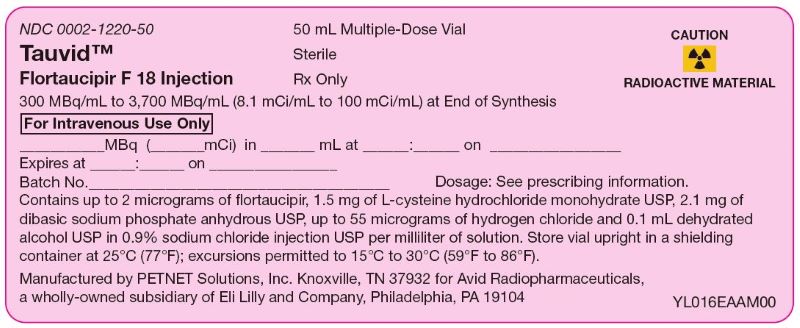
PACKAGE LABEL – Tauvid 100 mci 50 mL SHIELD NDC 0002-1220-50 Tauvid™ Flortaucipir F 18 Injection 50 mL Multiple-Dose Vial Sterile Rx Only CAUTION ☢ RADIOACTIVE MATERIAL 300 MBq/mL to 3,700 MBq/mL (8.1 mCi/mL to 100 mCi/mL) at End of Synthesis For Intravenous Use Only _____MBq (_____mCi) in _____mL at _____:_____ on _____ Expires at _____:_____ on _____ Batch No._____ Dosage: See prescribing information. Contains up to 2 micrograms of flortaucipir, 1.5 mg L-cysteine hydrochloride monohydrate USP, 2.1 mg of dibasic sodium phosphate anhydrous USP, up to 55 micrograms of hydrogen chloride and 0.1 mL dehydrated alcohol USP in 0.9% sodium chloride injection USP per milliliter of solution.
Store vial upright in a shielding container at 25°C (77°F); excursions permitted to 15°C to 30°C (59°F to 86°F). Manufactured by PETNET Solutions, Inc. Knoxville, TN 37932 for Avid Radiopharmaceuticals, a wholly-owned subsidiary of Eli Lilly and Company, Philadelphia, PA 19104 Principal Display Panel
About this NDC listing & data coverage
What data is (and isn’t) available for this NDC — tap to expand
| NDC identity (package / product / labeler codes) | ✓ Available |
| Labeler | ✓ Available |
| Product & package description | ✓ Available |
| Marketing category & status | ✓ Available |
| Active ingredient / dosage form / route | ✓ Available |
| FDA label (SPL via DailyMed) | ✓ Available |
| Package photos | ✓ Available |
| Inactive ingredients (structured) | ✓ Available |
| NADAC pharmacy acquisition price (CMS) | — Not published for this NDC CMS publishes NADAC only for NDCs reported in its retail-pharmacy survey. |
| Orange Book / therapeutic-equivalence data | ✓ Available |
| HCPCS J-code billing crosswalk | — Not published for this NDC Most self-administered / retail products have no J-code — that is normal. |
| Medicaid utilization (CMS SDUD) | — Not published for this NDC CMS reports utilization only for NDCs with Medicaid claims above its privacy threshold. |