
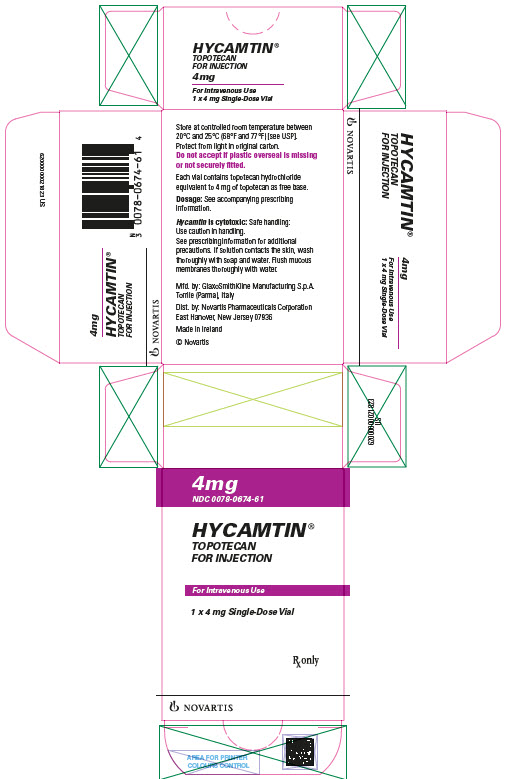
HYCAMTIN topotecan hydrochloride 4 mg/4mL Injection, Powder, Lyophilized, For Solution — NDC 0078-0674-61 (Billing 00078-0674-61)
This is a package of HYCAMTIN topotecan hydrochloride 4 mg/4mL Injection, Powder, Lyophilized, For Solution from Novartis Pharmaceuticals Corporation, marketed since Dec 2016 and currently FDA-listed. It is this product's only package size.
NDC database record
One package, one record: these facts belong to NDC 0078-0674-61 alone.
- Record
- FDA NDC Directory package listing · Human prescription drug
- Code segments
- 0078 labeler · 0674 product · 61 package
- Package marketed since
- Dec 21, 2016
- Sample package
- No — commercial package
- Listing certified through
- Dec 31, 2026
- Barcode (UPC-A, from the NDC)
- 3 0078067461 4
- FDA record last changed
- Jul 24, 2026
Identity & classification
Regulatory identifiers FDA, NLM and CMS codes for this package
Drug-database identifiers Medi-Span GPI and First Databank GCN / HICL / AHFS classification
- GSN (GCN sequence number): 026807
- GCN: 22661
- GPI-14 (Medi-Span): 21550080102120
- HICL (First Databank): 011381
- AHFS class code: 10:00.00.00
- RxCUI (RxNorm): 637550
Where does this data come from?
- FDA openFDA NDC Directory · synced Oct 1, 2026
- FDA label on DailyMed · label index refreshed Oct 5, 2026
- RxNorm (NLM RxNav) · catalog refreshed Oct 1, 2026
- Medi-Span GPI (licensed)
- First Databank (licensed) · refreshed Oct 1, 2026
RxNorm drug class
This medicine belongs to the Topoisomerase Inhibitor class.
Where does this data come from?
- RxClass (NLM) · catalog refreshed Oct 1, 2026
Clinical
Topotecan injection is used to treat ovarian cancer (cancer that begins in the female reproductive organs where eggs are formed) and small cell lung cancer (a type of cancer that begins in the lungs) that have spread and did not improve after treatment with other medications. It is also used together with other medications to treat cervical cancer (cancer that begins in the opening of the uterus [womb]) that has not improved or has come back after other treatments. Topotecan is in a class of medications called topoisomerase type I inhibitors. It works by killing cancer cells.
Read the full MedlinePlus article ↗- It's a chemotherapy given by IV. It treats metastatic ovarian cancer and small cell lung cancer when used alone, and certain advanced or recurrent cervical cancers when combined wi...
- A healthcare professional gives it as an IV infusion over about 30 minutes, in repeating courses. Your dose is based on your body size. You'll have blood tests before and during tr...
- Low blood counts are very common. You may also have nausea, vomiting, hair loss, diarrhea or constipation, and tiredness. Your team will help you manage these.
- Call for fever, chills, or other signs of infection. Also call for severe belly pain or diarrhea, new cough or trouble breathing, unusual bleeding or bruising, or signs of an aller...
Patient education
Supplement & herbal interactions
Where does this data come from?
- MedlinePlus (NLM) · refreshed Oct 1, 2026
- FDA label on DailyMed · label index refreshed Oct 5, 2026
Ask a licensed pharmacist directly — free, answered by our team.
Pricing
A drug doesn't have one price. Each row is a different public payment system, and none is what you'd pay at the counter — that depends on your insurance. The ⓘ on each row explains what it measures.
| Price system | Per mL | Per package |
|---|---|---|
| Retail pharmacies payNADAC · weekly | Not in the retail survey — common for institutional, discontinued, or low-volume packs. | |
| Medicaid paysCMS SDUD · 12 mo | No recent Medicaid claims on file for this NDC — rare and low-volume NDCs are suppressed in the public data. | |
| Medicare drug plans payPart D · quarterly | No Part D plan price is available for this NDC in our data. | |
| Medicare Part B allowsASP · J9351 | $2.759 / J9351 unit | — |
Where does this data come from?
- CMS NADAC weekly file
- CMS ASP pricing files · refreshed Sep 20, 2026
- CMS Medicaid State Drug Utilization Data · refreshed Oct 5, 2026
- CMS Part D plan pricing files · refreshed Sep 24, 2026
- VA National Acquisition Center price file
Billing & reimbursement
Where does this data come from?
- CMS ASP NDC-HCPCS crosswalk · refreshed Sep 22, 2026
- DMEPDAC NDC-HCPCS crosswalk
- openFDA NSDE billing units · refreshed Sep 7, 2026
Packaging — all sizes for this product
| Package NDC | Description | Marketing start | Marketing end | Status |
|---|---|---|---|---|
| 00078-0674-61 You're viewing this Main listing | 1 VIAL, SINGLE-DOSE in 1 CARTON / 4 mL in 1 VIAL, SINGLE-DOSE | 2016-12-21 | — | Active |
Therapeutic equivalents
| Product | Labeler | Pack | NADAC/unit | TE | Status | Price vs. this |
|---|---|---|---|---|---|---|
| Hycamtin 4 mg/4mLthis 00078-0674-61 | Novartis | 1 vial | — | AP | FDA listed | — |
| topotecan hydrochloride 4 mg/4mL 16729-0151-31 | Accord | 1 vial | — | AP | FDA listed | — |
| Topotecan hydrochloride 4 mg/4mL 45963-0615-56 | Actavis | 1 vial | — | AP | FDA listed | — |
| Topotecan Hydrochloride 4 mg/4mL 63323-0762-94 | Fresenius | 1 vial | — | AP | Discontinued | — |
Where does this data come from?
- FDA openFDA NDC Directory · synced Oct 1, 2026
- FDA Orange Book · refreshed Oct 3, 2026
- CMS NADAC weekly file
Availability & generic status
The FDA lists approved generic versions of this medicine, but that does not always mean a pharmacy can get one today. Patent rules, launch agreements, supply and pricing can affect when generics actually arrive.
Where does this data come from?
- FDA Orange Book · refreshed Oct 3, 2026
What it looks like
Where does this data come from?
- FDA label on DailyMed · label index refreshed Oct 5, 2026
Inactive Ingredients / Excipients
Inactive ingredients, also called excipients, are components of the drug product other than the active ingredient. They may include fillers, dyes, coatings, preservatives, flavors, or other formulation ingredients.
🧪 Avoiding an ingredient? See Topotecan Injection inactive ingredients by manufacturer: every current product's list side by side, so you can ask your pharmacy for the version that does not list it.
💡 Tap an ingredient (hover on desktop) to see what it is and why it’s used.
-
UNII QTT17582CB
A strong acid used to adjust and maintain the proper pH level in liquid medicines, ensuring stability and preventing breakdown of active ingredients.
-
UNII 3OWL53L36A
A natural sugar alcohol derived from seaweed or synthesized in the lab. It's used as a filler to add bulk, a sweetener in sugar-free formulas, and a disintegrant to help tablets break apart in the stomach.
-
UNII 55X04QC32I
A strong alkaline chemical used to adjust and maintain the pH balance of liquid medicines. It helps keep the medicine stable and ensures it stays effective during storage.
-
UNII W4888I119H
Tartaric acid is a natural organic acid found in grapes and tamarinds. In medicines, it works as a buffer to control acidity, an antioxidant to prevent spoilage, and sometimes a flavoring or binding agent.
4 inactive ingredients listed in the exact product block matched to this NDC.
Where does this data come from?
ingredient classCode="IACT" elements from the exact product block matched by this NDC. Label-section narrative from DailyMed / the openFDA label index is shown separately when available.- FDA label on DailyMed · label index refreshed Oct 5, 2026
- FDA openFDA NDC Directory · synced Oct 1, 2026
Inactive ingredient FAQ
Are inactive ingredients the same for every manufacturer?
Why might an inactive ingredient be missing?
Can inactive ingredients matter?
Manufacturer & labeler
More NDCs from Novartis Pharmaceuticals Corporation labeler code 00078
- Gleevec imatinib mesylate 400 mg Tablet NDC 0078-0649-13
- Jadenu deferasirox 90 mg Tablet, Film Coated NDC 0078-0654-15
- Jadenu deferasirox 180 mg Tablet, Film Coated NDC 0078-0655-15
- Jadenu deferasirox 360 mg Tablet, Film Coated NDC 0078-0656-15
- ENTRESTO Sacubitril and Valsartan 24 mg; 26 mg Tablet, Film Coated NDC 0078-0659-20
- Tykerb lapatinib 250 mg Tablet NDC 0078-0671-19
- Tafinlar dabrafenib 75 mg Capsule NDC 0078-0681-66
- Tafinlar dabrafenib 50 mg Capsule NDC 0078-0682-66
- Arranon nelarabine 5 mg/mL Injection NDC 0078-0683-61
- Promacta eltrombopag olamine 12.5 mg Tablet, Film Coated NDC 0078-0684-15
- Promacta eltrombopag olamine 25 mg Tablet, Film Coated NDC 0078-0685-15
- Promacta eltrombopag olamine 50 mg Tablet, Film Coated NDC 0078-0686-15
Where does this data come from?
- FDA openFDA NDC Directory · synced Oct 1, 2026
- Drugs@FDA
Full prescribing information FDA SPL
🚨 Boxed Warning ▾
WARNING: MYELOSUPPRESSION HYCAMTIN can cause severe myelosuppression. Administer first cycle only to patients with baseline neutrophil counts of greater than or equal to 1,500/mm 3 and platelet counts greater than or equal to 100,000/mm 3 . Monitor blood cell counts [see Warnings and Precautions ( 5.1 )] .
WARNING: MYELOSUPPRESSION See full prescribing information for complete boxed warning. HYCAMTIN can cause severe myelosuppression. Administer first cycle only to patients with baseline neutrophil counts greater than or equal to 1,500/mm 3 and platelet counts greater than or equal to 100,000/mm 3 .
Monitor blood cell counts ( 2.4 , 5.1 ).
🎯 Indications and Usage ▾
1 INDICATIONS AND USAGE HYCAMTIN for injection is a topoisomerase inhibitor indicated for treatment of: Patients with metastatic ovarian cancer after disease progression on or after initial or subsequent chemotherapy, as a single agent ( 1.1 ) Patients with small cell lung cancer (SCLC) platinum-sensitive disease who progressed at least 60 days after initiation of first-line chemotherapy, as a single agent ( 1.2 ) Patients with Stage IV-B, recurrent, or persistent cervical cancer which is not amenable to curative treatment, in combination with cisplatin ( 1.3 )
1.1Ovarian Cancer HYCAMTIN ® for injection, as a single agent, is indicated for the treatment of patients with metastatic ovarian cancer after disease progression on or after initial or subsequent chemotherapy.
1.2Small Cell Lung Cancer HYCAMTIN for injection, as a single agent, is indicated for the treatment of patients with small cell lung cancer (SCLC) with platinum-sensitive disease who progressed at least 60 days after initiation of first‑line chemotherapy.
1.3Cervical Cancer HYCAMTIN for injection, in combination with cisplatin, is indicated for the treatment of patients with Stage IV-B, recurrent, or persistent cervical cancer not amenable to curative treatment.
⏱️ Dosage and Administration ▾
2 DOSAGE AND ADMINISTRATION Ovarian Cancer and Small Cell Lung Cancer: 1.5 mg/m 2 by intravenous infusion over 30 minutes daily for 5 consecutive days, starting on Day 1 of a 21-day cycle ( 2.2 , 2.3 ) Cervical Cancer: 0.75 mg/m 2 by intravenous infusion over 30 minutes on Days 1, 2, and 3, with cisplatin 50 mg/m 2 on Day 1, of a 21-day cycle ( 2.4 ) Renal Impairment: Reduce dose if creatinine clearance (CLcr) 20 to 39 mL/min ( 2.6 )
2.1Important Safety Information Verify dosage using body surface area. Do not exceed a single dose of 4 mg intravenously.
2.2Recommended Dosage for Ovarian Cancer The recommended dosage of HYCAMTIN for injection is 1.5 mg/m 2 by intravenous infusion over 30 minutes daily for 5 consecutive days, starting on Day 1 of a 21-day cycle until disease progression or unacceptable toxicity.
2.3Recommended Dosage for Small Cell Lung Cancer (SCLC) The recommended dosage of HYCAMTIN for injection is 1.5 mg/m 2 by intravenous infusion over 30 minutes daily for 5 consecutive days, starting on Day 1 of a 21-day cycle.
2.4Recommended Dosage for Cervical Cancer The recommended dosage of HYCAMTIN for injection is 0.75 mg/m 2 by intravenous infusion over 30 minutes daily on Days 1, 2, and 3, in combination with cisplatin 50 mg/m 2 on Day 1, of a 21-day cycle.
2.5Dosage Modifications for Adverse Reactions Hematologic Do not administer subsequent cycles of HYCAMTIN for injection until neutrophils recover to greater than 1,000/mm 3 , platelets recover to greater than 100,000/mm 3 , and hemoglobin levels recover to greater than or equal to 9 g/dL (with transfusion if necessary). For HYCAMTIN for injection as a single agent, reduce the dose to 1.25 mg/m 2 /day for: neutrophil counts of less than 500/mm 3 or administer granulocyte-colony stimulating factor (G-CSF) starting no sooner than 24 hours following the last dose platelet counts less than 25,000/mm 3 during previous cycle For HYCAMTIN for injection in combination with cisplatin, reduce the dose to 0.6 mg/m 2 /day (and further to 0.45 mg/m 2 if necessary) for: febrile neutropenia (defined as neutrophil counts less than 1,000/mm 3 with temperature of greater than or equal to 38.0°C (100.4°F) or administer G-CSF starting no sooner than 24 hours following the last dose platelet counts less than 25,000/mm 3 during previous cycle
2.6Dosage Modification for Renal Impairment For HYCAMTIN for injection as a single agent, reduce the dose to 0.75 mg/m 2 /day for patients with creatinine clearance (CLcr) of 20 to 39 mL/min (calculated with the Cockcroft-Gault method using ideal body weight) [see Clinical Pharmacology (12.3)] .
2.7Preparation and Intravenous Administration Visually inspect for particulate matter and discoloration prior to administration, whenever solution and container permit. Preparation Reconstitute each 4 mg vial of HYCAMTIN for injection with 4 mL Sterile Water for Injection, USP. Dilute the appropriate volume of the reconstituted solution in either 0.9% Sodium Chloride Intravenous Infusion, USP or 5% Dextrose in Water Injection, USP.
Stability Because the vials contain no preservative, use contents immediately after reconstitution. Discard any unused portion. Store reconstituted product diluted for infusion at approximately 20°C to 25°C (68°F to 77°F) protected from light for no more than 24 hours.
Discard after 24 hours. HYCAMTIN for injection is a cytotoxic drug. Follow applicable handling and disposal procedures.
1
💊 Dosage Forms and Strengths ▾
3 DOSAGE FORMS AND STRENGTHS For injection: 4 mg (free base) of topotecan as a light yellow to greenish lyophilized powder in single-dose vial for reconstitution. For injection: 4 mg (free base) lyophilized powder in single-dose vial ( 3 )
⛔ Contraindications ▾
4 CONTRAINDICATIONS HYCAMTIN is contraindicated in patients who have a history of severe hypersensitivity reactions to topotecan. Reactions have included anaphylactoid reactions [see Adverse Reactions (6.2)] . History of severe hypersensitivity reactions to topotecan ( 4 )
⚠️ Warnings and Cautions ▾
5 WARNINGS AND PRECAUTIONS Interstitial Lung Disease (ILD): Fatal cases have occurred. Permanently discontinue if ILD confirmed. ( 5.2 ) Extravasation and Tissue Injury: Severe cases have occurred. If extravasation occurs, immediately stop administration and institute recommended management procedures. ( 5.3 ) Embryo-Fetal Toxicity: Can cause fetal harm. Advise patients of potential risk to the fetus and to use effectives contraception. ( 5.4 , 8.1 , 8.3 )
5.1Myelosuppression HYCAMTIN can cause severe myelosuppression. Single Agent Grade 4 neutropenia occurred in 78% of 879 patients, with a median duration of 7 days and was most common during Cycle 1 (58% of patients). Grade 4 neutropenia associated with infection occurred in 13% and febrile neutropenia occurred in 5%.
Sepsis occurred in 4% of patients and was fatal in 1%. Grade 4 thrombocytopenia occurred in 27%, with a median duration of 5 days. Grade 3 or 4 anemia occurred in 37% of patients.
Combination with Cisplatin Grade 4 neutropenia occurred in 48% and Grade 4 thrombocytopenia occurred in 7% of 147 patients. Grade 3 or 4 anemia occurred in 40% of patients. Topotecan can cause fatal typhlitis (neutropenic enterocolitis).
Consider the possibility of typhlitis in patients presenting with fever, neutropenia, and abdominal pain. Administer the first cycle of HYCAMTIN for injection only to patients with a baseline neutrophil count of greater than or equal to 1,500/mm 3 and a platelet count greater than or equal to 100,000/mm 3 . Monitor blood counts frequently during treatment.
Withhold and reduce dose of HYCAMTIN for injection based on neutrophil counts, platelet counts and hemoglobin levels [see Dosage and Administration (2.5)].
5.2Interstitial Lung Disease Interstitial lung disease (ILD), including fatalities, can occur with HYCAMTIN. Underlying risk factors include history of ILD, pulmonary fibrosis, lung cancer, thoracic radiation, and use of pneumotoxic drugs or colony stimulating factors. Monitor for pulmonary symptoms indicative of ILD. Permanently discontinue HYCAMTIN for injection if ILD is confirmed.
5.3Extravasation and Tissue Injury Extravasation, including severe cases, can occur with HYCAMTIN for injection. If signs or symptoms of extravasation occur, immediately stop administration of HYCAMTIN for injection and institute recommended management procedures [see Adverse Reactions (6.1)] .
5.4Embryo-Fetal Toxicity Based on animal data, HYCAMTIN can cause fetal harm when administered to a pregnant woman. Topotecan caused embryolethality, fetotoxicity, and teratogenicity in rats and rabbits when administered during organogenesis. Advise women of the potential risk to a fetus.
Advise females of reproductive potential to use effective contraception during treatment and for 6 months after the last dose of HYCAMTIN for injection. Advise males with a female partner of reproductive potential to use effective contraception during treatment with HYCAMTIN for injection and for 3 months after the last dose [see Use in Specific Populations (8.1, 8.3), Nonclinical Toxicology (13.1)] .
🤒 Adverse Reactions ▾
6 ADVERSE REACTIONS The following serious adverse reactions are described elsewhere in the labeling: Myelosuppression [see Warnings and Precautions (5.1)] Interstitial Lung Disease (ILD) [see Warnings and Precautions (5.2)] Extravasation and Tissue Injury [see Warnings and Precautions (5.3)] Ovarian Cancer The most common Grade 3 or 4 hematologic adverse reactions (incidence > 5%) were neutropenia, anemia, thrombocytopenia, and febrile neutropenia. ( 6.1 ) The most common (incidence > 5%) non-hematologic adverse reactions (all Grades) were nausea, vomiting, fatigue, diarrhea, and dyspnea.
( 6.1 ) SCLC The most common Grade 3 or 4 hematologic adverse reactions were (incidence > 5%) neutropenia, anemia, thrombocytopenia, and febrile neutropenia. ( 6.1 ) The most common (incidence > 5%) non-hematologic adverse reactions (all Grades) were asthenia, dyspnea, nausea, pneumonia, abdominal pain, and fatigue. ( 6.1 ) Cervical Cancer The most common Grade 3 or 4 hematologic adverse reactions were (incidence > 5%) neutropenia, anemia, and thrombocytopenia.
( 6.1 ) The most common (incidence > 25% and ≥ 2% higher than cisplatin alone) non-hematologic adverse reactions were pain, vomiting, and infection/febrile neutropenia. ( 6.1 ) To report SUSPECTED ADVERSE REACTIONS, contact Novartis Pharmaceuticals Corporation at 1-888-669-6682 or FDA at 1-800-FDA-1088 or www.fda.gov/medwatch .
6.1Clinical Trials Experience Because clinical trials are conducted under widely varying conditions, adverse reaction rates observed in the clinical trials of a drug cannot be directly compared with rates in the clinical trials of another drug and may not reflect the rates observed in practice. The data in Warnings and Precautions reflect exposure to HYCAMTIN for injection from eight trials in which 879 patients with ovarian cancer or small cell lung cancer (SCLC) received HYCAMTIN for injection 1.5 mg/m 2 by intravenous infusion daily for 5 consecutive days, starting on Day 1 of a 21 day cycle and from one trial (Study GOG 0179) in which 147 patients with cervical cancer received HYCAMTIN for injection 0.75 mg/m 2 by intravenous infusion daily on Days 1, 2, and 3, with cisplatin 50 mg/m 2 by intravenous infusion on Day 1, of a 21-day cycle.
Ovarian Cancer The safety of HYCAMTIN for injection was evaluated in a randomized trial conducted in 226 patients with metastatic ovarian cancer (Study 039) [see Clinical Studies (14.1)] . Table 1 shows the incidence of Grade 3 and 4 hematologic and non-hematologic adverse reactions that occurred in patients receiving HYCAMTIN for injection. Table 1.
Adverse Reactions Occurring in Greater than or Equal to 5% of Patients With Ovarian Cancer in Study 039 a Death related to sepsis occurred in 2% of patients receiving HYCAMTIN and 0% of patients receiving paclitaxel. b Pain includes body pain, skeletal pain, and back pain. Adverse Reactions HYCAMTIN for Injection (n = 112) Paclitaxel (n = 114) Grade 3-4 (%) Grade 3-4 (%) Hematologic Grade 4 neutropenia (< 500/mm 3 ) Grade 3 or 4 anemia (Hgb < 8 g/dL) Grade 4 thrombocytopenia (< 25,000/mm 3 ) Febrile neutropenia 80 41 27 23 21 6 3 4 Non-Hematologic Infections Sepsis a 5 2 Respiratory, thoracic, and mediastinal Dyspnea 6 5 Gastrointestinal Vomiting 10 3 Nausea 10 2 Diarrhea 6 1 Abdominal pain 5 4 Intestinal obstruction 5 4 Constipation 5 0 General and administrative site conditions Fatigue 7 6 Pain b 5 7 Asthenia 5 3 Small Cell Lung Cancer (SCLC) The safety of HYCAMTIN for injection was evaluated in randomized, comparative trial in patients with recurrent or progressive SCLC (Study 090) [see Clinical Studies (14.2)] .
Table 2 shows the Grade 3 or 4 hematologic and non-hematologic adverse reactions in patients with SCLC. Table 2. Adverse Reactions Occurring in Greater than or Equal to 5% of Patients With Small Cell Lung Cancer in Study 090 a Death related to sepsis occurred in 3% of patients receiving HYCAMTIN and 1% of patients receiving CAV. b Pain includes body pain, skeletal p… [Excerpted — this section continues on DailyMed.]
👥 Use in Specific Populations ▾
8 USE IN SPECIFIC POPULATIONS Lactation: Advise not to breastfeed. ( 8.2 )
8.1Pregnancy Risk Summary Based on animal data and its mechanism of action, HYCAMTIN can cause fetal harm when administered to a pregnant woman. There are no available clinical data on the use of HYCAMTIN in pregnancy. Topotecan caused embryolethality, fetotoxicity, and teratogenicity in rats and rabbits when administered during organogenesis at doses similar to the clinical dose (see Data) .
Advise pregnant women of the potential risk to a fetus. In the U.S. general population, the background risk of major birth defects is 2% to 4% and of miscarriage is 15% to 20% of clinically recognized pregnancies. Data Animal Data In rabbits, an intravenous dose of 0.10 mg/kg/day [about equal to the 1.5 mg/m 2 clinical dose based on body surface area (BSA)] given on Days 6 through 20 of gestation caused maternal toxicity, embryolethality and reduced fetal body weight.
In the rat, an intravenous dose of 0.23 mg/kg/day (about equal to the 1.5 mg/m 2 clinical dose based on BSA) given for 14 days before mating through gestation Day 6 caused fetal resorption, microphthalmia, pre-implant loss, and mild maternal toxicity. Administration of an intravenous dose of 0.10 mg/kg/day (about half the 1.5 mg/m 2 clinical dose based on BSA) given to rats on Days 6 through 17 of gestation caused an increase in post-implantation mortality. This dose also caused an increase in total fetal malformations.
The most frequent malformations were of the eye (microphthalmia, anophthalmia, rosette formation of the retina, coloboma of the retina, ectopic orbit), brain (dilated lateral and third ventricles), skull, and vertebrae.
8.2Lactation Risk Summary There are no data on the presence of topotecan or its metabolites in human milk or their effects on the breastfed infant or on milk production. Lactating rats excrete high concentrations of topotecan in milk (see Data) . Because of the potential for serious adverse reactions in breastfed infants, advise women not to breastfeed during treatment with HYCAMTIN for injection and for 1 week after the last dose.
Data Following intravenous administration of topotecan to lactating rats at a dose of 4.72 mg/m 2 (about twice the 1.5 mg/m 2 clinical dose based on BSA) to lactating rats, topotecan was excreted into milk at concentrations up to 48-fold higher than those in plasma.
8.3Females and Males of Reproductive Potential Pregnancy Testing Verify pregnancy status of females of reproductive potential prior to initiating HYCAMTIN for injection [see Use in Specific Populations (8.1)] . Contraception HYCAMTIN can cause fetal harm when administered to a pregnant woman [see Use in Specific Populations (8.1)] . Females Advise females of reproductive potential to use effective contraception during treatment with HYCAMTIN for injection and for 6 months after the last dose.
Males HYCAMTIN may damage spermatozoa, resulting in possible genetic and fetal abnormalities. Advise males with a female partner of reproductive potential to use effective contraception during treatment with HYCAMTIN for injection and for 3 months after the last dose [see Nonclinical Toxicology (13.1)] . Infertility Females HYCAMTIN can have both acute and long-term effects on fertility [see Nonclinical Toxicology (13.1)] .
Males Effects on spermatogenesis occurred in animals administered topotecan [see Nonclinical Toxicology (13.1)] .
8.4Pediatric Use Safety and effectiveness in pediatric patients have not been established.
8.5Geriatric Use Of the 879 patients with metastatic ovarian cancer or small cell lung cancer in clinical trials of HYCAMTIN for injection, 32% were aged 65 years and older, while 3.8% were aged 75 years and older. Of the 140 patients with Stage IV-B, relapsed, or refractory cervical cancer in clinical trials of HYCAMTIN for injection who received HYCAMTIN with cisplatin in the randomized clinical trial, 6% were aged 65 years and older, while 3% were aged 75 years an… [Excerpted — this section continues on DailyMed.]
🤰 Pregnancy ▾
8.1Pregnancy Risk Summary Based on animal data and its mechanism of action, HYCAMTIN can cause fetal harm when administered to a pregnant woman. There are no available clinical data on the use of HYCAMTIN in pregnancy. Topotecan caused embryolethality, fetotoxicity, and teratogenicity in rats and rabbits when administered during organogenesis at doses similar to the clinical dose (see Data) .
Advise pregnant women of the potential risk to a fetus. In the U.S. general population, the background risk of major birth defects is 2% to 4% and of miscarriage is 15% to 20% of clinically recognized pregnancies. Data Animal Data In rabbits, an intravenous dose of 0.10 mg/kg/day [about equal to the 1.5 mg/m 2 clinical dose based on body surface area (BSA)] given on Days 6 through 20 of gestation caused maternal toxicity, embryolethality and reduced fetal body weight.
In the rat, an intravenous dose of 0.23 mg/kg/day (about equal to the 1.5 mg/m 2 clinical dose based on BSA) given for 14 days before mating through gestation Day 6 caused fetal resorption, microphthalmia, pre-implant loss, and mild maternal toxicity. Administration of an intravenous dose of 0.10 mg/kg/day (about half the 1.5 mg/m 2 clinical dose based on BSA) given to rats on Days 6 through 17 of gestation caused an increase in post-implantation mortality. This dose also caused an increase in total fetal malformations.
The most frequent malformations were of the eye (microphthalmia, anophthalmia, rosette formation of the retina, coloboma of the retina, ectopic orbit), brain (dilated lateral and third ventricles), skull, and vertebrae.
🧒 Pediatric Use ▾
8.4Pediatric Use Safety and effectiveness in pediatric patients have not been established.
🧓 Geriatric Use ▾
8.5Geriatric Use Of the 879 patients with metastatic ovarian cancer or small cell lung cancer in clinical trials of HYCAMTIN for injection, 32% were aged 65 years and older, while 3.8% were aged 75 years and older. Of the 140 patients with Stage IV-B, relapsed, or refractory cervical cancer in clinical trials of HYCAMTIN for injection who received HYCAMTIN with cisplatin in the randomized clinical trial, 6% were aged 65 years and older, while 3% were aged 75 years and older. No overall differences in effectiveness or safety were observed between these patients and younger patients and other reported clinical experience has not identified differences in responses between the elderly and younger patients.
🆘 Overdosage ▾
10 OVERDOSAGE Overdoses (up to 10-fold of the recommended dose) have occurred in patients receiving intravenous topotecan. The primary complication of overdosage is myelosuppression. Elevated hepatic enzymes, mucositis, gastrointestinal toxicity, and skin toxicity have occurred with overdosages. If an overdose is suspected, monitor the patient closely for myelosuppression and institute supportive-care measures as appropriate.
🧬 Clinical Pharmacology ▾
12 CLINICAL PHARMACOLOGY
12.1Mechanism of Action Topoisomerase I relieves torsional strain in DNA by inducing reversible single-strand breaks. Topotecan binds to the topoisomerase I‑DNA complex and prevents re-ligation of these single-strand breaks. The cytotoxicity of topotecan is thought to be due to double-strand DNA damage produced during DNA synthesis, when replication enzymes interact with the ternary complex formed by topotecan, topoisomerase I, and DNA.
Mammalian cells cannot efficiently repair these double-strand breaks.
12.3Pharmacokinetics Following administration of HYCAMTIN for injection at doses of 0.5 to 1.5 mg/m 2 (0.1 to 0.3 times the recommended single agent dose) administered as a 30-minute infusion, area under the curve (AUC) increases proportionally with dose. Distribution Protein binding of topotecan is approximately 35%. Elimination The terminal half-life of topotecan is 2 to 3 hours following intravenous administration.
Metabolism Topotecan undergoes a reversible pH-dependent hydrolysis of its pharmacologically active lactone moiety. At pH less than or equal to 4, the lactone is exclusively present, whereas the ring-opened hydroxy-acid form predominates at physiologic pH. Topotecan is metabolized to an N-demethylated metabolite in vitro.
The mean metabolite: parent AUC ratio was about 3% for total topotecan and topotecan lactone following intravenous administration. Excretion The overall recovery of total topotecan and its N-desmethyl metabolite in urine and feces over 9 days averaged 73% ± 2% following an intravenous dose. Mean values of 51% ± 3% as total topotecan and 3% ± 1% as N-desmethyl topotecan were excreted in the urine.
Fecal elimination of total topotecan accounted for 18% ± 4% while fecal elimination of N-desmethyl topotecan was 1.7% ± 0.6%. An O-glucuronidation metabolite of topotecan and N-desmethyl topotecan has been identified in the urine. Specific Populations No clinically significant differences in the pharmacokinetics of topotecan were observed based on age, sex, or hepatic impairment following intravenous administration.
Patients with Renal Impairment Compared to patients with CLcr (calculated by the Cockcroft-Gault method using ideal body weight) greater than 60 mL/min, plasma clearance of topotecan lactone decreased by 33% in patients with CLcr 40-60 mL/min and decreased 65% in patients with CLcr 20-39 mL/min. The effect on topotecan pharmacokinetics in patients with CLcr less than 20 mL/min is unknown [see Dosage and Administration (2.6)] . Drug Interaction Studies Clinical Studies No clinically significant changes in topotecan pharmacokinetics were observed when coadministered cisplatin.
No clinically significant changes in the pharmacokinetics of free platinum were observed in patients coadministered cisplatin with topotecan. In Vitro Studies Topotecan does not inhibit CYP1A2, CYP2A6, CYP2C8/9, CYP2C19, CYP2D6, CYP2E, CYP3A, or CYP4A or dihydropyrimidine dehydrogenase.
🧬 Mechanism of Action ▾
12.1Mechanism of Action Topoisomerase I relieves torsional strain in DNA by inducing reversible single-strand breaks. Topotecan binds to the topoisomerase I‑DNA complex and prevents re-ligation of these single-strand breaks. The cytotoxicity of topotecan is thought to be due to double-strand DNA damage produced during DNA synthesis, when replication enzymes interact with the ternary complex formed by topotecan, topoisomerase I, and DNA.
Mammalian cells cannot efficiently repair these double-strand breaks.
📦 How Supplied / Storage and Handling ▾
16 HOW SUPPLIED/STORAGE AND HANDLING HYCAMTIN for injection is supplied as a sterile, lyophilized, buffered, light yellow to greenish powder for reconstitution in 4-mg (free base) single-dose vials. NDC 0078-0674-61 (package of 1) Store between 20°C and 25°C (68°F and 77°F) [see USP Controlled Room Temperature] in original carton. Protect from light. HYCAMTIN for injection is a cytotoxic drug. Follow applicable handling and disposal procedures. 1
📋 Description ▾
11 DESCRIPTION Topotecan is a topoisomerase inhibitor. The chemical name for topotecan hydrochloride is ( S )-10-[(dimethylamino)methyl]-4-ethyl-4,9-dihydroxy-1 H -pyrano[3’,4’:6,7] indolizino [1,2- b ]quinoline-3,14-(4 H ,12 H )-dione monohydrochloride. The molecular formula is C 23 H 23 N 3 O 5 •HCl and the molecular weight is 457.9 g/mol.
It is soluble in water and melts with decomposition at 213ºC to 218ºC. Topotecan hydrochloride has the following structural formula: HYCAMTIN (topotecan) for injection, for intravenous use is supplied as a sterile, lyophilized, buffered, light yellow to greenish powder available in single-dose vials. Each 4 mg vial contains 4 mg topotecan hydrochloride as free base.
The reconstituted solution ranges in color from yellow to yellow-green. Inactive ingredients are mannitol, 48 mg, and tartaric acid, 20 mg. Hydrochloric acid and sodium hydroxide may be used to adjust the pH.
The solution pH ranges from 2.5 to 3.5. topotecan hydrochloride chemical structure
💬 Information for Patients ▾
17 PATIENT COUNSELING INFORMATION Myelosuppression Inform patients that HYCAMTIN decreases blood cell counts such as white blood cells, platelets, and red blood cells. Advise patients to notify their healthcare provider promptly for fever, other signs of infection, or bleeding [see Warnings and Precautions (5.1)] . Interstitial Lung Disease (ILD) Inform patients of the risks of severe ILD.
Advise patients to contact their healthcare provider immediately to report new or worsening respiratory symptoms [see Warnings and Precautions (5.2)] . Embryo-Fetal Toxicity Advise females of reproductive potential and males with female partners of reproductive potential of the potential risk to a fetus. Advise women to contact their healthcare provider if they become pregnant, or if pregnancy is suspected during treatment with HYCAMTIN for injection [see Warnings and Precautions (5.4), Use in Specific Populations (8.1, 8.3)] .
Advise females of reproductive potential to use effective contraception during treatment and for 6 months after the last dose of HYCAMTIN for injection [see Use in Specific Populations (8.1, 8.3)] . Advise males with a female partner of reproductive potential to use effective contraception during treatment and for 3 months after the last dose of HYCAMTIN for injection [see Use in Specific Populations (8.1, 8.3), Nonclinical Toxicology (13.1)] . Lactation Advise women to discontinue breastfeeding during treatment and for 1 week after the last dose of HYCAMTIN for injection [see Use in Specific Populations (8.2)] .
Infertility Advise male and female patients of the potential risk for impaired fertility [see Use in Specific Populations (8.3), Nonclinical Toxicology (13.1)] . Asthenia and Fatigue Advise patients that HYCAMTIN for injection may cause asthenia or fatigue. These symptoms may impair the ability to safely drive or operate machinery.
Distributed by: Novartis Pharmaceuticals Corporation East Hanover, New Jersey 07936 © Novartis T2019-115
🧬 Pharmacokinetics ▾
12.3Pharmacokinetics Following administration of HYCAMTIN for injection at doses of 0.5 to 1.5 mg/m 2 (0.1 to 0.3 times the recommended single agent dose) administered as a 30-minute infusion, area under the curve (AUC) increases proportionally with dose. Distribution Protein binding of topotecan is approximately 35%. Elimination The terminal half-life of topotecan is 2 to 3 hours following intravenous administration.
Metabolism Topotecan undergoes a reversible pH-dependent hydrolysis of its pharmacologically active lactone moiety. At pH less than or equal to 4, the lactone is exclusively present, whereas the ring-opened hydroxy-acid form predominates at physiologic pH. Topotecan is metabolized to an N-demethylated metabolite in vitro.
The mean metabolite: parent AUC ratio was about 3% for total topotecan and topotecan lactone following intravenous administration. Excretion The overall recovery of total topotecan and its N-desmethyl metabolite in urine and feces over 9 days averaged 73% ± 2% following an intravenous dose. Mean values of 51% ± 3% as total topotecan and 3% ± 1% as N-desmethyl topotecan were excreted in the urine.
Fecal elimination of total topotecan accounted for 18% ± 4% while fecal elimination of N-desmethyl topotecan was 1.7% ± 0.6%. An O-glucuronidation metabolite of topotecan and N-desmethyl topotecan has been identified in the urine. Specific Populations No clinically significant differences in the pharmacokinetics of topotecan were observed based on age, sex, or hepatic impairment following intravenous administration.
Patients with Renal Impairment Compared to patients with CLcr (calculated by the Cockcroft-Gault method using ideal body weight) greater than 60 mL/min, plasma clearance of topotecan lactone decreased by 33% in patients with CLcr 40-60 mL/min and decreased 65% in patients with CLcr 20-39 mL/min. The effect on topotecan pharmacokinetics in patients with CLcr less than 20 mL/min is unknown [see Dosage and Administration (2.6)] . Drug Interaction Studies Clinical Studies No clinically significant changes in topotecan pharmacokinetics were observed when coadministered cisplatin.
No clinically significant changes in the pharmacokinetics of free platinum were observed in patients coadministered cisplatin with topotecan. In Vitro Studies Topotecan does not inhibit CYP1A2, CYP2A6, CYP2C8/9, CYP2C19, CYP2D6, CYP2E, CYP3A, or CYP4A or dihydropyrimidine dehydrogenase.
🔬 Clinical Studies ▾
14 CLINICAL STUDIES
14.1Ovarian Cancer The efficacy of HYCAMTIN for injection was evaluated in two clinical trials of 223 patients with metastatic ovarian cancer. All patients had disease that had recurred on, or was unresponsive to, a platinum-containing regimen. Patients in these trials received an initial dose of 1.5 mg/m 2 as an intravenous infusion for 5 consecutive days, starting on Day 1 of a 21-day cycle.
One trial (Study 039) was a randomized trial of 112 patients who received HYCAMTIN for injection and of 114 patients who received paclitaxel (175 mg/m 2 intravenously over 3 hours on Day 1 of a 21-day cycle). All patients had recurrent ovarian cancer after a platinum-containing regimen or had not responded to at least 1 prior platinum-containing regimen. Patients who did not respond to the trial therapy, or who progressed, could be given the alternative treatment.
The efficacy outcome measures were overall response rate, response duration, time to progression, and overall survival (OS). The results of the trial did not show statistically significant improvements in response rates, response duration, time to progression, and OS as shown in Table 4. Table 4.
Efficacy Results in Ovarian Cancer in Study 039 Abbreviation: CI, confidence interval. a The calculation for response duration was based on the interval between first response and time to progression. Parameters HYCAMTIN for Injection (n = 112) Paclitaxel (n = 114) Overall response rate (95% CI) 21% (13%, 28%) 14% (8%, 20%) Complete response rate 5% 3% Partial response rate 16% 11% Response duration a (months) Median (95% CI) 6 (5.1, 7.6) 5 (3.7, 7.8) Time to progression (months) Median (95% CI) 4.4 (2.8, 5.4) 3.4 (2.7, 4.2) Hazard ratio (95% CI) 0.76 (0.57, 1.02) Overall survival (months) Median (95% CI) 14.5 (10.7, 16.5) 12.2 (9.7, 15.8) Hazard ratio (95% CI) 0.97 (0.71, 1.34) The median time to response was 7.6 weeks (3.1 weeks to 5 months) with HYCAMTIN for injection compared with 6 weeks (2.4 weeks to 4.1 months) with paclitaxel.
In the cross-over phase, 13% of 61 patients who received HYCAMTIN after paclitaxel had a partial response and 10% of 49 patients who received paclitaxel after HYCAMTIN had a response (2 complete responses). HYCAMTIN for injection was active in ovarian cancer patients who had developed resistance to platinum-containing therapy, defined as tumor progression while on, or tumor relapse within 6 months after completion of, a platinum-containing regimen. One complete and 6 partial responses were seen in 60 patients, for a response rate of 12%.
In the same trial, there were no complete responders and 4 partial responders on the paclitaxel arm, for a response rate of 7%. HYCAMTIN for injection was also studied in an open-label, non-comparative trial in 111 patients with recurrent ovarian cancer after treatment with a platinum-containing regimen, or who had not responded to 1 prior platinum-containing regimen. The response rate was 14% (95% CI: 7%, 20%).
The median duration of response was 5 months (4.6 weeks to 9.6 months). The time to progression was 2.6 months (5 days to 1.4 years). The median survival was 1.3 years (1.4 weeks, to 2.2 years).
14.2Small Cell Lung Cancer (SCLC) The efficacy of HYCAMTIN for injection was evaluated in 426 patients with recurrent or progressive small cell lung cancer (SCLC) in a randomized, comparative trial and in 3 single-arm trials. Randomized Comparative Trial In a randomized, comparative trial, 211 patients were randomized 1:1 to receive HYCAMTIN for injection (1.5 mg/m 2 once daily intravenously for 5 days starting on Day 1 of a 21-day cycle) or CAV (cyclophosphamide 1,000 mg/m 2 , doxorubicin 45 mg/m 2 , vincristine 2 mg administered sequentially on Day 1 of a 21-day cycle).
All patients were considered sensitive to first-line chemotherapy (responders who then subsequently progressed greater than or equal to 60 days after completion of first-line therapy). A total of 77% of patients treated with HYCAMTIN… [Excerpted — this section continues on DailyMed.]
🧪 Nonclinical Toxicology ▾
13 NONCLINICAL TOXICOLOGY
13.1Carcinogenesis, Mutagenesis, Impairment of Fertility Carcinogenicity testing of topotecan has not been performed. Topotecan is known to be genotoxic to mammalian cells and is a probable carcinogen. Topotecan was mutagenic to L5178Y mouse lymphoma cells and clastogenic to cultured human lymphocytes with and without metabolic activation.
It was also clastogenic to mouse bone marrow. Topotecan did not cause mutations in bacterial cells. Topotecan given to female rats prior to mating at an intravenous dose of 1.4 mg/m 2 [about equal to the clinical dose based on body surface area (BSA)] caused superovulation possibly related to inhibition of follicular atresia.
This dose given to pregnant female rats also caused increased pre-implantation loss. Studies in dogs given at an intravenous dose of 0.4 mg/m 2 (about 0.25 times the clinical dose based on BSA) of topotecan daily for a month suggest that treatment may cause an increase in the incidence of multinucleated spermatogonial giant cells in the testes.
📄 Carcinogenesis, Mutagenesis, Impairment of Fertility ▾
13.1Carcinogenesis, Mutagenesis, Impairment of Fertility Carcinogenicity testing of topotecan has not been performed. Topotecan is known to be genotoxic to mammalian cells and is a probable carcinogen. Topotecan was mutagenic to L5178Y mouse lymphoma cells and clastogenic to cultured human lymphocytes with and without metabolic activation.
It was also clastogenic to mouse bone marrow. Topotecan did not cause mutations in bacterial cells. Topotecan given to female rats prior to mating at an intravenous dose of 1.4 mg/m 2 [about equal to the clinical dose based on body surface area (BSA)] caused superovulation possibly related to inhibition of follicular atresia.
This dose given to pregnant female rats also caused increased pre-implantation loss. Studies in dogs given at an intravenous dose of 0.4 mg/m 2 (about 0.25 times the clinical dose based on BSA) of topotecan daily for a month suggest that treatment may cause an increase in the incidence of multinucleated spermatogonial giant cells in the testes.
📚 References ▾
15 REFERENCES 1. "OSHA Hazardous Drugs." OSHA. http://www.osha.gov/SLTC/hazardousdrugs/index.html .
📄 Package Label / Principal Display Panel ▾
PRINCIPAL DISPLAY PANEL NDC 0078-0674-61 4 mg HYCAMTIN ® TOPOTECAN FOR INJECTION For Intravenous Use 1 x 4 mg Single-Dose Vial R x only NOVARTIS Hycamtin 4 mg 1 x 4 mg Single-Dose Vial
About this NDC listing & data coverage
What data is (and isn’t) available for this NDC — tap to expand
| NDC identity (package / product / labeler codes) | ✓ Available |
| Labeler | ✓ Available |
| Product & package description | ✓ Available |
| Marketing category & status | ✓ Available |
| Active ingredient / dosage form / route | ✓ Available |
| FDA label (SPL via DailyMed) | ✓ Available |
| Package photos | ✓ Available |
| Inactive ingredients (structured) | ✓ Available |
| NADAC pharmacy acquisition price (CMS) | — Not published for this NDC CMS publishes NADAC only for NDCs reported in its retail-pharmacy survey. |
| Orange Book / therapeutic-equivalence data | ✓ Available |
| HCPCS J-code billing crosswalk | ✓ Available |
| Medicaid utilization (CMS SDUD) | — Not published for this NDC CMS reports utilization only for NDCs with Medicaid claims above its privacy threshold. |