
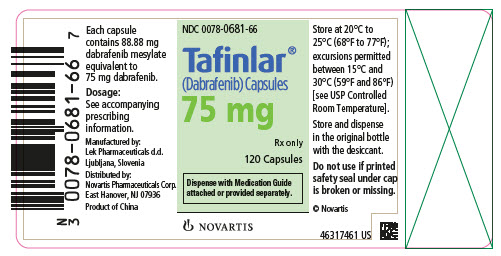
Tafinlar dabrafenib 75 mg Capsule, 120-count — NDC 0078-0681-66 (Billing 00078-0681-66)
This is a package of 120 capsules of Tafinlar dabrafenib 75 mg Capsule from Novartis Pharmaceuticals Corporation, marketed since Apr 2016 and currently FDA-listed. It is this product's only package size.
NDC database record
One package, one record: these facts belong to NDC 0078-0681-66 alone.
- Record
- FDA NDC Directory package listing · Human prescription drug
- Code segments
- 0078 labeler · 0681 product · 66 package
- Package marketed since
- Apr 1, 2016
- Sample package
- No — commercial package
- Listing certified through
- Dec 31, 2027
- Billing quantity
- 120 EA per package
- Barcode (UPC-A, from the NDC)
- 3 0078068166 7
- Medicaid fills, this package
- 2,084 prescriptions in the last four reported quarters
- FDA record last changed
- Oct 8, 2026
Identity & classification
Regulatory identifiers FDA, NLM and CMS codes for this package
Drug-database identifiers Medi-Span GPI and First Databank GCN / HICL / AHFS classification
- GSN (GCN sequence number): 071034
- GCN: 34724
- GPI-14 (Medi-Span): 21532025100130
- HICL (First Databank): 040360
- AHFS class code: 10:00.00.00
- RxCUI (RxNorm): 1424916
Where does this data come from?
- FDA openFDA NDC Directory · synced Oct 8, 2026
- FDA label on DailyMed · label index refreshed Oct 8, 2026
- RxNorm (NLM RxNav) · catalog refreshed Oct 8, 2026
- Medi-Span GPI (licensed)
- First Databank (licensed) · refreshed Oct 8, 2026
RxNorm drug class
This medicine belongs to the Kinase Inhibitor class.
Where does this data come from?
- RxClass (NLM) · catalog refreshed Oct 8, 2026
Clinical
Dabrafenib is used to treat certain types of melanoma (a type of skin cancer), lung cancer, thyroid cancer, glioma (a cancerous brain tumor), and certain other solid tumors. Dabrafenib is in a class of medications called kinase inhibitors. It works by blocking the action of an abnormal protein that signals cancer cells to multiply. This helps stop the spread of cancer cells.
Read the full MedlinePlus article ↗- It treats cancers with a BRAF V600 mutation, such as melanoma, non-small cell lung cancer, anaplastic thyroid cancer, other solid tumors and low-grade glioma in children. It is oft...
- Take it twice a day, about 12 hours apart, on an empty stomach, 1 hour before or 2 hours after eating. Do not open or crush the capsules. If you vomit, do not take an extra dose. F...
- Fever, chills, headache, rash, joint pain, tiredness and stomach upset are common. Call your doctor if your temperature reaches 100.4°F, since your medicine may need to be paused.
- Call for unusual bleeding, vision changes or eye pain, a severe rash or blistering, new skin growths, shortness of breath or swelling, or very high blood sugar symptoms. These can...
Patient education
Supplement & herbal interactions
Some supplements/herbs that may interact with Dabrafenib — tap one for details:
Where does this data come from?
- MedlinePlus (NLM) · refreshed Oct 8, 2026
- FDA label on DailyMed · label index refreshed Oct 8, 2026
Ask a licensed pharmacist directly — free, answered by our team.
Pricing
A drug doesn't have one price. Each row is a different public payment system, and none is what you'd pay at the counter — that depends on your insurance. The ⓘ on each row explains what it measures.
| Price system | Per each | Per package |
|---|---|---|
| Retail pharmacies payNADAC · weekly | Not in the retail survey — common for institutional, discontinued, or low-volume packs. | |
| Medicaid paysCMS SDUD · 12 mo | $131.71 | $15,805.76 / 120 capsules |
| Medicare drug plans payPart D · Q2 2026 | $134.98 | $16,197.14 / 120 capsules |
Where does this data come from?
- CMS NADAC weekly file
- CMS ASP pricing files · refreshed Sep 20, 2026
- CMS Medicaid State Drug Utilization Data · through Q1 2026
- CMS Part D plan pricing files · refreshed Sep 24, 2026
- VA National Acquisition Center price file
Packaging — all sizes for this product
| Package NDC | Description | Marketing start | Marketing end | Status |
|---|---|---|---|---|
| 00078-0681-66 You're viewing this Main listing | 120 CAPSULE in 1 BOTTLE | 2016-04-01 | — | Active |
Therapeutic equivalents
| Product | Labeler | Pack | NADAC/unit | TE | Status | Price vs. this |
|---|---|---|---|---|---|---|
| Tafinlar 75 mgthis 00078-0681-66 | Novartis | 120 capsules | — | — | FDA listed | — |
Where does this data come from?
- FDA openFDA NDC Directory · synced Oct 8, 2026
- FDA Orange Book · refreshed Oct 3, 2026
- CMS NADAC weekly file
Availability & generic status
We did not find an FDA-approved generic match for this exact strength, form and route. Patent/protection dates below may affect future generic timing.
Why the date isn’t exact: Generic timing can change because patents may be challenged, settled, licensed, added, removed, or worked around with a narrower label — and FDA approval does not always mean a pharmacy can get the generic today.
🛈 What do these terms mean?
- Patent
- Legal protection listed in the Orange Book that may delay generic approval or launch. Issued by the U.S. Patent & Trademark Office.
- Substance patent
- Covers the active drug molecule itself — the hardest to design around. A generic generally can’t launch until it expires.
- Formulation (product) patent
- Covers a specific formulation or dosage form. A generic can sometimes work around it with a different formulation.
- Method-of-use patent
- A patent covering one specific approved use of the drug — not necessarily the whole molecule. A generic can sometimes launch with a “skinny label” that carves out the protected use and keeps the others.
- Skinny label
- A generic label that omits a still-patented use when the FDA allows it — letting a generic reach the market for the unprotected uses.
- Exclusivity
- FDA-granted marketing protection, separate from patents — e.g. 5-yr new chemical entity, 7-yr orphan drug, or a +6-month pediatric extension.
- Paragraph IV
- A generic applicant’s formal challenge to a listed patent. It can potentially lead to earlier generic entry, but often involves litigation or a settlement.
- RLD / RS
- Reference Listed Drug — the brand product the FDA uses as the reference for generic applications. Reference Standard — the product the FDA expects generics to compare against in bioequivalence testing.
- TE / AB rating
- FDA therapeutic-equivalence rating. An AB rating generally means the FDA considers a generic therapeutically equivalent to — and substitutable for — the brand.
- LOE (loss of exclusivity)
- The latest patent or exclusivity currently listed — the loss-of-exclusivity / latest-listed-protection date shown on this page. Paragraph-IV challenges and settlements can move the real date earlier; FDA approval and a manufacturer’s decision to market can move it later.
Built from the FDA Orange Book. The bars above are scaled to each protection’s expiry; the red LOE marker is the last one to lapse.
| Patent | Type | Use code | Expires |
|---|---|---|---|
| US 9233956 ↗ | Method of use | U-2032 | May 4, 2029 |
| US 9233956 ↗ | Method of use | U-2296 | May 4, 2029 |
| US 7994185 ↗ | Drug substance | U-2296 | Jan 20, 2030 |
| US 7994185 ↗ | Drug substance | U-2032 | Jan 20, 2030 |
| US 7994185 ↗ | Drug substance | U-1406 | Jan 20, 2030 |
| US 8703781 ↗ | Drug substance | U-2296 | Oct 15, 2030 |
| US 8703781 ↗ | Drug substance | U-1713 | Oct 15, 2030 |
| US 8415345 ↗ | Drug substance | U-2032 | Jan 20, 2030 |
| US 8415345 ↗ | Drug substance | U-2031 | Jan 20, 2030 |
| US 8415345 ↗ | Drug substance | U-1406 | Jan 20, 2030 |
| US 8415345 ↗ | Drug substance | U-1406 | Jan 20, 2030 |
| US 8415345 ↗ | Drug substance | U-2031 | Jan 20, 2030 |
| US 8415345 ↗ | Drug substance | U-2032 | Jan 20, 2030 |
| US 8415345 ↗ | Drug substance | U-2296 | Jan 20, 2030 |
| US 8703781 ↗ | Drug substance | U-1713 | Oct 15, 2030 |
| US 8703781 ↗ | Drug substance | U-2298 | Oct 15, 2030 |
| US 9233956 ↗ | Method of use | U-1811 | May 4, 2029 |
| US 9233956 ↗ | Method of use | U-2296 | May 4, 2029 |
| US 7994185 ↗ | Drug substance | U-2296 | Jan 20, 2030 |
| US 7994185 ↗ | Drug substance | U-2032 | Jan 20, 2030 |
| US 7994185 ↗ | Drug substance | U-1406 | Jan 20, 2030 |
| US 8952018 ↗ | Method of use | U-2027 | Oct 15, 2030 |
| US 8703781 ↗ | Drug substance | U-2032 | Oct 15, 2030 |
| US 9233956 ↗ | Method of use | U-2031 | May 4, 2029 |
| US 9233956 ↗ | Method of use | U-1811 | May 4, 2029 |
| US 9233956 ↗ | Method of use | U-2031 | May 4, 2029 |
| US 10869869 ↗ | Method of use | U-3185 | Aug 30, 2033 |
| US 10869869 ↗ | Method of use | U-3185 | Aug 30, 2033 |
| US 8952018 ↗ | Method of use | U-2027 | Oct 15, 2030 |
| US 8703781 ↗ | Drug substance | U-2032 | Oct 15, 2030 |
| US 8703781 ↗ | Drug substance | U-2296 | Oct 15, 2030 |
| US 8703781 ↗ | Drug substance | U-2298 | Oct 15, 2030 |
| US 7994185 ↗ | Drug substance | U-2031 | Jan 20, 2030 |
| US 7994185 ↗ | Drug substance | U-2031 | Jan 20, 2030 |
| US 8415345 ↗ | Drug substance | U-2296 | Jan 20, 2030 |
| US 9233956 ↗ | Method of use | U-2032 | May 4, 2029 |
| US 7994185*PED ↗ | Drug product | — | Jul 20, 2030 |
| US 8415345*PED ↗ | Drug product | — | Jul 20, 2030 |
| US 7994185*PED ↗ | Drug product | — | Jul 20, 2030 |
| US 8415345*PED ↗ | Drug product | — | Jul 20, 2030 |
| US 9233956*PED ↗ | Drug product | — | Nov 4, 2029 |
| US 9233956*PED ↗ | Drug product | — | Nov 4, 2029 |
| US 8952018*PED ↗ | Drug product | — | Apr 15, 2031 |
| US 8952018*PED ↗ | Drug product | — | Apr 15, 2031 |
| US 8703781*PED ↗ | Drug product | — | Apr 15, 2031 |
| US 8703781*PED ↗ | Drug product | — | Apr 15, 2031 |
| US 10869869*PED ↗ | Drug product | — | Feb 28, 2034 |
| US 10869869*PED ↗ | Drug product | — | Feb 28, 2034 |
| Code | What it grants | Expires |
|---|---|---|
| I-908 | New indication (3-year) | Mar 16, 2026 |
| ODE-428 | Orphan Drug Exclusivity (7-year) | Mar 16, 2030 |
| I-908 | New indication (3-year) | Mar 16, 2026 |
| ODE-428 | Orphan Drug Exclusivity (7-year) | Mar 16, 2030 |
| PED | Pediatric Exclusivity (+6 months) | Sep 16, 2030 |
| PED | Pediatric Exclusivity (+6 months) | Sep 16, 2030 |
| PED | Pediatric Exclusivity (+6 months) | Sep 16, 2026 |
| PED | Pediatric Exclusivity (+6 months) | Sep 16, 2026 |
Is there a generic version of TAFINLAR 75 MG CAPSULE?
The FDA approved a generic — why can’t I get it at my pharmacy yet?
Why do different websites show different generic release dates?
What does “FDA listed” mean?
What does a patent or protection date mean here?
What does “current Orange Book estimate” mean?
Can a generic come out before the last patent expires?
Can a generic come out after the listed dates?
What is the difference between patents and exclusivity?
Why are there multiple patent dates?
Where does this data come from?
- FDA Orange Book · refreshed Oct 3, 2026
What it looks like
Where does this data come from?
- FDA label on DailyMed · label index refreshed Oct 8, 2026
Inactive Ingredients / Excipients
Inactive ingredients, also called excipients, are components of the drug product other than the active ingredient. They may include fillers, dyes, coatings, preservatives, flavors, or other formulation ingredients.
🧪 Avoiding an ingredient? See Dabrafenib inactive ingredients by manufacturer: every current product's list side by side, so you can ask your pharmacy for the version that does not list it.
💡 Tap an ingredient (hover on desktop) to see what it is and why it’s used.
-
UNII OP1R32D61U
Microcrystalline cellulose is a purified form of cellulose, a natural fiber from plant sources. It acts as a binder and filler in tablets and capsules, helping hold ingredients together and give the medicine its shape and size.
-
UNII 1K09F3G675
Ferric oxide red is an inorganic iron compound used as a colorant in medicines. It gives tablets, capsules, or other dosage forms a red or reddish tint for identification and appearance.
-
UNII 3NXW29V3WO
Hypromellose is a plant-based thickener made from cellulose. It's used in medicines as a binder to hold ingredients together, a coating for tablets, and a thickener for liquids.
-
UNII 70097M6I30
Magnesium stearate is a salt made from magnesium and stearic acid, a fatty substance. It's used in tablets and capsules as a lubricant and glidant to help ingredients flow smoothly during manufacturing and prevent sticking.
-
UNII ETJ7Z6XBU4
Silicon dioxide is a naturally occurring mineral used as a glidant and anti-caking agent. It helps powder ingredients flow smoothly and prevents clumping during manufacturing and storage.
-
UNII 15FIX9V2JP
Titanium dioxide is a bright white mineral powder commonly used as a colorant and opacifying agent. It makes pills and tablets white or lighter in color and helps make coatings non-transparent.
6 inactive ingredients listed in the exact product block matched to this NDC.
Where does this data come from?
ingredient classCode="IACT" elements from the exact product block matched by this NDC. Label-section narrative from DailyMed / the openFDA label index is shown separately when available.- FDA label on DailyMed · label index refreshed Oct 8, 2026
- FDA openFDA NDC Directory · synced Oct 8, 2026
Inactive ingredient FAQ
Are inactive ingredients the same for every manufacturer?
Why might an inactive ingredient be missing?
Can inactive ingredients matter?
Manufacturer & labeler
More NDCs from Novartis Pharmaceuticals Corporation labeler code 00078
- Jadenu deferasirox 90 mg Tablet, Film Coated NDC 0078-0654-15
- Jadenu deferasirox 180 mg Tablet, Film Coated NDC 0078-0655-15
- Jadenu deferasirox 360 mg Tablet, Film Coated NDC 0078-0656-15
- ENTRESTO Sacubitril and Valsartan 24 mg; 26 mg Tablet, Film Coated NDC 0078-0659-20
- Tykerb lapatinib 250 mg Tablet NDC 0078-0671-19
- HYCAMTIN topotecan hydrochloride 4 mg/4mL Injection, Powder, Lyophilized, For Solution NDC 0078-0674-61
- Tafinlar dabrafenib 50 mg Capsule NDC 0078-0682-66
- Arranon nelarabine 5 mg/mL Injection NDC 0078-0683-61
- Promacta eltrombopag olamine 12.5 mg Tablet, Film Coated NDC 0078-0684-15
- Promacta eltrombopag olamine 25 mg Tablet, Film Coated NDC 0078-0685-15
- Promacta eltrombopag olamine 50 mg Tablet, Film Coated NDC 0078-0686-15
- Promacta eltrombopag olamine 75 mg Tablet, Film Coated NDC 0078-0687-15
Where does this data come from?
- FDA openFDA NDC Directory · synced Oct 8, 2026
- Drugs@FDA
Full prescribing information FDA SPL
🎯 Indications and Usage ▾
1 INDICATIONS AND USAGE TAFINLAR is a kinase inhibitor indicated as a single agent for the treatment of patients with unresectable or metastatic melanoma with BRAF V600E mutation as detected by an FDA-approved test. ( 1.1 , 2.1 ) TAFINLAR is indicated, in combination with trametinib , for: the treatment of patients with unresectable or metastatic melanoma with BRAF V600E or V600K mutations as detected by an FDA-approved test. ( 1.2 , 2.1 ) the adjuvant treatment of patients with melanoma with BRAF V600E or V600K mutations, as detected by an FDA-approved test, and involvement of lymph node(s), following complete resection.
( 1.3 , 2.1 ) the treatment of patients with metastatic non-small cell lung cancer (NSCLC) with BRAF V600E mutation as detected by an FDA-approved test. ( 1.4 , 2.1 ) the treatment of patients with locally advanced or metastatic anaplastic thyroid cancer (ATC) with BRAF V600E mutation, as detected by an FDA-approved test, and with no satisfactory locoregional treatment options. ( 1.5 , 2.1 ) the treatment of adult and pediatric patients 1 year of age and older with unresectable or metastatic solid tumors with BRAF V600E mutation who have progressed following prior treatment and have no satisfactory alternative treatment options.
This indication is approved under accelerated approval based on overall response rate (ORR) and duration of response (DoR). Continued approval for this indication may be contingent upon verification and description of clinical benefit in a confirmatory trial(s). ( 1.6 , 2.1 ) the treatment of pediatric patients 1 year of age and older with low-grade glioma (LGG) with a BRAF V600E mutation who require systemic therapy.
( 1.7 , 2.1 ) Limitations of Use : TAFINLAR is not indicated for treatment of patients with colorectal cancer because of known intrinsic resistance to BRAF inhibition. ( 1.8 , 12.1 ) TAFINLAR is not indicated for treatment of patients with wild-type BRAF solid tumors. ( 5.2 )
1.1BRAF V600E Mutation-Positive Unresectable or Metastatic Melanoma TAFINLAR ® is indicated as a single agent for the treatment of patients with unresectable or metastatic melanoma with BRAF V600E mutation as detected by an FDA-approved test.
1.2BRAF V600E or V600K Mutation-Positive Unresectable or Metastatic Melanoma TAFINLAR is indicated, in combination with trametinib, for the treatment of patients with unresectable or metastatic melanoma with BRAF V600E or V600K mutations, as detected by an FDA-approved test [see Dosage and Administration (2.1)] .
1.3Adjuvant Treatment of BRAF V600E or V600K Mutation-Positive Melanoma TAFINLAR is indicated, in combination with trametinib, for the adjuvant treatment of patients with melanoma with BRAF V600E or V600K mutations, as detected by an FDA-approved test, and involvement of lymph node(s), following complete resection [see Dosage and Administration (2.1)] .
1.4BRAF V600E Mutation-Positive Metastatic NSCLC TAFINLAR is indicated, in combination with trametinib, for the treatment of patients with metastatic non-small cell lung cancer (NSCLC) with BRAF V600E mutation as detected by an FDA-approved test [see Dosage and Administration (2.1)] .
1.5BRAF V600E Mutation-Positive Locally Advanced or Metastatic Anaplastic Thyroid Cancer TAFINLAR is indicated, in combination with trametinib, for the treatment of patients with locally advanced or metastatic anaplastic thyroid cancer (ATC) with BRAF V600E mutation, as detected by an FDA-approved test, and with no satisfactory locoregional treatment options [see Dosage and Administration (2.1)] .
1.6BRAF V600E Mutation-Positive Unresectable or Metastatic Solid Tumors TAFINLAR is indicated, in combination with trametinib, for the treatment of adult and pediatric patients 1 year of age and older with unresectable or metastatic solid tumors with BRAF V600E mutation who have progressed following prior treatment and have no satisfactory alternative treatment options [see Dosage and Administration (2.1)] . This indication… [Excerpted — this section continues on DailyMed.]
⏱️ Dosage and Administration ▾
2 DOSAGE AND ADMINISTRATION The recommended dosage of TAFINLAR in adult patients is 150 mg (two 75 mg capsules) orally twice daily. The recommended dosage for TAFINLAR in pediatric patients is based on body weight. Take TAFINLAR at least 1 hour before or 2 hours after a meal. ( 2 )
2.1Patient Selection Melanoma Confirm the presence of BRAF V600E mutation in tumor specimens prior to initiation of treatment with TAFINLAR as a single agent [see Warnings and Precautions (5.2), Clinical Studies (14.1)] . Confirm the presence of BRAF V600E or V600K mutation in tumor specimens prior to initiation of treatment with TAFINLAR and trametinib [see Warnings and Precautions (5.2), Clinical Studies (14.2, 14.3)] . Information on FDA-approved tests for the detection of BRAF V600 mutations in melanoma is available at: http://www.fda.gov/CompanionDiagnostics .
NSCLC Confirm the presence of BRAF V600E mutation in tumor specimens prior to initiation of treatment with TAFINLAR and trametinib [see Clinical Studies (14.4)] . Information on FDA-approved tests for the detection of BRAF V600E mutations in NSCLC is available at: http://www.fda.gov/CompanionDiagnostics . ATC Confirm the presence of BRAF V600E mutation in tumor specimens prior to initiation of treatment with TAFINLAR and trametinib [see Clinical Studies (14.5)] .
Information on FDA-approved tests for the detection of BRAF V600E mutations in ATC is available at: http://www.fda.gov/CompanionDiagnostics . Solid Tumors Confirm the presence of BRAF V600E mutation in tumor specimens prior to initiation of treatment with TAFINLAR and trametinib [see Clinical Studies (14.6)] . An FDA-approved test for the detection of BRAF V600E mutation in solid tumors other than melanoma and NSCLC is not currently available.
Low-Grade Glioma Confirm the presence of BRAF V600E mutation in tumor specimens prior to initiation of treatment with TAFINLAR and trametinib [see Clinical Studies (14.7)] . An FDA-approved test for the detection of BRAF V600E mutation in LGG is not currently available.
2.2Recommended Dosage TAFINLAR Capsules Adult Patients The recommended dosage for TAFINLAR capsules in adult patients is 150 mg taken orally twice daily [see Dosage and Administration (2.3)] . Pediatric Patients The recommended dosage for TAFINLAR capsules in pediatric patients who weigh at least 26 kg is based on body weight (Table 1) [see Dosage and Administration (2.3)] . A recommended dosage of TAFINLAR capsules has not been established in patients who weigh less than 26 kg.
Table 1. Recommended Dosage for TAFINLAR Capsules in Pediatric Patients (Weight-based) Body Weight Recommended Dosage 26 to 37 kg 75 mg orally twice daily 38 to 50 kg 100 mg orally twice daily 51 kg or greater 150 mg orally twice daily TAFINLAR Tablets for Oral Suspension Adult and Pediatric Patients The recommended dosage for TAFINLAR tablets for oral suspension for adult and pediatric patients is based on body weight (Table 2) [see Dosage and Administration (2.3)] . Table 2.
Recommended Dosage for TAFINLAR Tablets for Oral Suspension in Adult and Pediatric Patients (Weight-based) Body Weight Recommended Dosage 8 to 9 kg 20 mg twice daily 10 to 13 kg 30 mg twice daily 14 to 17 kg 40 mg twice daily 18 to 21 kg 50 mg twice daily 22 to 25 kg 60 mg twice daily 26 to 29 kg 70 mg twice daily 30 to 33 kg 80 mg twice daily 34 to 37 kg 90 mg twice daily 38 to 41 kg 100 mg twice daily 42 to 45 kg 110 mg twice daily 46 to 50 kg 130 mg twice daily ≥ 51 kg 150 mg twice daily Duration of Treatment The recommended duration of treatment for patients with unresectable or metastatic melanoma or solid tumors, metastatic NSCLC, or locally advanced or metastatic anaplastic thyroid cancer is until disease progression or unacceptable toxicity.
The recommended duration of treatment in the adjuvant melanoma setting is until disease recurrence or unacceptable toxicity for up to 1 year. The recommended duration of treatment for pediatric patients with LGG is until disease p… [Excerpted — this section continues on DailyMed.]
💊 Dosage Forms and Strengths ▾
3 DOSAGE FORMS AND STRENGTHS TAFINLAR Capsules: 50 mg: Dark red capsule imprinted with ‘GS TEW’ and ‘50 mg’. 75 mg: Dark pink capsule imprinted with ‘GS LHF’ and ‘75 mg’. TAFINLAR Tablets for Oral Suspension: 10 mg: White to slightly yellow, round, biconvex 6 mm tablet debossed with “D” on one side and “NVR” on the other, contains berry flavor. TAFINLAR Capsules: 50 mg, 75 mg ( 3 ) TAFINLAR Tablets for Oral Suspension: 10 mg ( 3 )
⛔ Contraindications ▾
4 CONTRAINDICATIONS None. None. ( 4 )
⚠️ Warnings and Cautions ▾
5 WARNINGS AND PRECAUTIONS New Primary Malignancies, Cutaneous and Non-Cutaneous : Can occur when TAFINLAR is administered as a single agent or with trametinib. Monitor patients for new malignancies prior to, or while on therapy, and following discontinuation of treatment. ( 5.1 , 2.4 ) Tumor Promotion in BRAF Wild-type Tumors : Increased cell proliferation can occur with BRAF inhibitors.
( 5.2 , 2.1 ) Hemorrhage : Major hemorrhagic events can occur in patients receiving TAFINLAR with trametinib. Monitor for signs and symptoms of bleeding. ( 5.3 ) Cardiomyopathy : Assess left ventricular ejection fraction (LVEF) before treatment with TAFINLAR and trametinib, after one month of treatment, then every 2 to 3 months thereafter.
( 5.4 , 2.4 ) Uveitis : Perform ophthalmological evaluation for any visual disturbances. ( 5.5 , 2.4 ) Serious Febrile Reactions : Incidence and severity of pyrexia are increased with TAFINLAR and trametinib. ( 5.6 , 2.4 ) Serious Skin Toxicities : Monitor for skin toxicities.
Discontinue for intolerable Grade 2 or for Grade 3 or 4 rash not improving within 3 weeks despite interruption of TAFINLAR. Permanently discontinue for severe cutaneous adverse reactions (SCARs). ( 5.7 , 2.4 ) Hyperglycemia : Monitor serum glucose levels in patients with preexisting diabetes or hyperglycemia.
( 5.8 ) Glucose-6-phosphate Dehydrogenase Deficiency (G6PD) : Closely monitor for hemolytic anemia. ( 5.9 ) Hemophagocytic Lymphohistiocytosis (HLH) : Interrupt treatment for suspected HLH. Discontinue treatment if HLH is confirmed.
( 5.11 ) Embryo-Fetal Toxicity : Can cause fetal harm. Advise females of reproductive potential of potential risk to a fetus and to use an effective non-hormonal method of contraception. ( 5.12 , 8.1 , 8.3 )
5.1New Primary Malignancies Cutaneous Malignancies TAFINLAR Monotherapy (Adult) : In the pooled safety population [see Adverse Reactions (6.1)] , cutaneous squamous cell carcinomas (cuSCC), and keratoacanthomas occurred in 11% and 4% of patients, respectively. Basal cell carcinoma and new primary melanoma occurred in 4% and 1% of patients, respectively. TAFINLAR Administered with Trametinib (Adult) : In the pooled safety population [see Adverse Reactions (6.1)] , the incidence of cuSCC (including keratoacanthomas) occurred in 2% of patients.
Basal cell carcinoma and new primary melanoma occurred in 3% and < 1% of patients, respectively. TAFINLAR Administered with Trametinib (Pediatric) : In the pooled safety population, new primary melanoma occurred in < 1% of patients. Perform dermatologic evaluations prior to initiation of TAFINLAR, every 2 months while on therapy, and for up to 6 months following discontinuation of TAFINLAR.
Non-Cutaneous Malignancies Based on its mechanism of action, TAFINLAR may promote the growth and development of malignancies with activation of RAS through mutation or other mechanisms [see Warnings and Precautions (5.2)] . In the pooled adult safety populations of TAFINLAR monotherapy and TAFINLAR administered with trametinib [see Adverse Reactions (6.1)] , non-cutaneous malignancies occurred in 1% of patients. Monitor patients receiving TAFINLAR for signs or symptoms of non-cutaneous malignancies.
Permanently discontinue TAFINLAR for RAS mutation-positive non-cutaneous malignancies [see Dosage and Administration (2.4)] .
5.2Tumor Promotion in BRAF Wild-Type Tumors In vitro experiments have demonstrated paradoxical activation of MAP-kinase signaling and increased cell proliferation in BRAF wild-type cells which are exposed to BRAF inhibitors. Confirm evidence of BRAF V600E or V600K mutation status prior to initiation of TAFINLAR as a single agent or in combination with trametinib [see Indications and Usage (1.6), Dosage and Administration (2.1)] .
5.3Hemorrhage Hemorrhage, including major hemorrhage defined as symptomatic bleeding in a critical area or organ, can occur when TAFINLAR is administered with trametinib. Fatal cases have been reported. TAFINLAR Administered w… [Excerpted — this section continues on DailyMed.]
🤒 Adverse Reactions ▾
6 ADVERSE REACTIONS The following clinically significant adverse reactions are described elsewhere in the labeling: New Primary Malignancies [see Warnings and Precautions (5.1)] Tumor Promotion in BRAF Wild-Type Tumors [see Warnings and Precautions (5.2)] Hemorrhage [see Warnings and Precautions (5.3)] Cardiomyopathy [see Warnings and Precautions (5.4)] Uveitis [see Warnings and Precautions (5.5)] Serious Febrile Reactions [see Warnings and Precautions (5.6)] Serious Skin Toxicities [see Warnings and Precautions (5.7)] Hyperglycemia [see Warnings and Precautions (5.8)] Glucose-6-Phosphate Dehydrogenase Deficiency [see Warnings and Precautions (5.9)] Hemophagocytic Lymphohistiocytosis [see Warnings and Precautions (5.11)] There are additional adverse reactions associated with trametinib.
Refer to the trametinib prescribing information for additional information. Most common adverse reactions (≥ 20%) for TAFINLAR as a single agent are hyperkeratosis, headache, pyrexia, arthralgia, papilloma, alopecia, and palmar-plantar erythrodysesthesia syndrome. ( 6.1 ) Most common adverse reactions (≥ 20%) for TAFINLAR in combination with trametinib include: Unresectable or metastatic melanoma: pyrexia, rash, chills, headache, arthralgia, and cough.
( 6.1 ) Adjuvant treatment of melanoma: pyrexia, fatigue, nausea, headache, rash, chills, diarrhea, vomiting, arthralgia, and myalgia. ( 6.1 ) NSCLC: pyrexia, fatigue, nausea, vomiting, diarrhea, dry skin, decreased appetite, edema, rash, chills, hemorrhage, cough, and dyspnea. ( 6.1 ) Adult patients with solid tumors: pyrexia, fatigue, nausea, rash, chills, headache, hemorrhage, cough, vomiting, constipation, diarrhea, myalgia, arthralgia, and edema.
( 6.1 ) Pediatric patients with solid tumors: pyrexia, rash, vomiting, fatigue, dry skin, cough, diarrhea, dermatitis acneiform, headache, abdominal pain, nausea, hemorrhage, constipation, and paronychia. ( 6.1 ) Pediatric patients with LGG: pyrexia, rash, headache, vomiting, musculoskeletal pain, fatigue, diarrhea, dry skin, nausea, hemorrhage, abdominal pain, and dermatitis acneiform. ( 6.1 ) To report SUSPECTED ADVERSE REACTIONS, contact Novartis Pharmaceuticals Corporation at 1-888-669-6682 or FDA at 1-800-FDA-1088 or www.fda.gov/medwatch .
6.1Clinical Trials Experience Because clinical trials are conducted under widely varying conditions, adverse reaction rates observed in the clinical trials of a drug cannot be directly compared to rates in the clinical trials of another drug and may not reflect the rates observed in practice. Adult Safety Pools The pooled safety population described in the WARNINGS AND PRECAUTIONS reflects exposure to TAFINLAR 150 mg orally, twice daily as a single agent in 586 patients with various solid tumors, including BRAF V600 mutation-positive unresectable or metastatic melanoma, enrolled in BREAK-2, BREAK-3, BREAK-MB, BRF113220, and BRF112680.
Among these 586 patients who received TAFINLAR as a single agent, 46% were exposed for 6 months or longer and 15% were exposed for greater than one year. The pooled safety population described in the WARNINGS AND PRECAUTIONS reflects exposure to TAFINLAR 150 mg orally, twice daily, administered in combination with trametinib 2 mg orally, once daily, in 1087 patients enrolled in COMBI-d, COMBI-v, COMBI-AD, and BRF113928 with unresectable or metastatic melanoma, adjuvant melanoma, or NSCLC. Among these 1087 patients who received TAFINLAR administered with trametinib, 70% were exposed for 6 months or longer and 21% were exposed for greater than one year.
Pediatric Safety Pool The pediatric pooled safety population described in the WARNINGS AND PRECAUTIONS reflects exposure to weight-based TAFINLAR orally, twice daily administered in combination with trametinib in 166 pediatric patients across two trials: a multi-center, open-label, multi-cohort study in pediatric patients with BRAF V600E mutation-positive glioma requiring systemic therapy (Study G2201; n = 123) and a multi-center,… [Excerpted — this section continues on DailyMed.]
🔄 Drug Interactions ▾
7 DRUG INTERACTIONS Avoid concurrent administration of strong inhibitors of CYP3A4 or CYP2C8. ( 7.1 ) Concomitant use with agents that are sensitive substrates of CYP3A4, CYP2C8, CYP2C9, CYP2C19, or CYP2B6 may result in loss of efficacy of these agents. ( 7.2 )
7.1Effects of Other Drugs on TAFINLAR Strong inhibitors of CYP3A4 or CYP2C8 may increase the concentration of dabrafenib [see Clinical Pharmacology (12.3)] . Substitution of strong inhibitors of CYP3A4 or CYP2C8 is recommended during treatment with TAFINLAR. If concomitant use of strong inhibitors of CYP3A4 or CYP2C8 is unavoidable, monitor patients closely for adverse reactions when taking strong inhibitors.
7.2Effects of TAFINLAR on Other Drugs Dabrafenib decreased the systemic exposures of midazolam (a CYP3A4 substrate), S-warfarin (a CYP2C9 substrate), and R-warfarin (a CYP3A4/CYP1A2 substrate) [see Clinical Pharmacology (12.3)] . Monitor international normalized ratio (INR) levels more frequently in patients receiving warfarin during initiation or discontinuation of dabrafenib. Coadministration of TAFINLAR with other substrates of these enzymes, including dexamethasone or hormonal contraceptives , can result in decreased concentrations and loss of efficacy [see Use in Specific Populations (8.1, 8.
3 )] . Substitute for these medications or monitor patients for loss of efficacy if use of these medications is unavoidable.
👥 Use in Specific Populations ▾
8 USE IN SPECIFIC POPULATIONS Lactation : Do not breastfeed. ( 8.2 ) Females and Males of Reproductive Potential : May impair fertility. ( 8.3 )
8.1Pregnancy Risk Summary Based on findings from animal reproduction studies and its mechanism of action [see Clinical Pharmacology (12.1)] , TAFINLAR can cause fetal harm when administered to a pregnant woman. There is insufficient data in pregnant women exposed to TAFINLAR to assess the risks. Dabrafenib was teratogenic and embryotoxic in rats at doses three times greater than the human exposure at the recommended adult clinical dose of 150 mg twice daily (see Data) .
Advise pregnant women of the potential risk to a fetus. In the U.S. general population, the estimated background risk of major birth defects and miscarriage in clinically recognized pregnancies is 2% to 4% and 15% to 20%, respectively. Data Animal Data In a combined female fertility and embryo-fetal development study in rats conducted during the period of organogenesis, developmental toxicity consisted of embryo-lethality, ventricular septal defects, and variation in thymic shape at a dabrafenib dose of 300 mg/kg/day [approximately three times the human exposure at the recommended adult dose based on area under the curve (AUC)].
At doses of 20 mg/kg/day or greater (equivalent to the human exposure at the recommended adult dose based on AUC), rats demonstrated delays in skeletal development and reduced fetal body weight.
8.2Lactation Risk Summary There are no data on the presence of dabrafenib in human milk, or the effects of dabrafenib on the breastfed child or on milk production. Because of the potential for serious adverse reactions in breastfed children, advise women not to breastfeed during treatment with TAFINLAR and for 2 weeks following the last dose.
8.3Females and Males of Reproductive Potential Pregnancy Testing Verify pregnancy status in females of reproductive potential prior to initiating TAFINLAR. Contraception Based on data from animal studies and its mechanism of action, TAFINLAR can cause fetal harm when administered to pregnant women [see Use in Specific Populations (8.1 )]. Females Advise female patients of reproductive potential to use effective contraception during treatment with TAFINLAR and for 2 weeks after the last dose.
Counsel patients to use a non-hormonal method of contraception since TAFINLAR can render hormonal contraceptives ineffective [see Drug Interactions (7.2)] . Males To avoid potential drug exposure to pregnant partners and female partners of reproductive potential, advise male patients (including those who have had vasectomies) with female partners of reproductive potential to use condoms during treatment with TAFINLAR and for 2 weeks after the last dose. Infertility Females Advise female patients of reproductive potential that TAFINLAR may impair fertility.
A reduction in fertility was observed in female rats at dose exposures equivalent to the human exposure at the recommended adult dose. A reduction in the number of corpora lutea was noted in pregnant rats at dose exposures approximately three times the human exposure at the recommended adult dose [see Nonclinical Toxicology (13.1)]. Males Advise male patients of the potential risk for impaired spermatogenesis which may be irreversible.
Effects on spermatogenesis have been observed in animals treated with dabrafenib at dose exposures up to three times the human exposure at the recommended adult dose [see Nonclinical Toxicology (13.1)].
8.4Pediatric Use BRAF V600E Mutation-Positive Unresectable or Metastatic Solid Tumors and LGG The safety and effectiveness of TAFINLAR in combination with trametinib have been established in pediatric patients 1 year of age and older with unresectable or metastatic solid tumors with BRAF V600E mutation who have progressed following prior treatment and have no satisfactory alternative treatment options; or with LGG with BRAF V600E mutation who require systemic therapy. Use of TAFINLAR in comb… [Excerpted — this section continues on DailyMed.]
🤰 Pregnancy ▾
8.1Pregnancy Risk Summary Based on findings from animal reproduction studies and its mechanism of action [see Clinical Pharmacology (12.1)] , TAFINLAR can cause fetal harm when administered to a pregnant woman. There is insufficient data in pregnant women exposed to TAFINLAR to assess the risks. Dabrafenib was teratogenic and embryotoxic in rats at doses three times greater than the human exposure at the recommended adult clinical dose of 150 mg twice daily (see Data) .
Advise pregnant women of the potential risk to a fetus. In the U.S. general population, the estimated background risk of major birth defects and miscarriage in clinically recognized pregnancies is 2% to 4% and 15% to 20%, respectively. Data Animal Data In a combined female fertility and embryo-fetal development study in rats conducted during the period of organogenesis, developmental toxicity consisted of embryo-lethality, ventricular septal defects, and variation in thymic shape at a dabrafenib dose of 300 mg/kg/day [approximately three times the human exposure at the recommended adult dose based on area under the curve (AUC)].
At doses of 20 mg/kg/day or greater (equivalent to the human exposure at the recommended adult dose based on AUC), rats demonstrated delays in skeletal development and reduced fetal body weight.
🧒 Pediatric Use ▾
8.4Pediatric Use BRAF V600E Mutation-Positive Unresectable or Metastatic Solid Tumors and LGG The safety and effectiveness of TAFINLAR in combination with trametinib have been established in pediatric patients 1 year of age and older with unresectable or metastatic solid tumors with BRAF V600E mutation who have progressed following prior treatment and have no satisfactory alternative treatment options; or with LGG with BRAF V600E mutation who require systemic therapy. Use of TAFINLAR in combination with trametinib for these indications is supported by evidence from studies X2101 and G2201 that enrolled 171 patients (1 to < 18 years of age) with BRAF V600 mutation-positive advanced solid tumors, of which 4 (2.3%) patients were 1 to < 2 years of age, 39 (23%) patients were 2 to < 6 years of age, 54 (32%) patients were 6 to < 12 years of age, and 74 (43%) patients were 12 to < 18 years of age [see Adverse Reactions (6.1), Clinical Pharmacology (12.3), Clinical Studies (14.6, 14.7)] .
The safety and effectiveness of TAFINLAR in combination with trametinib have not been established for these indications in pediatric patients less than 1 year old. The safety and effectiveness of TAFINLAR as a single agent in pediatric patients have not been established. Juvenile Animal Toxicity Data In a repeat-dose toxicity study in juvenile rats, an increased incidence of kidney cysts and tubular deposits were noted at doses as low as 0.2 times the human exposure at the recommended adult dose based on AUC.
Additionally, forestomach hyperplasia, decreased bone length, and early vaginal opening were noted at doses as low as 0.8 times the human exposure at the recommended adult dose based on AUC.
🧓 Geriatric Use ▾
8.5Geriatric Use Of the 586 patients with various solid tumors who received single agent TAFINLAR, 22% were aged 65 years and older. Of the 187 patients with melanoma who received single-agent TAFINLAR in the BREAK-3 study, 21% were aged 65 years and older [see Clinical Studies (14.1)] . No overall differences in the effectiveness or safety of TAFINLAR were observed between geriatric patients as compared to younger adults in the BREAK-3 study.
Of the 994 patients with melanoma who received TAFINLAR plus trametinib in the COMBI-d, COMBI-v, and COMBI-AD studies [see Clinical Studies (14.2, 14.3)] , 21% were aged 65 years and older and 5% were aged 75 years and older. No overall differences in the effectiveness of TAFINLAR plus trametinib were observed in geriatric patients as compared to younger adults across these melanoma studies. The incidences of peripheral edema (26% vs.
12%) and anorexia (21% vs. 9%) were increased in geriatric patients as compared to younger adults in these studies. Of the 171 patients with NSCLC who received TAFINLAR in Study BRF113928, there were insufficient numbers of geriatric patients to determine whether they respond differently from younger adults [see Clinical Studies (14.4)] .
Of the 26 patients with ATC who received TAFINLAR in Study BRF117019, 77% were aged 65 years and older, and 31% were aged 75 years and older [see Clinical Studies (14.5)] . This study in ATC did not include sufficient numbers of younger adults to determine whether they respond differently compared to geriatric patients.
🆘 Overdosage ▾
10 OVERDOSAGE There is no information on overdosage of TAFINLAR. Since dabrafenib is highly bound to plasma proteins, hemodialysis is likely to be ineffective in the treatment of overdose with TAFINLAR.
🧬 Clinical Pharmacology ▾
12 CLINICAL PHARMACOLOGY
12.1Mechanism of Action Dabrafenib is an inhibitor of some mutated forms of BRAF kinases with in vitro IC 50 values of 0.65, 0.5, and 1.84 nM for BRAF V600E, BRAF V600K, and BRAF V600D enzymes, respectively. Dabrafenib also inhibits wild-type BRAF and CRAF kinases with IC 50 values of 3.2 and 5.0 nM, respectively, and other kinases, such as SIK1, NEK11, and LIMK1 at higher concentrations. Some mutations in the BRAF gene, including those that result in BRAF V600E, can result in constitutively activated BRAF kinases that may stimulate tumor cell growth [see Indications and Usage (1)] .
Dabrafenib inhibits cell growth of various BRAF V600 mutation-positive tumors in vitro and in vivo. Dabrafenib and trametinib target two different kinases in the RAS/RAF/MEK/ERK pathway. Use of dabrafenib and trametinib in combination resulted in greater growth inhibition of BRAF V600 mutation-positive tumor cell lines in vitro and prolonged inhibition of tumor growth in BRAF V600 mutation-positive tumor xenografts compared with either drug alone.
In the setting of BRAF-mutant colorectal cancer, induction of EGFR-mediated MAPK pathway re-activation has been identified as a mechanism of intrinsic resistance to BRAF inhibitors [see Indications and Usage (1.8)].
12.2Pharmacodynamics Cardiac Electrophysiology The potential effect of TAFINLAR on QT interval was assessed in a dedicated multiple-dose study in 32 patients with BRAF V600 mutation-positive tumors. No large changes in the mean QT interval (i.e., > 20 ms) were detected with dabrafenib 300 mg administered twice daily (two times the recommended dosage). In clinical trials, QTc (heart rate-corrected QT) prolongation to ≥ 500 ms occurred in 0.8% of 264 patients who received TAFINLAR with trametinib and in 1.5% of patients who received TAFINLAR as a single agent.
The QTc was increased > 60 ms from baseline in 3.8% of patients who received TAFINLAR with trametinib and 3% of patients treated with TAFINLAR as a single agent.
12.3Pharmacokinetics Following administration of TAFINLAR capsules, dabrafenib C max and AUC increased in a dose-proportional manner across the dose range of 12 mg (0.08 times the approved recommended adult dose) to 300 mg (2 times the approved recommended adult dose), but the increase was less than dose-proportional after steady state twice-daily dosing. After twice-daily dosing, the mean accumulation ratio was 0.7, and the intersubject variability (CV%) of AUC at steady-state was 38%. Absorption The median time to achieve peak plasma concentration (T max ) is 2 hours.
Mean absolute bioavailability of TAFINLAR capsules is 95% and TAFINLAR tablets for oral suspension is 76%. Effect of Food Following administration of TAFINLAR capsules, a high-fat meal (approximately 1000 calories, 58-75 grams fat, 58 grams carbohydrates, and 33 grams protein) decreased C max by 51%, decreased AUC by 31%, and delayed median T max by 3.6 hours as compared with the fasted state. Administration of a single 150 mg dose of TAFINLAR tablets for the oral suspension with a low-fat, low-calorie meal (approximately 500 calories, 14 grams fat, 80 grams carbohydrates, and 12 grams protein) decreased dabrafenib C max by 35% and AUC by 29% as compared with the fasted state.
Distribution Dabrafenib is 99.7% bound to human plasma proteins. The apparent volume of distribution (V c /F) is
70.3L. Elimination The mean terminal half-life is 8 hours. Hydroxy-dabrafenib terminal half-life (10 hours) parallels that of dabrafenib while the carboxy- and desmethyl-dabrafenib metabolites exhibit longer half-lives (21 to 22 hours).
The apparent clearance of dabrafenib is 17 L/h after a single dose and 34 L/h after twice-daily dosing for 2 weeks. Metabolism The metabolism of dabrafenib is primarily mediated by CYP2C8 and CYP3A4 to form hydroxy-dabrafenib. Hydroxy-dabrafenib is further oxidized via CYP3A4 to form carboxy-dabrafenib and subsequently excreted in bile and urine.
Carboxy-dabrafenib is d… [Excerpted — this section continues on DailyMed.]
🧬 Mechanism of Action ▾
12.1Mechanism of Action Dabrafenib is an inhibitor of some mutated forms of BRAF kinases with in vitro IC 50 values of 0.65, 0.5, and 1.84 nM for BRAF V600E, BRAF V600K, and BRAF V600D enzymes, respectively. Dabrafenib also inhibits wild-type BRAF and CRAF kinases with IC 50 values of 3.2 and 5.0 nM, respectively, and other kinases, such as SIK1, NEK11, and LIMK1 at higher concentrations. Some mutations in the BRAF gene, including those that result in BRAF V600E, can result in constitutively activated BRAF kinases that may stimulate tumor cell growth [see Indications and Usage (1)] .
Dabrafenib inhibits cell growth of various BRAF V600 mutation-positive tumors in vitro and in vivo. Dabrafenib and trametinib target two different kinases in the RAS/RAF/MEK/ERK pathway. Use of dabrafenib and trametinib in combination resulted in greater growth inhibition of BRAF V600 mutation-positive tumor cell lines in vitro and prolonged inhibition of tumor growth in BRAF V600 mutation-positive tumor xenografts compared with either drug alone.
In the setting of BRAF-mutant colorectal cancer, induction of EGFR-mediated MAPK pathway re-activation has been identified as a mechanism of intrinsic resistance to BRAF inhibitors [see Indications and Usage (1.8)].
📦 How Supplied / Storage and Handling ▾
16 HOW SUPPLIED/STORAGE AND HANDLING TAFINLAR Capsules: 50 mg capsules: Dark red capsule imprinted with ‘GS TEW’ and ‘50 mg’ available in bottles of 120 with child-resistant closures (NDC 0078-0682-66). Each bottle contains a silica gel desiccant. 75 mg capsules: Dark pink capsule imprinted with ‘GS LHF’ and ‘75 mg’ available in bottles of 120 with child-resistant closures (NDC 0078-0681-66).
Each bottle contains a silica gel desiccant. Store at 20°C to 25°C (68°F to 77°F); excursions permitted between 15°C and 30°C (59°F and 86°F) [see USP Controlled Room Temperature]. Store and dispense in the original bottle with the desiccant.
TAFINLAR Tablets for Oral Suspension: 10 mg tablets for oral suspension: white to slightly yellow, round biconvex 6 mm tablet debossed with “D” on one side and “NVR” on the other side. Available in bottles of 210 with child-resistant closures (NDC 0078-1154-21). Each bottle contains 2 silica gel desiccants.
Store at 20°C to 25°C (68°F to 77°F); excursions permitted between 15°C and 30°C (59°F and 86°F) [see USP Controlled Room Temperature]. Store and dispense in the original bottle with the desiccant.
📋 Description ▾
11 DESCRIPTION Dabrafenib mesylate is a kinase inhibitor. The chemical name for dabrafenib mesylate is N-{3-[5-(2-amino-4-pyrimidinyl)-2-(1,1-dimethylethyl)-1,3-thiazol-4-yl]-2-fluorophenyl}-2,6-difluorobenzene sulfonamide, methanesulfonate salt. It has the molecular formula C 23 H 20 F 3 N 5 O 2 S 2 •CH 4 O 3 S and a molecular weight of 615.68 g/mol.
Dabrafenib mesylate has the following chemical structure: Dabrafenib mesylate is a white to slightly colored solid with three pK a s: 6.6, 2.2, and -1.5. It is very slightly soluble at pH 1 and practically insoluble above pH 4 in aqueous media. TAFINLAR (dabrafenib) capsules for oral use are supplied as 50 mg and 75 mg capsules for oral administration.
Each 50 mg capsule contains 59.25 mg dabrafenib mesylate equivalent to 50 mg of dabrafenib free base. Each 75 mg capsule contains 88.88 mg dabrafenib mesylate equivalent to 75 mg of dabrafenib free base. The inactive ingredients of TAFINLAR capsules are colloidal silicon dioxide, magnesium stearate, and microcrystalline cellulose.
Capsule shells contain hypromellose, red iron oxide (E172), and titanium dioxide (E171). TAFINLAR (dabrafenib) tablets for oral suspension are supplied as 10 mg tablets for oral administration. Each 10 mg tablet contains 11.85 mg dabrafenib mesylate equivalent to 10 mg of dabrafenib base.
The inactive ingredients of TAFINLAR tablets are acesulfame potassium, artificial berry flavor, colloidal silicon dioxide, crospovidone, hypromellose, magnesium stearate, mannitol, microcrystalline cellulose. The following chemical structure for Dabrafenib mesylate is a kinase inhibitor. The chemical name for dabrafenib mesylate is N-{3-[5-(2-amino-4-pyrimidinyl)-2-(1,1-dimethylethyl)-1,3-thiazol-4-yl]-2-fluorophenyl}-2,6-difluorobenzene sulfonamide, methanesulfonate salt.
It has the molecular formula C23H20F3N5O2S2•CH4O3S and a molecular weight of 615.68.
💬 Information for Patients ▾
17 PATIENT COUNSELING INFORMATION Advise the patient to read the FDA-approved patient labeling (Medication Guide and Instructions for Use). New Primary Cutaneous and Non-Cutaneous Malignancies Advise patients that TAFINLAR increases the risk of developing new primary cutaneous and non-cutaneous malignancies. Advise patients to contact their healthcare provider immediately for any new lesions, changes to existing lesions on their skin, or signs and symptoms of other malignancies [see Warnings and Precautions (5.1)] .
Hemorrhage Advise patients that TAFINLAR administered with trametinib increases the risk of intracranial and gastrointestinal hemorrhage. Advise patients to contact their healthcare provider to seek immediate medical attention for signs or symptoms of unusual bleeding or hemorrhage [see Warnings and Precautions (5.3)] . Cardiomyopathy Advise patients that TAFINLAR can cause cardiomyopathy and to immediately report any signs or symptoms of heart failure to their healthcare provider [see Warnings and Precautions (5.4)] .
Uveitis Advise patients that TAFINLAR can cause uveitis, including iritis and iridocyclitis and to contact their healthcare provider if they experience any changes in their vision [see Warnings and Precautions (5.5)] . Serious Febrile Reactions Advise patients that TAFINLAR can cause pyrexia, including serious febrile reactions. Inform patients that the incidence and severity of pyrexia are increased when TAFINLAR is administered with trametinib.
Instruct patients to contact their healthcare provider if they develop a fever while taking TAFINLAR [see Warnings and Precautions (5.6)] . Serious Skin Toxicities Advise patients that TAFINLAR can cause serious skin toxicities and to contact their healthcare provider for progressive or intolerable rash. Advise patients to contact their healthcare provider immediately if they develop signs and symptoms of a severe skin reaction [see Warnings and Precautions (5.7)] .
Hyperglycemia Advise patients that TAFINLAR can impair glucose control in diabetic patients resulting in the need for more intensive hypoglycemic treatment and to contact their healthcare provider to report symptoms of severe hyperglycemia [see Warnings and Precautions (5.8)] . Glucose-6-phosphate Dehydrogenase (G6PD) Deficiency Advise patients that TAFINLAR may cause hemolytic anemia in patients with G6PD deficiency. Advise patients with known G6PD deficiency to contact their healthcare provider to report signs or symptoms of anemia or hemolysis [see Warnings and Precautions (5.9)] .
Embryo-Fetal Toxicity Advise pregnant women and females of reproductive potential of the potential risk to a fetus [see Warnings and Precautions (5.12), Use in Specific Populations (8.1, 8.3)] . Advise females to contact their healthcare provider of a known or suspected pregnancy. Advise females of reproductive potential to use effective non-hormonal contraception during treatment and for 2 weeks after discontinuation of treatment with TAFINLAR.
Advise male patients with female partners of reproductive potential to use condoms during treatment with TAFINLAR and for 2 weeks after the last dose. Lactation Advise women not to breastfeed during treatment with TAFINLAR and for 2 weeks after the last dose of TAFINLAR [see Use in Specific Populations (8.2)] . Infertility Advise males and females of reproductive potential of the potential risk for impaired fertility with TAFINLAR [see Use in Specific Populations (8.3)].
Administration Instruct patients to take TAFINLAR capsules on an empty stomach (at least 1 hour before or 2 hours after a meal) [see Dosage and Administration (2.3)] . Instruct patients to take the oral suspension on an empty stomach (at least 1 hour before or 2 hours after a meal). Breastfeeding and/or baby formula may be given on demand if a pediatric patient is unable to tolerate the fasting conditions [see Dosage and Administration (2.3)] . tHxID ™ is a trademark of bioMérieux.
Oncomine ™ Dx Target Test… [Excerpted — this section continues on DailyMed.]
💬 Medication Guide ▾
This Medication Guide has been approved by the U.S. Food and Drug Administration. Revised: March 2025 MEDICATION GUIDE TAFINLAR ® (TAFF-in-lar) (dabrafenib) capsules TAFINLAR ® (TAFF-in-lar) (dabrafenib) tablets for oral suspension Important information: If your healthcare provider prescribes TAFINLAR for you to be taken or given with trametinib, also read the Patient Information leaflet that comes with trametinib.
What is the most important information I should know about TAFINLAR? TAFINLAR may cause serious side effects, including: Risk of new cancers. TAFINLAR, when used alone or with trametinib, may cause skin cancers, called cutaneous squamous cell carcinoma (cuSCC), keratoacanthoma, basal cell carcinoma, or melanoma.
Talk with your healthcare provider about your risk for these cancers. Check your skin and tell your healthcare provider right away about any skin changes, including a: new wart skin sore or reddish bump that bleeds or does not heal change in size or color of a mole Your healthcare provider should check your skin before treatment with TAFINLAR, every 2 months during treatment with TAFINLAR, and for up to 6 months after you stop taking TAFINLAR to look for any new skin cancers. Your healthcare provider should also check for cancers that may not occur on the skin.
Tell your healthcare provider about any new symptoms that develop during treatment with TAFINLAR. See "What are the possible side effects of TAFINLAR?" for more information about side effects. What is TAFINLAR?
TAFINLAR is a prescription medicine used: alone or in combination with a medicine called trametinib to treat a type of skin cancer called melanoma: ○ that has spread to other parts of the body or cannot be removed by surgery, and ○ that has a certain type of abnormal “BRAF” gene. in combination with trametinib, to help prevent melanoma that has a certain type of abnormal “BRAF” gene from coming back after the cancer has been removed by surgery. in combination with trametinib to treat a type of lung cancer called non-small cell lung cancer (NSCLC): ○ that has spread to other parts of the body, and ○ that has a certain type of abnormal “BRAF” gene. in combination with trametinib to treat a type of thyroid cancer called anaplastic thyroid cancer (ATC): ○ that has spread to other parts of the body and you have no satisfactory treatment options , and ○ that has a certain type of abnormal “BRAF” gene. in combination with trametinib to treat solid tumors in adults and children 1 year and older: ○ that cannot be removed with surgery or have spread to other parts of the body, and that have gotten worse (progressed), and you have no satisfactory treatment options, and ○ that have a certain type of abnormal “BRAF” gene. in combination with trametinib to treat a type of brain tumor called glioma in children 1 year and older: ○ that is low-grade glioma (LGG), and ○ that have a certain type of abnormal “BRAF” gene, and ○ who require a medicine by mouth or injection (systemic therapy).
TAFINLAR is not for use in treating people with colorectal cancer or wild-type BRAF solid tumors. Your healthcare provider will perform a test to make sure that TAFINLAR is right for you. It is not known if TAFINLAR used in combination with trametinib is safe and effective in children less than 1 year of age.
It is not known if TAFINLAR used alone is safe and effective in children. Before you take or give TAFINLAR, tell your healthcare provider about all of your medical conditions, including if you: have had bleeding problems have heart problems have eye problems have liver or kidney problems have diabetes plan to have surgery, dental, or other medical procedures have a deficiency of the glucose-6-phosphate dehydrogenase (G6PD) enzyme are pregnant or plan to become pregnant. TAFINLAR can harm your unborn baby.
Females who are able to become pregnant: ○ Your healthcare provider will do a test to see if you are pregnant before starting treatment with TAFINLAR. ○ You should use ef… [Excerpted — this section continues on DailyMed.]
🧬 Pharmacokinetics ▾
12.3Pharmacokinetics Following administration of TAFINLAR capsules, dabrafenib C max and AUC increased in a dose-proportional manner across the dose range of 12 mg (0.08 times the approved recommended adult dose) to 300 mg (2 times the approved recommended adult dose), but the increase was less than dose-proportional after steady state twice-daily dosing. After twice-daily dosing, the mean accumulation ratio was 0.7, and the intersubject variability (CV%) of AUC at steady-state was 38%. Absorption The median time to achieve peak plasma concentration (T max ) is 2 hours.
Mean absolute bioavailability of TAFINLAR capsules is 95% and TAFINLAR tablets for oral suspension is 76%. Effect of Food Following administration of TAFINLAR capsules, a high-fat meal (approximately 1000 calories, 58-75 grams fat, 58 grams carbohydrates, and 33 grams protein) decreased C max by 51%, decreased AUC by 31%, and delayed median T max by 3.6 hours as compared with the fasted state. Administration of a single 150 mg dose of TAFINLAR tablets for the oral suspension with a low-fat, low-calorie meal (approximately 500 calories, 14 grams fat, 80 grams carbohydrates, and 12 grams protein) decreased dabrafenib C max by 35% and AUC by 29% as compared with the fasted state.
Distribution Dabrafenib is 99.7% bound to human plasma proteins. The apparent volume of distribution (V c /F) is
70.3L. Elimination The mean terminal half-life is 8 hours. Hydroxy-dabrafenib terminal half-life (10 hours) parallels that of dabrafenib while the carboxy- and desmethyl-dabrafenib metabolites exhibit longer half-lives (21 to 22 hours).
The apparent clearance of dabrafenib is 17 L/h after a single dose and 34 L/h after twice-daily dosing for 2 weeks. Metabolism The metabolism of dabrafenib is primarily mediated by CYP2C8 and CYP3A4 to form hydroxy-dabrafenib. Hydroxy-dabrafenib is further oxidized via CYP3A4 to form carboxy-dabrafenib and subsequently excreted in bile and urine.
Carboxy-dabrafenib is decarboxylated to form desmethyl-dabrafenib; desmethyl-dabrafenib may be reabsorbed from the gut. Desmethyl-dabrafenib is further metabolized by CYP3A4 to oxidative metabolites. Mean metabolite-to-parent AUC ratios following repeat-dose administration are 0.9, 11, and 0.7 for hydroxy-, carboxy-, and desmethyl-dabrafenib, respectively.
Based on systemic exposure, relative potency, and pharmacokinetic properties, both hydroxy- and desmethyl-dabrafenib are likely to contribute to the clinical activity of dabrafenib. Excretion Fecal excretion is the major route of elimination accounting for 71% of radioactive dose while urinary excretion accounted for 23% of total radioactivity as metabolites only. Specific Populations Age (18 to 93 years), sex, weight (36 to 170 kg), and renal impairment (eGFR 15 to 89 mL/min/1.73 m 2 ) have no clinically relevant effect on the pharmacokinetics of dabrafenib.
Pediatric Patients The pharmacokinetics of dabrafenib in glioma and other solid tumors were evaluated in 243 patients aged 1 to < 18 years following a single dose or multiple doses. Pharmacokinetic parameters in patients aged 1 to < 18 years are within range of values previously observed in adults given the same dose based on weight. Weight (6 to 156 kg) had a statistically significant effect on dabrafenib oral clearance in this population.
Patients with Hepatic Impairment Mild hepatic impairment (bilirubin ≤ ULN and AST > ULN or bilirubin > 1x to 1.5x ULN and any AST) has no effect on systemic exposure to dabrafenib and its metabolites. No data are available in patients with moderate (bilirubin > 1.5x to 3x ULN and any AST) or severe (bilirubin > 3x to 10x ULN and any AST) hepatic impairment. Drug Interaction Studies Effect of Trametinib on Dabrafenib: Coadministration of TAFINLAR 75 mg twice daily with trametinib 2 mg daily resulted in a 23% increase in AUC of dabrafenib, a 33% increase in AUC of desmethyl-dabrafenib, and no change in AUC of hydroxy-dabrafenib as compared with administration… [Excerpted — this section continues on DailyMed.]
🧬 Pharmacodynamics ▾
12.2Pharmacodynamics Cardiac Electrophysiology The potential effect of TAFINLAR on QT interval was assessed in a dedicated multiple-dose study in 32 patients with BRAF V600 mutation-positive tumors. No large changes in the mean QT interval (i.e., > 20 ms) were detected with dabrafenib 300 mg administered twice daily (two times the recommended dosage). In clinical trials, QTc (heart rate-corrected QT) prolongation to ≥ 500 ms occurred in 0.8% of 264 patients who received TAFINLAR with trametinib and in 1.5% of patients who received TAFINLAR as a single agent.
The QTc was increased > 60 ms from baseline in 3.8% of patients who received TAFINLAR with trametinib and 3% of patients treated with TAFINLAR as a single agent.
🔬 Clinical Studies ▾
14 CLINICAL STUDIES Figure 1. Kaplan-Meier Curves of Investigator-Assessed Progression-Free Survival in the BREAK-3 Study Figure 2. Kaplan-Meier Curves for Overall Survival in the COMBI-d Study Figure 3.
Kaplan-Meier Curves for Overall Survival in the COMBI-v Study Figure 4. Kaplan-Meier Curves for Investigator-Assessed Relapse-Free Survival in COMBI-AD in the Adjuvant Treatment of Melanoma Figure 5. Kaplan-Meier Curves for Progression-Free Survival in Study G2201 (LGG Cohort)
14.1BRAF V600E Mutation-Positive Unresectable or Metastatic Melanoma – TAFINLAR as a Single Agent BREAK-3 Study The safety and efficacy of TAFINLAR as a single agent were evaluated in an international, multi-center, randomized (3:1), open-label, active-controlled trial (the BREAK-3 study; NCT01227889) conducted in 250 patients with previously untreated BRAF V600E mutation-positive, unresectable or metastatic melanoma. Patients with any prior use of BRAF inhibitors or MEK inhibitors were excluded. Patients were randomized to receive TAFINLAR 150 mg orally twice daily (n = 187) or dacarbazine 1000 mg/m 2 intravenously every 3 weeks (n = 63).
Randomization was stratified by disease stage at baseline [unresectable Stage III (regional nodal or in-transit metastases), M1a (distant skin, subcutaneous, or nodal metastases), or M1b (lung metastases) versus M1c melanoma (all other visceral metastases or elevated serum LDH)]. The main efficacy outcome measure was progression-free survival (PFS) as assessed by the investigator. In addition, an independent radiology review committee (IRRC) assessed the following efficacy outcome measures in pre-specified supportive analyses: PFS, confirmed overall response rate (ORR), and duration of response (DoR).
The median age of patients in the BREAK-3 study was 52 years. The majority of the trial population was male (60%), White (99%), had an ECOG performance status of 0 (67%), had M1c disease (66%), and had normal LDH (62%). All patients had tumor tissue with mutations in BRAF V600E as determined by a clinical trial assay at a centralized testing site.
Tumor samples from 243 patients (97%) were tested retrospectively using an FDA-approved companion diagnostic test, tHxID™-BRAF assay. The median durations of follow-up prior to initiation of alternative treatment in patients randomized to receive TAFINLAR was 5.1 months and in the dacarbazine arm was 3.5 months. Twenty-eight (44%) patients crossed over from the dacarbazine arm at the time of disease progression to receive TAFINLAR.
The BREAK-3 study demonstrated a statistically significant increase in PFS in the patients treated with TAFINLAR. Table 20 and Figure 1 summarize the PFS results. Table 20.
Investigator-Assessed Progression-Free Survival and Confirmed Overall Response Results in the BREAK-3 Study Abbreviations: CI, confidence interval; DoR, duration of response; HR, hazard ratio; NR, not reached. a Pike estimator, stratified by disease state. b Stratified log-rank test. Investigator-Assessed Endpoints TAFINLAR N = 187 Dacarbazine N = 63 Progression- F ree Survival Number of events (%) 78 (42%) 41 (65%) Progressive disease 76 41 Death 2 0 Median, months (95% CI) 5.1 (4.9, 6.9) 2.7 (1.5, 3.2) HR a (95% CI) 0.33 (0.20, 0.54) P value b < 0.0001 Confirmed Tumor Responses Overall response rate (95% CI) 52% (44%, 59%) 17% (9%, 29%) Complete response, n (%) 6 (3%) 0 Partial response, n (%) 91 (48%) 11 (17%) Duration of response Median DoR, months (95% CI) 5.6 (5.4, NR) NR (5.0, NR) Figure 1.
Kaplan-Meier Curves of Investigator-Assessed Progression-Free Survival in the BREAK-3 Study In supportive analyses based on IRRC assessment and in an exploratory subgroup analysis of patients with retrospectively confirmed V600E mutation-positive melanoma with the tHxID™-BRAF assay, the PFS results were consistent with those of the primary efficacy analysis. BREAK-MB Study The activity of TAFINLAR for the treatment of BRAF V600E mutation-positive melanoma, metastatic to the brain was eva… [Excerpted — this section continues on DailyMed.]
🧪 Nonclinical Toxicology ▾
13 NONCLINICAL TOXICOLOGY
13.1Carcinogenesis, Mutagenesis, Impairment of Fertility Carcinogenicity studies with dabrafenib have not been conducted. TAFINLAR increased the risk of cuSCCs in patients in clinical trials. Dabrafenib was not mutagenic in vitro in the bacterial reverse mutation assay (Ames test) or the mouse lymphoma assay and was not clastogenic in an in vivo rat bone marrow micronucleus test.
In a combined female fertility and embryo-fetal development study in rats, a reduction in fertility was noted at doses greater than or equal to 20 mg/kg/day (equivalent to the human exposure at the recommended adult dose based on AUC). A reduction in the number of ovarian corpora lutea was noted in pregnant females at 300 mg/kg/day (which is approximately three times the human exposure at the recommended adult dose based on AUC). Male fertility studies with dabrafenib have not been conducted; however, in repeat-dose studies, testicular degeneration/depletion was seen in rats and dogs at doses equivalent to and three times the human exposure at the recommended adult dose based on AUC, respectively.
13.2Animal Toxicology and/or Pharmacology Adverse cardiovascular effects were noted in dogs at dabrafenib doses of 50 mg/kg/day (approximately five times the human exposure at the recommended adult dose based on AUC) or greater, when administered for up to 4 weeks. Adverse effects consisted of coronary arterial degeneration/necrosis and hemorrhage, as well as cardiac atrioventricular valve hypertrophy/hemorrhage.
📄 Carcinogenesis, Mutagenesis, Impairment of Fertility ▾
13.1Carcinogenesis, Mutagenesis, Impairment of Fertility Carcinogenicity studies with dabrafenib have not been conducted. TAFINLAR increased the risk of cuSCCs in patients in clinical trials. Dabrafenib was not mutagenic in vitro in the bacterial reverse mutation assay (Ames test) or the mouse lymphoma assay and was not clastogenic in an in vivo rat bone marrow micronucleus test.
In a combined female fertility and embryo-fetal development study in rats, a reduction in fertility was noted at doses greater than or equal to 20 mg/kg/day (equivalent to the human exposure at the recommended adult dose based on AUC). A reduction in the number of ovarian corpora lutea was noted in pregnant females at 300 mg/kg/day (which is approximately three times the human exposure at the recommended adult dose based on AUC). Male fertility studies with dabrafenib have not been conducted; however, in repeat-dose studies, testicular degeneration/depletion was seen in rats and dogs at doses equivalent to and three times the human exposure at the recommended adult dose based on AUC, respectively.
📖 Instructions for Use ▾
This Instructions for Use has been approved by the U.S. Food and Drug Administration. Revised: March 2024 INSTRUCTIONS FOR USE TAFINLAR ® (TAFF-in-lar) (dabrafenib) tablets for oral suspension This “Instructions for Use” contains information on how to prepare and take or give TAFINLAR tablets for oral suspension.
Important information you need to know before taking or giving TAFINLAR tablets for oral suspension Read this “Instructions for Use” carefully before you prepare and take or give TAFINLAR oral suspension for the first time and each time you get a refill. There may be new information. This “Instructions for Use” does not take the place of talking with your healthcare provider about your or your child’s medical condition and treatment.
Your healthcare provider or pharmacist should show you how to prepare and take or give a dose of TAFINLAR oral suspension correctly. Always take or give TAFINLAR exactly as your healthcare provider tells you to. If you have any questions about how to prepare and take or give a dose of TAFINLAR oral suspension, talk to your healthcare provider or pharmacist.
Always use the dosing cup that comes with your TAFINLAR pack. If your pack does not contain a dosing cup, contact your healthcare provider or pharmacist. Use only clean water to rinse.
Do not use soap or dishwashing liquid to clean the dosing cup. If at any time TAFINLAR oral suspension gets on your or your child’s skin, wash the area well with soap and water. If at any time TAFINLAR oral suspension gets in your or your child’s eyes, rinse the eyes well with cool water.
If you spill any TAFINLAR oral suspension, follow the instructions at the end of this “Instructions for Use” in Section E. “How to clean up any spilled TAFINLAR oral suspension”. You will receive the TAFINLAR tablets in a sealed bottle. The TAFINLAR tablets must be mixed in water before taking or giving a dose of TAFINLAR oral suspension.
The tablets break apart (disperse) in the water and may not fully dissolve. Follow the instructions below to mix the tablets in water. The TAFINLAR pack should contain: You will also need drinking water.
For taking or giving a dose of the TAFINLAR oral suspension by swallowing, go to Section A. For taking or giving a dose of the TAFINLAR oral suspension through a feeding tube or using an oral syringe, go to Section B. Section A.
Preparing and taking or giving a dose of the TAFINLAR oral suspension by swallowing directly from the dosing cup If any of the TAFINLAR oral suspension comes into contact with your skin or eyes when you are following the steps below, follow instructions in the section “Important information you need to know before taking or giving TAFINLAR tablets for oral suspension”. To prepare and take or give a dose of TAFINLAR oral suspension, you will need: the prescribed number of tablets 1 dosing cup 1 teaspoon drinking water To take or give a dose of TAFINLAR oral suspension by mouth (swallowing the TAFINLAR oral suspension), you or your child can drink it directly from the dosing cup.
Step 1. Wash and dry your hands before preparing TAFINLAR tablets as an oral suspension. Add cool drinking water up to the markings on the dosing cup, as follows: Note: The amount of water does not need to be exact.
If the prescribed dose is 1 to 4 tablets, you will need about 5 mL of water. If the prescribed dose is 5 to 15 tablets, you will need about 10 mL of water. Step 2.
Remove the bottle cap by pushing down and turning counter-clockwise in the direction of the arrow, as shown. Do not throw away (dispose of) the cap. If you are opening the bottle for the first time, remove the seal from the bottle.
Step 3. Count out the prescribed number of tablets into your hand. Add the prescribed number of tablets into the water in your dosing cup.
The bottle contains 2 plastic canisters to keep the tablets dry. If either canister falls out when you are taking out the tablets, re-insert it back into the bottle. Step 4.
Place the cap back onto th… [Excerpted — this section continues on DailyMed.]
📄 Recent Major Changes ▾
Warnings and Precautions, Uveitis ( 5.5 ) 4/2025
📄 Package Label / Principal Display Panel ▾
PRINCIPAL DISPLAY PANEL NDC 0078-0682-66 Tafinlar ® (Dabrafenib) Capsules 50 mg Rx only 120 Capsules Dispense with Medication Guide attached or provided separately. NOVARTIS PRINCIPAL DISPLAY PANEL NDC 0078-0682-66 Tafinlar® (Dabrafenib) Capsules 50 mg Rx only 120 Capsules Dispense with Medication Guide attached or provided separately. NOVARTIS
PRINCIPAL DISPLAY PANEL NDC 0078-0681-66 Tafinlar ® (Dabrafenib) Capsules 75 mg Rx only 120 Capsules Dispense with Medication Guide attached or provided separately. NOVARTIS PRINCIPAL DISPLAY PANEL NDC 0078-0681-66 Tafinlar® (Dabrafenib) Capsules 75 mg Rx only 120 Capsules Dispense with Medication Guide attached or provided separately. NOVARTIS
PRINCIPAL DISPLAY PANEL NDC 0078-1154-21 Rx only Tafinlar ® (dabrafenib) Tablets for Oral Suspension* 10 mg per tablet *DISPERSE TABLETS IN WATER PRIOR TO INGESTION. DO NOT SWALLOW WHOLE, CHEW OR CRUSH. Dispense and store in original container with the desiccant**.
Dispense with Medication Guide. 210 Tablets NOVARTIS PRINCIPAL DISPLAY PANEL NDC 0078-1154-21 Rx only Tafinlar® (dabrafenib) Tablets for Oral Suspension* 10 mg per tablet *DISPERSE TABLETS IN WATER PRIOR TO INGESTION. DO NOT SWALLOW WHOLE, CHEW OR CRUSH.
Dispense and store in original container with the desiccant**. Dispense with Medication Guide. 210 Tablets NOVARTIS
Medicaid utilization & spend
Medicare Part D spend CMS · PART D · 2026 (Q1)
About this NDC listing & data coverage
What data is (and isn’t) available for this NDC — tap to expand
| NDC identity (package / product / labeler codes) | ✓ Available |
| Labeler | ✓ Available |
| Product & package description | ✓ Available |
| Marketing category & status | ✓ Available |
| Active ingredient / dosage form / route | ✓ Available |
| FDA label (SPL via DailyMed) | ✓ Available |
| Package photos | ✓ Available |
| Inactive ingredients (structured) | ✓ Available |
| NADAC pharmacy acquisition price (CMS) | — Not published for this NDC CMS publishes NADAC only for NDCs reported in its retail-pharmacy survey. |
| Orange Book / therapeutic-equivalence data | ✓ Available |
| HCPCS J-code billing crosswalk | — Not published for this NDC Most self-administered / retail products have no J-code — that is normal. |
| Medicaid utilization (CMS SDUD) | ✓ Available |