
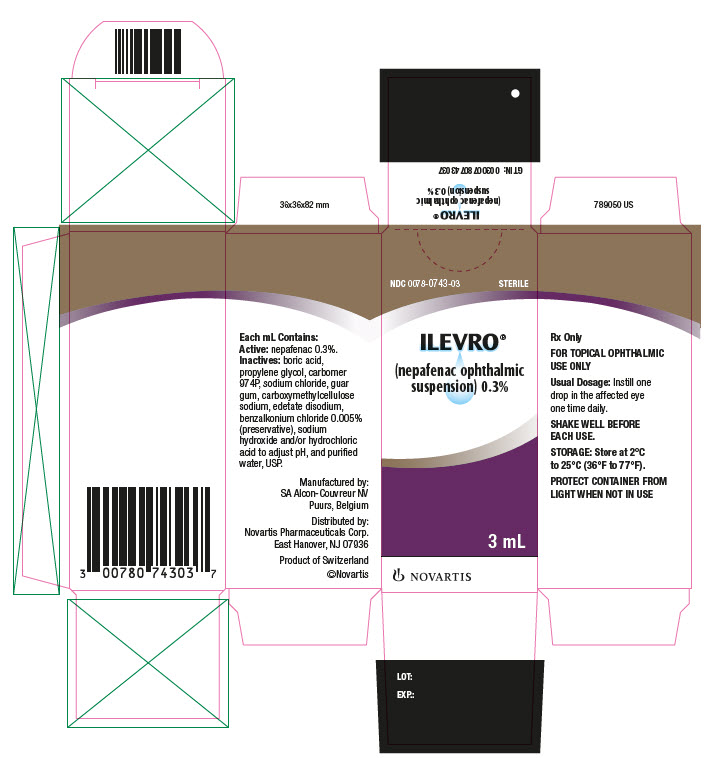
ILEVRO nepafenac 3 mg/mL Suspension/ Drops, 1 bottle
🆔 Identity & classification
Where does this data come from?
🏷️ RxNorm drug class
This medicine belongs to the Nonsteroidal Anti-inflammatory Drug class.
Where does this data come from?
🏭 Manufacturer & labeler
Where does this data come from?
🩺 Clinical
- This drop is used to control pain and swelling in your eye after cataract surgery. It belongs to a class of medicines called NSAIDs — the same family as ibuprofen — but in eye drop...
- For Ilevro 0.3%, you start one drop in the affected eye the day before your surgery. On the day of surgery, you put in your regular daily drop and then an extra drop 30 to 120 minu...
- No — do not put your contact lenses in while you are using this medication. This is an important precaution during your recovery period.
- Can I wear my contact lenses while using this?
Patient education
Supplement & herbal interactions
Some supplements/herbs that may interact with Nepafenac — tap one for details:
Nepafenac may be associated with lower levels of 1 nutrient — worth a chat with your pharmacist, not a cause for alarm.
Where does this data come from?
Ask a licensed pharmacist directly — free, answered by our team.
🧪 Inactive Ingredients / Excipients
Inactive ingredients, also called excipients, are components of the drug product other than the active ingredient. They may include fillers, dyes, coatings, preservatives, flavors, or other formulation ingredients.
💡 Tap an ingredient (hover on desktop) to see what it is and why it’s used.
-
UNII F5UM2KM3W7
Benzalkonium chloride is a chemical compound that works as a preservative and antimicrobial agent in medications. It prevents bacterial and fungal growth in liquid formulations to keep the product safe during storage and use.
-
UNII R57ZHV85D4
Boric acid is a weak acid derived from boron. In medicines, it typically serves as a buffer to help maintain the product's pH level and may act as a preservative in certain formulations.
-
UNII HHT01ZNK31
Carbomer Homopolymer Type B is a synthetic polymer made from acrylic acid. It absorbs water and forms a gel, so it's used in medicines as a thickener, suspending agent, and to help create a smooth texture in creams, gels, and lotions.
-
UNII K679OBS311
Carboxymethylcellulose sodium is a plant-derived thickening agent made from cellulose. In medicines, it acts as a binder to hold ingredients together, a disintegrant to help the tablet break apart, or a thickener in liquids.
-
UNII 7FLD91C86K
Edetate disodium is a chemical compound that binds and removes certain metal ions. In medicines, it acts as a preservative and stabilizer by preventing metals like calcium from interfering with the product's shelf life and consistency.
-
UNII E89I1637KE
Guar gum is a natural thickener made from guar bean seeds. It's used in medicines as a binder and thickening agent to hold ingredients together and create the right texture and consistency.
-
UNII QTT17582CB
A strong acid used to adjust and maintain the proper pH level in liquid medicines, ensuring stability and preventing breakdown of active ingredients.
-
UNII 6DC9Q167V3
Propylene glycol is a clear liquid derived from petroleum or vegetable sources. It acts as a solvent, humectant, and preservative in medicines, helping dissolve active ingredients and maintain product stability.
-
UNII 451W47IQ8X
Sodium chloride is common table salt. It's used in medicines as a buffer to maintain proper pH, as a filler to add bulk, or to adjust the osmotic balance in liquid formulations.
-
UNII 55X04QC32I
A strong alkaline chemical used to adjust and maintain the pH balance of liquid medicines. It helps keep the medicine stable and ensures it stays effective during storage.
-
UNII 059QF0KO0R
Water is a liquid solvent that dissolves and mixes ingredients together in liquid medicines, syrups, and injections. It helps distribute the active drug evenly throughout the product.
11 inactive ingredients listed in the exact product block matched to this NDC.
Where does this data come from?
ingredient classCode="IACT" elements from the exact product block matched by this NDC. Label-section narrative from DailyMed / the openFDA label index is shown separately when available.Inactive ingredient FAQ
Are inactive ingredients the same for every manufacturer?
Why might an inactive ingredient be missing?
Can inactive ingredients matter?
💲 Pricing
A drug doesn't have one price. Each row is a different public payment system, and none is what you'd pay at the counter — that depends on your insurance. The ⓘ on each row explains what it measures.
| Price system | Per mL | Per package |
|---|---|---|
| Retail pharmacies payNADAC · weekly | Not in the retail survey — common for institutional, discontinued, or low-volume packs. | |
| Medicaid paysCMS SDUD · 12 mo | No recent Medicaid claims on file for this NDC — rare and low-volume NDCs are suppressed in the public data. | |
| Medicare drug plans payPart D · quarterly | No Part D plan price is available for this NDC in our data. | |
Where does this data come from?
🔁 Therapeutic equivalents
| Product | Labeler | Pack | NADAC/unit | TE | Status | Price vs. this |
|---|---|---|---|---|---|---|
| Ilevro 3 mg/mL 82667-0400-03 | Harrow | 1 bottle | $121.183 | — | Availability likely | — |
| Ilevro 3 mg/mLthis 00078-0743-96 | Novartis | 1 bottle | — | — | Discontinued | — |
Where does this data come from?
⏳ Availability & generic status
We did not find an FDA-approved generic match for this exact strength, form and route. Patent/protection dates below may affect future generic timing.
Why the date isn’t exact: Generic timing can change because patents may be challenged, settled, licensed, added, removed, or worked around with a narrower label — and FDA approval does not always mean a pharmacy can get the generic today.
🛈 What do these terms mean?
- Patent
- Legal protection listed in the Orange Book that may delay generic approval or launch. Issued by the U.S. Patent & Trademark Office.
- Substance patent
- Covers the active drug molecule itself — the hardest to design around. A generic generally can’t launch until it expires.
- Formulation (product) patent
- Covers a specific formulation or dosage form. A generic can sometimes work around it with a different formulation.
- Method-of-use patent
- A patent covering one specific approved use of the drug — not necessarily the whole molecule. A generic can sometimes launch with a “skinny label” that carves out the protected use and keeps the others.
- Skinny label
- A generic label that omits a still-patented use when the FDA allows it — letting a generic reach the market for the unprotected uses.
- Exclusivity
- FDA-granted marketing protection, separate from patents — e.g. 5-yr new chemical entity, 7-yr orphan drug, or a +6-month pediatric extension.
- Paragraph IV
- A generic applicant’s formal challenge to a listed patent. It can potentially lead to earlier generic entry, but often involves litigation or a settlement.
- RLD / RS
- Reference Listed Drug — the brand product the FDA uses as the reference for generic applications. Reference Standard — the product the FDA expects generics to compare against in bioequivalence testing.
- TE / AB rating
- FDA therapeutic-equivalence rating. An AB rating generally means the FDA considers a generic therapeutically equivalent to — and substitutable for — the brand.
- LOE (loss of exclusivity)
- The latest patent or exclusivity currently listed — the loss-of-exclusivity / latest-listed-protection date shown on this page. Paragraph-IV challenges and settlements can move the real date earlier; FDA approval and a manufacturer’s decision to market can move it later.
Built from the FDA Orange Book. The bars above are scaled to each protection’s expiry; the red LOE marker is the last one to lapse.
| Patent | Type | Use code | Expires |
|---|---|---|---|
| US 9662398 ↗ | Drug product | — | Dec 1, 2030 |
| US 8921337 ↗ | Drug product | — | Mar 31, 2032 |
Is there a generic version of this drug?
The FDA approved a generic — why can’t I get it at my pharmacy yet?
Why do different websites show different generic release dates?
What does “FDA listed” mean?
What does a patent or protection date mean here?
What does “current Orange Book estimate” mean?
Can a generic come out before the last patent expires?
Can a generic come out after the listed dates?
What is the difference between patents and exclusivity?
Why are there multiple patent dates?
Where does this data come from?
💊 Medicaid utilization by pack size
📊 Medicare Part D spend CMS · PART D · 2026 (Q1)
📦 Packaging — all sizes for this product
| Package NDC | Description | Per unit | Per pack | Marketing start | Status |
|---|---|---|---|---|---|
| 00078-0743-03 | 1 BOTTLE in 1 CARTON (0078-0743-03) / 3 mL in 1 BOTTLE | $121.18 / mL | $363.55 | 2021-01-15 | Discontinued by firm |
| 00078-0743-96 You're viewing this | 1 BOTTLE in 1 CARTON (0078-0743-96) / .8 mL in 1 BOTTLE | — | — | 2021-01-15 | Discontinued by firm |
This pack shows little to no recent Medicaid volume — a different pack size carries most fills. See all packs ↓
Pack size FAQ
What quantity is in NDC 00078-0743-96?
What NDC number is used to bill for this package of ILEVRO nepafenac 3 mg/mL Suspension/ Drops?
Prices are the latest CMS NADAC pharmacy acquisition cost per NDC; per-pack figures are per-unit × pack quantity, shown only when the pack is denominated in the same measure NADAC prices.
🧭 About this NDC listing & data coverage
What data is (and isn’t) available for this NDC — tap to expand
| NDC identity (package / product / labeler codes) | ✓ Available |
| Labeler | ✓ Available |
| Product & package description | ✓ Available |
| Marketing category & status | ✓ Available |
| Active ingredient / dosage form / route | ✓ Available |
| FDA label (SPL via DailyMed) | ✓ Available |
| Package photos | ✓ Available |
| Inactive ingredients (structured) | ✓ Available |
| NADAC pharmacy acquisition price (CMS) | — Not published for this NDC CMS publishes NADAC only for NDCs reported in its retail-pharmacy survey. |
| Orange Book / therapeutic-equivalence data | ✓ Available |
| HCPCS J-code billing crosswalk | — Not published for this NDC Most self-administered / retail products have no J-code — that is normal. |
| Medicaid utilization (CMS SDUD) | — Not published for this NDC CMS reports utilization only for NDCs with Medicaid claims above its privacy threshold. |
Questions about this listing
Why is there no price listed?
What does the discontinued status mean for this NDC?
Is the NDC printed on the package the same as the 11-digit billing NDC?
What do the three segments of this NDC mean?
Does this product come in other package sizes?
Who lists this product with the FDA?
Do I need a prescription for this product?
Where does this data come from?
📄 Full prescribing information FDA SPL
🎯 Indications and Usage ▾
1 INDICATIONS AND USAGE ILEVRO ® 0.3% is indicated for the treatment of pain and inflammation associated with cataract surgery. ILEVRO ® 0.3% is a nonsteroidal, anti-inflammatory prodrug indicated for the treatment of pain and inflammation associated with cataract surgery ( 1 ).
⏱️ Dosage and Administration ▾
2 DOSAGE AND ADMINISTRATION One drop of ILEVRO ® 0.3% should be applied to the affected eye one-time-daily beginning 1 day prior to cataract surgery, continued on the day of surgery and through the first 2 weeks of the postoperative period. An additional drop should be administered 30 to 120 minutes prior to surgery. ( 2 )
2.1Recommended Dosing One drop of ILEVRO ® 0.3% should be applied to the affected eye one time daily beginning 1 day prior to cataract surgery, continued on the day of surgery and through the first 2 weeks of the postoperative period. An additional drop should be administered 30 to 120 minutes prior to surgery.
2.2Use with Other Topical Ophthalmic Medications ILEVRO ® 0.3% may be administered in conjunction with other topical ophthalmic medications such as beta-blockers, carbonic anhydrase inhibitors, alpha-agonists, cycloplegics, and mydriatics. If more than one topical ophthalmic medication is being used, the medicines must be administered at least 5 minutes apart.
💊 Dosage Forms and Strengths ▾
3 DOSAGE FORMS AND STRENGTHS Sterile ophthalmic suspension 0.3%: 1.7 mL in a 4 mL bottle and 3 mL in a 4 mL bottle. Sterile ophthalmic suspension 0.3%: 1.7 mL in a 4 mL bottle and 3 mL in a 4 mL bottle. ( 3 )
⛔ Contraindications ▾
4 CONTRAINDICATIONS ILEVRO ® 0.3% is contraindicated in patients with previously demonstrated hypersensitivity to any of the ingredients in the formula or to other nonsteroidal anti-inflammatory drugs (NSAIDs). Hypersensitivity to any of the ingredients in the formula or to other non-steroidal anti-inflammatory drugs (NSAIDS). ( 4 )
⚠️ Warnings and Cautions ▾
5 WARNINGS AND PRECAUTIONS Increased bleeding time due to interference with thrombocyte aggregation ( 5.1 ) Delayed healing ( 5.2 ) Corneal effects including keratitis ( 5.3 )
5.1Increased Bleeding Time With some NSAIDs including ILEVRO ® 0.3%, there exists the potential for increased bleeding time due to interference with thrombocyte aggregation. There have been reports that ocularly applied nonsteroidal anti-inflammatory drugs may cause increased bleeding of ocular tissues (including hyphema) in conjunction with ocular surgery. It is recommended that ILEVRO ® 0.3% be used with caution in patients with known bleeding tendencies or who are receiving other medications which may prolong bleeding time.
5.2Delayed Healing Topical NSAIDs including ILEVRO ® 0.3%, may slow or delay healing. Topical corticosteroids are also known to slow or delay healing. Concomitant use of topical NSAIDs and topical steroids may increase the potential for healing problems.
5.3Corneal Effects Use of topical NSAIDs may result in keratitis. In some susceptible patients, continued use of topical NSAIDs may result in epithelial breakdown, corneal thinning, corneal erosion, corneal ulceration, or corneal perforation. These events may be sight threatening.
Patients with evidence of corneal epithelial breakdown should immediately discontinue use of topical NSAIDs including ILEVRO ® 0.3% and should be closely monitored for corneal health. Postmarketing experience with topical NSAIDs suggests that patients with complicated ocular surgeries, corneal denervation, corneal epithelial defects, diabetes mellitus, ocular surface diseases (e.g., dry eye syndrome), rheumatoid arthritis, or repeat ocular surgeries within a short period of time may be at increased risk for corneal adverse events, which may become sight threatening.
Topical NSAIDs should be used with caution in these patients. Postmarketing experience with topical NSAIDs also suggests that use more than 1 day prior to surgery or use beyond 14 days post-surgery may increase patient risk and severity of corneal adverse events.
5.4Contact Lens Wear ILEVRO ® 0.3% should not be administered while using contact lenses.
🤒 Adverse Reactions ▾
6 ADVERSE REACTIONS Because clinical studies are conducted under widely varying conditions, adverse reaction rates observed in the clinical studies of a drug cannot be directly compared to the rates in the clinical studies of another drug and may not reflect the rates observed in practice. Most common adverse reactions (5% to 10%) are capsular opacity, decreased visual acuity, foreign body sensation, increased intraocular pressure, and sticky sensation. ( 6.1 ) To report SUSPECTED ADVERSE REACTIONS, contact Novartis Pharmaceuticals Corporation at 1-888-669-6682 or FDA at 1-800-FDA-1088 or www.fda.gov/medwatch .
6.1Serious and Otherwise Important Adverse Reactions The following adverse reactions are discussed in greater detail in other sections of labeling. Increased Bleeding Time [see Warnings and Precautions (5.1)] Delayed Healing [see Warnings and Precautions (5.2)] Corneal Effects [see Warnings and Precautions (5.3)]
6.2Ocular Adverse Reactions The most frequently reported ocular adverse reactions following cataract surgery were capsular opacity, decreased visual acuity, foreign body sensation, increased intraocular pressure (IOP), and sticky sensation. These reactions occurred in approximately 5% to 10% of patients. Other ocular adverse reactions occurring at an incidence of approximately 1% to 5% included conjunctival edema, corneal edema, dry eye, lid margin crusting, ocular discomfort, ocular hyperemia, ocular pain, ocular pruritus, photophobia, tearing, and vitreous detachment.
Some of these reactions may be the consequence of the cataract surgical procedure.
6.3Non-Ocular Adverse Reactions Non-ocular adverse reactions reported at an incidence of 1% to 4% included headache, hypertension, nausea/vomiting, and sinusitis.
👥 Use in Specific Populations ▾
8 USE IN SPECIFIC POPULATIONS
8.1Pregnancy Teratogenic Effects. Pregnancy Category C: Reproduction studies performed with nepafenac in rabbits and rats at oral doses up to 10 mg/kg/day have revealed no evidence of teratogenicity due to nepafenac, despite the induction of maternal toxicity. At this dose, the animal plasma exposure to nepafenac and amfenac was approximately 70 and 630 times human plasma exposure at the recommended human topical ophthalmic dose for rats and 20 and 180 times human plasma exposure for rabbits, respectively.
In rats, maternally toxic doses greater than or equal to 10 mg/kg were associated with dystocia, increased postimplantation loss, reduced fetal weights and growth, and reduced fetal survival. Nepafenac has been shown to cross the placental barrier in rats. There are no adequate and well-controlled studies in pregnant women.
Because animal reproduction studies are not always predictive of human response, ILEVRO ® 0.3% should be used during pregnancy only if the potential benefit justifies the potential risk to the fetus. Non-teratogenic Effects Because of the known effects of prostaglandin biosynthesis inhibiting drugs on the fetal cardiovascular system (closure of the ductus arteriosus), the use of ILEVRO ® 0.3% during late pregnancy should be avoided.
8.3Nursing Mothers Nepafenac is excreted in the milk of lactating rats. It is not known whether this drug is excreted in human milk. Because many drugs are excreted in human milk, caution should be exercised when ILEVRO ® 0.3% is administered to a nursing woman.
8.4Pediatric Use The safety and effectiveness of ILEVRO ® 0.3% in pediatric patients below the age of 10 years have not been established.
8.5Geriatric Use No overall differences in safety and effectiveness have been observed between elderly and younger patients.
🤰 Pregnancy ▾
8.1Pregnancy Teratogenic Effects. Pregnancy Category C: Reproduction studies performed with nepafenac in rabbits and rats at oral doses up to 10 mg/kg/day have revealed no evidence of teratogenicity due to nepafenac, despite the induction of maternal toxicity. At this dose, the animal plasma exposure to nepafenac and amfenac was approximately 70 and 630 times human plasma exposure at the recommended human topical ophthalmic dose for rats and 20 and 180 times human plasma exposure for rabbits, respectively.
In rats, maternally toxic doses greater than or equal to 10 mg/kg were associated with dystocia, increased postimplantation loss, reduced fetal weights and growth, and reduced fetal survival. Nepafenac has been shown to cross the placental barrier in rats. There are no adequate and well-controlled studies in pregnant women.
Because animal reproduction studies are not always predictive of human response, ILEVRO ® 0.3% should be used during pregnancy only if the potential benefit justifies the potential risk to the fetus. Non-teratogenic Effects Because of the known effects of prostaglandin biosynthesis inhibiting drugs on the fetal cardiovascular system (closure of the ductus arteriosus), the use of ILEVRO ® 0.3% during late pregnancy should be avoided.
🧒 Pediatric Use ▾
8.4Pediatric Use The safety and effectiveness of ILEVRO ® 0.3% in pediatric patients below the age of 10 years have not been established.
🧓 Geriatric Use ▾
8.5Geriatric Use No overall differences in safety and effectiveness have been observed between elderly and younger patients.
🧬 Clinical Pharmacology ▾
12 CLINICAL PHARMACOLOGY
12.1Mechanism of Action After topical ocular dosing, nepafenac penetrates the cornea and is converted by ocular tissue hydrolases to amfenac, a NSAID. Nepafenac and amfenac are thought to inhibit the action of prostaglandin H synthase (cyclooxygenase), an enzyme required for prostaglandin production.
12.3Pharmacokinetics Following bilateral topical ocular once-daily dosing of ILEVRO ® 0.3%, the concentrations of nepafenac and amfenac peaked at a median time of 0.5 hour and 0.75 hour, respectively on both Day 1 and Day 4. The mean steady-state C max for nepafenac and for amfenac were 0.847 ± 0.269 ng/mL and 1.13 ± 0.491 ng/mL, respectively. Nepafenac at concentrations up to 3000 ng/mL and amfenac at concentrations up to 1000 ng/mL did not inhibit the in vitro metabolism of six specific marker substrates of cytochrome P450 (CYP) isozymes (CYP1A2, CYP2C9, CYP2C19, CYP2D6, CYP2E1, and CYP3A4).
Therefore, drug-drug interactions involving CYP mediated metabolism of concomitantly administered drugs are unlikely.
🧬 Mechanism of Action ▾
12.1Mechanism of Action After topical ocular dosing, nepafenac penetrates the cornea and is converted by ocular tissue hydrolases to amfenac, a NSAID. Nepafenac and amfenac are thought to inhibit the action of prostaglandin H synthase (cyclooxygenase), an enzyme required for prostaglandin production.
📦 How Supplied / Storage and Handling ▾
16 HOW SUPPLIED/STORAGE AND HANDLING ILEVRO ® 0.3% is supplied in a white, oval, low density polyethylene dispenser with a natural low density polyethylene dispensing plug and gray polypropylene cap. The 1.7 mL fill is presented in an overwrap, which provides tamper evidence to the package. Tamper evidence for the 3 mL fill is provided with a shrink band around the closure and neck area of the package.
1.7mL in 4 mL bottle NDC 0078-0743-17 3 mL in 4 mL bottle NDC 0078-0743-03 Storage: Store at 2°C to 25°C (36°F to 77°F). Protect from light.
📋 Description ▾
11 DESCRIPTION ILEVRO ® 0.3% is a sterile, topical, NSAID prodrug for ophthalmic use. Each mL of ILEVRO ® 0.3% contains 3 mg of nepafenac. Nepafenac is designated chemically as 2-amino-3-benzoylbenzeneacetamide with an empirical formula of C 15 H 14 N 2 O 2 .
The structural formula of nepafenac is: Nepafenac is a yellow crystalline powder. The molecular weight of nepafenac is 254.28 g/mol. ILEVRO ® 0.3% is supplied as a sterile, aqueous suspension with a pH approximately of 6.8.
The osmolality of ILEVRO ® 0.3% is approximately 300 mOsm/kg. Each mL of ILEVRO ® 0.3% contains: Active: nepafenac 0.3%. Inactives: boric acid, propylene glycol, carbomer 974P, sodium chloride, guar gum, carboxymethylcellulose sodium, edetate disodium, benzalkonium chloride 0.005% (preservative), sodium hydroxide and/or hydrochloric acid to adjust pH and purified water, USP. structural formula of nepafenac
💬 Information for Patients ▾
17 PATIENT COUNSELING INFORMATION Slow or Delayed Healing Inform the patient of the possibility that slow or delayed healing may occur while using NSAIDs [see Warnings and Precautions (5.2)] . Avoiding Contamination of the Product Instruct the patient to avoid allowing the tip of the dispensing container to contact the eye or surrounding structures because this could cause the tip to become contaminated by common bacteria known to cause ocular infections. Serious damage to the eye and subsequent loss of vision may result from using contaminated solutions.
Use of the same bottle for both eyes is not recommended with topical eye drops that are used in association with surgery. Contact Lens Wear ILEVRO ® 0.3% should not be administered while wearing contact lenses [see Warnings and Precautions (5.4)] . Intercurrent Ocular Conditions Advise the patient that if they develop an intercurrent ocular condition (e.g., trauma, or infection) or have ocular surgery, they should immediately seek their physician’s advice concerning the continued use of the multi-dose container [see Warnings and Precautions (5.1)] .
Concomitant Topical Ocular Therapy If more than one topical ophthalmic medication is being used, the medicines must be administered at least 5 minutes apart [see Dosage and Administration (2.2)] . Shake Well Before Use Patients should be instructed to shake well before each use [see Dosage and Administration (2.1)] . Distributed by Novartis Pharmaceuticals Corporation East Hanover, New Jersey 07936 ©2020 T2020-15