
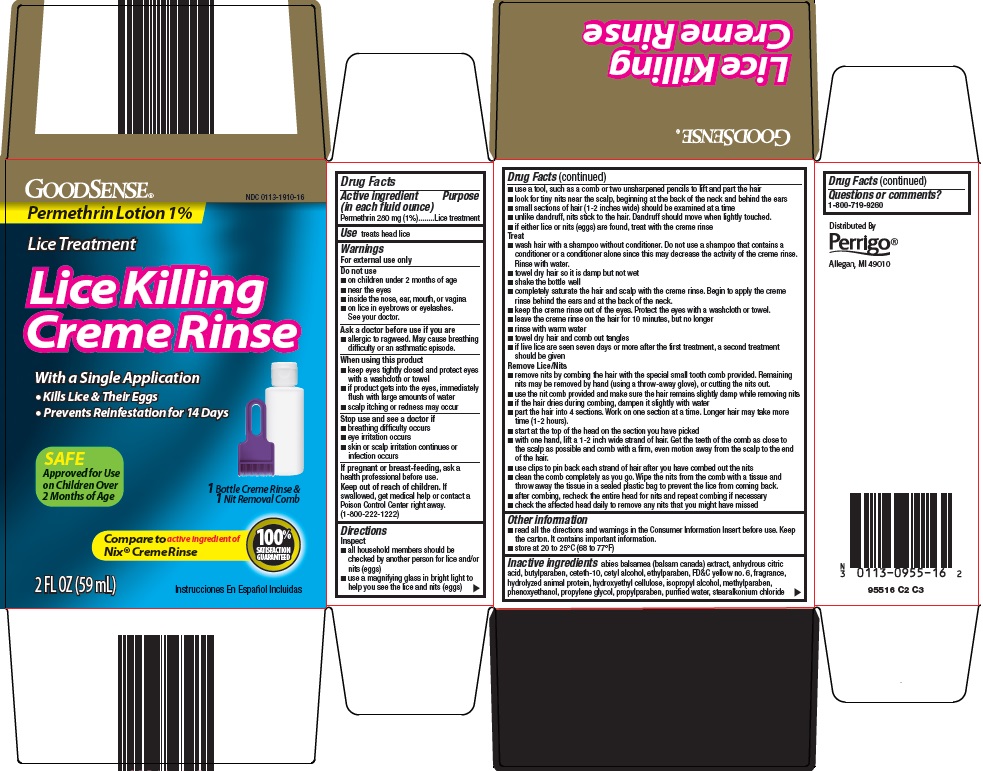
good sense lice killing creme rinse Permethrin 1 mg/100mL Lotion — NDC 0113-1910-16 (Billing 00113-1910-16)
This is a package of good sense lice killing creme rinse Permethrin 1 mg/100mL Lotion from L. Perrigo Company, marketed since Jul 2019 and currently FDA-listed; retail pharmacies pay about $0.1123 per mL (NADAC). It is this product's only package size.
NDC database record
One package, one record: these facts belong to NDC 0113-1910-16 alone.
- Record
- FDA NDC Directory package listing · Human OTC drug
- Code segments
- 0113 labeler · 1910 product · 16 package
- Package marketed since
- Jul 24, 2019
- Sample package
- No — commercial package
- Listing certified through
- Dec 31, 2026
- Barcode (UPC-A, from the NDC)
- 3 0113191016 0
- Medicaid fills, this package
- 734 prescriptions in the last four reported quarters
- FDA record last changed
- Jul 24, 2026
Identity & classification
Regulatory identifiers FDA, NLM and CMS codes for this package
Drug-database identifiers Medi-Span GPI and First Databank GCN / HICL / AHFS classification
- GSN (GCN sequence number): 007663
- GCN: 44520
- GPI-14 (Medi-Span): 90900035000910
- HICL (First Databank): 021814
- AHFS class code: 84:04.12.00
Where does this data come from?
- FDA openFDA NDC Directory · synced Oct 1, 2026
- FDA label on DailyMed · label index refreshed Oct 5, 2026
- RxNorm (NLM RxNav) · catalog refreshed Oct 1, 2026
- Medi-Span GPI (licensed)
- First Databank (licensed) · refreshed Oct 1, 2026
Clinical
Permethrin is used to treat scabies ('mites that attach themselves to the skin) in adults and children 2 months of age and older. Over-the-counter permethrin is used to treat lice (small insects that attach themselves to the skin on the head) in adults and children 2 months of age and older. Permethrin is in a class of medications called scabicides and pediculicides. It works by killing lice and mites.
Read the full MedlinePlus article ↗- Elimite 5% Cream treats scabies, which is caused by a tiny mite. The lice creme rinse products are used when lice or nits are found in the hair. Make sure you use the right product...
- Wash your hair with a shampoo that has no conditioner, then rinse and towel dry until damp. Saturate the hair and scalp, keep it out of your eyes, and leave it on for 10 minutes on...
- If you see live lice seven days or more after the first treatment, you should do a second treatment. Check the head daily and keep combing out any nits you missed.
- Burning, stinging, itching and redness where it was applied are the most common. These are usually mild and short-lived. Call your doctor if irritation keeps going, an infection de...
Patient education
Supplement & herbal interactions
Where does this data come from?
- MedlinePlus (NLM) · refreshed Oct 1, 2026
- FDA label on DailyMed · label index refreshed Oct 5, 2026
Ask a licensed pharmacist directly — free, answered by our team.
Pricing
A drug doesn't have one price. Each row is a different public payment system, and none is what you'd pay at the counter — that depends on your insurance. The ⓘ on each row explains what it measures.
| Price system | Per mL | Per package |
|---|---|---|
| Retail pharmacies payNADAC · weekly | $0.112 | $6.63 / 59 ml |
| Medicaid paysCMS SDUD · 12 mo | $0.2042 | $12.05 / 59 ml |
| Medicare drug plans payPart D · quarterly | No Part D plan price is available for this NDC in our data. | |
Where does this data come from?
- CMS NADAC weekly file · file of Feb 21, 2024
- CMS ASP pricing files · refreshed Sep 20, 2026
- CMS Medicaid State Drug Utilization Data · through Q1 2026
- CMS Part D plan pricing files · refreshed Sep 24, 2026
- VA National Acquisition Center price file
Packaging — all sizes for this product
| Package NDC | Description | Marketing start | Marketing end | Status |
|---|---|---|---|---|
| 00113-1910-16 You're viewing this Main listing | 1 BOTTLE in 1 CARTON / 59 mL in 1 BOTTLE | 2019-07-24 | — | Active |
Therapeutic equivalents
| Product | Labeler | Pack | NADAC/unit | TE | Status | Price vs. this |
|---|---|---|---|---|---|---|
| good sense lice killing creme rinse 1 mg/100mLthis 00113-1910-16 | L. | 1 bottle | $0.112 | — | FDA listed | — |
| Nix Lice Killing Creme Rinse 1 g/100mL 63471-3006-02 | Geodis | 1 bottle | — | — | FDA listed | — |
| Nix 1 g/100mL 63736-0030-01 | Insight | 1 bottle | — | — | FDA listed | — |
| Topcare lice killing creme rinse 1 mg/100mL 36800-0629-26 | Topco | 2 bottles | — | — | FDA listed | — |
Where does this data come from?
- FDA openFDA NDC Directory · synced Oct 1, 2026
- FDA Orange Book · refreshed Oct 3, 2026
- CMS NADAC weekly file · file of Feb 21, 2024
Availability & generic status
This product is an FDA-approved generic. Other versions of the same drug are listed under Therapeutic equivalents, least expensive first.
Where does this data come from?
- FDA Orange Book · refreshed Oct 3, 2026
Inactive Ingredients / Excipients
Inactive ingredients, also called excipients, are components of the drug product other than the active ingredient. They may include fillers, dyes, coatings, preservatives, flavors, or other formulation ingredients.
🧪 Avoiding an ingredient? See Permethrin Topical inactive ingredients by manufacturer: every current product's list side by side, so you can ask your pharmacy for the version that does not list it.
💡 Tap an ingredient (hover on desktop) to see what it is and why it’s used.
-
UNII XF417D3PSL
Anhydrous citric acid is a sour, crystalline powder derived from citric acid with water removed. In medicines, it acts as a buffer to control pH, adds tartness to improve taste, and helps tablets disintegrate.
-
UNII H1TFV1454Z
Balsam fir leafy twig is a plant extract from the evergreen balsam fir tree. It's used in medicines as a flavoring agent and fragrance to improve taste or smell.
-
UNII 3QPI1U3FV8
A preservative derived from benzoic acid that prevents bacterial and fungal growth in medicines. It helps extend shelf life and maintain product safety during storage and use.
-
UNII LF9X1PN3XJ
A synthetic ingredient derived from cetyl alcohol and ethylene oxide. It works as an emulsifier and surfactant to help mix oil and water-based components, keeping the medicine uniform and stable.
-
UNII 936JST6JCN
Cetyl alcohol is a waxy, fatty substance derived from plant or animal sources. It acts as an emulsifier and thickener in medicines, helping blend oil and water components and giving products a smooth, creamy texture.
-
UNII 14255EXE39
Ethylparaben is a preservative, a chemical that stops bacteria and mold from growing in the medicine. It keeps the product safe and effective throughout its shelf life.
-
UNII H77VEI93A8
A synthetic yellow dye used to color medications. It helps identify the drug and make it visually distinctive, with no effect on how the medicine works.
-
UNII ND2M416302
Isopropyl alcohol is a clear liquid solvent derived from petroleum. In medicines, it dissolves active ingredients and other components, helps the product flow smoothly, and aids in sterilization during manufacturing.
-
UNII A2I8C7HI9T
Methylparaben is a preservative derived from benzoic acid that prevents growth of bacteria, fungi, and mold in medicines. It extends the product's shelf life and maintains safety during storage.
-
UNII HIE492ZZ3T
Phenoxyethanol is a synthetic preservative and antimicrobial agent used to prevent bacterial and fungal growth in medicines and cosmetic products, extending shelf life and maintaining product safety.
-
UNII 6DC9Q167V3
Propylene glycol is a clear liquid derived from petroleum or vegetable sources. It acts as a solvent, humectant, and preservative in medicines, helping dissolve active ingredients and maintain product stability.
-
UNII Z8IX2SC1OH
Propylparaben is a chemical preservative used to prevent bacterial and fungal growth in medicines and personal care products. It helps extend shelf life and maintain product safety during storage.
-
UNII 0OUO26BB88
A compound derived from stearyl alcohol that acts as an antistatic agent and emulsifier. It reduces static electricity in the powder and helps blend water and oil components together in the formulation.
-
UNII 059QF0KO0R
Water is a liquid solvent that dissolves and mixes ingredients together in liquid medicines, syrups, and injections. It helps distribute the active drug evenly throughout the product.
14 inactive ingredients listed in the exact product block matched to this NDC.
Label-section wording can be broader than the structured product block and may mention additional formulation ingredients.
Where does this data come from?
ingredient classCode="IACT" elements from the exact product block matched by this NDC. Label-section narrative from DailyMed / the openFDA label index is shown separately when available.- FDA label on DailyMed · label index refreshed Oct 5, 2026
- FDA openFDA NDC Directory · synced Oct 1, 2026
Inactive ingredient FAQ
Are inactive ingredients the same for every manufacturer?
Why might an inactive ingredient be missing?
Can inactive ingredients matter?
Manufacturer & labeler
More NDCs from L. Perrigo Company labeler code 00113
- Nasonex mometasone furoate 50 ug Spray, Metered NDC 0113-1720-01
- Good Sense Omeprazole 20 mg Tablet, Delayed Release NDC 0113-1723-01
- good sense tussin dm dextromethorphan hydrobromide, guaifenesin 20 mg/20mL; 200 mg/20mL Solution NDC 0113-1725-26
- good sense omeprazole delayed release 20 mg Tablet, Delayed Release NDC 0113-1803-03
- good sense headache relief acetaminophen, aspirin, caffeine 250 mg; 250 mg; 65 mg Tablet, Film Coated NDC 0113-1855-27
- good sense pain relief acetaminophen 500 mg Tablet, Film Coated NDC 0113-1889-71
- Good Sense Pain Relief Acetaminophen 500 mg Tablet NDC 0113-1975-09
- Childrens Nasonex mometasone furoate 50 ug Spray, Metered NDC 0113-1999-01
- Option 2 levonorgestrel 1.5 mg Tablet NDC 0113-2003-12
- Allergy and Congestion Relief loratadine, Pseudoephedrine sulfate 5 mg; 120 mg Tablet, Film Coated, Extended Release NDC 0113-2007-46
- GOOD SENSE TUSSIN acetaminophen, dextromethorphan hydrobromide, guaifenesin 650 mg/20mL; 20 mg/20mL; 400 mg/20mL Solution NDC 0113-2009-34
- sinus 12 hour Pseudoephedrine HCl 120 mg Tablet, Film Coated, Extended Release NDC 0113-2017-60
Where does this data come from?
- FDA openFDA NDC Directory · synced Oct 1, 2026
- Drugs@FDA
FDA label — Drug Facts FDA SPL
🎯 Indications and Usage ▾
Use treats head lice
⏱️ Dosage and Administration ▾
Directions Inspect • all household members should be checked by another person for lice and/or nits (eggs) • use a magnifying glass in bright light to help you see the lice and nits (eggs) • use a tool, such as a comb or two unsharpened pencils to lift and part the hair • look for tiny nits near the scalp, beginning at the back of the neck and behind the ears • small sections of hair (1-2 inches wide) should be examined at a time • unlike dandruff, nits stick to the hair. Dandruff should move when lightly touched. • if either lice or nits (eggs) are found, treat with the creme rinse Treat • wash hair with a shampoo without conditioner.
Do not use a shampoo that contains a conditioner or a conditioner alone since this may decrease the activity of the creme rinse. Rinse with water. • towel dry hair so it is damp but not wet • shake the bottle well • completely saturate the hair and scalp with the creme rinse. Begin to apply the creme rinse behind the ears and at the back of the neck. • keep the creme rinse out of the eyes.
Protect the eyes with a washcloth or towel. • leave the creme rinse on the hair for 10 minutes, but no longer • rinse with warm water • towel dry hair and comb out tangles • if live lice are seen seven days or more after the first treatment, a second treatment should be given Remove Lice/Nits • remove nits by combing the hair with the special small tooth comb provided. Remaining nits may be removed by hand (using a throw-away glove), or cutting the nits out. • use the nit comb provided and make sure the hair remains slightly damp while removing nits • if the hair dries during combing, dampen it slightly with water • part the hair into 4 sections.
Work on one section at a time. Longer hair may take more time (1-2 hours). • start at the top of the head on the section you have picked • with one hand, lift a 1-2 inch wide strand of hair. Get the teeth of the comb as close to the scalp as possible and comb with a firm, even motion away from the scalp to the end of the hair. • use clips to pin back each strand of hair after you have combed out the nits • clean the comb completely as you go.
Wipe the nits from the comb with a tissue and throw away the tissue in a sealed plastic bag to prevent the lice from coming back. • after combing, recheck the entire head for nits and repeat combing if necessary • check the affected head daily to remove any nits that you might have missed
⚠️ Warnings ▾
Warnings For external use only Do not use • on children under 2 months of age • near the eyes • inside the nose, ear, mouth, or vagina • on lice in eyebrows or eyelashes. See your doctor. Ask a doctor before use if you are • allergic to ragweed.
May cause breathing difficulty or an asthmatic episode. When using this product • keep eyes tightly closed and protect eyes with a washcloth or towel • if product gets into the eyes, immediately flush with large amounts of water • scalp itching or redness may occur Stop use and see a doctor if • breathing difficulty occurs • eye irritation occurs • skin or scalp irritation continues or infection occurs If pregnant or breast-feeding, ask a health professional before use. Keep out of reach of children.
If swallowed, get medical help or contact a Poison Control Center right away. (1-800-222-1222)
📦 Storage and Handling ▾
Other information • read all the directions and warnings in the Consumer Information Insert before use. Keep the carton. It contains important information. • store at 20 to 25°C (68 to 77°F)
🧪 Active Ingredient ▾
Active ingredient (in each fluid ounce) Permethrin 280 mg (1%)
🧪 Inactive Ingredients ▾
Inactive ingredients abies balsamea (balsam canada) extract, anhydrous citric acid, butylparaben, ceteth-10, cetyl alcohol, ethylparaben, FD&C yellow no. 6, fragrance, hydrolyzed animal protein, hydroxyethyl cellulose, isopropyl alcohol, methylparaben, phenoxyethanol, propylene glycol, propylparaben, purified water, stearalkonium chloride
🎯 Purpose ▾
Purpose Lice treatment
📄 Do Not Use ▾
Do not use • on children under 2 months of age • near the eyes • inside the nose, ear, mouth, or vagina • on lice in eyebrows or eyelashes. See your doctor.
📄 Ask a Doctor Before Use If ▾
Ask a doctor before use if you are • allergic to ragweed. May cause breathing difficulty or an asthmatic episode.
📄 When Using This Product ▾
When using this product • keep eyes tightly closed and protect eyes with a washcloth or towel • if product gets into the eyes, immediately flush with large amounts of water • scalp itching or redness may occur
📄 Stop Use and Ask a Doctor If ▾
Stop use and see a doctor if • breathing difficulty occurs • eye irritation occurs • skin or scalp irritation continues or infection occurs
🤰 If Pregnant or Breast-Feeding ▾
If pregnant or breast-feeding, ask a health professional before use.
📄 Keep Out of Reach of Children ▾
Keep out of reach of children. If swallowed, get medical help or contact a Poison Control Center right away. (1-800-222-1222)
📄 Questions or Comments ▾
Questions or comments? 1-800-719-9260
📄 Package Label / Principal Display Panel ▾
Principal Display Panel Permethrin Lotion 1% Lice Treatment Lice Killing Creme Rinse With a Single Application Kills Lice & Their Eggs Prevents Reinfestation for 14 Days SAFE Approved for Use on Children Over 2 Months of Age 1 Bottle Creme Rinse & 1 Nit Removal Comb Compare to active ingredient of Nix ® Creme Rinse 100% SATISFACTION GUARANTEED 2 FL OZ (59 mL) lice killing creme rinse image