
LACTULOSE 10 g/15mL Solution — NDC 0121-4577-06 (Billing 00121-4577-06)
This is a package of LACTULOSE 10 g/15mL Solution from PAI Holdings, LLC dba PAI Pharma, no longer marketed (first marketed Jul 1966), no longer in the FDA NDC Directory. It is the main listing for this product, which comes in 3 package sizes.
NDC database record
One package, one record: these facts belong to NDC 0121-4577-06 alone.
- Record
- FDA NDC Directory package listing · Human prescription drug
- Code segments
- 0121 labeler · 4577 product · 06 package
- Listing certified through
- Dec 31, 2026
- Barcode (UPC-A, from the NDC)
- 3 0121457706 8
- FDA record last changed
- Jul 24, 2026
Identity & classification
Regulatory identifiers FDA, NLM and CMS codes for this package
Drug-database identifiers Medi-Span GPI and First Databank GCN / HICL / AHFS classification
- GSN (GCN sequence number): 029054
- GCN: 10167
- GPI-14 (Medi-Span): 46600020002010
- HICL (First Databank): 001396
- AHFS class code: 40:10.00.00
- RxCUI (RxNorm): 391937
Where does this data come from?
- FDA openFDA NDC Directory · synced Oct 8, 2026
- FDA label on DailyMed · label index refreshed Oct 6, 2026
- RxNorm (NLM RxNav) · catalog refreshed Oct 1, 2026
- Medi-Span GPI (licensed)
- First Databank (licensed) · refreshed Oct 8, 2026
RxNorm drug class
This medicine belongs to the Osmotic Laxative class.
Where does this data come from?
- RxClass (NLM) · catalog refreshed Oct 1, 2026
Clinical
- It depends on the product. Some, like Generlac and Enulose, prevent and treat portal-systemic encephalopathy, a brain problem tied to liver disease. Others, like Constulose and Kri...
- For constipation, it can take 24 to 48 hours to produce a bowel movement. For encephalopathy, you may improve within 24 hours, but it might not start before 48 hours or later.
- Gas, bloating, belching and cramps are the most common, affecting about 20% of people. Nausea and vomiting can happen. If you get diarrhea, tell your doctor, since the dose may nee...
- Check with me or your doctor first. Other laxatives can mask whether your lactulose dose is working, and nonabsorbable antacids may weaken its effect. Neomycin and similar antibiot...
Patient education
Supplement & herbal interactions
Some supplements/herbs that may interact with Lactulose — tap one for details:
Where does this data come from?
- MedlinePlus (NLM) · refreshed Oct 1, 2026
- FDA label on DailyMed · label index refreshed Oct 6, 2026
Ask a licensed pharmacist directly — free, answered by our team.
Pricing
A drug doesn't have one price. Each row is a different public payment system, and none is what you'd pay at the counter — that depends on your insurance. The ⓘ on each row explains what it measures.
| Price system | Per mL | Per package |
|---|---|---|
| Retail pharmacies payNADAC · weekly | Not in the retail survey — common for institutional, discontinued, or low-volume packs. | |
| Medicaid paysCMS SDUD · 12 mo | No recent Medicaid claims on file for this NDC — rare and low-volume NDCs are suppressed in the public data. | |
| Medicare drug plans payPart D · quarterly | No Part D plan price is available for this NDC in our data. | |
Where does this data come from?
- CMS NADAC weekly file
- CMS ASP pricing files · refreshed Sep 20, 2026
- CMS Medicaid State Drug Utilization Data · refreshed Oct 8, 2026
- CMS Part D plan pricing files · refreshed Sep 24, 2026
- VA National Acquisition Center price file
Packaging — all sizes for this product
| Package NDC | Description | Marketing start | Marketing end | Status |
|---|---|---|---|---|
| 00121-4577-06 You're viewing this Main listing | 6 CARTON in 1 CASE / 16 CUP, UNIT-DOSE in 1 CARTON / 15 mL in 1 CUP, UNIT-DOSE | 2019-05-03 | — | Discontinued by firm |
| 00121-4577-40 0121-4577-40 | 4 TRAY in 1 CASE / 10 CUP, UNIT-DOSE in 1 TRAY / 15 mL in 1 CUP, UNIT-DOSE | 1966-07-30 | — | Active |
| 00121-4577-50 0121-4577-50 | 5 TRAY in 1 CASE / 5 CUP, UNIT-DOSE in 1 TRAY / 15 mL in 1 CUP, UNIT-DOSE | 2022-11-19 | — | Active |
Pack size FAQ
What quantity is in this package?
What NDC number is used to bill for this package of LACTULOSE 10 g/15mL Solution?
Therapeutic equivalents
| Product | Labeler | Pack | NADAC/unit | TE | Status | Price vs. this |
|---|---|---|---|---|---|---|
| Lactulose Solution 10 g/15mL 81033-0241-32 | Kesin | 946 ml | $0.013 | AA | Availability likely | — |
| Enulose 10 g/15mL 45963-0438-64 | Actavis | 473 ml | $0.013 | AA | Availability likely | — |
| Generlac 10 g/15mL 62135-0892-47 | Chartwell | 473 ml | $0.013 | AA | Availability likely | — |
| Lactulose 10 g/15mL 00116-4005-08 | Xttrium | 237 ml | $0.019 | AA | Availability likely | — |
| Constulose 10 g/15mL 45963-0439-63 | Actavis | 237 ml | $0.019 | AA | Availability likely | — |
| Lactulose 10 g/15mL 83745-0405-08 | APOZEAL | 237 ml | $0.019 | AA | Availability likely | — |
| Lactulose 10 g/15mL 62135-0003-37 | Chartwell | 237 ml | $0.020 | AA | Availability likely | — |
| Lactulose 10 g/15mL 51672-4243-09 | Sun | 1 bottle | $0.022 | AA | Availability likely | — |
| Lactulose 10 g/15mL 00121-0873-06 | PAI | 16 cups | — | AA | FDA listed | — |
| Lactulose 20 g/30mL 00121-1154-06 | PAI | 16 cups | — | AA | Discontinued | — |
| Lactulose 20 g/30mL 00121-1746-00 | PAI | 10 cups | — | AA | FDA listed | — |
| Lactulose 10 g/15mLthis 00121-4577-06 | PAI | 16 cups | — | AA | Discontinued | — |
| Lactulose 10 g/15mL 00527-5125-68 | Lannett | 237 ml | — | AA | FDA listed | — |
| Lactulose 10 g/15mL 17856-0874-03 | Atlantic | 50 cups | — | AA | FDA listed | — |
| Lactulose 10 g/15mL 18124-0002-16 | Fresenius | 473 ml | — | AA | FDA listed | — |
| Lactulose 20 g/30mL 55154-9448-05 | Cardinal | 5 cups | — | AA | FDA listed | — |
| Lactulose Solution 10 g/15mL 61037-0471-02 | Bajaj | 236 ml | — | AA | FDA listed | — |
| Lactulose 10 g/15mL 62135-0002-24 | Chartwell | 10 cups | — | AA | FDA listed | — |
| Lactulose 10 g/15mL 62135-0004-24 | Chartwell | 10 cups | — | AA | FDA listed | — |
| Enulose 10 g/15mL 63629-8800-01 | Bryant | 473 ml | — | AA | FDA listed | — |
| Lactulose Solution 10 g/15mL 64980-0592-12 | Rising | 118 ml | — | AA | FDA listed | — |
| Lactulose 10 g/15mL 68999-0002-24 | Chartwell | 10 cups | — | AA | FDA listed | — |
| Lactulose 20 g/30mL 68999-0004-24 | Chartwell | 10 cups | — | AA | FDA listed | — |
| Lactulose 10 g/15mL 82804-0107-47 | Proficient | 473 ml | — | AA | FDA listed | — |
| Lactulose 10 g/15mL 83745-0249-08 | APOZEAL | 237 ml | — | AA | FDA listed | — |
| Lactulose 10 g/15mL 60687-0917-14 | American | 10 cups | — | AA | FDA listed | — |
Where does this data come from?
- FDA openFDA NDC Directory · synced Oct 8, 2026
- FDA Orange Book · refreshed Oct 3, 2026
- CMS NADAC weekly file
Availability & generic status
This product is an FDA-approved generic. Other versions of the same drug are listed under Therapeutic equivalents, least expensive first.
Where does this data come from?
- FDA Orange Book · refreshed Oct 3, 2026
What it looks like
Where does this data come from?
- FDA label on DailyMed · label index refreshed Oct 6, 2026
Inactive Ingredients / Excipients
Inactive ingredients, also called excipients, are components of the drug product other than the active ingredient. They may include fillers, dyes, coatings, preservatives, flavors, or other formulation ingredients.
🧪 Avoiding an ingredient? See Lactulose inactive ingredients by manufacturer: every current product's list side by side, so you can ask your pharmacy for the version that does not list it.
💡 Tap an ingredient (hover on desktop) to see what it is and why it’s used.
-
UNII H77VEI93A8
A synthetic yellow dye used to color medications. It helps identify the drug and make it visually distinctive, with no effect on how the medicine works.
-
UNII 55X04QC32I
A strong alkaline chemical used to adjust and maintain the pH balance of liquid medicines. It helps keep the medicine stable and ensures it stays effective during storage.
-
UNII 059QF0KO0R
Water is a liquid solvent that dissolves and mixes ingredients together in liquid medicines, syrups, and injections. It helps distribute the active drug evenly throughout the product.
3 inactive ingredients listed in the exact product block matched to this NDC.
Where does this data come from?
ingredient classCode="IACT" elements from the exact product block matched by this NDC. Label-section narrative from DailyMed / the openFDA label index is shown separately when available.- FDA label on DailyMed · label index refreshed Oct 6, 2026
- FDA openFDA NDC Directory · synced Oct 8, 2026
Inactive ingredient FAQ
Are inactive ingredients the same for every manufacturer?
Why might an inactive ingredient be missing?
Can inactive ingredients matter?
Manufacturer & labeler
More NDCs from PAI Holdings, LLC dba PAI Pharma labeler code 00121
- Potassium Chloride 40 meq/15mL Solution NDC 0121-2847-00
- Lacosamide 150 mg/15mL Solution NDC 0121-3036-95
- Acetaminophen 650 mg/20.3mL Solution NDC 0121-3141-00
- Lithium 8 meq/5mL Solution NDC 0121-4027-94
- Lacosamide 200 mg/20mL Solution NDC 0121-4048-95
- Gabapentin 250 mg/5mL Solution NDC 0121-4067-40
- VALPROIC ACID 250 mg/5mL Solution NDC 0121-4675-00
- Fluoxetine 20 mg/5mL Solution NDC 0121-4721-40
- Ranitidine 15 mg/mL Syrup NDC 0121-4727-10
- Prednisolone Sodium Phosphate 15 mg/5mL Solution NDC 0121-4759-50
- Calcium Carbonate 1250 mg/5mL Suspension NDC 0121-4766-05
- Hydrocodone Bitartrate and Acetaminophen 2.5 mg/5mL; 108 mg/5mL Solution NDC 0121-4772-10
Where does this data come from?
- FDA openFDA NDC Directory · synced Oct 8, 2026
- Drugs@FDA
Full prescribing information FDA SPL
🎯 Indications and Usage ▾
INDICATIONS AND USAGE For the treatment of constipation. In patients with a history of chronic constipation, lactulose solution therapy increases the number of bowel movements per day and the number of days on which bowel movements occur.
⏱️ Dosage and Administration ▾
DOSAGE AND ADMINISTRATION The usual dose is 1 to 2 tablespoonfuls (15 to 30 mL, containing 10 g to 20 g of lactulose) daily. The dose may be increased to 60 mL daily if necessary. Twenty-four to 48 hours may be required to produce a normal bowel movement. Note: Some patients have found that lactulose solution may be more acceptable when mixed with fruit juice, water or milk.
⛔ Contraindications ▾
CONTRAINDICATIONS Since lactulose solution contains galactose (less than 1.6 g/15 mL), it is contraindicated in patients who require a low galactose diet.
⚠️ Warnings ▾
WARNINGS A theoretical hazard may exist for patients being treated with lactulose solution who may be required to undergo electrocautery procedures during proctoscopy or colonoscopy. Accumulation of H 2 gas in significant concentration in the presence of an electrical spark may result in an explosive reaction. Although this complication has not been reported with lactulose, patients on lactulose therapy undergoing such procedures should have a thorough bowel cleansing with a non-fermentable solution.
Insufflation of CO 2 as an additional safeguard may be pursued but is considered to be a redundant measure.
🤒 Adverse Reactions ▾
ADVERSE REACTIONS Precise frequency data are not available. Initial dosing may produce flatulence and intestinal cramps, which are usually transient. Excessive dosage can lead to diarrhea with potential complications such as loss of fluids, hypokalemia, and hypernatremia. Nausea and vomiting have been reported. To report SUSPECTED ADVERSE REACTIONS, contact Pharmaceutical Associates, Inc. at 1-800-845-8210.
🔄 Drug Interactions ▾
Drug Interactions Results of preliminary studies in humans and rats suggest that nonabsorbable antacids given concurrently with lactulose may inhibit the desired lactulose-induced drop in colonic pH. Therefore, a possible lack of desired effect of treatment should be taken into consideration before such drugs are given concomitantly with lactulose solution.
🤰 Pregnancy ▾
Pregnancy:Teratogenic Effects. Pregnancy Category B: Reproduction studies have been performed in mice, rats, and rabbits at doses up to 3 or 6 times the usual human oral dose and have revealed no evidence of impaired fertility or harm to the fetus due to lactulose. There are, however, no adequate and well-controlled studies in pregnant women.
Because animal reproduction studies are not always predictive of human response, this drug should be used during pregnancy only if clearly needed.
🧒 Pediatric Use ▾
Pediatric Use Safety and effectiveness in pediatric patients have not been established.
🆘 Overdosage ▾
OVERDOSAGE Signs and Symptoms There have been no reports of accidental overdosage. In the event of overdosage, it is expected that diarrhea and abdominal cramps would be the major symptoms. Medication should be terminated.
Oral LD 50 The acute oral LD 50 of the drug is 48.8 mL/kg in mice and greater than 30 mL/kg in rats. Dialysis Dialysis data are not available for lactulose. Its molecular similarity to sucrose, however, would suggest that it should be dialyzable.
🧬 Clinical Pharmacology ▾
CLINICAL PHARMACOLOGY Lactulose is poorly absorbed from the gastrointestinal tract, and no enzyme capable of hydrolysis of this disaccharide is present in human gastrointestinal tissue. As a result, oral doses of lactulose solution reach the colon virtually unchanged. In the colon, lactulose is broken down primarily to lactic acid, and also to small amounts of formic and acetic acids, by the action of colonic bacteria, which results in an increase in osmotic pressure and slight acidification of the colonic contents.
This in turn causes an increase in stool water content and softens the stool. Since lactulose does not exert its effect until it reaches the colon, and since transit time through the colon may be slow, 24 to 48 hours may be required to produce the desired bowel movement. Lactulose solution given orally to man and experimental animals resulted in only small amounts reaching the blood.
Urinary excretion has been determined to be 3% or less and is essentially complete within 24 hours.
📦 How Supplied / Storage and Handling ▾
HOW SUPPLIED NDC 0121-0577-08: 8 fl oz (237 mL) bottles NDC 0121-0577-16: 16 fl oz (473 mL) bottles NDC 0121-0577-32: 32 fl oz (946 mL) bottle NDC 0121-4577-15: 15 mL unit dose cup NDC 0121-4577-40: Case contains 40 unit dose cups of 15 mL (0121-4577-15) packaged in 4 trays of 10 unit dose cups each. NDC 0121-4577-06: Case contains 96 unit dose cups of 15 mL (0121-4577-15) packaged in 6 cartons of 16 unit dose cups each. NDC 0121-1154-30: 30 mL unit dose cup NDC 0121-1154-40: Case contains 40 unit dose cups of 30 mL (0121-1154-30) packaged in 4 trays of 10 unit dose cups each.
NDC 0121-1154-00: Case contains 100 unit dose cups of 30 mL (0121-1154-30) packaged in 10 trays of 10 unit dose cups each. NDC 0121-1154-06: Case contains 96 unit dose cups of 30 mL (0121-1154-30) packaged in 6 cartons of 16 unit dose cups each. Lactulose solution contains lactulose 667 mg/mL (10 g/15 mL).
Store at controlled room temperature, 20°-25°C (68°-77°F). [See USP] Do not freeze. Under recommended storage conditions, a normal darkening of color may occur. Such darkening is characteristic of sugar solutions and does not affect therapeutic action.
Prolonged exposure to temperatures above 30°C (86°F) or to direct light may cause extreme darkening and turbidity which may be pharmaceutically objectionable. If this condition develops, do not use. Prolonged exposure to freezing temperatures may cause change to a semisolid, too viscous to pour.
Viscosity will return to normal upon warming to room temperature. Keep tightly closed. Dispense in original container or tight, light-resistant container with a child-resistant closure.
To the Pharmacist: When ordering this product, include the product number (or NDC) in the description.
📦 Storage and Handling ▾
Store at controlled room temperature, 20°-25°C (68°-77°F). [See USP] Do not freeze. Under recommended storage conditions, a normal darkening of color may occur. Such darkening is characteristic of sugar solutions and does not affect therapeutic action.
Prolonged exposure to temperatures above 30°C (86°F) or to direct light may cause extreme darkening and turbidity which may be pharmaceutically objectionable. If this condition develops, do not use. Prolonged exposure to freezing temperatures may cause change to a semisolid, too viscous to pour.
Viscosity will return to normal upon warming to room temperature. Keep tightly closed. Dispense in original container or tight, light-resistant container with a child-resistant closure.
To the Pharmacist: When ordering this product, include the product number (or NDC) in the description.
📋 Description ▾
DESCRIPTION Lactulose is a synthetic disaccharide in solution form for oral administration. Each 15 mL of Lactulose Solution contains: 10 g lactulose (and less than 1.6 g galactose, less than 1.2 g lactose, and 1.2 g or less of other sugars). Also contains FD&C Yellow No.
6, purified water, and flavoring. Sodium hydroxide used to adjust pH. The pH range is 2.5 to 6.5.
Lactulose is a colonic acidifier which promotes laxation. The chemical name for lactulose is 4-0-ß-D-galactopyranosyl-D-fructofuranose. It has the following structural formula: The molecular weight is 342.30.
It is freely soluble in water. Chemical Structure
💬 Information for Patients ▾
Information for Patients In the event that an unusual diarrheal condition occurs, contact your physician.
⚠️ Precautions ▾
PRECAUTIONS General Since lactulose solution contains galactose (less than1.6 g/15 mL) and lactose (less than 1.2 g/15 mL), it should be used with caution in diabetics. Information for Patients In the event that an unusual diarrheal condition occurs, contact your physician. Laboratory Tests Elderly, debilitated patients who receive lactulose solution for more than six months should have serum electrolytes (potassium, chloride, carbon dioxide) measured periodically.
Drug Interactions Results of preliminary studies in humans and rats suggest that nonabsorbable antacids given concurrently with lactulose may inhibit the desired lactulose-induced drop in colonic pH. Therefore, a possible lack of desired effect of treatment should be taken into consideration before such drugs are given concomitantly with lactulose solution. Carcinogenesis, Mutagenesis, Impairment of Fertility There are no known human data on long-term potential for carcinogenicity, mutagenicity, or impairment of fertility.
There are no known animal data on long-term potential for mutagenicity. Administration of lactulose solution in the diet of mice for 18 months in concentrations of 3 and 10 percent (V/W) did not produce any evidence of carcinogenicity. In studies in mice, rats, and rabbits, doses of lactulose solution up to 6 or 12 mL/kg/day produced no deleterious effects in breeding, conception, or parturition.
Pregnancy:Teratogenic Effects. Pregnancy Category B: Reproduction studies have been performed in mice, rats, and rabbits at doses up to 3 or 6 times the usual human oral dose and have revealed no evidence of impaired fertility or harm to the fetus due to lactulose. There are, however, no adequate and well-controlled studies in pregnant women.
Because animal reproduction studies are not always predictive of human response, this drug should be used during pregnancy only if clearly needed. Nursing Mothers It is not known whether this drug is excreted in human milk. Because many drugs are excreted in human milk, caution should be exercised when lactulose solution is administered to a nursing woman.
Pediatric Use Safety and effectiveness in pediatric patients have not been established.
🍼 Nursing Mothers ▾
Nursing Mothers It is not known whether this drug is excreted in human milk. Because many drugs are excreted in human milk, caution should be exercised when lactulose solution is administered to a nursing woman.
📄 Carcinogenesis, Mutagenesis, Impairment of Fertility ▾
Carcinogenesis, Mutagenesis, Impairment of Fertility There are no known human data on long-term potential for carcinogenicity, mutagenicity, or impairment of fertility. There are no known animal data on long-term potential for mutagenicity. Administration of lactulose solution in the diet of mice for 18 months in concentrations of 3 and 10 percent (V/W) did not produce any evidence of carcinogenicity.
In studies in mice, rats, and rabbits, doses of lactulose solution up to 6 or 12 mL/kg/day produced no deleterious effects in breeding, conception, or parturition.
📄 Package Label / Principal Display Panel ▾
PRINCIPAL DISPLAY PANEL - 15 mL Cup Lid UNIT DOSE Delivers 15 mL NDC 0121-4577-15 L ACTULOSE S OLUTION USP 10 g/15 mL Indication: For the treatment of constipation. See Insert. FOR INSTITUTIONAL USE ONLY Rx ONLY PHARMACEUTICAL ASSOCIATES, INC. GREENVILLE, SC 29605 F45771500 PRINCIPAL DISPLAY PANEL - 15 mL Cup Lid
PRINCIPAL DISPLAY PANEL - 30 mL Cup Lid - NDC 0121-1154-30 UNIT DOSE Delivers 30 mL NDC 0121-1154-30 L ACTULOSE S OLUTION USP 20 g/30 mL Indication: For the treatment of constipation. See Insert. FOR INSTITUTIONAL USE ONLY Rx ONLY PHARMACEUTICAL ASSOCIATES, INC. GREENVILLE, SC 29605 A45773001 PRINCIPAL DISPLAY PANEL - 30 mL Cup Lid - NDC 0121-1154-30
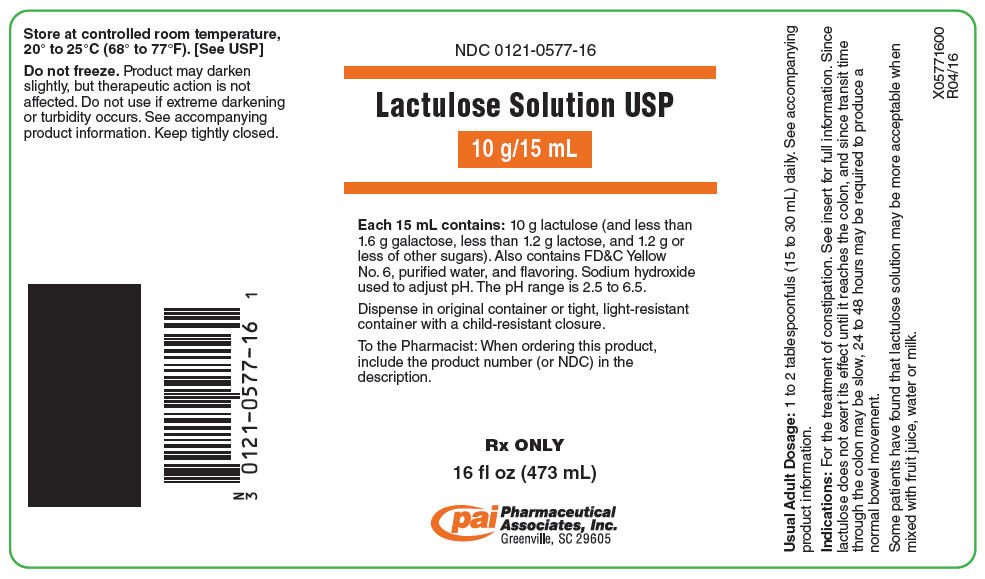
PRINCIPAL DISPLAY PANEL -116 oz bottle 0121-0577-16 NDC 0121-0577-16 LACTULOSE Solution USP 10g/15 mL Each 15 mL contains: 10 g lactulose (and less than 1.6 g galactose, less than 1.2 g lactose, and 1.2 g or less of other sugars). Also contains FD&C Yellow No. 6, purified water, and flavoring.
Sodium hydroxide used to adjust pH. The pH range is 2.5 to 6.5.Dispense in original container or tight, light-resistant container with a child-resistant closure. To the Pharmacist: When ordering this product, include the product number (or NDC) in the description.
16 oz bottle label
Medicare Part D spend CMS · PART D · 2026 (Q1)
About this NDC listing & data coverage
What data is (and isn’t) available for this NDC — tap to expand
| NDC identity (package / product / labeler codes) | ✓ Available |
| Labeler | ✓ Available |
| Product & package description | ✓ Available |
| Marketing category & status | ✓ Available |
| Active ingredient / dosage form / route | ✓ Available |
| FDA label (SPL via DailyMed) | ✓ Available |
| Package photos | ✓ Available |
| Inactive ingredients (structured) | ✓ Available |
| NADAC pharmacy acquisition price (CMS) | — Not published for this NDC CMS publishes NADAC only for NDCs reported in its retail-pharmacy survey. |
| Orange Book / therapeutic-equivalence data | ✓ Available |
| HCPCS J-code billing crosswalk | — Not published for this NDC Most self-administered / retail products have no J-code — that is normal. |
| Medicaid utilization (CMS SDUD) | — Not published for this NDC CMS reports utilization only for NDCs with Medicaid claims above its privacy threshold. |