
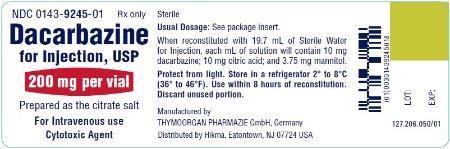
Dacarbazine 200 mg Injection, Powder, Lyophilized, For Solution — NDC 0143-9245-10 (Billing 00143-9245-10)
This is a package of Dacarbazine 200 mg Injection, Powder, Lyophilized, For Solution from Hikma Pharmaceuticals USA Inc., marketed since Aug 2001 and currently FDA-listed. It is this product's only package size.
NDC database record
One package, one record: these facts belong to NDC 0143-9245-10 alone.
- Record
- FDA NDC Directory package listing · Human prescription drug
- Code segments
- 0143 labeler · 9245 product · 10 package
- Package marketed since
- Aug 8, 2001
- Sample package
- No — commercial package
- Listing certified through
- Dec 31, 2026
- Barcode (UPC-A, from the NDC)
- 3 0143924510 0
- Medicaid fills, this package
- 858 prescriptions in the last four reported quarters
- FDA record last changed
- Jul 24, 2026
Identity & classification
Regulatory identifiers FDA, NLM and CMS codes for this package
Drug-database identifiers Medi-Span GPI and First Databank GCN / HICL / AHFS classification
- GSN (GCN sequence number): 008834
- GCN: 38731
- GPI-14 (Medi-Span): 21700020002110
- HICL (First Databank): 003927
- AHFS class code: 10:00.00.00
- RxCUI (RxNorm): 1731338
Where does this data come from?
- FDA openFDA NDC Directory · synced Oct 1, 2026
- FDA label on DailyMed · label index refreshed Oct 3, 2026
- RxNorm (NLM RxNav) · catalog refreshed Oct 1, 2026
- Medi-Span GPI (licensed)
- First Databank (licensed) · refreshed Oct 1, 2026
RxNorm drug class
This medicine belongs to the Alkylating Drug class.
Where does this data come from?
- RxClass (NLM) · catalog refreshed Oct 1, 2026
Clinical
- Dacarbazine is a chemotherapy drug used for two types of cancer. It's approved to treat metastatic malignant melanoma — that's an advanced skin cancer that has spread to other area...
- No, you won't take this one at home. Dacarbazine is given as an IV infusion — directly into a vein — by trained healthcare professionals in a clinic or hospital. Treatment is given...
- How is dacarbazine given — do I take it at home?
- Nausea and vomiting are very common, especially in the first couple of doses — more than 90% of people experience this. The good news is it usually gets better after the first day...
Patient education
Supplement & herbal interactions
Some supplements/herbs that may interact with Dacarbazine — tap one for details:
Dacarbazine may be associated with lower levels of 1 nutrient — worth a chat with your pharmacist, not a cause for alarm.
Where does this data come from?
- MedlinePlus (NLM) · refreshed Oct 1, 2026
- FDA label on DailyMed · label index refreshed Oct 3, 2026
Ask a licensed pharmacist directly — free, answered by our team.
Pricing
A drug doesn't have one price. Each row is a different public payment system, and none is what you'd pay at the counter — that depends on your insurance. The ⓘ on each row explains what it measures.
| Price system | Per mL | Per package |
|---|---|---|
| Retail pharmacies payNADAC · weekly | Not in the retail survey — common for institutional, discontinued, or low-volume packs. | |
| Medicaid paysCMS SDUD · 12 mo | $14.68 | $2,936.42 / 200 ml |
| Medicare drug plans payPart D · quarterly | No Part D plan price is available for this NDC in our data. | |
| Medicare Part B allowsASP · J9130 | $3.463 / J9130 unit | — |
Where does this data come from?
- CMS NADAC weekly file
- CMS ASP pricing files · refreshed Sep 20, 2026
- CMS Medicaid State Drug Utilization Data · through Q1 2026
- CMS Part D plan pricing files · refreshed Sep 24, 2026
- VA National Acquisition Center price file
Billing & reimbursement
Where does this data come from?
- CMS ASP NDC-HCPCS crosswalk · refreshed Sep 22, 2026
- DMEPDAC NDC-HCPCS crosswalk
- openFDA NSDE billing units · refreshed Sep 7, 2026
Packaging — all sizes for this product
| Package NDC | Description | Marketing start | Marketing end | Status |
|---|---|---|---|---|
| 00143-9245-10 You're viewing this Main listing | 10 VIAL in 1 CARTON / 20 mL in 1 VIAL | 2001-08-08 | — | Active |
Therapeutic equivalents
| Product | Labeler | Pack | NADAC/unit | TE | Status | Price vs. this |
|---|---|---|---|---|---|---|
| Dacarbazine 200 mgthis 00143-9245-10 | Hikma | 10 vials | — | AP | FDA listed | — |
| Dacarbazine 10 mg/mL 63323-0128-20 | Fresenius | 10 vials | — | — | FDA listed | — |
| Dacarbazine 200 mg/20mL 71288-0174-21 | Meitheal | 10 vials | — | AP | FDA listed | — |
Where does this data come from?
- FDA openFDA NDC Directory · synced Oct 1, 2026
- FDA Orange Book · refreshed Oct 3, 2026
- CMS NADAC weekly file
Availability & generic status
This product is an FDA-approved generic. Other versions of the same drug are listed under Therapeutic equivalents, least expensive first.
Where does this data come from?
- FDA Orange Book · refreshed Oct 3, 2026
Inactive Ingredients / Excipients
Inactive ingredients, also called excipients, are components of the drug product other than the active ingredient. They may include fillers, dyes, coatings, preservatives, flavors, or other formulation ingredients.
💡 Tap an ingredient (hover on desktop) to see what it is and why it’s used.
-
UNII XF417D3PSL
Anhydrous citric acid is a sour, crystalline powder derived from citric acid with water removed. In medicines, it acts as a buffer to control pH, adds tartness to improve taste, and helps tablets disintegrate.
-
UNII 3OWL53L36A
A natural sugar alcohol derived from seaweed or synthesized in the lab. It's used as a filler to add bulk, a sweetener in sugar-free formulas, and a disintegrant to help tablets break apart in the stomach.
2 inactive ingredients listed in the exact product block matched to this NDC.
Where does this data come from?
ingredient classCode="IACT" elements from the exact product block matched by this NDC. Label-section narrative from DailyMed / the openFDA label index is shown separately when available.- FDA label on DailyMed · label index refreshed Oct 3, 2026
- FDA openFDA NDC Directory · synced Oct 1, 2026
Inactive ingredient FAQ
Are inactive ingredients the same for every manufacturer?
Why might an inactive ingredient be missing?
Can inactive ingredients matter?
Manufacturer & labeler
More NDCs from Hikma Pharmaceuticals USA Inc. labeler code 00143
- Rifampin 600 mg Injection, Powder, Lyophilized, For Solution NDC 0143-9230-01
- Vecuronium Bromide 20 mg Injection, Powder, For Solution NDC 0143-9232-10
- Benztropine Mesylate 1 mg/mL Injection NDC 0143-9233-05
- Vecuronium Bromide 10 mg Injection, Powder, For Solution NDC 0143-9234-10
- Bleomycin 15 [USP'U]/1 Injection, Powder, Lyophilized, For Solution NDC 0143-9240-01
- Bleomycin 30 [USP'U]/1 Injection, Powder, Lyophilized, For Solution NDC 0143-9241-01
- Buprenorphine Hydrochloride .324 mg/mL Injection NDC 0143-9246-05
- Dexrazoxane 250 mg Injection, Powder, Lyophilized, For Solution NDC 0143-9247-01
- Dexrazoxane 500 mg Injection, Powder, Lyophilized, For Solution NDC 0143-9248-01
- Amoxicillin and Clavulanate Potassium 875 mg; 125 mg Tablet NDC 0143-9249-20
- Rocuronium Bromide 10 mg/mL Injection NDC 0143-9250-10
- Rocuronium Bromide 10 mg/mL Injection NDC 0143-9251-10
Where does this data come from?
- FDA openFDA NDC Directory · synced Oct 1, 2026
- Drugs@FDA
Full prescribing information FDA SPL
🚨 Boxed Warning ▾
WARNING It is recommended that dacarbazine be administered under the supervision of a qualified physician experienced in the use of cancer chemotherapeutic agents. 1.Hemopoietic depression is the most common toxicity with dacarbazine (see WARNINGS ). 2.Hepatic necrosis has been reported (see WARNINGS ).
3.Studies have demonstrated this agent to have a carcinogenic and teratogenic effect when used in animals. 4.In treatment of each patient, the physician must weigh carefully the possibility of achieving therapeutic benefit against the risk of toxicity.
Boxed Warning WARNING It is recommended that dacarbazine be administered under the supervision of a qualified physician experienced in the use of cancer chemotherapeutic agents. Hemopoietic depression is the most common toxicity with dacarbazine (see WARNINGS ). Hepatic necrosis has been reported (see WARNINGS ).
Studies have demonstrated this agent to have a carcinogenic and teratogenic effect when used in animals. In treatment of each patient, the physician must weigh carefully the possibility of achieving therapeutic benefit against the risk of toxicity.
🎯 Indications and Usage ▾
INDICATIONS AND USAGE Dacarbazine for Injection, USP is indicated in the treatment of metastatic malignant melanoma. In addition, dacarbazine is also indicated for Hodgkin's disease as a second-line therapy when used in combination with other effective agents.
⏱️ Dosage and Administration ▾
DOSAGE AND ADMINISTRATION Malignant Melanoma The recommended dosage is 2 to 4.5 mg/kg/day for 10 days. Treatment may be repeated at 4 week intervals. An alternate recommended dosage is 250 mg/square meter body surface/day I.V. for 5 days.
Treatment may be repeated every 3 weeks. Hodgkin's Disease The recommended dosage of dacarbazine in the treatment of Hodgkin's disease is 150 mg/square meter body surface/day for 5 days, in combination with other effective drugs. Treatment may be repeated every 4 weeks.
An alternative recommended dosage is 375 mg/square meter body surface on day 1, in combination with other effective drugs, to be repeated every 15 days. Dacarbazine 200 mg/vial is reconstituted with 19.7 mL of Sterile Water for Injection. The resulting solution contains 10 mg/mL of dacarbazine having a pH of 3.0 to 4.0.
The calculated dose of the resulting solution is drawn into a syringe and administered only intravenously. The reconstituted solution may be further diluted with 5% dextrose injection, or sodium chloride injection, and administered as an intravenous infusion. After reconstitution and prior to use, the solution in the vial may be stored at 4°C for up to 72 hours or at normal room conditions (temperature and light) for up to 8 hours.
If the reconstituted solution is further diluted in 5% dextrose injection or sodium chloride injection, the resulting solution may be stored at 4°C for up to 24 hours or at normal room conditions for up to 8 hours. Procedures for proper handling and disposal of anticancer drugs should be considered. Several guidelines on this subject have been published.
1-7 There is no general agreement that all of the procedures recommended in the guidelines are necessary or appropriate. Parenteral drug products should be inspected visually for particulate matter or discoloration prior to administration whenever solution and container permit.
⛔ Contraindications ▾
CONTRAINDICATIONS Dacarbazine is contraindicated in patients who have demonstrated a hypersensitivity to it in the past.
⚠️ Warnings ▾
WARNINGS Hemopoietic depression is the most common toxicity with dacarbazine and involves primarily the leukocytes and platelets, although, anemia may sometimes occur. Leukopenia and thrombocytopenia may be severe enough to cause death. The possible bone marrow depression requires careful monitoring of white blood cells, red blood cells, and platelet levels.
Hemopoietic toxicity may warrant temporary suspension or cessation of therapy with dacarbazine. Hepatic toxicity accompanied by hepatic vein thrombosis and hepatocellular necrosis resulting in death, has been reported. The incidence of such reactions has been low; approximately 0.01% of patients treated.
This toxicity has been observed mostly when dacarbazine has been administered concomitantly with other anti-neoplastic drugs; however, it has also been reported in some patients treated with dacarbazine alone. Anaphylaxis can occur following the administration of dacarbazine.
🤒 Adverse Reactions ▾
ADVERSE REACTIONS Symptoms of anorexia, nausea, and vomiting are the most frequently noted of all toxic reactions. Over 90% of patients are affected with the initial few doses. The vomiting lasts 1 to 12 hours and is incompletely and unpredictably palliated with phenobarbital and/or prochlorperazine.
Rarely, intractable nausea and vomiting have necessitated discontinuance of therapy with dacarbazine. Rarely, dacarbazine has caused diarrhea. Some helpful suggestions include restricting the patient’s oral intake of food for 4 to 6 hours prior to treatment.
The rapid toleration of these symptoms suggests that a central nervous system mechanism may be involved, and usually these symptoms subside after the first 1 or 2 days. There are a number of minor toxicities that are infrequently noted. Patients have experienced an influenza-like syndrome of fever to 39°C, myalgias and malaise.
These symptoms occur usually after large single doses, may last for several days, and they may occur with successive treatments. Alopecia has been noted as has facial flushing and facial paresthesia. There have been few reports of significant liver or renal function test abnormalities in man.
However, these abnormalities have been observed more frequently in animal studies. Erythematous and urticarial rashes have been observed infrequently after administration of dacarbazine. Rarely, photosensitivity reactions may occur.
OVERDOSAGE Give supportive treatment and monitor blood cell counts.
🤰 Pregnancy ▾
Pregnancy Teratogenic effects; Pregnancy Category C Dacarbazine has been shown to be teratogenic in rats when given in doses 20 times the human daily dose on day 12 of gestation. Dacarbazine when administered in 10 times the human daily dose to male rats (twice weekly for 9 weeks) did not affect the male libido, although female rats mated to male rats had higher incidence of resorptions than controls. In rabbits, dacarbazine daily dose 7 times the human daily dose given on Days 6 to 15 of gestation resulted in fetal skeletal anomalies.
There are no adequate and well-controlled studies in pregnant women. Dacarbazine should be used during pregnancy only if the potential benefit justifies the potential risk to the fetus. It is not known whether this drug is excreted in human milk.
Because many drugs are excreted in human milk and because of the potential for tumorigenicity shown for dacarbazine in animal studies, a decision should be made whether to discontinue nursing or to discontinue the drug, taking into account the importance of the drug to the mother.
🆘 Overdosage ▾
OVERDOSAGE Give supportive treatment and monitor blood cell counts.
🧬 Clinical Pharmacology ▾
CLINICAL PHARMACOLOGY After intravenous administration of dacarbazine, the volume of distribution exceeds total body water content suggesting localization in some body tissue, probably the liver. Its disappearance from the plasma is biphasic with initial half-life of 19 minutes and a terminal half-life of 5 hours. In a patient with renal and hepatic dysfunctions, the half-lives were lengthened to 55 minutes and 7.2 hours.
The average cumulative excretion of unchanged dacarbazine in the urine is 40% of the injected dose in 6 hours. Dacarbazine is subject to renal tubular secretion rather than glomerular filtration. At therapeutic concentrations dacarbazine is not appreciably bound to human plasma protein.
In man, dacarbazine is extensively degraded. Besides unchanged dacarbazine, 5-aminoimidazole-4-carboxamide (AIC) is a major metabolite of dacarbazine excreted in the urine. AIC is not derived endogenously but from the injected dacarbazine, because the administration of radioactive dacarbazine labeled with 14 C in the imidazole portion of the molecule (dacarbazine-2- 14 C) gives rise to AIC-2- 14 C.
Although the exact mechanism of action of dacarbazine is not known, three hypotheses have been offered: 1.inhibition of DNA synthesis by acting as a purine analog 2.action as an alkylating agent 3.interaction with SH groups
📦 How Supplied / Storage and Handling ▾
HOW SUPPLIED Dacarbazine for Injection, USP is supplied as follows: NDC 0143-9245-10 200 mg/vial of sterile dacarbazine in boxes of 10. Store in a refrigerator 2° to 8°C (36° to 46°F). To report SUSPECTED ADVERSE REACTIONS, contact Hikma Pharmaceuticals USA Inc. at 1-877-845-0689, or the FDA at 1-800-FDA-1088 or www.fda.gov/medwatch . For Product Inquiry call 1-877-845-0689.
📋 Description ▾
DESCRIPTION Dacarbazine for Injection, USP is a colorless to an ivory colored solid which is light sensitive. Each vial contains 200 mg of dacarbazine (the active ingredient), anhydrous citric acid and mannitol. Dacarbazine is reconstituted and administered intravenously (pH 3.0 to 4.0).
Dacarbazine is an anticancer agent. Chemically, dacarbazine is 5-(3,3-Dimethyl-1-triazeno)imidazole-4-carboxamide with the following structural formula: C 6 H 10 N 6 O M.W. = 182.19 structural formula
⚠️ Precautions ▾
PRECAUTIONS Hospitalization is not always necessary but adequate laboratory study capability must be available. Extravasation of the drug subcutaneously during intravenous administration may result in tissue damage and severe pain. Local pain, burning sensation, and irritation at the site of injection may be relieved by locally applied hot packs.
Carcinogenicity of dacarbazine was studied in rats and mice. Proliferative endocardial lesions, including fibrosarcomas and sarcomas were induced by dacarbazine in rats. In mice, administration of dacarbazine resulted in the induction of angiosarcomas of the spleen.
Pregnancy Teratogenic effects; Pregnancy Category C Dacarbazine has been shown to be teratogenic in rats when given in doses 20 times the human daily dose on day 12 of gestation. Dacarbazine when administered in 10 times the human daily dose to male rats (twice weekly for 9 weeks) did not affect the male libido, although female rats mated to male rats had higher incidence of resorptions than controls. In rabbits, dacarbazine daily dose 7 times the human daily dose given on Days 6 to 15 of gestation resulted in fetal skeletal anomalies.
There are no adequate and well-controlled studies in pregnant women. Dacarbazine should be used during pregnancy only if the potential benefit justifies the potential risk to the fetus. It is not known whether this drug is excreted in human milk.
Because many drugs are excreted in human milk and because of the potential for tumorigenicity shown for dacarbazine in animal studies, a decision should be made whether to discontinue nursing or to discontinue the drug, taking into account the importance of the drug to the mother.
📚 References ▾
REFERENCES 1.Recommendations for the Safe Handling of Parenteral Antineoplastic Drugs. NIH Publication No. 83-2621.
For sale by the Superintendent of Documents, U.S. Government Printing Office, Washington, D.C. 20402.
2.AMA Council Report. Guidelines for Handling Parenteral Antineoplastics. JAMA, March 15, 1985.
3.National Study Commission on Cytotoxic Exposure Recommendations for Handling Cytotoxic Agents. Available from Louis P. Jeffrey, Sc.
D., Director of Pharmacy Services, Rhode Island Hospital, 593 Eddy Street. Providence. Rhode Island 02902.
4.Clinical Oncological Society of Australia, Guidelines and recommendations for safe handling of antineoplastic agents. Med. J.
Australia 1: 426-428, 1983. 5.Jones, R. B.. et al.: Safe handling of chemotherapeutic agents: A report from the Mount Sinai Medical Center.
Ca-A Cancer Journal for Clinicians Sept./Oct., 258-263.1983. 6.American Society of Hospital Pharmacists technical assistance bulletin on handling cytotoxic drugs in hospitals. Am.
J.Hosp. Pharm, 42: 131-137, 1985. 7.Controlling Occupational Exposure to Hazardous Drugs.
(OSHA Work-Practice Guidelines). Am J Health-Syst Pharm, 53: 1669-1685, 1996.
📄 Package Label / Principal Display Panel ▾
PRINCIPAL DISPLAY PANEL NDC 0143- 9245 -01 Rx only Dacarbazine for Injection, USP 200 mg per vial Prepared as the citrate salt For Intravenous use Cytotoxic Agent NDC 0143- 9245 -10 Rx only Dacarbazine for Injection, USP 200 mg per vial Prepared as the citrate salt For Intravenous use Cytotoxic Agent 10 Single Dose Sterile Vials vial CARTON
Medicaid utilization & spend
Medicare Part D spend CMS · PART D · 2026 (Q1)
About this NDC listing & data coverage
What data is (and isn’t) available for this NDC — tap to expand
| NDC identity (package / product / labeler codes) | ✓ Available |
| Labeler | ✓ Available |
| Product & package description | ✓ Available |
| Marketing category & status | ✓ Available |
| Active ingredient / dosage form / route | ✓ Available |
| FDA label (SPL via DailyMed) | ✓ Available |
| Package photos | ✓ Available |
| Inactive ingredients (structured) | ✓ Available |
| NADAC pharmacy acquisition price (CMS) | — Not published for this NDC CMS publishes NADAC only for NDCs reported in its retail-pharmacy survey. |
| Orange Book / therapeutic-equivalence data | ✓ Available |
| HCPCS J-code billing crosswalk | ✓ Available |
| Medicaid utilization (CMS SDUD) | ✓ Available |