
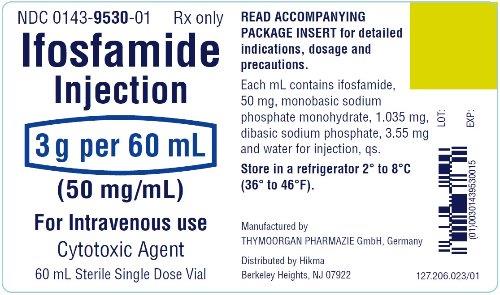
Ifosfamide 50 mg/mL Injection — NDC 0143-9530-01 (Billing 00143-9530-01)
This is a package of Ifosfamide 50 mg/mL Injection from Hikma Pharmaceuticals USA Inc., marketed since Jun 2017 and currently FDA-listed. It is this product's only package size.
NDC database record
One package, one record: these facts belong to NDC 0143-9530-01 alone.
- Record
- FDA NDC Directory package listing · Human prescription drug
- Code segments
- 0143 labeler · 9530 product · 01 package
- Package marketed since
- Jun 10, 2017
- Sample package
- No — commercial package
- Listing certified through
- Dec 31, 2027
- Barcode (UPC-A, from the NDC)
- 3 0143953001 5
- Medicaid fills, this package
- 34 prescriptions in the last four reported quarters
- FDA record last changed
- Jul 24, 2026
Identity & classification
Regulatory identifiers FDA, NLM and CMS codes for this package
Drug-database identifiers Medi-Span GPI and First Databank GCN / HICL / AHFS classification
- GSN (GCN sequence number): 062947
- GCN: 98710
- GPI-14 (Medi-Span): 21101025002030
- HICL (First Databank): 004570
- AHFS class code: 10:00.00.00
- RxCUI (RxNorm): 1791597
Where does this data come from?
- FDA openFDA NDC Directory · synced Oct 1, 2026
- FDA label on DailyMed · label index refreshed Oct 5, 2026
- RxNorm (NLM RxNav) · catalog refreshed Oct 1, 2026
- Medi-Span GPI (licensed)
- First Databank (licensed) · refreshed Oct 1, 2026
RxNorm drug class
This medicine belongs to the Alkylating Drug class.
Where does this data come from?
- RxClass (NLM) · catalog refreshed Oct 1, 2026
Clinical
- It is used with other cancer medicines as third-line chemotherapy for germ cell testicular cancer. That means it is used after earlier treatments. It is always paired with mesna to...
- It is given through an IV by your care team, as a slow infusion lasting at least 30 minutes. This is usually once a day for 5 days, repeated about every 3 weeks if your blood count...
- Common ones are hair loss, nausea and vomiting, low blood counts, anemia, and blood in the urine. Infections and brain effects like drowsiness or confusion can also happen. Tell yo...
- Call right away for fever or signs of infection, confusion, hallucinations, or seizures. Also call for bloody urine, chest pain, irregular heartbeat, breathing trouble, or signs of...
Patient education
Supplement & herbal interactions
Some supplements/herbs that may interact with Ifosfamide — tap one for details:
Ifosfamide may be associated with lower levels of 4 nutrients — worth a chat with your pharmacist, not a cause for alarm.
Where does this data come from?
- MedlinePlus (NLM) · refreshed Oct 1, 2026
- FDA label on DailyMed · label index refreshed Oct 5, 2026
Ask a licensed pharmacist directly — free, answered by our team.
Pricing
A drug doesn't have one price. Each row is a different public payment system, and none is what you'd pay at the counter — that depends on your insurance. The ⓘ on each row explains what it measures.
| Price system | Per each | Per package |
|---|---|---|
| Retail pharmacies payNADAC · weekly | Not in the retail survey — common for institutional, discontinued, or low-volume packs. | |
| Medicaid paysCMS SDUD · 12 mo | $1.42 | $1.42 / 1 vial |
| Medicare drug plans payPart D · quarterly | No Part D plan price is available for this NDC in our data. | |
| Medicare Part B allowsASP · J9208 | $27.613 / J9208 unit | — |
Where does this data come from?
- CMS NADAC weekly file
- CMS ASP pricing files · refreshed Sep 20, 2026
- CMS Medicaid State Drug Utilization Data · through Q1 2026
- CMS Part D plan pricing files · refreshed Sep 24, 2026
- VA National Acquisition Center price file
Billing & reimbursement
Where does this data come from?
- CMS ASP NDC-HCPCS crosswalk · refreshed Sep 22, 2026
- DMEPDAC NDC-HCPCS crosswalk
- openFDA NSDE billing units · refreshed Sep 7, 2026
Packaging — all sizes for this product
| Package NDC | Description | Marketing start | Marketing end | Status |
|---|---|---|---|---|
| 00143-9530-01 You're viewing this Main listing | 1 VIAL in 1 BOX / 60 mL in 1 VIAL | 2017-06-10 | — | Active |
Therapeutic equivalents
| Product | Labeler | Pack | NADAC/unit | TE | Status | Price vs. this |
|---|---|---|---|---|---|---|
| Ifosfamide 50 mg/mLthis 00143-9530-01 | Hikma | 1 vial | — | AP | FDA listed | — |
| Ifosfamide 50 mg/mL 00143-9531-01 | Hikma | 1 vial | — | AP | FDA listed | — |
Where does this data come from?
- FDA openFDA NDC Directory · synced Oct 1, 2026
- FDA Orange Book · refreshed Oct 3, 2026
- CMS NADAC weekly file
Availability & generic status
This product is an FDA-approved generic. Other versions of the same drug are listed under Therapeutic equivalents, least expensive first.
Where does this data come from?
- FDA Orange Book · refreshed Oct 3, 2026
Inactive Ingredients / Excipients
Inactive ingredients, also called excipients, are components of the drug product other than the active ingredient. They may include fillers, dyes, coatings, preservatives, flavors, or other formulation ingredients.
🧪 Avoiding an ingredient? See Ifosfamide Injection inactive ingredients by manufacturer: every current product's list side by side, so you can ask your pharmacy for the version that does not list it.
💡 Tap an ingredient (hover on desktop) to see what it is and why it’s used.
-
3.55 mg / 1 mL
UNII GR686LBA74
Sodium phosphate, dibasic is a salt derived from phosphoric acid. It acts as a buffer to help maintain the medicine's pH balance and may serve as a binder or filler in tablets and capsules.
-
1.035 mg / 1 mL
UNII 593YOG76RN
A salt made from sodium and phosphate that helps regulate acidity and maintain proper pH balance in the medicine. It also acts as a buffer to keep the product stable.
-
UNII 059QF0KO0R
Water is a liquid solvent that dissolves and mixes ingredients together in liquid medicines, syrups, and injections. It helps distribute the active drug evenly throughout the product.
3 inactive ingredients listed in the exact product block matched to this NDC.
Where does this data come from?
ingredient classCode="IACT" elements from the exact product block matched by this NDC. Label-section narrative from DailyMed / the openFDA label index is shown separately when available.- FDA label on DailyMed · label index refreshed Oct 5, 2026
- FDA openFDA NDC Directory · synced Oct 1, 2026
Inactive ingredient FAQ
Are inactive ingredients the same for every manufacturer?
Why might an inactive ingredient be missing?
Can inactive ingredients matter?
Manufacturer & labeler
More NDCs from Hikma Pharmaceuticals USA Inc. labeler code 00143
- Methotrexate 25 mg/mL Solution NDC 0143-9517-01
- Methotrexate 25 mg/mL Solution NDC 0143-9518-01
- Methotrexate 25 mg/mL Solution NDC 0143-9519-10
- Dexmedetomidine Hydrochloride 4 ug/mL Injection, Solution NDC 0143-9525-10
- Dexmedetomidine Hydrochloride 4 ug/mL Injection, Solution NDC 0143-9526-10
- Fluphenazine Decanoate 25 mg/mL Injection NDC 0143-9529-01
- Ifosfamide 50 mg/mL Injection NDC 0143-9531-01
- Dexmedetomidine HCl 100 ug/mL Injection NDC 0143-9532-25
- Allopurinol sodium 500 mg/25mL Injection, Powder, Lyophilized, For Solution NDC 0143-9533-01
- Linezolid 600 mg/300mL Injection, Solution NDC 0143-9534-10
- Nicardipine Hydrochloride 2.5 mg/mL Injection NDC 0143-9542-10
- Daunorubicin Hydrochloride 5 mg/mL Injection NDC 0143-9550-01
Where does this data come from?
- FDA openFDA NDC Directory · synced Oct 1, 2026
- Drugs@FDA
Full prescribing information FDA SPL
🚨 Boxed Warning ▾
WARNING: MYELOSUPPRESSION, NEUROTOXICITY, and UROTOXICITY WARNING: MYELOSUPPRESSION, NEUROTOXICITY, AND UROTOXICITY Myelosuppression can be severe and lead to fatal infections. Monitor blood counts prior to and at intervals after each treatment cycle. CNS toxicities can be severe and result in encephalopathy and death.
Monitor for CNS toxicity and discontinue treatment for encephalopathy. Nephrotoxicity can be severe and result in renal failure. Hemorrhagic cystitis can be severe and can be reduced by the prophylactic use of mesna. [see Warnings and Precautions ( 5.1 to 5.3) ] WARNING: MYELOSUPPRESSION, NEUROTOXICITY, and UROTOXICITY See full prescribing information for complete boxed warning • Myelosuppression can be severe and lead to fatal infections (5.1) • CNS toxicities can be severe and result in encephalopathy and death (5.2) • Nephrotoxicity can be severe and result in renal failure.
Hemorrhagic cystitis can be severe. (5.3)
🎯 Indications and Usage ▾
1 INDICATIONS AND USAGE Ifosfamide Injection is indicated for use in combination with certain other approved antineoplastic agentsfor third-line chemotherapy of germ cell testicular cancer. It should be used in combination with mesna for prophylaxis of hemorrhagic cystitis. Ifosfamide Injection is an alkylating drug indicated for use in combination with certain other approved antineoplastic agents for third-line chemotherapy of germ cell testicular cancer.
It should be used in combination with mesna for prophylaxis of hemorrhagic cystitis. (1)
⏱️ Dosage and Administration ▾
2 DOSAGE AND ADMINISTRATION Ifosfamide Injection should be administered intravenously at a dose of 1.2 grams per m 2 per day for 5 consecutive days. Treatment is repeated every 3 weeks or after recovery from hematologic toxicity. In order to prevent bladder toxicity, ifosfamide injection should be given with extensive hydration consisting of at least 2 liters of oral or intravenous fluid per day.
Mesna should be used to reduce the incidence of hemorrhagic cystitis. Ifosfamide injection should be administered as a slow intravenous infusion lasting a minimum of 30 minutes. Studies of ifosfamide injection in patients with hepatic or renal impairment have not been conducted [see Use in Specifi c Populations ( 8.6 , 8.7 )] .
Preparation for Intravenous Administration/Stability Solutions of ifosfamide injection may be diluted further to achieve concentrations of 0.6 to 20 mg/mL in the following fluids: 5% Dextrose Injection 0.9% Sodium Chloride Injection Lactated Ringer’s Injections Sterile Water for Injection Because essentially identical stability results were obtained for Sterile Water admixtures as for the other admixtures (5% Dextrose Injection, 0.9% Sodium Chloride Injection, and Lactated Ringer’s Injection), the use of large volume parenteral glass bottles, Viaflex bags or PAB™ bags that contain intermediate concentrations or mixtures of excipients (e.g., 2.5% Dextrose Injection, 0.45% Sodium Chloride Injection, or 5% Dextrose and 0.9% Sodium Chloride Injection) is also acceptable.
Further diluted solutions of ifosfamide injection should be refrigerated and used within 24 hours. Benzyl alcohol-containing solutions can reduce the stability of ifosfamide injection. Parenteral drug products should be inspected visually for particulate matter and discoloration prior to administration, whenever solution and container permit.
Dosage and duration of treatment and/or treatment intervals depend on the scheme of combination therapy, the patient’s general state of health and organ function, and the results of laboratory monitoring. (2) • Ifosfamide injection should be administered as a slow intravenous infusion lasting a minimum of 30 minutes at a dose of 1.2 grams per m2 per day for 5 consecutive days. (2) • Treatment is repeated every 3 weeks or after recovery from hematologic toxicity.
(2) • To prevent bladder toxicity, ifosfamide injection should be given with extensive hydration consisting of at least 2 liters of oral or intravenous fl uid per day. (2, 5.3 ) • Mesna should be used to reduce the incidence of hemorrhagic cystitis. (2)
💊 Dosage Forms and Strengths ▾
3 DOSAGE FORMS AND STRENGTHS 1 g/20 mL single-dose vial 3 g/60 mL single-dose vial • Single dose vials: 1 g/20 mL, 3 g/60 mL (3)
⛔ Contraindications ▾
4 CONTRAINDICATIONS Ifosfamide is contraindicated in patients with: • Known hypersensitivity to administration of ifosfamide. • Urinary outflow obstruction. • Known hypersensitivity to administration of ifosfamide. (4) • Urinary outflow obstruction. (4)
⚠️ Warnings and Cautions ▾
5 WARNINGS AND PRECAUTIONS • Myelosuppression: Can be severe and lead to fatal infections. Monitor blood counts prior to and at intervals after treatment. (5.1) • Neurotoxicity: Severe and fatal neurotoxicity can occur.
Carefully monitor the patient for CNS toxicity and other neurotoxic effects. Discontinue therapy should encephalopathy develop. (5.2) • Urotoxicity: Severe nephrotoxicity with renal failure and death can occur.
Monitor for nephrotoxicity with serum and urine chemistries. Mesna should be used to reduce hemorrhagic cystitis. (5.3) • Cardiotoxicity: Arrhythmias, other ECG changes, and cardiomyopathy can occur and result in death.
Use with caution in patients with cardiac risk factors and in patients with preexisting cardiac disease. The risk of cardiotoxicity is dose dependent. (5.4) • Pulmonary toxicity: Interstitial pneumonitis, pulmonary fi brosis, and other forms of pulmonary toxicity with fatal outcomes can occur.
Monitor for signs and symptoms of pulmonary toxicity and treat as clinically indicated (5.5) • Secondary malignancies as late sequelae have occurred. (5.6) • Pregnancy: Can cause fetal harm. Women should not become pregnant and men should not father a child during therapy.
(5.8) • Anaphylactic/anaphylactoid reactions have been reported. (5.10)
5.1Myelosuppression, Immunosuppression, and Infections Treatment with ifosfamide may cause myelosuppression and significant suppression of immune responses, which can lead to severe infections. Fatal outcomes of ifosfamide-associated myelosuppression have been reported. Ifosfamide-induced myelosuppression can cause leukopenia, neutropenia, thrombocytopenia (associated with a higher risk of bleeding events), and anemia.
The nadir of the leukocyte count tends to be reached approximately during the second week after administration. When ifosfamide is given in combination with other chemotherapeutic/hematotoxic agents and/or radiation therapy, severe myelosuppression is frequently observed. The risk of myelosuppression is dose-dependent and is increased with administration of a single high dose compared with fractionated administration.
The risk of myelosuppression is also increased in patients with reduced renal function. Severe immunosuppression has led to serious, sometimes fatal, infections. Sepsis and septic shock also have been reported.
Infections reported with ifosfamide include pneumonias, as well as other bacterial, fungal, viral, and parasitic infections. Latent infections can be reactivated. In patients treated with ifosfamide, reactivation has been reported for various viral infections.
Infections must be treated appropriately. Antimicrobial prophylaxis may be indicated in certain cases of neutropenia at the discretion of the managing physician. In case of neutropenic fever, antibiotics and/or antimycotics must be given.
Close hematologic monitoring is recommended. White blood cell (WBC) count, platelet count and hemoglobin should be obtained prior to each administration and at appropriate intervals after administration. Unless clinically essential, ifosfamide should not be given to patients with a WBC count below 2000/μL and/or a platelet count below 50,000/μL.
Ifosfamide should be given cautiously, if at all, to patients with presence of an infection, severe immunosuppression or compromised bone marrow reserve, as indicated by leukopenia, granulocytopenia, extensive bone marrow metastases, prior radiation therapy, or prior therapy with other cytotoxic agents.
5.2Central Nervous System Toxicity, Neurotoxicity Administration of ifosfamide can cause CNS toxicity and other neurotoxic effects. The risk of CNS toxicity and other neurotoxic effects necessitates careful monitoring of the patient. Neurologic manifestations consisting of somnolence, confusion, hallucinations, blurred vision, psychotic behavior, extrapyramidal symptoms, urinary incontinence, seizures, and in some instances, coma, have been reported following ifosfamide therapy.
There have al… [Excerpted — this section continues on DailyMed.]
🤒 Adverse Reactions ▾
6 ADVERSE REACTIONS In clinical trials of ifosfamide monotherapy, the most common (≥ 10%) adverse reactions were alopecia, nausea/vomiting, leukopenia, anemia, CNS toxicity, hematuria, and infection. (6.1) To report SUSPECTED ADVERSE REACTIONS, contact Hikma Pharmaceuticals USA Inc. at 1-877-845-0689, or FDA at 1-800-FDA-1088 or www.fda.gov/medwatch.
6.1Adverse Reactions from Clinical Trials Because clinical trials are conducted from widely varying conditions, adverse reaction rates observed in the clinical trials of a drug cannot be directly compared to rates in the clinical trials of another drug and may not reflect the rates observed in clinical practice. The adverse reactions and frequencies below are based on 30 publications describing clinical experience with fractionated administration of ifosfamide as monotherapy with a total dose of 4 to 12 g/m 2 per course.
System Organ Class (SOC) Adverse Reaction Percentage (Ratio) INFECTIONS AND INFESTATIONS Infection 9.9% (112/1128) BLOOD AND LYMPHATIC SYSTEM DISORDERS Leukopenia 1 (any) Leukopenia <1 x 10 3 /µL 43.5% (267/614) Thrombocytopenia 2 (any) Thrombocytopenia 50 x 10 3 /µL 4.8% (35/729) Anemia 3 37.9% (202/533) METABOLISM AND NUTRITION DISORDERS Anorexia 1.1% (15/1317) NERVOUS SYSTEM DISORDERS Central nervous system toxicity 4,5 15.4% (154/1001) Peripheral neuropathy 0.4% (5/1317) CARDIAC DISORDERS Cardiotoxicity 6 0.5% (7/1317) VASCULAR DISORDERS Hypotention 7 0.3% (4/1317) GASTROINTESTINAL DISORDERS Nausea/Vomiting 46.8% (443/964) Diarrhea 0.7% (9/1317) Stomatitis 0.3% (4/1317) HEPATOBILIARY DISORDERS Hepatotoxicity 8 1.8% (22/1190) SKIN AND SUBCUTANEOUS TISSUES DISORDERS Alopecia 89.6% (540/603) Dermatitis 0.08% (1/1317) Papular rash 0.08% (1/1317) RENAL AND URINARY DISORDERS Hemorrhagic cystitis 9 Hematuria - without mesna 44.1% (282/640) - with mesna 21.3% (33/155) Macrohematuria - without mesna 11.1% (66/594) - with mesna 5.2% (5/97) Renal dysfunction 10 -- Renal structural damage -- GENERAL DISORDERS AND ADMINISTRATIVE SITE CONDITIONS Phlebitis 11 2.8% (37/1317) Neutropenic fever 12 1% (13/1317) Fatigue 0.3% (4/1317) Malaise Unable to calculate 1 The following adverse reaction terms have been reported for leukopenia: neutropenia, granulocytopenia, lymphopenia, and pancytopenia.
For neutropenic fever, see below. 2 Thrombocytopenia may also be complicated by bleeding. Bleeding with fatal outcome has been reported.
3 Includes cases reported as anemia and decrease in hemoglobin/hematocrit. 4 Encephalopathy with coma and death has been reported. 5 Central nervous system toxicity was reported to be manifested by the following signs and symptoms: Abnormal behavior, Affect lability Aggression, Agitation, Anxiety, Aphasia, Asthenia, Ataxia, Cerebellar syndrome, Cerebral function defi ciency, Cognitive disorder, Coma, Confusional state, Convulsions, Cranial nerve dysfunction, Depressed state of consciousness, Depression, Disorientation, Dizziness, Electroencephalogram abnormal, Encephalopathy, Flat affect.
Hallucinations, Headache, Ideation, Lethargy, Memory impairment, Mood change, Motor dysfunction, Muscle spasms, Myoclonus, Progressive loss of brainstem reflexes, Psychotic reaction, Restlessness, Somnolence, Tremor, Urinary incontinence. 6 Cardiotoxicity was reported as congestive heart failure, tachycardia, pulmonary edema. Fatal outcome has been reported.
7 Hypotension leading to shock and fatal outcome has been reported. 8 Hepatotoxicity was reported as increases in liver enzymes, i.e., serum alanine aminotransferase, serum aspartate aminotransferase, alkaline phosphatase, gamma-glutamyltransferase and lactate dehydrogenase, increased bilirubin, jaundice, hepatorenal syndrome. 9 Reported symptoms of hemorrhagic cystitis included dysuria and pollakiuria.
See also Post-marketing Adverse Reactions (6.2). 10 Renal dysfunction was reported to be manifested as: Renal failure (including acute renal failure, irreversible renal failure; fatal outcomes have been reported), Se… [Excerpted — this section continues on DailyMed.]
🔄 Drug Interactions ▾
7 DRUG INTERACTIONS Ifosfamide is a substrate for both CYP3A4 and CYP2B6. • CYP3A4 Inducers: monitor for increased toxicity when used in combination with CYP3A4 inducers. (7.1) • CYP3A4 Inhibitors: use in combination with CYP3A4 inhibitors could decrease the effectiveness of ifosfamide. (7.2)
7.1Inducers of CYP3A4 CYP3A4 inducers (e.g., carbamazepine, phenytoin, fosphenytoin, phenobarbital, rifampin, St. John Wort) may increase the metabolism of ifosfamide to its active alkylating metabolites. CYP3A4 inducers may increase the formation of the neurotoxic/nephrotoxic ifosfamide metabolite, chloroacetaldehyde. Closely monitor patients taking ifosfamide with CYP3A4 inducers for toxicities and consider dose adjustment.
7.2Inhibitors of CYP3A4 CYP3A4 inhibitors (e.g., ketoconazole, fluconazole, itraconazole, sorafenib, aprepitant, fosaprepitant, grapefruit, grapefruit juice) may decrease the metabolism of ifosfamide to its active alkylating metabolites, perhaps decreasing the effectiveness of ifosfamide treatment.
7.1Inducers of CYP3A4 CYP3A4 inducers (e.g., carbamazepine, phenytoin, fosphenytoin, phenobarbital, rifampin, St. John Wort) may increase the metabolism of ifosfamide to its active alkylating metabolites. CYP3A4 inducers may increase the formation of the neurotoxic/nephrotoxic ifosfamide metabolite, chloroacetaldehyde. Closely monitor patients taking ifosfamide with CYP3A4 inducers for toxicities and consider dose adjustment.
7.2Inhibitors of CYP3A4 CYP3A4 inhibitors (e.g., ketoconazole, fluconazole, itraconazole, sorafenib, aprepitant, fosaprepitant, grapefruit, grapefruit juice) may decrease the metabolism of ifosfamide to its active alkylating metabolites, perhaps decreasing the effectiveness of ifosfamide treatment.
👥 Use in Specific Populations ▾
8 USE IN SPECIFIC POPULATIONS • Pregnancy: fetal growth retardation and neonatal anemia. (8.1) • Geriatric use: dose selection should be cautious. (8.5) • Patients with renal impairment: monitor for toxicity and consider dose reduction as needed ( 8.6)
8.1Pregnancy Ifosfamide can cause fetal harm when administered to a pregnant woman. Fetal growth retardation and neonatal anemia have been reported following exposure to ifosfamide-containing chemotherapy regimens during pregnancy. Animal studies indicate that ifosfamide is capable of causing gene mutations and chromosomal damage in vivo .
In pregnant mice, resorptions increased and anomalies were present at day 19 after a 30 mg/m 2 dose of ifosfamide was administered on day 11 of gestation. Embryo-lethal effects were observed in rats following the administration of 54 mg/m 2 doses of ifosfamide from the 6th through the 15th day of gestation and embryotoxic effects were apparent after dams received 18 mg/m 2 doses over the same dosing period. Ifosfamide is embryotoxic to rabbits receiving 88 mg/m2/day doses from the 6th through the 18th day after mating.
The number of anomalies was also significantly increased over the control group. Women should not become pregnant and men should not father a child during therapy with ifosfamide. Further, men should not father a child for up to 6 months after the end of therapy.
If this drug is used during pregnancy, or if the patient becomes pregnant while taking this drug or after treatment, the patient should be apprised of the potential hazard to a fetus.
8.3Nursing Mothers Ifosfamide is excreted in breast milk. Because of the potential for serious adverse events and the tumorigenicity shown for ifosfamide in animal studies, a decision should be made whether to discontinue nursing or to discontinue the drug, taking into account the importance of the drug to the mother. Women must not breastfeed during treatment with ifosfamide.
8.4Pediatric Use Safety and effectiveness have not been established in pediatric patients.
8.5Geriatric Use In general, dose selection for an elderly patient should be cautious, refl ecting the greater frequency of decreased hepatic, renal, or cardiac function, and of concomitant disease or other drug therapy. A study of patients 40 to 71 years of age indicated that elimination half-life appears to increase with advancing age [see Pharmacokinetics (12.3) ] . This apparent increase in half-life appeared to be related to increases in volume of distribution of ifosfamide with age.
No signifi cant changes in total plasma clearance or renal or non-renal clearance with age were reported. Ifosfamide and its metabolites are known to be substantially excreted by the kidney, and the risk of toxic reactions to this drug may be greater in patients with impaired renal function. Because elderly patients are more likely to have decreased renal function, care should be taken in dose selection, and it may be useful to monitor renal function.
8.6Use in Patients with Renal Impairment No formal studies were conducted in patients with renal impairment. Ifosfamide and its metabolites are known to be excreted by the kidneys and may accumulate in plasma with decreased renal function. Patients with renal impairment should be closely monitored for toxicity and dose reduction may be considered. Ifosfamide and its metabolites are dialyzable.
8.7Use in Patients with Hepatic Impairment No formal studies were conducted in patients with hepatic impairment. Ifosfamide is extensively metabolized in the liver and forms both efficacious and toxic metabolites. Ifosfamide should be given cautiously to patients with impaired hepatic function.
8.6Use in Patients with Renal Impairment No formal studies were conducted in patients with renal impairment. Ifosfamide and its metabolites are known to be excreted by the kidneys and may accumulate in plasma with decreased renal function. Patients with renal impairment should be closely monitored for toxicit… [Excerpted — this section continues on DailyMed.]
🤰 Pregnancy ▾
8.1Pregnancy Ifosfamide can cause fetal harm when administered to a pregnant woman. Fetal growth retardation and neonatal anemia have been reported following exposure to ifosfamide-containing chemotherapy regimens during pregnancy. Animal studies indicate that ifosfamide is capable of causing gene mutations and chromosomal damage in vivo .
In pregnant mice, resorptions increased and anomalies were present at day 19 after a 30 mg/m 2 dose of ifosfamide was administered on day 11 of gestation. Embryo-lethal effects were observed in rats following the administration of 54 mg/m 2 doses of ifosfamide from the 6th through the 15th day of gestation and embryotoxic effects were apparent after dams received 18 mg/m 2 doses over the same dosing period. Ifosfamide is embryotoxic to rabbits receiving 88 mg/m2/day doses from the 6th through the 18th day after mating.
The number of anomalies was also significantly increased over the control group. Women should not become pregnant and men should not father a child during therapy with ifosfamide. Further, men should not father a child for up to 6 months after the end of therapy.
If this drug is used during pregnancy, or if the patient becomes pregnant while taking this drug or after treatment, the patient should be apprised of the potential hazard to a fetus.
🧒 Pediatric Use ▾
8.4Pediatric Use Safety and effectiveness have not been established in pediatric patients.
🧓 Geriatric Use ▾
8.5Geriatric Use In general, dose selection for an elderly patient should be cautious, refl ecting the greater frequency of decreased hepatic, renal, or cardiac function, and of concomitant disease or other drug therapy. A study of patients 40 to 71 years of age indicated that elimination half-life appears to increase with advancing age [see Pharmacokinetics (12.3) ] . This apparent increase in half-life appeared to be related to increases in volume of distribution of ifosfamide with age.
No signifi cant changes in total plasma clearance or renal or non-renal clearance with age were reported. Ifosfamide and its metabolites are known to be substantially excreted by the kidney, and the risk of toxic reactions to this drug may be greater in patients with impaired renal function. Because elderly patients are more likely to have decreased renal function, care should be taken in dose selection, and it may be useful to monitor renal function.
🆘 Overdosage ▾
10 OVERDOSAGE No specific antidote for ifosfamide is known. Patients who receive an overdose should be closely monitored for the development of toxicities. Serious consequences of overdosage include manifestations of dose-dependent toxicities such as CNS toxicity, nephrotoxicity, myelosuppression, and mucositis [see Warnings and Precautions (5)] .
Management of overdosage would include general supportive measures to sustain the patient through any period of toxicity that might occur, including appropriate state-of-the-art treatment for any concurrent infection, myelosuppression, or other toxicity. Ifosfamide as well as ifosfamide metabolites are dialyzable. Cystitis prophylaxis with mesna may be helpful in preventing or limiting urotoxic effects with overdose.
🧬 Clinical Pharmacology ▾
12 CLINICAL PHARMACOLOGY
12.1Mechanism of Action Ifosfamide is a prodrug that requires metabolic activation by hepatic cytochrome P450 isoenzymes to exert its cytotoxic activity. Activation occurs by hydroxylation at the ring carbon atom forming the unstable intermediate 4-hydroxyifosfamide and its ring-opened aldo tautomer, which decomposes to yield the cytotoxic and urotoxic compound acrolein and an alkylating isophosphoramide mustard as well as multiple other nontoxic products. The exact mechanism of action of ifosfamide has not been determined, but its cytotoxic action is primarily through DNA crosslinks caused by alkylation by the isophosphoramide mustard at guanine N-7 positions.
The formation of inter- and intra-strand cross-links in the DNA results in cell death.
12.3Pharmacokinetics Ifosfamide exhibits dose-dependent pharmacokinetics in humans. At single doses of 3.8 to 5 g/m2, the plasma concentrations decay biphasically and themean terminal elimination half-life is about 15 hours. At doses of 1.6 to 2.4 g/m2/day, the plasma decay is monoexponential and the terminal elimination half-life is about 7 hours.
Ifosfamide exhibits time-dependent pharmacokinetics in humans. Following intravenous administration of 1.5 g/m 2 over 0.5 hour once daily for 5 days to 15 patients with neoplastic disease, a decrease in the median elimination half-life from 7.2 hours on Day 1 to 4.6 hours on Day 5 occurred with a concomitant increase in the median clearance from 66 mL/min on Day 1 to 115 mL/min on Day 5. There was no significant change in the volume of distribution on Day 5 compared with Day 1.
Distribution Ifosfamide volume of distribution (Vd) approximates the total body water volume, suggesting that distribution takes place with minimal tissue binding. Following intravenous administration of 1.5 g/m 2 over 0.5 hour once daily for 5 days to 15 patients with neoplastic disease, the median Vd of ifosfamide was
0.64 L/kg on Day 1 and
0.72L/kg on Day 5. Ifosfamide shows little plasma protein binding. Ifosfamide and its active metabolites are extensively bound by red blood cells.
Ifosfamide is not a substrate for P-glycoprotein. Metabolism Ifosfamide is extensively metabolized in humans through two metabolic pathways: ring oxidation (“activation”) to form the active metabolite, 4-hydroxy-ifosfamide and side-chain oxidation to form the inactive metabolites, 3-dechloro-ethylifosfamide or 2-dechloroethylifosfamide with liberation of the toxic metabolite, chloroacetaldehyde. Small quantities (nmol/mL) of ifosfamide mustard and 4-hydroxyifosfamide are detectable in human plasma.
Metabolism of ifosfamide is required for the generation of the biologically active species and while metabolism is extensive, it is also quite variable among patients. Excretion After administration of doses of 5 g/m 2 of 14C-labeled ifosfamide, from 70% to 86% of the dosed radioactivity was recovered in urine as metabolites, with about 61% of the dose excreted as parent compound. At doses of 1.6 to 2.4 g/m 2 only 12% to 18% of the dose was excreted in the urine as unchanged drug within 72 hours.
Two different dechloroethylated derivatives of ifosfamide, 4-carboxyifosfamide, thiodiacetic acid and cysteine conjugates of chloroacetic acid have been identifi ed as the major urinary metabolites of ifosfamide in humans and only small amounts of 4-hydroxyifosfamide and acrolein are present. Pediatrics Population PK analysis was performed on plasma data from 32 pediatric patients various malignant diseases aged between 1 and 18 years. Patients received a total of 45 courses of ifosfamide at doses of 1.2, 2 and 3 g/m 2 given intravenously over 1 or 3 hours on 1, 2, or 3 days.
The mean ± standard error population estimates for the initial clearance and volume of distribution of ifosfamide were 2.4±0.33 L/h/m 2 and 21±1.6 L/m 2 with an interindividual variability of 43% and 32%, respectively. Effect of Age A study of 20 patients between 40 to 71 years of age receiving 1.5… [Excerpted — this section continues on DailyMed.]
🧬 Mechanism of Action ▾
12.1Mechanism of Action Ifosfamide is a prodrug that requires metabolic activation by hepatic cytochrome P450 isoenzymes to exert its cytotoxic activity. Activation occurs by hydroxylation at the ring carbon atom forming the unstable intermediate 4-hydroxyifosfamide and its ring-opened aldo tautomer, which decomposes to yield the cytotoxic and urotoxic compound acrolein and an alkylating isophosphoramide mustard as well as multiple other nontoxic products. The exact mechanism of action of ifosfamide has not been determined, but its cytotoxic action is primarily through DNA crosslinks caused by alkylation by the isophosphoramide mustard at guanine N-7 positions.
The formation of inter- and intra-strand cross-links in the DNA results in cell death.
📦 How Supplied / Storage and Handling ▾
16 HOW SUPPLIED/STORAGE AND HANDLING Ifosfamide Injection is available in single-dose vials as follows: NDC 0143-9531-01 – 1 g/20 mL Single Dose Vial of ifosfamide; individually-boxed. NDC 0143-9530-01 – 3 g/60 mL Single Dose Vial of ifosfamide; individually-boxed. Store in a refrigerator 2°C to 8°C (36°F to 46°F).
See USP. Exercise caution when handling ifosfamide. The handling and preparation of ifosfamide should always be in accordance with current guidelines on safe handling of cytotoxic agents.
Several guidelines on this subject have been published. 1-4 Skin reactions associated with accidental exposure to ifosfamide may occur. To minimize the risk of dermal exposure, always wear impervious gloves when handling vials and solutions containing ifosfamide.
If ifosfamide solution contacts the skin or mucosa, immediately wash the skin thoroughly with soap and water or rinse the mucosa with copious amounts of water.
📋 Description ▾
11 DESCRIPTION Ifosfamide injection is presented in sterile, single-dose vials for administration by intravenous infusion. Each mL contains ifosfamide, 50 mg, monobasic sodium phosphate monohydrate, 1.035 mg, dibasic sodium phosphate, 3.55 mg and water for injection, q.s.. Ifosfamide is a chemotherapeutic agent chemically related to the nitrogen mustards and a synthetic analog cyclophosphamide.
Ifosfamide is 3-(2-ChloroethyI)-2-[(2-chloroethyl) amino]tetrahydro-2 H -1,3,2- oxazaphosphorine 2-oxide. Its structural formula is: C 7 H 15 C l2 N 2 O 2 P M. W. = 261.09 Ifosfamide is a white crystalline powder that is soluble in water.
Structural Formula
💬 Information for Patients ▾
17 PATIENT COUNSELING INFORMATION Myelosuppression, Immunosuppression, and Infections Advise patients that treatment with ifosfamide injection may cause myelosuppression which can be severe and lead to infections and fatal outcomes. Inform patients of the risks associated with the use of ifosfamide injection and plan for regular blood monitoring during therapy [see Boxed Warning, Warnings and Precautions (5.1) ] Inform patients to report fever or other symptoms of an infection [see Boxed Warning, Warnings and Precautions (5.1) , Adverse Reactions (6.2) ].
Advise patients on the risks of bleeding and anemia [see Warnings and Precautions (5.1, 5.8 ), Adverse Reactions (6.2 )], Use in Specific Populations (8.1) ]. Central Nervous System Toxicity, Neurotoxicity Advise patients on the risk of CNS toxicity and other neurotoxic effects with fatal outcome [see Boxed Warning, Warnings and Precautions (5.2) ]. Renal and Urothelial Toxicity and Effects Advise patients on the risk of bladder and kidney toxicity.
Advise patients of the need to increase fluid intake and frequent voiding to prevent accumulation in the bladder [see Warnings and Precautions (5.3) ]. Cardiotoxicity Advise patients on the risk of cardiotoxicity and fatal outcome. Advise patients to report preexisting cardiac disease and manifestations of cardiotoxicity [see Warnings and Precautions (5.4 ), Adverse Reactions (6.2) ].
Pulmonary Toxicity Advise patients on the risk of pulmonary toxicity leading to respiratory failure with fatal outcome. Inform patients to report signs and symptoms of pulmonary toxicity [see Warnings and Precautions (5.5) ]. Secondary Malignancies Advise patients on the risk of secondary malignancies due to therapy [see Warnings and Precautions (5.6) ].
Veno-occlusive Liver Disease Advise patients on the risk of veno-occlusive liver disease [see Warnings and Precautions (5.7) ]. Pregnancy Advise patients on the potential hazard to a fetus if a patient becomes pregnant or fathers a child during therapy and for up to 6 months after therapy. Advise patients to use effective contraception during therapy and for up to 6 months after therapy [see Warnings and Precautions (5.8) , Adverse Reactions (6.2)] .
Lactation Advise patients on the potential for serious adverse reactions and tumorigenicity when children are breastfed during therapy [see Use in Specific Populations (8.3) ]. Reproductive System Disorders Advise patients on the risk of amenorrhea, premature menopause, and sterility [see Warnings and Precautions (5.9), Adverse Reactions (6.2) ]. Skin and Subcutaneous Tissue Disorders Advise patients on the risk of alopecia, wound healing, and other serious skin and subcutaneous tissue disorders [see Warnings and Precautions (5.11) , Adverse Reactions (6.2 )].
Gastrointestinal Disorders Advise patients that the therapy may cause gastrointestinal disorders and alcohol may increase nausea and vomiting [see Adverse Reactions (6.2) ]. Advise patients on the risk of stomatitis and the importance of proper oral hygiene [see Adverse Reactions (6.2) ]. Eye Disorders Advise patients on the risk of eye disorders such as visual impairment, blurred vision, and eye irritation [see Adverse Reactions (6.2) ].
Ear and Labyrinth Disorders Advise patients on the risk of ear and labyrinth disorders such as deafness, vertigo, and tinnitus [see Adverse Reactions (6.2)] . Manufactured by: THYMOORGAN PHARMAZIE GmbH, Schiffgraben 23, 38690 Goslar, Germany Distributed by: Hikma Pharmaceuticals USA Inc. Berkeley Heights, NJ 07922 Revised June 2020 127.207.010/03
🍼 Nursing Mothers ▾
8.3Nursing Mothers Ifosfamide is excreted in breast milk. Because of the potential for serious adverse events and the tumorigenicity shown for ifosfamide in animal studies, a decision should be made whether to discontinue nursing or to discontinue the drug, taking into account the importance of the drug to the mother. Women must not breastfeed during treatment with ifosfamide.
🧬 Pharmacokinetics ▾
12.3Pharmacokinetics Ifosfamide exhibits dose-dependent pharmacokinetics in humans. At single doses of 3.8 to 5 g/m2, the plasma concentrations decay biphasically and themean terminal elimination half-life is about 15 hours. At doses of 1.6 to 2.4 g/m2/day, the plasma decay is monoexponential and the terminal elimination half-life is about 7 hours.
Ifosfamide exhibits time-dependent pharmacokinetics in humans. Following intravenous administration of 1.5 g/m 2 over 0.5 hour once daily for 5 days to 15 patients with neoplastic disease, a decrease in the median elimination half-life from 7.2 hours on Day 1 to 4.6 hours on Day 5 occurred with a concomitant increase in the median clearance from 66 mL/min on Day 1 to 115 mL/min on Day 5. There was no significant change in the volume of distribution on Day 5 compared with Day 1.
Distribution Ifosfamide volume of distribution (Vd) approximates the total body water volume, suggesting that distribution takes place with minimal tissue binding. Following intravenous administration of 1.5 g/m 2 over 0.5 hour once daily for 5 days to 15 patients with neoplastic disease, the median Vd of ifosfamide was
0.64 L/kg on Day 1 and
0.72L/kg on Day 5. Ifosfamide shows little plasma protein binding. Ifosfamide and its active metabolites are extensively bound by red blood cells.
Ifosfamide is not a substrate for P-glycoprotein. Metabolism Ifosfamide is extensively metabolized in humans through two metabolic pathways: ring oxidation (“activation”) to form the active metabolite, 4-hydroxy-ifosfamide and side-chain oxidation to form the inactive metabolites, 3-dechloro-ethylifosfamide or 2-dechloroethylifosfamide with liberation of the toxic metabolite, chloroacetaldehyde. Small quantities (nmol/mL) of ifosfamide mustard and 4-hydroxyifosfamide are detectable in human plasma.
Metabolism of ifosfamide is required for the generation of the biologically active species and while metabolism is extensive, it is also quite variable among patients. Excretion After administration of doses of 5 g/m 2 of 14C-labeled ifosfamide, from 70% to 86% of the dosed radioactivity was recovered in urine as metabolites, with about 61% of the dose excreted as parent compound. At doses of 1.6 to 2.4 g/m 2 only 12% to 18% of the dose was excreted in the urine as unchanged drug within 72 hours.
Two different dechloroethylated derivatives of ifosfamide, 4-carboxyifosfamide, thiodiacetic acid and cysteine conjugates of chloroacetic acid have been identifi ed as the major urinary metabolites of ifosfamide in humans and only small amounts of 4-hydroxyifosfamide and acrolein are present. Pediatrics Population PK analysis was performed on plasma data from 32 pediatric patients various malignant diseases aged between 1 and 18 years. Patients received a total of 45 courses of ifosfamide at doses of 1.2, 2 and 3 g/m 2 given intravenously over 1 or 3 hours on 1, 2, or 3 days.
The mean ± standard error population estimates for the initial clearance and volume of distribution of ifosfamide were 2.4±0.33 L/h/m 2 and 21±1.6 L/m 2 with an interindividual variability of 43% and 32%, respectively. Effect of Age A study of 20 patients between 40 to 71 years of age receiving 1.5 g/m 2 of ifosfamide daily for 3 or 5 days indicated that elimination half-life appears to increase with age. The elimination half-life increase appeared to be related to the increase in ifosfamide volume of distribution with age.
No significant changes in total plasma clearance or renal clearance with age were reported.
🔬 Clinical Studies ▾
14 CLINICAL STUDIES Patients with refractory testicular cancer (n=59) received a combination of ifosfamide, cisplatin, and either etoposide (VePesid®) or vinblastine (VIP) as third-line therapy or later. The selection of etoposide or vinblastine (“V” in the VIP regimen) was guided by the therapeutic effect achieved with prior regimens. The contribution of ifosfamide to the VIP combination was determined in patients treated with cisplatin-etoposide prior to ifosfamide-cisplatin-etoposide or those who received cisplatin-vinblastine prior to ifosfamide-cisplatin-vinblastine.
A total of 59 patients received a third-line salvage regimen which consisted of ifosfamide 1.2 g/m 2 /day intravenously on days 1 to 5, cisplatin 20 mg/m2/day intravenously on days 1 to 5, and either etoposide 75 mg/m 2 /day intravenously on days 1 to 5 or vinblastine 0.22 mg/kg intravenously on day 1. Efficacy results with the VIP regimen were compared to data pooled from six single agent phase II trials conducted between August 1980 and October 1985 including a total of 90 patients of whom 65 were eligible as controls of this study.
Twenty-three patients in the VIP regimen became free of disease with VIP alone or VIP plus surgery, whereas a single patient in the historical control group achieved complete response. The median survival time exceeded two years in the VIP group versus less than one year in the control group. Performance status ≥ 80, embryonal carcinoma and minimal disease were favorable prognostic factors for survival.
In all prognostic categories, the difference between VIP and historical controls remained highly significant. Number. (%) of Patients p-value VIP Control Total Patients 59 (100) 65 (100) Disease-free 23 (39) 1 (2) < 0.001 Chemotherapy alone 15 (25) 1 (2) < 0.001 Chemotherapy plus surgery 8 (14) 0 Overall Response 32 (54) 2 (3) < 0.001 Time to progression (weeks) Median 19 4 < 0.001a Range 1 to 205+ 1 to 29 Disease-free interval (weeks) Median 114 29 Range 13 to 205+ -- Survival (weeks) Median 53 10 < 0.001a Range 1 to 205+ 1 to 123+ a: Gehan-Breslow and Mantel-Cox tests In a study, 50 fully evaluable patients with germ cell testicular cancer were treated with ifosfamide in combination with cisplatin and either vinblastine or etoposide after failing (47 of 50 patients) at least two prior chemotherapy regimens consisting of cisplatin/vinblastine/bleomycin, (PVB), cisplatin/vinblastine/actinomycin D/bleomycin/cyclophosphamide, (VAB6), or the combination of cisplatin and etoposide.
Patients were selected for remaining cisplatin sensitivity because they had previously responded to a cisplatin containing regimen and had not progressed while on the cisplatin containing regimen or within 3 weeks of stopping it. Patients served as their own control based on the premise that long term complete responses could not be achieved by retreatment with a regimen to which they had previously responded and subsequently relapsed. Ten of 50 fully evaluable patients were still alive 2 to 5 years after treatment.
Four of the 10 long term survivors were rendered free of cancer by surgical resection after treatment with the ifosfamide regimen; median survival for the entire group of 50 fully evaluable patients was 53 weeks.
🧪 Nonclinical Toxicology ▾
13 NONCLINICAL TOXICOLOGY
13.1Carcinogenesis, Mutagenesis, Impairment of Fertility Ifosfamide has been shown to be carcinogenic in rats when administered by intraperitoneal injection at 6 mg/kg (37 mg/m 2 , or about 3% of the daily human dose on a mg/m 2 basis) 3 times a week for 52 weeks. Female rats had a signifi cantly higher incidence of uterine leiomyosarcomas and mammary fibroadenomas than vehicle controls. The mutagenic potential of ifosfamide has been documented in bacterial systems in vitro and mammalian cells in vivo .
In vivo , ifosfamide has induced mutagenic effects in mice and Drosophila melanogaster germ cells, and has induced a significant increase in dominant lethal mutations in male mice as well as recessive sex-linked lethal mutations in Drosophila. Ifosfamide was administered to male and female beagle dogs at doses of 1 or 4.64 mg/kg/day (20 or 93 mg/m 2 ) orally 6 days a week for 26 weeks. Male dogs at 4.64 mg/kg (about 7.7% of the daily clinical dose on a mg/m 2 basis) had testicular atrophy with degeneration of the seminiferous tubular epithelium.
In a second study, male and female rats were given 0, 25, 50, or 100 mg/kg (0, 150, 300, or 600 mg/m 2 ) ifosfamide intraperitoneally once every 3 weeks for 6 months. Decreased spermatogenesis was observed in most male rats given 100 mg/kg (about half the daily clinical dose on a mg/m 2 basis).
📄 Carcinogenesis, Mutagenesis, Impairment of Fertility ▾
13.1Carcinogenesis, Mutagenesis, Impairment of Fertility Ifosfamide has been shown to be carcinogenic in rats when administered by intraperitoneal injection at 6 mg/kg (37 mg/m 2 , or about 3% of the daily human dose on a mg/m 2 basis) 3 times a week for 52 weeks. Female rats had a signifi cantly higher incidence of uterine leiomyosarcomas and mammary fibroadenomas than vehicle controls. The mutagenic potential of ifosfamide has been documented in bacterial systems in vitro and mammalian cells in vivo .
In vivo , ifosfamide has induced mutagenic effects in mice and Drosophila melanogaster germ cells, and has induced a significant increase in dominant lethal mutations in male mice as well as recessive sex-linked lethal mutations in Drosophila. Ifosfamide was administered to male and female beagle dogs at doses of 1 or 4.64 mg/kg/day (20 or 93 mg/m 2 ) orally 6 days a week for 26 weeks. Male dogs at 4.64 mg/kg (about 7.7% of the daily clinical dose on a mg/m 2 basis) had testicular atrophy with degeneration of the seminiferous tubular epithelium.
In a second study, male and female rats were given 0, 25, 50, or 100 mg/kg (0, 150, 300, or 600 mg/m 2 ) ifosfamide intraperitoneally once every 3 weeks for 6 months. Decreased spermatogenesis was observed in most male rats given 100 mg/kg (about half the daily clinical dose on a mg/m 2 basis).
📚 References ▾
15 REFERENCES 1. NIOSH Alert: Preventing occupational exposures to antineoplastic and other hazardous drugs in healthcare settings. 2004.
U.S. Department of Health and Human Services, Public Health Service, Centers for Disease Control and Prevention, National Institute for Occupational Safety and Health, DHHS (NIOSH) Publication No. 2004-165.
2. OSHA Technical Manual, TED 1-0.15A, Section VI: Chapter 2. Controlling occupational exposure to hazardous drugs.
OSHA, 1999. http://www.osha.gov/dts/osta/otm/otm_vi/otm_vi_2.html 3. American Society of Health-System Pharmacists. ASHP guidelines on handling hazardous drugs.
Am J Health-Syst Pharm . 2006; 63:1172-1193. 4.
Polovich M, White JM, Kelleher LO, (eds.) 2005. Chemotherapy and biotherapy guidelines and recommendations for practice. (2nd ed.) Pittsburgh, PA: Oncology Nursing Society.
📄 Package Label / Principal Display Panel ▾
PACKAGE/LABEL PRINCIPAL DISPLAY PANEL NDC 0143- 9531 -01 Rx only Ifosfamide Injection 1 g per 20 mL (50 mg/mL) For Intravenous use Cytotoxic Agent 20 mL Sterile Single Dose Vial NDC 0143- 9531 -01 Rx only Ifosfamide Injection 1 g per 20 mL (50 mg/mL) For Intravenous use Cytotoxic Agent 1 Sterile Single Dose Vial vial carton
PACKAGE/LABEL PRINCIPAL DISPLAY PANEL NDC 0143- 9530 -01 Rx only Ifosfamide Injection 3 g per 60 mL (50 mg/mL) For Intravenous use Cytotoxic Agent 60 mL Sterile Single Dose Vial NDC 0143- 9530 -01 Rx only Ifosfamide Injection 3 g per 60 mL (50 mg/mL) For Intravenous use Cytotoxic Agent 1 Sterile Single Dose Vial vial carton
Medicaid utilization & spend
Medicare Part D spend CMS · PART D · 2025 (Q1-Q4)
Reported adverse events (FAERS)
Top reported reactions
Reporter sex
Serious outcomes
Where does this data come from?
About this NDC listing & data coverage
What data is (and isn’t) available for this NDC — tap to expand
| NDC identity (package / product / labeler codes) | ✓ Available |
| Labeler | ✓ Available |
| Product & package description | ✓ Available |
| Marketing category & status | ✓ Available |
| Active ingredient / dosage form / route | ✓ Available |
| FDA label (SPL via DailyMed) | ✓ Available |
| Package photos | ✓ Available |
| Inactive ingredients (structured) | ✓ Available |
| NADAC pharmacy acquisition price (CMS) | — Not published for this NDC CMS publishes NADAC only for NDCs reported in its retail-pharmacy survey. |
| Orange Book / therapeutic-equivalence data | ✓ Available |
| HCPCS J-code billing crosswalk | ✓ Available |
| Medicaid utilization (CMS SDUD) | ✓ Available |