
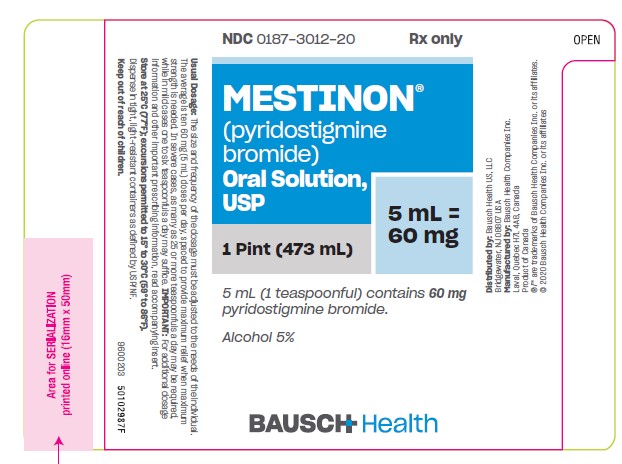
Mestinon pyridostigmine bromide 60 mg/5mL Solution, 473 mL — NDC 0187-3012-20 (Billing 00187-3012-20)
This is a package of 473 mL of Mestinon pyridostigmine bromide 60 mg/5mL Solution from Bausch Health US, LLC, marketed since Jan 1965 and currently FDA-listed. It is this product's only package size.
Identity & classification
Regulatory identifiers FDA, NLM and CMS codes for this package
Drug-database identifiers Medi-Span GPI and First Databank GCN / HICL / AHFS classification
- GSN (GCN sequence number): 004763
- GCN: 18520
- GPI-14 (Medi-Span): 76000050102060
- HICL (First Databank): 001990
- AHFS class code: 12:04.00.00
- RxCUI (RxNorm): 903843
Where does this data come from?
- FDA openFDA NDC Directory · synced Oct 1, 2026
- FDA label on DailyMed · label index refreshed Oct 1, 2026
- RxNorm (NLM RxNav) · catalog refreshed Oct 1, 2026
- Medi-Span GPI (licensed)
- First Databank (licensed) · refreshed Oct 1, 2026
RxNorm drug class
This medicine belongs to the Cholinesterase Inhibitor class.
Where does this data come from?
- RxClass (NLM) · catalog refreshed Oct 1, 2026
Clinical
- It depends on the product. Mestinon and the oral solution treat myasthenia gravis. Regonol is a hospital injection that reverses muscle relaxants. Other tablets are for military us...
- Take it exactly as prescribed. Oral products are swallowed, and doses are adjusted to your needs and spaced through the day. The military extended-release tablet must be taken with...
- Stomach upset is most common, including diarrhea, cramps and nausea. Some people notice twitching, sweating or drooling. These come from extra acetylcholine activity, so tell your...
- Get help right away for trouble breathing, severe dizziness, fainting, or growing muscle weakness. These can be signs of a serious reaction or too much medicine.
Patient education
Supplement & herbal interactions
Some supplements/herbs that may interact with Pyridostigmine Bromide — tap one for details:
Where does this data come from?
- MedlinePlus (NLM) · refreshed Oct 1, 2026
- FDA label on DailyMed · label index refreshed Oct 1, 2026
Ask a licensed pharmacist directly — free, answered by our team.
Pricing
A drug doesn't have one price. Each row is a different public payment system, and none is what you'd pay at the counter — that depends on your insurance. The ⓘ on each row explains what it measures.
| Price system | Per mL | Per package |
|---|---|---|
| Retail pharmacies payNADAC · weekly | Not in the retail survey — common for institutional, discontinued, or low-volume packs. | |
| Medicaid paysCMS SDUD · 12 mo | $3.57 | $1,689.08 / 473 ml |
| Medicare drug plans payPart D · Q2 2026 | $4.41 | $2,087.59 / 473 ml |
Where does this data come from?
- CMS NADAC weekly file
- CMS ASP pricing files · refreshed Sep 20, 2026
- CMS Medicaid State Drug Utilization Data · through Q4 2025
- CMS Part D plan pricing files · refreshed Sep 24, 2026
- VA National Acquisition Center price file
Packaging — all sizes for this product
| Package NDC | Description | Marketing start | Marketing end | Status |
|---|---|---|---|---|
| 00187-3012-20 You're viewing this Main listing | 473 mL in 1 BOTTLE | 1965-01-25 | — | Active |
Therapeutic equivalents
| Product | Labeler | Pack | NADAC/unit | TE | Status | Price vs. this |
|---|---|---|---|---|---|---|
| Pryidostigmine Bromide 60 mg/5mL 16571-0833-16 | Rising | 473 ml | $0.565 | AA | Availability likely | — |
| Pyridostigmine Bromide 60 mg/5mL 42192-0626-16 | Acella | 473 ml | $0.565 | AA | Availability likely | — |
| Pyridostigmine Bromide 60 mg/5mL 69238-1731-02 | Amneal | 473 ml | $0.565 | AA | Availability likely | — |
| Pyridostigmine 60 mg/5mL 70954-0148-10 | Novitium | 473 ml | $0.565 | AA | Availability likely | — |
| Pyridostigmine Bromide 60 mg/5mL 72205-0098-72 | Novadoz | 473 ml | $0.565 | AA | Availability likely | — |
| Mestinon 60 mg/5mLthis 00187-3012-20 | Bausch | 473 ml | — | AA | FDA listed | — |
| Pryidostigmine Bromide 60 mg/5mL 24689-0104-01 | Apnar | 473 ml | — | AA | FDA listed | — |
| Pyridostigmine Bromide 60 mg/5mL 66689-0406-10 | VistaPharm, | 10 cups | — | AA | FDA listed | — |
| pyridostigmine bromide 60 mg/5mL 68682-0307-05 | Oceanside | 473 ml | — | AA | Discontinued | — |
Where does this data come from?
- FDA openFDA NDC Directory · synced Oct 1, 2026
- FDA Orange Book · refreshed Oct 3, 2026
- CMS NADAC weekly file
Availability & generic status
FDA-approved generic versions are listed, and recent pricing/market data suggests they may be available — see Therapeutic equivalents.
Where does this data come from?
- FDA Orange Book · refreshed Oct 3, 2026
What it looks like
Where does this data come from?
- FDA label on DailyMed · label index refreshed Oct 1, 2026
Inactive Ingredients / Excipients
Inactive ingredients, also called excipients, are components of the drug product other than the active ingredient. They may include fillers, dyes, coatings, preservatives, flavors, or other formulation ingredients.
💡 Tap an ingredient (hover on desktop) to see what it is and why it’s used.
-
UNII 3K9958V90M
A liquid solvent derived from fermentation or chemical synthesis. In medicines, alcohol dissolves active ingredients, helps preserve the product, and improves how the body absorbs certain drugs.
-
UNII H3R47K3TBD
FD&C Blue No. 1 is a synthetic blue dye approved for use in foods and medicines. It serves as a colorant to give the medication its distinctive appearance and help with product identification.
-
UNII WZB9127XOA
A synthetic red dye used to color medications and make them easier to identify. It serves as a colorant in tablets, capsules, and liquid formulations.
-
UNII PDC6A3C0OX
Glycerin is a clear, thick liquid derived from plant oils or fats. It acts as a humectant to retain moisture, a sweetener, and a solvent in medications.
-
UNII 33X04XA5AT
Lactic acid is a naturally occurring organic acid derived from milk or plant sources. It lowers and maintains pH in formulations, helps preserve the product, and can enhance ingredient stability and absorption.
-
UNII OJ245FE5EU
Sodium benzoate is a salt derived from benzoic acid, a preservative. It's added to medicines to prevent growth of bacteria, fungi, and other microorganisms that could spoil the product.
-
UNII 506T60A25R
Sorbitol is a natural sugar alcohol derived from glucose. It serves as a sweetener, humectant, and bulking agent in medications to improve taste and help maintain moisture in the product.
-
UNII C151H8M554
A natural sugar derived from sugar cane or sugar beets. It's used as a sweetener, filler, and binder to improve taste, add bulk, and help hold tablet or capsule ingredients together.
-
UNII 059QF0KO0R
Water is a liquid solvent that dissolves and mixes ingredients together in liquid medicines, syrups, and injections. It helps distribute the active drug evenly throughout the product.
9 inactive ingredients listed in the exact product block matched to this NDC.
Where does this data come from?
ingredient classCode="IACT" elements from the exact product block matched by this NDC. Label-section narrative from DailyMed / the openFDA label index is shown separately when available.- FDA label on DailyMed · label index refreshed Oct 1, 2026
- FDA openFDA NDC Directory · synced Oct 1, 2026
Inactive ingredient FAQ
Are inactive ingredients the same for every manufacturer?
Why might an inactive ingredient be missing?
Can inactive ingredients matter?
Manufacturer & labeler
Where does this data come from?
- FDA openFDA NDC Directory · synced Oct 1, 2026
- Drugs@FDA
Full prescribing information FDA SPL
🎯 Indications and Usage ▾
INDICATION: MESTINON is useful in the treatment of myasthenia gravis.
⏱️ Dosage and Administration ▾
DOSAGE AND ADMINISTRATION: MESTINON is available in three dosage forms: Oral Solution - raspberry-flavored, containing 60 mg pyridostigmine bromide per teaspoonful (5 mL). This form permits accurate dosage adjustment for children and “brittle” myasthenic patients who require fractions of 60 mg doses. It is more easily swallowed, especially in the morning, by patients with bulbar involvement.
Conventional tablets - each containing 60 mg pyridostigmine bromide. TIMESPAN tablets - each containing 180 mg pyridostigmine bromide. This form provides uniformly slow release, hence prolonged duration of drug action; it facilitates control of myasthenic symptoms with fewer individual doses daily.
The immediate effect of a 180 mg TIMESPAN tablet is about equal to that of a 60 mg Conventional tablet; however, its duration of effectiveness, although varying in individual patients, averages 2½ times that of a 60 mg dose. Dosage: The size and frequency of the dosage must be adjusted to the needs of the individual patient. Oral Solution and Conventional tablets - The average dose is ten 60 mg tablets or ten 5 mL teaspoonfuls daily, spaced to provide maximum relief when maximum strength is needed.
In severe cases as many as 25 tablets or teaspoonfuls a day may be required, while in mild cases one to six tablets or teaspoonfuls a day may suffice. TIMESPAN tablets - One to three 180 mg tablets, once or twice daily, will usually be sufficient to control symptoms; however, the needs of certain individuals may vary markedly from this average. The interval between doses should be at least 6 hours.
For optimum control, it may be necessary to use the more rapidly acting regular tablets or oral solution in conjunction with TIMESPAN therapy. NOTE: For information on a diagnostic test for myasthenia gravis, and for the evaluation and stabilization of therapy, please see product literature on Tensilon (edrophonium chloride).
⛔ Contraindications ▾
CONTRAINDICATIONS: MESTINON is contraindicated in mechanical intestinal or urinary obstruction, and particular caution should be used in its administration to patients with bronchial asthma. Care should be observed in the use of atropine for counteracting side effects, as discussed below.
⚠️ Warnings ▾
WARNINGS: Although failure of patients to show clinical improvement may reflect underdosage, it can also be indicative of overdosage. As is true of all cholinergic drugs, overdosage of MESTINON may result in cholinergic crisis, a state characterized by increasing muscle weakness which, through involvement of the muscles of respiration, may lead to death. Myasthenic crisis due to an increase in the severity of the disease is also accompanied by extreme muscle weakness, and thus may be difficult to distinguish from cholinergic crisis on a symptomatic basis.
Such differentiation is extremely important, since increases in doses of MESTINON or other drugs of this class in the presence of cholinergic crisis or of a refractory or “insensitive” state could have grave consequences. Osserman and Genkins 1 indicate that the differential diagnosis of the two types of crisis may require the use of Tensilon (edrophonium chloride) as well as clinical judgment. The treatment of the two conditions obviously differs radically.
Whereas the presence of myasthenic crisis suggests the need for more intensive anticholinesterase therapy, the diagnosis of cholinergic crisis, according to Osserman and Genkins 1 , calls for the prompt withdrawal of all drugs of this type. The immediate use of atropine in cholinergic crisis is also recommended. Atropine may also be used to abolish or obtund gastrointestinal side effects or other muscarinic reactions; but such use, by masking signs of overdosage, can lead to inadvertent induction of cholinergic crisis.
For detailed information on the management of patients with myasthenia gravis, the physician is referred to one of the excellent reviews such as those by Osserman and Genkins 2 , Grob 3 or Schwab. 4,5 Usage in Pregnancy : The safety of MESTINON during pregnancy or lactation in humans has not been established. Therefore, use of MESTINON in women who may become pregnant requires weighing the drug’s potential benefits against its possible hazards to mother and child.
🤒 Adverse Reactions ▾
ADVERSE REACTIONS: The side effects of MESTINON are most commonly related to overdosage and generally are of two varieties, muscarinic and nicotinic. Among those in the former group are nausea, vomiting, diarrhea, abdominal cramps, increased peristalsis, increased salivation, increased bronchial secretions, miosis and diaphoresis. Nicotinic side effects are comprised chiefly of muscle cramps, fasciculation and weakness.
Muscarinic side effects can usually be counteracted by atropine, but for reasons shown in the preceding section the expedient is not without danger. As with any compound containing the bromide radical, a skin rash may be seen in an occasional patient. Such reactions usually subside promptly upon discontinuance of the medication.
To report SUSPECTED ADVERSE REACTIONS, contact Bausch Health US, LLC at 1-800-321-4576 or FDA at 1-800-FDA-1088 or www.fda.gov/medwatch.
🤰 Pregnancy ▾
Usage in Pregnancy : The safety of MESTINON during pregnancy or lactation in humans has not been established. Therefore, use of MESTINON in women who may become pregnant requires weighing the drug’s potential benefits against its possible hazards to mother and child.
🧒 Pediatric Use ▾
Pediatric Use: Safety and effectiveness in pediatric patients have not been established.
🧬 Mechanism of Action ▾
ACTIONS: MESTINON inhibits the destruction of acetylcholine by cholinesterase and thereby permits freer transmission of nerve impulses across the neuromuscular junction. Pyridostigmine is an analog of neostigmine (Prostigmin), but differs from it in certain clinically significant respects; for example, pyridostigmine is characterized by a longer duration of action and fewer gastrointestinal side effects.
📦 How Supplied / Storage and Handling ▾
HOW SUPPLIED: Oral Solution, 60 mg pyridostigmine bromide per teaspoonful (5 mL) and 5% alcohol - bottles of 1 pint (473 mL) (NDC 0187-3012-20). Tablets, are available as white, flat-faced tablets containing 60 mg pyridostigmine bromide in bottles of 100 (NDC 0187-3010-30). Each tablet is engraved “MESTINON 60 V” on one side and is quadrisect scored on the other.
TIMESPAN tablets, are available as light straw-colored, capsule-shaped tablets containing 180 mg pyridostigmine bromide in bottles of 30 (NDC 0187-3013-30). Each tablet is engraved “MES V 180” on one side and is single-scored on the other. Note: Because of the hygroscopic nature of the TIMESPAN tablets, mottling may occur.
This does not affect their efficacy. Store MESTINON (pyridostigmine bromide) Oral Solution, USP, MESTINON tablets, and TIMESPAN tablets at 25°C (77°F); excursions permitted to 15° to 30°C (59° to 86°F). Keep MESTINON tablets and TIMESPAN tablets in a dry place with the silica gel enclosed.
📦 Storage and Handling ▾
Store MESTINON (pyridostigmine bromide) Oral Solution, USP, MESTINON tablets, and TIMESPAN tablets at 25°C (77°F); excursions permitted to 15° to 30°C (59° to 86°F). Keep MESTINON tablets and TIMESPAN tablets in a dry place with the silica gel enclosed.
📋 Description ▾
DESCRIPTION: MESTINON (pyridostigmine bromide) is an orally active cholinesterase inhibitor. Chemically, pyridostigmine bromide is 3-hydroxy-1-methylpyridinium bromide dimethylcarbamate. Its structural formula is: MESTINON is available in the following forms: Oral Solution containing 60 mg pyridostigmine bromide per teaspoonful in a vehicle containing 5% alcohol, glycerin, lactic acid, sodium benzoate, sorbitol, sucrose, FD&C Red No.
40, FD&C Blue No. 1, flavors and water. Tablets containing 60 mg pyridostigmine bromide; each tablet also contains lactose, silicon dioxide and stearic acid.
TIMESPAN tablets containing 180 mg pyridostigmine bromide; each tablet also contains carnauba wax, corn-derived proteins, isopropyl alcohol, magnesium stearate, silica gel, tribasic calcium phosphate and water. mestinon-01.jpg
⚠️ Precautions ▾
PRECAUTION: Pyridostigmine is mainly excreted unchanged by the kidney. 6,7,8 Therefore, lower doses may be required in patients with renal disease, and treatment should be based on titration of drug dosage to effect. 6,7 Pediatric Use: Safety and effectiveness in pediatric patients have not been established.
📚 References ▾
REFERENCES: 1. Osserman KE, Genkins G. Studies in myasthenia gravis: Reduction in mortality rate after crisis.
JAMA. Jan 1963; 183:97-101. 2.
Osserman KE, Genkins G. Studies in myasthenia gravis. NY State J Med.
June 1961; 61:2076-2085. 3. Grob D.
Myasthenia gravis. A review of pathogenesis and treatment. Arch Intern Med.
Oct 1961; 108:615-638. 4. Schwab RS.
Management of myasthenia gravis. New Eng J Med . Mar 1963; 268:596-597.
5. Schwab RS. Management of myasthenia gravis.
New Eng J Med . Mar 1963; 268:717-719. 6.
Cronnelly R, Stanski DR, Miller RD, Sheiner LB. Pyridostigmine kinetics with and without renal function. Clin Pharmacol Ther.
1980; 28: No. 1, 78-81. 7.
Miller RD. Pharmacodynamics and pharmacokinetics of anticholinesterase. In: Ruegheimer E, Zindler M, ed.
Anesthesiology . (Hamburg, Germany: Congress; Sep 14-21, 1980; 222-223.) (Int Congr. No.
538), Amsterdam, Netherlands: Excerpta Medica; 1981. 8. Breyer-Pfaff U, Maier U, Brinkmann AM, Schumm F.
Pyridostigmine kinetics in healthy subjects and patients with myasthenia gravis. Clin Pharmacol Ther . 1985; 5:495-501.
📄 Package Label / Principal Display Panel ▾
PRINCIPAL DISPLAY PANEL - 473 mL Bottle Label NDC 0187-3012-20 Rx Only MESTINON ® (pyridostigmine bromide). Oral Solution, USP 1 Pint (473 mL) 5 mL = 60 mg 5 mL (1 teaspoonful) contains 60 mg pyridostigmine bromide. Alcohol 5% BAUSCH Health label
PRINCIPAL DISPLAY PANEL - 60 mg Tablets Bottle Label NDC 0187-3010-30 Rx Only Mestinon ® (pyridostigmine bromide) Tablets, USP 60 mg 100 Tablets Each tablet contains 60 mg pyridostigmine bromide BAUSCH Health Dispense in tight containers as defined in USP/NF. IMPORTANT: These tablets are hygrosciopic. Keep in dry place with the silica gel enclosed.
Usual Dosage: See accompanying package insert. Store at 25°C (77°F); excursions permitted to 15° to 30°C (59° to 86°F). 60mg-label.jpg
PRINCIPAL DISPLAY PANEL - 180 mg Bottle Label NDC 0187-3013-30 Rx Only MESTINON ® (pyridostigmine bromide) TIMESPAN ® Tablets 180 mg 30 Tablets Each tablet contains180 mg pyridostigmine bromide in a specially constructed tablet for sustained release BAUSCH Health 9549902 50104061C label
Medicaid utilization & spend
Medicare Part D spend CMS · PART D · 2026 (Q1)
About this NDC listing & data coverage
What data is (and isn’t) available for this NDC — tap to expand
| NDC identity (package / product / labeler codes) | ✓ Available |
| Labeler | ✓ Available |
| Product & package description | ✓ Available |
| Marketing category & status | ✓ Available |
| Active ingredient / dosage form / route | ✓ Available |
| FDA label (SPL via DailyMed) | ✓ Available |
| Package photos | ✓ Available |
| Inactive ingredients (structured) | ✓ Available |
| NADAC pharmacy acquisition price (CMS) | — Not published for this NDC CMS publishes NADAC only for NDCs reported in its retail-pharmacy survey. |
| Orange Book / therapeutic-equivalence data | ✓ Available |
| HCPCS J-code billing crosswalk | — Not published for this NDC Most self-administered / retail products have no J-code — that is normal. |
| Medicaid utilization (CMS SDUD) | ✓ Available |