
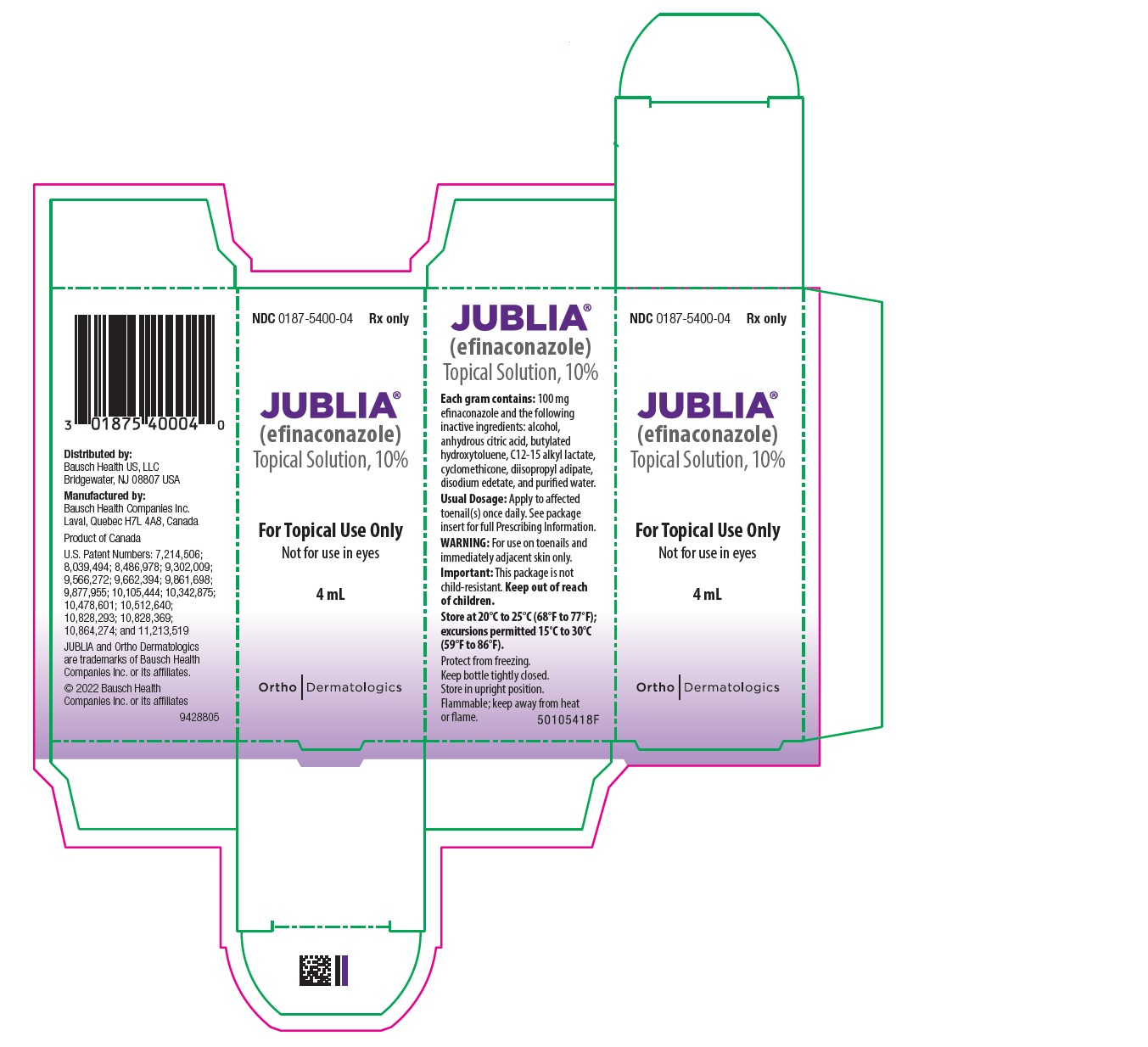
JUBLIA efinaconazole 100 mg/mL Solution
🆔 Identity & classification
Where does this data come from?
🏷️ RxNorm drug class
This medicine belongs to the Azole Antifungal class.
Where does this data come from?
🏭 Manufacturer & labeler
Where does this data come from?
🩺 Clinical
Efinaconazole topical solution is used to treat fungal toenail infections (infections that may cause nail discoloration, splitting, or pain). Efinaconazole topical solution is in a class of medications called antifungals. It works by stopping the growth of nail fungus.
Read the full MedlinePlus article ↗- Jublia treats onychomycosis — a fungal infection that gets into your toenail and causes it to look thick, discolored, or crumbly. It targets two specific fungi, Trichophyton rubrum...
- What exactly is Jublia treating on my toenail?
- Yes, and that's completely normal to wonder about. Toenails grow very slowly, so it takes a full 48 weeks for the healthy nail to grow in and replace the infected one. Stopping ear...
- Do I really have to use it for 48 weeks? That seems like a long time.
Patient education
Supplement & herbal interactions
Some supplements/herbs that may interact with Efinaconazole — tap one for details:
Where does this data come from?
Ask a licensed pharmacist directly — free, answered by our team.
🧪 Inactive Ingredients / Excipients
Inactive ingredients, also called excipients, are components of the drug product other than the active ingredient. They may include fillers, dyes, coatings, preservatives, flavors, or other formulation ingredients.
💡 Tap an ingredient (hover on desktop) to see what it is and why it’s used.
-
UNII 3K9958V90M
A liquid solvent derived from fermentation or chemical synthesis. In medicines, alcohol dissolves active ingredients, helps preserve the product, and improves how the body absorbs certain drugs.
-
UNII XF417D3PSL
Anhydrous citric acid is a sour, crystalline powder derived from citric acid with water removed. In medicines, it acts as a buffer to control pH, adds tartness to improve taste, and helps tablets disintegrate.
-
UNII 1P9D0Z171K
BHT is a synthetic antioxidant that prevents fats and oils in medicines from breaking down and becoming rancid. It helps keep the product stable and effective during storage.
-
UNII GC844VRD7E
A synthetic fatty acid ester derived from plant oils and lactic acid. It acts as an emulsifier and solvent to help mix oil and water-based ingredients and improve how the medicine dissolves or spreads in the body.
-
UNII NMQ347994Z
Cyclomethicone is a silicone-based fluid that acts as a lubricant and solvent in medicines. It helps products flow smoothly, reduces friction between particles, and aids in even distribution of active ingredients.
-
UNII P7E6YFV72X
Diisopropyl adipate is a clear, oily liquid derived from adipic acid. It acts as a plasticizer and solvent in medicines, helping soften coatings and improve how the drug dissolves or spreads in the body.
-
UNII 7FLD91C86K
Edetate disodium is a chemical compound that binds and removes certain metal ions. In medicines, it acts as a preservative and stabilizer by preventing metals like calcium from interfering with the product's shelf life and consistency.
-
UNII 059QF0KO0R
Water is a liquid solvent that dissolves and mixes ingredients together in liquid medicines, syrups, and injections. It helps distribute the active drug evenly throughout the product.
8 inactive ingredients listed in the exact product block matched to this NDC.
Where does this data come from?
ingredient classCode="IACT" elements from the exact product block matched by this NDC. Label-section narrative from DailyMed / the openFDA label index is shown separately when available.Inactive ingredient FAQ
Are inactive ingredients the same for every manufacturer?
Why might an inactive ingredient be missing?
Can inactive ingredients matter?
💲 Pricing
A drug doesn't have one price. Each row is a different public payment system, and none is what you'd pay at the counter — that depends on your insurance. The ⓘ on each row explains what it measures.
| Price system | Per mL | Per package |
|---|---|---|
| Retail pharmacies payNADAC · weekly | Not in the retail survey — common for institutional, discontinued, or low-volume packs. | |
| Medicaid paysCMS SDUD · 12 mo | No recent Medicaid claims on file for this NDC — rare and low-volume NDCs are suppressed in the public data. | |
| Medicare drug plans payPart D · Q2 2026 | $208.47 | $416.93 / 2 ml |
Where does this data come from?
🔁 Therapeutic equivalents
| Product | Labeler | Pack | NADAC/unit | TE | Status | Price vs. this |
|---|---|---|---|---|---|---|
| Jublia 100 mg/mLthis 00187-5400-02 | Bausch | 1 bottle | — | AB | FDA listed | — |
Where does this data come from?
⏳ Availability & generic status
The FDA lists approved generic versions of this medicine, but that does not always mean a pharmacy can get one today. Patent rules, launch agreements, supply and pricing can affect when generics actually arrive.
Why the date isn’t exact: Generic timing can change because patents may be challenged, settled, licensed, added, removed, or worked around with a narrower label — and FDA approval does not always mean a pharmacy can get the generic today.
🛈 What do these terms mean?
- Patent
- Legal protection listed in the Orange Book that may delay generic approval or launch. Issued by the U.S. Patent & Trademark Office.
- Substance patent
- Covers the active drug molecule itself — the hardest to design around. A generic generally can’t launch until it expires.
- Formulation (product) patent
- Covers a specific formulation or dosage form. A generic can sometimes work around it with a different formulation.
- Method-of-use patent
- A patent covering one specific approved use of the drug — not necessarily the whole molecule. A generic can sometimes launch with a “skinny label” that carves out the protected use and keeps the others.
- Skinny label
- A generic label that omits a still-patented use when the FDA allows it — letting a generic reach the market for the unprotected uses.
- Exclusivity
- FDA-granted marketing protection, separate from patents — e.g. 5-yr new chemical entity, 7-yr orphan drug, or a +6-month pediatric extension.
- Paragraph IV
- A generic applicant’s formal challenge to a listed patent. It can potentially lead to earlier generic entry, but often involves litigation or a settlement.
- RLD / RS
- Reference Listed Drug — the brand product the FDA uses as the reference for generic applications. Reference Standard — the product the FDA expects generics to compare against in bioequivalence testing.
- TE / AB rating
- FDA therapeutic-equivalence rating. An AB rating generally means the FDA considers a generic therapeutically equivalent to — and substitutable for — the brand.
- LOE (loss of exclusivity)
- The latest patent or exclusivity currently listed — the loss-of-exclusivity / latest-listed-protection date shown on this page. Paragraph-IV challenges and settlements can move the real date earlier; FDA approval and a manufacturer’s decision to market can move it later.
Built from the FDA Orange Book. The bars above are scaled to each protection’s expiry; the red LOE marker is the last one to lapse.
| Patent | Type | Use code | Expires |
|---|---|---|---|
| US 7214506 ↗ | Method of use | U-281 | Feb 22, 2026 |
| US 9566272 ↗ | Method of use | U-1969 | Jan 3, 2028 |
| US 9877955 ↗ | Method of use | U-1969 | Jan 3, 2028 |
| US 10512640 ↗ | Method of use | U-1969 | Jan 3, 2028 |
| US 10342875 ↗ | Method of use | U-2720 | Oct 2, 2034 |
| US 10478601 ↗ | Method of use | U-2721 | Apr 25, 2035 |
| US 11654139 ↗ | Method of use | U-1969 | Oct 2, 2034 |
| US 11213519 ↗ | Method of use | U-2720 | Jan 3, 2028 |
| US 10828293 ↗ | Method of use | U-2720 | Oct 2, 2034 |
| US 10864274 ↗ | Method of use | U-2720 | Oct 2, 2034 |
| US 11872218 ↗ | Method of use | U-1969 | Jan 3, 2028 |
| US 8039494 ↗ | Method of use | U-281 | Jul 8, 2030 |
| US 9662394 ↗ | Drug product | — | Oct 2, 2034 |
| US 9861698 ↗ | Drug product | — | Jul 8, 2030 |
| US 8486978 ↗ | Drug product | — | Oct 24, 2030 |
| US 10828369 ↗ | Drug product | — | Jan 3, 2028 |
| US 10105444 ↗ | Drug product | — | Jul 8, 2030 |
| US 9302009 ↗ | Drug product | — | Oct 24, 2030 |
Is there a generic version of JUBLIA 10% TOPICAL SOLUTION?
The FDA approved a generic — why can’t I get it at my pharmacy yet?
Why do different websites show different generic release dates?
What does “FDA listed” mean?
What does a patent or protection date mean here?
What does “current Orange Book estimate” mean?
Can a generic come out before the last patent expires?
Can a generic come out after the listed dates?
What is the difference between patents and exclusivity?
Why are there multiple patent dates?
Where does this data come from?
💊 Medicaid utilization by pack size
📊 Medicare Part D spend CMS · PART D · 2026 (Q1)
🔬 Reported adverse events (FAERS)
Top reported reactions
Reporter sex
Serious outcomes
Where does this data come from?
📦 Packaging — all sizes for this product
| Package NDC | Description | Per unit | Per pack | Marketing start | Status |
|---|---|---|---|---|---|
| 00187-5400-02 You're viewing this | 1 BOTTLE, WITH APPLICATOR in 1 CARTON (0187-5400-02) / 2 mL in 1 BOTTLE, WITH APPLICATOR | — | — | 2015-12-17 | Active |
| 00187-5400-04 | 1 BOTTLE, WITH APPLICATOR in 1 CARTON (0187-5400-04) / 4 mL in 1 BOTTLE, WITH APPLICATOR | $182.24 / mL | $728.97 | 2014-06-06 | Active |
| 00187-5400-08 | 1 BOTTLE, WITH APPLICATOR in 1 CARTON (0187-5400-08) / 8 mL in 1 BOTTLE, WITH APPLICATOR | $181.86 / mL | $1,454.85 | 2014-06-06 | Active |
This pack shows little to no recent Medicaid volume — a different pack size carries most fills. See all packs ↓
Pack size FAQ
What quantity is in NDC 00187-5400-02?
What NDC number is used to bill for this package of JUBLIA efinaconazole 100 mg/mL Solution?
Prices are the latest CMS NADAC pharmacy acquisition cost per NDC; per-pack figures are per-unit × pack quantity, shown only when the pack is denominated in the same measure NADAC prices.
🧭 About this NDC listing & data coverage
What data is (and isn’t) available for this NDC — tap to expand
| NDC identity (package / product / labeler codes) | ✓ Available |
| Labeler | ✓ Available |
| Product & package description | ✓ Available |
| Marketing category & status | ✓ Available |
| Active ingredient / dosage form / route | ✓ Available |
| FDA label (SPL via DailyMed) | ✓ Available |
| Package photos | ✓ Available |
| Inactive ingredients (structured) | ✓ Available |
| NADAC pharmacy acquisition price (CMS) | — Not published for this NDC CMS publishes NADAC only for NDCs reported in its retail-pharmacy survey. |
| Orange Book / therapeutic-equivalence data | ✓ Available |
| HCPCS J-code billing crosswalk | — Not published for this NDC Most self-administered / retail products have no J-code — that is normal. |
| Medicaid utilization (CMS SDUD) | — Not published for this NDC CMS reports utilization only for NDCs with Medicaid claims above its privacy threshold. |
Questions about this listing
Why is there no price listed?
Is the NDC printed on the package the same as the 11-digit billing NDC?
What do the three segments of this NDC mean?
Is this package still being marketed?
Does this product come in other package sizes?
Who lists this product with the FDA?
Do I need a prescription for this product?
Where does this data come from?
📄 Full prescribing information FDA SPL
🎯 Indications and Usage ▾
1 INDICATIONS AND USAGE JUBLIA (efinaconazole) topical solution, 10% is an azole antifungal indicated for the topical treatment of onychomycosis of the toenail(s) due to Trichophyton rubrum and Trichophyton mentagrophytes . JUBLIA is an azole antifungal indicated for the topical treatment of onychomycosis of the toenail(s) due to Trichophyton rubrum and Trichophyton mentagrophytes . (1)
⏱️ Dosage and Administration ▾
2 DOSAGE AND ADMINISTRATION Apply JUBLIA to affected toenails once daily for 48 weeks, using the integrated flow-through brush applicator. When applying JUBLIA, ensure the toenail, the toenail folds, toenail bed, hyponychium, and the undersurface of the toenail plate, are completely covered. JUBLIA is for topical use only and not for oral, ophthalmic, or intravaginal use. • Apply JUBLIA to affected toenails once daily for 48 weeks using the integrated flow-through brush applicator.
(2) • When applying JUBLIA, ensure the toenail, the toenail folds, toenail bed, hyponychium, and the undersurface of the toenail plate, are completely covered. (2) • For topical use only. Not for oral, ophthalmic, or intravaginal use.
(2)
💊 Dosage Forms and Strengths ▾
3 DOSAGE FORMS AND STRENGTHS JUBLIA (efinaconazole) topical solution, 10% contains 100 mg of efinaconazole in each gram of clear, colorless to pale yellow solution. Solution: 10%. (3)
⛔ Contraindications ▾
4 CONTRAINDICATIONS None. None. (4)
🤒 Adverse Reactions ▾
6 ADVERSE REACTIONS The most common adverse reactions (incidence >1%) were ingrown toenails, application site dermatitis, application site vesicles, and application site pain. (6.1) To report SUSPECTED ADVERSE REACTIONS, contact Bausch Health US, LLC at 1-800-321-4576 or FDA at 1-800-FDA-1088 or www.fda.gov/medwatch.
6.1Clinical Trials Experience Because clinical trials are conducted under widely varying conditions, adverse reaction rates observed in the clinical trials of a drug cannot be directly compared to rates in the clinical trials of another drug and may not reflect the rates observed in practice. In two clinical trials, 1227 subjects were treated with JUBLIA, 1161 for at least 24 weeks and 780 for 48 weeks. Adverse reactions reported within 48 weeks of treatment and in at least 1% of subjects treated with JUBLIA and those reported in subjects treated with the vehicle are presented in Table 1 .
Table 1: Adverse Reactions Reported by at Least 1% of Subjects Treated for up to 48 Weeks Adverse Event, n (%) JUBLIA (N=1,227) Vehicle (N=413) Ingrown toenail 28 (2.3%) 3 (0.7%) Application site dermatitis 27 (2.2%) 1 (0.2%) Application site vesicles 20 (1.6%) 0 (0.0%) Application site pain 13 (1.1%) 1 (0.2%)
6.2Postmarketing Experience The following adverse reactions have been identified during post-approval use of JUBLIA. Because these reactions are reported voluntarily from a population of uncertain size, it is not always possible to estimate their frequency or establish a causal relationship to drug exposure. General Disorders and Administration Site Conditions: Application site erythema and exfoliation Skin and Subcutaneous Tissue Disorders: Onychomadesis, Nail discoloration
🔄 Drug Interactions ▾
7 DRUG INTERACTIONS In vitro studies have shown that JUBLIA, at therapeutic concentrations, neither inhibits nor induces cytochrome P450 (CYP450) enzymes.
👥 Use in Specific Populations ▾
8 USE IN SPECIFIC POPULATIONS
8.1Pregnancy Risk Summary There are no available human data for the use of JUBLIA during pregnancy to inform any drug associated risks of major birth defects, miscarriage, or adverse maternal or fetal outcomes. In animal reproduction studies, efinaconazole did not cause malformations or any harm to the fetus when administered to pregnant rabbits and rats during the period of organogenesis at subcutaneous doses up to 112 and 154 times, respectively, the Maximum Recommended Human Dose (MRHD) based on Area Under the Curve (AUC) comparisons.
Embryolethality was observed only in rats in the presence of maternal toxicity at systemic exposures 559 times the MRHD based on AUC comparisons. Subcutaneous efinaconazole administration to pregnant rats from the beginning of organogenesis through the end of lactation did not cause embryofetal toxicity or developmental effects at systemic exposures 17 times the MRHD based on AUC comparisons (see Data) . The background risk of major birth defects and miscarriage for the indicated population is unknown.
However, the background risk in the U.S. general population of major birth defects is 2 to 4%, and of miscarriage is 15 to 20%, of clinically recognized pregnancies. Data Animal Data Systemic embryofetal development studies were conducted in rats and rabbits. Subcutaneous doses of 2, 10 and 50 mg/kg/day efinaconazole were administered during the period of organogenesis (gestational days 6-16) to pregnant female rats.
In the presence of maternal toxicity, embryofetal toxicity (increased embryofetal deaths, decreased number of live fetuses, and placental effects) was noted at 50 mg/kg/day (559 times the MRHD based on AUC comparisons). No embryofetal toxicity was noted at 10 mg/kg/day (112 times the MRHD based on AUC comparisons). No malformations were observed at 50 mg/kg/day (559 times the MRHD based on AUC comparisons).
Subcutaneous doses of 1, 5, and 10 mg/kg/day efinaconazole were administered during the period of organogenesis (gestational days 6-19) to pregnant female rabbits. In the presence of maternal toxicity, there was no embryofetal toxicity or malformations at 10 mg/kg/day (154 times the MRHD based on AUC comparisons). In a pre- and postnatal development study in rats, subcutaneous doses of 1, 5 and 25 mg/kg/day efinaconazole were administered from the beginning of organogenesis (gestation day 6) through the end of lactation (lactation day 20).
In the presence of maternal toxicity, embryofetal toxicity (increased prenatal pup mortality, reduced live litter sizes and increased postnatal pup mortality) was noted at 25 mg/kg/day. No embryofetal toxicity was noted at 5 mg/kg/day (17 times the MRHD based on AUC comparisons). No effects on postnatal development were noted at 25 mg/kg/day (89 times the MRHD based on AUC comparisons).
8.2Lactation Risk Summary It is not known whether efinaconazole is excreted in human milk. After repeated subcutaneous administration, efinaconazole was detected in milk of nursing rats. Because many drugs are excreted in human milk, caution should be exercised when JUBLIA is administered to nursing women.
The developmental and health benefits of breastfeeding should be considered, along with the mother’s clinical need for JUBLIA, and any potential adverse effects on the breastfed infant from JUBLIA.
8.4Pediatric Use The safety and effectiveness of JUBLIA were established in patients 6 years and older. Use of JUBLIA in these age groups is supported by evidence from well-controlled trials in adults with additional data from an open-label safety study in 60 pediatric subjects ages 6 to 17 (including a pharmacokinetic study in 17 subjects 12 years to less than 17 years old) [see Clinical Pharmacology (12.3) ]. Safety and effectiveness of JUBLIA in pediatric subjects under 6 years of age have not been established.
8.5Geriatric Use Of the total number of subjects in clinical trials of JUBLIA, 11.3% were 65 and over, while none were 7…
🤰 Pregnancy ▾
8.1Pregnancy Risk Summary There are no available human data for the use of JUBLIA during pregnancy to inform any drug associated risks of major birth defects, miscarriage, or adverse maternal or fetal outcomes. In animal reproduction studies, efinaconazole did not cause malformations or any harm to the fetus when administered to pregnant rabbits and rats during the period of organogenesis at subcutaneous doses up to 112 and 154 times, respectively, the Maximum Recommended Human Dose (MRHD) based on Area Under the Curve (AUC) comparisons.
Embryolethality was observed only in rats in the presence of maternal toxicity at systemic exposures 559 times the MRHD based on AUC comparisons. Subcutaneous efinaconazole administration to pregnant rats from the beginning of organogenesis through the end of lactation did not cause embryofetal toxicity or developmental effects at systemic exposures 17 times the MRHD based on AUC comparisons (see Data) . The background risk of major birth defects and miscarriage for the indicated population is unknown.
However, the background risk in the U.S. general population of major birth defects is 2 to 4%, and of miscarriage is 15 to 20%, of clinically recognized pregnancies. Data Animal Data Systemic embryofetal development studies were conducted in rats and rabbits. Subcutaneous doses of 2, 10 and 50 mg/kg/day efinaconazole were administered during the period of organogenesis (gestational days 6-16) to pregnant female rats.
In the presence of maternal toxicity, embryofetal toxicity (increased embryofetal deaths, decreased number of live fetuses, and placental effects) was noted at 50 mg/kg/day (559 times the MRHD based on AUC comparisons). No embryofetal toxicity was noted at 10 mg/kg/day (112 times the MRHD based on AUC comparisons). No malformations were observed at 50 mg/kg/day (559 times the MRHD based on AUC comparisons).
Subcutaneous doses of 1, 5, and 10 mg/kg/day efinaconazole were administered during the period of organogenesis (gestational days 6-19) to pregnant female rabbits. In the presence of maternal toxicity, there was no embryofetal toxicity or malformations at 10 mg/kg/day (154 times the MRHD based on AUC comparisons). In a pre- and postnatal development study in rats, subcutaneous doses of 1, 5 and 25 mg/kg/day efinaconazole were administered from the beginning of organogenesis (gestation day 6) through the end of lactation (lactation day 20).
In the presence of maternal toxicity, embryofetal toxicity (increased prenatal pup mortality, reduced live litter sizes and increased postnatal pup mortality) was noted at 25 mg/kg/day. No embryofetal toxicity was noted at 5 mg/kg/day (17 times the MRHD based on AUC comparisons). No effects on postnatal development were noted at 25 mg/kg/day (89 times the MRHD based on AUC comparisons).
🧒 Pediatric Use ▾
8.4Pediatric Use The safety and effectiveness of JUBLIA were established in patients 6 years and older. Use of JUBLIA in these age groups is supported by evidence from well-controlled trials in adults with additional data from an open-label safety study in 60 pediatric subjects ages 6 to 17 (including a pharmacokinetic study in 17 subjects 12 years to less than 17 years old) [see Clinical Pharmacology (12.3) ]. Safety and effectiveness of JUBLIA in pediatric subjects under 6 years of age have not been established.
🧓 Geriatric Use ▾
8.5Geriatric Use Of the total number of subjects in clinical trials of JUBLIA, 11.3% were 65 and over, while none were 75 and over. No overall differences in safety and effectiveness were observed between these subjects and younger subjects, and other reported clinical experience has not identified differences in responses between the elderly and the younger subjects, but greater sensitivity of some older individuals cannot be ruled out.
🧬 Clinical Pharmacology ▾
12 CLINICAL PHARMACOLOGY
12.1Mechanism of Action JUBLIA topical solution is an azole antifungal [ see Clinical Pharmacology (12.4) ].
12.2Pharmacodynamics The pharmacodynamics of JUBLIA is unknown.
12.3Pharmacokinetics Systemic absorption of efinaconazole in 18 adult subjects with severe onychomycosis was determined after application of JUBLIA once daily for 28 days to patients’ 10 toenails and 0.5 cm adjacent skin. The concentration of efinaconazole in plasma was determined at multiple time points over the course of 24-hour periods on days 1, 14, and 28. Efinaconazole mean ± SD plasma C max on Day 28 was 0.67 ± 0.37 ng/mL and the mean ± SD AUC was 12.15 ± 6.91 ng*h/mL.
The plasma concentration versus time profile at steady state was generally flat over a 24-hour dosing interval. In a separate study of healthy volunteers, the plasma half-life of efinaconazole following daily applications when applied to all 10 toenails for 7 days was 29.9 hours. Specific Populations Pediatric patients PK of efinaconazole was assessed in 17 pediatric subjects 12 to <17 years of age with moderate to severe onychomycosis following application of JUBLIA once daily to all 10 toenails for 28 days.
The plasma concentrations of efinaconazole in pediatric subjects were relatively flat over a 24-hour dosing interval. The mean ± SD plasma C max and AUC 0-24 for efinaconazole on Day 28 were 0.55±0.38 ng/mL and 11.4±7.68 h•ng/mL, respectively. Drug Interactions JUBLIA is considered a non-inhibitor of the CYP450 enzyme family.
In in vitro studies using human liver microsomes, efinaconazole did not inhibit CYP1A2, CYP2A6, CYP2C8, CYP2C9, CYP2C19, CYP2D6, CYP2PE1 and CYP3A4 enzyme activities at expected clinical systemic concentrations. In vitro studies in human primary hepatocytes showed that efinaconazole did not induce CYP1A2 or CYP3A4 activities.
12.4Microbiology Mechanism of Action Efinaconazole is an azole antifungal. Efinaconazole inhibits fungal lanosterol 14α-demethylase involved in the biosynthesis of ergosterol, a constituent of fungal cell membranes. Activity In Vitro and In Vivo Efinaconazole has been shown to be active against isolates of the following microorganisms, both in vitro and in clinical infections.
Efinaconazole exhibits in vitro minimum inhibitory concentrations (MICs) of 0.06 mcg/mL or less against most (≥90%) isolates of the following microorganisms: Trichophyton rubrum Trichophyton mentagrophytes Mechanism of Resistance Efinaconazole drug resistance development was studied in vitro against T. mentagrophytes, T. rubrum and C. albicans . Serial passage of fungal cultures in the presence of sub-growth inhibitory concentrations of efinaconazole increased the MIC by up to 4-fold. The clinical significance of these in vitro results is unknown.
🧬 Mechanism of Action ▾
12.1Mechanism of Action JUBLIA topical solution is an azole antifungal [ see Clinical Pharmacology (12.4) ].
📦 How Supplied / Storage and Handling ▾
16 HOW SUPPLIED/STORAGE AND HANDLING JUBLIA (efinaconazole) topical solution, 10% is a clear, colorless to pale yellow solution supplied in a white plastic bottle with an integrated flow-through brush applicator as follows: • 4 mL (NDC 0187-5400-04) • 8 mL (NDC 0187-5400-08) Storage and Handling Conditions: Store at 20°C to 25°C (68°F to 77°F); excursions permitted to 15°C to 30°C (59°F to 86°F) [see USP Controlled Room Temperature]. • Solution is flammable; keep away from heat or flame. • Protect from freezing. • Keep out of reach of children. • Keep bottle tightly closed. • Store in upright position.
📦 Storage and Handling ▾
Storage and Handling Conditions: Store at 20°C to 25°C (68°F to 77°F); excursions permitted to 15°C to 30°C (59°F to 86°F) [see USP Controlled Room Temperature]. • Solution is flammable; keep away from heat or flame. • Protect from freezing. • Keep out of reach of children. • Keep bottle tightly closed. • Store in upright position.
📋 Description ▾
11 DESCRIPTION JUBLIA (efinaconazole) topical solution, 10% is a clear, colorless to pale yellow solution for topical use. Each gram of JUBLIA contains 100 mg of efinaconazole. Efinaconazole is an azole antifungal with a chemical name of ((2R,3R)-2-(2,4-difluorophenyl)-3-(4-methylenepiperidin-1-yl)-1-(1H-1,2,4-triazol-1-yl) butan-2-ol).
The structural formula for efinaconazole is represented below: JUBLIA contains the following inactive ingredients: alcohol, anhydrous citric acid, butylated hydroxytoluene, C12-15 alkyl lactate, cyclomethicone, diisopropyl adipate, disodium edetate, and purified water. chemical structure
💬 Information for Patients ▾
17 PATIENT COUNSELING INFORMATION Advise the patient to read the FDA-approved patient labeling (Patient Information and Instructions for Use). • JUBLIA is for external use only and is not for oral, ophthalmic, or intravaginal use. It is for use on toenails and immediately adjacent skin only. • Apply JUBLIA once daily to clean dry toenails. Wait for at least 10 minutes after showering, bathing, or washing before applying. • Use JUBLIA only on the affected toenails, as directed by your healthcare provider. • Inform a healthcare professional if the area of application shows signs of persistent irritation (for example, redness, itching, swelling). • The impact of nail polish or other cosmetic nail products on the efficacy of JUBLIA has not been evaluated. • Flammable, avoid use near heat or open flame.