
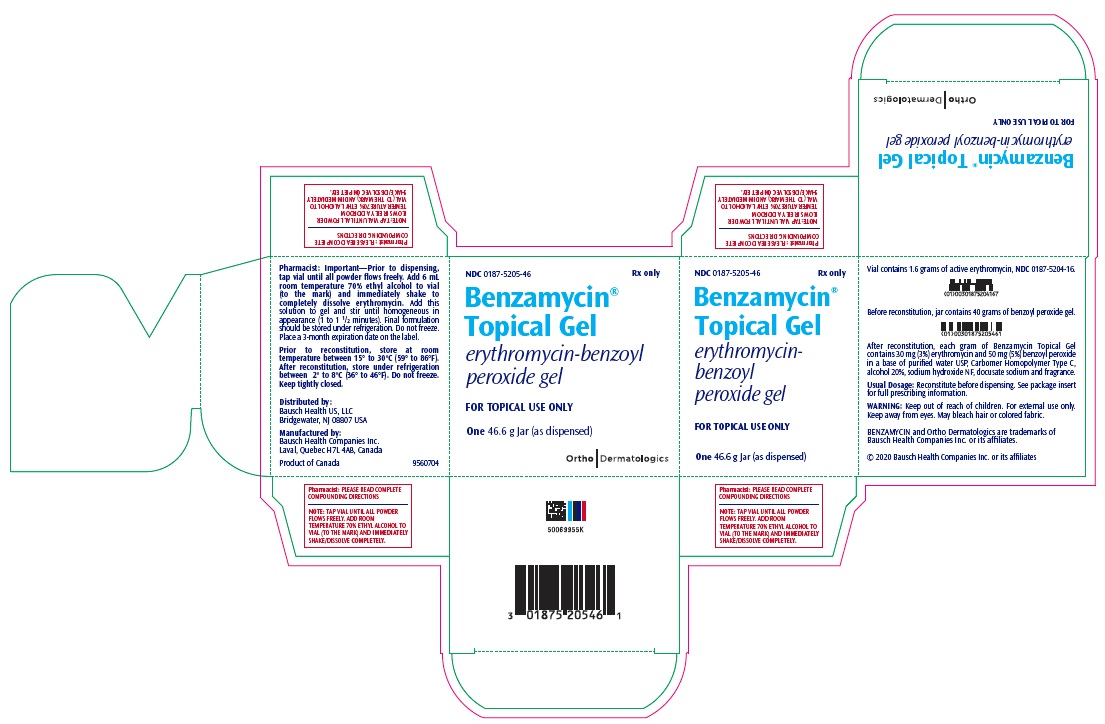
Benzamycin erythromycin and benzoyl peroxide Kit — NDC 00187-5205-46 package photo

Benzamycin erythromycin and benzoyl peroxide Kit

by Bausch Health US, LLC · 1 KIT in 1 BOX (0187-5205-46) * 1.6 g in 1 VIAL, PLASTIC * 40 g in 1 JAR
NDC 00187-5205-46
🏷️ FDA NDC (as labeled) 0187-5205-46 billing pads the labeler segment with a zero
Rx only Brand On market Non-controlled
🗂️ Data synced Jul 24, 2026 · sources: openFDA · FDA label (DailyMed) · FDA Orange & Purple Book · First Databank · CMS NADAC, ASP, Medicare & Medicaid · RxNorm
📋 All sources & update times →

🆔 Identity & classification

FDA NDC (as labeled) 0187-5205-46
Product NDC 0187-5205
11-digit billing NDC 00187520546
NCPDP billing unit GM — per gram (weight)
RxCUI 213082, 244374, 308694
Application # NDA050557
SPL Set ID c8c05e98-ec28-4636-8e5c-9a2557483e3c
DEA schedule Non-controlled
Marketing category NDA
Marketing status On market
FDA listing status Listed (active directory)
Marketing start 1984-10-26
Dosage form KIT
GPI-14 90059902104010
GPI class Benzamycin
GCN Seq No 007678
GCN 85400
HICL code 003354
Ingredient (HICL) Erythromycin/Benzoyl Peroxide
HIC1 code Q
Therapeutic class — broad (HIC1) Ear/Eye/Nose/Rectum/Topical/Vagina/Other
HIC2 code Q5
Therapeutic class — intermediate (HIC2) Agents Acting Principally On The Skin
HIC3 code Q5W
Therapeutic class — specific (HIC3) Topical Antibiotics
AHFS code 08:12.12.04
AHFS class Erythromycin Antibiotics
FDB label name BENZAMYCIN GEL
FDB brand name Benzamycin
Legend status F — Federal legend — prescription drug or device
TE code (Orange Book) AB · RLD · RS
Why two NDCs? The FDA registers this code as 0187-5205-46 — a 4-4-2 layout, and that's what's printed on the package and shown on DailyMed. For insurance claims, every NDC is standardized to a uniform 11-digit 5-4-2 format by adding a zero to the labeler segment → 00187-5205-46. Same drug, same package — only the format differs.
Where does this data come from?
Identifiers from the FDA openFDA NDC Directory and Structured Product Labeling; RxCUI from RxNorm (NLM); GPI from Medi-Span; GCN / HIC / AHFS / legend from First Databank.

🏷️ RxNorm drug class

This medicine belongs to the Peroxides class.

Drug family (ATC) Peroxides
Where does this data come from?
Therapeutic classes from RxNorm RxClass (U.S. National Library of Medicine) — Established Pharmacologic Class (FDA), ATC drug family (WHO) and mechanism of action, matched by this product’s RxCUI.

🏭 Manufacturer & labeler

LabelerBausch Health US, LLC
Application holderVALEANT INTERNATIONAL SRL
FDA applicationNDA050557 (NDA)
Labeler code00187
First marketedOct 1984
Product typeHuman Prescription Drug
Portfolio51 products on file
The labeler markets the product; the application holder owns the FDA approval. They’re often the same company but can differ (e.g. a repackager or an authorized generic). A mailing address / phone appears here when the manufacturer includes it in the product’s FDA label (not all do).
Where does this data come from?
Labeler, application holder and registered establishment from the FDA openFDA NDC Directory and Drugs@FDA; address/contact from the product’s FDA label.

🩺 Clinical

Label name BENZAMYCIN GEL Ingredient Erythromycin/Benzoyl Peroxide
📖 What it is MedlinePlus · NLM

The combination of erythromycin and benzoyl peroxide is used to treat acne. Erythromycin and benzoyl peroxide are in a class of medications called topical antibiotics. The combination of erythromycin and benzoyl peroxide works by killing the bacteria that cause acne.

Read the full MedlinePlus article ↗
Where does this data come from?
Plain-language summary from MedlinePlus (U.S. National Library of Medicine); supplement & herbal interactions and nutrient depletion data from the Natural Medicines database; our full guide is HelloPharmacist editorial content.

🧪 Inactive Ingredients / Excipients

Inactive ingredients, also called excipients, are components of the drug product other than the active ingredient. They may include fillers, dyes, coatings, preservatives, flavors, or other formulation ingredients.

A current SPL was checked, but it does not contain a structured or narrative inactive-ingredient list for this product. This does not mean the product has no inactive ingredients.
Where does this data come from?
Source: official FDA Structured Product Labeling (SPL) via DailyMed and the openFDA label index. Structured IACT rows and label-wide narrative are kept separate; availability and product-level specificity depend on the submitted label.

Inactive ingredient FAQ

Are inactive ingredients the same for every manufacturer?
No. Inactive ingredients can differ by manufacturer, dosage form, strength, and package / product version.
Why might an inactive ingredient be missing?
Some SPLs do not provide a complete structured inactive-ingredient list, and older or unusual labels may only include the information in narrative text.
Can inactive ingredients matter?
Yes. They can matter for allergies, intolerances, dyes, gluten / lactose concerns, preservatives, and formulation differences — but confirm with a pharmacist or the manufacturer when it’s clinically important.

💲 Pricing

A drug doesn't have one price. Each row is a different public payment system, and none is what you'd pay at the counter — that depends on your insurance. The ⓘ on each row explains what it measures.

Price systemPer eachPer package
Retail pharmacies payNADAC · weekly Not in the retail survey — common for institutional, discontinued, or low-volume packs.
Medicaid paysCMS SDUD · 12 mo $1.50 —
Medicare drug plans payPart D · Q2 2026 $1.32 —
Where does this data come from?
NADAC (National Average Drug Acquisition Cost) is the CMS weekly pharmacy-acquisition-cost survey — what pharmacies pay. ASP (Average Sales Price) is the CMS Medicare Part B drug-payment file, published quarterly. Medicaid pays is computed by us from CMS State Drug Utilization Data (total reimbursed ÷ units, trailing 12 months) — gross of rebates and inclusive of dispensing fees, so it reflects what Medicaid paid, not an acquisition cost. Medicare drug plans pay is the median negotiated point-of-sale unit cost across plans listing this NDC in the CMS quarterly Prescription Drug Plan pricing files, before rebates. The VA pays is the federal contract price (FSS, and the statutory Big 4 ceiling where listed) from the VA National Acquisition Center pharmaceutical price file. All are free public government data; each measures a different payer, so the figures are not directly comparable.

🔁 Therapeutic equivalents

ProductLabelerPackNADAC/unitTEStatusPrice vs. this
Erythromycin and Benzoyl Peroxide 68682-0901-46 Oceanside 1 kit $1.078 AB FDA listed —
Erythromycin and Benzoyl Peroxide 68682-0900-23 Oceanside 1 kit $1.593 AB FDA listed —
Erythromycin and Benzoyl Peroxide 30 mg/g; 50 mg/g 64980-0328-01 Rising 23.3 g $1.599 AB Availability likely —
Benzamycinthis 00187-5205-46 Bausch 1 kit — AB FDA listed —
About this product: this is the brand-name version. Some generic versions are approved by the FDA, but we could not confirm current pharmacy availability from our pricing/market data.
Where does this data come from?
Equivalents are other NDCs of the same ingredient, form and route from the openFDA NDC Directory, ranked least-expensive-first by NADAC. Therapeutic-equivalence (AB) ratings come from the FDA Orange Book; biologics use the FDA Purple Book for biosimilar & interchangeable status.

⏳ Availability & generic status

🏛️
1984
On the market since
Oct 1984
📍
2026
Currently FDA-listed
42 years listed
🔒
·
Generic approved (availability unconfirmed)
see note
🔒Generic approved by FDA, but pharmacy availability is not confirmed

The FDA lists approved generic versions of this medicine, but that does not always mean a pharmacy can get one today. Patent rules, launch agreements, supply and pricing can affect when generics actually arrive.

Where does this data come from?
Patents and exclusivity from the FDA Orange Book (small-molecule drugs), refreshed from public FDA data. Generic launch timing is an estimate, not a guarantee.

🗺️ Medicaid utilization & spend

📍 This exact package only: Medicaid data is reported per full 11-digit NDC — labeler, product and pack size — so every number here is for 00187-5205-46, not the drug overall. Other pack sizes report separately.
💊 Pharmacy benefit only: These are Medicaid outpatient pharmacy claims, billed by NDC. They exclude the medical benefit — clinic- or hospital-administered drugs billed under HCPCS J-codes — so drugs used mostly that way (e.g. Avastin, Lucentis, Keytruda) can look low or missing here. That’s expected, not an error.
📅 Q1 2025 – Q4 2025 · 4 quarters of data
ⓘ The newest quarter is usually incomplete when first published; states restate recent quarters in later CMS releases, so the latest figures typically revise upward. State coverage-policy changes can also shift quarter-to-quarter totals.
Prescriptions last 4 qtrs
279
Units reimbursed last 4 qtrs
13K
Gross reimbursed last 4 qtrs
$19.5K
Avg / prescription
$70.05
Avg / unit
$1.5032
Latest quarter Q4 2025
14Rx
Fee-for-service vs managed care ⓘ
100% FFS
Fee-for-service · 279 Rx Managed care · 0 Rx
State Medicaid map
Alaska: no data reported AK Maine: no data reported ME Washington: no data reported WA Idaho: no data reported ID Montana: no data reported MT North Dakota: no data reported ND Minnesota: no data reported MN Wisconsin: no data reported WI Michigan: no data reported MI New York: no data reported NY Vermont: no data reported VT New Hampshire: no data reported NH Oregon: no data reported OR Nevada: no data reported NV Wyoming: no data reported WY South Dakota: no data reported SD Iowa: no data reported IA Illinois: no data reported IL Indiana: no data reported IN Ohio: no data reported OH Pennsylvania: no data reported PA New Jersey: no data reported NJ Massachusetts: no data reported MA California: 559 units · 1.4 per 100k residents CA Utah: no data reported UT Colorado: no data reported CO Nebraska: no data reported NE Missouri: no data reported MO Kentucky: no data reported KY West Virginia: 12,442 units · 703 per 100k residents WV Virginia: no data reported VA Maryland: no data reported MD Connecticut: no data reported CT Rhode Island: no data reported RI Arizona: no data reported AZ New Mexico: no data reported NM Kansas: no data reported KS Arkansas: no data reported AR Tennessee: no data reported TN North Carolina: no data reported NC South Carolina: no data reported SC Delaware: no data reported DE Oklahoma: no data reported OK Louisiana: no data reported LA Mississippi: no data reported MS Alabama: no data reported AL Georgia: no data reported GA D.C.: no data reported DC Hawaii: no data reported HI Texas: no data reported TX Florida: no data reported FL
Units reimbursed · per 100k residents
1.4703
gray = no data reported ⓘ
Colors are per 100,000 residents, so big states don’t automatically dominate. Tap or hover a state for its actual totals.
Tap or hover a state
…for its Medicaid breakdown
🏆 Top states by units · per 100k residents
1 West Virginia 703 /100k
2 California 1.4 /100k
National units — by quarter
💵 About the dollar figures: “reimbursed” is what Medicaid paid pharmacies before confidential manufacturer rebates, so the program’s real net cost is lower than these numbers. Fee-for-service and managed-care claims are combined unless split above. Source: CMS State Drug Utilization Data; per-100k rates use 2023 Census population estimates.

📊 Medicare Part D spend CMS · PART D · 2025 (Q1-Q4)

Medicare Part D (outpatient prescription) spending for Benzamycin — the program that covers self-administered drugs. 1 manufacturer.
⚠️ Drug-level data: CMS publishes Part D spending by drug, not by NDC — these figures combine every manufacturer, strength and package size sold under the name Benzamycin. That’s a different level of aggregation than the Medicaid card above, which is specific to this exact 11-digit NDC (pack size included), so the two aren’t directly comparable.
Total Part D spend
$954.74
Claims incl. refills
12
Beneficiaries
—
Spend / beneficiary
—
Spend / claim
$79.56
💵 About the dollar figures: spending is what Part D plans paid before confidential manufacturer rebates, so the program’s real net cost is lower. A blank patient count means fewer than 11 people — CMS hides counts that small to protect privacy. Source: CMS Medicare Quarterly Part D Spending by Drug (data.cms.gov), updated quarterly.

📦 Packaging — all sizes for this product

Package NDCDescription Marketing startStatus
00187-5205-46 You're viewing this 1 KIT in 1 BOX (0187-5205-46) * 1.6 g in 1 VIAL, PLASTIC * 40 g in 1 JAR 1984-10-26 Active

🧭 About this NDC listing & data coverage

Finished prescription product Kit / multi-component package

Kit / multi-component package

This NDC identifies a kit — a package containing more than one component. Structured data (pricing, ingredients, equivalents) is often reported per component rather than for the kit NDC itself, which can make this page look thinner than the components' own pages.

What data is (and isn’t) available for this NDC — tap to expand
NDC identity (package / product / labeler codes) ✓ Available
Labeler ✓ Available
Product & package description ✓ Available
Marketing category & status ✓ Available
Active ingredient / dosage form / route ✓ Available
FDA label (SPL via DailyMed) ✓ Available
Package photos ✓ Available
Inactive ingredients (structured) — Not published for this NDC The labeler did not submit a structured excipient list, or no SPL is available.
NADAC pharmacy acquisition price (CMS) — Not published for this NDC CMS publishes NADAC only for NDCs reported in its retail-pharmacy survey.
Orange Book / therapeutic-equivalence data ✓ Available
HCPCS J-code billing crosswalk — Not published for this NDC Most self-administered / retail products have no J-code — that is normal.
Medicaid utilization (CMS SDUD) ✓ Available
“Not published” reflects what the public FDA / CMS / NLM sources provide for this exact package code — it is a property of the data feeds, not a judgment about the product.

Questions about this listing

Why is there no price listed?
The pricing shown on our NDC pages comes from CMS NADAC, a voluntary survey of retail community pharmacy invoices. CMS does not publish a NADAC for every NDC — packages outside the retail survey (institutional and hospital products, bulk packages, discontinued items, and many OTC items) may never receive one. A missing price reflects the survey's scope, not this product's actual cost, and does not mean the product is free or unavailable.
Is the NDC printed on the package the same as the 11-digit billing NDC?
Yes, they identify this exact package in different formats. The FDA registers it as 0187-5205-46, which is what is printed on the packaging and shown on DailyMed. Insurance claims use a fixed 11-digit 5-4-2 format, so the short segment is padded with a leading zero: 00187-5205-46, written without dashes as 00187520546. The Identity section at the top of this page lists every form of this code.
What do the three segments of this NDC mean?
In 00187-5205-46, the first segment (00187) is the labeler code FDA assigned to Bausch Health US, LLC; the middle segment (5205) identifies this specific product — its ingredient, strength, and dosage form; and the last segment (46) identifies this exact package size and type. Together they name one specific package of one specific product.
Is this package still being marketed?
Yes, per the latest FDA NDC Directory data on this page: this package is listed as actively marketed, with no marketing end date reported by Bausch Health US, LLC. Listing status can change — the directory data on this page refreshes weekly.
Who lists this product with the FDA?
Bausch Health US, LLC is the labeler of record for this NDC — the company under whose FDA-assigned code the package is listed. The labeler may be the manufacturer itself or a distributor marketing the product under its own code.
Do I need a prescription for this product?
This NDC is listed with FDA as a prescription product, so it is dispensed under a prescriber's order. Your pharmacist can tell you whether any over-the-counter forms of the same medication exist.
This page identifies an FDA-listed package (the NDC) and reports public regulatory and pricing data about the listing. It is reference information, not a medical recommendation — talk to your pharmacist or prescriber about your own medication.
Where does this data come from?
Listing facts (marketing category, packager status, marketing dates) from the FDA openFDA NDC Directory; label availability from DailyMed; pricing coverage from CMS NADAC; equivalence scope from the FDA Orange Book.

📄 Full prescribing information FDA SPL

The complete FDA label for this product — the official prescribing information, verbatim, section by section. Jump with a chip, search within the label, or expand everything.
🎯 Indications and Usage 15 words ▾

INDICATIONS AND USAGE Benzamycin Topical Gel is indicated for the topical treatment of acne vulgaris.

⏱️ Dosage and Administration 37 words ▾

DOSAGE AND ADMINISTRATION Benzamycin Topical Gel should be applied twice daily, morning and evening, or as directed by a physician, to affected areas after the skin is thoroughly washed, rinsed with warm water and gently patted dry.

⛔ Contraindications 18 words ▾

CONTRAINDICATIONS Benzamycin Topical Gel is contraindicated in those individuals who have shown hypersensitivity to any of its components.

⚠️ Warnings 130 words ▾

WARNINGS Pseudomembranous colitis has been reported with nearly all antibacterial agents, including erythromycin, and may range in severity from mild to life-threatening. Therefore, it is important to consider this diagnosis in patients who present with diarrhea subsequent to the administration of antibacterial agents. Treatment with antibacterial agents alters the normal flora of the colon and may permit overgrowth of clostridia.

Studies indicate that a toxin produced by Clostridium difficile is one primary cause of “antibiotic-associated colitis”. After the diagnosis of pseudomembranous colitis has been established, therapeutic measures should be initiated. Mild cases of pseudomembranous colitis usually respond to drug discontinuation alone.

In moderate to severe cases, consideration should be given to management with fluids and electrolytes, protein supplementation and treatment with an antibacterial drug clinically effective against C. difficile colitis.

🤒 Adverse Reactions 90 words ▾

ADVERSE REACTIONS In controlled clinical trials, the incidence of adverse reactions associated with the use of Benzamycin Topical Gel was approximately 3%. These were dryness and urticarial reaction. The following additional local adverse reactions have been reported occasionally: irritation of the skin including peeling, itching, burning sensation, erythema, inflammation of the face, eyes and nose, and irritation of the eyes.

Skin discoloration, oiliness and tenderness of the skin have also been reported. To report SUSPECTED ADVERSE REACTIONS, contact Bausch Health US, LLC at 1-800-321-4576 or FDA at 1-800-FDA-1088 or www.fda.gov/medwatch.

🤰 Pregnancy 104 words ▾

Pregnancy: Teratogenic Effects: Animal reproduction studies have not been conducted with Benzamycin Topical Gel or benzoyl peroxide. There was no evidence of teratogenicity or any other adverse effect on reproduction in female rats fed erythromycin base (up to 0.25% diet) prior to and during mating, during gestation and through weaning of two successive litters. There are no well-controlled trials in pregnant women with Benzamycin Topical Gel.

It also is not known whether Benzamycin Topical Gel can cause fetal harm when administered to a pregnant woman or can affect reproductive capacity. Benzamycin Topical Gel should be given to a pregnant woman only if clearly needed.

🧒 Pediatric Use 20 words ▾

Pediatric Use: Safety and effectiveness of this product in pediatric patients below the age of 12 have not been established.

🧬 Clinical Pharmacology 66 words ▾

CLINICAL PHARMACOLOGY The exact mechanism by which erythromycin reduces lesions of acne vulgaris is not fully known; however, the effect appears to be due in part to the antibacterial activity of the drug. Benzoyl peroxide has a keratolytic and desquamative effect which may also contribute to its efficacy. Benzoyl peroxide has been shown to be absorbed by the skin where it is converted to benzoic acid.

📦 How Supplied / Storage and Handling 140 words ▾

How Supplied and Compounding Directions: Size Benzoyl Peroxide Gel Active Erythromycin Powder (In Plastic Vial) 70% Ethyl Alcohol To Be Added (Net Weight) NDC 46.6 grams 0187-5205-46 40 grams 1.6 grams 6 mL (as dispensed) Prior to dispensing, tap vial until all powder flows freely. Add indicated amount of room temperature 70% ethyl alcohol to vial (to the mark) and immediately shake to completely dissolve erythromycin. Add this solution to gel and stir until homogeneous in appearance (1 to 1½ minutes).

Benzamycin Topical Gel should then be stored under refrigeration. Do not freeze. Place a 3-month expiration date on the label.

NOTE: Prior to reconstitution, store at room temperature between 15° to 30°C (59° to 86°F). After reconstitution, store under refrigeration between 2° to 8°C (36° to 46°F). Do not freeze.

Keep tightly closed. Keep out of reach of children.

📋 Description 201 words ▾

DESCRIPTION Benzamycin ® Topical Gel contains erythromycin [(3R*,4S*,5S*,6R*, 7R*, 9R*, 11R*, 12R*, 13S*, 14R*)-4-[(2,6-Dideoxy-3- C -methyl-3- O -methyl-α-L- ribo -hexopyranosyl)-oxy]-14-ethyl-7,12,13-trihydroxy-3,5,7,9,11,13-hexamethyl-6-[[3,4,6-trideoxy-3-(dimethylamino)-β-D- xylo -hexopyranosyl]oxy]oxacyclotetradecane-2,10-dione]. Erythromycin is a macrolide antibiotic produced from a strain of Saccharopolyspora erythraea (formerly Streptomyces erythreus ). It is a base and readily forms salts with acids.

Chemically erythromycin is C 37 H 67 NO 13 . It has the following structural formula: Erythromycin has the molecular weight of 733.94. It is a white crystalline powder and has a solubility of approximately 1 mg/mL in water and is soluble in alcohol at 25°C.

Benzamycin Topical Gel also contains benzoyl peroxide for topical use. Benzoyl peroxide is an antibacterial and keratolytic agent. Chemically benzoyl peroxide is C 14 H 10 O 4 .

It has the following structural formula: Benzoyl peroxide has the molecular weight of 242.23. It is a white granular powder and is sparingly soluble in water and alcohol and soluble in acetone, chloroform and ether. Each gram of Benzamycin Topical Gel contains, as dispensed, 30 mg (3%) of erythromycin and 50 mg (5%) of benzoyl peroxide in a base of purified water USP, Carbomer Homopolymer Type C, alcohol 20%, sodium hydroxide NF, docusate sodium and fragrance. chemstructure.jpg structuralform.jpg

💬 Information for Patients 110 words ▾

Information for Patients: Patients using Benzamycin Topical Gel should receive the following information and instructions: 1. This medication is to be used as directed by the physician. It is for external use only.

Avoid contact with the eyes, nose, mouth, and all mucous membranes. 2. This medication should not be used for any disorder other than that for which it was prescribed.

3. Patients should not use any other topical acne preparation unless otherwise directed by their physician. 4.

Patients should report to their physician any signs of local adverse reactions. 5. Benzamycin Topical Gel may bleach hair or colored fabric.

6. Keep product refrigerated and discard after 3 months.

Source: FDA Structured Product Labeling, mirrored from DailyMed / openFDA. Prefer the government’s original formatting? View this label on DailyMed ↗
For educational and professional reference only — not medical advice. Pricing reflects published NADAC and CMS ASP (free public data) and may differ from your acquisition cost; always verify before billing or dispensing.