
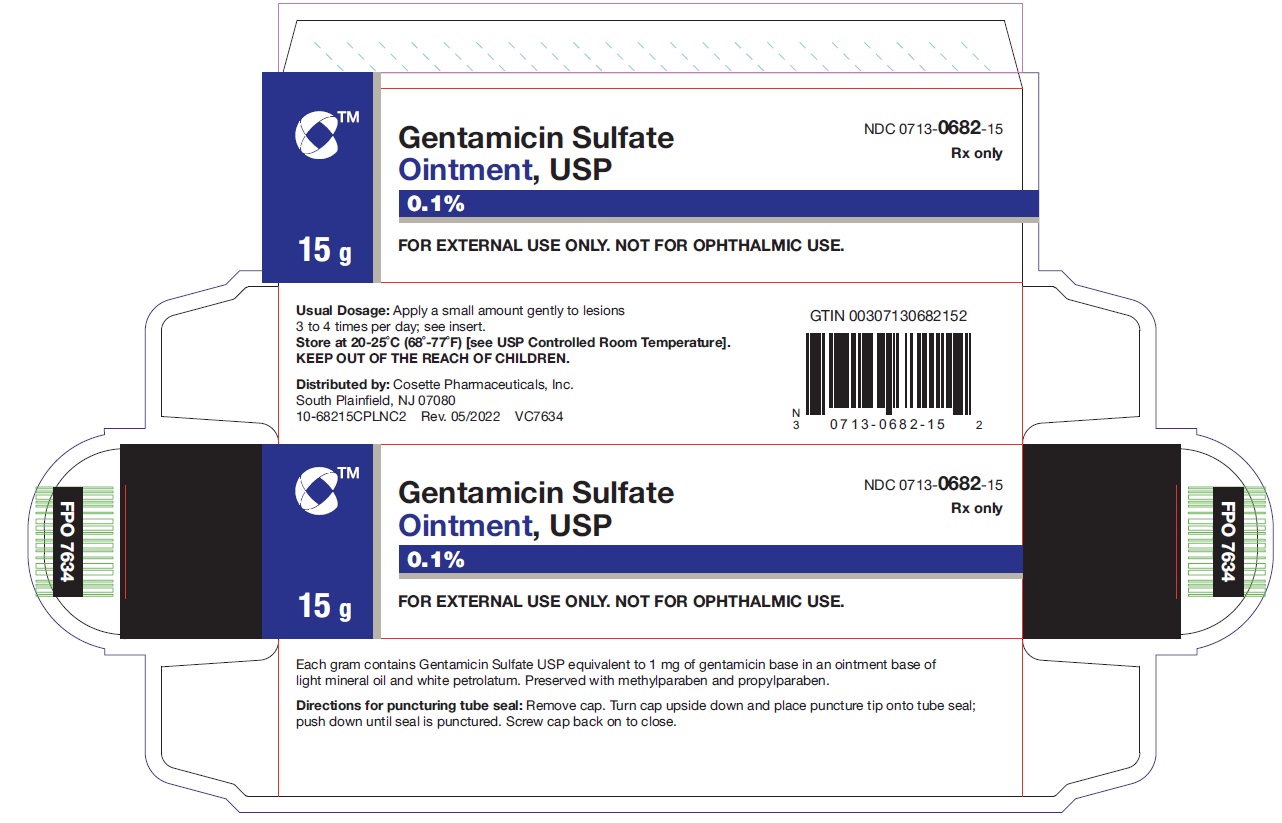
Gentamicin Sulfate 1 mg/g Ointment — NDC 0713-0682-15 (Billing 00713-0682-15)
This is a package of Gentamicin Sulfate 1 mg/g Ointment from Cosette Pharmaceuticals, Inc., marketed since Nov 2014 and currently FDA-listed; retail pharmacies pay about $0.9407 per g (NADAC). It is the main listing for this product, which comes in 2 package sizes.
NDC database record
One package, one record: these facts belong to NDC 0713-0682-15 alone.
- Record
- FDA NDC Directory package listing · Human prescription drug
- Code segments
- 0713 labeler · 0682 product · 15 package
- Package marketed since
- Dec 21, 2017
- Sample package
- No — commercial package
- Listing certified through
- Dec 31, 2026
- Barcode (UPC-A, from the NDC)
- 3 0713068215 2
- Medicaid fills, this package
- 8,457 prescriptions in the last four reported quarters
- FDA record last changed
- Jul 24, 2026
Identity & classification
Regulatory identifiers FDA, NLM and CMS codes for this package
Drug-database identifiers Medi-Span GPI and First Databank GCN / HICL / AHFS classification
- GSN (GCN sequence number): 007725
- GCN: 31800
- GPI-14 (Medi-Span): 90100050104205
- HICL (First Databank): 004032
- AHFS class code: 08:12.02.00
- RxCUI (RxNorm): 310465
Where does this data come from?
- FDA openFDA NDC Directory · synced Oct 8, 2026
- FDA label on DailyMed · label index refreshed Oct 8, 2026
- RxNorm (NLM RxNav) · catalog refreshed Oct 1, 2026
- Medi-Span GPI (licensed)
- First Databank (licensed) · refreshed Oct 8, 2026
RxNorm drug class
This medicine belongs to the Aminoglycoside Antibacterial class.
Where does this data come from?
- RxClass (NLM) · catalog refreshed Oct 1, 2026
Clinical
Topical gentamicin is used in adults and children 1 year of age and older to treat skin infections caused by certain bacteria. Topical gentamicin is in a class of medications called antibiotics. It works by killing bacteria that cause infections.
Read the full MedlinePlus article ↗- Gentamicin topical is used for a wide range of bacterial skin infections. That includes common ones like impetigo, boils, infected eczema, infected cuts or scrapes, pustular acne,...
- What kinds of skin infections does gentamicin topical actually treat?
- It depends on the type of skin involved. The cream is better for wet, oozy infections or greasy conditions like infected seborrheic dermatitis or pustular acne — and it's also easi...
- Apply a small amount to the affected area three to four times a day. You can cover it with a gauze dressing afterward if you'd like. If you're treating impetigo, gently remove any...
Patient education
Supplement & herbal interactions
Gentamicin (IV) may be associated with lower levels of 8 nutrients — worth a chat with your pharmacist, not a cause for alarm.
Where does this data come from?
- MedlinePlus (NLM) · refreshed Oct 8, 2026
- FDA label on DailyMed · label index refreshed Oct 8, 2026
Ask a licensed pharmacist directly — free, answered by our team.
Pricing
A drug doesn't have one price. Each row is a different public payment system, and none is what you'd pay at the counter — that depends on your insurance. The ⓘ on each row explains what it measures.
| Price system | Per g | Per package |
|---|---|---|
| Retail pharmacies payNADAC · weekly | $0.941 | $14.11 / 15 g |
| Medicaid paysCMS SDUD · 12 mo | $1.41 | $21.19 / 15 g |
| Medicare drug plans payPart D · Q2 2026 | $1.44 | $21.62 / 15 g |
Where does this data come from?
- CMS NADAC weekly file · file of Oct 7, 2026
- CMS ASP pricing files · refreshed Sep 20, 2026
- CMS Medicaid State Drug Utilization Data · through Q1 2026
- CMS Part D plan pricing files · refreshed Sep 24, 2026
- VA National Acquisition Center price file
Packaging — all sizes for this product
| Package NDC | Description | Per unit | Per pack | Marketing start | Marketing end | Status |
|---|---|---|---|---|---|---|
| 00713-0682-15 You're viewing this Main listing | 1 TUBE in 1 CARTON / 15 g in 1 TUBE | $0.9407 / g | $14.11 | 2017-12-21 | — | Active |
| 00713-0682-31 0713-0682-31 | 1 TUBE in 1 CARTON / 30 g in 1 TUBE | $0.7705 / g | $23.12 | 2017-12-21 | — | Active |
Per g, this pack runs about 22% above the cheapest pack (NDC 00713-0682-31, $0.7705 vs $0.9407 NADAC).
In Medicaid, this is the most-dispensed pack of this product — about 55% of fills over the last four reported quarters. See all packs ↓
Pack size FAQ
What quantity is in this package?
What NDC number is used to bill for this package of Gentamicin Sulfate 1 mg/g Ointment?
Prices are the latest CMS NADAC pharmacy acquisition cost per NDC; per-pack figures are per-unit × pack quantity, shown only when the pack is denominated in the same measure NADAC prices.
Therapeutic equivalents
| Product | Labeler | Pack | NADAC/unit | TE | Status | Price vs. this |
|---|---|---|---|---|---|---|
| Gentamicin Sulfate 1 mg/g 45802-0046-11 | Padagis | 1 tube | $0.771 | AT | Availability likely | save 18% |
| Gentamicin Sulfate 1 mg/g 00713-0683-15 | Cosette | 1 tube | $0.884 | AT | Availability likely | save 6% |
| Gentamicin Sulfate 1 mg/g 45802-0056-11 | Padagis | 1 tube | $0.887 | AT | Availability likely | save 6% |
| Gentamicin Sulfate 1 mg/gthis 00713-0682-15 | Cosette | 1 tube | $0.941 | AT | Availability likely | — |
| Gentamicin Sulfate 1 mg/g 71205-0560-15 | Proficient | 1 tube | — | AT | FDA listed | — |
| Gentamicin Sulfate 1 mg/g 21922-0110-04 | Encube | 1 tube | — | — | FDA listed | — |
Where does this data come from?
- FDA openFDA NDC Directory · synced Oct 8, 2026
- FDA Orange Book · refreshed Oct 3, 2026
- CMS NADAC weekly file · file of Oct 7, 2026
Availability & generic status
This product is an FDA-approved generic. Other versions of the same drug are listed under Therapeutic equivalents, least expensive first.
Where does this data come from?
- FDA Orange Book · refreshed Oct 3, 2026
Inactive Ingredients / Excipients
Inactive ingredients, also called excipients, are components of the drug product other than the active ingredient. They may include fillers, dyes, coatings, preservatives, flavors, or other formulation ingredients.
🧪 Avoiding an ingredient? See Gentamicin Topical inactive ingredients by manufacturer: every current product's list side by side, so you can ask your pharmacy for the version that does not list it.
💡 Tap an ingredient (hover on desktop) to see what it is and why it’s used.
-
UNII N6K5787QVP
Light mineral oil is a clear, odorless liquid derived from petroleum. In medicines, it acts as a lubricant and emollient to help the product spread smoothly and improve texture.
-
UNII A2I8C7HI9T
Methylparaben is a preservative derived from benzoic acid that prevents growth of bacteria, fungi, and mold in medicines. It extends the product's shelf life and maintains safety during storage.
-
UNII 4T6H12BN9U
Petrolatum is a purified mineral oil-based jelly derived from petroleum. In medicines, it acts as an emollient, lubricant, and moisture barrier to soften skin, reduce friction, and help prevent water loss from formulations.
-
UNII Z8IX2SC1OH
Propylparaben is a chemical preservative used to prevent bacterial and fungal growth in medicines and personal care products. It helps extend shelf life and maintain product safety during storage.
4 inactive ingredients listed in the exact product block matched to this NDC.
Where does this data come from?
ingredient classCode="IACT" elements from the exact product block matched by this NDC. Label-section narrative from DailyMed / the openFDA label index is shown separately when available.- FDA label on DailyMed · label index refreshed Oct 8, 2026
- FDA openFDA NDC Directory · synced Oct 8, 2026
Inactive ingredient FAQ
Are inactive ingredients the same for every manufacturer?
Why might an inactive ingredient be missing?
Can inactive ingredients matter?
Manufacturer & labeler
More NDCs from Cosette Pharmaceuticals, Inc. labeler code 00713
- Desonide .5 mg/g Cream NDC 0713-0661-15
- Fluocinonide .5 mg/g Cream NDC 0713-0663-15
- Fluocinonide .5 mg/g Cream NDC 0713-0664-15
- Tazarotene 1 mg/g Cream NDC 0713-0670-31
- Triamcinolone Acetonide 1 mg/mL Lotion NDC 0713-0676-53
- Nystatin 100000 [USP'U]/g Cream NDC 0713-0678-15
- Gentamicin Sulfate 1 mg/g Cream NDC 0713-0683-15
- Nystatin 100000 [USP'U]/g Ointment NDC 0713-0686-15
- Fluocinolone Acetonide .25 mg/g Cream NDC 0713-0709-15
- Hydrocortisone Valerate 2 mg/g Cream NDC 0713-0720-15
- Tazarotene .5 mg/g Cream NDC 0713-0765-31
- Promethazine Hydrochloride and Dextromethorphan Hydrobromide 6.25 mg/5mL; 15 mg/5mL Solution NDC 0713-0780-75
Where does this data come from?
- FDA openFDA NDC Directory · synced Oct 8, 2026
- Drugs@FDA
Full prescribing information FDA SPL
🎯 Indications and Usage ▾
INDICATIONS AND USAGE Primary skin infections: Impetigo contagiosa, superficial folliculitis, ecthyma, furunculosis, sycosis barbae, and pyoderma gangrenosum. Secondary skin infections: Infectious eczematoid dermatitis, pustular acne, pustular psoriasis, infected seborrheic dermatitis, infected contact dermatitis (including poison ivy), infected excoriations, and bacterial superinfections of fungal or viral infections. NOTE: Gentamicin Sulfate is a bactericidal agent that is not effective against viruses or fungi in skin infections.
It is useful in the treatment of infected skin cysts and certain other skin abscesses when preceded by incision and drainage to permit adequate contact between the antibiotic and the infecting bacteria. Good results have been obtained in the treatment of infected stasis and other skin ulcers, infected superficial burns, paronychia, infected insect bites and stings, infected lacerations and abrasions and wounds from minor surgery. Patients sensitive to neomycin can be treated with Gentamicin Sulfate, although regular observation of patients sensitive to topical antibiotics is advisable when such patients are treated with any topical antibiotic.
Gentamicin sulfate cream is recommended for wet, oozing primary infections, and greasy, secondary infections, such as postular acne or infected seborrheic dermatitis. Gentamicin Sulfate Ointment, USP 0.1% helps retain moisture and has been useful in infection on dry eczematous or psoriatic skin. Gentamicin Sulfate Ointment, USP 0.1% has been used successfully in infants over one year of age as well as in adults and children.
⏱️ Dosage and Administration ▾
DOSAGE AND ADMINISTRATION A small amount of Gentamicin Sulfate Ointment, USP 0.1% should be applied gently to lesions three to four times a day. The area treated may be covered with a gauze dressing, if desired. In impetigo contagiosa, the crusts should be removed before application of Gentamicin Sulfate Ointment, USP 0.1% to permit maximum contact between the antibiotic and the infection.
Care should be exercised to avoid further contamination of the infected skin. Infected stasis ulcers have responded well to Gentamicin Sulfate under gelatin packing.
⛔ Contraindications ▾
CONTRAINDICATIONS Gentamicin Sulfate Ointment, USP 0.1% is contraindicated in individuals with a history of sensitivity reactions to any of its components.
🤒 Adverse Reactions ▾
ADVERSE REACTIONS In patients with dermatoses treated with Gentamicin Sulfate, irritation (erythema and pruritus) that did not usually require discontinuance of treatment has been reported in a small percentage of cases. There was no evidence of irritation or sensitization, however, in any of these patients patch-tested subsequently with gentamicin on normal skin. Possible photosensitization has been reported in several patients but could not be elicited in these patients by reapplication of gentamicin followed by exposure to ultraviolet radiation.
To report SUSPECTED ADVERSE REACTIONS, contact Cosette Pharmaceuticals, Inc. at 1-800-922-1038 or FDA at 1-800-FDA-1088 or www.fda.gov/medwatch.
🧬 Clinical Pharmacology ▾
CLINICAL PHARMACOLOGY Gentamicin Sulfate is a wide spectrum antibiotic that provides highly effective topical treatment in primary and secondary bacterial infections of the skin. This product may clear infections that have not responded to other topical antibiotic agents. In impetigo contagiosa and other primary skin infections, treatment with a small amount of Gentamicin Sulfate Ointment three to four times daily usually clears the lesions promptly.
In secondary skin infections, the product facilitates the treatment of the underlying dermatosis by controlling the infection. Bacteria susceptible to the action of Gentamicin Sulfate include sensitive strains of Streptococci (group A beta-hemolytic, alphahemolytic), Staphylococcus aureus (coagulase positive, coagulase negative, and some penicillinase-producing strains), and the gram-negative bacteria, Pseudomonas aeruginosa, Aerobacteraerogens, Escherichia coli, Proteus vulgaris and Klebsiellapneumoniae.
📦 How Supplied / Storage and Handling ▾
HOW SUPPLIED Gentamicin Sulfate Ointment, USP 0.1% is available as follows: 15 g tube (NDC 0713- 0682 -15) 30 g tube (NDC 0713- 0682 -31) STORAGE Store at 20-25°C (68-77°F) [see USP Controlled Room Temperature]. Distributed by: Cosette Pharmaceuticals, Inc. South Plainfield, NJ 07080 Rev. 05/2022 8-0682CPLNC2 VC7635
📋 Description ▾
DESCRIPTION Gentamicin Sulfate Ointment, USP 0.1% is a wide spectrum antibiotic preparation for topical administration. Each gram of Gentamicin Sulfate Ointment, USP 0.1% contains Gentamicin Sulfate USP equivalent to 1 mg of gentamicin base in a base of light mineral oil and white petrolatum, with 0.5 mg methylparaben and 0.1 mg propylparaben as preservatives.
⚠️ Precautions ▾
PRECAUTIONS Use of topical antibiotics occasionally allows overgrowth of nonsusceptible organisms, including fungi. If this occurs, or if irritation, sensitization, or superinfection develops, treatment with Gentamicin Sulfate Ointment, USP 0.1% should be discontinued and appropriate therapy instituted.
📄 Package Label / Principal Display Panel ▾
PRINCIPAL DISPLAY PANEL NDC 0713-0682-15 Gentamicin Sulfate Ointment, USP 0.1% 15 g Rx only FOR EXTERNAL USE ONLY. NOT FOR OPHTHALMIC USE. Cosette Pharmaceuticals, Inc. NDC 0713-0682-31 Gentamicin Sulfate Ointment, USP 0.1% 30 g Rx only FOR EXTERNAL USE ONLY. NOT FOR OPHTHALMIC USE. Cosette Pharmaceuticals, Inc. 15 g Carton 30 g Carton