
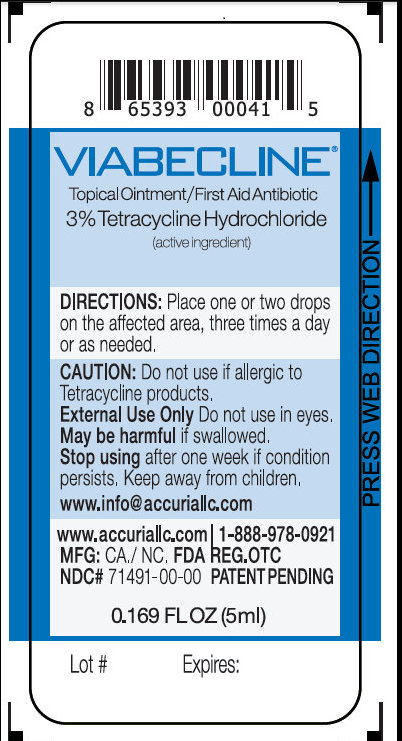
Viabecline TETRACYCLINE HYDROCHLORIDE 30 mg/mL Ointment, 5 mL — NDC 71491-100-00 (Billing 71491-0100-00)
This is a package of 5 mL of Viabecline TETRACYCLINE HYDROCHLORIDE 30 mg/mL Ointment from Accuria, LLC, marketed since Jun 2017 and currently FDA-listed. It is the main listing for this product, which comes in 2 package sizes.
NDC database record
One package, one record: these facts belong to NDC 71491-100-00 alone.
- Record
- FDA NDC Directory package listing · Human OTC drug
- Code segments
- 71491 labeler · 100 product · 00 package
- Package marketed since
- Jun 15, 2017
- Sample package
- No — commercial package
- Listing certified through
- Dec 31, 2026
- Barcode (UPC-A, from the NDC)
- 3 7149110000 6
- FDA record last changed
- Jul 24, 2026
Identity & classification
Regulatory identifiers FDA, NLM and CMS codes for this package
Drug-database identifiers Medi-Span GPI and First Databank GCN / HICL / AHFS classification
- GSN (GCN sequence number): 077679
- GCN: 43776
- HICL (First Databank): 004003
- AHFS class code: 08:12.24.00
- RxCUI (RxNorm): 1542813
Where does this data come from?
- FDA openFDA NDC Directory · synced Oct 8, 2026
- FDA label on DailyMed · label index refreshed Oct 8, 2026
- RxNorm (NLM RxNav) · catalog refreshed Oct 1, 2026
- Medi-Span GPI (licensed)
- First Databank (licensed) · refreshed Oct 8, 2026
RxNorm drug class
This medicine belongs to the Tetracycline-class Antimicrobial class.
Where does this data come from?
- RxClass (NLM) · catalog refreshed Oct 1, 2026
Clinical
- The tablets and capsules treat certain bacterial infections, such as respiratory, skin and chlamydia infections, when the bacteria are susceptible. Topical products are first aid t...
- Swallow them with a full glass of water, and don't take them right before lying down. That helps prevent irritation of your esophagus. Food, dairy and antacids can block absorption...
- How should I take the capsules or tablets?
- Stomach upset is most common, including nausea, vomiting, diarrhea and loss of appetite. You may also burn more easily in the sun, so cover up. Call your doctor for severe diarrhea...
Patient education
Supplement & herbal interactions
Tetracycline may be associated with lower levels of 11 nutrients — worth a chat with your pharmacist, not a cause for alarm.
Where does this data come from?
- MedlinePlus (NLM) · refreshed Oct 8, 2026
- FDA label on DailyMed · label index refreshed Oct 8, 2026
Ask a licensed pharmacist directly — free, answered by our team.
Pricing
A drug doesn't have one price. Each row is a different public payment system, and none is what you'd pay at the counter — that depends on your insurance. The ⓘ on each row explains what it measures.
| Price system | Per g | Per package |
|---|---|---|
| Retail pharmacies payNADAC · weekly | Not in the retail survey — common for institutional, discontinued, or low-volume packs. | |
| Medicaid paysCMS SDUD · 12 mo | No recent Medicaid claims on file for this NDC — rare and low-volume NDCs are suppressed in the public data. | |
| Medicare drug plans payPart D · quarterly | No Part D plan price is available for this NDC in our data. | |
Where does this data come from?
- CMS NADAC weekly file
- CMS ASP pricing files · refreshed Sep 20, 2026
- CMS Medicaid State Drug Utilization Data · refreshed Oct 8, 2026
- CMS Part D plan pricing files · refreshed Sep 24, 2026
- VA National Acquisition Center price file
Packaging — all sizes for this product
| Package NDC | Description | Marketing start | Marketing end | Status |
|---|---|---|---|---|
| 71491-0100-00 You're viewing this Main listing | 5 mL in 1 BOTTLE, DROPPER | 2017-06-15 | — | Active |
| 71491-0100-01 71491-100-01 | 15 mL in 1 BOTTLE, DROPPER | 2017-06-15 | — | Active |
You're viewing the smallest of 2 pack sizes for this product.
Pack size FAQ
What quantity is in this package?
How does this package differ from NDC 71491-0100-01?
What NDC number is used to bill for this package of Viabecline TETRACYCLINE HYDROCHLORIDE 30 mg/mL Ointment?
Therapeutic equivalents
| Product | Labeler | Pack | NADAC/unit | TE | Status | Price vs. this |
|---|---|---|---|---|---|---|
| Vitastem 30 mg/mL 71262-0002-00 | ViaDerma | 1 bottle | — | — | Discontinued | — |
| Tetracyte Topical Tetracycline Hydrochloride 30 mg/mL 71262-0009-01 | VIADERMA | 1 bottle | — | — | FDA listed | — |
| Tetracyte First Aid and Antibiotic Topical 30 mg/g 71262-0011-01 | VIADERMA | 1 bottle | — | — | FDA listed | — |
| Vitastem First Aid Antibiotic 30 mg/g 71262-0012-01 | VIADERMA | 1 bottle | — | — | FDA listed | — |
| Viabecline 30 mg/mLthis 71491-0100-00 | Accuria, | 5 ml | — | — | FDA listed | — |
| Honestly Battleborn First Aid for Real Man 30 mg/g 85494-0001-01 | HONESTLY | 1 bottle | — | — | FDA listed | — |
Where does this data come from?
- FDA openFDA NDC Directory · synced Oct 8, 2026
- FDA Orange Book · refreshed Oct 3, 2026
- CMS NADAC weekly file
Availability & generic status
We did not find an FDA-approved generic match for this exact strength, form and route.
Where does this data come from?
- FDA Orange Book · refreshed Oct 3, 2026
Inactive Ingredients / Excipients
Inactive ingredients, also called excipients, are components of the drug product other than the active ingredient. They may include fillers, dyes, coatings, preservatives, flavors, or other formulation ingredients.
🧪 Avoiding an ingredient? See Tetracycline inactive ingredients by manufacturer: every current product's list side by side, so you can ask your pharmacy for the version that does not list it.
💡 Tap an ingredient (hover on desktop) to see what it is and why it’s used.
-
UNII Q40Q9N063P
Acetic acid is a weak organic acid commonly used in medicines as a buffer and pH adjuster. It helps maintain the proper acidity level to ensure the drug remains stable and effective in its formulation.
-
UNII PQ6CK8PD0R
Ascorbic acid, also known as vitamin C, is a white crystalline powder. It serves as an antioxidant to prevent degradation of other ingredients and may also function as a preservative in the formulation.
-
UNII MOR84MUD8E
Chlorhexidine digluconate is an antimicrobial compound added to some medicines as a preservative to prevent bacterial and fungal growth, extending shelf life and maintaining product safety.
-
UNII 1C6V77QF41
Cholecalciferol is vitamin D3, a fat-soluble vitamin added to medicines as a nutritional supplement or active ingredient fortification. It helps the body absorb calcium and support bone health.
-
UNII YOW8V9698H
Dimethyl sulfoxide is a clear liquid solvent derived from wood pulp. In medicines, it helps dissolve or carry active ingredients and improve how the body absorbs the drug.
-
UNII E107L85C40
Dipropylene glycol is a clear liquid made from propylene glycol. It acts as a solvent and humectant in medicines, helping dissolve active ingredients and retain moisture in the formulation.
-
UNII WQ29KQ9POT
Gluconolactone is a mild organic acid derived from glucose. It functions as a buffer and pH regulator in medicines, helping maintain stable acidity levels and improve product stability.
-
UNII PDC6A3C0OX
Glycerin is a clear, thick liquid derived from plant oils or fats. It acts as a humectant to retain moisture, a sweetener, and a solvent in medications.
-
UNII 4QD397987E
An amino acid used as a buffer and stabilizer in medications. It helps maintain the pH balance and protects the active drug from breaking down during storage and use.
-
UNII 273FM27VK1
A plant-derived cellulose compound used as a binder and thickener in medications. It helps hold tablet ingredients together and can increase the thickness of liquid formulations.
-
UNII 70097M6I30
Magnesium stearate is a salt made from magnesium and stearic acid, a fatty substance. It's used in tablets and capsules as a lubricant and glidant to help ingredients flow smoothly during manufacturing and prevent sticking.
-
UNII A2I8C7HI9T
Methylparaben is a preservative derived from benzoic acid that prevents growth of bacteria, fungi, and mold in medicines. It extends the product's shelf life and maintains safety during storage.
-
UNII 55X04QC32I
A strong alkaline chemical used to adjust and maintain the pH balance of liquid medicines. It helps keep the medicine stable and ensures it stays effective during storage.
-
UNII X045WJ989B
Sorbic acid is a preservative derived from berries that prevents mold, yeast, and bacterial growth in medicines. It keeps the product stable and safe during storage.
-
UNII 4ELV7Z65AP
Stearic acid is a fatty acid derived from plant or animal sources. It acts as a binder and lubricant in tablets and capsules, helping them hold together and flow smoothly during manufacturing.
-
UNII 059QF0KO0R
Water is a liquid solvent that dissolves and mixes ingredients together in liquid medicines, syrups, and injections. It helps distribute the active drug evenly throughout the product.
16 inactive ingredients listed in the exact product block matched to this NDC.
Label-section wording can be broader than the structured product block and may mention additional formulation ingredients.
Where does this data come from?
ingredient classCode="IACT" elements from the exact product block matched by this NDC. Label-section narrative from DailyMed / the openFDA label index is shown separately when available.- FDA label on DailyMed · label index refreshed Oct 8, 2026
- FDA openFDA NDC Directory · synced Oct 8, 2026
Inactive ingredient FAQ
Are inactive ingredients the same for every manufacturer?
Why might an inactive ingredient be missing?
Can inactive ingredients matter?
Manufacturer & labeler
Where does this data come from?
- FDA openFDA NDC Directory · synced Oct 8, 2026
- Drugs@FDA
FDA label — Drug Facts FDA SPL
🎯 Indications and Usage ▾
Use First aid to help prevent skin infection in minor cuts, scrapes, and burns.
⏱️ Dosage and Administration ▾
Directions Clean the affected area Apply a small amount of this product (an amount equal to the surface area of the tip of a finger) on the area 1 to 3 times daily. May be covered with a sterile bandage.
⚠️ Warnings ▾
Warnings May be harmful if swallowed. For external use only. Do not use if allergic to any ingredient listed on this label. Allergy Alert: Do not use Ask doctor before use if you have Stop use and ask a doctor if the condition persists or gets worse. in the eyes over large areas of the body longer than 1 week unless directed by a doctor deep or puncture wounds animal bites serious burns
🧪 Active Ingredient ▾
Activer Ingredient (in each gram) Tetracycline Hydrochloride 30 mg
🧪 Inactive Ingredients ▾
Inactive Ingredients ACETIC ACID, ASCORBIC ACID, CHLORHEXIDINE GLUCONATE, CHOLECALCIFEROL, DIMETHYL SULFOXIDE, DIPROPYLENE GLYCOL, GLUCONO DELTA LACTONE, GLYCERIN, HISTIDINE, HYDROXETHYL-CELLULOSE, MAGNESIUM STEARATE, METHYLPARABEN, SODIUM HYDROXIDE, SORBIC ACID, STEARIC ACID, WATER
🎯 Purpose ▾
Purpose First Aid Antibiotic
📄 Keep Out of Reach of Children ▾
If swallowed, get medical help or contact a poison Control Center right away. Keep out of reach of children.
📄 Other Information ▾
Other information Keep product refrigerated to preserve its effectiveness and color Stop use if the product is misused: If the bottle is left open and or not refrigerated, the liquid will tend to turn black over time. Discard the product if the liquid turns black due to misuse. This product is an OTC antibiotic for human use.
Contains no alcohol, no animal ingredients. Blended for typical skin color. May stain cloth.
No claims regarding stem cell healing are implied for this product.
📄 Package Label / Principal Display Panel ▾
Package Label: 71491-100-00 VIABECLICNE 5 ML Package Label: 71491-100-01 VIABECLINE 15ML 1 2 3 7 5
Reported adverse events (FAERS)
Top reported reactions
Reporter sex
Serious outcomes
Where does this data come from?
About this NDC listing & data coverage
What data is (and isn’t) available for this NDC — tap to expand
| NDC identity (package / product / labeler codes) | ✓ Available |
| Labeler | ✓ Available |
| Product & package description | ✓ Available |
| Marketing category & status | ✓ Available |
| Active ingredient / dosage form / route | ✓ Available |
| FDA label (SPL via DailyMed) | ✓ Available |
| Package photos | ✓ Available |
| Inactive ingredients (structured) | ✓ Available |
| NADAC pharmacy acquisition price (CMS) | — Not published for this NDC CMS publishes NADAC only for NDCs reported in its retail-pharmacy survey. |
| Orange Book / therapeutic-equivalence data | — Not published for this NDC Applies only to products approved under an NDA/ANDA; many listings are out of scope. |
| HCPCS J-code billing crosswalk | — Not published for this NDC Most self-administered / retail products have no J-code — that is normal. |
| Medicaid utilization (CMS SDUD) | — Not published for this NDC CMS reports utilization only for NDCs with Medicaid claims above its privacy threshold. |